TABLETING TECHNOLOGY
Presented By:
Amit Kumar kundu : 113-29-320
Lubricants
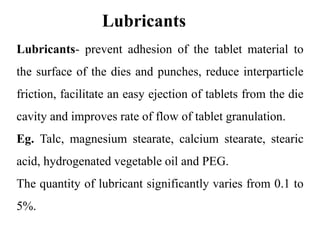
Lubricants- prevent adhesion of the tablet material to
the surface of the dies and punches, reduce interparticle
friction, facilitate an easy ejection of tablets from the die
cavity and improves rate of flow of tablet granulation.
Eg. Talc, magnesium stearate, calcium stearate, stearic
acid, hydrogenated vegetable oil and PEG.
The quantity of lubricant significantly varies from 0.1 to
5%.
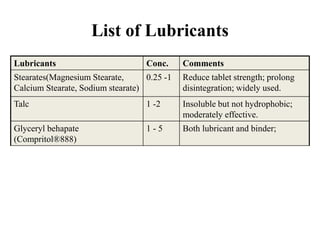
List of Lubricants
Lubricants Conc. Comments
Stearates(Magnesium Stearate,
Calcium Stearate, Sodium stearate)
0.25 -1 Reduce tablet strength; prolong
disintegration; widely used.
Talc 1 -2 Insoluble but not hydrophobic;
moderately effective.
Glyceryl behapate
(Compritol®888)
1 - 5 Both lubricant and binder;
Glidants
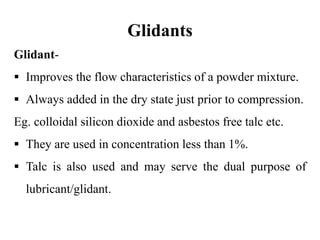
Glidant-
 Improves the flow characteristics of a powder mixture.
 Always added in the dry state just prior to compression.
Eg. colloidal silicon dioxide and asbestos free talc etc.
 They are used in concentration less than 1%.
 Talc is also used and may serve the dual purpose of
lubricant/glidant.
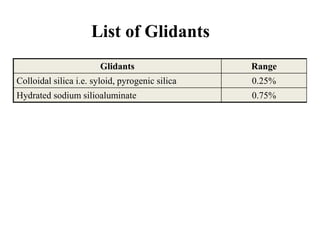
Glidants Range
Colloidal silica i.e. syloid, pyrogenic silica 0.25%
Hydrated sodium silioaluminate 0.75%
List of Glidants
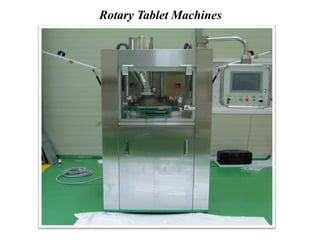
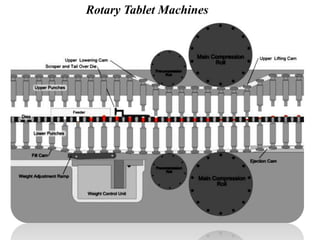
Rotary Tablet Machines
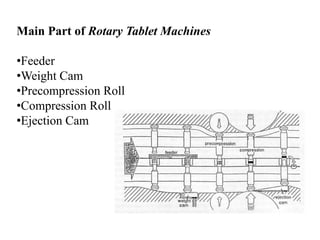
Main Part of Rotary Tablet Machines
•Feeder
•Weight Cam
•Precompression Roll
•Compression Roll
•Ejection Cam
Rotary Tablet Machines
Tablet making process:
Active pharmaceutical ingredient(API) +
Intragranular disintegrating agent.
mixing
Then addition of binder to the power
mixture to form wet mass.
Binder containing
3-5% starch in H2O
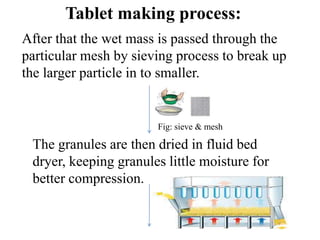
After that the wet mass is passed through the
particular mesh by sieving process to break up
the larger particle in to smaller.
Fig: sieve & mesh
The granules are then dried in fluid bed
dryer, keeping granules little moisture for
better compression.
Tablet making process:
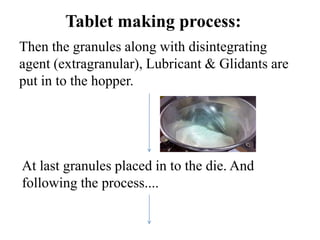
Then the granules along with disintegrating
agent (extragranular), Lubricant & Glidants are
put in to the hopper.
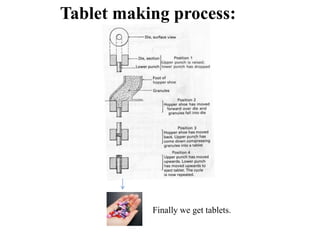
At last granules placed in to the die. And
following the process....
Tablet making process:
Finally we get tablets.
Tablet making process:
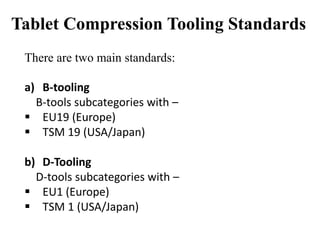
Tablet Compression Tooling Standards
There are two main standards:
a) B-tooling
B-tools subcategories with –
 EU19 (Europe)
 TSM 19 (USA/Japan)
b) D-Tooling
D-tools subcategories with –
 EU1 (Europe)
 TSM 1 (USA/Japan)
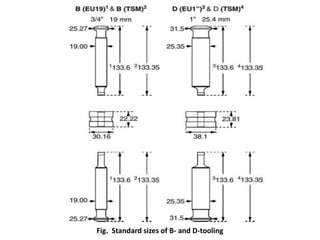
Fig. Standard sizes of B- and D-tooling
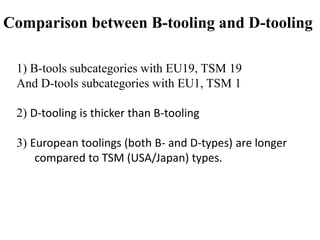
Comparison between B-tooling and D-tooling
1) B-tools subcategories with EU19, TSM 19
And D-tools subcategories with EU1, TSM 1
2) D-tooling is thicker than B-tooling
3) European toolings (both B- and D-types) are longer
compared to TSM (USA/Japan) types.
Process Related Problems
The defects related to Tableting
Process are as follows:
i) CAPPING
ii) LAMINATION
iii) CRACKING
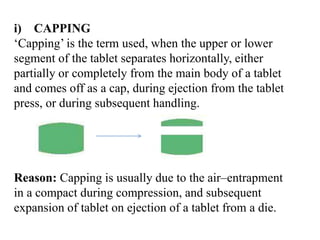
i) CAPPING
‘Capping’ is the term used, when the upper or lower
segment of the tablet separates horizontally, either
partially or completely from the main body of a tablet
and comes off as a cap, during ejection from the tablet
press, or during subsequent handling.
Reason: Capping is usually due to the air–entrapment
in a compact during compression, and subsequent
expansion of tablet on ejection of a tablet from a die.
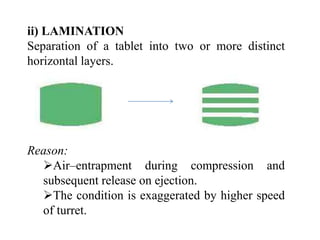
ii) LAMINATION
Separation of a tablet into two or more distinct
horizontal layers.
Reason:
Air–entrapment during compression and
subsequent release on ejection.
The condition is exaggerated by higher speed
of turret.
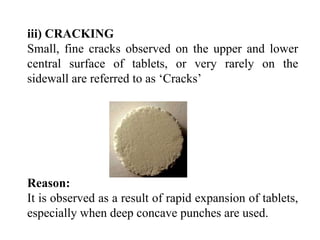
iii) CRACKING
Small, fine cracks observed on the upper and lower
central surface of tablets, or very rarely on the
sidewall are referred to as ‘Cracks’
Reason:
It is observed as a result of rapid expansion of tablets,
especially when deep concave punches are used.
Thanks To All

Tableting technology

  • 1.
  • 2.
    Lubricants Lubricants- prevent adhesionof the tablet material to the surface of the dies and punches, reduce interparticle friction, facilitate an easy ejection of tablets from the die cavity and improves rate of flow of tablet granulation. Eg. Talc, magnesium stearate, calcium stearate, stearic acid, hydrogenated vegetable oil and PEG. The quantity of lubricant significantly varies from 0.1 to 5%.
  • 3.
    List of Lubricants LubricantsConc. Comments Stearates(Magnesium Stearate, Calcium Stearate, Sodium stearate) 0.25 -1 Reduce tablet strength; prolong disintegration; widely used. Talc 1 -2 Insoluble but not hydrophobic; moderately effective. Glyceryl behapate (Compritol®888) 1 - 5 Both lubricant and binder;
  • 4.
    Glidants Glidant-  Improves theflow characteristics of a powder mixture.  Always added in the dry state just prior to compression. Eg. colloidal silicon dioxide and asbestos free talc etc.  They are used in concentration less than 1%.  Talc is also used and may serve the dual purpose of lubricant/glidant.
  • 5.
    Glidants Range Colloidal silicai.e. syloid, pyrogenic silica 0.25% Hydrated sodium silioaluminate 0.75% List of Glidants
  • 6.
  • 7.
    Main Part ofRotary Tablet Machines •Feeder •Weight Cam •Precompression Roll •Compression Roll •Ejection Cam
  • 8.
  • 9.
    Tablet making process: Activepharmaceutical ingredient(API) + Intragranular disintegrating agent. mixing Then addition of binder to the power mixture to form wet mass. Binder containing 3-5% starch in H2O
  • 10.
    After that thewet mass is passed through the particular mesh by sieving process to break up the larger particle in to smaller. Fig: sieve & mesh The granules are then dried in fluid bed dryer, keeping granules little moisture for better compression. Tablet making process:
  • 11.
    Then the granulesalong with disintegrating agent (extragranular), Lubricant & Glidants are put in to the hopper. At last granules placed in to the die. And following the process.... Tablet making process:
  • 12.
    Finally we gettablets. Tablet making process:
  • 13.
    Tablet Compression ToolingStandards There are two main standards: a) B-tooling B-tools subcategories with –  EU19 (Europe)  TSM 19 (USA/Japan) b) D-Tooling D-tools subcategories with –  EU1 (Europe)  TSM 1 (USA/Japan)
  • 14.
    Fig. Standard sizesof B- and D-tooling
  • 15.
    Comparison between B-toolingand D-tooling 1) B-tools subcategories with EU19, TSM 19 And D-tools subcategories with EU1, TSM 1 2) D-tooling is thicker than B-tooling 3) European toolings (both B- and D-types) are longer compared to TSM (USA/Japan) types.
  • 16.
    Process Related Problems Thedefects related to Tableting Process are as follows: i) CAPPING ii) LAMINATION iii) CRACKING
  • 17.
    i) CAPPING ‘Capping’ isthe term used, when the upper or lower segment of the tablet separates horizontally, either partially or completely from the main body of a tablet and comes off as a cap, during ejection from the tablet press, or during subsequent handling. Reason: Capping is usually due to the air–entrapment in a compact during compression, and subsequent expansion of tablet on ejection of a tablet from a die.
  • 18.
    ii) LAMINATION Separation ofa tablet into two or more distinct horizontal layers. Reason: Air–entrapment during compression and subsequent release on ejection. The condition is exaggerated by higher speed of turret.
  • 19.
    iii) CRACKING Small, finecracks observed on the upper and lower central surface of tablets, or very rarely on the sidewall are referred to as ‘Cracks’ Reason: It is observed as a result of rapid expansion of tablets, especially when deep concave punches are used.
  • 20.