Journal of Pharmacy Research Vol.10 Issue 9 September 2016
Raghavendra Kumar Gunda et al. / Journal of Pharmacy Research 2016,10(9),579-588
579-588
Research Article
ISSN: 0974-6943
Available online through
http://jprsolutions.info
1. INTRODUCTION: Tablets are the  most  popular oral  solid
formulations available in the market and are preferred by patients
and   physicians alike.  Recently fast  dissolving  formulation  is
popular as Novel Drug Delivery Systems because they are easy to
administer and lead to Patient Compliance.
Difficulty in swallowing (Dysphasia) is a common problem of all age
groups, especially elderly and pediatrics, because of physiological
changes  associated with  these groups  of patients.  Researchers
throughout the World are focusing intensively on the methods for
the development of new drug delivery systems to enhance patient’s
compliance.
Fast  dissolving  tablets  become  an  emerging  trend  in  the
pharmaceutical industry. Fast dissolving tablets are  ideal for all
types  of  people,  including  for    people  who  have  swallowing
difficulties, pediatric, geriatric, and bedridden patients. It is also for
active patients who are busy, travelling and may not have access to
water. Fast dissolving tablets are also known as orodispersible tablets,
mouth-dissolving tablets, orally disintegrating tablets, melt-in mouth
tablets, rapimelts, porous tablets, quick dissolving etc. Many drugs
have the potentials to be made into orodispersible tablets. They vary
from analgesics to neuroleptics and anti-psychotic drugs. However
*Corresponding author.
Mr.Raghavendra Kumar Gunda M.Pharm
Assistant Professor, Department of Pharmaceutics,
Narasaraopeta Institute of Pharmaceutical Sciences,
Narasaraopet, Guntur(D.t), A.P. India-522601.
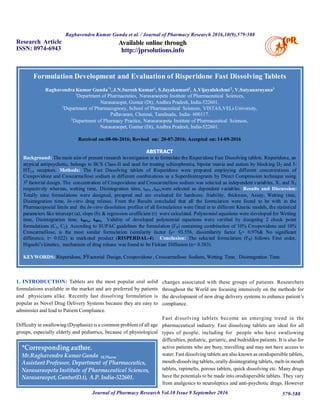
Formulation Development and Evaluation of Risperidone Fast Dissolving Tablets
Raghavendra Kumar Gunda*1
, J.N.Suresh Kumar1
, S.Jayakumari2
, A.Vijayalakshmi2
, V.Satyanarayana3
1
Department of Pharmaceutics,  Narasaraopeta Institute  of Pharmaceutical  Sciences, 
Narasaraopet, Guntur (Dt), Andhra Pradesh, India-522601.
2Department of Pharmacognosy, School of Pharmaceutical  Sciences, VISTAS,VELs University, 
Pallavaram, Chennai, Tamilnadu,  India- 600117.
3
Department of Pharmacy Practice, Narasaraopeta Institute of Pharmaceutical  Sciences, 
Narasaraopet, Guntur (Dt), Andhra Pradesh, India-522601.
Received on:08-06-2016; Revised on: 20-07-2016; Accepted on: 14-09-2016
ABSTRACT
Background: The main aim of present research investigation is to formulate the Risperidone Fast Dissolving tablets. Risperidone, an
atypical antipsychotic, belongs to BCS Class-II and used for treating schizophrenia, bipolar mania and autism by blocking D2 and 5-
HT2A receptors. Methods: The Fast Dissolving tablets of Risperidone were prepared employing different concentrations of
Crospovidone and Croscarmellose sodium in different combinations as a Superdisintegrants by Direct Compression technique using
32 factorial design. The concentration of Crospovidone and Croscarmellose sodium was selected as independent variables, X1 and X2
respectively whereas, wetting time, Disintegration time, t50% ,t90%were selected as dependent variables. Results and Discussion:
Totally nine formulations were designed, preapred and are evaluated for hardness, friability, thickness, Assay, Wetting time,
Disintegration time, In-vitro drug release. From the Results concluded that all the formulation were found to be with in the
Pharmacopoeial limits and the In-vitro dissolution profiles of all formulations were fitted in to different Kinetic models, the statistical
parameters like intercept (a), slope (b) & regression coefficient (r) were calculated. Polynomial equations were developed for Wetting
time, Disintegration time, t50%, t90%. Validity of developed polynomial equations were verified by designing 2 check point
formulations (C1, C2). According to SUPAC guidelines the formulation (F5) containing combination of 10% Crospovidone and 10%
Croscarmellose, is the most similar formulation (similarity factor f2= 93.556, dissimilarity factor f1= 0.976& No significant
difference, t= 0.022) to marketed product (RISPERDAL-4). Conclusion: The selected formulation (F5) follows First order,
Higuchi’s kinetics, mechanism of drug release was found to be Fickian Diffusion (n= 0.383).
KEYWORDS: Risperidone, 32Factorial  Design, Crospovidone , Croscarmellose Sodium, Wetting  Time,  Disintegration  Time.
Journal of Pharmacy Research Vol.10 Issue 9 September 2016
Raghavendra Kumar Gunda et al. / Journal of Pharmacy Research 2016,10(9),579-588
579-588
only a small percentage of them are researched on and some have
been manufactured and marketed.
The speed of solubility of drug affects the rate of absorption of the
drug.  The  faster  the  drug  dissolve  into  solution,  quicker  the
absorption and onset of clinical effect. They should readily dissolve
or disintegrate in the saliva generally within <60 seconds. Some
drugs are absorbed from the mouth, pharynx and esophagus as the
saliva passes down into the stomach.
The small volume of saliva isusually sufficient to result in tablet
disintegration in the oral cavity. The medication can then be absorbed
partially or entirely into the systemic circulation from blood vessels
in the sublingualmucosa, or it can be swallowed as a solution to be
absorbed from the gastrointestinal tract.
Thesublingual route usually produces a faster onset of action than
orally  ingested  tablets  and  theportion  absorbed  through  the
sublingual  blood  vessels  bypasses  the  hepatic  first-pass
metabolicprocesses.The  performance  of ODT  depends on  the
technology used in their manufacture.
1.1. Drug Profile and Rationality For Experimental Design:
Risperidone is an antipsychotic with extremely potent serotonin-
5HT2 and potent dopamine-D2 antagonistic properties Risperidone
is rapidly and very well absorbed after administration orally. It is
extensively converted in the liver. Its absorption does not appear to
be affected by food. It is belongs to class II of the Biopharmaceutical
Classification System (BCS) where dissolutionrate is the limit factor
for its absorption1
. Hence the drug is selected for formulating Fast
Dissolving Tablets by Direct compression method.
It is an important issue is to design an optimized formulation with an
appropriate dissolution rate in a short time period and minimum trials.
Many statistical experimental designs have been recognized as useful
techniques to  optimize the  process variables.  For this  purpose,
response surface methodology (RSM) utilizing a polynomial equation
has been widely used. Different types of RSM designs include 3-
level factorial design, central composite design (CCD), Box-Behnken
design and D-optimal design. Response surface methodology (RSM)
is  used  when  only  a  few  significant  factors  are  involved  in
experimental  optimization.  The  technique  requires  less
experimentation and time, thus proving to be far more effective and
cost-effective than the conventional methods ofManufacturing2-5
.
Dissolving  Tablets  of  Risperidoneusing  Crospovidoneand
Croscarmellosesodium. Instead of normal and trial method, a standard
statistical tool design of experiments is employed to study the effect
of formulation variables on the release properties.
Large scale production needs more simplicity in the formulation with
economic and cheapest dosage form. The Fast Dissolving tablets
formulation by direct compression method is most acceptable in
large scale production.
A 32
 full factorial design was employed to systematically study the
drug release profile. A 32
 full factorial design was employed to
investigate the effect of two independent variables (factors), i.e the
amounts of  Crospovidone and Croscarmellose on the dependent
variables, i.e.  Wetting Time, Disintegration time,  t50%
, t90%
,( Time
taken to release 50%, 90% respectively).
2.MATERIALS AND METHODS
Materials used in this study were obtained from the different sources.
Risperidonewas a gift sample from RPG Life Sciences Limited,
Mumbai, India. Crospovidone, Croscarmellose, Di Calcium Phosphate,
were procured from LobaChemiePvt.Ltd, Mumbai. Other excipients
such as Magnesium Stearate and talc were procured from S.D. Fine
Chem. Ltd, Mumbai.
2.1. Formulation Development of Risperidone Fast Dissolving
Tablets:
The factorial design is a technique that allows identification of factors
involved in a process and assesses their relative importance. In
addition, any interaction between factors chosen can be identified.
Construction of a factorial design involves the selection of parameters
and the choice of responses6
.
A  selected  three  level,  two  factor  experimental  design  (32
factorialdesign) describe the proportion in which the independent
variables    Crospovidone  and    Croscarmellose  were  used  in
formulation of  Risperidone Fast Dissolving Tablets. The time required
for 50% (t50%
), 90% (t90%
) drug dissolution, Disintegration Time and
Wetting Time were selected as dependent variables. Significance
terms were chosen at 95% confidence interval (p<0.05) for Final
Equations.   Polynomial  equations were developed for t50%
, t90%
,
Disintegration Time and Wetting Time (step-wise backward Linear
Regression Analysis).
The three levels of factor X1
 (Crospovidone) at a concentration of
5%,10%,  15%.three  levels  of  factor X2
(Croscarmellose)  at  a
concentration of 5%, 10%, 15%. (% with respect to average weightHence an attempt is made in this research work to formulate Fast
Journal of Pharmacy Research Vol.10 Issue 9 September 2016
Raghavendra Kumar Gunda et al. / Journal of Pharmacy Research 2016,10(9),579-588
579-588
of Tablet, i.e 100 mg) was taken as the rationale for the design of the
RisperidoneFast  Dissolving  tablet  formulation.  Totally  nine
Risperidone  Fast Dissolvingtablet  formulations were  prepared
employing selected combinations of the two factors i.eX1
, X2
as per
32
 Factorial and evaluated to find out the significance of combined
effects of X1
, X2
to select the best combination and the concentration
required to achieve the desired Fast release/ Dissolution of drug (by
means  providing large Surface area and Improved Solubility)  from
the dosage form.
2.2. Preparation of Risperidone Fast Dissolving Tablets:
Risperidone Tablets were prepared by direct compression method.
The composition of each tablet is shown in Table No 2 . The drug,
diluents, superdisintegrants were passed through sieve #40. All the
above ingredients were properly mixed together (ina poly-bag). Talc
and Magnesium stearate were passed through mesh #80, mixed and
blended with initial mixture in a poly-bag. The powder blend was
compressed into tablets on a 8 station rotary punch tableting machine
(mini-press) using 8 mm circular punches and same hardness was
used for the required  number tablets. Compressed tablets  were
examined as per official standards and unofficial tests. Tablets were
packaged  in  well  closed  light  resistance  and  moisture  proof
containers.
2.3. Experimental Design:
Experimental  design  utilized  in  present  investigation  for  the
optimization  of  Superdisintegrant  concentration  such  as,
concentration of Crospovidone was taken as X1
 and concentration
of Croscarmellose sodium was taken as X2
. Experimental design was
given  in  the  Table  1.  Three  levels  for  the  Concentration  of
Crospovidone were selected and coded as -1= 5%, 0=10%, +1=15%.
Three levels for the Concentration of Croscarmellose sodium were
selected and coded as -1= 5%, 0=10%, +1=15%.  Formulae for all the
experimental batches were given in Table 27
.
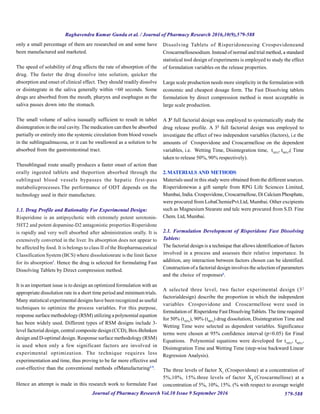
Table 1: Experimental Design Layout
Formulation Code X1 X2
F1 1 1
F2 1 0
F3 1 -1
F4 0 1
F5 0 0
F6 0 -1
F7 -1 1
F8 -1 0
F9 -1 -1
C1 -0.5 -0.5
C2 0.5 0.5
Table2:FormulaeforthePreparationofRisperidoneFastDissolving
Tablets as Per Experimental Design
Name of Ingredients Quantity ofIngredients per each Tablet (mg)
F1 F2 F3 F4 F5 F6 F7 F8 F9
Risperidone 4 4 4 4 4 4 4 4 4
MCC 60 65 70 65 70 75 70 75 80
Crospovidone 15 15 15 10 10 10 5 5 5
Croscarmellose sodium 15 10 5 15 10 5 15 10 5
Peppermint Flavor 2 2 2 2 2 2 2 2 2
Magnesium Stearate 2 2 2 2 2 2 2 2 2
Talc 2 2 2 2 2 2 2 2 2
Total Weight 100 100 100 100 100 100 100 100 100
2.4. Evaluation of Risperidone fast dissolving tablets:
2.4.1. Hardness8
The hardness of the tablets was tested by diametric compression
using a Monsanto Hardness Tester. A tablet hardness of about 2-4
Kg/cm2
 is considered adequate for mechanical stability.
2.4.2. Friability8
The friability of the tablets was measured in a Roche Friabilator. 20
Tablets were taken, Weighed and Initial weight was noted (W0
) are
dedusted in a drum for a fixed time (100 Freefalls, in a Roche Friabilator)
and weighed (W) again. Percentage friability was calculated from the
loss in weight as given in equation as below. The weight loss should
not be more than 1 %
Friability(%)=[(Initialweight-Finalweight)/(Initialweight)]x100
2.4.3. Content Uniformity8
In this test, 20 tablets were randomly selected and the percent drug
content was determined, the tablets contained not less than 85% or
not more than 115% (100±15%)of the labeled drug content can be
considered as the test was passed.
2.4.4. Assay9,10
Drug content was determined by weighing randomly selected tablets,
pulverizing to  a fine powder. The  powder equivalent to 10  mg
Risperidone was weighed and dissolved in 10 ml of methanol in
volumetric flask using magnetic stirrer, the volume was adjusted to
100 ml with Phosphate buffer pH 6.8and the solution was filtered. An
aliquot of 1.0 ml of solution were diluted to 10 ml Phosphate buffer
pH  6.8  in separate  volumetric  flask.  The  drug  content in  was
determined spectrophotometrically at 280 nm.
2.4.5. Thickness8
Thickness of the all tablet formulations were measured using vernier
calipers by placing tablet between two arms of the vernier calipers.
Journal of Pharmacy Research Vol.10 Issue 9 September 2016
Raghavendra Kumar Gunda et al. / Journal of Pharmacy Research 2016,10(9),579-588
579-588
2.4.6. Wetting time11,12
To measure Wetting time of the Tablet, a piece of Tissue paper folded
twice was placed in a small petri dish (Internal Diameter is= 6.5 cm)
containing 5 ml of Distilled water. A Tablet placed on the paper, and
the time for complete wetting of the tablet was measured in seconds.
2.4.7. In-vitro Dissolution Study12
The In-vitro dissolution study  for the  Risperidone Fast Dissolving
tablets   were carried  out in  USP XXIII type-II dissolution  test
apparatus (Paddle type) using 900 ml of Phosphate buffer pH 6.8 as
dissolution  medium   at 50  rpm and  temperature 37±0.5°C. At
predetermined time intervals, 5 ml of the samples were withdrawn by
means of a syringe fitted with a pre-filter, the volume withdrawn at
each interval was replaced with same quantity of fresh dissolution
medium. The resultant samples were analyzed for the presence of the
drug release by measuring the absorbance at 280 nm using UV Visible
spectrophotometer after suitable dilutions. The determinations were
performed in triplicate (n=3).
2.4.8. Disintegration test12
Disintegration of fast disintegrating tablets is achieved in the mouth
owing to the action of saliva, however amount of saliva in the mouth
is limited and no tablet disintegration test was found in USP and IP
to simulate in vivo conditions. A modified method was used  to
determine disintegration time of the tablets. A cylindrical vessel was
used in which 10 mesh screen was placed in such way that only 2 ml
of disintegrating or dissolution medium would be placed below the
sieve. To determine disintegration time, 6 ml of Sorenson’s buffer
(pH 6.8), was placed inside the vessel in such way that 4 ml of the
media was below the sieve and 2 ml above the sieve. Tablet was
placed on the sieve and the whole assembly was then placed on a
shaker. The time at which all the particles pass through the sieve was
taken as a disintegration time of the tablet. Six tablets were chosen
randomly from the composite samples and the average value was
determined.
2.4.9. Kinetic modeling of drug release13-16
The dissolution profile of all the formulations was fitted in to zero-
order, first-order, Higuchi and Korsmeyer-peppas models to ascertain
the kinetic modeling of drug release.
3. RESULTS AND DISCUSSION:
Fast Dissolving  tablets of  Risperidone were prepared and optimized
by 32
 factorial design in order to select the best combination of
different Superdisintegrants, Crospovidone, Croscarmellose sodium
and also to achieve the  predicted rapid  release of drug from the
dosage form(by Disintegrating quickly). The two factorial parameters
involved  in  the development  of  formulations  are,  quantity  of
Crospovidone&Croscarmellose sodium as independent variables (X1
,
X2
), and  In vitro dissolution parameters such as   t50% , 
t90%  
andWetting
time, Disintegrating  Time as  dependent variables.
 Totally  nine
formulations were prepared using 3 levels of 2 factors and all the
formulations containing 4 mg of  Risperidone were prepared as a
Fast Dissolving  tablet dosage form by Direct Compression technique
as per the formulae given in Table 2.
All the prepared tablets were evaluated for different post compression
parameters, drug content, mean hardness, friability, mean thickness,
Weight variation as per official methods and results are given in
Table 3. The hardness of  tablets was in the range of  2.5±0.16-
2.85±0.14 Kg/cm2
. Weight loss in the friability test was not more
than 0.305±0.32%. Drug content of prepared tablets was within
acceptance range only.  The Wetting Time of tablets was in the range
of 29.76±1.30-36.67±1.6 sec. The Disintegration Time of tablets
was in the range of 14.66±1.5-19.50±1.7 sec.Results for all Post-
compression parameters were tabulated or shown in Table 3. In-vitro
Dissolution  studies were  performed for  prepared tablets  using
Phosphate buffer pH 6.8 as a dissolution  media at 50 rpm and
temperature 37±0.5°C. The In-vitro dissolution profiles of tablets are
shown in Fig.1 and the dissolution parameters are given in Table 4.
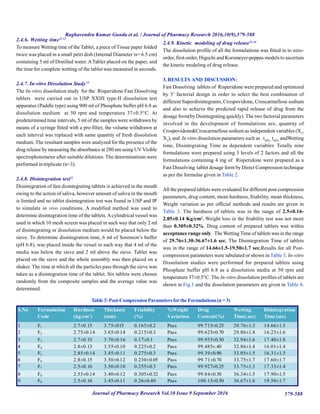
Table3:Post-CompressionParametersfortheFormulations(n=3)
S.No Formulation Hardness Thickness Friability %Weight Drug Wetting Disintegration
Code (kg/cm2) (mm) (%) Variation Content(%) Time( sec) Time (sec)
1 F1 2.7±0.15 3.75±015 0.165±0.2 Pass 99.715±0.25 29.76±1.3 14.66±1.5
2 F2 2.75±0.14 3.65±0.14 0.215±0.3 Pass 99.625±0.70 29.86±1.4 16.23±1.6
3 F3 2.7±0.15 3.70±0.16 0.17±0.1 Pass 99.935±0.50 32.94±1.6 17.40±1.8
4 F4 2.8±0.13 3.55±0.10 0.225±0.2 Pass 99.485±.40 32.86±1.4 16.01±1.4
5 F5 2.85±0.14 3.45±0.11 0.275±0.3 Pass 99.39±0.90 33.05±1.5 16.31±1.5
6 F6 2.8±0.15 3.50±0.12 0.230±0.05 Pass 99.71±0.70 33.75±1.7 17.60±1.7
7 F7 2.5±0.16 3.50±0.10 0.255±0.3 Pass 99.927±0.25 33.75±1.3 17.33±1.4
8 F8 2.55±0.14 3.40±0.12 0.305±0.32 Pass 99.84±0.30 36.34±1.5 17.90±1.5
9 F9 2.5±0.16 3.45±0.11 0.26±0.40 Pass 100.15±0.50 36.67±1.6 19.50±1.7
Journal of Pharmacy Research Vol.10 Issue 9 September 2016
Raghavendra Kumar Gunda et al. / Journal of Pharmacy Research 2016,10(9),579-588
579-588
Cumulative % Drug release of Factorial Design Formulations F1
-F9
 at
45 min were found to be in the range of 99.94±0.21-100.06±0.15
%. From the result it reveals that the release rate was higher for
formulations containing High level of Crospovidone / Croscarmellose
sodium compared with other Formulations containing Lower level,
due to High concentration of  Superdisintegrant in  combination,
shows  various disintegration  mechanism  such  as wicking  and
swelling etc more compared with lower concentration and alone,
drug  may  release  rapidly  and  shows improved  bioavailability.
Therefore, required release of drug can be obtained by manipulating
the composition of Crospovidone and Croscarmellose sodium.
Much variation was observed in the Wetting time, Disintegrating
time, t50%
and t90%
  due to formulation  variables. Formulation  F5
containing 10 mg of Crospovidone, 10 mg of Croscarmellose sodium
showed promising dissolution parameter (Wetting time=
33.05±1.5sec
, Disintegrating time=
16.31±1.5 sec , t50% =
8.370 min , t90% =
27.813
min). The difference in burst effect of the initial time is a result of the
difference in the Concentration of Superdisintegrants mixtures. This
reveals that increased concentration of superdisintegrants resulted
in a corresponding decrease in the Wetting Time, which might be
due  to the  result  of  wicking  and  other possible  disintegrating
mechanisms. Disintegration time is directly proportional to wetting
time.
The In -vitro dissolution  data  of  Risperidone  Fast  Dissolving
formulations   was  subjected  to  goodness  of  fit  test by  linear
regression analysis according to zero order and first order kinetic
equations, Higuchi’s and Korsmeyer-Peppas models to assess the
mechanism of drug release. The results of linear regression analysis
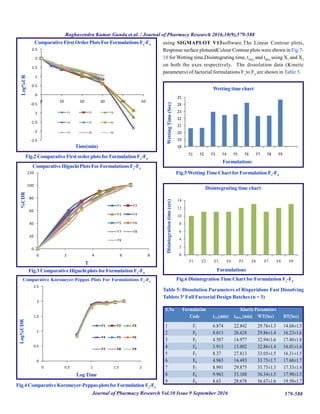
including regression coefficients are summarized in Table 4 and plots
shown in fig.1-4.  It was observed from the above that dissolution of
all the tablets  followed First order kinetics with co-efficient  of
determination (R2
) values in the range of 0.936-0.992. The values
of r of factorial formulations for Higuchi’s equation was found to be
in the range of 0.939-0.987, which shows that the dissolution data
fitted well to Higuchi’s square root of time equation confirming the
release followed diffusion mechanism. Kinetic data also treated for
Peppas equation, the slope (n) values ranges from 0.272-0.464 that
shows Fickian diffusion mechanism.Fig.5, 6 shows Wetting Time
Chart  and  Disintegration Time  chart respectively.  Polynomial
equations were derived for Wetting time, 
Disintegrating time, t50%
and t90% 
values by backward stepwise linear regression analysisusing
PCP Disso software and Response surface plots were constructed
Comparative zero order plots for formulations F1
-F9
%CDR
Time(min)
0
20
40
60
80
100
120
0 10 20 30 40 50
F1 F2
F3 F4
F5 F6
F7 F8
F9
Fig.1 ComparativeZero order plots forFormulation F1
-F9
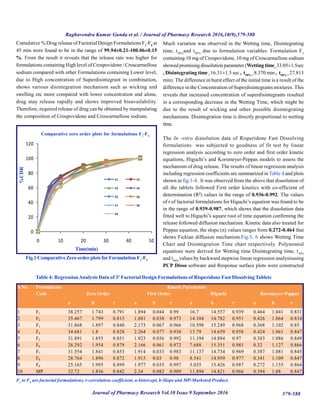
Table 4: RegressionAnalysis Data of 32
Factorial Design Formulations of Risperidone Fast Dissolving Tablets
S.No Formulation Kinetic Parameters
Code Zero Order First Order Higuchi Korsmeyer-Peppas
a b r a b r a b r a b r
1 F1 38.257 1.743 0.791 1.894 0.044 0.99 16.7 14.557 0.939 0.464 1.041 0.831
2 F2 35.467 1.799 0.815 1.881 0.038 0.973 14.104 14.782 0.951 0.426 1.064 0.834
3 F3 31.868 1.897 0.848 2.173 0.067 0.966 10.598 15.249 0.968 0.368 1.102 0.85
4 F4 34.681 1.8 0.828 2.264 0.077 0.936 13.79 14.659 0.958 0.424 1.061 0.847
5 F5 31.891 1.855 0.851 1.923 0.036 0.992 11.194 14.884 0.97 0.383 1.086 0.849
6 F6 28.292 1.954 0.879 2.166 0.061 0.972 7.688 15.351 0.981 0.32 1.127 0.866
7 F7 31.554 1.841 0.853 1.914 0.033 0.983 11.137 14.734 0.969 0.387 1.081 0.845
8 F8 28.764 1.896 0.872 1.915 0.03 0.98 8.541 14.959 0.977 0.341 1.109 0.847
9 F9 25.165 1.995 0.899 1.977 0.035 0.997 5.035 15.426 0.987 0.272 1.155 0.864
10 MP 32.72 1.836 0.842 2.34 0.082 0.909 11.894 14.821 0.966 0.394 1.08 0.847
F1
to F9
are factorial formulations, r-correlation coefficient, a-Intercept, b-Slope and MP-Marketed Product.
Journal of Pharmacy Research Vol.10 Issue 9 September 2016
Raghavendra Kumar Gunda et al. / Journal of Pharmacy Research 2016,10(9),579-588
579-588
Comparative First OrderPlots For Formulations F1
-F9
Log%UR
Time(min)
-2.5
-2
-1.5
-1
-0.5
0
0.5
1
1.5
2
2.5
0 10 20 30 40 50
F1 F2 F3
F4 F5 F6
F7 F8 F9
Fig.2 ComparativeFirst order plots forFormulation F1
-F9
%CDR
Comparative Higuchi PlotsFor Formulations F1
-F9
T
0
20
40
60
80
100
120
0 2 4 6 8
F1 F2
F3 F4
F5 F6
F7 F8
F9
Fig.3 Comparative Higuchiplots for Formulation F1
-F9
LogTime
Log%CDR
Comparative Korsmeyer-Peppas Plots For Formulations F1
-F9
0
0.5
1
1.5
2
2.5
0 0.5 1 1.5 2
F1 F2 F3
F4 F5 F6
F7 F8 F9
Fig.4 Comparative Korsmeyer-Peppasplots forFormulation F1
-F9
using  SIGMAPLOT V13software.The  Linear  Contour  plots,
Response surface plotsandColour Contour plots were shown in Fig.7-
18 for Wetting time,Disintegrating time, t50%  
and t90% 
using X1
 and X2
on  both the  axes  respectively.   The  dissolution  data  (Kinetic
parameters) of factorial formulations F1 
to F9
 are shown in Table 5.
Wetting time chart
WettingTime(Sec)
Formulations
18
19
20
21
22
23
24
25
F1 F2 F3 F4 F5 F6 F7 F8 F9
Fig.5 Wetting Time Chart for Formulation F1
-F9
Disintegrating time chart
Disintegrationtime(sec)
0
2
4
6
8
10
12
14
F1 F2 F3 F4 F5 F6 F7 F8 F9
Formulations
Fig.6 Disintegration Time Chart for Formulation F1
-F9
S.No Formulation Kinetic Parameters
Code t1/2(min) t90% (min) WT(Sec) DT(Sec)
1 F1 6.874 22.842 29.76±1.3 14.66±1.5
2 F2 8.013 26.628 29.86±1.4 16.23±1.6
3 F3 4.507 14.977 32.94±1.6 17.40±1.8
4 F4 3.913 13.002 32.86±1.4 16.01±1.4
5 F5 8.37 27.813 33.05±1.5 16.31±1.5
6 F6 4.963 16.493 33.75±1.7 17.60±1.7
7 F7 8.991 29.875 33.75±1.3 17.33±1.4
8 F8 9.963 33.108 36.34±1.5 17.90±1.5
9 F9 8.63 28.678 36.67±1.6 19.50±1.7
Table 5: Dissolution Parameters of Risperidone Fast Dissolving
Tablets 3² Full Factorial Design Batches (n = 3)
Journal of Pharmacy Research Vol.10 Issue 9 September 2016
Raghavendra Kumar Gunda et al. / Journal of Pharmacy Research 2016,10(9),579-588
579-588
Fig.7 Linear Contour plot for Wetting Time Fig.8 Linear Contour plot for Disintegration Time
Fig.9 Linear Contour plot for t50%
Fig.10 Linear Contour plot for t90%
Fig.11 Response Surface plot for Wetting Time Fig.12 Response Surface plot for Disintegration Time
Journal of Pharmacy Research Vol.10 Issue 9 September 2016
Raghavendra Kumar Gunda et al. / Journal of Pharmacy Research 2016,10(9),579-588
579-588
Fig.13. Response Surface plot for t50%
Fig.14. Response Surface plot for t90%
                      Fig.15. Colour Contour plot for Wetting Time Fig.16. Colour Contour plot for Disintegration Time
                              Fig.17.Colour Contour plot for t50%
Fig.18.Colour Contour plot for t90%
Journal of Pharmacy Research Vol.10 Issue 9 September 2016
Raghavendra Kumar Gunda et al. / Journal of Pharmacy Research 2016,10(9),579-588
579-588
Polynomial equation for 3² full factorial designs is given in Equation
Y= b0
+b1
X1
+b2
X2
+b12
X1
X2
+b11
X1
²+b22
X2
²…
Where, Y is dependent variable, b0
 arithmetic mean response of  nine
batches, and b1
 estimated co-efficient for factor X1
. The main effects
(X1
 and X2
) represent the average result of changing one factor at a
time from its low to high value. The interaction term (X1
X2
) shows
how the response changes when two  factors are simultaneously
changed. The  polynomial terms  (X1
²  and  X2
²)  are  included  to
investigate non-linearity. Validity of derived equations was verified
by  preparing Two  Check  point  Formulations of  Intermediate
concentration(C1
, C2
).
The equations for Wetting time, Disintegrating time, t50%
 and t90%
developed as follows,
Y1
=  33.220-2.367X1
-1.165X2
-0.065X1
X2
+0.205X2
2 
(forWettingtime)
Y2
=  16.993-1.073X1
-1.083X2
-0.143 X1
X2
+0.53 X1
2
+0.27 X2
2 
(for
Disintegration time)
Y3
=  7.136-1.365X1
+0.2797X2
0.502 X1
X2
+2.08 X1
2
-2.47 X2
2 
(fort50%
)
Y4
=  23.713-4.536X1
+0.929X2
+1.667 X1
X2
+6.92 X1
2
-8.21 X2
2 
(fort90%
)
The positive sign for co-efficient of X1
 in Y1, 
Y2, 
Y3
 and Y4
 equations
indicates  that, as the concentration  of  Crospovidone  decreases,
Wetting  time, 
Disintegrating  time,  t50%
and  t90% 
value
increases(inversely proportional relationship). In other words the
data demonstrate that both X1
 (amount of Crospovidone) and X2
(amount of Croscarmellose sodium) affect the time required for drug
release (Wetting time, 
Disintegrating time, t50%
and t90%
). From the
results it can be concluded that, and increase in the amount of the
Superdisintegrant leads to decrease in Disintegration time of the
Dosage form and drug release pattern may be changed by appropriate
selection of the X1
 and X2
 levels. The Dissolution parameters for
predicted from the polynomial equations derived and those actual
observed from experimental results are summarized in Table 6.  The
closeness of  Predicted  and  Observed values  for Wetting  time,
Disintegrating time,
t50%
and t90% 
indicates validity of derived equations
for dependent variables. The Response surface Plots were presented
to show the effects  of X1
 and X2 
on Wetting time,
Disintegrating
time,
t50%
and t90%.
 The final best (Optimized) formulation (F5
) is
compared with marketed product (RISPERDAL-4) shows similarity
factor (f2
) 93.556, difference factor (f1
) 0.976 (There is no significant
difference in drug release  becausetcal
is<0.05).
4.CONCLUSION
The  present  research  work  envisages  the  applicability  of
Superdisintegrants  such as  Crospovidone and  Croscarmellose
sodium in the design and development of Fast Dissolving  tablet
formulations of Risperidone utilizing the 32
 factorial design.  From
the results it was clearly understand that as the concentration of
Superdisintegrant increases the release rate of  drug was RAPID
(Improved Solubility) and both of these Superdisintegrants can be
used in combination since do not interact with the drug which may
be more helpful in achieving the desired fast Dissolving of the dosage
form for rapid action and improved Bioavailability. The optimized
formulation  followed Higuchi’s  kinetics while the drug  release
mechanism was found to beFickian Diffusion, first order release type.
On the basis of evaluation parameters, the optimized formulation F5
may be used for the effective management of schizophrenia, bipolar
mania, and autism.This may improve the patient compliance by
showing rapid action via disintegration without difficult in swallowing
and side  effects which  will ultimately  improve the  therapeutic
outcome.we could be able to minimize the per oral cost of  the
Formulation.
ACKNOWLEDGEMENTS
The author would like to thank Management, Principal, Teaching,
Non-teaching Staff of Narasaraopeta Institute of Pharmaceutical
Sciences,  Narasaraopet, Guntur (D.t), A.P.,  India for providing
support for successful completion of research work.
REFERENCES
1. Yardi Saibi, Hitoshi Sato, Hidehisa Tachiki. Developing
InVitro–InVivo Correlation  of  Risperidone  Immediate
Release Tablet. AAPS PharmSciTech, 2012;Vol. 13, No. 3:
890-895.
2. M.A.Shende,    R.P.Marathe,  S.B.  Khetmalas,  P.  N.
Dhabale.Studies  on development  of Sustained  release
Diltiazem  hydrochloride  matrices  through  jack  fruit
mucilage.  International  Journal  of  Pharmacy  and
Pharmaceutical Sciences ,2014; 6, (7): 72-78.
Table 6: Dissolution Parameters for Predicted and Observed Values for Check Point Formulations
Formulation Code Predicted Value Actual Observed Value
WT(Sec) DT(Sec) t50% (min) t90% (min) WT(Sec) DT(Sec) t50% (min) t90% (min)
C1 35.121 18.235 7.707 25.61 35.23 18.45 7.79 25.632
C2 31.59 16.08 6.621 22.003 31.93 16.27 6.652 22.59
Journal of Pharmacy Research Vol.10 Issue 9 September 2016
Raghavendra Kumar Gunda et al. / Journal of Pharmacy Research 2016,10(9),579-588
579-588
Source of support: Nil, Conflict of interest: None Declared
3. Swarbrick  J,  Boylan  JC.  Optimization  techniques  in
formulation  and  processing,  Encyclopedia  of
Pharmaceutical   technology. New York:Marcel Dekker;1994.
p. 70.
4. Montgomery DC. Introduction to factorial deigns. Design
and Analysis of Experiments. 5th ed. Wiley India Pvt.Ltd:
New Delhi;2004. p. 170-217.
5. Schwartz  BJ,  Connor  RE.  Optimization  technique  in
pharmaceutical formulations and processing.  J Drugs and
Pharm Sciin Modern Pharmaceutics, 1996;72(3):727-54.
6. A. A. Kharia, s. N. Hiremath, a. K. Singhai,  K. Omray and S.
K. Jain, Design and optimization of floating drug delivery
system of acyclovir . Indian J. Pharm. Sci.,2010; 72 (5): 599-
606.
7. Raghavendra Kumar Gunda, J. N. Suresh Kumar, Ch Ajay
Babu and M. V. Anjaneyulu, Formulation development and
evaluation of lamotrigine sustained release tablets using 32
factorial design., International Journal of  Pharmaceutical
Sciences and Research, 2015; 6(4): 1746-1752.
8. Raghavendra Kumar Gunda. Formulation development and
evaluation of rosiglitazone maleate sustained release tablets
using 32
factorial design.  International J of  PharmTech
Research, 2015; 8(4): 713-724.
9. Smita V. Pawar, M. S. Junagade. Formulation and Evaluation
of Mouth Dissolving Film of Risperidone. International J of
PharmTech Research, 2015; 8(6): 218-230.
10. Gawande  Shilpa,  Chandewar Anil.  Formulation  and
evaluation of  orodispersible tablet of  Risperidone.  Der
Pharmacia Lettre, 2011; 3 (6):151-156.
11. Sunada  H,  Bi  YX,  Yonezawa  Y,  Danjo  K.  Preparation, 
evaluation and  optimization of rapidly   disintegrating 
tablets. Powder Technol 2002;  122:18898. 
12. Raghavendra  Kumar  Gunda,  J.  N.  Suresh  Kumar,  V.
Satyanarayana, Swathi Batta, Ch. Meher Harika. Formulation
Development  and  Evaluation  of  Carbamazepine  Fast
Dissolving  Tablets.  Journal  of  Pharmacy  Research,
2016;10(5):216-225.
13. K.P.R.Chowdary,  Optimization  of  valsartan  tablet
formulation by 23 factorial design Journal of Global Trends
in Pharmaceutical Sciences, 2014;  Volume 5(1),1374-1379 .
14. Notari RE. Biopharmaceutics and clinical pharmacokinetics.
4th ed. New York: Marcel Dekker Inc; 1987; 6-21.
15. Higuchi T, Mechanism of  sustained-action  medication.
Theoretical analysis  of rate  of release  of  solid  drugs
dispersed in solid matrices.  J Pharm Sci.1963; 51:1145-9.
16. Peppas NA. Analysis of fickian and non-fickian drug release
from polymers Pharm ActaHelv1985; 60:110-1.

Formulation Development and Evaluation of Risperidone Fast Dissolving Tablets

  • 1.
    Journal of PharmacyResearch Vol.10 Issue 9 September 2016 Raghavendra Kumar Gunda et al. / Journal of Pharmacy Research 2016,10(9),579-588 579-588 Research Article ISSN: 0974-6943 Available online through http://jprsolutions.info 1. INTRODUCTION: Tablets are the  most  popular oral  solid formulations available in the market and are preferred by patients and   physicians alike.  Recently fast  dissolving  formulation  is popular as Novel Drug Delivery Systems because they are easy to administer and lead to Patient Compliance. Difficulty in swallowing (Dysphasia) is a common problem of all age groups, especially elderly and pediatrics, because of physiological changes  associated with  these groups  of patients.  Researchers throughout the World are focusing intensively on the methods for the development of new drug delivery systems to enhance patient’s compliance. Fast  dissolving  tablets  become  an  emerging  trend  in  the pharmaceutical industry. Fast dissolving tablets are  ideal for all types  of  people,  including  for    people  who  have  swallowing difficulties, pediatric, geriatric, and bedridden patients. It is also for active patients who are busy, travelling and may not have access to water. Fast dissolving tablets are also known as orodispersible tablets, mouth-dissolving tablets, orally disintegrating tablets, melt-in mouth tablets, rapimelts, porous tablets, quick dissolving etc. Many drugs have the potentials to be made into orodispersible tablets. They vary from analgesics to neuroleptics and anti-psychotic drugs. However *Corresponding author. Mr.Raghavendra Kumar Gunda M.Pharm Assistant Professor, Department of Pharmaceutics, Narasaraopeta Institute of Pharmaceutical Sciences, Narasaraopet, Guntur(D.t), A.P. India-522601. Formulation Development and Evaluation of Risperidone Fast Dissolving Tablets Raghavendra Kumar Gunda*1 , J.N.Suresh Kumar1 , S.Jayakumari2 , A.Vijayalakshmi2 , V.Satyanarayana3 1 Department of Pharmaceutics,  Narasaraopeta Institute  of Pharmaceutical  Sciences,  Narasaraopet, Guntur (Dt), Andhra Pradesh, India-522601. 2Department of Pharmacognosy, School of Pharmaceutical  Sciences, VISTAS,VELs University,  Pallavaram, Chennai, Tamilnadu,  India- 600117. 3 Department of Pharmacy Practice, Narasaraopeta Institute of Pharmaceutical  Sciences,  Narasaraopet, Guntur (Dt), Andhra Pradesh, India-522601. Received on:08-06-2016; Revised on: 20-07-2016; Accepted on: 14-09-2016 ABSTRACT Background: The main aim of present research investigation is to formulate the Risperidone Fast Dissolving tablets. Risperidone, an atypical antipsychotic, belongs to BCS Class-II and used for treating schizophrenia, bipolar mania and autism by blocking D2 and 5- HT2A receptors. Methods: The Fast Dissolving tablets of Risperidone were prepared employing different concentrations of Crospovidone and Croscarmellose sodium in different combinations as a Superdisintegrants by Direct Compression technique using 32 factorial design. The concentration of Crospovidone and Croscarmellose sodium was selected as independent variables, X1 and X2 respectively whereas, wetting time, Disintegration time, t50% ,t90%were selected as dependent variables. Results and Discussion: Totally nine formulations were designed, preapred and are evaluated for hardness, friability, thickness, Assay, Wetting time, Disintegration time, In-vitro drug release. From the Results concluded that all the formulation were found to be with in the Pharmacopoeial limits and the In-vitro dissolution profiles of all formulations were fitted in to different Kinetic models, the statistical parameters like intercept (a), slope (b) & regression coefficient (r) were calculated. Polynomial equations were developed for Wetting time, Disintegration time, t50%, t90%. Validity of developed polynomial equations were verified by designing 2 check point formulations (C1, C2). According to SUPAC guidelines the formulation (F5) containing combination of 10% Crospovidone and 10% Croscarmellose, is the most similar formulation (similarity factor f2= 93.556, dissimilarity factor f1= 0.976& No significant difference, t= 0.022) to marketed product (RISPERDAL-4). Conclusion: The selected formulation (F5) follows First order, Higuchi’s kinetics, mechanism of drug release was found to be Fickian Diffusion (n= 0.383). KEYWORDS: Risperidone, 32Factorial  Design, Crospovidone , Croscarmellose Sodium, Wetting  Time,  Disintegration  Time.
  • 2.
    Journal of PharmacyResearch Vol.10 Issue 9 September 2016 Raghavendra Kumar Gunda et al. / Journal of Pharmacy Research 2016,10(9),579-588 579-588 only a small percentage of them are researched on and some have been manufactured and marketed. The speed of solubility of drug affects the rate of absorption of the drug.  The  faster  the  drug  dissolve  into  solution,  quicker  the absorption and onset of clinical effect. They should readily dissolve or disintegrate in the saliva generally within <60 seconds. Some drugs are absorbed from the mouth, pharynx and esophagus as the saliva passes down into the stomach. The small volume of saliva isusually sufficient to result in tablet disintegration in the oral cavity. The medication can then be absorbed partially or entirely into the systemic circulation from blood vessels in the sublingualmucosa, or it can be swallowed as a solution to be absorbed from the gastrointestinal tract. Thesublingual route usually produces a faster onset of action than orally  ingested  tablets  and  theportion  absorbed  through  the sublingual  blood  vessels  bypasses  the  hepatic  first-pass metabolicprocesses.The  performance  of ODT  depends on  the technology used in their manufacture. 1.1. Drug Profile and Rationality For Experimental Design: Risperidone is an antipsychotic with extremely potent serotonin- 5HT2 and potent dopamine-D2 antagonistic properties Risperidone is rapidly and very well absorbed after administration orally. It is extensively converted in the liver. Its absorption does not appear to be affected by food. It is belongs to class II of the Biopharmaceutical Classification System (BCS) where dissolutionrate is the limit factor for its absorption1 . Hence the drug is selected for formulating Fast Dissolving Tablets by Direct compression method. It is an important issue is to design an optimized formulation with an appropriate dissolution rate in a short time period and minimum trials. Many statistical experimental designs have been recognized as useful techniques to  optimize the  process variables.  For this  purpose, response surface methodology (RSM) utilizing a polynomial equation has been widely used. Different types of RSM designs include 3- level factorial design, central composite design (CCD), Box-Behnken design and D-optimal design. Response surface methodology (RSM) is  used  when  only  a  few  significant  factors  are  involved  in experimental  optimization.  The  technique  requires  less experimentation and time, thus proving to be far more effective and cost-effective than the conventional methods ofManufacturing2-5 . Dissolving  Tablets  of  Risperidoneusing  Crospovidoneand Croscarmellosesodium. Instead of normal and trial method, a standard statistical tool design of experiments is employed to study the effect of formulation variables on the release properties. Large scale production needs more simplicity in the formulation with economic and cheapest dosage form. The Fast Dissolving tablets formulation by direct compression method is most acceptable in large scale production. A 32  full factorial design was employed to systematically study the drug release profile. A 32  full factorial design was employed to investigate the effect of two independent variables (factors), i.e the amounts of  Crospovidone and Croscarmellose on the dependent variables, i.e.  Wetting Time, Disintegration time,  t50% , t90% ,( Time taken to release 50%, 90% respectively). 2.MATERIALS AND METHODS Materials used in this study were obtained from the different sources. Risperidonewas a gift sample from RPG Life Sciences Limited, Mumbai, India. Crospovidone, Croscarmellose, Di Calcium Phosphate, were procured from LobaChemiePvt.Ltd, Mumbai. Other excipients such as Magnesium Stearate and talc were procured from S.D. Fine Chem. Ltd, Mumbai. 2.1. Formulation Development of Risperidone Fast Dissolving Tablets: The factorial design is a technique that allows identification of factors involved in a process and assesses their relative importance. In addition, any interaction between factors chosen can be identified. Construction of a factorial design involves the selection of parameters and the choice of responses6 . A  selected  three  level,  two  factor  experimental  design  (32 factorialdesign) describe the proportion in which the independent variables    Crospovidone  and    Croscarmellose  were  used  in formulation of  Risperidone Fast Dissolving Tablets. The time required for 50% (t50% ), 90% (t90% ) drug dissolution, Disintegration Time and Wetting Time were selected as dependent variables. Significance terms were chosen at 95% confidence interval (p<0.05) for Final Equations.   Polynomial  equations were developed for t50% , t90% , Disintegration Time and Wetting Time (step-wise backward Linear Regression Analysis). The three levels of factor X1  (Crospovidone) at a concentration of 5%,10%,  15%.three  levels  of  factor X2 (Croscarmellose)  at  a concentration of 5%, 10%, 15%. (% with respect to average weightHence an attempt is made in this research work to formulate Fast
  • 3.
    Journal of PharmacyResearch Vol.10 Issue 9 September 2016 Raghavendra Kumar Gunda et al. / Journal of Pharmacy Research 2016,10(9),579-588 579-588 of Tablet, i.e 100 mg) was taken as the rationale for the design of the RisperidoneFast  Dissolving  tablet  formulation.  Totally  nine Risperidone  Fast Dissolvingtablet  formulations were  prepared employing selected combinations of the two factors i.eX1 , X2 as per 32  Factorial and evaluated to find out the significance of combined effects of X1 , X2 to select the best combination and the concentration required to achieve the desired Fast release/ Dissolution of drug (by means  providing large Surface area and Improved Solubility)  from the dosage form. 2.2. Preparation of Risperidone Fast Dissolving Tablets: Risperidone Tablets were prepared by direct compression method. The composition of each tablet is shown in Table No 2 . The drug, diluents, superdisintegrants were passed through sieve #40. All the above ingredients were properly mixed together (ina poly-bag). Talc and Magnesium stearate were passed through mesh #80, mixed and blended with initial mixture in a poly-bag. The powder blend was compressed into tablets on a 8 station rotary punch tableting machine (mini-press) using 8 mm circular punches and same hardness was used for the required  number tablets. Compressed tablets  were examined as per official standards and unofficial tests. Tablets were packaged  in  well  closed  light  resistance  and  moisture  proof containers. 2.3. Experimental Design: Experimental  design  utilized  in  present  investigation  for  the optimization  of  Superdisintegrant  concentration  such  as, concentration of Crospovidone was taken as X1  and concentration of Croscarmellose sodium was taken as X2 . Experimental design was given  in  the  Table  1.  Three  levels  for  the  Concentration  of Crospovidone were selected and coded as -1= 5%, 0=10%, +1=15%. Three levels for the Concentration of Croscarmellose sodium were selected and coded as -1= 5%, 0=10%, +1=15%.  Formulae for all the experimental batches were given in Table 27 . Table 1: Experimental Design Layout Formulation Code X1 X2 F1 1 1 F2 1 0 F3 1 -1 F4 0 1 F5 0 0 F6 0 -1 F7 -1 1 F8 -1 0 F9 -1 -1 C1 -0.5 -0.5 C2 0.5 0.5 Table2:FormulaeforthePreparationofRisperidoneFastDissolving Tablets as Per Experimental Design Name of Ingredients Quantity ofIngredients per each Tablet (mg) F1 F2 F3 F4 F5 F6 F7 F8 F9 Risperidone 4 4 4 4 4 4 4 4 4 MCC 60 65 70 65 70 75 70 75 80 Crospovidone 15 15 15 10 10 10 5 5 5 Croscarmellose sodium 15 10 5 15 10 5 15 10 5 Peppermint Flavor 2 2 2 2 2 2 2 2 2 Magnesium Stearate 2 2 2 2 2 2 2 2 2 Talc 2 2 2 2 2 2 2 2 2 Total Weight 100 100 100 100 100 100 100 100 100 2.4. Evaluation of Risperidone fast dissolving tablets: 2.4.1. Hardness8 The hardness of the tablets was tested by diametric compression using a Monsanto Hardness Tester. A tablet hardness of about 2-4 Kg/cm2  is considered adequate for mechanical stability. 2.4.2. Friability8 The friability of the tablets was measured in a Roche Friabilator. 20 Tablets were taken, Weighed and Initial weight was noted (W0 ) are dedusted in a drum for a fixed time (100 Freefalls, in a Roche Friabilator) and weighed (W) again. Percentage friability was calculated from the loss in weight as given in equation as below. The weight loss should not be more than 1 % Friability(%)=[(Initialweight-Finalweight)/(Initialweight)]x100 2.4.3. Content Uniformity8 In this test, 20 tablets were randomly selected and the percent drug content was determined, the tablets contained not less than 85% or not more than 115% (100±15%)of the labeled drug content can be considered as the test was passed. 2.4.4. Assay9,10 Drug content was determined by weighing randomly selected tablets, pulverizing to  a fine powder. The  powder equivalent to 10  mg Risperidone was weighed and dissolved in 10 ml of methanol in volumetric flask using magnetic stirrer, the volume was adjusted to 100 ml with Phosphate buffer pH 6.8and the solution was filtered. An aliquot of 1.0 ml of solution were diluted to 10 ml Phosphate buffer pH  6.8  in separate  volumetric  flask.  The  drug  content in  was determined spectrophotometrically at 280 nm. 2.4.5. Thickness8 Thickness of the all tablet formulations were measured using vernier calipers by placing tablet between two arms of the vernier calipers.
  • 4.
    Journal of PharmacyResearch Vol.10 Issue 9 September 2016 Raghavendra Kumar Gunda et al. / Journal of Pharmacy Research 2016,10(9),579-588 579-588 2.4.6. Wetting time11,12 To measure Wetting time of the Tablet, a piece of Tissue paper folded twice was placed in a small petri dish (Internal Diameter is= 6.5 cm) containing 5 ml of Distilled water. A Tablet placed on the paper, and the time for complete wetting of the tablet was measured in seconds. 2.4.7. In-vitro Dissolution Study12 The In-vitro dissolution study  for the  Risperidone Fast Dissolving tablets   were carried  out in  USP XXIII type-II dissolution  test apparatus (Paddle type) using 900 ml of Phosphate buffer pH 6.8 as dissolution  medium   at 50  rpm and  temperature 37±0.5°C. At predetermined time intervals, 5 ml of the samples were withdrawn by means of a syringe fitted with a pre-filter, the volume withdrawn at each interval was replaced with same quantity of fresh dissolution medium. The resultant samples were analyzed for the presence of the drug release by measuring the absorbance at 280 nm using UV Visible spectrophotometer after suitable dilutions. The determinations were performed in triplicate (n=3). 2.4.8. Disintegration test12 Disintegration of fast disintegrating tablets is achieved in the mouth owing to the action of saliva, however amount of saliva in the mouth is limited and no tablet disintegration test was found in USP and IP to simulate in vivo conditions. A modified method was used  to determine disintegration time of the tablets. A cylindrical vessel was used in which 10 mesh screen was placed in such way that only 2 ml of disintegrating or dissolution medium would be placed below the sieve. To determine disintegration time, 6 ml of Sorenson’s buffer (pH 6.8), was placed inside the vessel in such way that 4 ml of the media was below the sieve and 2 ml above the sieve. Tablet was placed on the sieve and the whole assembly was then placed on a shaker. The time at which all the particles pass through the sieve was taken as a disintegration time of the tablet. Six tablets were chosen randomly from the composite samples and the average value was determined. 2.4.9. Kinetic modeling of drug release13-16 The dissolution profile of all the formulations was fitted in to zero- order, first-order, Higuchi and Korsmeyer-peppas models to ascertain the kinetic modeling of drug release. 3. RESULTS AND DISCUSSION: Fast Dissolving  tablets of  Risperidone were prepared and optimized by 32  factorial design in order to select the best combination of different Superdisintegrants, Crospovidone, Croscarmellose sodium and also to achieve the  predicted rapid  release of drug from the dosage form(by Disintegrating quickly). The two factorial parameters involved  in  the development  of  formulations  are,  quantity  of Crospovidone&Croscarmellose sodium as independent variables (X1 , X2 ), and  In vitro dissolution parameters such as   t50% ,  t90%   andWetting time, Disintegrating  Time as  dependent variables.  Totally  nine formulations were prepared using 3 levels of 2 factors and all the formulations containing 4 mg of  Risperidone were prepared as a Fast Dissolving  tablet dosage form by Direct Compression technique as per the formulae given in Table 2. All the prepared tablets were evaluated for different post compression parameters, drug content, mean hardness, friability, mean thickness, Weight variation as per official methods and results are given in Table 3. The hardness of  tablets was in the range of  2.5±0.16- 2.85±0.14 Kg/cm2 . Weight loss in the friability test was not more than 0.305±0.32%. Drug content of prepared tablets was within acceptance range only.  The Wetting Time of tablets was in the range of 29.76±1.30-36.67±1.6 sec. The Disintegration Time of tablets was in the range of 14.66±1.5-19.50±1.7 sec.Results for all Post- compression parameters were tabulated or shown in Table 3. In-vitro Dissolution  studies were  performed for  prepared tablets  using Phosphate buffer pH 6.8 as a dissolution  media at 50 rpm and temperature 37±0.5°C. The In-vitro dissolution profiles of tablets are shown in Fig.1 and the dissolution parameters are given in Table 4. Table3:Post-CompressionParametersfortheFormulations(n=3) S.No Formulation Hardness Thickness Friability %Weight Drug Wetting Disintegration Code (kg/cm2) (mm) (%) Variation Content(%) Time( sec) Time (sec) 1 F1 2.7±0.15 3.75±015 0.165±0.2 Pass 99.715±0.25 29.76±1.3 14.66±1.5 2 F2 2.75±0.14 3.65±0.14 0.215±0.3 Pass 99.625±0.70 29.86±1.4 16.23±1.6 3 F3 2.7±0.15 3.70±0.16 0.17±0.1 Pass 99.935±0.50 32.94±1.6 17.40±1.8 4 F4 2.8±0.13 3.55±0.10 0.225±0.2 Pass 99.485±.40 32.86±1.4 16.01±1.4 5 F5 2.85±0.14 3.45±0.11 0.275±0.3 Pass 99.39±0.90 33.05±1.5 16.31±1.5 6 F6 2.8±0.15 3.50±0.12 0.230±0.05 Pass 99.71±0.70 33.75±1.7 17.60±1.7 7 F7 2.5±0.16 3.50±0.10 0.255±0.3 Pass 99.927±0.25 33.75±1.3 17.33±1.4 8 F8 2.55±0.14 3.40±0.12 0.305±0.32 Pass 99.84±0.30 36.34±1.5 17.90±1.5 9 F9 2.5±0.16 3.45±0.11 0.26±0.40 Pass 100.15±0.50 36.67±1.6 19.50±1.7
  • 5.
    Journal of PharmacyResearch Vol.10 Issue 9 September 2016 Raghavendra Kumar Gunda et al. / Journal of Pharmacy Research 2016,10(9),579-588 579-588 Cumulative % Drug release of Factorial Design Formulations F1 -F9  at 45 min were found to be in the range of 99.94±0.21-100.06±0.15 %. From the result it reveals that the release rate was higher for formulations containing High level of Crospovidone / Croscarmellose sodium compared with other Formulations containing Lower level, due to High concentration of  Superdisintegrant in  combination, shows  various disintegration  mechanism  such  as wicking  and swelling etc more compared with lower concentration and alone, drug  may  release  rapidly  and  shows improved  bioavailability. Therefore, required release of drug can be obtained by manipulating the composition of Crospovidone and Croscarmellose sodium. Much variation was observed in the Wetting time, Disintegrating time, t50% and t90%   due to formulation  variables. Formulation  F5 containing 10 mg of Crospovidone, 10 mg of Croscarmellose sodium showed promising dissolution parameter (Wetting time= 33.05±1.5sec , Disintegrating time= 16.31±1.5 sec , t50% = 8.370 min , t90% = 27.813 min). The difference in burst effect of the initial time is a result of the difference in the Concentration of Superdisintegrants mixtures. This reveals that increased concentration of superdisintegrants resulted in a corresponding decrease in the Wetting Time, which might be due  to the  result  of  wicking  and  other possible  disintegrating mechanisms. Disintegration time is directly proportional to wetting time. The In -vitro dissolution  data  of  Risperidone  Fast  Dissolving formulations   was  subjected  to  goodness  of  fit  test by  linear regression analysis according to zero order and first order kinetic equations, Higuchi’s and Korsmeyer-Peppas models to assess the mechanism of drug release. The results of linear regression analysis including regression coefficients are summarized in Table 4 and plots shown in fig.1-4.  It was observed from the above that dissolution of all the tablets  followed First order kinetics with co-efficient  of determination (R2 ) values in the range of 0.936-0.992. The values of r of factorial formulations for Higuchi’s equation was found to be in the range of 0.939-0.987, which shows that the dissolution data fitted well to Higuchi’s square root of time equation confirming the release followed diffusion mechanism. Kinetic data also treated for Peppas equation, the slope (n) values ranges from 0.272-0.464 that shows Fickian diffusion mechanism.Fig.5, 6 shows Wetting Time Chart  and  Disintegration Time  chart respectively.  Polynomial equations were derived for Wetting time,  Disintegrating time, t50% and t90%  values by backward stepwise linear regression analysisusing PCP Disso software and Response surface plots were constructed Comparative zero order plots for formulations F1 -F9 %CDR Time(min) 0 20 40 60 80 100 120 0 10 20 30 40 50 F1 F2 F3 F4 F5 F6 F7 F8 F9 Fig.1 ComparativeZero order plots forFormulation F1 -F9 Table 4: RegressionAnalysis Data of 32 Factorial Design Formulations of Risperidone Fast Dissolving Tablets S.No Formulation Kinetic Parameters Code Zero Order First Order Higuchi Korsmeyer-Peppas a b r a b r a b r a b r 1 F1 38.257 1.743 0.791 1.894 0.044 0.99 16.7 14.557 0.939 0.464 1.041 0.831 2 F2 35.467 1.799 0.815 1.881 0.038 0.973 14.104 14.782 0.951 0.426 1.064 0.834 3 F3 31.868 1.897 0.848 2.173 0.067 0.966 10.598 15.249 0.968 0.368 1.102 0.85 4 F4 34.681 1.8 0.828 2.264 0.077 0.936 13.79 14.659 0.958 0.424 1.061 0.847 5 F5 31.891 1.855 0.851 1.923 0.036 0.992 11.194 14.884 0.97 0.383 1.086 0.849 6 F6 28.292 1.954 0.879 2.166 0.061 0.972 7.688 15.351 0.981 0.32 1.127 0.866 7 F7 31.554 1.841 0.853 1.914 0.033 0.983 11.137 14.734 0.969 0.387 1.081 0.845 8 F8 28.764 1.896 0.872 1.915 0.03 0.98 8.541 14.959 0.977 0.341 1.109 0.847 9 F9 25.165 1.995 0.899 1.977 0.035 0.997 5.035 15.426 0.987 0.272 1.155 0.864 10 MP 32.72 1.836 0.842 2.34 0.082 0.909 11.894 14.821 0.966 0.394 1.08 0.847 F1 to F9 are factorial formulations, r-correlation coefficient, a-Intercept, b-Slope and MP-Marketed Product.
  • 6.
    Journal of PharmacyResearch Vol.10 Issue 9 September 2016 Raghavendra Kumar Gunda et al. / Journal of Pharmacy Research 2016,10(9),579-588 579-588 Comparative First OrderPlots For Formulations F1 -F9 Log%UR Time(min) -2.5 -2 -1.5 -1 -0.5 0 0.5 1 1.5 2 2.5 0 10 20 30 40 50 F1 F2 F3 F4 F5 F6 F7 F8 F9 Fig.2 ComparativeFirst order plots forFormulation F1 -F9 %CDR Comparative Higuchi PlotsFor Formulations F1 -F9 T 0 20 40 60 80 100 120 0 2 4 6 8 F1 F2 F3 F4 F5 F6 F7 F8 F9 Fig.3 Comparative Higuchiplots for Formulation F1 -F9 LogTime Log%CDR Comparative Korsmeyer-Peppas Plots For Formulations F1 -F9 0 0.5 1 1.5 2 2.5 0 0.5 1 1.5 2 F1 F2 F3 F4 F5 F6 F7 F8 F9 Fig.4 Comparative Korsmeyer-Peppasplots forFormulation F1 -F9 using  SIGMAPLOT V13software.The  Linear  Contour  plots, Response surface plotsandColour Contour plots were shown in Fig.7- 18 for Wetting time,Disintegrating time, t50%   and t90%  using X1  and X2 on  both the  axes  respectively.   The  dissolution  data  (Kinetic parameters) of factorial formulations F1  to F9  are shown in Table 5. Wetting time chart WettingTime(Sec) Formulations 18 19 20 21 22 23 24 25 F1 F2 F3 F4 F5 F6 F7 F8 F9 Fig.5 Wetting Time Chart for Formulation F1 -F9 Disintegrating time chart Disintegrationtime(sec) 0 2 4 6 8 10 12 14 F1 F2 F3 F4 F5 F6 F7 F8 F9 Formulations Fig.6 Disintegration Time Chart for Formulation F1 -F9 S.No Formulation Kinetic Parameters Code t1/2(min) t90% (min) WT(Sec) DT(Sec) 1 F1 6.874 22.842 29.76±1.3 14.66±1.5 2 F2 8.013 26.628 29.86±1.4 16.23±1.6 3 F3 4.507 14.977 32.94±1.6 17.40±1.8 4 F4 3.913 13.002 32.86±1.4 16.01±1.4 5 F5 8.37 27.813 33.05±1.5 16.31±1.5 6 F6 4.963 16.493 33.75±1.7 17.60±1.7 7 F7 8.991 29.875 33.75±1.3 17.33±1.4 8 F8 9.963 33.108 36.34±1.5 17.90±1.5 9 F9 8.63 28.678 36.67±1.6 19.50±1.7 Table 5: Dissolution Parameters of Risperidone Fast Dissolving Tablets 3² Full Factorial Design Batches (n = 3)
  • 7.
    Journal of PharmacyResearch Vol.10 Issue 9 September 2016 Raghavendra Kumar Gunda et al. / Journal of Pharmacy Research 2016,10(9),579-588 579-588 Fig.7 Linear Contour plot for Wetting Time Fig.8 Linear Contour plot for Disintegration Time Fig.9 Linear Contour plot for t50% Fig.10 Linear Contour plot for t90% Fig.11 Response Surface plot for Wetting Time Fig.12 Response Surface plot for Disintegration Time
  • 8.
    Journal of PharmacyResearch Vol.10 Issue 9 September 2016 Raghavendra Kumar Gunda et al. / Journal of Pharmacy Research 2016,10(9),579-588 579-588 Fig.13. Response Surface plot for t50% Fig.14. Response Surface plot for t90%                       Fig.15. Colour Contour plot for Wetting Time Fig.16. Colour Contour plot for Disintegration Time                               Fig.17.Colour Contour plot for t50% Fig.18.Colour Contour plot for t90%
  • 9.
    Journal of PharmacyResearch Vol.10 Issue 9 September 2016 Raghavendra Kumar Gunda et al. / Journal of Pharmacy Research 2016,10(9),579-588 579-588 Polynomial equation for 3² full factorial designs is given in Equation Y= b0 +b1 X1 +b2 X2 +b12 X1 X2 +b11 X1 ²+b22 X2 ²… Where, Y is dependent variable, b0  arithmetic mean response of  nine batches, and b1  estimated co-efficient for factor X1 . The main effects (X1  and X2 ) represent the average result of changing one factor at a time from its low to high value. The interaction term (X1 X2 ) shows how the response changes when two  factors are simultaneously changed. The  polynomial terms  (X1 ²  and  X2 ²)  are  included  to investigate non-linearity. Validity of derived equations was verified by  preparing Two  Check  point  Formulations of  Intermediate concentration(C1 , C2 ). The equations for Wetting time, Disintegrating time, t50%  and t90% developed as follows, Y1 =  33.220-2.367X1 -1.165X2 -0.065X1 X2 +0.205X2 2  (forWettingtime) Y2 =  16.993-1.073X1 -1.083X2 -0.143 X1 X2 +0.53 X1 2 +0.27 X2 2  (for Disintegration time) Y3 =  7.136-1.365X1 +0.2797X2 0.502 X1 X2 +2.08 X1 2 -2.47 X2 2  (fort50% ) Y4 =  23.713-4.536X1 +0.929X2 +1.667 X1 X2 +6.92 X1 2 -8.21 X2 2  (fort90% ) The positive sign for co-efficient of X1  in Y1,  Y2,  Y3  and Y4  equations indicates  that, as the concentration  of  Crospovidone  decreases, Wetting  time,  Disintegrating  time,  t50% and  t90%  value increases(inversely proportional relationship). In other words the data demonstrate that both X1  (amount of Crospovidone) and X2 (amount of Croscarmellose sodium) affect the time required for drug release (Wetting time,  Disintegrating time, t50% and t90% ). From the results it can be concluded that, and increase in the amount of the Superdisintegrant leads to decrease in Disintegration time of the Dosage form and drug release pattern may be changed by appropriate selection of the X1  and X2  levels. The Dissolution parameters for predicted from the polynomial equations derived and those actual observed from experimental results are summarized in Table 6.  The closeness of  Predicted  and  Observed values  for Wetting  time, Disintegrating time, t50% and t90%  indicates validity of derived equations for dependent variables. The Response surface Plots were presented to show the effects  of X1  and X2  on Wetting time, Disintegrating time, t50% and t90%.  The final best (Optimized) formulation (F5 ) is compared with marketed product (RISPERDAL-4) shows similarity factor (f2 ) 93.556, difference factor (f1 ) 0.976 (There is no significant difference in drug release  becausetcal is<0.05). 4.CONCLUSION The  present  research  work  envisages  the  applicability  of Superdisintegrants  such as  Crospovidone and  Croscarmellose sodium in the design and development of Fast Dissolving  tablet formulations of Risperidone utilizing the 32  factorial design.  From the results it was clearly understand that as the concentration of Superdisintegrant increases the release rate of  drug was RAPID (Improved Solubility) and both of these Superdisintegrants can be used in combination since do not interact with the drug which may be more helpful in achieving the desired fast Dissolving of the dosage form for rapid action and improved Bioavailability. The optimized formulation  followed Higuchi’s  kinetics while the drug  release mechanism was found to beFickian Diffusion, first order release type. On the basis of evaluation parameters, the optimized formulation F5 may be used for the effective management of schizophrenia, bipolar mania, and autism.This may improve the patient compliance by showing rapid action via disintegration without difficult in swallowing and side  effects which  will ultimately  improve the  therapeutic outcome.we could be able to minimize the per oral cost of  the Formulation. ACKNOWLEDGEMENTS The author would like to thank Management, Principal, Teaching, Non-teaching Staff of Narasaraopeta Institute of Pharmaceutical Sciences,  Narasaraopet, Guntur (D.t), A.P.,  India for providing support for successful completion of research work. REFERENCES 1. Yardi Saibi, Hitoshi Sato, Hidehisa Tachiki. Developing InVitro–InVivo Correlation  of  Risperidone  Immediate Release Tablet. AAPS PharmSciTech, 2012;Vol. 13, No. 3: 890-895. 2. M.A.Shende,    R.P.Marathe,  S.B.  Khetmalas,  P.  N. Dhabale.Studies  on development  of Sustained  release Diltiazem  hydrochloride  matrices  through  jack  fruit mucilage.  International  Journal  of  Pharmacy  and Pharmaceutical Sciences ,2014; 6, (7): 72-78. Table 6: Dissolution Parameters for Predicted and Observed Values for Check Point Formulations Formulation Code Predicted Value Actual Observed Value WT(Sec) DT(Sec) t50% (min) t90% (min) WT(Sec) DT(Sec) t50% (min) t90% (min) C1 35.121 18.235 7.707 25.61 35.23 18.45 7.79 25.632 C2 31.59 16.08 6.621 22.003 31.93 16.27 6.652 22.59
  • 10.
    Journal of PharmacyResearch Vol.10 Issue 9 September 2016 Raghavendra Kumar Gunda et al. / Journal of Pharmacy Research 2016,10(9),579-588 579-588 Source of support: Nil, Conflict of interest: None Declared 3. Swarbrick  J,  Boylan  JC.  Optimization  techniques  in formulation  and  processing,  Encyclopedia  of Pharmaceutical   technology. New York:Marcel Dekker;1994. p. 70. 4. Montgomery DC. Introduction to factorial deigns. Design and Analysis of Experiments. 5th ed. Wiley India Pvt.Ltd: New Delhi;2004. p. 170-217. 5. Schwartz  BJ,  Connor  RE.  Optimization  technique  in pharmaceutical formulations and processing.  J Drugs and Pharm Sciin Modern Pharmaceutics, 1996;72(3):727-54. 6. A. A. Kharia, s. N. Hiremath, a. K. Singhai,  K. Omray and S. K. Jain, Design and optimization of floating drug delivery system of acyclovir . Indian J. Pharm. Sci.,2010; 72 (5): 599- 606. 7. Raghavendra Kumar Gunda, J. N. Suresh Kumar, Ch Ajay Babu and M. V. Anjaneyulu, Formulation development and evaluation of lamotrigine sustained release tablets using 32 factorial design., International Journal of  Pharmaceutical Sciences and Research, 2015; 6(4): 1746-1752. 8. Raghavendra Kumar Gunda. Formulation development and evaluation of rosiglitazone maleate sustained release tablets using 32 factorial design.  International J of  PharmTech Research, 2015; 8(4): 713-724. 9. Smita V. Pawar, M. S. Junagade. Formulation and Evaluation of Mouth Dissolving Film of Risperidone. International J of PharmTech Research, 2015; 8(6): 218-230. 10. Gawande  Shilpa,  Chandewar Anil.  Formulation  and evaluation of  orodispersible tablet of  Risperidone.  Der Pharmacia Lettre, 2011; 3 (6):151-156. 11. Sunada  H,  Bi  YX,  Yonezawa  Y,  Danjo  K.  Preparation,  evaluation and  optimization of rapidly   disintegrating  tablets. Powder Technol 2002;  122:18898.  12. Raghavendra  Kumar  Gunda,  J.  N.  Suresh  Kumar,  V. Satyanarayana, Swathi Batta, Ch. Meher Harika. Formulation Development  and  Evaluation  of  Carbamazepine  Fast Dissolving  Tablets.  Journal  of  Pharmacy  Research, 2016;10(5):216-225. 13. K.P.R.Chowdary,  Optimization  of  valsartan  tablet formulation by 23 factorial design Journal of Global Trends in Pharmaceutical Sciences, 2014;  Volume 5(1),1374-1379 . 14. Notari RE. Biopharmaceutics and clinical pharmacokinetics. 4th ed. New York: Marcel Dekker Inc; 1987; 6-21. 15. Higuchi T, Mechanism of  sustained-action  medication. Theoretical analysis  of rate  of release  of  solid  drugs dispersed in solid matrices.  J Pharm Sci.1963; 51:1145-9. 16. Peppas NA. Analysis of fickian and non-fickian drug release from polymers Pharm ActaHelv1985; 60:110-1.