COMPOSITE MATERIALS IN
AIRCRAFT STRUCTURES
Prepared By:
RAHUL DUBEY
Overview
 Composite Materials: A Brief Introduction
Why Composites?
Advantages of Composites
Applications in Aerospace Industry
Limitations of Composites
Conclusion
References
Introduction
Modern technologies require materials with
unusual combination of properties
Cannot be met by conventional materials.
 Aerospace EngineeringApplications
 Low density, strong & stiff, and abrasion,
corrosion & impact resistant material.
Composite Materials
Material property combinations have been
extended
Exhibit a significant proportion of properties of
constituent phases
Number of composites occur in nature
1.Wood
 Strong & flexible cellulose fibers held together
by stiffer lignin
2. Bone
 Soft & strong collagen surrounds hard & brittle
apatite
Definition
 A composite material in the present context
 A combination of two or more materials with certain
desired properties or improved properties
 The original identity of dispersed (reinforcement)
phase should be retained during manufacturing
and/service
 Multiphase alloys & ceramics are not composites
 Most composites have been created to improve the
combination of mechanical properties
 Stiffness, toughness, ambient & high temperature
strength
Why Composites?
To enhance the material properties &
performance efficiency
To design materials with combination of
desired properties
Advantages of Composites
 High strength/stiffness to weight ratio
 Energy efficient
 Corrosion and weather resistant
 Properties for specific design conditions
 Directional properties
 Easy to make complex shapes
Constituents
 Reinforcement - Discontinuous phase
(constituent)
 Matrix - Continuous phase (constituent)
Polymer Composite
Constituents
Reinforcements
 principal load bearing member
Matrix
 provides a medium for binding and holding the
reinforcements or fillers together into a solid
 protects the reinforcement from environmental
degradation
 serves to transfer load from one insert (fibre,
flake or particles) to the other
 provides finish, colour, texture, durability and
other functional properties
Classification
Nature of Origin
 Natural Composites
 Man-made Composites
Matrix
 Polymer Matrix Composites (PMC)
 Metal Matrix Composites (MMC)
 Ceramic Matrix Composites (CMC)
Reinforcements
 Fibre & Particulate Composites
 Macro-, Micro- and Nano-composites
Purpose of Second Phase
to enhance matrix properties
 PMC: to increase E, σy,TS, creep resistance
 MMC: to increase σy,TS, creep resistance
 CMC: to increase Kc
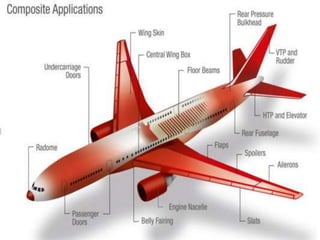
Applications of Composites in
Aerospace
Starting with first fully-composite glider
“phonix”, Fibre reinforced plastics (FRPs)
have gained importance in aerospace
industry.
2000 tons of finished composite parts, with a
value of 760 million dollars were produced by
European aerospace industry in 2000.
V/STOL (vertical and/or short take-off and landing); SST (supersonic transport)
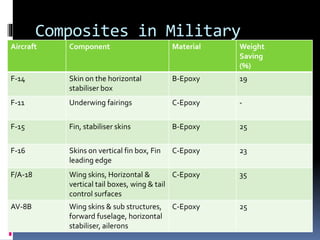
Composites in Military
Aircraft
Aircraft Component Material Weight
Saving
(%)
F-14 Skin on the horizontal
stabiliser box
B-Epoxy 19
F-11 Underwing fairings C-Epoxy -
F-15 Fin, stabiliser skins B-Epoxy 25
F-16 Skins on vertical fin box, Fin
leading edge
C-Epoxy 23
F/A-18 Wing skins, Horizontal &
vertical tail boxes, wing & tail
control surfaces
C-Epoxy 35
AV-8B Wing skins & sub structures,
forward fuselage, horizontal
stabiliser, ailerons
C-Epoxy 25
Limitations of Composites
 Composites are more expensive than conventional
materials on a cost to cost basis
 The chances of formation of defects at the interface
are high
 Most of the fibre reinforced composites are
anisotropic in nature
 The production rate of composites is generally low
 Database on the properties of different composites
is not available
 Recycling is another hurdle for the wide usage of
 composites
In Conclusion...
References
 Agarwal, B.D., L.J. Broutman and K. Chandrashekhara.
2006. Analysis and performance of fiber composites, 3rd edn.,
NewYork:JohnWiley & sons.
 Chawla, K.K. 2012. Composite materials:Science and
engineering, 3rd edn., NewYork, USA: Springer-Verlag Inc.
 Mallick, P.K. 2008. Fiber-reinforced composites, 3rd edn.,
Boca Raton, USA: CRC Press.
 Ajayan, P.M., L.S. Schadler and P.V. Braun. 2003.
Nanocomposite science and technology, Morlenbach,
Germany:WILEY-VCH.
 Balasubramanian, M. 2013. Composite materials and
processing, Boca Raton, USA: CRC Press.
 Suresh, S., Mortensen,A. and Needleman,A. (Eds.) 1993.
Fundamentals

Composite Materials in Aircraft Structures

  • 1.
    COMPOSITE MATERIALS IN AIRCRAFTSTRUCTURES Prepared By: RAHUL DUBEY
  • 2.
    Overview  Composite Materials:A Brief Introduction Why Composites? Advantages of Composites Applications in Aerospace Industry Limitations of Composites Conclusion References
  • 3.
    Introduction Modern technologies requirematerials with unusual combination of properties Cannot be met by conventional materials.  Aerospace EngineeringApplications  Low density, strong & stiff, and abrasion, corrosion & impact resistant material.
  • 4.
    Composite Materials Material propertycombinations have been extended Exhibit a significant proportion of properties of constituent phases Number of composites occur in nature 1.Wood  Strong & flexible cellulose fibers held together by stiffer lignin 2. Bone  Soft & strong collagen surrounds hard & brittle apatite
  • 5.
    Definition  A compositematerial in the present context  A combination of two or more materials with certain desired properties or improved properties  The original identity of dispersed (reinforcement) phase should be retained during manufacturing and/service  Multiphase alloys & ceramics are not composites  Most composites have been created to improve the combination of mechanical properties  Stiffness, toughness, ambient & high temperature strength
  • 6.
    Why Composites? To enhancethe material properties & performance efficiency To design materials with combination of desired properties
  • 7.
    Advantages of Composites High strength/stiffness to weight ratio  Energy efficient  Corrosion and weather resistant  Properties for specific design conditions  Directional properties  Easy to make complex shapes
  • 8.
    Constituents  Reinforcement -Discontinuous phase (constituent)  Matrix - Continuous phase (constituent) Polymer Composite
  • 9.
    Constituents Reinforcements  principal loadbearing member Matrix  provides a medium for binding and holding the reinforcements or fillers together into a solid  protects the reinforcement from environmental degradation  serves to transfer load from one insert (fibre, flake or particles) to the other  provides finish, colour, texture, durability and other functional properties
  • 11.
    Classification Nature of Origin Natural Composites  Man-made Composites Matrix  Polymer Matrix Composites (PMC)  Metal Matrix Composites (MMC)  Ceramic Matrix Composites (CMC) Reinforcements  Fibre & Particulate Composites  Macro-, Micro- and Nano-composites
  • 12.
    Purpose of SecondPhase to enhance matrix properties  PMC: to increase E, σy,TS, creep resistance  MMC: to increase σy,TS, creep resistance  CMC: to increase Kc
  • 15.
    Applications of Compositesin Aerospace Starting with first fully-composite glider “phonix”, Fibre reinforced plastics (FRPs) have gained importance in aerospace industry. 2000 tons of finished composite parts, with a value of 760 million dollars were produced by European aerospace industry in 2000.
  • 17.
    V/STOL (vertical and/orshort take-off and landing); SST (supersonic transport)
  • 18.
    Composites in Military Aircraft AircraftComponent Material Weight Saving (%) F-14 Skin on the horizontal stabiliser box B-Epoxy 19 F-11 Underwing fairings C-Epoxy - F-15 Fin, stabiliser skins B-Epoxy 25 F-16 Skins on vertical fin box, Fin leading edge C-Epoxy 23 F/A-18 Wing skins, Horizontal & vertical tail boxes, wing & tail control surfaces C-Epoxy 35 AV-8B Wing skins & sub structures, forward fuselage, horizontal stabiliser, ailerons C-Epoxy 25
  • 22.
    Limitations of Composites Composites are more expensive than conventional materials on a cost to cost basis  The chances of formation of defects at the interface are high  Most of the fibre reinforced composites are anisotropic in nature  The production rate of composites is generally low  Database on the properties of different composites is not available  Recycling is another hurdle for the wide usage of  composites
  • 24.
  • 25.
    References  Agarwal, B.D.,L.J. Broutman and K. Chandrashekhara. 2006. Analysis and performance of fiber composites, 3rd edn., NewYork:JohnWiley & sons.  Chawla, K.K. 2012. Composite materials:Science and engineering, 3rd edn., NewYork, USA: Springer-Verlag Inc.  Mallick, P.K. 2008. Fiber-reinforced composites, 3rd edn., Boca Raton, USA: CRC Press.  Ajayan, P.M., L.S. Schadler and P.V. Braun. 2003. Nanocomposite science and technology, Morlenbach, Germany:WILEY-VCH.  Balasubramanian, M. 2013. Composite materials and processing, Boca Raton, USA: CRC Press.  Suresh, S., Mortensen,A. and Needleman,A. (Eds.) 1993. Fundamentals

Editor's Notes

  • #4 Generally strong materials are relatively dense Increasing strength or stiffness generally results in a decrease in impact strength
  • #12 Continuous fiber reinforced composites Particulate composites Unidirectional Bidirectional 3-Directional Multidirectional Woven Angle ply Short fiber/whisker reinforced composites Aligned Random Planar random 3D random Cross ply Laminates: Multilayered composites Hybrid composites: Composites with two or more types of reinforcements Sandwich composites: Composites with core made-up of foam or honeycomb structure