A Seminar Presentation
on
POLYMER COMPOSITES
in
AVIATION INDUSTRY
By:
Shivi Kesarwani
M.Tech. (P.E.) 1st Year (II Sem)
1618987512
CIPET, Lucknow (U.P.)
CONTENT
• Introduction
• Evolution of Aerospace Structural Materials
• Polymer Composites in Aerospace & Aviation industry
• Current Scenario/ Case Studies
• Future of Polymer Composites in Aerospace &
Aviation industry
• Conclusion
• References
CONTENT
• Introduction
• Evolution of Aerospace Structural Materials
• Polymer Composites in Aerospace & Aviation industry
• Current Scenario/ Case Studies
• Future of Polymer Composites in Aerospace & Aviation
industry
• Conclusion
• References
INTRODUCTION
 What are Composite materials (definition) ?
 What are Polymer Composites ?
 Performance Benefits
What are Composite materials
(definition) ?
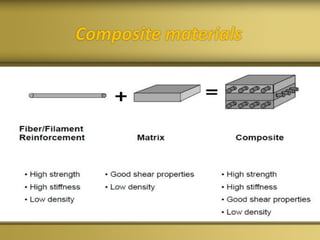
 Composite material is a material composed of two or more distinct phases(matrix
phase and dispersed phase) which are chemically & physically different.
 Composites are used because overall properties of the composites are superior to
those of the individual components.
 The primary phase, having a continuous character , is called matrix. Matrix is usually
more ductile and less hard phase. It holds the dispersed phase and shares a load with
it.
 The second phase (or phases) which is embedded in the matrix is called dispersed
phase. Dispersed phase is usually stronger than the matrix, therefore it is called
reinforcing phase.
Composite materials
Types of Composite materials
(On the basis of Matrix Materials)
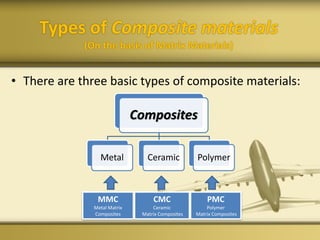
• There are three basic types of composite materials:
Composites
Metal Ceramic Polymer
MMC
Metal Matrix
Composites
CMC
Ceramic
Matrix Composites
PMC
Polymer
Matrix Composites
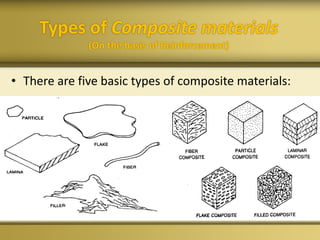
Types of Composite materials
(On the basis of Reinforcement)
• There are five basic types of composite materials:
What are Polymer Composites ?
(Or PMCs / Polymer Matrix Composites)
• Composite in which at least one component is a
polymer.
• Most common polymers are Polyesters, Vinyl esters,
Epoxy, Phenolic, Polyimide, Polyamide, PP, PEEK etc.
• Reinforcement
→Fibers
→Ground Minerals
• Strength depends on ratio of polymer to
reinforcement.
• Methods used are low cost and simple.
Performance Benefits
• Strength - greater than strongest metals, Stiffness - similar
to steel
• Density - light weight - half aluminium, fifth steel
– Even in conservative designs, 30% weight saving is easily
achievable
• Excellent fatigue and corrosion resistance
• Manufacture of complex shapes, reduced parts, easier
assembly, reduced machining
• Dimensional stability
– eg. space structures
CONTENT
• Introduction
• Evolution of Aerospace Structural Materials
• Polymer Composites in Aerospace & Aviation industry
• Current Scenario/ Case Studies
• Future of Polymer Composites in Aerospace & Aviation
industry
• Conclusion
• References
Evolution of
Aerospace Structural Materials
• Early aircraft design used a type of composite – a
combination of wood, canvas & high tension wires with
flight control achieved by twisting the tips of the wings and
employing the use of a rudder (high DT and low mass). A
composite design !
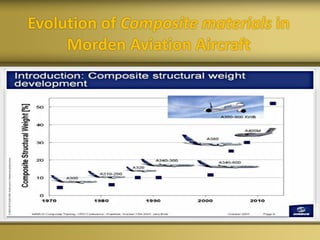
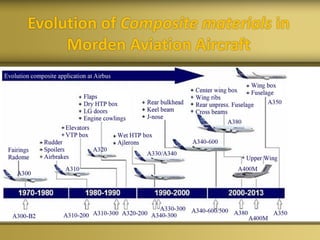
• Carbon fibre and glass fibre reinforced polymers first
included in aircraft during the 1970s
• The Aerospace industry is, however, inherently
conservative resulting in a small step by step approach –
composites have taken a long time to really ‘take-off’
• Conservatism in design has also limited platform shape and
construction to that of proven metallic designs rather then
embracing and designing for the new materials, but this is
changing.
• But composite usage is now increasing rapidly.
British Army Aeroplane No. 1 1908
Swan Inn Plateau near Farnborough
Evolution of Composite materials in
Morden Aviation Aircraft
Evolution of Composite materials in
Morden Aviation Aircraft
CONTENT
• Introduction
• Evolution of Aerospace Structural Materials
• Polymer Composites in Aerospace &
Aviation industry
• Current Scenario/ Case Studies
• Future of Polymer Composites in Aerospace & Aviation
industry
• Conclusion
• References
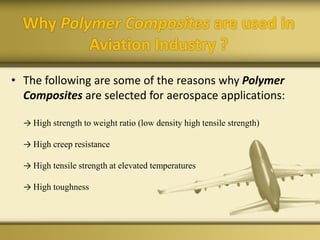
Why Polymer Composites are used in
Aviation Industry ?
• The following are some of the reasons why Polymer
Composites are selected for aerospace applications:
→ High strength to weight ratio (low density high tensile strength)
→ High creep resistance
→ High tensile strength at elevated temperatures
→ High toughness
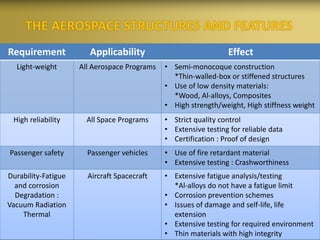
THE AEROSPACE STRUCTURES AND FEATURES
Requirement Applicability Effect
Light-weight All Aerospace Programs • Semi-monocoque construction
*Thin-walled-box or stiffened structures
• Use of low density materials:
*Wood, Al-alloys, Composites
• High strength/weight, High stiffness weight
High reliability All Space Programs • Strict quality control
• Extensive testing for reliable data
• Certification : Proof of design
Passenger safety Passenger vehicles • Use of fire retardant material
• Extensive testing : Crashworthiness
Durability-Fatigue
and corrosion
Degradation :
Vacuum Radiation
Thermal
Aircraft Spacecraft • Extensive fatigue analysis/testing
*Al-alloys do not have a fatigue limit
• Corrosion prevention schemes
• Issues of damage and self-life, life
extension
• Extensive testing for required environment
• Thin materials with high integrity
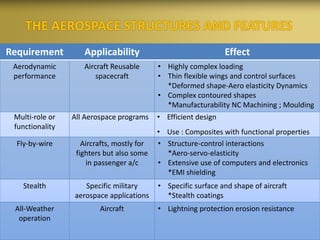
THE AEROSPACE STRUCTURES AND FEATURES
Requirement Applicability Effect
Aerodynamic
performance
Aircraft Reusable
spacecraft
• Highly complex loading
• Thin flexible wings and control surfaces
*Deformed shape-Aero elasticity Dynamics
• Complex contoured shapes
*Manufacturability NC Machining ; Moulding
Multi-role or
functionality
All Aerospace programs • Efficient design
• Use : Composites with functional properties
Fly-by-wire Aircrafts, mostly for
fighters but also some
in passenger a/c
• Structure-control interactions
*Aero-servo-elasticity
• Extensive use of computers and electronics
*EMI shielding
Stealth Specific military
aerospace applications
• Specific surface and shape of aircraft
*Stealth coatings
All-Weather
operation
Aircraft • Lightning protection erosion resistance
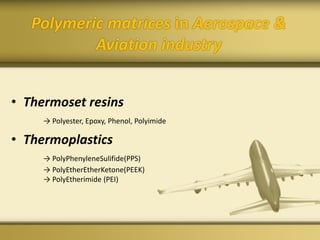
Polymeric matrices in Aerospace &
Aviation industry
• Thermoset resins
→ Polyester, Epoxy, Phenol, Polyimide
• Thermoplastics
→ PolyPhenyleneSulifide(PPS)
→ PolyEtherEtherKetone(PEEK)
→ PolyEtherimide (PEI)
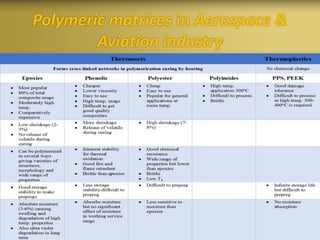
Polymeric matrices in Aerospace &
Aviation industry
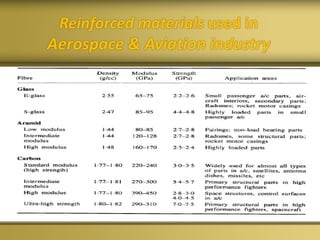
Reinforced materials used in
Aerospace & Aviation industry
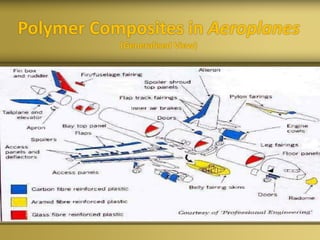
Polymer Composites in Aeroplanes
(Generalised View)
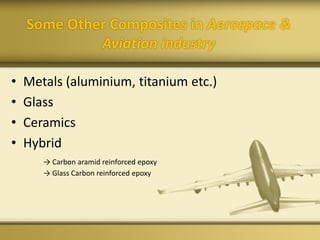
Some Other Composites in Aerospace &
Aviation industry
• Metals (aluminium, titanium etc.)
• Glass
• Ceramics
• Hybrid
→ Carbon aramid reinforced epoxy
→ Glass Carbon reinforced epoxy
CONTENT
• Introduction
• Evolution of Aerospace Structural Materials
• Polymer Composites in Aerospace & Aviation industry
• Current Scenario/ Case Studies
• Future of Polymer Composites in Aerospace & Aviation
industry
• Conclusion
• References
Case Study 1:
Boeing 777
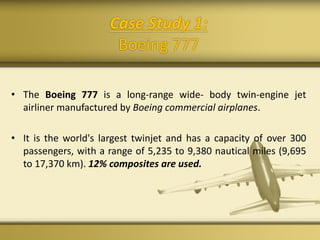
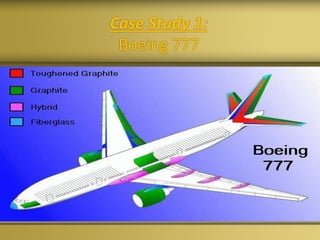
• The Boeing 777 is a long-range wide- body twin-engine jet
airliner manufactured by Boeing commercial airplanes.
• It is the world's largest twinjet and has a capacity of over 300
passengers, with a range of 5,235 to 9,380 nautical miles (9,695
to 17,370 km). 12% composites are used.
Case Study 1:
Boeing 777
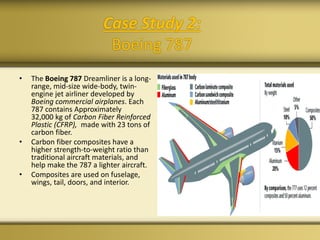
• The Boeing 787 Dreamliner is a long-
range, mid-size wide-body, twin-
engine jet airliner developed by
Boeing commercial airplanes. Each
787 contains Approximately
32,000 kg of Carbon Fiber Reinforced
Plastic (CFRP), made with 23 tons of
carbon fiber.
• Carbon fiber composites have a
higher strength-to-weight ratio than
traditional aircraft materials, and
help make the 787 a lighter aircraft.
• Composites are used on fuselage,
wings, tail, doors, and interior.
Case Study 2:
Boeing 787
Case Study 3:
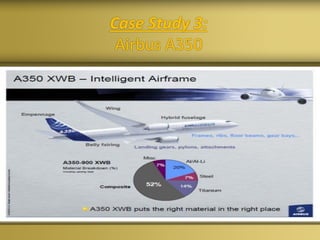
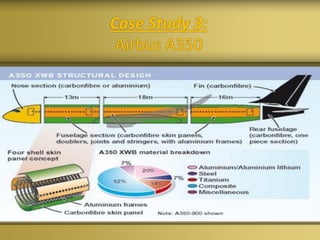
Airbus A350
• The A350XWB consists of 53% composites, 19% AL/AL-Li, 14%
Titanium and 6% steel. Composite skin panels are placed over
composite frames and the cross section remains ovoid.
• By applying composites on the A350XWB, Airbus has increased
the service intervals for the aircraft from six years to 12, which
significantly reduces maintenance costs for customers.
• The high percentage of composites also reduces the need for
fatigue – related inspections required on more traditional
aluminium jetliners, and lessens the requirement for
corrosion-related maintenance checks.
Case Study 3:
Airbus A350
Case Study 3:
Airbus A350
Case Study 4:
Airbus A380
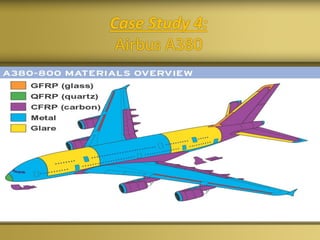
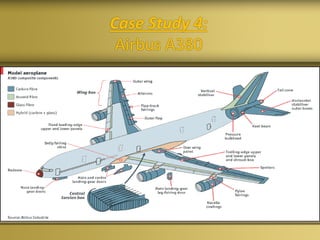
• The A380 is the first aircraft ever that boasts a CFRP (Carbon
Fibre Reinforced Plastic) composite central wing box,
representing a weight saving of up to one and a half tonnes
compared to the most advanced aluminium alloys.
• The upper deck floor beams and the rear pressure bulkhead are
made of CFRP. For this last component, different technologies
were tested such as Resin Film Infusion and Automated Fibre
Placement.
Case Study 4:
Airbus A380
Case Study 4:
Airbus A380
CONTENT
• Introduction
• Evolution of Aerospace Structural Materials
• Polymer Composites in Aerospace & Aviation industry
• Current Scenario/ Case Studies
• Future of Polymer Composites in Aerospace &
Aviation industry
• Conclusion
• References
Future of Polymer Composites in
Aerospace & Aviation industry
• With ever increasing fuel costs and environmental lobbying, commercial flying is under
sustained pressure to improve performance, and weight reduction is a key factor in
the equation.
• Beyond the day-to-day operating costs, the aircraft maintenance programs can be
simplified by component count reduction and corrosion reduction. The competitive
nature of the aircraft construction business ensures that any opportunity to reduce
operating costs is explored and exploited wherever possible.
• Competition exists in the military too, with continuous pressure to increase payload and
range, flight performance characteristics and 'survivability', not only of airplanes but of
missiles, too.
• Composite technology continues to advance, and the advent of new types such as
basalt and carbon nanotube forms is certain to accelerate and extend composite
usage.
CONTENT
• Introduction
• Evolution of Aerospace Structural Materials
• Polymer Composites in Aerospace & Aviation industry
• Current Scenario/ Case Studies
• Future of Polymer Composites in Aerospace &
Aviation industry
• Conclusion
• References
Conclusion
(Advantages & Disadvantages)
ADVANTAGES DISADVANTAGES
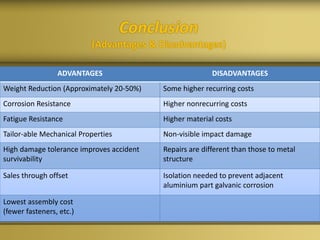
Weight Reduction (Approximately 20-50%) Some higher recurring costs
Corrosion Resistance Higher nonrecurring costs
Fatigue Resistance Higher material costs
Tailor-able Mechanical Properties Non-visible impact damage
High damage tolerance improves accident
survivability
Repairs are different than those to metal
structure
Sales through offset Isolation needed to prevent adjacent
aluminium part galvanic corrosion
Lowest assembly cost
(fewer fasteners, etc.)
Conclusion
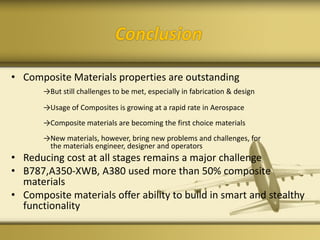
• Composite Materials properties are outstanding
→But still challenges to be met, especially in fabrication & design
→Usage of Composites is growing at a rapid rate in Aerospace
→Composite materials are becoming the first choice materials
→New materials, however, bring new problems and challenges, for
the materials engineer, designer and operators
• Reducing cost at all stages remains a major challenge
• B787,A350-XWB, A380 used more than 50% composite
materials
• Composite materials offer ability to build in smart and stealthy
functionality
References
• Dr. Ravi B. DEO, “Low-Cost Composite Materials and Structures for Aircraft Applications”, SM Journals (SM-1), May 2001
• Maria MRAZOVA (The Faculty of Operation and Economics of Transport, The Air Transport Department Univerzitna 1, 010 26 Zilina, Slovak
Republic) “Advanced composite materials of the future in Aerospace industry”, INCAS BULLETIN, Volume 5, Issue 3/ 2013
• Roxana NEDELCU (Military Technical Academy, Bucharest, Romania), “COMPOSITES MATERIALS FOR AVIATION INDUSTRY”, INTERNATIONAL
CONFERENCE of SCIENTIFIC PAPER, AFASES 2012, Brasov, 24-26 May 2012
• Md Saifuddin Ahmed Atique, “Polymer composites: a blessing to modern aerospace engineering”, International Conference on Mechanical,
Industrial and Energy Engineering 2014, 26-27 December, 2014, Khulna, BANGLADESH
• NV Srinivasulu, “MECHANICAL PROPERTIES OF POLYMER COMPOSITE MATERIALS”, International Journal of Research in Engineering and
Technology, ISSN: 2319-1163, Volume: 01 Issue: 01, Sep-2012
• “Composite airframe structures” by Michael C. Y. Niu
• Book: William D. Callister, “Materials Science and Engineering: An Introduction”, ISBN-13: 978-0-471-73696-7, ISBN-10: 0-471-73696-1, 2007
• Book: Sabu Thomas, Joseph Kuruvilla & Others, “Polymer Composites: Volume 1”, ISBN: 9783527326242, MAR 2012
• For Composite materials in Aerospace industries:
– http://www.aviation-history.com/theory/composite.htm
– http://authors.library.caltech.edu/5456/1/hrst.mit.edu/hrs/materials/public/composites/Composites_Overview.htm
– https://en.wikipedia.org/wiki/Aerospace_materials
• History of Aviation Industry:
– http://en.wikipedia.org/wiki/History_of_aviation
• Other Developments in Aviation Industries:
– http://www.airbus.com/
– http://www.boeing.com/
• Google Search
Shivi Kesarwani
M.Tech. (P.E.) 1st Year (II Sem)
1618987512
CIPET, Lucknow (U.P.)

Polymer Composites in Aviation Sector

  • 1.
    A Seminar Presentation on POLYMERCOMPOSITES in AVIATION INDUSTRY By: Shivi Kesarwani M.Tech. (P.E.) 1st Year (II Sem) 1618987512 CIPET, Lucknow (U.P.)
  • 2.
    CONTENT • Introduction • Evolutionof Aerospace Structural Materials • Polymer Composites in Aerospace & Aviation industry • Current Scenario/ Case Studies • Future of Polymer Composites in Aerospace & Aviation industry • Conclusion • References
  • 3.
    CONTENT • Introduction • Evolutionof Aerospace Structural Materials • Polymer Composites in Aerospace & Aviation industry • Current Scenario/ Case Studies • Future of Polymer Composites in Aerospace & Aviation industry • Conclusion • References
  • 4.
    INTRODUCTION  What areComposite materials (definition) ?  What are Polymer Composites ?  Performance Benefits
  • 5.
    What are Compositematerials (definition) ?  Composite material is a material composed of two or more distinct phases(matrix phase and dispersed phase) which are chemically & physically different.  Composites are used because overall properties of the composites are superior to those of the individual components.  The primary phase, having a continuous character , is called matrix. Matrix is usually more ductile and less hard phase. It holds the dispersed phase and shares a load with it.  The second phase (or phases) which is embedded in the matrix is called dispersed phase. Dispersed phase is usually stronger than the matrix, therefore it is called reinforcing phase.
  • 6.
  • 7.
    Types of Compositematerials (On the basis of Matrix Materials) • There are three basic types of composite materials: Composites Metal Ceramic Polymer MMC Metal Matrix Composites CMC Ceramic Matrix Composites PMC Polymer Matrix Composites
  • 8.
    Types of Compositematerials (On the basis of Reinforcement) • There are five basic types of composite materials:
  • 9.
    What are PolymerComposites ? (Or PMCs / Polymer Matrix Composites) • Composite in which at least one component is a polymer. • Most common polymers are Polyesters, Vinyl esters, Epoxy, Phenolic, Polyimide, Polyamide, PP, PEEK etc. • Reinforcement →Fibers →Ground Minerals • Strength depends on ratio of polymer to reinforcement. • Methods used are low cost and simple.
  • 10.
    Performance Benefits • Strength- greater than strongest metals, Stiffness - similar to steel • Density - light weight - half aluminium, fifth steel – Even in conservative designs, 30% weight saving is easily achievable • Excellent fatigue and corrosion resistance • Manufacture of complex shapes, reduced parts, easier assembly, reduced machining • Dimensional stability – eg. space structures
  • 11.
    CONTENT • Introduction • Evolutionof Aerospace Structural Materials • Polymer Composites in Aerospace & Aviation industry • Current Scenario/ Case Studies • Future of Polymer Composites in Aerospace & Aviation industry • Conclusion • References
  • 12.
    Evolution of Aerospace StructuralMaterials • Early aircraft design used a type of composite – a combination of wood, canvas & high tension wires with flight control achieved by twisting the tips of the wings and employing the use of a rudder (high DT and low mass). A composite design ! • Carbon fibre and glass fibre reinforced polymers first included in aircraft during the 1970s • The Aerospace industry is, however, inherently conservative resulting in a small step by step approach – composites have taken a long time to really ‘take-off’ • Conservatism in design has also limited platform shape and construction to that of proven metallic designs rather then embracing and designing for the new materials, but this is changing. • But composite usage is now increasing rapidly. British Army Aeroplane No. 1 1908 Swan Inn Plateau near Farnborough
  • 13.
    Evolution of Compositematerials in Morden Aviation Aircraft
  • 14.
    Evolution of Compositematerials in Morden Aviation Aircraft
  • 15.
    CONTENT • Introduction • Evolutionof Aerospace Structural Materials • Polymer Composites in Aerospace & Aviation industry • Current Scenario/ Case Studies • Future of Polymer Composites in Aerospace & Aviation industry • Conclusion • References
  • 16.
    Why Polymer Compositesare used in Aviation Industry ? • The following are some of the reasons why Polymer Composites are selected for aerospace applications: → High strength to weight ratio (low density high tensile strength) → High creep resistance → High tensile strength at elevated temperatures → High toughness
  • 17.
    THE AEROSPACE STRUCTURESAND FEATURES Requirement Applicability Effect Light-weight All Aerospace Programs • Semi-monocoque construction *Thin-walled-box or stiffened structures • Use of low density materials: *Wood, Al-alloys, Composites • High strength/weight, High stiffness weight High reliability All Space Programs • Strict quality control • Extensive testing for reliable data • Certification : Proof of design Passenger safety Passenger vehicles • Use of fire retardant material • Extensive testing : Crashworthiness Durability-Fatigue and corrosion Degradation : Vacuum Radiation Thermal Aircraft Spacecraft • Extensive fatigue analysis/testing *Al-alloys do not have a fatigue limit • Corrosion prevention schemes • Issues of damage and self-life, life extension • Extensive testing for required environment • Thin materials with high integrity
  • 18.
    THE AEROSPACE STRUCTURESAND FEATURES Requirement Applicability Effect Aerodynamic performance Aircraft Reusable spacecraft • Highly complex loading • Thin flexible wings and control surfaces *Deformed shape-Aero elasticity Dynamics • Complex contoured shapes *Manufacturability NC Machining ; Moulding Multi-role or functionality All Aerospace programs • Efficient design • Use : Composites with functional properties Fly-by-wire Aircrafts, mostly for fighters but also some in passenger a/c • Structure-control interactions *Aero-servo-elasticity • Extensive use of computers and electronics *EMI shielding Stealth Specific military aerospace applications • Specific surface and shape of aircraft *Stealth coatings All-Weather operation Aircraft • Lightning protection erosion resistance
  • 19.
    Polymeric matrices inAerospace & Aviation industry • Thermoset resins → Polyester, Epoxy, Phenol, Polyimide • Thermoplastics → PolyPhenyleneSulifide(PPS) → PolyEtherEtherKetone(PEEK) → PolyEtherimide (PEI)
  • 20.
    Polymeric matrices inAerospace & Aviation industry
  • 21.
    Reinforced materials usedin Aerospace & Aviation industry
  • 22.
    Polymer Composites inAeroplanes (Generalised View)
  • 23.
    Some Other Compositesin Aerospace & Aviation industry • Metals (aluminium, titanium etc.) • Glass • Ceramics • Hybrid → Carbon aramid reinforced epoxy → Glass Carbon reinforced epoxy
  • 24.
    CONTENT • Introduction • Evolutionof Aerospace Structural Materials • Polymer Composites in Aerospace & Aviation industry • Current Scenario/ Case Studies • Future of Polymer Composites in Aerospace & Aviation industry • Conclusion • References
  • 25.
    Case Study 1: Boeing777 • The Boeing 777 is a long-range wide- body twin-engine jet airliner manufactured by Boeing commercial airplanes. • It is the world's largest twinjet and has a capacity of over 300 passengers, with a range of 5,235 to 9,380 nautical miles (9,695 to 17,370 km). 12% composites are used.
  • 26.
  • 27.
    • The Boeing787 Dreamliner is a long- range, mid-size wide-body, twin- engine jet airliner developed by Boeing commercial airplanes. Each 787 contains Approximately 32,000 kg of Carbon Fiber Reinforced Plastic (CFRP), made with 23 tons of carbon fiber. • Carbon fiber composites have a higher strength-to-weight ratio than traditional aircraft materials, and help make the 787 a lighter aircraft. • Composites are used on fuselage, wings, tail, doors, and interior. Case Study 2: Boeing 787
  • 28.
    Case Study 3: AirbusA350 • The A350XWB consists of 53% composites, 19% AL/AL-Li, 14% Titanium and 6% steel. Composite skin panels are placed over composite frames and the cross section remains ovoid. • By applying composites on the A350XWB, Airbus has increased the service intervals for the aircraft from six years to 12, which significantly reduces maintenance costs for customers. • The high percentage of composites also reduces the need for fatigue – related inspections required on more traditional aluminium jetliners, and lessens the requirement for corrosion-related maintenance checks.
  • 29.
  • 30.
  • 31.
    Case Study 4: AirbusA380 • The A380 is the first aircraft ever that boasts a CFRP (Carbon Fibre Reinforced Plastic) composite central wing box, representing a weight saving of up to one and a half tonnes compared to the most advanced aluminium alloys. • The upper deck floor beams and the rear pressure bulkhead are made of CFRP. For this last component, different technologies were tested such as Resin Film Infusion and Automated Fibre Placement.
  • 32.
  • 33.
  • 34.
    CONTENT • Introduction • Evolutionof Aerospace Structural Materials • Polymer Composites in Aerospace & Aviation industry • Current Scenario/ Case Studies • Future of Polymer Composites in Aerospace & Aviation industry • Conclusion • References
  • 35.
    Future of PolymerComposites in Aerospace & Aviation industry • With ever increasing fuel costs and environmental lobbying, commercial flying is under sustained pressure to improve performance, and weight reduction is a key factor in the equation. • Beyond the day-to-day operating costs, the aircraft maintenance programs can be simplified by component count reduction and corrosion reduction. The competitive nature of the aircraft construction business ensures that any opportunity to reduce operating costs is explored and exploited wherever possible. • Competition exists in the military too, with continuous pressure to increase payload and range, flight performance characteristics and 'survivability', not only of airplanes but of missiles, too. • Composite technology continues to advance, and the advent of new types such as basalt and carbon nanotube forms is certain to accelerate and extend composite usage.
  • 36.
    CONTENT • Introduction • Evolutionof Aerospace Structural Materials • Polymer Composites in Aerospace & Aviation industry • Current Scenario/ Case Studies • Future of Polymer Composites in Aerospace & Aviation industry • Conclusion • References
  • 37.
    Conclusion (Advantages & Disadvantages) ADVANTAGESDISADVANTAGES Weight Reduction (Approximately 20-50%) Some higher recurring costs Corrosion Resistance Higher nonrecurring costs Fatigue Resistance Higher material costs Tailor-able Mechanical Properties Non-visible impact damage High damage tolerance improves accident survivability Repairs are different than those to metal structure Sales through offset Isolation needed to prevent adjacent aluminium part galvanic corrosion Lowest assembly cost (fewer fasteners, etc.)
  • 38.
    Conclusion • Composite Materialsproperties are outstanding →But still challenges to be met, especially in fabrication & design →Usage of Composites is growing at a rapid rate in Aerospace →Composite materials are becoming the first choice materials →New materials, however, bring new problems and challenges, for the materials engineer, designer and operators • Reducing cost at all stages remains a major challenge • B787,A350-XWB, A380 used more than 50% composite materials • Composite materials offer ability to build in smart and stealthy functionality
  • 39.
    References • Dr. RaviB. DEO, “Low-Cost Composite Materials and Structures for Aircraft Applications”, SM Journals (SM-1), May 2001 • Maria MRAZOVA (The Faculty of Operation and Economics of Transport, The Air Transport Department Univerzitna 1, 010 26 Zilina, Slovak Republic) “Advanced composite materials of the future in Aerospace industry”, INCAS BULLETIN, Volume 5, Issue 3/ 2013 • Roxana NEDELCU (Military Technical Academy, Bucharest, Romania), “COMPOSITES MATERIALS FOR AVIATION INDUSTRY”, INTERNATIONAL CONFERENCE of SCIENTIFIC PAPER, AFASES 2012, Brasov, 24-26 May 2012 • Md Saifuddin Ahmed Atique, “Polymer composites: a blessing to modern aerospace engineering”, International Conference on Mechanical, Industrial and Energy Engineering 2014, 26-27 December, 2014, Khulna, BANGLADESH • NV Srinivasulu, “MECHANICAL PROPERTIES OF POLYMER COMPOSITE MATERIALS”, International Journal of Research in Engineering and Technology, ISSN: 2319-1163, Volume: 01 Issue: 01, Sep-2012 • “Composite airframe structures” by Michael C. Y. Niu • Book: William D. Callister, “Materials Science and Engineering: An Introduction”, ISBN-13: 978-0-471-73696-7, ISBN-10: 0-471-73696-1, 2007 • Book: Sabu Thomas, Joseph Kuruvilla & Others, “Polymer Composites: Volume 1”, ISBN: 9783527326242, MAR 2012 • For Composite materials in Aerospace industries: – http://www.aviation-history.com/theory/composite.htm – http://authors.library.caltech.edu/5456/1/hrst.mit.edu/hrs/materials/public/composites/Composites_Overview.htm – https://en.wikipedia.org/wiki/Aerospace_materials • History of Aviation Industry: – http://en.wikipedia.org/wiki/History_of_aviation • Other Developments in Aviation Industries: – http://www.airbus.com/ – http://www.boeing.com/ • Google Search
  • 40.
    Shivi Kesarwani M.Tech. (P.E.)1st Year (II Sem) 1618987512 CIPET, Lucknow (U.P.)