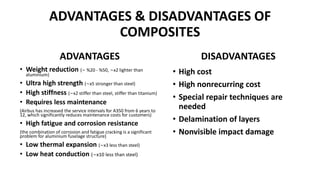
This document discusses the use of composite materials in the aerospace industry. It defines composites as materials made from two or more components and describes several types used in aircraft like carbon fiber reinforced polymer (CFRP) and glass fiber reinforced polymer (GFRP). Composites provide benefits for aircraft like weight reduction and high strength to weight ratio. Major applications include aircraft fuselages, wings, and tail components. Composites now make up over 50% of the total weight of some aircraft like Airbus planes.

![INTRODUCTION
Materials can be classified into four major categories; metals, polymers,
ceramics and composites.
Figure 1. Metal [1] Figure 2. Polymer [2] Figure 3. Ceramic [3] Figure 4. Composite [4]](https://image.slidesharecdn.com/compositeaerospaceapplications-181102151753-231020181344-9e02d594/85/compositeaerospaceapplications-181102151753-pdf-3-320.jpg)
![WHAT IS COMPOSITE ?
Composite is
combine of at least
two materials to get
a new better
material which has
unique properties.It
consists of two
parts; matrix and
reinforcement.
Figure 5. Composition of composites [5]](https://image.slidesharecdn.com/compositeaerospaceapplications-181102151753-231020181344-9e02d594/85/compositeaerospaceapplications-181102151753-pdf-4-320.jpg)
![COMPOSITE TYPES ARE USED IN AEROSPACE
INDUSTRY
• CFRP (Carbon fiber
reinforced polymer)
• GFRP (Glass fiber
reinforced polymer)
• AFRP (Aramid fiber
reinforced polymer)
• GLARE (Glass
reinforced aluminium)
Figure 6. CFRP [6] Figure 7. GFRP [7]
Figure 8. AFRP [8] Figure 9. GLARE [9]](https://image.slidesharecdn.com/compositeaerospaceapplications-181102151753-231020181344-9e02d594/85/compositeaerospaceapplications-181102151753-pdf-5-320.jpg)
![WHY COMPOSITES ARE USED IN AEROSPACE
INDUSTRY ?
The crucial point is design and manufacture an aircraft as light as possible while
guaranteeing the safety. The reduction in weight enables it to carry more
passengers, burn less fuel, fly further…or combinations of the three. Composites
are appropriate solution because of their;
• Low density
• High strength to weight ratio
• High stiffness to weight ratio
• High corrosion resistance
• High fatigue resistance
• High impact resistance
Figure 10. Specific strength comparison of composites and metals [10]](https://image.slidesharecdn.com/compositeaerospaceapplications-181102151753-231020181344-9e02d594/85/compositeaerospaceapplications-181102151753-pdf-6-320.jpg)
![APPLICATIONS OF COMPOSITE IN AEROSPACE
• Fuselage
• Wing flaps
• Wing box
• Tail cone
• Radome
• Floor beams and panels
• Helicopter main and tail rotor
blades
• Space vehicles
• Satellites
• Missiles
• Rockets etc.
Figure 11. Composite and thermoplastic applications in Airbus A380 [11]](https://image.slidesharecdn.com/compositeaerospaceapplications-181102151753-231020181344-9e02d594/85/compositeaerospaceapplications-181102151753-pdf-7-320.jpg)
![EVOLUTION OF THE OVERALL COMPOSITE
WEIGHT IN AIRBUS AIRCRAFTS
In 1970’s, only %5 of total
weight in Airbus aircrafts
was composite and now
over %50 of total weight
is composite.
Figure 12. Portion of composite materials in Airbus aircrafts [12]](https://image.slidesharecdn.com/compositeaerospaceapplications-181102151753-231020181344-9e02d594/85/compositeaerospaceapplications-181102151753-pdf-8-320.jpg)
![Figure 13. Airbus A350 composite structure [13]](https://image.slidesharecdn.com/compositeaerospaceapplications-181102151753-231020181344-9e02d594/85/compositeaerospaceapplications-181102151753-pdf-9-320.jpg)
![Figure 14. Airbus eurofighter typhoon composite structure [14]](https://image.slidesharecdn.com/compositeaerospaceapplications-181102151753-231020181344-9e02d594/85/compositeaerospaceapplications-181102151753-pdf-10-320.jpg)
![FUTURE OF COMPOSITES IN AEROSPACE
INDUSTRY
• CMC (Ceramic matrix
composite)
• MMC (Metal matrix
composite)
• Carbon nanotube
technology
• Composite 3d printing
Figure 15. CMC Jet engine turbine blade [15] Figure 16. Ti-MMC bling [16]
Figure 17. Carbon nanotube [17] Figure 18. Composite 3d printer [18]](https://image.slidesharecdn.com/compositeaerospaceapplications-181102151753-231020181344-9e02d594/85/compositeaerospaceapplications-181102151753-pdf-12-320.jpg)

![REFERENCES
• http://www.appropedia.org/Composites_in_the_Aircraft_Industry
• https://www.azom.com/article.aspx?ArticleID=8152
• https://www.airbus.com
• https://www.thebalancecareers.com/composite-materials-aircraft-structure-282777
• https://www.slideshare.net/KanchhaLama/application-of-composite-materials-in-
aerospace-industry-1
• https://www.slideshare.net/chuchu42/smnr-on-composite-in-aerospace
• Advanced composite materials of the future in aerospace industry - Maria MRAZOVA
• Cost/Weight Optimization of Aircraft Structures - MARKUS KAUFMANN
• COMPOSITES MATERIALS FOR AVIATION INDUSTRY - Roxana NEDELCU, Pierrick REDON
• CompositeMaterialsforAircraftStructures - Dr. Douglas S. Cairns, Lysle A. Wood
Distinguished Professor
• http://www.leesh.cn/Uploads/5767ccd5e0eca.jpg [1]
• https://banner2.kisspng.com/20180203/juw/kisspng-plastic-bottle-polyethylene-terephthalate-water-bo-plastic-bottle-
5a755909bbe7a0.0941422915176399457697.jpg [2]
• http://www.henryolsonfuneral.com/ceramic.png [3]
• https://encrypted-tbn0.gstatic.com/images?q=tbn:ANd9GcSvxeNX8FMufv37GqgLvnlLtJZl60b5f1L7HuMNkzRjbaLPF5RKpg
[4]
• https://iarjset.com/upload/2016/april-16/IARJSET%2013.pdf [5]
• https://cdn2.bigcommerce.com/server2700/72b8a/templates/__custom/images/carbon-section.png?t=1510615335 [6]
• https://sc02.alicdn.com/kf/HTB1XE5PNpXXXXXNXFXXq6xXFXXXf/Zccy-e-glass-fibre-woven-roving-for.jpg_350x350.jpg [7]
• https://www.serieaweekly.com/wp-content/uploads/2018/09/Aramid-Fiber-Reinforcement-Materials.jpg [8]
• https://cdn.materialdistrict.com/wp-content/uploads/2010/08/MET202-14-601x400.jpg [9]
• https://www.hydraulicspneumatics.com/sites/hydraulicspneumatics.com/files/uploads/2015/02/New%20Fig%203.png
[10]
• http://2.bp.blogspot.com/-Ik9DsHdaGBQ/T3qdeg2RSlI/AAAAAAAAAQ4/WFjgQRGh9sY/s640/plane01_b.jpg [11]
• http://s15858.pcdn.co/wp-content/uploads/sites/default/files/images/http-www.ahrtp.com-EG-Images5-EADS-Airbus-
variants-composite-weight-opt600x458-Airbus.jpg [12]
• https://www.researchgate.net/publication/274059750/figure/download/fig6/AS:393370229854210@1470798179134/A
350-XWB-material-breakdown.png [13]
• https://resboiu.files.wordpress.com/2011/02/ef-characteristics.jpg [14]
• https://d2n4wb9orp1vta.cloudfront.net/cms/CMCblade-247px.jpg;width=560 [15]
• https://www.slideserve.com/gustav/the-rolls-royce-trent-engine [16]
• https://3c1703fe8d.site.internapcdn.net/newman/gfx/news/hires/2016/57d1575f1dd5b.jpg [17]
• https://www.compositesworld.com/cdn/cms/0518-CW-blog-ContinuousComposites-continuous-fibers.jpg [18]
• [https://www.continuouscomposites.com/gallery](https://image.slidesharecdn.com/compositeaerospaceapplications-181102151753-231020181344-9e02d594/85/compositeaerospaceapplications-181102151753-pdf-14-320.jpg)


