SCHOOL OF AERONAUTICS(NEEMRANA)
[SEMINAR]
TOPIC
COMPOSITE MATERIAL-AIRCRAFT Mfg.
GUIDED BY:-
Prof. Gaurav Sardana
SUBMITTED BY:- SOMANSH KALRA
REG. NO :- 2085
Semester :- 4TH
Semister
Course:- B Tech Integrated
2.
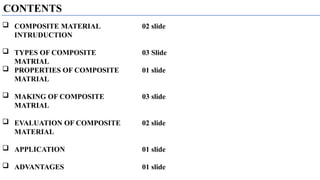
CONTENTS
COMPOSITE MATERIAL
INTRUDUCTION
TYPES OF COMPOSITE
MATRIAL
PROPERTIES OF COMPOSITE
MATRIAL
MAKING OF COMPOSITE
MATRIAL
EVALUATION OF COMPOSITE
MATERIAL
APPLICATION
ADVANTAGES
02 slide
03 Slide
01 slide
03 slide
02 slide
01 slide
01 slide
3.
COMPOSITE MATERIALINTRUDUCTION
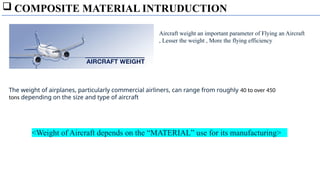
The weight of airplanes, particularly commercial airliners, can range from roughly 40 to over 450
tons depending on the size and type of aircraft
Aircraft weight an important parameter of Flying an Aircraft
, Lesser the weight , More the flying efficiency
<Weight of Aircraft depends on the “MATERIAL” use for its manufacturing>
4.
COMPOSITE MATERIALINTRUDUCTION
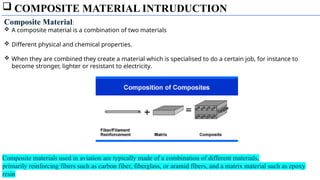
Composite Material:
A composite material is a combination of two materials
Different physical and chemical properties.
When they are combined they create a material which is specialised to do a certain job, for instance to
become stronger, lighter or resistant to electricity.
Composite materials used in aviation are typically made of a combination of different materials,
primarily reinforcing fibers such as carbon fiber, fiberglass, or aramid fibers, and a matrix material such as epoxy
resin
5.
TYPES OFCOMPOSITE MATERIAL
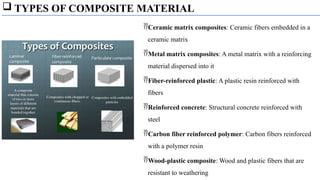
Ceramic matrix composites: Ceramic fibers embedded in a ceramic matrix
Metal matrix composites: A metal matrix with a reinforcing material dispersed into it
Fiber-reinforced plastic: A plastic resin reinforced with fibers
Reinforced concrete: Structural concrete reinforced with steel
Carbon fiber reinforced polymer: Carbon fibers reinforced with a polymer resin
Wood-plastic composite: Wood and plastic fibers that are resistant to weathering
Example of Composite Material
6.
TYPES OFCOMPOSITE MATERIAL
Ceramic matrix composites: Ceramic fibers embedded in a
ceramic matrix
Metal matrix composites: A metal matrix with a reinforcing
material dispersed into it
Fiber-reinforced plastic: A plastic resin reinforced with
fibers
Reinforced concrete: Structural concrete reinforced with
steel
Carbon fiber reinforced polymer: Carbon fibers reinforced
with a polymer resin
Wood-plastic composite: Wood and plastic fibers that are
resistant to weathering
7.
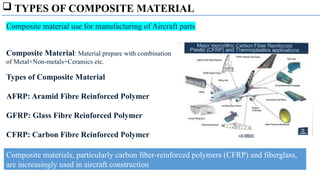
Composite material usefor manufacturing of Aircraft parts
Composite Material: Material prepare with combination
of Metal+Non-metals+Ceramics etc.
Types of Composite Material
AFRP: Aramid Fibre Reinforced Polymer
GFRP: Glass Fibre Reinforced Polymer
CFRP: Carbon Fibre Reinforced Polymer
Composite materials, particularly carbon fiber-reinforced polymers (CFRP) and fiberglass,
are increasingly used in aircraft construction
TYPES OF COMPOSITE MATERIAL
8.
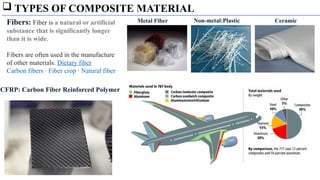
Fibers: Fiber isa natural or artificial
substance that is significantly longer
than it is wide.
Fibers are often used in the manufacture
of other materials. Dietary fiber
Carbon fibers · Fiber crop · Natural fiber
Metal Fiber Non-metal:Plastic Ceramic
CFRP: Carbon Fiber Reinforced Polymer
TYPES OF COMPOSITE MATERIAL
9.
PROPERTIES OFCOMPOSITE MATERIAL
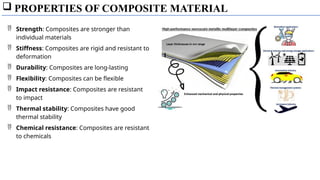
Strength: Composites are stronger than
individual materials
Stiffness: Composites are rigid and resistant to
deformation
Durability: Composites are long-lasting
Flexibility: Composites can be flexible
Impact resistance: Composites are resistant
to impact
Thermal stability: Composites have good
thermal stability
Chemical resistance: Composites are resistant
to chemicals
10.
MAKING OFCOMPOSITE MATERIAL
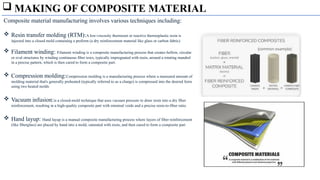
Composite material manufacturing involves various techniques including:
Resin transfer molding (RTM):A low-viscosity thermoset or reactive thermoplastic resin is
injected into a closed mold containing a preform (a dry reinforcement material like glass or carbon fabric)
Filament winding: Filament winding is a composite manufacturing process that creates hollow, circular
or oval structures by winding continuous fiber tows, typically impregnated with resin, around a rotating mandrel
in a precise pattern, which is then cured to form a composite part.
Compression molding:Compression molding is a manufacturing process where a measured amount of
molding material that's generally preheated (typically referred to as a charge) is compressed into the desired form
using two heated molds
Vacuum infusion:is a closed-mold technique that uses vacuum pressure to draw resin into a dry fiber
reinforcement, resulting in a high-quality composite part with minimal voids and a precise resin-to-fiber ratio.
Hand layup: Hand layup is a manual composite manufacturing process where layers of fiber reinforcement
(like fiberglass) are placed by hand into a mold, saturated with resin, and then cured to form a composite part
11.
EVALUSSION OFCOMPOSITE MATERIAL
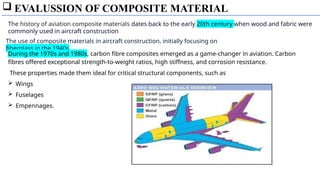
The use of composite materials in aircraft construction, initially focusing on
fiberglass in the 1940s
The history of aviation composite materials dates back to the early 20th century when wood and fabric were
commonly used in aircraft construction
During the 1970s and 1980s, carbon fibre composites emerged as a game-changer in aviation. Carbon
fibres offered exceptional strength-to-weight ratios, high stiffness, and corrosion resistance.
These properties made them ideal for critical structural components, such as
Wings
Fuselages
Empennages.
COMPOSITE MATERIALINTRUDUCTION
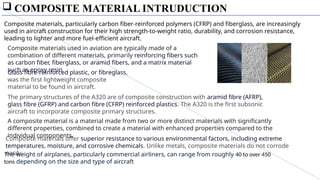
Composite materials used in aviation are typically made of a
combination of different materials, primarily reinforcing fibers such
as carbon fiber, fiberglass, or aramid fibers, and a matrix material
such as epoxy resin
Composite materials, particularly carbon fiber-reinforced polymers (CFRP) and fiberglass, are increasingly
used in aircraft construction for their high strength-to-weight ratio, durability, and corrosion resistance,
leading to lighter and more fuel-efficient aircraft.
Glass fibre-reinforced plastic, or fibreglass,
was the first lightweight composite
material to be found in aircraft.
The primary structures of the A320 are of composite construction with aramid fibre (AFRP),
glass fibre (GFRP) and carbon fibre (CFRP) reinforced plastics. The A320 is the first subsonic
aircraft to incorporate composite primary structures.
A composite material is a material made from two or more distinct materials with significantly
different properties, combined to create a material with enhanced properties compared to the
individual components.
Composite materials offer superior resistance to various environmental factors, including extreme
temperatures, moisture, and corrosive chemicals. Unlike metals, composite materials do not corrode
easily.
The weight of airplanes, particularly commercial airliners, can range from roughly 40 to over 450
tons depending on the size and type of aircraft
![SCHOOL OF AERONAUTICS (NEEMRANA)
[SEMINAR]
TOPIC
COMPOSITE MATERIAL-AIRCRAFT Mfg.
GUIDED BY:-
Prof. Gaurav Sardana
SUBMITTED BY:- SOMANSH KALRA
REG. NO :- 2085
Semester :- 4TH
Semister
Course:- B Tech Integrated](https://image.slidesharecdn.com/seminar-compositematerialaircraftmfg-250531103856-21cde13e/85/Seminar-Composite-Material-Aircraft-Mfg-pptx-1-320.jpg)
![SCHOOL OF AERONAUTICS (NEEMRANA)
[SEMINAR]
TOPIC
COMPOSITE MATERIAL-AIRCRAFT Mfg.
GUIDED BY:-
Prof. Gaurav Sardana
SUBMITTED BY:- SOMANSH KALRA
REG. NO :- 2085
Semester :- 4TH
Semister
Course:- B Tech Integrated](https://image.slidesharecdn.com/seminar-compositematerialaircraftmfg-250531103856-21cde13e/75/Seminar-Composite-Material-Aircraft-Mfg-pptx-1-2048.jpg)