WHAT IS A COMPOSITE
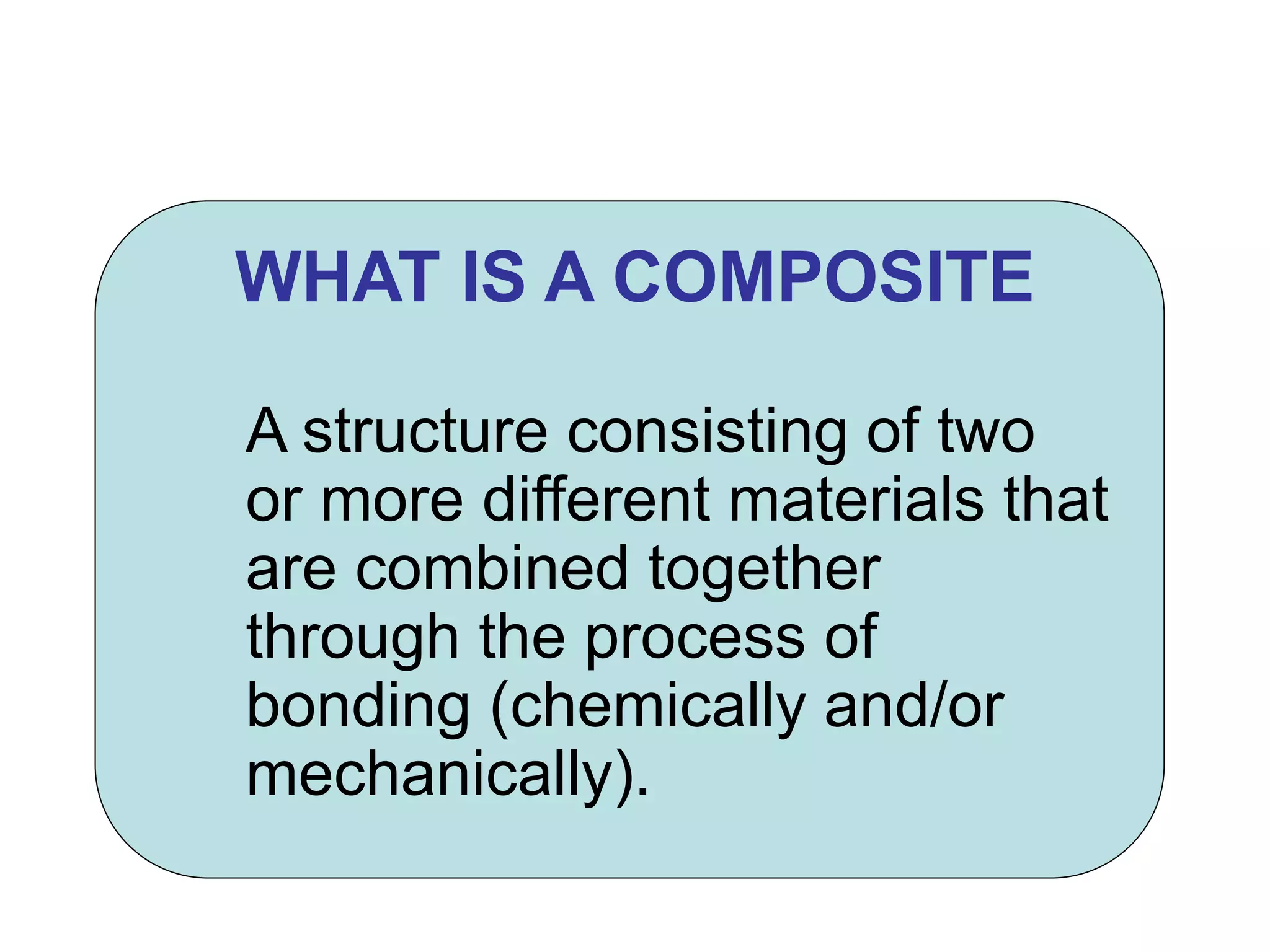
A structure consisting of two
or more different materials that
are combined together
through the process of
bonding (chemically and/or
mechanically).
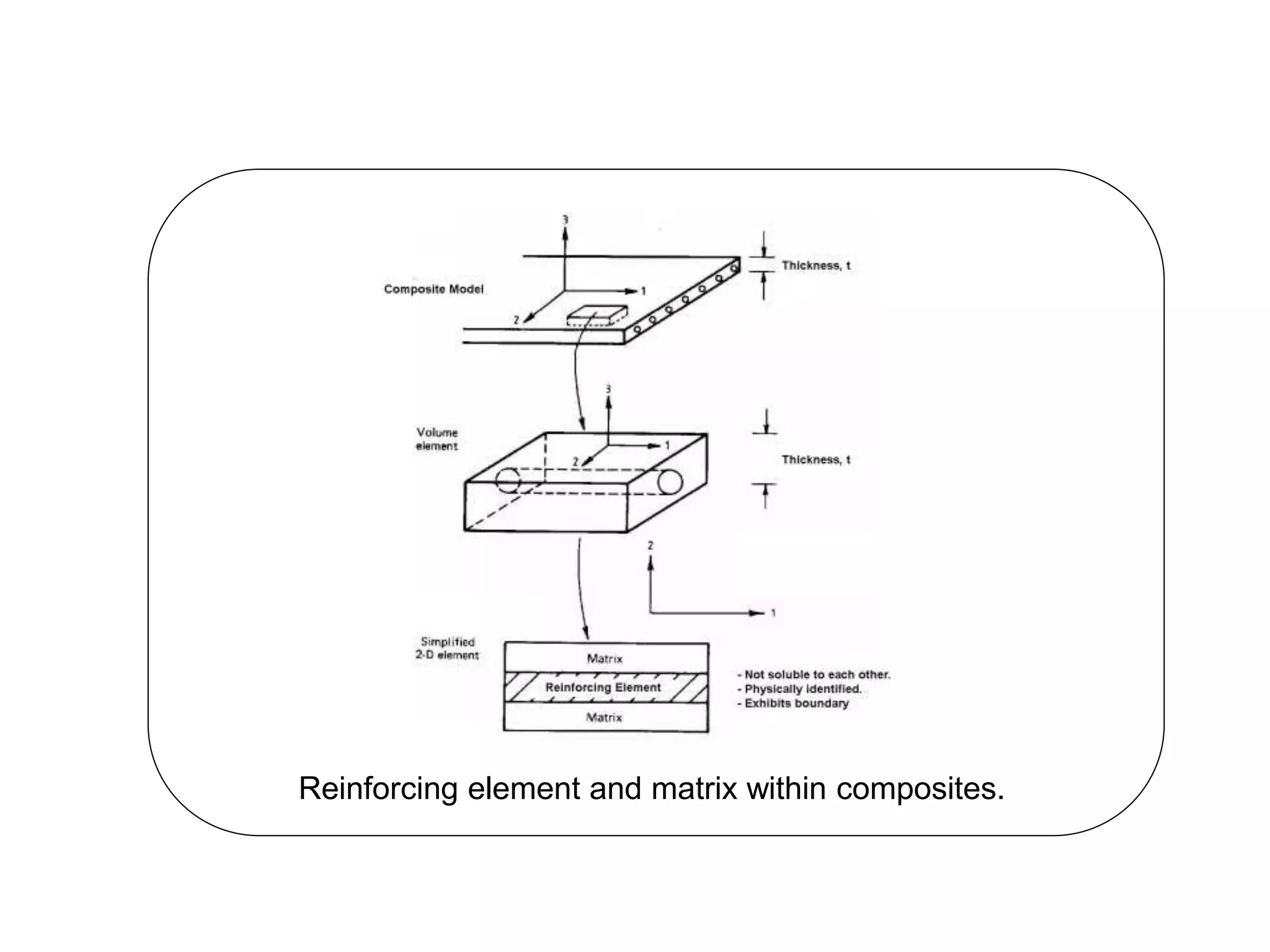
Reinforcing element and matrix within composites.
The Properties of a Composite Material
Depends on
1. the properties of the individual materials,
2. the relative amount (ratio) of materials,
3. the size, shape, and distribution of the materials,
4. the degree of the bonding between materials;
and
5. the orientation of the various materials.
THE CLASSES OF COMPOSITES
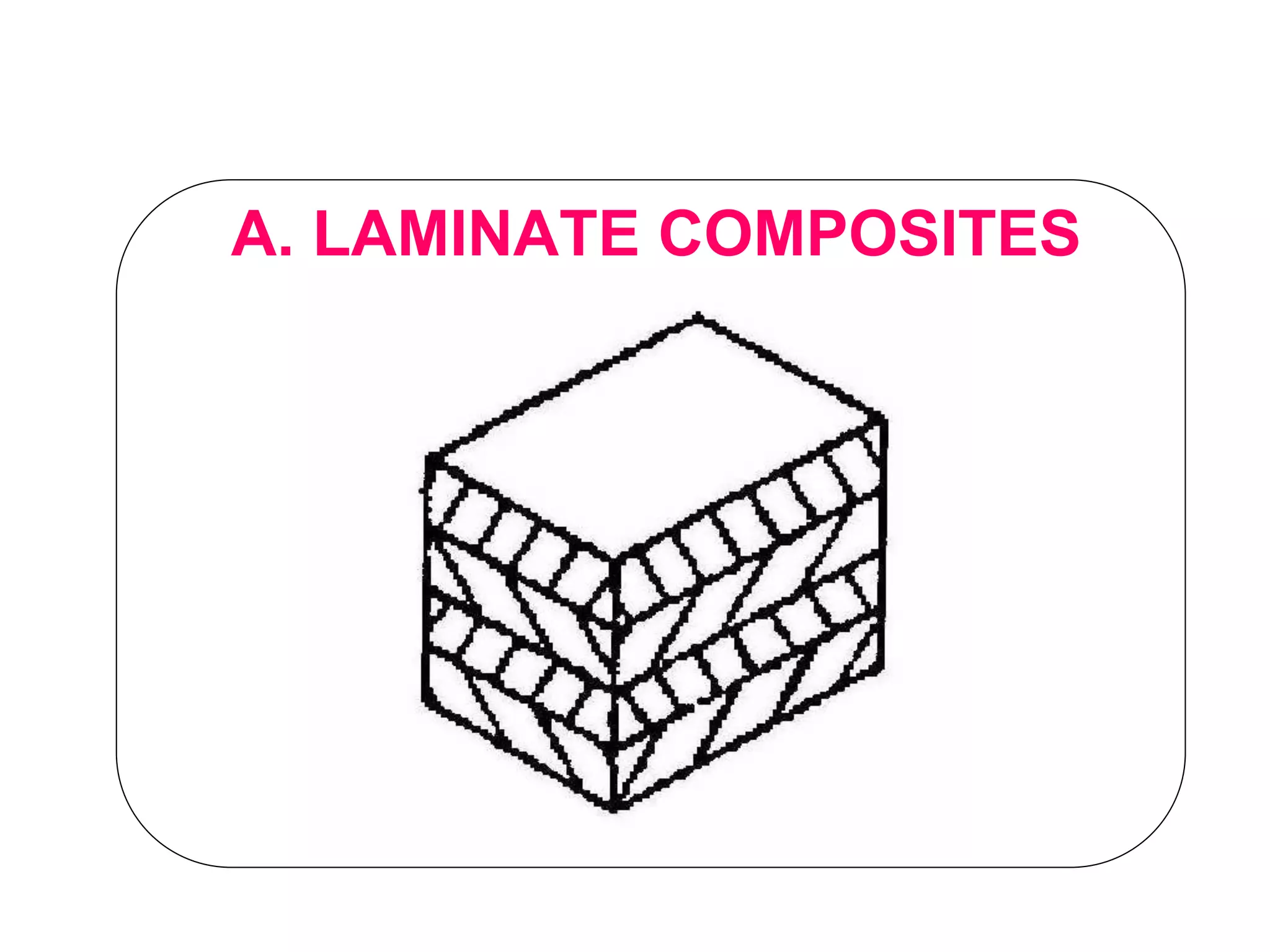
A. LAMINATE COMPOSITE
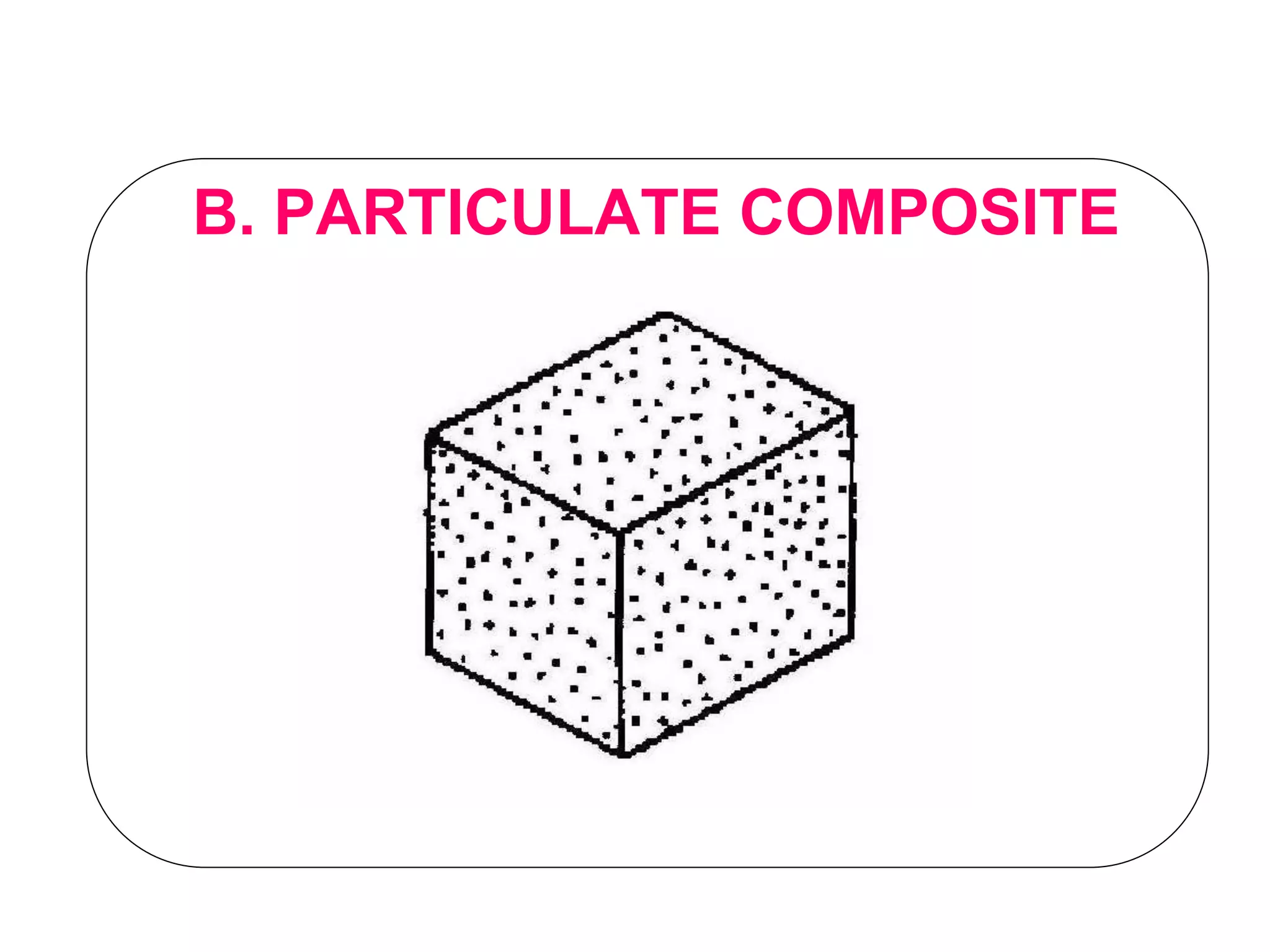
B. PARTICULATE COMPOSITE
C. FIBER REINFORCED COMPOSITE
A. LAMINATE COMPOSITES
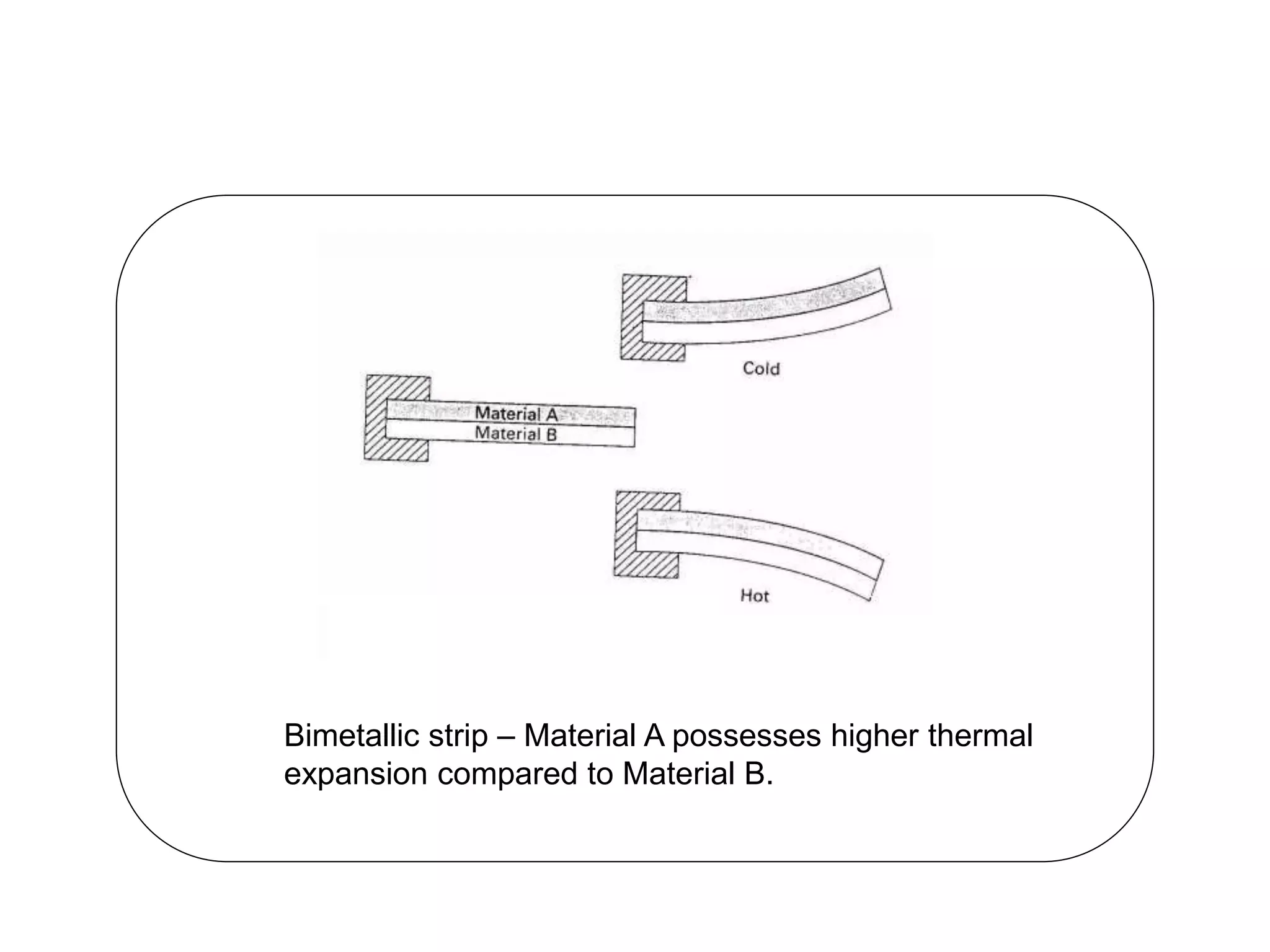
Bimetallic strip – Material A possesses higher thermal
expansion compared to Material B.
B. PARTICULATE COMPOSITE
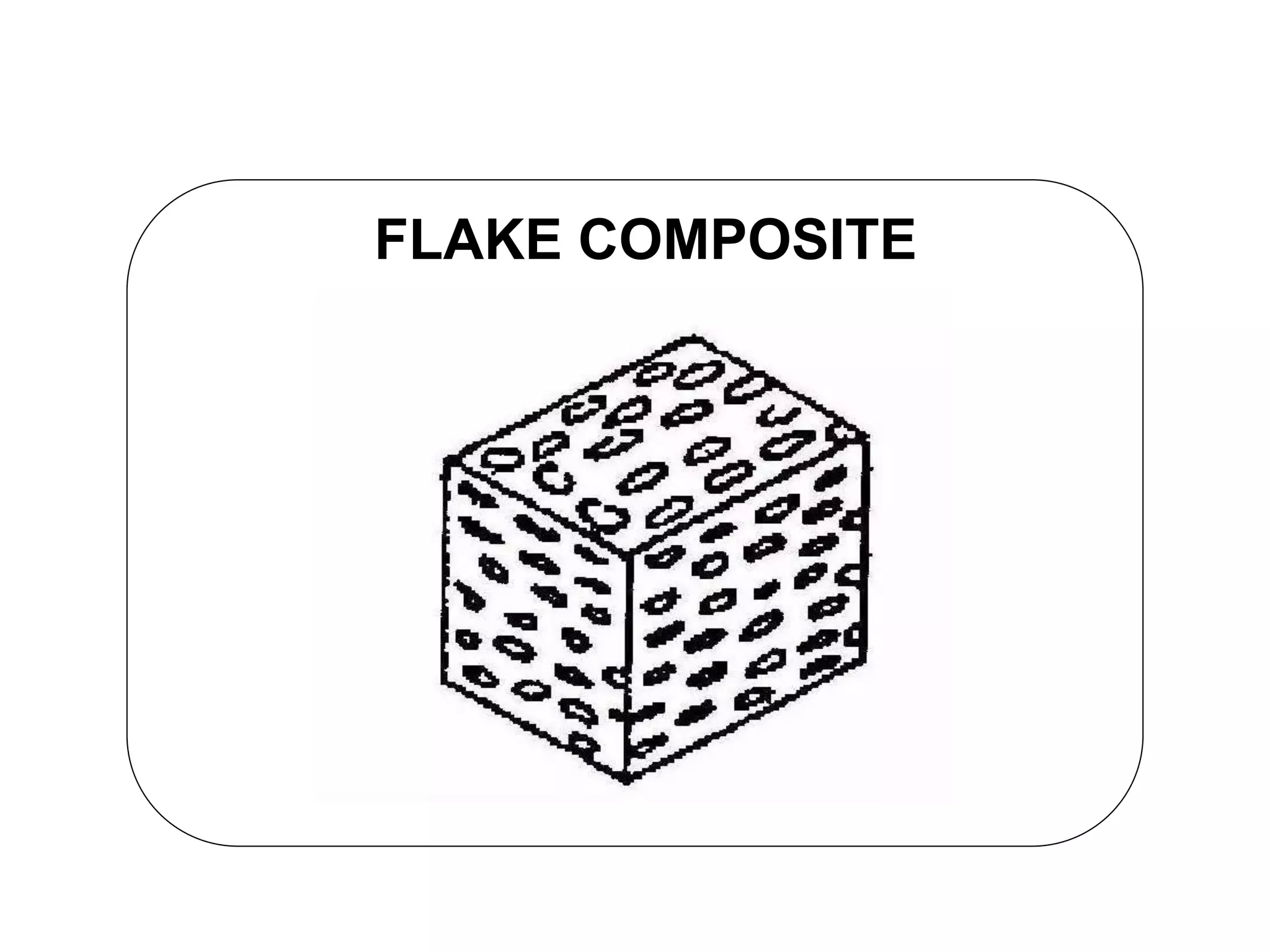
FLAKE COMPOSITE
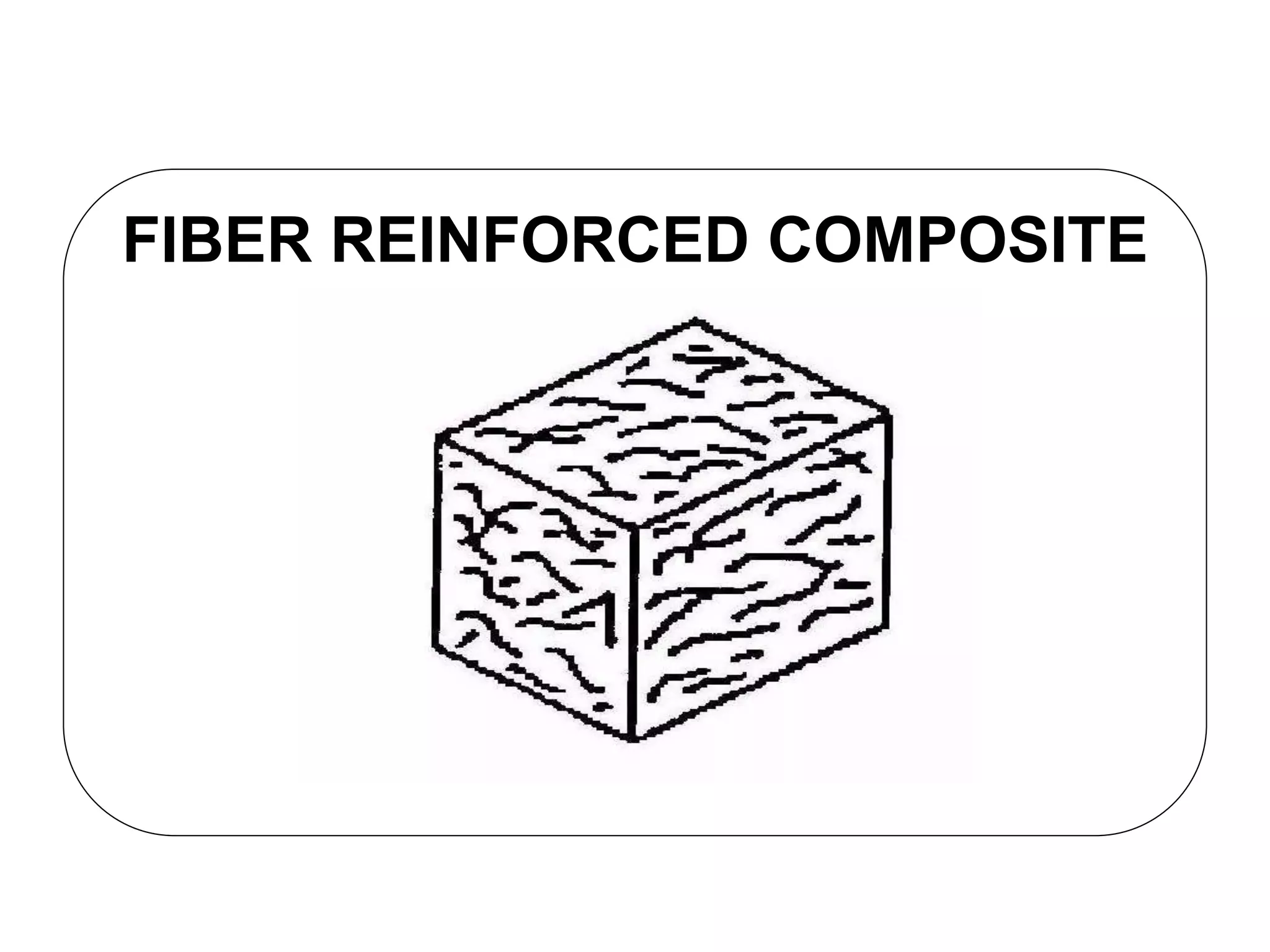
FIBER REINFORCED COMPOSITE
FILLERS
Fibrous Particulate
COMPOSITE
Fibrous Particulate
MATRIX
Ceramics
(Auminium- oxide, Carbon,
SiC, Silicon nitride, etc.)
Metallic ( Al, Al-alloys, Ti-alloys
Mg-alloys, etc.)
Polymeric
(Thermoplastic and thermosetting)
Type of Advanced Composite
Material:
a) Fiber Reinforced Plastic (FRP)
b) Metal-Matrix Composites(MMC)
c) Carbon-Carbon ompositesC&C)
d) Ceramic-Matrix Composites (CMC)
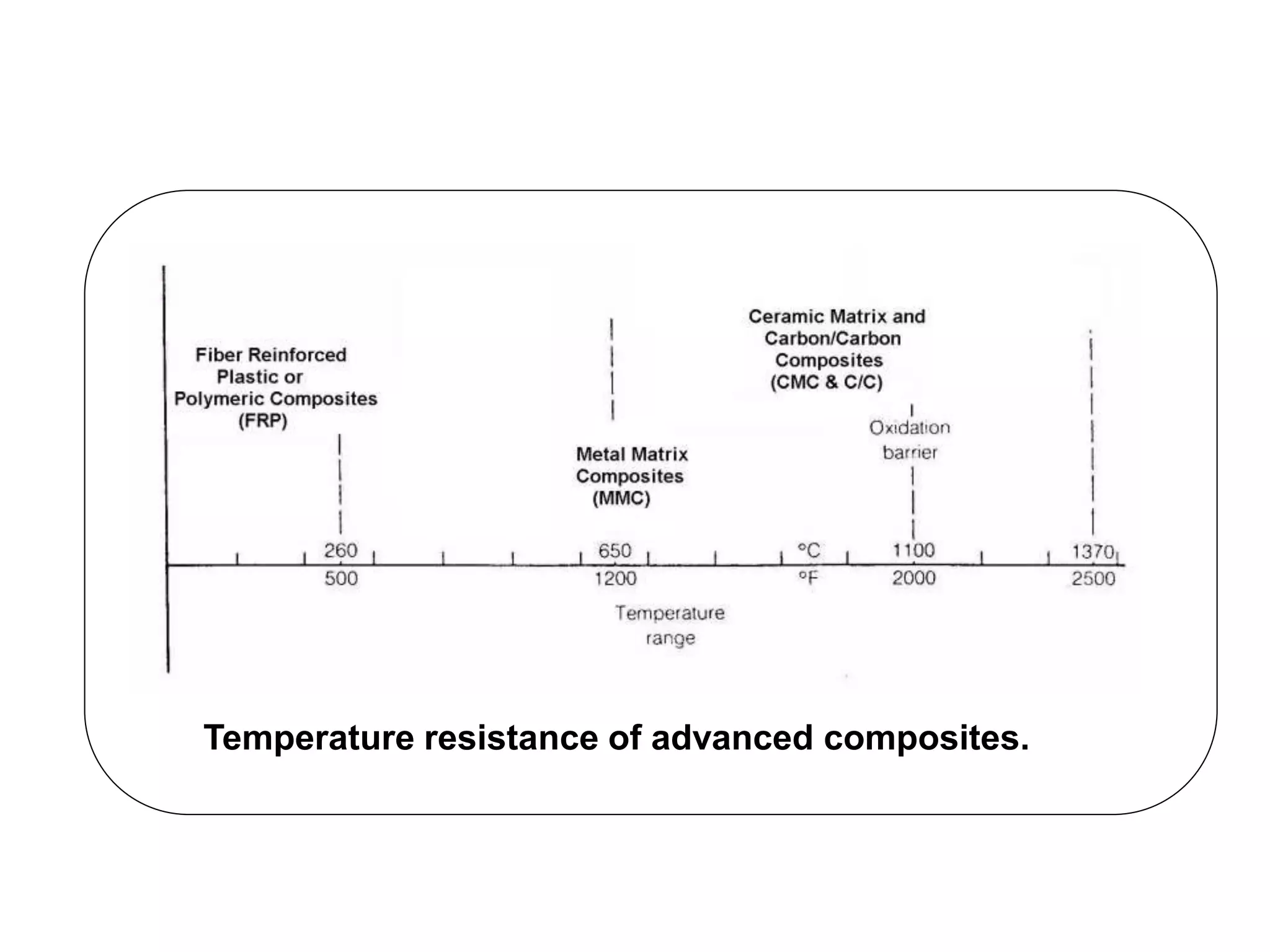
Temperature resistance of advanced composites.
I. Fiber reinforced Plastic (FRP)
• It is the most popular used in aviation industry due to its
high strength and/or stiffness to weight ratio.
• It is consist resin material such as epoxy, and high
strength, high modulus fibers such as Graphite,
Fiberglass and Kevlar.
• High strength and stiffness can be tailored (strength
placed in desired orientation) with tremendous weight
reduction. Typical composite structure of this type will
have 20% weight reduction and 30% stronger than
aluminum structure.
• Thermal expansion can be designed so low, or even
negative.
• Maximum service temperature of about 315 OC (600 OF)
because the matrix is Polymer type.
II. Metal Matrix Composites (MMC)
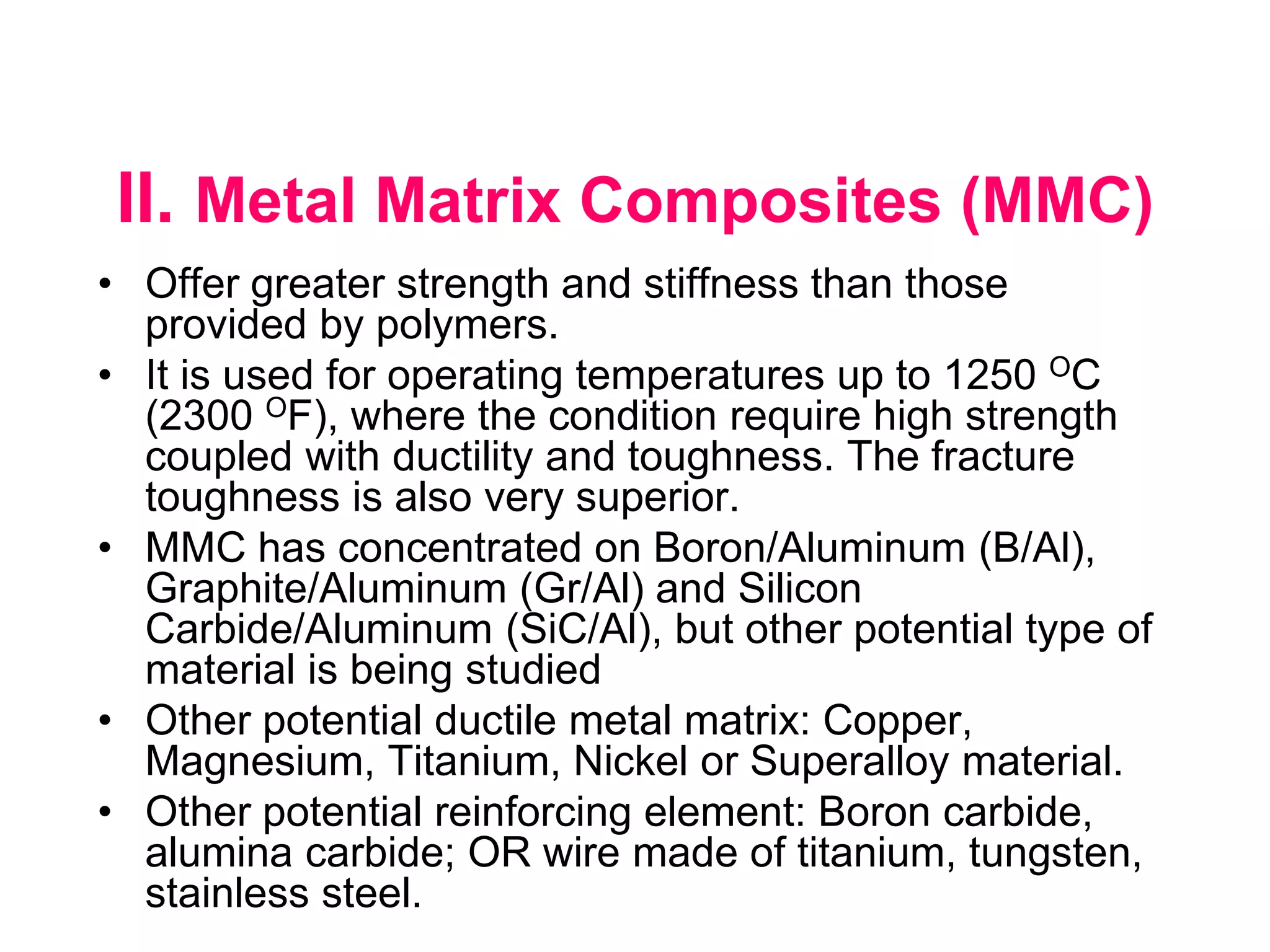
• Offer greater strength and stiffness than those
provided by polymers.
• It is used for operating temperatures up to 1250 OC
(2300 OF), where the condition require high strength
coupled with ductility and toughness. The fracture
toughness is also very superior.
• MMC has concentrated on Boron/Aluminum (B/Al),
Graphite/Aluminum (Gr/Al) and Silicon
Carbide/Aluminum (SiC/Al), but other potential type of
material is being studied
• Other potential ductile metal matrix: Copper,
Magnesium, Titanium, Nickel or Superalloy material.
• Other potential reinforcing element: Boron carbide,
alumina carbide; OR wire made of titanium, tungsten,
stainless steel.
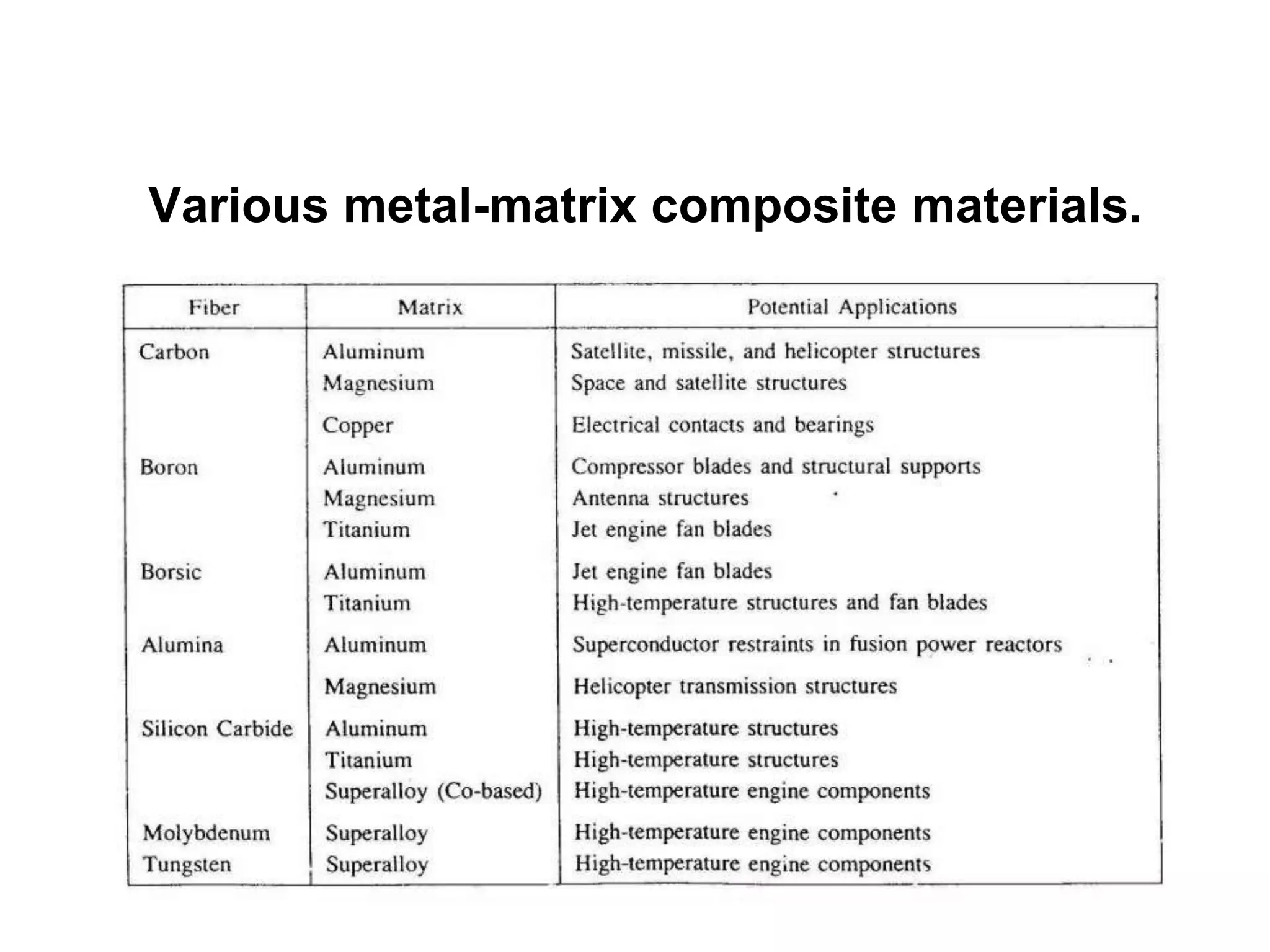
Various metal-matrix composite materials.
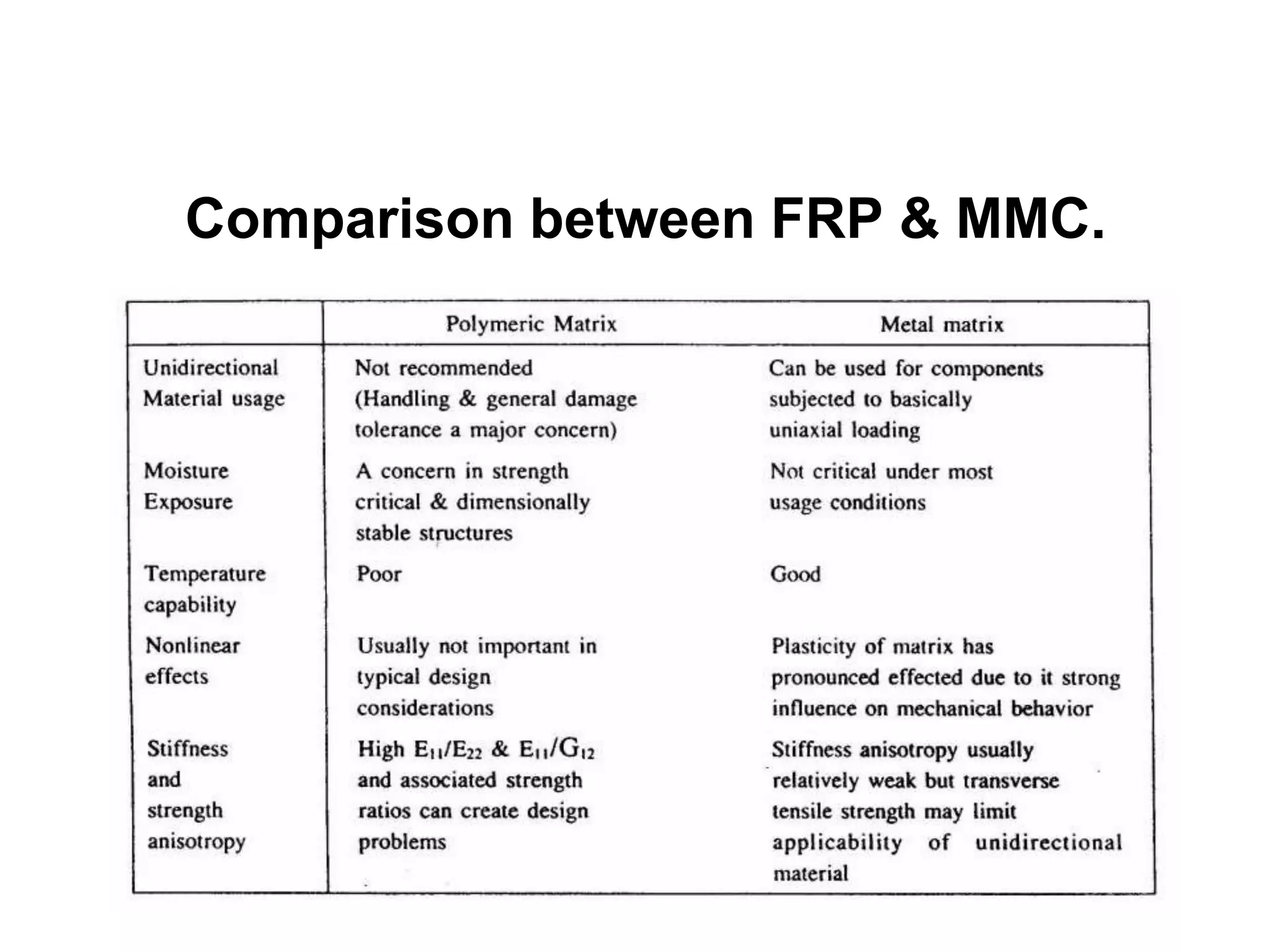
Comparison between FRP & MMC.
III. Carbon Carbon Matrix (C&C)
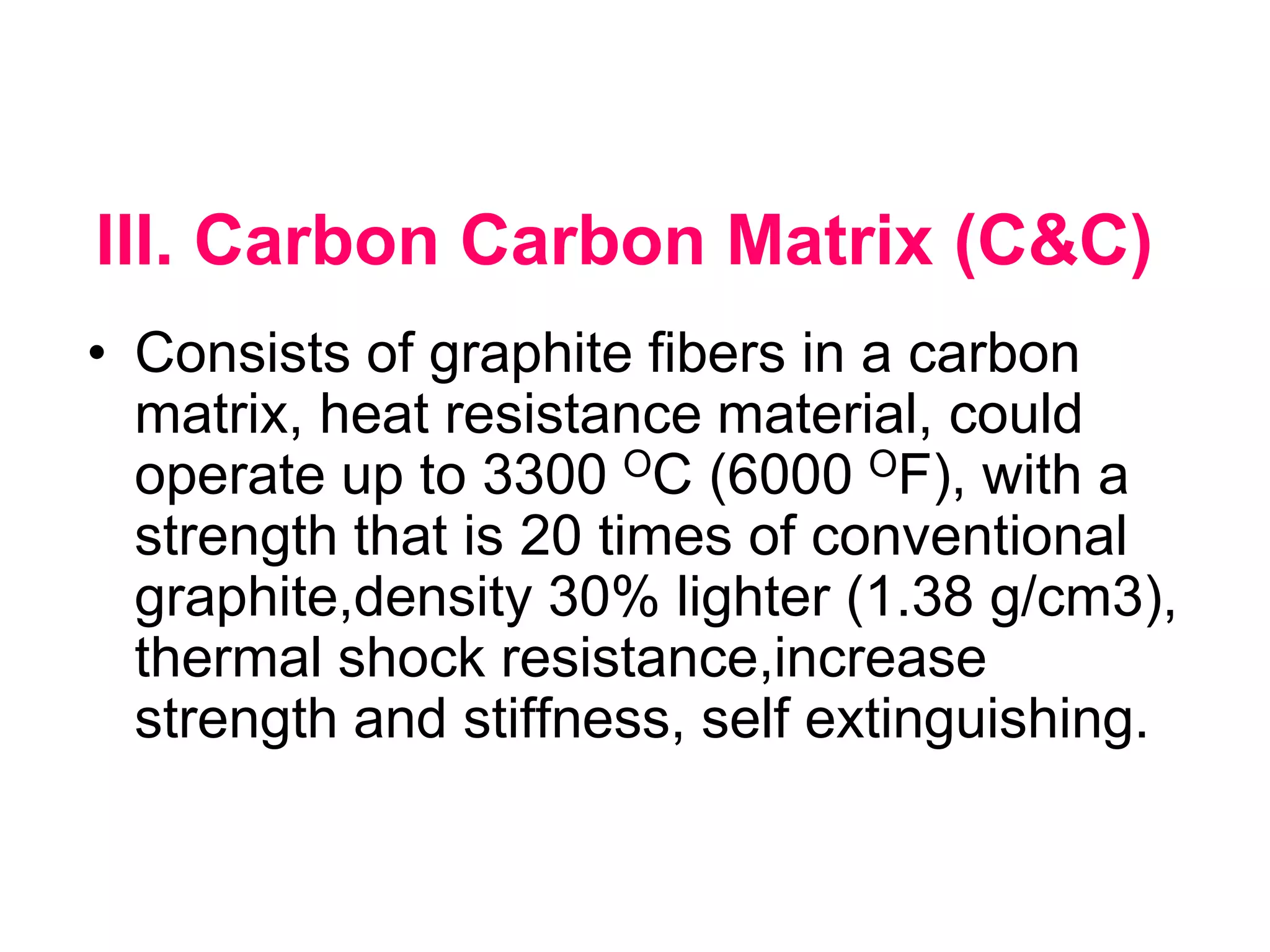
• Consists of graphite fibers in a carbon
matrix, heat resistance material, could
operate up to 3300 OC (6000 OF), with a
strength that is 20 times of conventional
graphite,density 30% lighter (1.38 g/cm3),
thermal shock resistance,increase
strength and stiffness, self extinguishing.
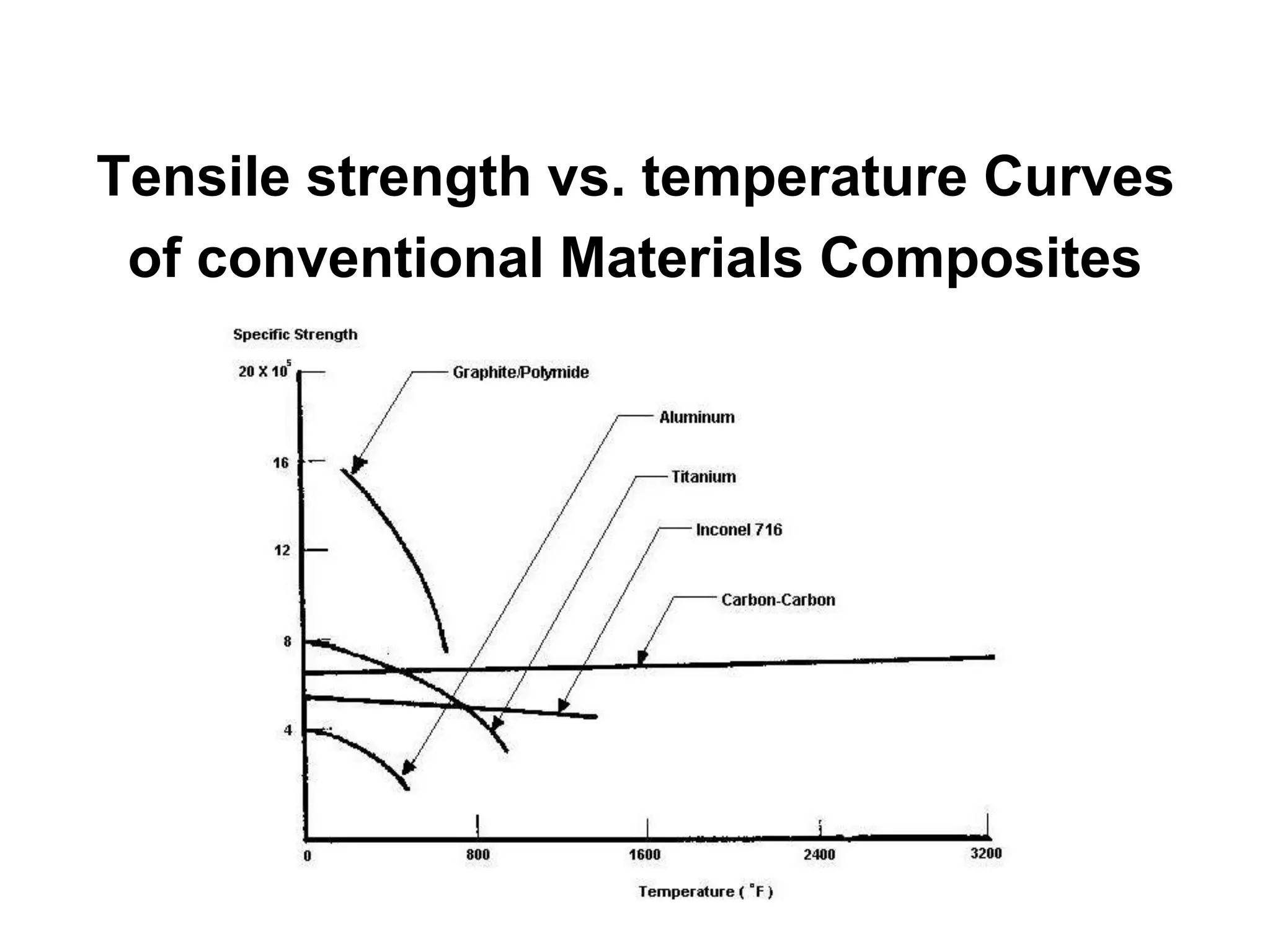
Tensile strength vs. temperature Curves
of conventional Materials Composites
IV. Ceramic Matrix Composites
(CMC)
• Lightweight, high temperature strength,
and good dimensional and environmental
stability (excellent resistance to oxidation).
• Unfortunately, they are very expensive
and brittle.
• Ceramic have been used on braking
systems on commercial and military
aircraft.
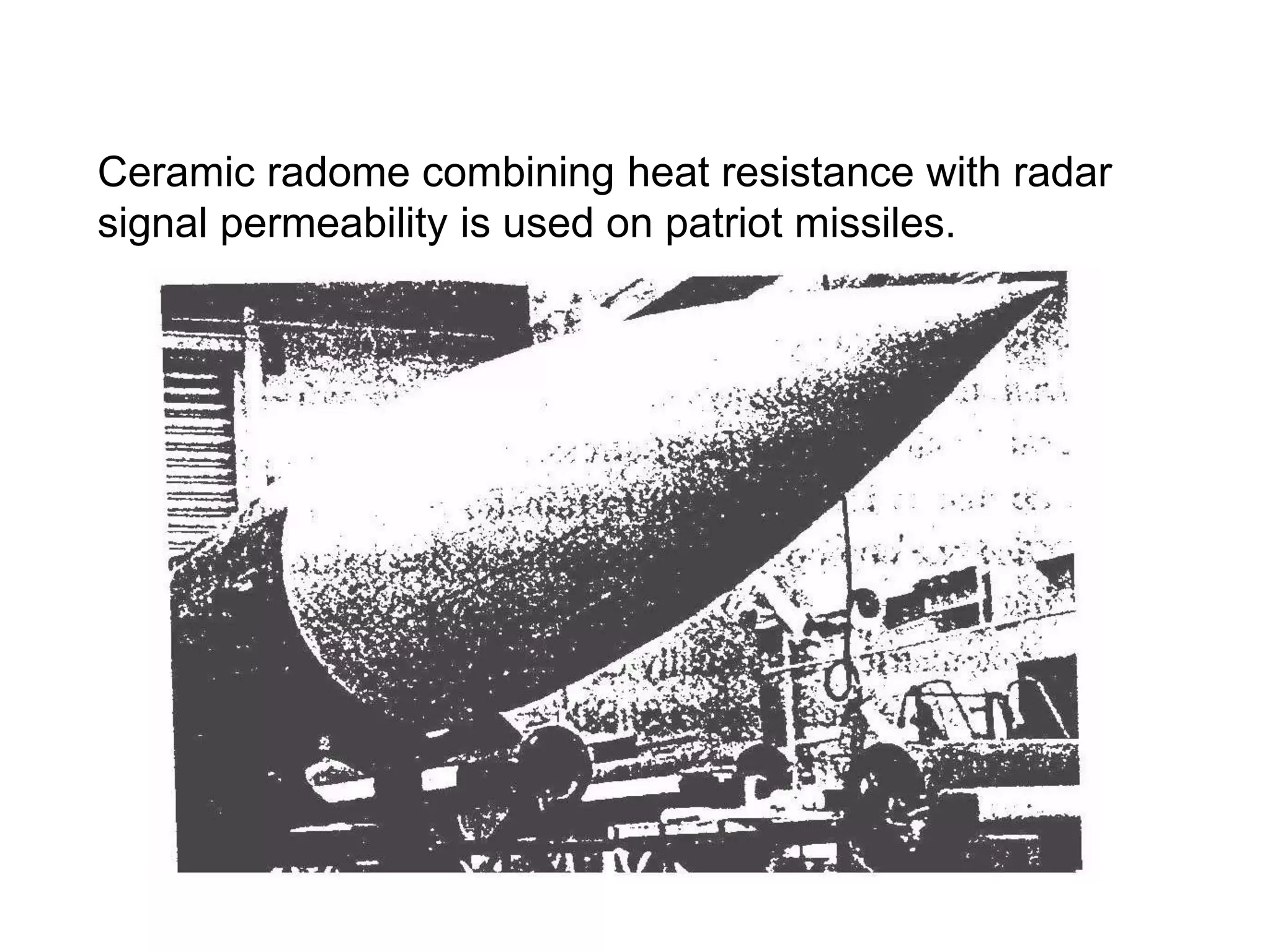
Ceramic radome combining heat resistance with radar
signal permeability is used on patriot missiles.
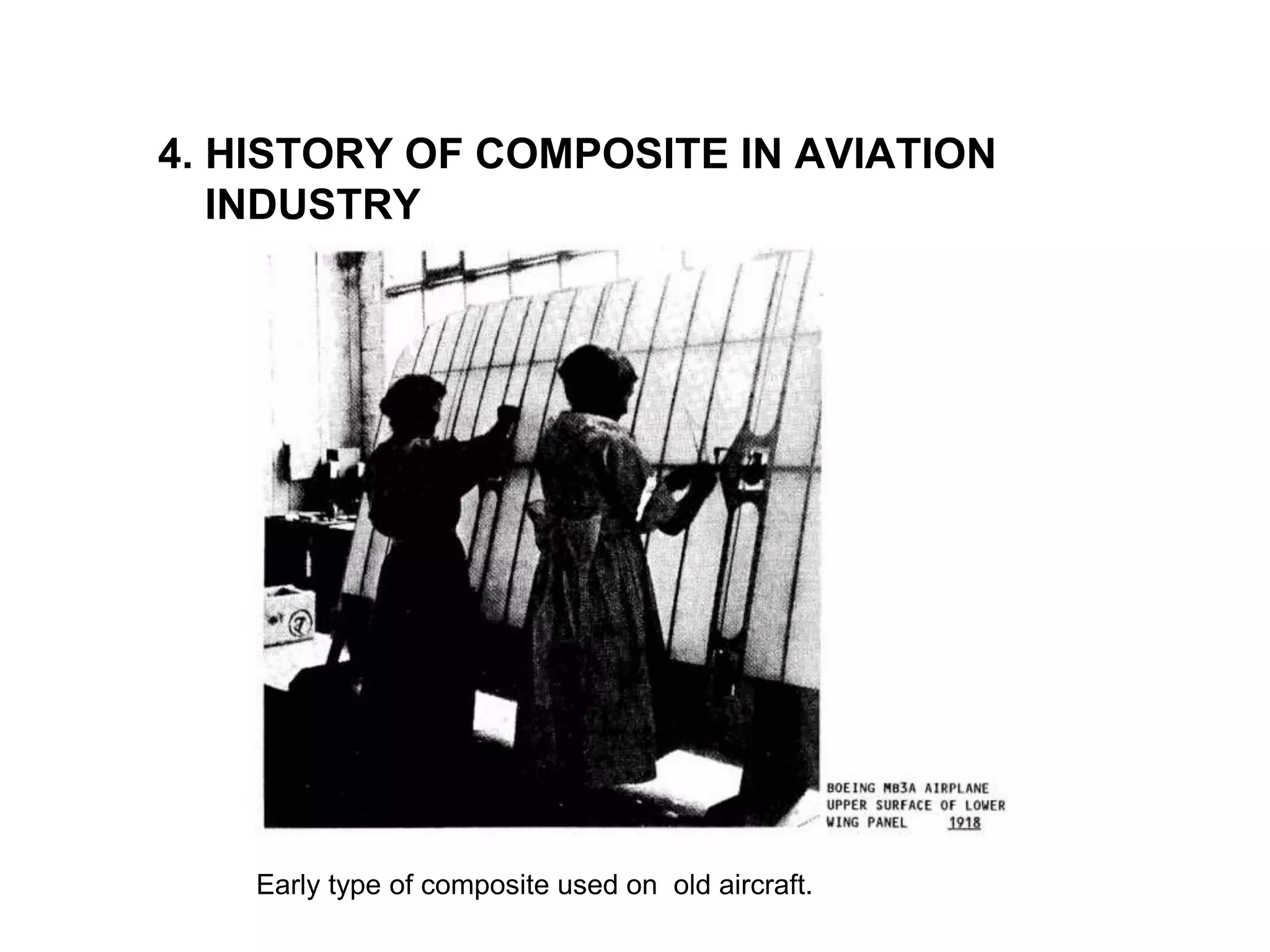
4. HISTORY OF COMPOSITE IN AVIATION
INDUSTRY
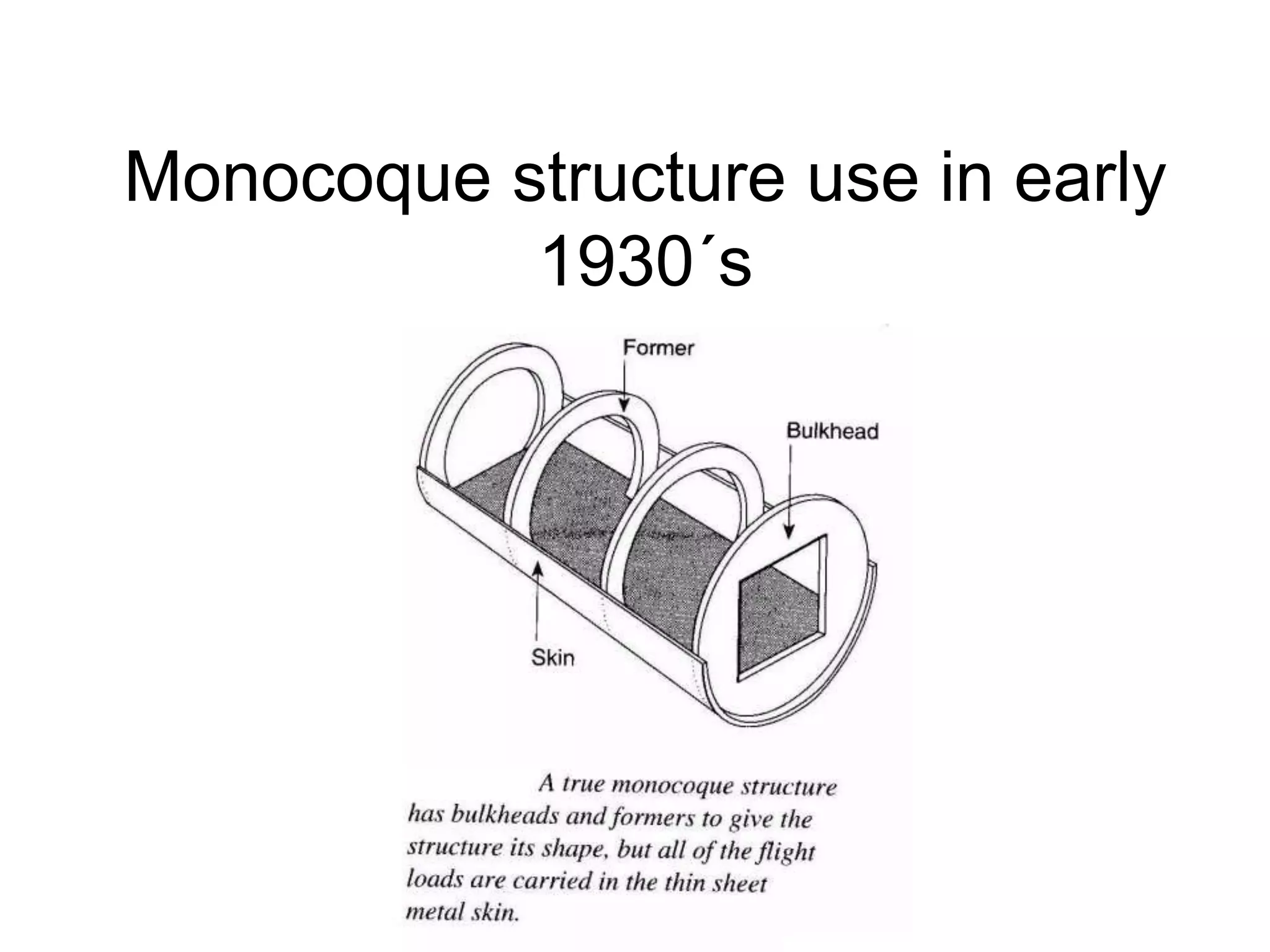
Early type of composite used on old aircraft.
Monocoque structure use in early
1930´s
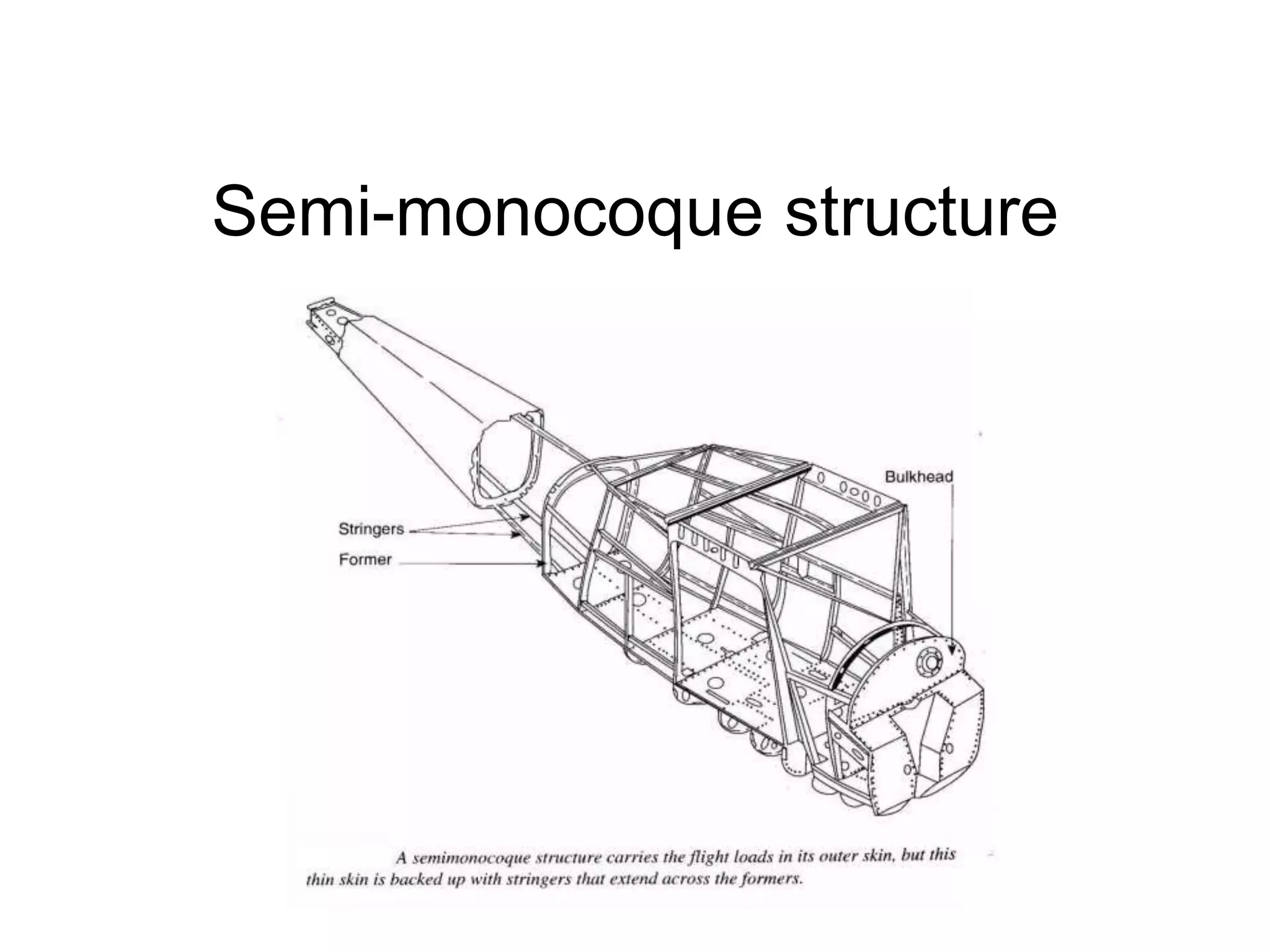
Semi-monocoque structure
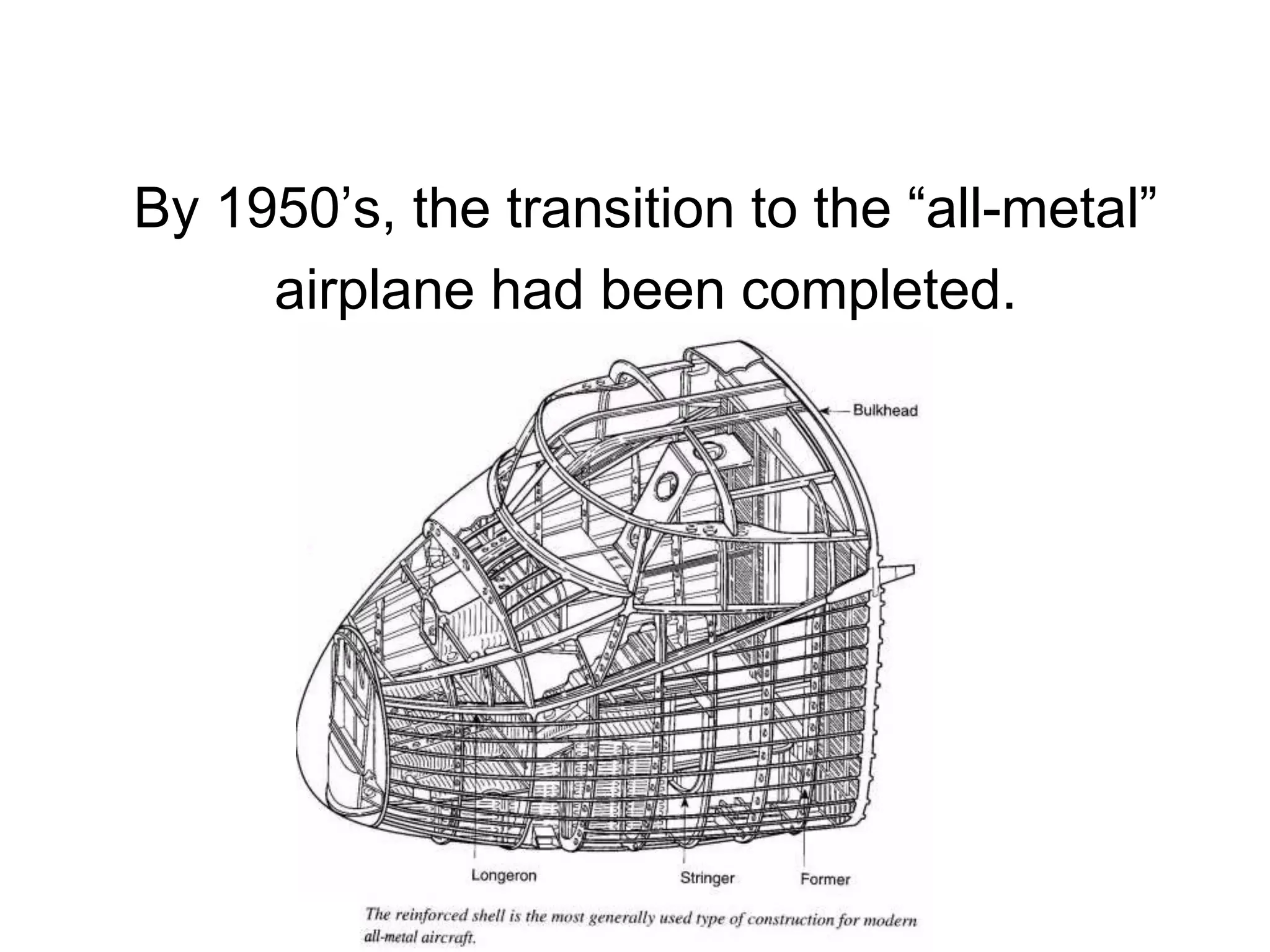
By 1950’s, the transition to the “all-metal”
airplane had been completed.
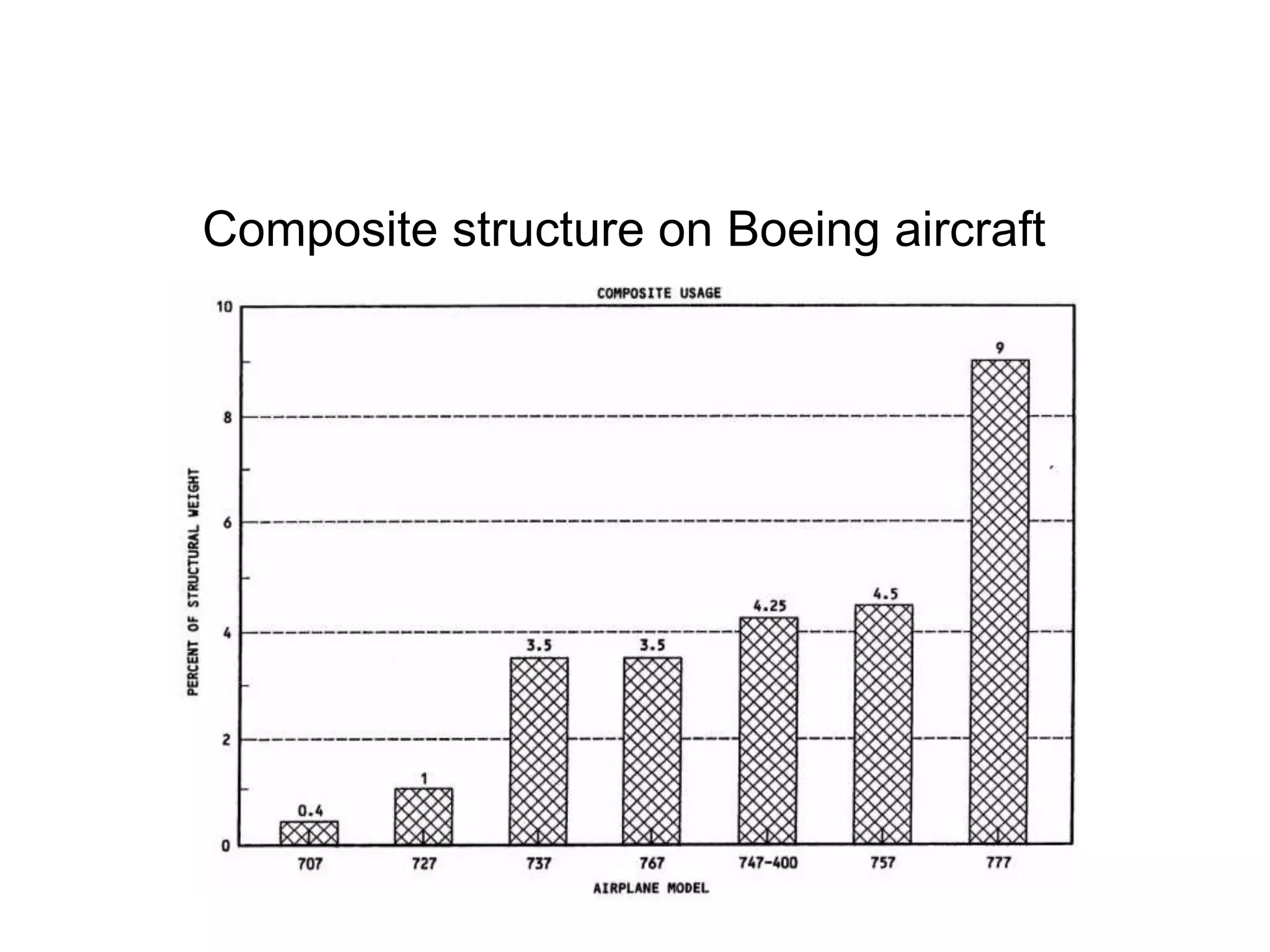
Composite structure on Boeing aircraft
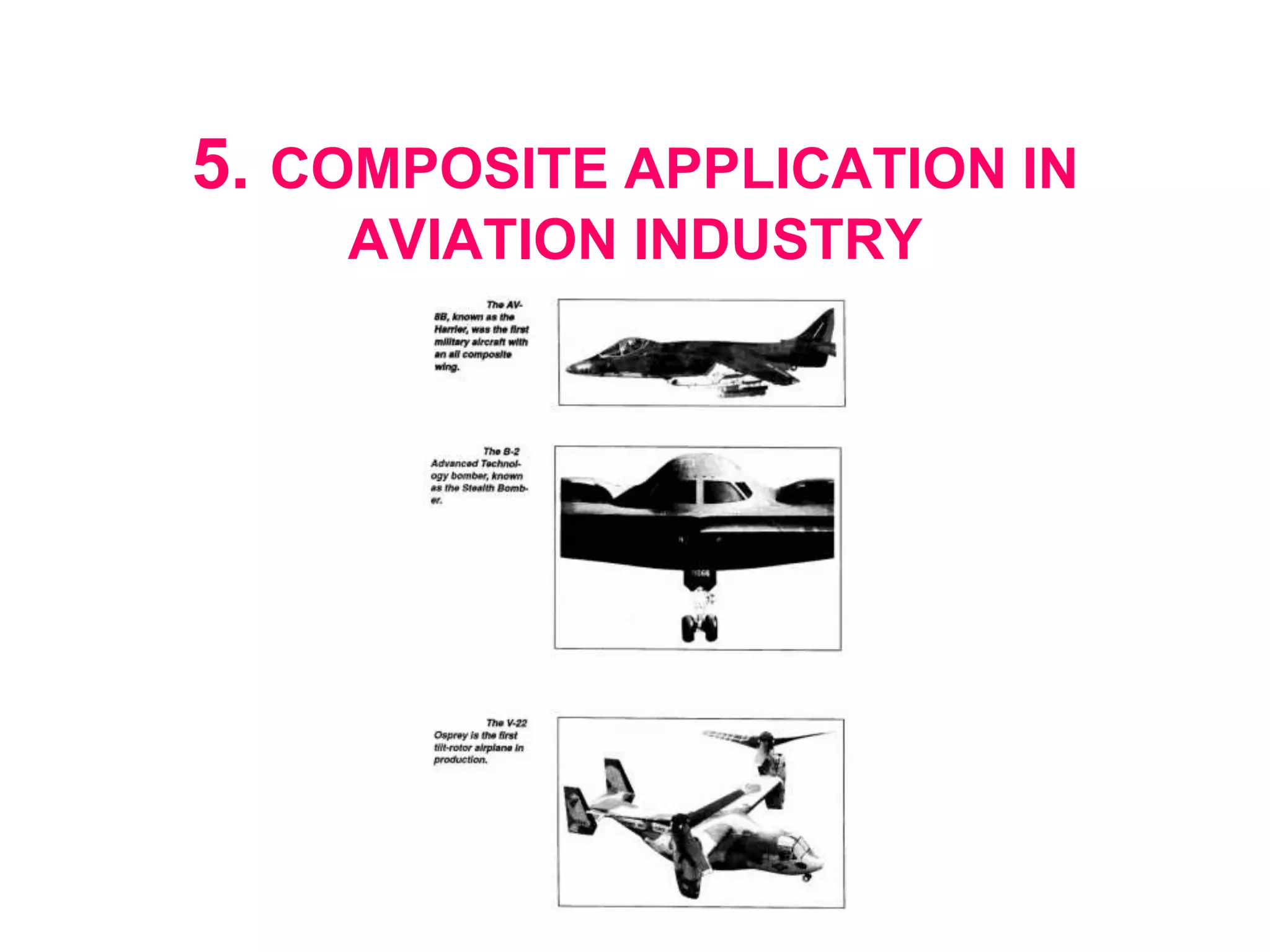
5. COMPOSITE APPLICATION IN
AVIATION INDUSTRY
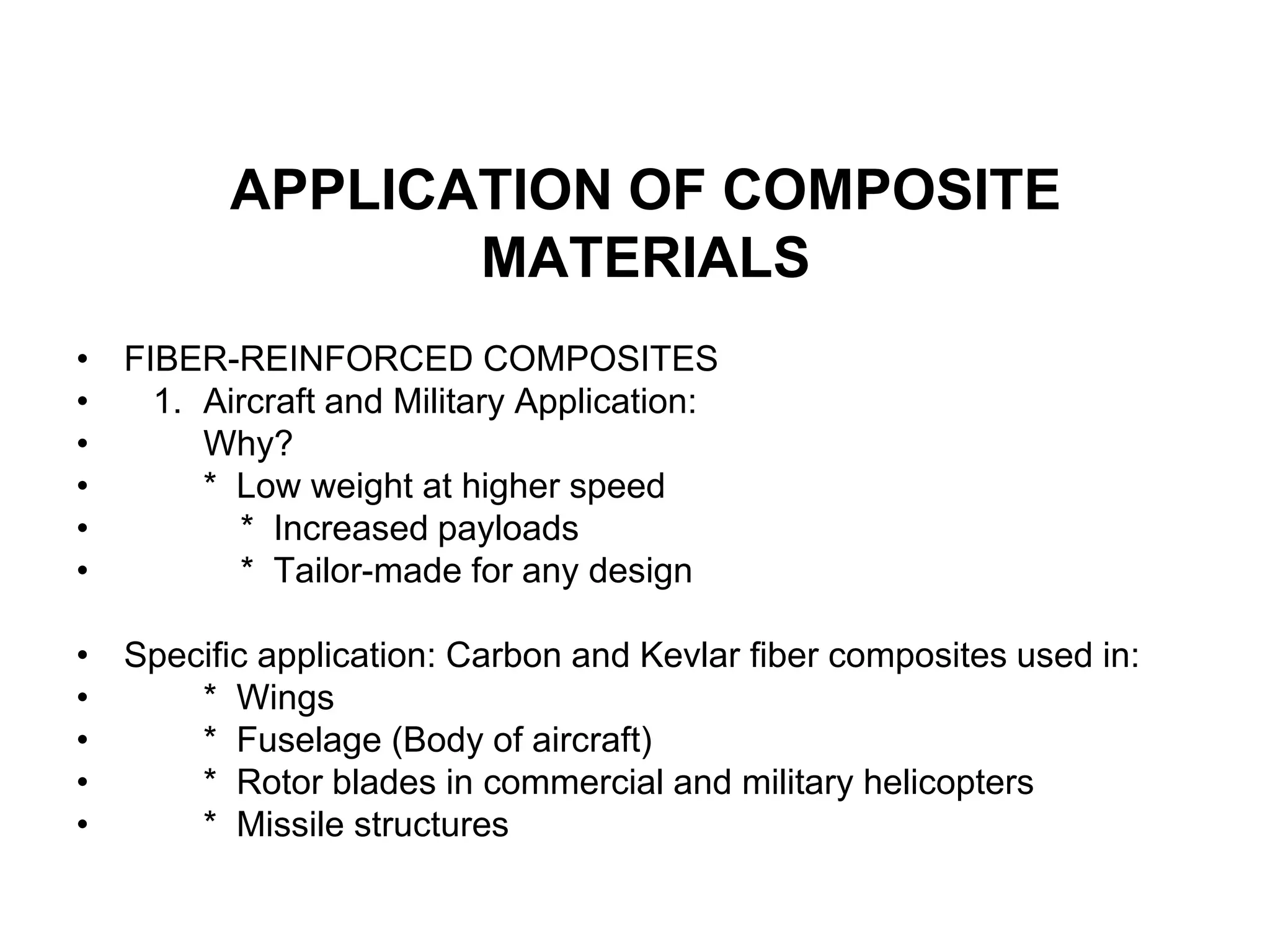
APPLICATION OF COMPOSITE
MATERIALS
• FIBER-REINFORCED COMPOSITES
• 1. Aircraft and Military Application:
• Why?
• * Low weight at higher speed
• * Increased payloads
• * Tailor-made for any design
• Specific application: Carbon and Kevlar fiber composites used in:
• * Wings
• * Fuselage (Body of aircraft)
• * Rotor blades in commercial and military helicopters
• * Missile structures
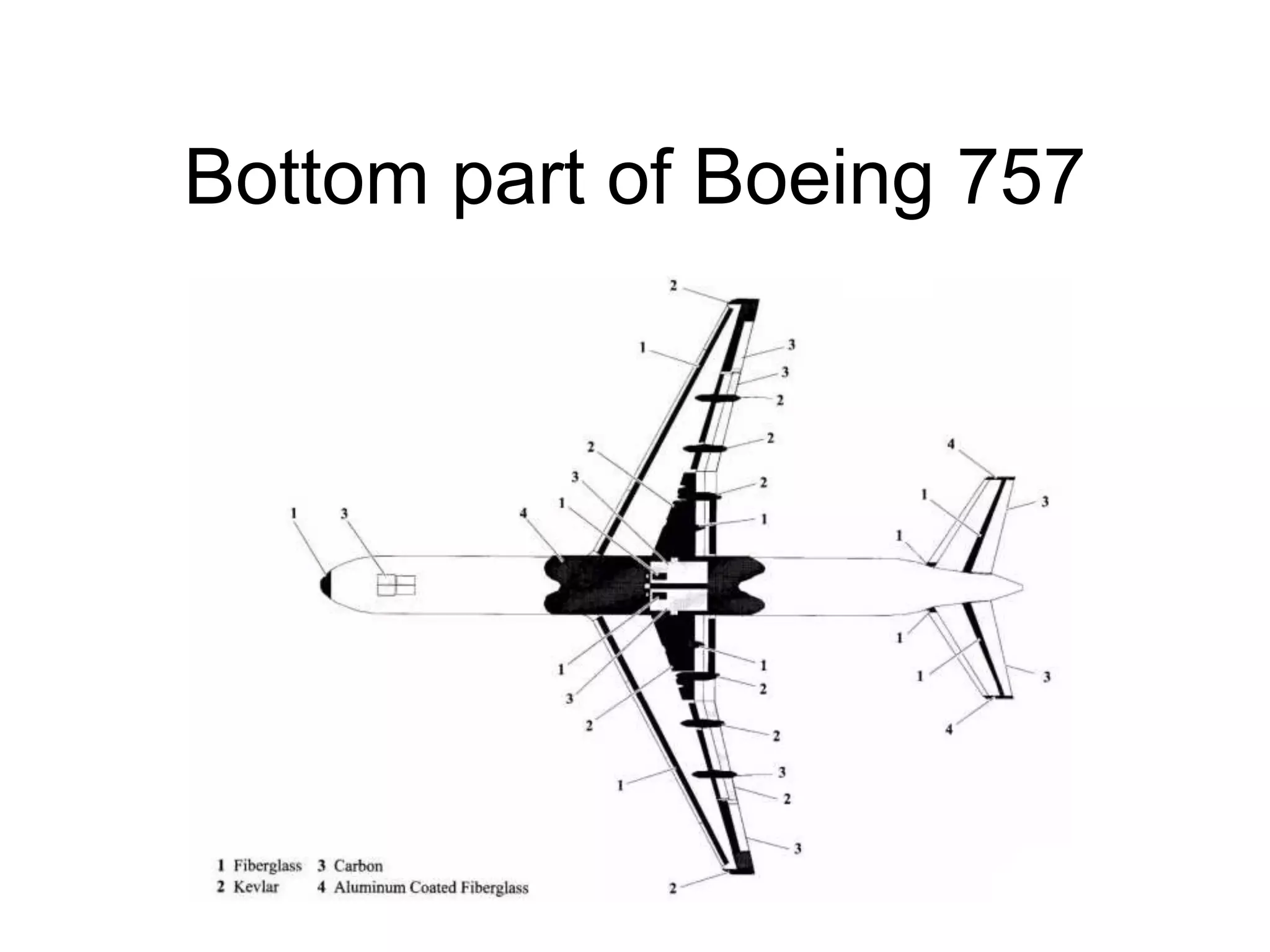
Bottom part of Boeing 757
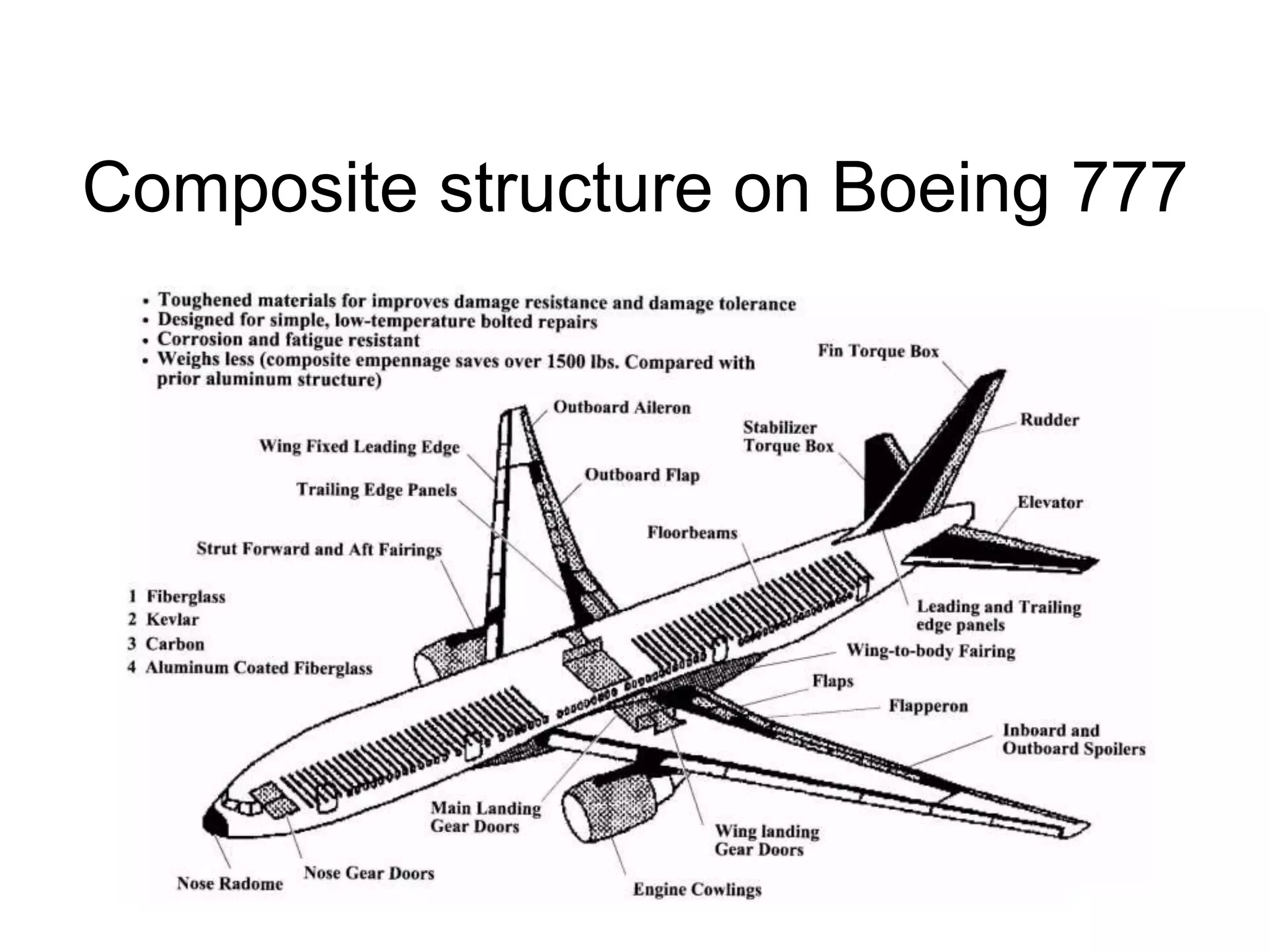
Composite structure on Boeing 777
30
MALAYSIAN INSTITUTE OF AVIATION TECHNOLOGY
CO-2100 COMPOSITE IN AVIATION INDUSTRY
(AVIN)
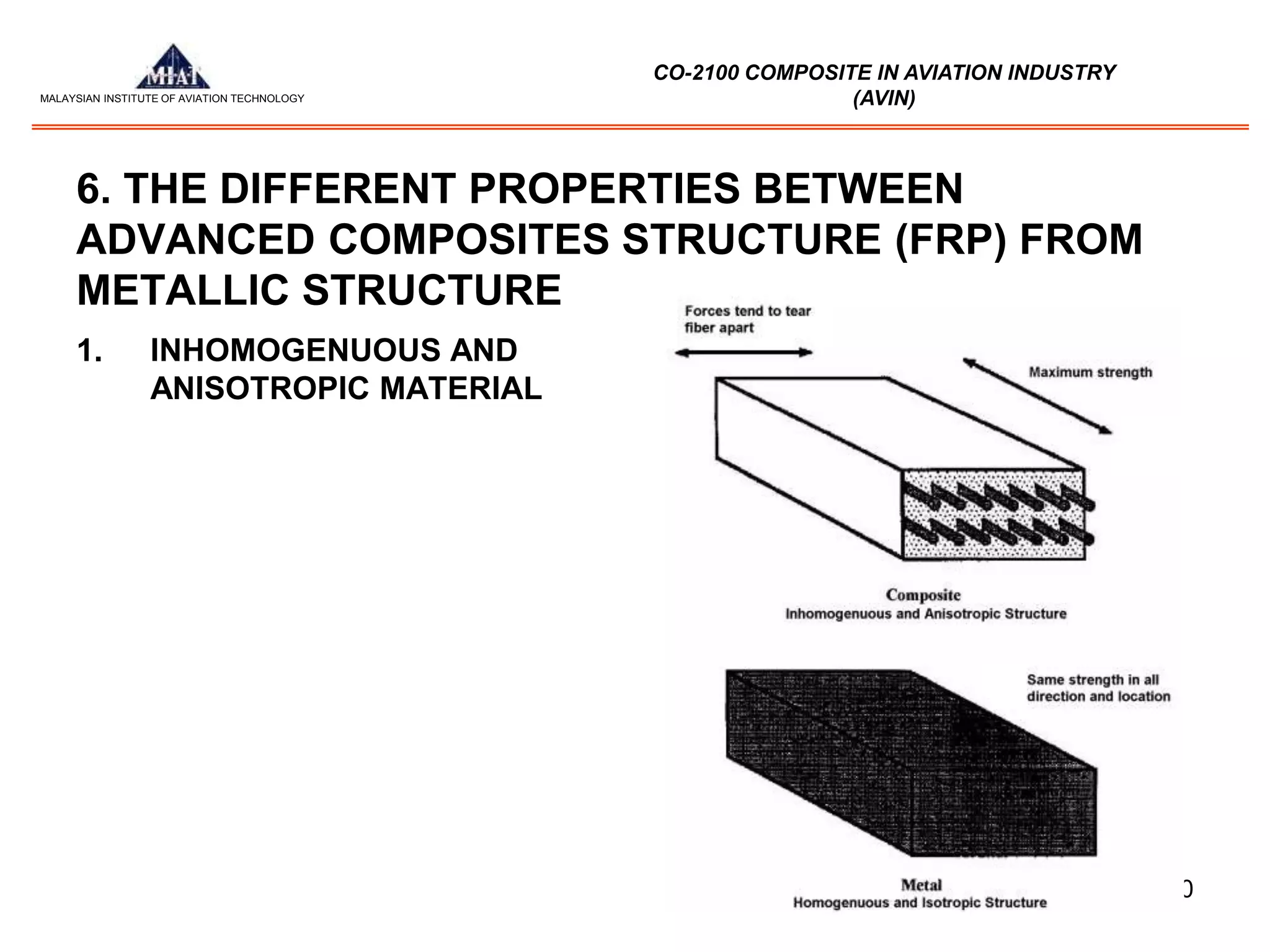
6. THE DIFFERENT PROPERTIES BETWEEN
ADVANCED COMPOSITES STRUCTURE (FRP) FROM
METALLIC STRUCTURE
1. INHOMOGENUOUS AND
ANISOTROPIC MATERIAL
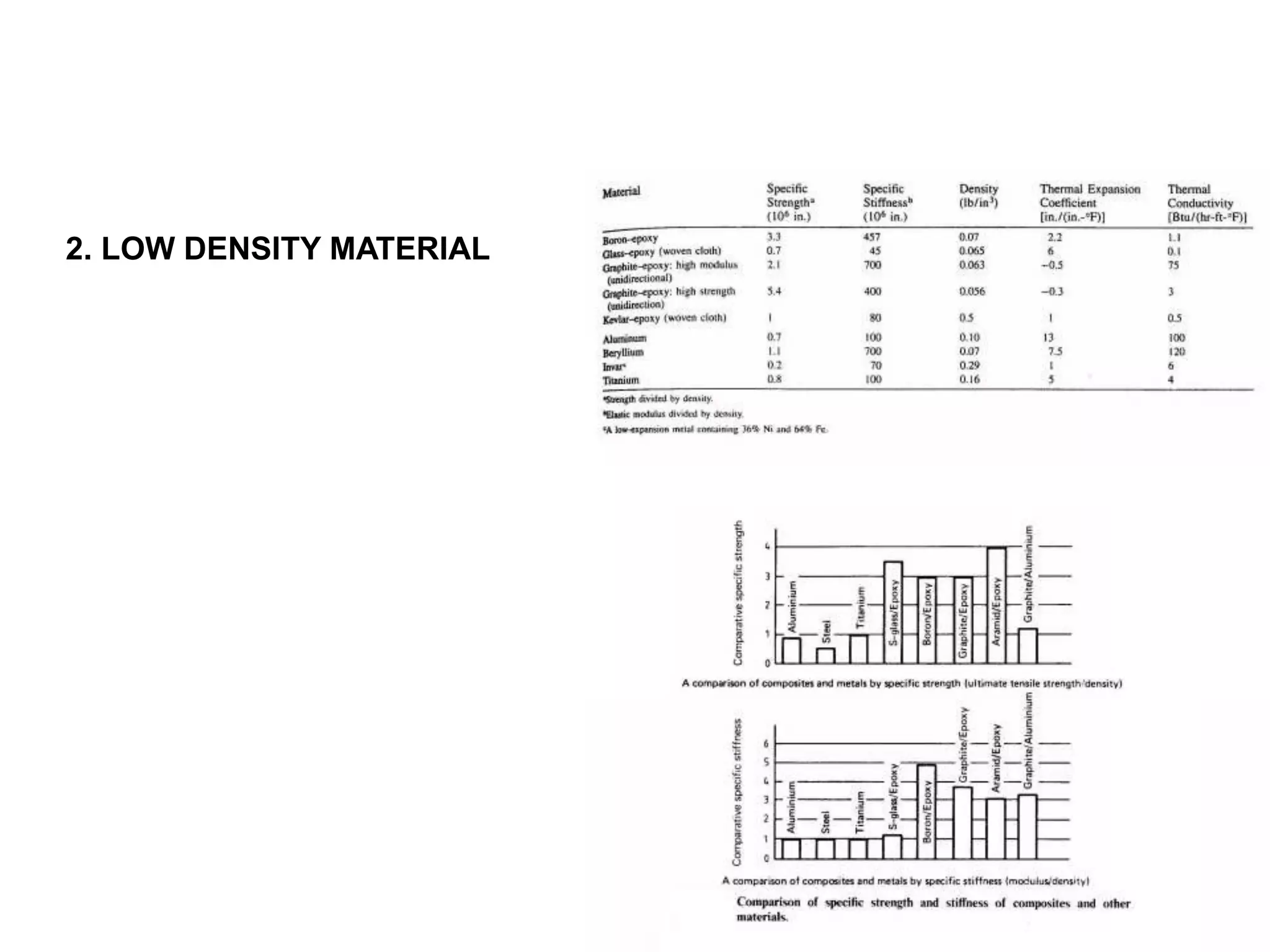
2. LOW DENSITY MATERIAL
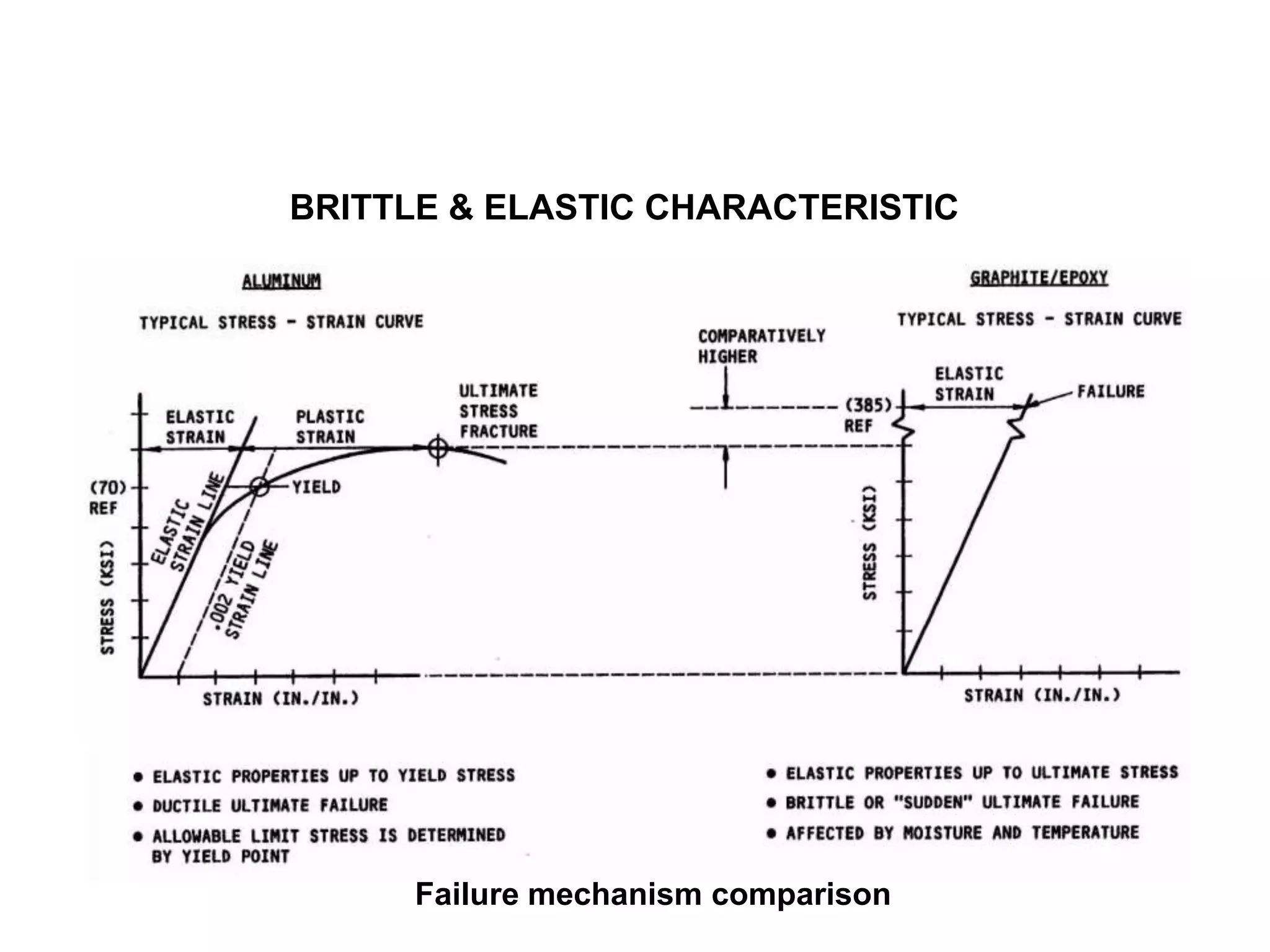
BRITTLE & ELASTIC CHARACTERISTIC
Failure mechanism comparison
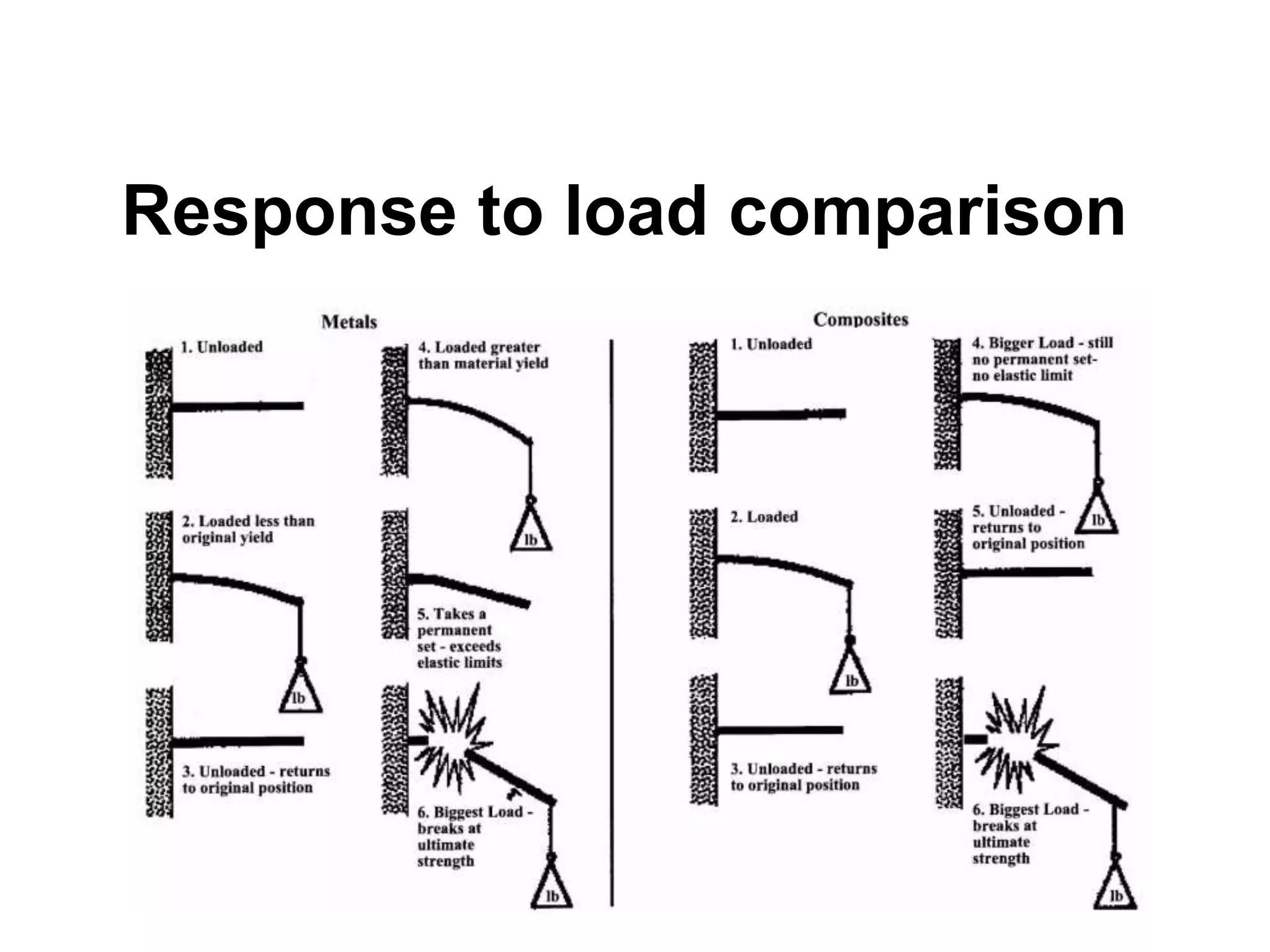
Response to load comparison
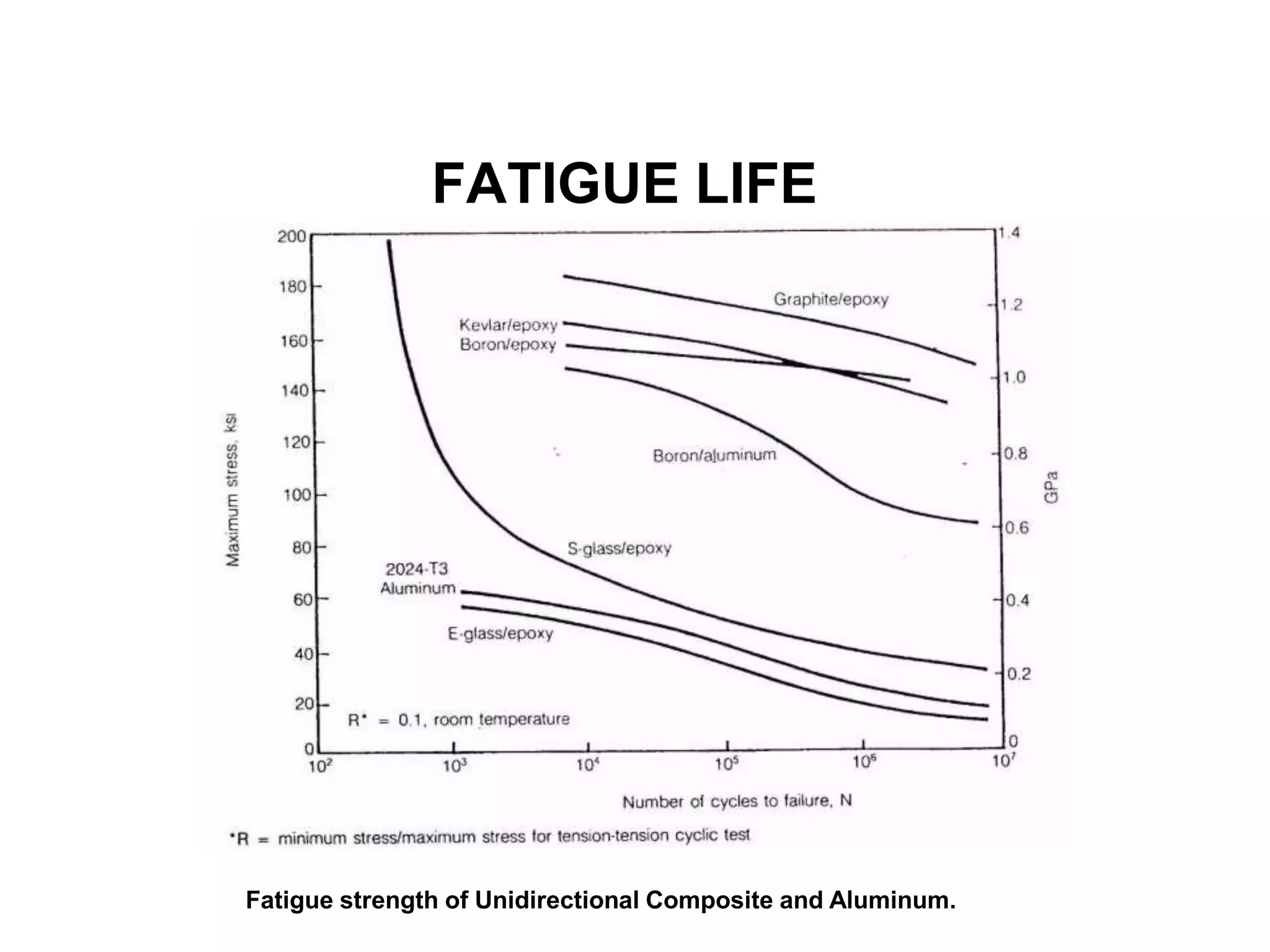
FATIGUE LIFE
Fatigue strength of Unidirectional Composite and Aluminum.
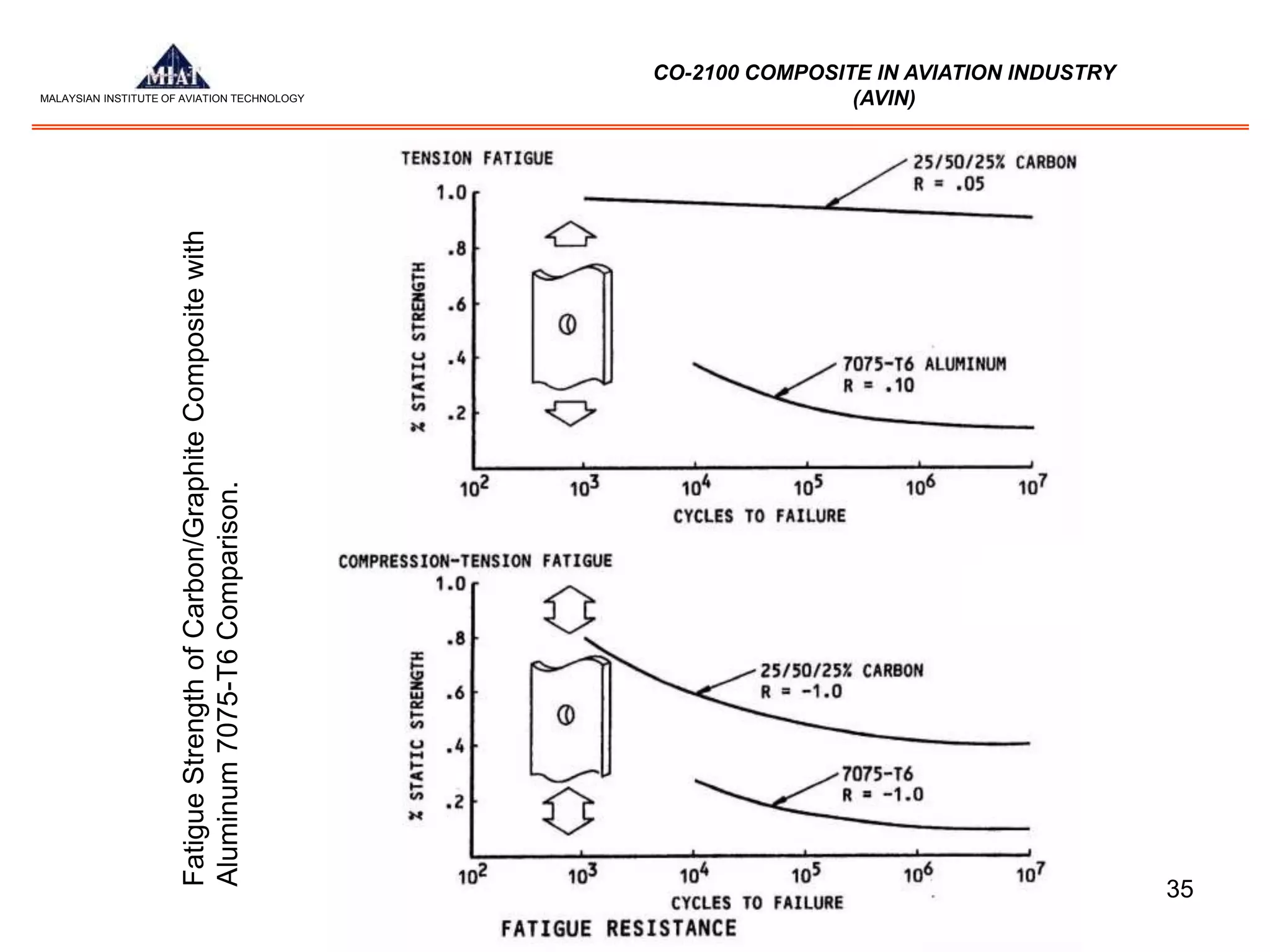
35
MALAYSIAN INSTITUTE OF AVIATION TECHNOLOGY
CO-2100 COMPOSITE IN AVIATION INDUSTRY
(AVIN)
Fatigue
Strength
of
Carbon/Graphite
Composite
with
Aluminum
7075-T6
Comparison.
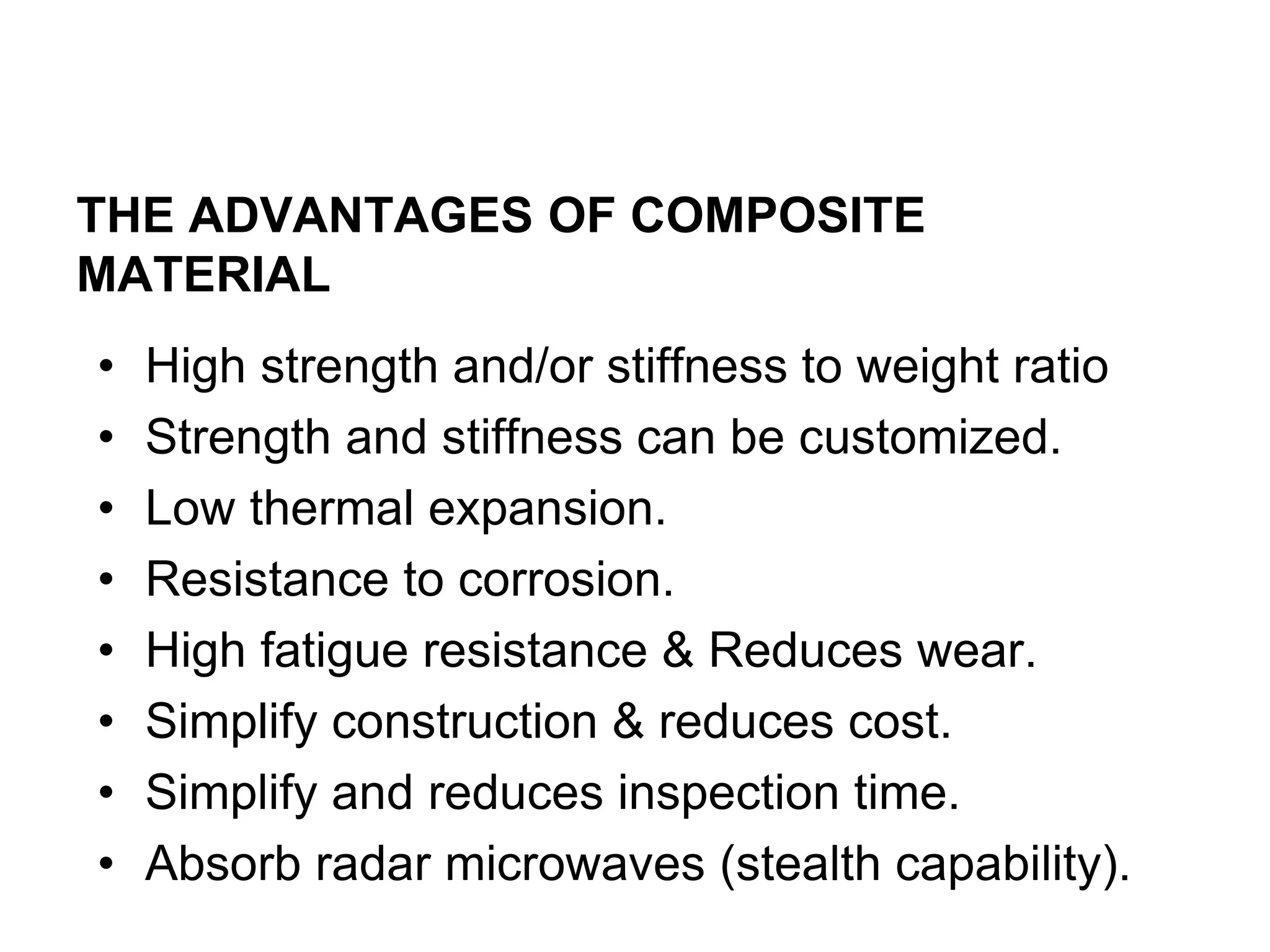
THE ADVANTAGES OF COMPOSITE
MATERIAL
• High strength and/or stiffness to weight ratio
• Strength and stiffness can be customized.
• Low thermal expansion.
• Resistance to corrosion.
• High fatigue resistance & Reduces wear.
• Simplify construction & reduces cost.
• Simplify and reduces inspection time.
• Absorb radar microwaves (stealth capability).
THE DISADVANTAGES OF COMPOSITE
MATERIAL
– Manufacture & repair cure time.
– Mechanical properties affected by
temperature and moisture.
– Difficulty, reliability issue & cost in inspection.
– Low bearing and interlaminar strength.
– High material cost (getting inexpensive).
– Poor energy absorption and impact damage.
– May require lightning strike protection.
THE PRIMARY DESIGN
CONSIDERATIONS ON DESIGNING
COMPOSITE STRUCTURE
• MATERIAL SELECTION & COMPOSITION
• FORM & STRUCTURAL ARRANGEMENT &
DISTRIBUTION OF CONSTITUENTS
• TYPE OF APPLICATION
• OPERATIONAL ENVIRONMENT
• MISSION REQUIREMENTS
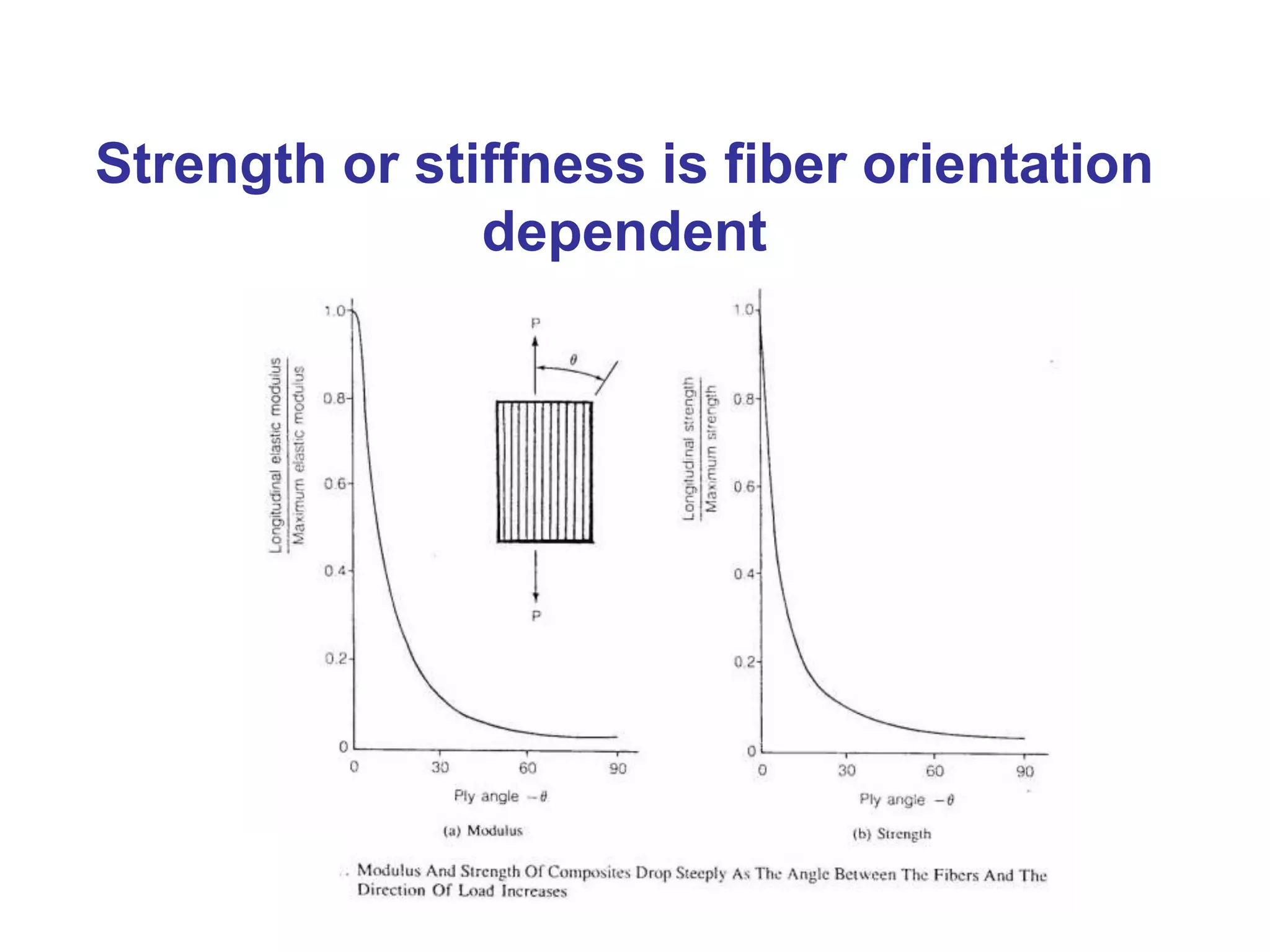
Strength or stiffness is fiber orientation
dependent
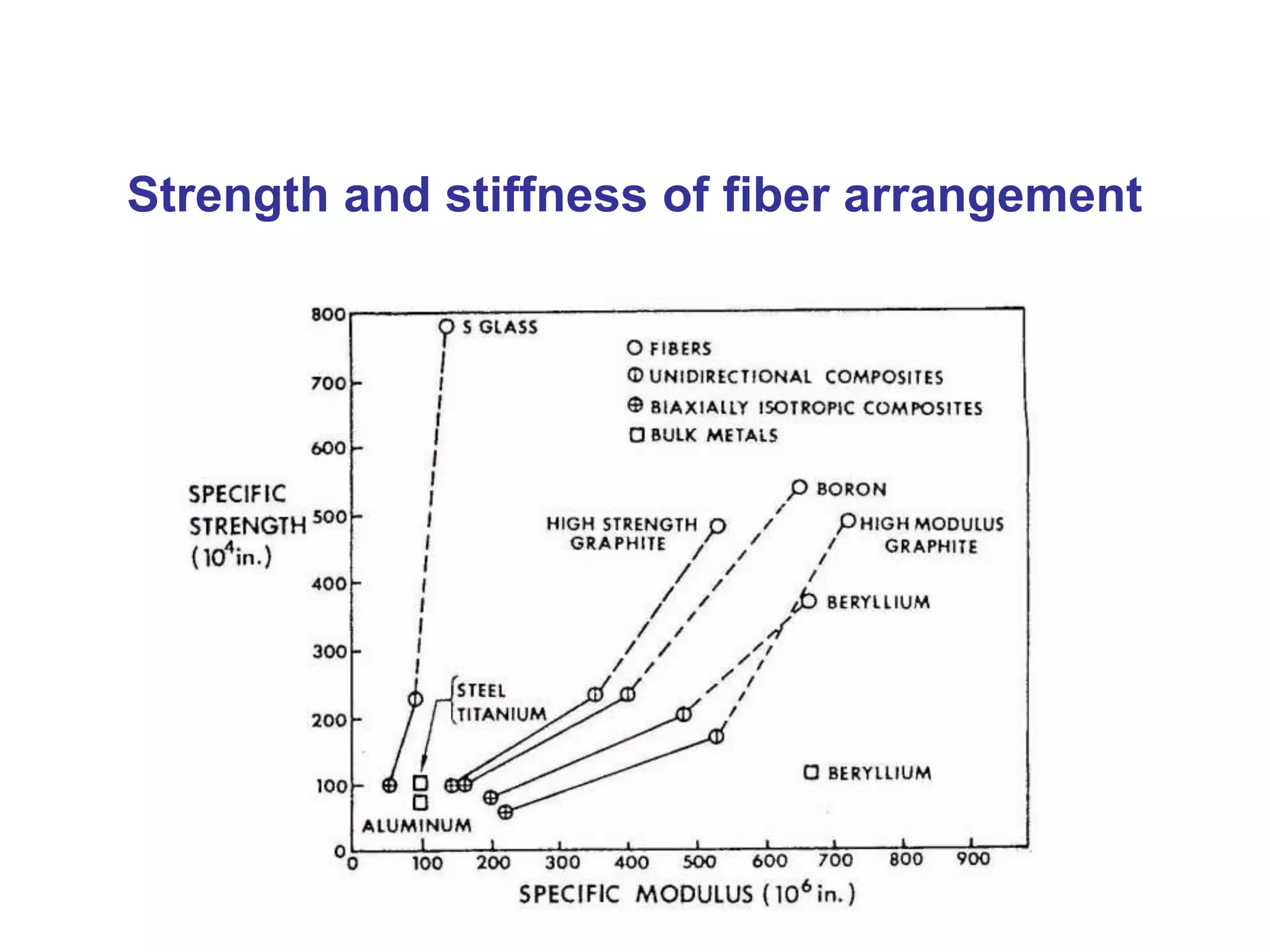
Strength and stiffness of fiber arrangement
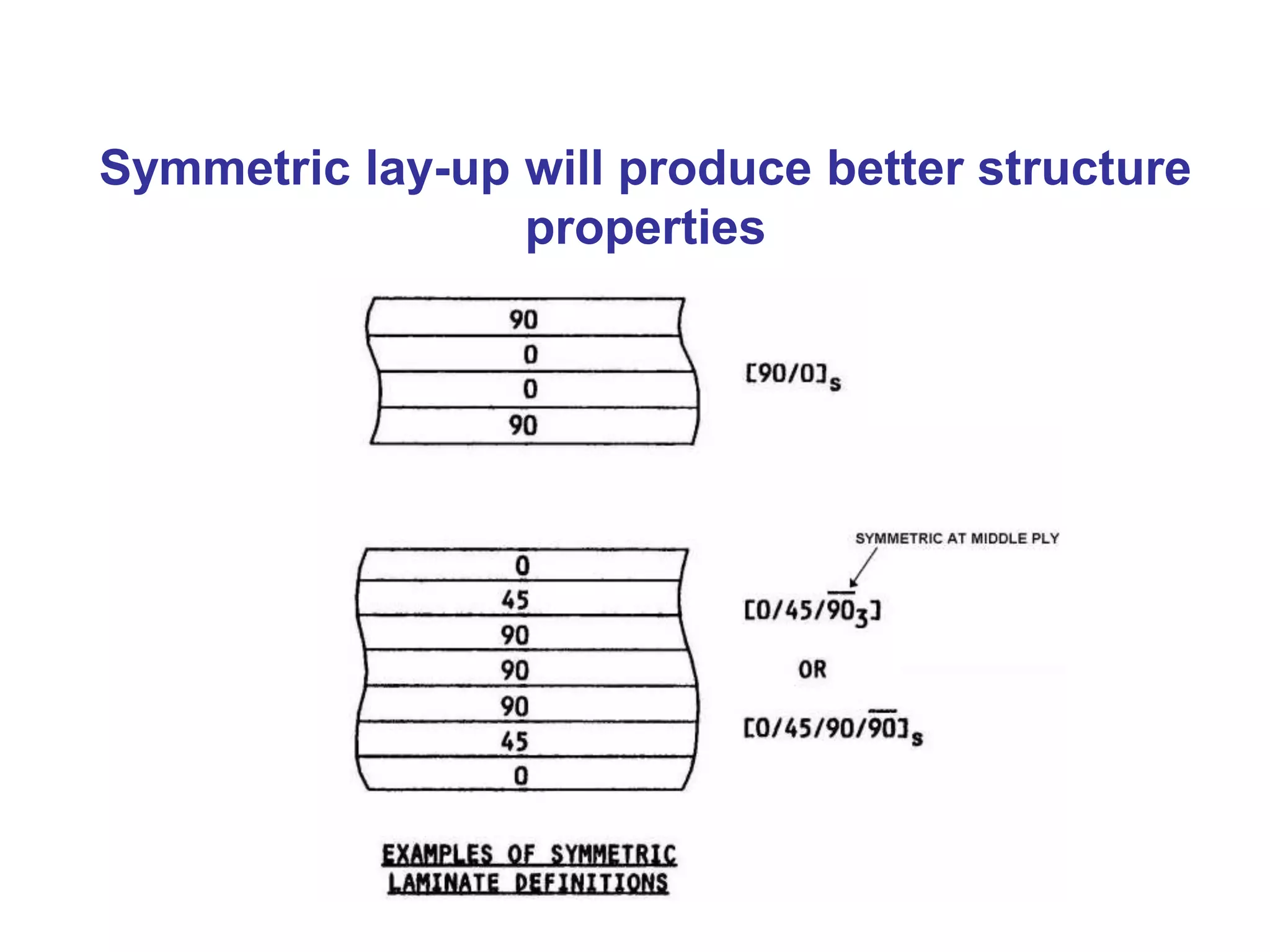
Symmetric lay-up will produce better structure
properties
TYPE OF APPLICATION
• Determine the type of structure
• Service life
• Corrosion problems
• Method of joining
• Lightning protection
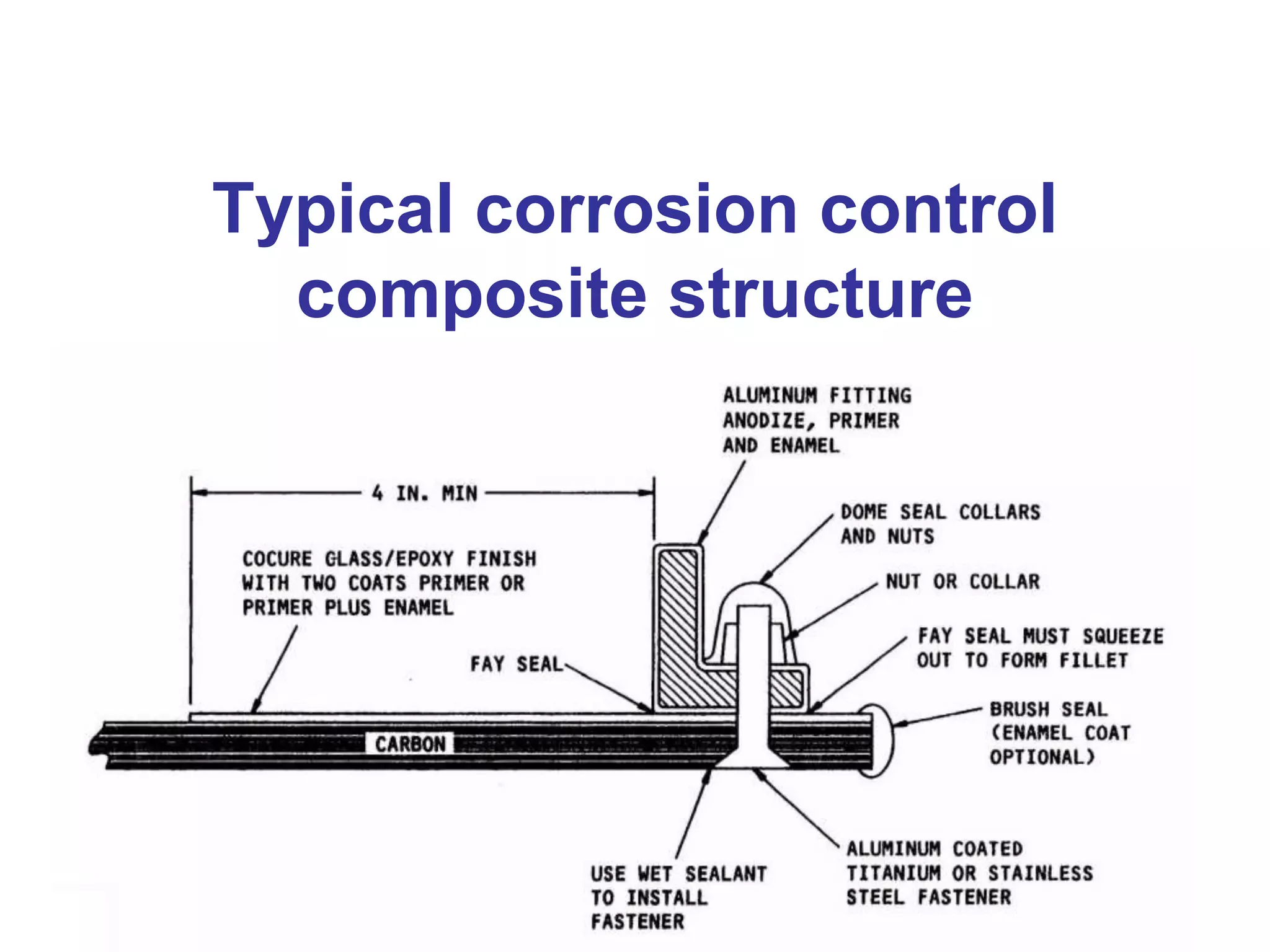
Typical corrosion control
composite structure
Lightning zone strike

WHAT IS A COMPOSITE.ppt

  • 1.
    WHAT IS ACOMPOSITE A structure consisting of two or more different materials that are combined together through the process of bonding (chemically and/or mechanically).
  • 2.
    Reinforcing element andmatrix within composites.
  • 3.
    The Properties ofa Composite Material Depends on 1. the properties of the individual materials, 2. the relative amount (ratio) of materials, 3. the size, shape, and distribution of the materials, 4. the degree of the bonding between materials; and 5. the orientation of the various materials.
  • 4.
    THE CLASSES OFCOMPOSITES A. LAMINATE COMPOSITE B. PARTICULATE COMPOSITE C. FIBER REINFORCED COMPOSITE
  • 5.
  • 6.
    Bimetallic strip –Material A possesses higher thermal expansion compared to Material B.
  • 7.
  • 8.
  • 9.
  • 10.
    FILLERS Fibrous Particulate COMPOSITE Fibrous Particulate MATRIX Ceramics (Auminium-oxide, Carbon, SiC, Silicon nitride, etc.) Metallic ( Al, Al-alloys, Ti-alloys Mg-alloys, etc.) Polymeric (Thermoplastic and thermosetting)
  • 11.
    Type of AdvancedComposite Material: a) Fiber Reinforced Plastic (FRP) b) Metal-Matrix Composites(MMC) c) Carbon-Carbon ompositesC&C) d) Ceramic-Matrix Composites (CMC)
  • 12.
    Temperature resistance ofadvanced composites.
  • 13.
    I. Fiber reinforcedPlastic (FRP) • It is the most popular used in aviation industry due to its high strength and/or stiffness to weight ratio. • It is consist resin material such as epoxy, and high strength, high modulus fibers such as Graphite, Fiberglass and Kevlar. • High strength and stiffness can be tailored (strength placed in desired orientation) with tremendous weight reduction. Typical composite structure of this type will have 20% weight reduction and 30% stronger than aluminum structure. • Thermal expansion can be designed so low, or even negative. • Maximum service temperature of about 315 OC (600 OF) because the matrix is Polymer type.
  • 14.
    II. Metal MatrixComposites (MMC) • Offer greater strength and stiffness than those provided by polymers. • It is used for operating temperatures up to 1250 OC (2300 OF), where the condition require high strength coupled with ductility and toughness. The fracture toughness is also very superior. • MMC has concentrated on Boron/Aluminum (B/Al), Graphite/Aluminum (Gr/Al) and Silicon Carbide/Aluminum (SiC/Al), but other potential type of material is being studied • Other potential ductile metal matrix: Copper, Magnesium, Titanium, Nickel or Superalloy material. • Other potential reinforcing element: Boron carbide, alumina carbide; OR wire made of titanium, tungsten, stainless steel.
  • 15.
  • 16.
  • 17.
    III. Carbon CarbonMatrix (C&C) • Consists of graphite fibers in a carbon matrix, heat resistance material, could operate up to 3300 OC (6000 OF), with a strength that is 20 times of conventional graphite,density 30% lighter (1.38 g/cm3), thermal shock resistance,increase strength and stiffness, self extinguishing.
  • 18.
    Tensile strength vs.temperature Curves of conventional Materials Composites
  • 19.
    IV. Ceramic MatrixComposites (CMC) • Lightweight, high temperature strength, and good dimensional and environmental stability (excellent resistance to oxidation). • Unfortunately, they are very expensive and brittle. • Ceramic have been used on braking systems on commercial and military aircraft.
  • 20.
    Ceramic radome combiningheat resistance with radar signal permeability is used on patriot missiles.
  • 21.
    4. HISTORY OFCOMPOSITE IN AVIATION INDUSTRY Early type of composite used on old aircraft.
  • 22.
    Monocoque structure usein early 1930´s
  • 23.
  • 24.
    By 1950’s, thetransition to the “all-metal” airplane had been completed.
  • 25.
    Composite structure onBoeing aircraft
  • 26.
    5. COMPOSITE APPLICATIONIN AVIATION INDUSTRY
  • 27.
    APPLICATION OF COMPOSITE MATERIALS •FIBER-REINFORCED COMPOSITES • 1. Aircraft and Military Application: • Why? • * Low weight at higher speed • * Increased payloads • * Tailor-made for any design • Specific application: Carbon and Kevlar fiber composites used in: • * Wings • * Fuselage (Body of aircraft) • * Rotor blades in commercial and military helicopters • * Missile structures
  • 28.
    Bottom part ofBoeing 757
  • 29.
  • 30.
    30 MALAYSIAN INSTITUTE OFAVIATION TECHNOLOGY CO-2100 COMPOSITE IN AVIATION INDUSTRY (AVIN) 6. THE DIFFERENT PROPERTIES BETWEEN ADVANCED COMPOSITES STRUCTURE (FRP) FROM METALLIC STRUCTURE 1. INHOMOGENUOUS AND ANISOTROPIC MATERIAL
  • 31.
  • 32.
    BRITTLE & ELASTICCHARACTERISTIC Failure mechanism comparison
  • 33.
    Response to loadcomparison
  • 34.
    FATIGUE LIFE Fatigue strengthof Unidirectional Composite and Aluminum.
  • 35.
    35 MALAYSIAN INSTITUTE OFAVIATION TECHNOLOGY CO-2100 COMPOSITE IN AVIATION INDUSTRY (AVIN) Fatigue Strength of Carbon/Graphite Composite with Aluminum 7075-T6 Comparison.
  • 36.
    THE ADVANTAGES OFCOMPOSITE MATERIAL • High strength and/or stiffness to weight ratio • Strength and stiffness can be customized. • Low thermal expansion. • Resistance to corrosion. • High fatigue resistance & Reduces wear. • Simplify construction & reduces cost. • Simplify and reduces inspection time. • Absorb radar microwaves (stealth capability).
  • 37.
    THE DISADVANTAGES OFCOMPOSITE MATERIAL – Manufacture & repair cure time. – Mechanical properties affected by temperature and moisture. – Difficulty, reliability issue & cost in inspection. – Low bearing and interlaminar strength. – High material cost (getting inexpensive). – Poor energy absorption and impact damage. – May require lightning strike protection.
  • 38.
    THE PRIMARY DESIGN CONSIDERATIONSON DESIGNING COMPOSITE STRUCTURE • MATERIAL SELECTION & COMPOSITION • FORM & STRUCTURAL ARRANGEMENT & DISTRIBUTION OF CONSTITUENTS • TYPE OF APPLICATION • OPERATIONAL ENVIRONMENT • MISSION REQUIREMENTS
  • 39.
    Strength or stiffnessis fiber orientation dependent
  • 40.
    Strength and stiffnessof fiber arrangement
  • 41.
    Symmetric lay-up willproduce better structure properties
  • 42.
    TYPE OF APPLICATION •Determine the type of structure • Service life • Corrosion problems • Method of joining • Lightning protection
  • 43.
  • 44.