1
2016.01.282016.01.28
Hüseyin KÜÇÜKHüseyin KÜÇÜK
ADVANCEDADVANCED
COMPOSITESCOMPOSITES
2
AGENDA
 Early Forms of Composites
 Definition of Advanced Composites
 Advantages / Disadvantages
 Types of Advanced Composites
 Storage, Handling, and Safety
 Review
3
EARLY FORMS OF
COMPOSITES
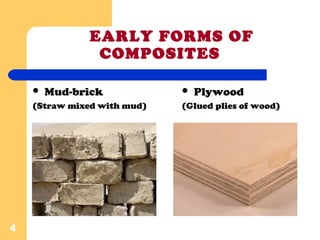
 Mud-brick
(Straw mixed with mud)
4
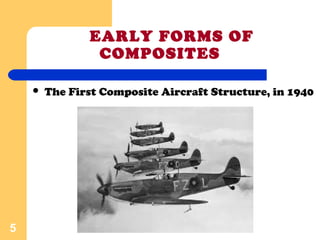
 Plywood
(Glued plies of wood)
EARLY FORMS OF
COMPOSITES
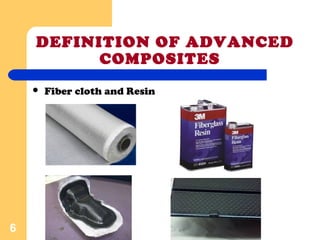
 The First Composite Aircraft Structure, in 1940
5
DEFINITION OF ADVANCED
COMPOSITES
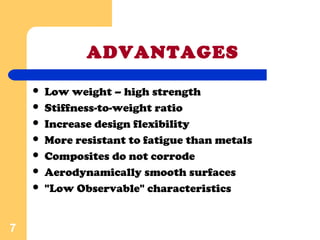
 Fiber cloth and Resin
6
ADVANTAGES
 Low weight – high strength
 Stiffness-to-weight ratio
 Increase design flexibility
 More resistant to fatigue than metals
 Composites do not corrode
 Aerodynamically smooth surfaces
 "Low Observable" characteristics
7
DISADVANTAGES
 Expensive raw material cost
 Labor intensive
 Hidden damage can be hard to detect
 Special training and skills are required
 Some composites can cause corrosion
 Short shelf life
 Moisture absorption (aramid)
8
TYPES of COMPOSITES
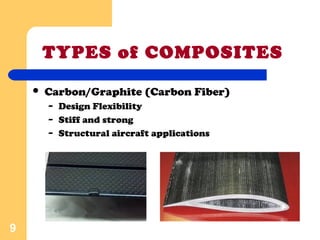
 Carbon/Graphite (Carbon Fiber)
– Design Flexibility
– Stiff and strong
– Structural aircraft applications
9
TYPES of COMPOSITES
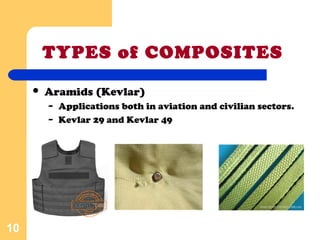
 Aramids (Kevlar)
– Applications both in aviation and civilian sectors.
– Kevlar 29 and Kevlar 49
10
TYPES of COMPOSITES
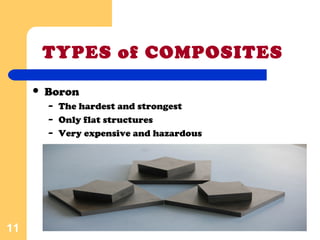
 Boron
– The hardest and strongest
– Only flat structures
– Very expensive and hazardous
11
STORAGE, HANDLING,
SAFETY
 Storage
– Non-Frost-Free Freezer
– Constant 0 °F or lower
– Moisture proof bags
12
 Handling
– Non-powdered latex or nitrile gloves
 Safety
– Wear safety goggles
– Protect your skin
– Wear air supplied respirator or mask
 Definition of composites
 Advantages / Disadvantages
 Types of Composites
13
REVIEW

Advanced composites