DEPARTMENT OF MECHANICAL ENGINEERING
“COMPOSITE MATERIAL”
PRESENTED BY
K.JOSAPH
K.ANAND PAUL
 Introduction
 Classification of composite materials
 Polymer matrix composite
 Metal matrix composite
 Ceramic matrix composite
 Advantages and limitation
 Applications
 conclusions
 A composite material is a combination of two
materials with different physical and chemical
properties. When they are combined they create a
material which is specialized to do a certain job,
for instance to become stronger, lighter or
resistant to electricity
 Composites can also used metal fibres reinforcing
other metals as in metal matrix composites(MMC)
or ceramic matrix composites (CMC) and
concrete
 The engineers can also select properties such as
resistance to heat, chemicals and weathering by
choosing an appropriate matrix material
 A polymer matrix composite (PMC) is a composite
material composed of a variety of short or
continuous fibers bound together by a matrix of
organic polymers. PMCs are designed to transfer
loads between fibers of a matrix.
 In PMCs, the reinforcement materials add
the strength to the composites.
 PMCs usage has been established for decades in
aerospace and automotive industries2; and has
been expanding to new applications, such as
marine, infrastructure, energy, and biomedical
fields.
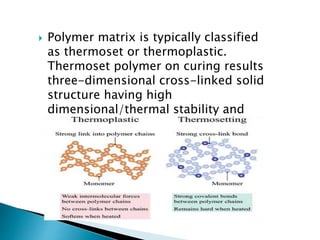
 Polymer matrix is typically classified
as thermoset or thermoplastic.
Thermoset polymer on curing results
three-dimensional cross-linked solid
structure having high
dimensional/thermal stability and
solvent-resistant properties
APPLICATIONS
The polymer-matrix composites are of
huge importance in various fields like
 household
 construction
 military
 industry
 marine
 sports, communications, electronics,
 medical devices,aerospace, and the
automobile.
 Metal matrix composites (MMCs) are a group of
materials (such as metals, alloys or intermetallic
compounds) incorporated with various reinforcing
phases, such as particulates, whiskers or continuous
fibers
 MMCs are made by dispersing a reinforcing material
into a metal matrix. The reinforcement surface can be
coated to prevent a chemical reaction with the matrix.
 They posses high stiffness, light weight
and high thermal conductivity.
MMCs are classified into
(1) Fiber reinforced MMCs
(2) particle reinforced MMCs
(3) multilayered laminate
The fiber composites can be further classified as
continuous and discontinuous fiber reinforced .
 Metal matrix composites are used for
1.satellites
2.missiles
3.helicopters
4.jet engine fan blades.
5.aerospace.
6.Themal management.
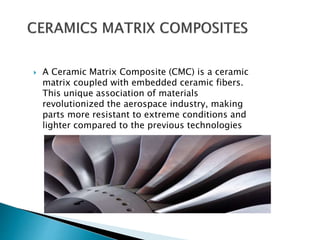
 A Ceramic Matrix Composite (CMC) is a ceramic
matrix coupled with embedded ceramic fibers.
This unique association of materials
revolutionized the aerospace industry, making
parts more resistant to extreme conditions and
lighter compared to the previous technologies
 They are light in weight and offer
resistance to high temperature and
corrosive environment
 Due to high cost their use is limited
to special applications such as heat
exchanger tubes and thermal
protective system
 It is used for making teacups and
mugs and asbestos roofing sheets
Ceramic matrix composites are used in
 Heat exchangers.
 Turbine blades.
 Stator vanes.
 High-performance braking systems.
 Immersion burner tubes.
 Bulletproof armor
 Heating elements.
 Gas-fired burner parts.
Advantages of Composites
 1. A higher performance for a given weight leads
to fuel savings. Excellent strength-toweight and
stiffness-to-weight ratios can be achieved by
composite materials. This is usually expressed as
strength divided by density and stiffness
(modulus) divided by density. These are so-called
"specific" strength and "specific" modulus
characteristics.
 2. Laminate patterns and ply buildup in a part can
be tailored to give the required mechanical
properties in various directions
 3. It is easier to achieve smooth aerodynamic
profiles for drag reduction. Complex double-
curvature parts with a smooth surface finish can
be made in one manufacturing operation.
 4. Part count is reduced.
 5. Production cost is reduced.
Composites may be made by a wide
range of processes.
 6. Composites offer excellent
resistance to corrosion, chemical
attack, and chemicals are damaging
to composites and new types of
paint and stripper are being
developed to deal with this. Some
thermoplastics are not very resistant
to some solvents. Check the data
sheets for each type
Disadvantages of Composites
 1. Composites are more brittle than
wrought metals and thus are more easily
damaged. Cast metals also tend to be
brittle.
 2. Repair introduces new problems, for the
following reasons: Materials require
refrigerated transport and storage and
have limited shelf lives. . Hot curing is
necessary in many cases, requiring special
equipment. Curing either hot or cold takes
time. The job is not finished when the last
rivet has been installed.
 3. If rivets have been used and must be
removed, this presents problems of
removal without causing further damage.
 4. Repair at the original cure
temperature requires tooling and
pressure.
 5. Composites must be thoroughly
cleaned of all contamination before
repair.
 6. Composites must be dried before
repair because all resin matrices and
some fibers absorb moisture.
 CONCLUSION AND FUTURE SCOPE
There is a wide scope of composite
material in automotive, aerospace,
wind energy, electrical, sports,
domestic purpose, civil construction,
medical chemical industries etc.
Composite materials have a great
potentiality of application in
structures subjected primarily to
compressive loads.
THANK YOU
COMPOSITE MATERIALS.pptx

COMPOSITE MATERIALS.pptx

  • 1.
    DEPARTMENT OF MECHANICALENGINEERING “COMPOSITE MATERIAL” PRESENTED BY K.JOSAPH K.ANAND PAUL
  • 2.
     Introduction  Classificationof composite materials  Polymer matrix composite  Metal matrix composite  Ceramic matrix composite  Advantages and limitation  Applications  conclusions
  • 3.
     A compositematerial is a combination of two materials with different physical and chemical properties. When they are combined they create a material which is specialized to do a certain job, for instance to become stronger, lighter or resistant to electricity  Composites can also used metal fibres reinforcing other metals as in metal matrix composites(MMC) or ceramic matrix composites (CMC) and concrete  The engineers can also select properties such as resistance to heat, chemicals and weathering by choosing an appropriate matrix material
  • 5.
     A polymermatrix composite (PMC) is a composite material composed of a variety of short or continuous fibers bound together by a matrix of organic polymers. PMCs are designed to transfer loads between fibers of a matrix.  In PMCs, the reinforcement materials add the strength to the composites.  PMCs usage has been established for decades in aerospace and automotive industries2; and has been expanding to new applications, such as marine, infrastructure, energy, and biomedical fields.
  • 6.
     Polymer matrixis typically classified as thermoset or thermoplastic. Thermoset polymer on curing results three-dimensional cross-linked solid structure having high dimensional/thermal stability and solvent-resistant properties
  • 7.
    APPLICATIONS The polymer-matrix compositesare of huge importance in various fields like  household  construction  military  industry  marine  sports, communications, electronics,  medical devices,aerospace, and the automobile.
  • 9.
     Metal matrixcomposites (MMCs) are a group of materials (such as metals, alloys or intermetallic compounds) incorporated with various reinforcing phases, such as particulates, whiskers or continuous fibers  MMCs are made by dispersing a reinforcing material into a metal matrix. The reinforcement surface can be coated to prevent a chemical reaction with the matrix.  They posses high stiffness, light weight and high thermal conductivity.
  • 10.
    MMCs are classifiedinto (1) Fiber reinforced MMCs (2) particle reinforced MMCs (3) multilayered laminate The fiber composites can be further classified as continuous and discontinuous fiber reinforced .
  • 11.
     Metal matrixcomposites are used for 1.satellites 2.missiles 3.helicopters 4.jet engine fan blades. 5.aerospace. 6.Themal management.
  • 13.
     A CeramicMatrix Composite (CMC) is a ceramic matrix coupled with embedded ceramic fibers. This unique association of materials revolutionized the aerospace industry, making parts more resistant to extreme conditions and lighter compared to the previous technologies
  • 14.
     They arelight in weight and offer resistance to high temperature and corrosive environment  Due to high cost their use is limited to special applications such as heat exchanger tubes and thermal protective system  It is used for making teacups and mugs and asbestos roofing sheets
  • 15.
    Ceramic matrix compositesare used in  Heat exchangers.  Turbine blades.  Stator vanes.  High-performance braking systems.  Immersion burner tubes.  Bulletproof armor  Heating elements.  Gas-fired burner parts.
  • 17.
    Advantages of Composites 1. A higher performance for a given weight leads to fuel savings. Excellent strength-toweight and stiffness-to-weight ratios can be achieved by composite materials. This is usually expressed as strength divided by density and stiffness (modulus) divided by density. These are so-called "specific" strength and "specific" modulus characteristics.  2. Laminate patterns and ply buildup in a part can be tailored to give the required mechanical properties in various directions  3. It is easier to achieve smooth aerodynamic profiles for drag reduction. Complex double- curvature parts with a smooth surface finish can be made in one manufacturing operation.  4. Part count is reduced.
  • 18.
     5. Productioncost is reduced. Composites may be made by a wide range of processes.  6. Composites offer excellent resistance to corrosion, chemical attack, and chemicals are damaging to composites and new types of paint and stripper are being developed to deal with this. Some thermoplastics are not very resistant to some solvents. Check the data sheets for each type
  • 19.
    Disadvantages of Composites 1. Composites are more brittle than wrought metals and thus are more easily damaged. Cast metals also tend to be brittle.  2. Repair introduces new problems, for the following reasons: Materials require refrigerated transport and storage and have limited shelf lives. . Hot curing is necessary in many cases, requiring special equipment. Curing either hot or cold takes time. The job is not finished when the last rivet has been installed.  3. If rivets have been used and must be removed, this presents problems of removal without causing further damage.
  • 20.
     4. Repairat the original cure temperature requires tooling and pressure.  5. Composites must be thoroughly cleaned of all contamination before repair.  6. Composites must be dried before repair because all resin matrices and some fibers absorb moisture.
  • 21.
     CONCLUSION ANDFUTURE SCOPE There is a wide scope of composite material in automotive, aerospace, wind energy, electrical, sports, domestic purpose, civil construction, medical chemical industries etc. Composite materials have a great potentiality of application in structures subjected primarily to compressive loads.
  • 23.