Working Capital Policy
In this chapter… Importance of working capital management… Components of working capital… Factors influencing the working capital requirement… Profitability/Liquidity Trade off… Estimating working capital requirement… Operating cycle method… Percent of sales method… Finance Manager’s role in working capital management…
Estimation of Required Working Capital… For estimation of working capital, following four step procedure is applicable: Estimation of cash cost of the various current assets required by the firm. Estimation of current liabilities of the firm. Calculation of net working capital. Add percentage of contingency.
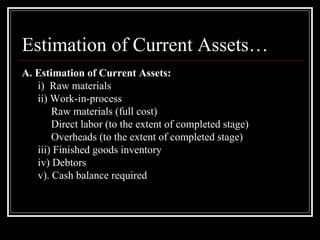
Estimation of Current Assets… A. Estimation of Current Assets: i)  Raw materials  ii) Work-in-process  Raw materials (full cost)  Direct labor (to the extent of completed stage)  Overheads (to the extent of completed stage)  iii) Finished goods inventory iv) Debtors v). Cash balance required
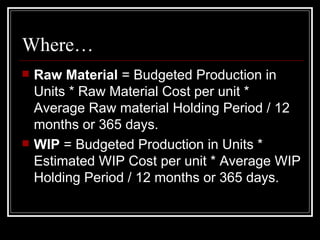
Where… Raw Material  = Budgeted Production in Units * Raw Material Cost per unit * Average Raw material Holding Period / 12 months or 365 days. WIP  = Budgeted Production in Units * Estimated WIP Cost per unit * Average WIP Holding Period / 12 months or 365 days.
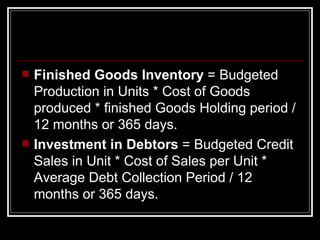
Finished Goods Inventory  = Budgeted Production in Units * Cost of Goods produced * finished Goods Holding period /12 months or 365 days. Investment in Debtors  = Budgeted Credit Sales in Unit * Cost of Sales per Unit * Average Debt Collection Period / 12 months or 365 days.
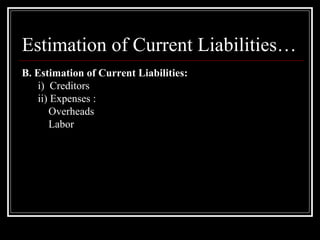
Estimation of Current Liabilities… B. Estimation of Current Liabilities: i)  Creditors  ii) Expenses : Overheads  Labor
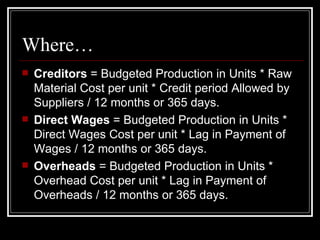
Where… Creditors  = Budgeted Production in Units * Raw Material Cost per unit * Credit period Allowed by Suppliers / 12 months or 365 days. Direct Wages  = Budgeted Production in Units * Direct Wages Cost per unit * Lag in Payment of Wages / 12 months or 365 days. Overheads  = Budgeted Production in Units * Overhead Cost per unit * Lag in Payment of Overheads / 12 months or 365 days.
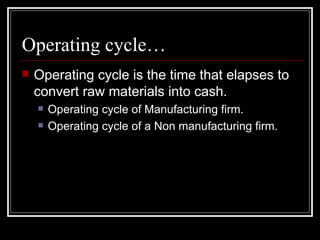
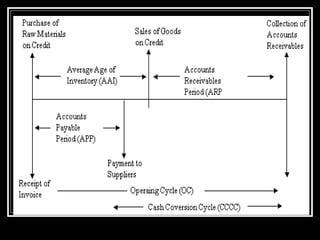
Operating cycle… Operating cycle is the time that elapses to convert raw materials into cash. Operating cycle of Manufacturing firm. Operating cycle of a Non manufacturing firm.
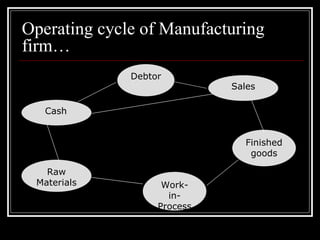
Operating cycle of Manufacturing firm… Cash Raw Materials Debtor Work-in- Process Sales Finished goods
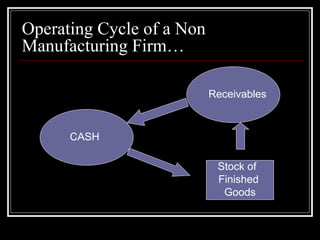
Operating Cycle of a Non Manufacturing Firm… Stock of  Finished  Goods CASH Receivables
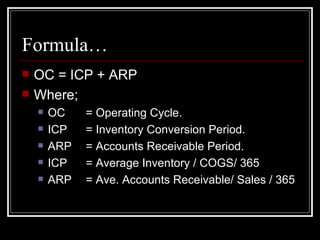
Formula… OC = ICP + ARP Where; OC  = Operating Cycle. ICP  = Inventory Conversion Period. ARP  = Accounts Receivable Period. ICP = Average Inventory / COGS/ 365 ARP = Ave. Accounts Receivable/ Sales / 365
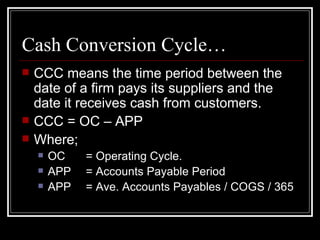
Cash Conversion Cycle… CCC means the time period between the date of a firm pays its suppliers and the date it receives cash from customers. CCC = OC – APP Where; OC = Operating Cycle. APP = Accounts Payable Period APP = Ave. Accounts Payables / COGS / 365
 

Ch 8

  • 1.
  • 2.
    In this chapter…Importance of working capital management… Components of working capital… Factors influencing the working capital requirement… Profitability/Liquidity Trade off… Estimating working capital requirement… Operating cycle method… Percent of sales method… Finance Manager’s role in working capital management…
  • 3.
    Estimation of RequiredWorking Capital… For estimation of working capital, following four step procedure is applicable: Estimation of cash cost of the various current assets required by the firm. Estimation of current liabilities of the firm. Calculation of net working capital. Add percentage of contingency.
  • 4.
    Estimation of CurrentAssets… A. Estimation of Current Assets: i) Raw materials ii) Work-in-process Raw materials (full cost) Direct labor (to the extent of completed stage) Overheads (to the extent of completed stage) iii) Finished goods inventory iv) Debtors v). Cash balance required
  • 5.
    Where… Raw Material = Budgeted Production in Units * Raw Material Cost per unit * Average Raw material Holding Period / 12 months or 365 days. WIP = Budgeted Production in Units * Estimated WIP Cost per unit * Average WIP Holding Period / 12 months or 365 days.
  • 6.
    Finished Goods Inventory = Budgeted Production in Units * Cost of Goods produced * finished Goods Holding period /12 months or 365 days. Investment in Debtors = Budgeted Credit Sales in Unit * Cost of Sales per Unit * Average Debt Collection Period / 12 months or 365 days.
  • 7.
    Estimation of CurrentLiabilities… B. Estimation of Current Liabilities: i) Creditors ii) Expenses : Overheads Labor
  • 8.
    Where… Creditors = Budgeted Production in Units * Raw Material Cost per unit * Credit period Allowed by Suppliers / 12 months or 365 days. Direct Wages = Budgeted Production in Units * Direct Wages Cost per unit * Lag in Payment of Wages / 12 months or 365 days. Overheads = Budgeted Production in Units * Overhead Cost per unit * Lag in Payment of Overheads / 12 months or 365 days.
  • 9.
    Operating cycle… Operatingcycle is the time that elapses to convert raw materials into cash. Operating cycle of Manufacturing firm. Operating cycle of a Non manufacturing firm.
  • 10.
    Operating cycle ofManufacturing firm… Cash Raw Materials Debtor Work-in- Process Sales Finished goods
  • 11.
    Operating Cycle ofa Non Manufacturing Firm… Stock of Finished Goods CASH Receivables
  • 12.
    Formula… OC =ICP + ARP Where; OC = Operating Cycle. ICP = Inventory Conversion Period. ARP = Accounts Receivable Period. ICP = Average Inventory / COGS/ 365 ARP = Ave. Accounts Receivable/ Sales / 365
  • 13.
    Cash Conversion Cycle…CCC means the time period between the date of a firm pays its suppliers and the date it receives cash from customers. CCC = OC – APP Where; OC = Operating Cycle. APP = Accounts Payable Period APP = Ave. Accounts Payables / COGS / 365
  • 14.