


• MANAGEMENT OF WORKING CAPITAL:
Working Capital Management involves
management of different components of working
capital such as cash, , accounts receivable,
creditors, inventories etc.
CASH MANAGEMENT
• Cash management is one of the key areas of working capital
management. Cash is the most liquid current assets.
• Cash is the common denominator to which all current assets
can be reduced because the other major liquid assets, i.e.
receivable and inventory get eventually converted into cash.
• This underlines the importance of cash management.
• The term “Cash” with reference to management of cash is
used in two ways. In a narrowsense cash refers to coins,
currency, cheques, drafts and deposits in banks.
• The broader view of cash includes near cash assets such as
marketable securities and time deposits in banks.
• The reason why these near cash assets are
included in cash is that they can readily be
converted into cash.
• Usually, excess cash is invested in marketable
securities as it contributes to profitability.
• Every firm should have adequate cash, neither
more nor less. Inadequate cash will lead to
production interruptions, while excessive cash
remains idle and will impair profitability.
SIGNIFICANCE
• 1. Cash planning –
Cash is the most important as well as the least unproductive
of all current assets. Though, it is necessary to meet the
firm’s obligations, yet idle cash earns nothing. Therefore, it
is essential to have a sound cash planning neither excess nor
inadequate.
• 2. Management of cash flows –
Synchronization between cash inflows and cash outflows
rarely happens. Sometimes, the cash inflows will be more
than outflows because of receipts from debtors, and cash
sales in huge amounts. At other times, cash outflows exceed
inflows due to payment of taxes, interest and dividends etc.
Hence, the cash flows should be managed for better cash
management.
• 3. Maintaining optimum cash balance –
Every firm should maintain optimum cash
balance. The management should also consider
the factors determining and influencing the cash
balances at various point of time. The cost of
excess cash and danger of inadequate cash
should be matched to determine the optimum
level of cash balances.
4. Investment of excess cash –
The firm has to invest the excess or idle funds in
short term securities or investments to earn
profits as idle funds earn nothing. This is one of
the important aspects of management of cash.
MOTIVES
• Motives or desires for holding cash refer to
various purposes. The purpose may be
different from person to person and situation to
situation. There are four important motives to
hold cash.
– a. Transactions motive
– b. Precautionary motive
– c. Speculative motive
– d. Compensation motive
Transactions motive -
• This motive refers to the holding of cash, to meet
routine cash requirements in the ordinary course of
business.
• A firm enters into a number of transactions which
requires cash payment. For example, purchase of
materials, payment of wages, salaries, taxes, interest
etc. Similarly, a firm receives cash from cash sales,
collections from debtors, return on investments etc.
• the transactions motive refers to the holding of cash to
meet expected obligations
• Though, a large portion of cash held for transactions
motive is in the form of cash, a part of it may be
invested in marketable securities whose maturity
conform to the timing of expected payments such as
dividends, taxes etc.
Precautionary motive -
• To meet unexpected contingencies.
• For example, strikes, sudden increase in cost of raw materials
etc.
• Cash held to meet these unforeseen situations is known as
precautionary cash balance and it provides a caution against
them.
• The amount of cash balance under precautionary motive is
influenced by two factors i.e. predictability of cash flows and
the availability of short term credit.
• If the firm can borrow at short-notice, it will need a relatively
small balance to meet contingencies and vice versa.
• Usually precautionary cash balances are invested in
marketable securities so that they contribute something to
profitability
Speculative motive -
• Sometimes firms would like to hold cash in order
to exploit, the profitable opportunities as and
when they arise.
• This motive is called as speculative motive. For
example, if the firm expects that the material
prices will fall, it can delay the purchases and
make purchases in future when price actually
declines.
• Similarly, with the hope of buying securities
when the interest rate is expected to decline, the
firm will hold cash. By and large, firms rarely
hold cash for speculative purposes
Compensation motive -
• This motive to hold cash balances is to
compensate banks and other financial institutes
for providing certain services and loans.
• Banks provide a variety of services to business
firms like clearance of cheques, drafts, transfer of
funds etc. Banks charge a commission or fee for
their services to the customers as indirect
compensation.
• Customers are required to maintain a minimum
cash balance at the bank. This balance cannot be
used for transaction purposes.
• Banks can utilize the balances to earn a return to
compensate their cost of services to the
customers. Such balances are compensating
balances.
• These balances are also required by some loan
agreements between a bank and its customers.
Banks require a chest to maintain a minimum
cash balance in his account to compensate the
bank when the supply of credit is restricted and
interest rates are rising
• Objectives The basic objectives of cash
management are
– (i) Meeting the payments schedule
– (ii) to minimize the cash balances. The task before
the cash management is to reconcile the two
conflicting nature of objectives.
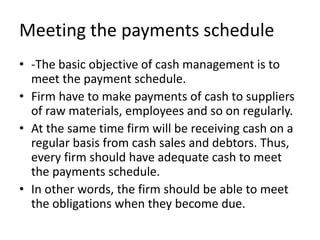
Meeting the payments schedule
• -The basic objective of cash management is to
meet the payment schedule.
• Firm have to make payments of cash to suppliers
of raw materials, employees and so on regularly.
• At the same time firm will be receiving cash on a
regular basis from cash sales and debtors. Thus,
every firm should have adequate cash to meet
the payments schedule.
• In other words, the firm should be able to meet
the obligations when they become due.
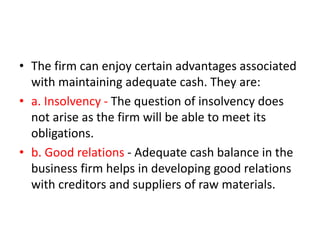
• The firm can enjoy certain advantages associated
with maintaining adequate cash. They are:
• a. Insolvency - The question of insolvency does
not arise as the firm will be able to meet its
obligations.
• b. Good relations - Adequate cash balance in the
business firm helps in developing good relations
with creditors and suppliers of raw materials.
• c. Credit worthiness - The maintenance of adequate
cash balances increase the credit worthiness of the
firm. Consequently it will be able to purchase raw
materials and procure credit with favorable terms and
conditions.
• d. Availing discount facilities - The firm can avail the
discounts offered by the creditors for payments before
the due date.
• e. To meet unexpected facilities - The firm can easily
meet the unexpected cash expenditure in situations
like strikes, competition from customers etc. with little
strain
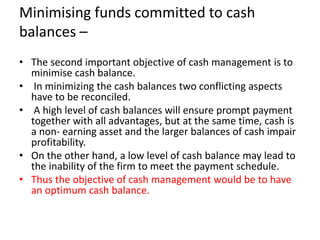
Minimising funds committed to cash
balances –
• The second important objective of cash management is to
minimise cash balance.
• In minimizing the cash balances two conflicting aspects
have to be reconciled.
• A high level of cash balances will ensure prompt payment
together with all advantages, but at the same time, cash is
a non- earning asset and the larger balances of cash impair
profitability.
• On the other hand, a low level of cash balance may lead to
the inability of the firm to meet the payment schedule.
• Thus the objective of cash management would be to have
an optimum cash balance.

cash management.pptx

  • 2.
    • MANAGEMENT OFWORKING CAPITAL: Working Capital Management involves management of different components of working capital such as cash, , accounts receivable, creditors, inventories etc.
  • 3.
    CASH MANAGEMENT • Cashmanagement is one of the key areas of working capital management. Cash is the most liquid current assets. • Cash is the common denominator to which all current assets can be reduced because the other major liquid assets, i.e. receivable and inventory get eventually converted into cash. • This underlines the importance of cash management. • The term “Cash” with reference to management of cash is used in two ways. In a narrowsense cash refers to coins, currency, cheques, drafts and deposits in banks. • The broader view of cash includes near cash assets such as marketable securities and time deposits in banks.
  • 4.
    • The reasonwhy these near cash assets are included in cash is that they can readily be converted into cash. • Usually, excess cash is invested in marketable securities as it contributes to profitability. • Every firm should have adequate cash, neither more nor less. Inadequate cash will lead to production interruptions, while excessive cash remains idle and will impair profitability.
  • 5.
    SIGNIFICANCE • 1. Cashplanning – Cash is the most important as well as the least unproductive of all current assets. Though, it is necessary to meet the firm’s obligations, yet idle cash earns nothing. Therefore, it is essential to have a sound cash planning neither excess nor inadequate. • 2. Management of cash flows – Synchronization between cash inflows and cash outflows rarely happens. Sometimes, the cash inflows will be more than outflows because of receipts from debtors, and cash sales in huge amounts. At other times, cash outflows exceed inflows due to payment of taxes, interest and dividends etc. Hence, the cash flows should be managed for better cash management.
  • 6.
    • 3. Maintainingoptimum cash balance – Every firm should maintain optimum cash balance. The management should also consider the factors determining and influencing the cash balances at various point of time. The cost of excess cash and danger of inadequate cash should be matched to determine the optimum level of cash balances. 4. Investment of excess cash – The firm has to invest the excess or idle funds in short term securities or investments to earn profits as idle funds earn nothing. This is one of the important aspects of management of cash.
  • 7.
    MOTIVES • Motives ordesires for holding cash refer to various purposes. The purpose may be different from person to person and situation to situation. There are four important motives to hold cash. – a. Transactions motive – b. Precautionary motive – c. Speculative motive – d. Compensation motive
  • 8.
    Transactions motive - •This motive refers to the holding of cash, to meet routine cash requirements in the ordinary course of business. • A firm enters into a number of transactions which requires cash payment. For example, purchase of materials, payment of wages, salaries, taxes, interest etc. Similarly, a firm receives cash from cash sales, collections from debtors, return on investments etc. • the transactions motive refers to the holding of cash to meet expected obligations • Though, a large portion of cash held for transactions motive is in the form of cash, a part of it may be invested in marketable securities whose maturity conform to the timing of expected payments such as dividends, taxes etc.
  • 9.
    Precautionary motive - •To meet unexpected contingencies. • For example, strikes, sudden increase in cost of raw materials etc. • Cash held to meet these unforeseen situations is known as precautionary cash balance and it provides a caution against them. • The amount of cash balance under precautionary motive is influenced by two factors i.e. predictability of cash flows and the availability of short term credit. • If the firm can borrow at short-notice, it will need a relatively small balance to meet contingencies and vice versa. • Usually precautionary cash balances are invested in marketable securities so that they contribute something to profitability
  • 10.
    Speculative motive - •Sometimes firms would like to hold cash in order to exploit, the profitable opportunities as and when they arise. • This motive is called as speculative motive. For example, if the firm expects that the material prices will fall, it can delay the purchases and make purchases in future when price actually declines. • Similarly, with the hope of buying securities when the interest rate is expected to decline, the firm will hold cash. By and large, firms rarely hold cash for speculative purposes
  • 11.
    Compensation motive - •This motive to hold cash balances is to compensate banks and other financial institutes for providing certain services and loans. • Banks provide a variety of services to business firms like clearance of cheques, drafts, transfer of funds etc. Banks charge a commission or fee for their services to the customers as indirect compensation. • Customers are required to maintain a minimum cash balance at the bank. This balance cannot be used for transaction purposes.
  • 12.
    • Banks canutilize the balances to earn a return to compensate their cost of services to the customers. Such balances are compensating balances. • These balances are also required by some loan agreements between a bank and its customers. Banks require a chest to maintain a minimum cash balance in his account to compensate the bank when the supply of credit is restricted and interest rates are rising
  • 13.
    • Objectives Thebasic objectives of cash management are – (i) Meeting the payments schedule – (ii) to minimize the cash balances. The task before the cash management is to reconcile the two conflicting nature of objectives.
  • 14.
    Meeting the paymentsschedule • -The basic objective of cash management is to meet the payment schedule. • Firm have to make payments of cash to suppliers of raw materials, employees and so on regularly. • At the same time firm will be receiving cash on a regular basis from cash sales and debtors. Thus, every firm should have adequate cash to meet the payments schedule. • In other words, the firm should be able to meet the obligations when they become due.
  • 15.
    • The firmcan enjoy certain advantages associated with maintaining adequate cash. They are: • a. Insolvency - The question of insolvency does not arise as the firm will be able to meet its obligations. • b. Good relations - Adequate cash balance in the business firm helps in developing good relations with creditors and suppliers of raw materials.
  • 16.
    • c. Creditworthiness - The maintenance of adequate cash balances increase the credit worthiness of the firm. Consequently it will be able to purchase raw materials and procure credit with favorable terms and conditions. • d. Availing discount facilities - The firm can avail the discounts offered by the creditors for payments before the due date. • e. To meet unexpected facilities - The firm can easily meet the unexpected cash expenditure in situations like strikes, competition from customers etc. with little strain
  • 17.
    Minimising funds committedto cash balances – • The second important objective of cash management is to minimise cash balance. • In minimizing the cash balances two conflicting aspects have to be reconciled. • A high level of cash balances will ensure prompt payment together with all advantages, but at the same time, cash is a non- earning asset and the larger balances of cash impair profitability. • On the other hand, a low level of cash balance may lead to the inability of the firm to meet the payment schedule. • Thus the objective of cash management would be to have an optimum cash balance.