Complicated UTIs
Due to urinary catheters
B. Dormanesh
Professor of pediatric nephrology
AJA University of medical sciences
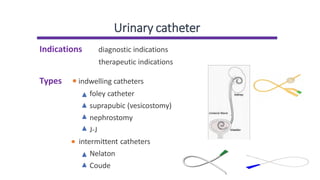
Urinary catheter
Indications diagnostic indications
therapeutic indications
Types indwelling catheters
foley catheter
suprapubic (vesicostomy)
nephrostomy
J-J
intermittent catheters
Nelaton
Coude
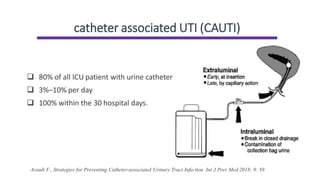
catheter associated UTI (CAUTI)
Assadi F., Strategies for Preventing Catheter-associated Urinary Tract Infection .Int J Prev Med.2018; 9: 50
❑ 80% of all ICU patient with urine catheter
❑ 3%–10% per day
❑ 100% within the 30 hospital days.
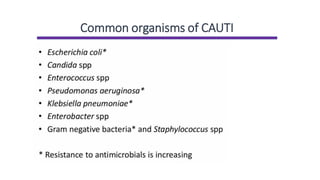
Common organisms of CAUTI
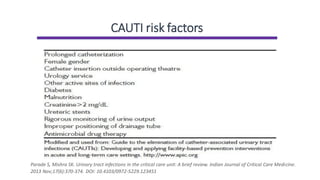
CAUTI risk factors
Parade S, Mishra SK. Urinary tract infections in the critical care unit: A brief review. Indian Journal of Critical Care Medicine.
2013 Nov;17(6):370-374. DOI: 10.4103/0972-5229.123451
Managing CAUTI
Urinary tract infection (catheter-associated): antimicrobial prescribing
NICE guideline [NG113] Published: 23 November 2018
Be aware :
❑ Give advice about managing symptoms with self-care
❑ Antibiotic treatment is not routinely needed for asymptomatic
bacteriuria in child with a catheter
❑ CAUTI is a symptomatic infection
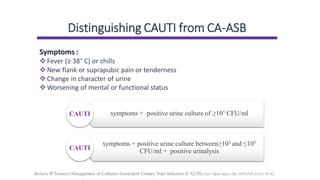
Distinguishing CAUTI from CA-ASB
Symptoms :
❖Fever (≥ 38° C) or chills
❖New flank or suprapubic pain or tenderness
❖Change in character of urine
❖Worsening of mental or functional status
.Babara W.Traunter,Management of Catheter-Associated Urinary Tract Infection (CAUTI).Curr Opin Infect Dis.2010 Feb;23(1):76-82
symptoms + positive urine culture of ≥105 CFU/ml
symptoms + positive urine culture between≥103 and ≤105
CFU/ml + positive urinalysis
CAUTI treatment
Urinary tract infection (catheter-associated): antimicrobial prescribing
NICE guideline [NG113] Published: 23 November 2018
❑removing or changing the catheter as soon as possible
❑obtain a urine sample before antibiotics are taken
❑start antibiotic therapy
❑Reassess the child after 48 hr.
CAUTI antibiotic therapy
Urinary tract infection (catheter-associated): antimicrobial prescribing
NICE guideline [NG113] Published: 23 November 2018
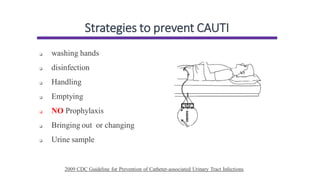
Strategies to prevent CAUTI
❑ washing hands
❑ disinfection
❑ Handling
❑ Emptying
❑ NO Prophylaxis
❑ Bringing out or changing
❑ Urine sample
2009 CDC Guideline for Prevention of Catheter-associated Urinary Tract Infections.
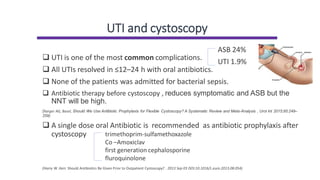
UTI and cystoscopy
❑ UTI is one of the most common complications.
❑ All UTIs resolved in ≤12–24 h with oral antibiotics.
❑ None of the patients was admitted for bacterial sepsis.
❑ Antibiotic therapy before cystoscopy , reduces symptomatic and ASB but the
NNT will be high.
(Karger AG, Basel, Should We Use Antibiotic Prophylaxis for Flexible Cystoscopy? A Systematic Review and Meta-Analysis , Urol Int 2015;95:249–
259)
❑ A single dose oral Antibiotic is recommended as antibiotic prophylaxis after
cystoscopy
(Harry W. Herr. Should Antibiotics Be Given Prior to Outpatient Cystoscopy? . 2013 Sep 03 DOI:10.1016/L.euro.2013.08.054)
ASB 24%
UTI 1.9%
trimethoprim-sulfamethoxazole
Co –Amoxiclav
first generation cephalosporine
fluroquinolone
UTI and vesicostomy
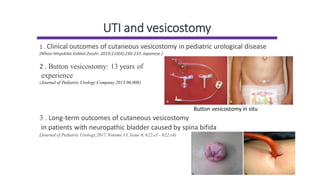
1 . Clinical outcomes of cutaneous vesicostomy in pediatric urological disease
(Nihon Hinyokika Gakkai Zasshi. 2019;110(4):230-233. Japanese.)
2 . Button vesicostomy: 13 years of
experience
(Journal of Pediatric Urology Company 2013.06.008)
3 . Long-term outcomes of cutaneous vesicostomy
in patients with neuropathic bladder caused by spina bifida
(Journal of Pediatric Urology,2017, Volume 13, Issue 6, 622.e1 - 622.e4)
Button vesicostomy in situ
UTI and Percutaneous Nephrostomy
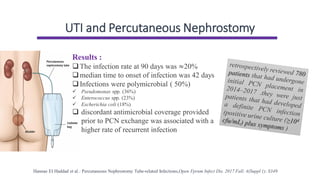
Hannae EI Haddad et al.: Percutaneous Nephrostomy Tube-related Infections,Open Fprum Infect Dis. 2017 Fall; 4(Suppl 1): S349
Results :
❑The infection rate at 90 days was ≈20%
❑median time to onset of infection was 42 days
❑Infections were polymicrobial ( 50%)
✓ Pseudomonas spp. (36%)
✓ Enterococcus spp. (23%)
✓ Escherichia coli (18%)
❑ discordant antimicrobial coverage provided
prior to PCN exchange was associated with a
higher rate of recurrent infection
Take home massage
Strategies Not recommended
o devices insertion once they aren’t really necessary
o Devices remaintance once they are no longer necessary
o Changing catheters or drainage bags at routine , fixed intervals
o Routine antimicrobial therapy
o Cleaning of periurethral area with antiseptic while catheter is in place
o Irrigation of renal pelvic or bladder with antimicrobials
o Instillation of anti septic solution into drainage bags
o Routine screening for asymptomatic bacteriuria
Thank you for your attention

Complicated uti

  • 1.
    Complicated UTIs Due tourinary catheters B. Dormanesh Professor of pediatric nephrology AJA University of medical sciences
  • 2.
    Urinary catheter Indications diagnosticindications therapeutic indications Types indwelling catheters foley catheter suprapubic (vesicostomy) nephrostomy J-J intermittent catheters Nelaton Coude
  • 3.
    catheter associated UTI(CAUTI) Assadi F., Strategies for Preventing Catheter-associated Urinary Tract Infection .Int J Prev Med.2018; 9: 50 ❑ 80% of all ICU patient with urine catheter ❑ 3%–10% per day ❑ 100% within the 30 hospital days.
  • 4.
  • 5.
    CAUTI risk factors ParadeS, Mishra SK. Urinary tract infections in the critical care unit: A brief review. Indian Journal of Critical Care Medicine. 2013 Nov;17(6):370-374. DOI: 10.4103/0972-5229.123451
  • 6.
    Managing CAUTI Urinary tractinfection (catheter-associated): antimicrobial prescribing NICE guideline [NG113] Published: 23 November 2018 Be aware : ❑ Give advice about managing symptoms with self-care ❑ Antibiotic treatment is not routinely needed for asymptomatic bacteriuria in child with a catheter ❑ CAUTI is a symptomatic infection
  • 7.
    Distinguishing CAUTI fromCA-ASB Symptoms : ❖Fever (≥ 38° C) or chills ❖New flank or suprapubic pain or tenderness ❖Change in character of urine ❖Worsening of mental or functional status .Babara W.Traunter,Management of Catheter-Associated Urinary Tract Infection (CAUTI).Curr Opin Infect Dis.2010 Feb;23(1):76-82 symptoms + positive urine culture of ≥105 CFU/ml symptoms + positive urine culture between≥103 and ≤105 CFU/ml + positive urinalysis
  • 8.
    CAUTI treatment Urinary tractinfection (catheter-associated): antimicrobial prescribing NICE guideline [NG113] Published: 23 November 2018 ❑removing or changing the catheter as soon as possible ❑obtain a urine sample before antibiotics are taken ❑start antibiotic therapy ❑Reassess the child after 48 hr.
  • 9.
    CAUTI antibiotic therapy Urinarytract infection (catheter-associated): antimicrobial prescribing NICE guideline [NG113] Published: 23 November 2018
  • 10.
    Strategies to preventCAUTI ❑ washing hands ❑ disinfection ❑ Handling ❑ Emptying ❑ NO Prophylaxis ❑ Bringing out or changing ❑ Urine sample 2009 CDC Guideline for Prevention of Catheter-associated Urinary Tract Infections.
  • 11.
    UTI and cystoscopy ❑UTI is one of the most common complications. ❑ All UTIs resolved in ≤12–24 h with oral antibiotics. ❑ None of the patients was admitted for bacterial sepsis. ❑ Antibiotic therapy before cystoscopy , reduces symptomatic and ASB but the NNT will be high. (Karger AG, Basel, Should We Use Antibiotic Prophylaxis for Flexible Cystoscopy? A Systematic Review and Meta-Analysis , Urol Int 2015;95:249– 259) ❑ A single dose oral Antibiotic is recommended as antibiotic prophylaxis after cystoscopy (Harry W. Herr. Should Antibiotics Be Given Prior to Outpatient Cystoscopy? . 2013 Sep 03 DOI:10.1016/L.euro.2013.08.054) ASB 24% UTI 1.9% trimethoprim-sulfamethoxazole Co –Amoxiclav first generation cephalosporine fluroquinolone
  • 12.
    UTI and vesicostomy 1. Clinical outcomes of cutaneous vesicostomy in pediatric urological disease (Nihon Hinyokika Gakkai Zasshi. 2019;110(4):230-233. Japanese.) 2 . Button vesicostomy: 13 years of experience (Journal of Pediatric Urology Company 2013.06.008) 3 . Long-term outcomes of cutaneous vesicostomy in patients with neuropathic bladder caused by spina bifida (Journal of Pediatric Urology,2017, Volume 13, Issue 6, 622.e1 - 622.e4) Button vesicostomy in situ
  • 13.
    UTI and PercutaneousNephrostomy Hannae EI Haddad et al.: Percutaneous Nephrostomy Tube-related Infections,Open Fprum Infect Dis. 2017 Fall; 4(Suppl 1): S349 Results : ❑The infection rate at 90 days was ≈20% ❑median time to onset of infection was 42 days ❑Infections were polymicrobial ( 50%) ✓ Pseudomonas spp. (36%) ✓ Enterococcus spp. (23%) ✓ Escherichia coli (18%) ❑ discordant antimicrobial coverage provided prior to PCN exchange was associated with a higher rate of recurrent infection
  • 14.
    Take home massage StrategiesNot recommended o devices insertion once they aren’t really necessary o Devices remaintance once they are no longer necessary o Changing catheters or drainage bags at routine , fixed intervals o Routine antimicrobial therapy o Cleaning of periurethral area with antiseptic while catheter is in place o Irrigation of renal pelvic or bladder with antimicrobials o Instillation of anti septic solution into drainage bags o Routine screening for asymptomatic bacteriuria
  • 15.
    Thank you foryour attention