Obstetric Fistulae
Mrs. U SREEVIDYA,
Msc. NURSING,
Associate Professor,
Apollo college of nursing,
CHITTOOR
PRE-TEST
1. Obstetrical fistula is best defined as:
A) A hole between the vagina and the bladder or rectum
B) An hole in perineum
C) A hole in the uterus
D) An injury to the cervix
2. Which of the following is NOT a risk factor of
developing an obstetrical fistula
A) Being a young first time mother
B) Being over age 35 at the time of delivery (advanced maternal age)
C) Having (untrained) family members as birth attendants
D) Poor nutritional status
3. What is a rectovaginal fistula?
A) A hole connecting the bladder to the vagina
B) A hole connecting the vagina to the uterus
C) A hole connecting the rectum to the vagina
D) Any hole on the rear wall of the vagina
4. Most common cause of VVF in india is:
A) Obstructed labour
B) Gynaec surgery
C) Radiation
D) Trauma
5. Postpartum VVF is best repaired after:
A. 6 weeks
B. 8 weeks
C. 3 months
D. 6 months
6. Mrs A, 48yrs had hysterectomy. On seventh
day, she devoloped fever, burning micturition
& continous dribbling of urine. She can also
pass urine voluntarily. The diagnosis is,
A. V V F
B. Ureterovaginal fistula
C. Stress incontinence
D. Urge incontinence
7.Most useful preoperative investigation for VVF
is:
A. Three swab test
B. Cystoscopy
C. Ultrasound
D. Urine culture
8. If RVF is present in high up(upper part )
preliminary treatment should be:
A. Colostomy
B. Colporraphy
C. Primary repair
D. Anterior resection
OBSTETRICAL FISTULA
• Obstetrical fistula is a life changing childbirth
injury.
• An obstetrical fistula is a hole or connection that occurs
between the vagina and the bladder or between the
vagina and rectum. This is most often caused during a
prolonged labor when the fetus' head applies
continuous pressure to the pelvic bones resulting in
soft tissue damage to the muscles in the pelvis.
Definition
– obstetric fistula is an abnormal communication
between the vagina and the bladder or rectum.
– Occurred in the course of pregnancy and results
in uncontrolled passage of urine, feaces or flatus
into the vagina.
Vesicovaginal Fistula
Causes
• Obstetrical
• Gynaecological
1.Obstetrical causes –
Ishemic: Due to prolonged compression effect on the
bladder base between the head and pubic symphysis
eg : obstructed labour
Traumatic :
• Instrumental vaginal delivery – in destructive operation,
forceps delivery
• Abdominal operation – Hysterectomy for rupture uterus,
LSCS
2. Gynaecological causes
• Operative Injury – Ant. Colporraphy, Abdominal
hysterectomy
• Traumatic - ant. Vaginal wall & bladder may be injured
following fall on a pointed objects, by a stick used for criminal
abortion
• Malignancy – by direct spread in cases of Advanced
carcinoma of cervix, vagina or bladder
• Radiation - Due to radiation effect ishemic necrosis may
occur
Types
• Simple - Healthy tissues with good access
• Complicated – Tissue loss, scarring, difficult access associated
with RVF
Depending upon SITE of the Fistula –
Juxtacervical :( close to cx) –communication between supratrigonal
region of bladder and vagina
Midvaginal : communication between base (Trigone) of bladder
and vagina
Juxtaurethral: communication between neck of bladder and vagina
Common Symptoms
The complete urinary incontinence that is describing as a
common symptom, as is bowel incontinence. However, women will
often report several different symptoms.
Common symptoms include the following:
• Constant urine leaking from vagina
• Irritation of the external genitalia
• Frequent urinary tract infections
• Leakage of gas and/or feces into the vagina if associated with RVF
• Vaginal discharge (Foul discharges)
• Nausea/vomiting
• Abdominal or pelvic pain
• Amenorrhea (or the absence of a normal menstrual period)
• Dyspareunia (painful sex)
• Psychosocial problems- social refuse; depression, low self-esteem,
and insomnia
Management
• Prophylaxis
• Immediate management– once the diagnosis
is made ,continuous catherization for 6-8 days
is maintained.
• Operative – surgery is the choice for definitive
management
Management cont..
Immediate management
• If there is access to treatment immediately following
birth injury, a catheter to be placed into the bladder
which allows it to remain empty.
• This takes pressure off of the hole, and prevents liquid
from flowing through it while it repairs itself.
• Doing this often allows it to heal on its own.
Non-invasive treatment options
There are some non-invasive treatment options available.
These have less risk than traditional surgery, including less risk of
infection and a faster healing time. But they work best for small
holes.
Two options are avaliable, either fibrin glue, which is medical
grade glue that can be used to seal the connection. Or, could use a
plug, which is a matrix made from collagen used to seal the
connection.
• Psychosocial counseling and rehabilitation
Definitive Surgery
• Ideal time for surgery is after 3 months following
delivery
• Surgical Fistula–
If recognised <24 hrs: immediate repair
If recognised >24 hrs : repair after 3 months
• Radiation Fistula : repair after 12 months
Surgical Management
• FISTULA REPAIR IS NOT AN EMERGENCY
• Most surgeons advise waiting at least 3 months from time of
injury before operating.
• In the early months, the surrounding tissues are oedematous
and hyperemic, making them friable and difficult to handle.
Preoperative care
• Improve the patient’s general condition- Nutrition, Infection,
Dermatitis, Urine acidification, Psyche.
• Contractures should be treated before surgery if possible.
• Encourage liberal clear fluid intake until about 4hrs before
surgery.
• Bowel preparation should include enema the night before.
Intraoperative Care
• Anesthesia: Spinal or GA
• Antibiotics: broad spectrum
• Suture material:
– Vicryl 2-0 - bladder and vagina
– Polydioxanone 4-0 - ureter
Patient positioning
ROUTE OF REPAIR
• Depends upon access to the fistula site, mobility of the vagina
and surgeon expertise.
SITE APPROACH
LOW FISTULA
Urethral
Juxtaurethral
VAGINAL
CIRCUMFERENTIAL
LOSS OF BLADDER NECK
COMBINED
ABDOMINOVAGINAL
MIDVAGINAL FISTULA TRANSVAGINAL
HIGH VAGINAL FISTULA
Post hysterectomy
Juxtacervical
ABDOMINAL OR VAGINAL
Principles of fistula repair
• First attempt is best .
 Tissue mobilization
 Hemostasis
 Adequate exposure
 Aseptic measures
 Tension free closure
 Reinforcement
 Expertise
Repair of Vesicovaginal Fistula
• Vaginal approach
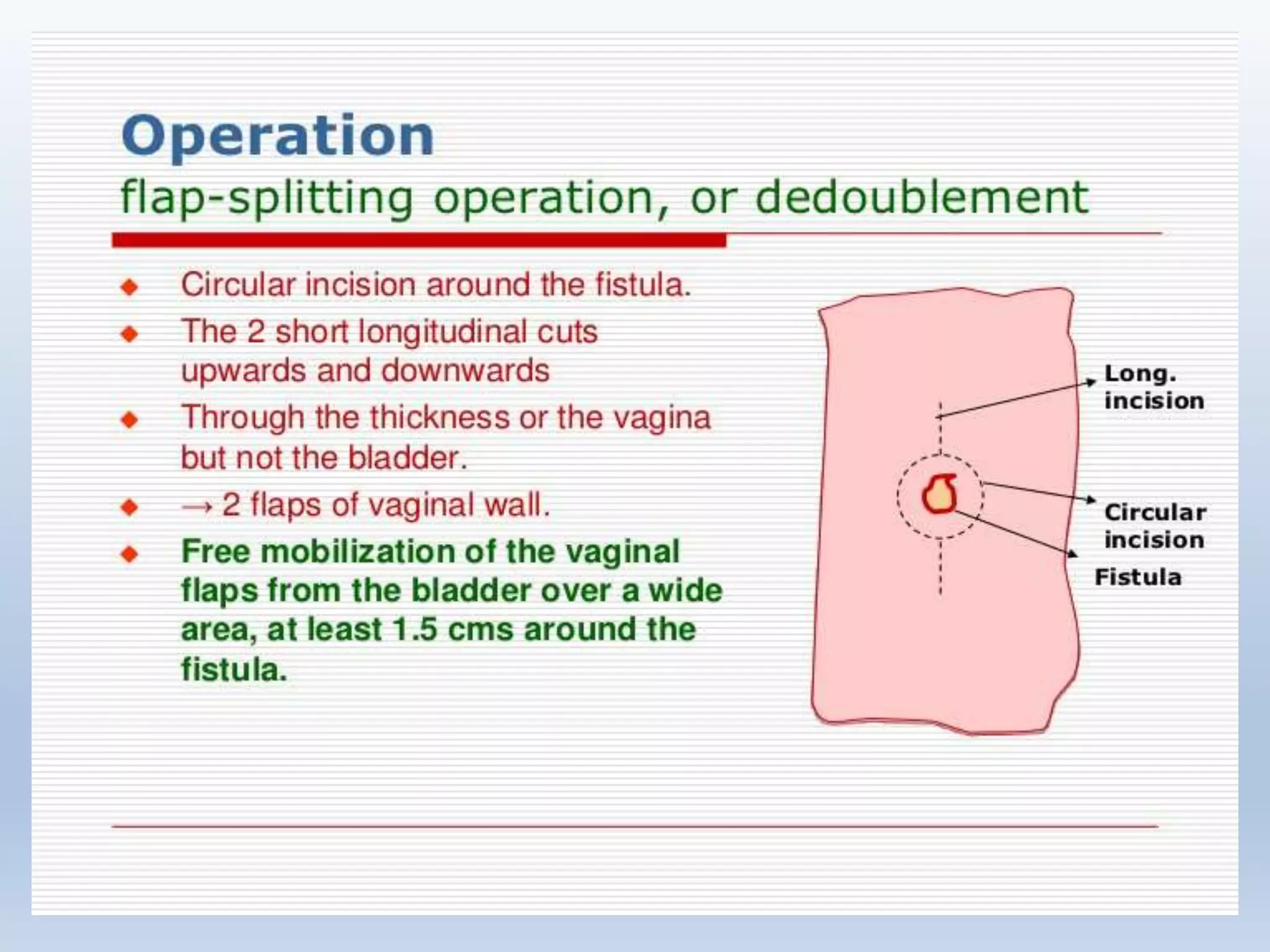
– Flap splitting technique
– Saucerization
– Latzko technique
• Abdominal approach
– Transvesical repair
– Transperitoneal repair
– Combined repair
Abdominal approach
• Indications
– High inaccessible fistula
– Multiple fistulas
– Involvement of uterus or bowel
– Need for ureteral re-implantation
– Complex fistula
Post-operative care cont..
• Maintain output at 100ml / hr
• Antimicrobials
• Plenty of fluids for continuous bladder
drainage
• Watch for any bladder block, fluid imbalance
Discharge Advice
• Topass urine frequently
• Avoid sexual intercourse for at least 3 months
• Todefer pregnancy for at least 1 year
• Subsequent deliveries should be abdominal
• If repair fails, local repair should be reattempted
after 3 months
Rectovaginal Fistula
Definition
Abnormal communication between the rectum
and vagina with involuntry escape of flatus
and or feces into vagina is called RVF.
Causes
1-Acquired
2- Congenital
Acquired –
Obstetrical causes –
• Incomplete healing or unrepaired recent
complete perineal tear is commonest.
• Obstructed labour- During obstructed labour
the compression effect produces necrosis
→infection→ sloughing→ fistule
• Instrumental injury inflicted during destructive
operation
Gynaecological –
• Following incomplete healing of repaired surgeries
• Trauma during operative procedure
• Malignancy of vagina, cervix or bowel
• Radiation
• Fall on sharp object
Congenital –
Anal canal may open into vestibule or
in vagina congenitally.
• Clinical presentation:
• Involuntary escape of flatus and/or feces into the
vagina
• Foul smelling vaginal discharge with periodic
uncontrolled escape of gas
• Appear immediately or 7-10 days after delivery
Diagnosis
• History collection
• Rectovaginal examination – size & shape of
fistula.
• Confirmation done by probe passing through
vagina into rectum.
• Confirmation
–Thin Probe is passed from the vagina through the fistulous
tract into the rectum/anal canal
– Methylene blue dye test
– Examination under anaesthesia
INVESTIGATIONS
– Barium enema
– Gastrograffin Enema
– Barium meal to confirm intestinal fistula
– Sigmoidoscopy & proctoscopy
– CT scans
– MRI
– Ultrasound
CLASSIFICATION
• Based on anatomical location of vaginal opening
– Low - vaginal opening near the posterior fourchette
– Mid - from the level of the cervix to just superior to the
posterior fourchette
– High -the fistula is in the area of the posterior fornix.
• Simple vs Complex
– Simple are small fistulas
– Complex are large
Treatment
• Preventive
• Good intranatal care
• Identification of simple abnormalities & repair it
• Care during gynaecological surgeries
• Surgery
• Situated in low down- simple repair
• Situated in middle third – repair by flap method
• Situated high up- Preliminary colostomy→local
repair after 3 wks→closure of colostomy after 3
wks
• SURGERY
Route:
– Transvaginal Approach
– Transanal Approach
– Abdominal Approach
Timing:
– Wait 8-12 weeks before surgical intervention to allow
surrounding inflammation to resolve completely
Lifestyle and home remedies
Good hygiene can help ease discomfort and reduce the chance of
vaginal or urinary tract infections while waiting for repair. Other home
remedies for people living with a rectovaginal fistula include:
•Wash with water. Shower or gently wash outer genital area with just
warm water each time when experience vaginal discharge or passage of
stool.
•Avoid irritants. Soap can dry and irritate the skin, but it may need a
gentle unscented soap in moderation. Avoid harsh or scented soap and
scented tampons and pads. Vaginal douches can increase the chance of
infection.
•Dry thoroughly. Allow the area to air-dry after washing, or gently pat the
area dry with a clean cloth or towel.
•Avoid rubbing with dry toilet paper. Pre-moistened, alcohol-
free, unscented towelettes or wipes or moistened cotton balls are
a good alternative.
•Apply a cream or powder. Moisture-barrier creams protect
irritated skin from liquid or stool. Nonmedicated talcum powder or
cornstarch also may help relieve discomfort. Be sure the area is
clean and dry before you apply any cream or powder.
•Wear cotton underwear and loose clothing. Tight clothing can
restrict airflow and worsen skin problems. Change soiled
underwear quickly. Products such as absorbent pads, disposable
underwear or adult diapers can help when passing liquid or stool,
but be sure they have an absorbent layer on top.
POST-TEST
1. Obstetrical fistula is best defined as:
A) A hole between the vagina and the bladder or rectum
B) An hole in perineum
C) A hole in the uterus
D) An injury to the cervix
2. Which of the following is NOT a risk factor of
developing an obstetrical fistula
A) Being a young first time mother
B) Being over age 35 at the time of delivery (advanced maternal age)
C) Having (untrained) family members as birth attendants
D) Poor nutritional status
3. What is a rectovaginal fistula?
A) A hole connecting the bladder to the vagina
B) A hole connecting the vagina to the uterus
C) A hole connecting the rectum to the vagina
D) Any hole on the rear wall of the vagina
4. Most common cause of VVF in india is:
A) Obstructed labour
B) Gynaec surgery
C) Radiation
D) Trauma
5. Postpartum VVF is best repaired after:
A. 6 weeks
B. 8 weeks
C. 3 months
D. 6 months
6. Mrs A, 48yrs had hysterectomy. On seventh
day, she devoloped fever, burning micturition
& continous dribbling of urine. She can also
pass urine voluntarily. The diagnosis is,
A. V V F
B. Ureterovaginal fistula
C. Stress incontinence
D. Urge incontinence
7.Most useful preoperative investigation for VVF
is:
A. Three swab test
B. Cystoscopy
C. Ultrasound
D. Urine culture
8. If RVF is present in high up(upper part )
preliminary treatment should be:
A. Colostomy
B. Colporraphy
C. Primary repair
D. Anterior resection
ANSWERS
1. A
2. D
3. C
4. A
5. C
6. B
7. B
8. A
Obstetric fistulae

Obstetric fistulae

  • 1.
    Obstetric Fistulae Mrs. USREEVIDYA, Msc. NURSING, Associate Professor, Apollo college of nursing, CHITTOOR
  • 2.
    PRE-TEST 1. Obstetrical fistulais best defined as: A) A hole between the vagina and the bladder or rectum B) An hole in perineum C) A hole in the uterus D) An injury to the cervix
  • 3.
    2. Which ofthe following is NOT a risk factor of developing an obstetrical fistula A) Being a young first time mother B) Being over age 35 at the time of delivery (advanced maternal age) C) Having (untrained) family members as birth attendants D) Poor nutritional status
  • 4.
    3. What isa rectovaginal fistula? A) A hole connecting the bladder to the vagina B) A hole connecting the vagina to the uterus C) A hole connecting the rectum to the vagina D) Any hole on the rear wall of the vagina
  • 5.
    4. Most commoncause of VVF in india is: A) Obstructed labour B) Gynaec surgery C) Radiation D) Trauma
  • 6.
    5. Postpartum VVFis best repaired after: A. 6 weeks B. 8 weeks C. 3 months D. 6 months
  • 7.
    6. Mrs A,48yrs had hysterectomy. On seventh day, she devoloped fever, burning micturition & continous dribbling of urine. She can also pass urine voluntarily. The diagnosis is, A. V V F B. Ureterovaginal fistula C. Stress incontinence D. Urge incontinence
  • 8.
    7.Most useful preoperativeinvestigation for VVF is: A. Three swab test B. Cystoscopy C. Ultrasound D. Urine culture
  • 9.
    8. If RVFis present in high up(upper part ) preliminary treatment should be: A. Colostomy B. Colporraphy C. Primary repair D. Anterior resection
  • 10.
    OBSTETRICAL FISTULA • Obstetricalfistula is a life changing childbirth injury. • An obstetrical fistula is a hole or connection that occurs between the vagina and the bladder or between the vagina and rectum. This is most often caused during a prolonged labor when the fetus' head applies continuous pressure to the pelvic bones resulting in soft tissue damage to the muscles in the pelvis.
  • 11.
    Definition – obstetric fistulais an abnormal communication between the vagina and the bladder or rectum. – Occurred in the course of pregnancy and results in uncontrolled passage of urine, feaces or flatus into the vagina.
  • 13.
  • 17.
    Causes • Obstetrical • Gynaecological 1.Obstetricalcauses – Ishemic: Due to prolonged compression effect on the bladder base between the head and pubic symphysis eg : obstructed labour Traumatic : • Instrumental vaginal delivery – in destructive operation, forceps delivery • Abdominal operation – Hysterectomy for rupture uterus, LSCS
  • 18.
    2. Gynaecological causes •Operative Injury – Ant. Colporraphy, Abdominal hysterectomy • Traumatic - ant. Vaginal wall & bladder may be injured following fall on a pointed objects, by a stick used for criminal abortion • Malignancy – by direct spread in cases of Advanced carcinoma of cervix, vagina or bladder • Radiation - Due to radiation effect ishemic necrosis may occur
  • 19.
    Types • Simple -Healthy tissues with good access • Complicated – Tissue loss, scarring, difficult access associated with RVF Depending upon SITE of the Fistula – Juxtacervical :( close to cx) –communication between supratrigonal region of bladder and vagina Midvaginal : communication between base (Trigone) of bladder and vagina Juxtaurethral: communication between neck of bladder and vagina
  • 23.
    Common Symptoms The completeurinary incontinence that is describing as a common symptom, as is bowel incontinence. However, women will often report several different symptoms. Common symptoms include the following: • Constant urine leaking from vagina • Irritation of the external genitalia • Frequent urinary tract infections • Leakage of gas and/or feces into the vagina if associated with RVF • Vaginal discharge (Foul discharges) • Nausea/vomiting • Abdominal or pelvic pain • Amenorrhea (or the absence of a normal menstrual period) • Dyspareunia (painful sex) • Psychosocial problems- social refuse; depression, low self-esteem, and insomnia
  • 30.
    Management • Prophylaxis • Immediatemanagement– once the diagnosis is made ,continuous catherization for 6-8 days is maintained. • Operative – surgery is the choice for definitive management
  • 32.
    Management cont.. Immediate management •If there is access to treatment immediately following birth injury, a catheter to be placed into the bladder which allows it to remain empty. • This takes pressure off of the hole, and prevents liquid from flowing through it while it repairs itself. • Doing this often allows it to heal on its own.
  • 33.
    Non-invasive treatment options Thereare some non-invasive treatment options available. These have less risk than traditional surgery, including less risk of infection and a faster healing time. But they work best for small holes. Two options are avaliable, either fibrin glue, which is medical grade glue that can be used to seal the connection. Or, could use a plug, which is a matrix made from collagen used to seal the connection. • Psychosocial counseling and rehabilitation
  • 34.
    Definitive Surgery • Idealtime for surgery is after 3 months following delivery • Surgical Fistula– If recognised <24 hrs: immediate repair If recognised >24 hrs : repair after 3 months • Radiation Fistula : repair after 12 months
  • 35.
    Surgical Management • FISTULAREPAIR IS NOT AN EMERGENCY • Most surgeons advise waiting at least 3 months from time of injury before operating. • In the early months, the surrounding tissues are oedematous and hyperemic, making them friable and difficult to handle.
  • 37.
    Preoperative care • Improvethe patient’s general condition- Nutrition, Infection, Dermatitis, Urine acidification, Psyche. • Contractures should be treated before surgery if possible. • Encourage liberal clear fluid intake until about 4hrs before surgery. • Bowel preparation should include enema the night before.
  • 38.
    Intraoperative Care • Anesthesia:Spinal or GA • Antibiotics: broad spectrum • Suture material: – Vicryl 2-0 - bladder and vagina – Polydioxanone 4-0 - ureter
  • 39.
  • 40.
    ROUTE OF REPAIR •Depends upon access to the fistula site, mobility of the vagina and surgeon expertise. SITE APPROACH LOW FISTULA Urethral Juxtaurethral VAGINAL CIRCUMFERENTIAL LOSS OF BLADDER NECK COMBINED ABDOMINOVAGINAL MIDVAGINAL FISTULA TRANSVAGINAL HIGH VAGINAL FISTULA Post hysterectomy Juxtacervical ABDOMINAL OR VAGINAL
  • 41.
    Principles of fistularepair • First attempt is best .  Tissue mobilization  Hemostasis  Adequate exposure  Aseptic measures  Tension free closure  Reinforcement  Expertise
  • 42.
    Repair of VesicovaginalFistula • Vaginal approach – Flap splitting technique – Saucerization – Latzko technique • Abdominal approach – Transvesical repair – Transperitoneal repair – Combined repair
  • 47.
    Abdominal approach • Indications –High inaccessible fistula – Multiple fistulas – Involvement of uterus or bowel – Need for ureteral re-implantation – Complex fistula
  • 49.
    Post-operative care cont.. •Maintain output at 100ml / hr • Antimicrobials • Plenty of fluids for continuous bladder drainage • Watch for any bladder block, fluid imbalance
  • 50.
    Discharge Advice • Topassurine frequently • Avoid sexual intercourse for at least 3 months • Todefer pregnancy for at least 1 year • Subsequent deliveries should be abdominal • If repair fails, local repair should be reattempted after 3 months
  • 51.
  • 52.
    Definition Abnormal communication betweenthe rectum and vagina with involuntry escape of flatus and or feces into vagina is called RVF.
  • 54.
    Causes 1-Acquired 2- Congenital Acquired – Obstetricalcauses – • Incomplete healing or unrepaired recent complete perineal tear is commonest. • Obstructed labour- During obstructed labour the compression effect produces necrosis →infection→ sloughing→ fistule
  • 55.
    • Instrumental injuryinflicted during destructive operation Gynaecological – • Following incomplete healing of repaired surgeries • Trauma during operative procedure • Malignancy of vagina, cervix or bowel • Radiation • Fall on sharp object
  • 56.
    Congenital – Anal canalmay open into vestibule or in vagina congenitally.
  • 57.
    • Clinical presentation: •Involuntary escape of flatus and/or feces into the vagina • Foul smelling vaginal discharge with periodic uncontrolled escape of gas • Appear immediately or 7-10 days after delivery
  • 58.
    Diagnosis • History collection •Rectovaginal examination – size & shape of fistula. • Confirmation done by probe passing through vagina into rectum.
  • 59.
    • Confirmation –Thin Probeis passed from the vagina through the fistulous tract into the rectum/anal canal – Methylene blue dye test – Examination under anaesthesia INVESTIGATIONS – Barium enema – Gastrograffin Enema – Barium meal to confirm intestinal fistula – Sigmoidoscopy & proctoscopy – CT scans – MRI – Ultrasound
  • 60.
    CLASSIFICATION • Based onanatomical location of vaginal opening – Low - vaginal opening near the posterior fourchette – Mid - from the level of the cervix to just superior to the posterior fourchette – High -the fistula is in the area of the posterior fornix. • Simple vs Complex – Simple are small fistulas – Complex are large
  • 61.
    Treatment • Preventive • Goodintranatal care • Identification of simple abnormalities & repair it • Care during gynaecological surgeries • Surgery • Situated in low down- simple repair • Situated in middle third – repair by flap method • Situated high up- Preliminary colostomy→local repair after 3 wks→closure of colostomy after 3 wks
  • 62.
    • SURGERY Route: – TransvaginalApproach – Transanal Approach – Abdominal Approach Timing: – Wait 8-12 weeks before surgical intervention to allow surrounding inflammation to resolve completely
  • 63.
    Lifestyle and homeremedies Good hygiene can help ease discomfort and reduce the chance of vaginal or urinary tract infections while waiting for repair. Other home remedies for people living with a rectovaginal fistula include: •Wash with water. Shower or gently wash outer genital area with just warm water each time when experience vaginal discharge or passage of stool. •Avoid irritants. Soap can dry and irritate the skin, but it may need a gentle unscented soap in moderation. Avoid harsh or scented soap and scented tampons and pads. Vaginal douches can increase the chance of infection. •Dry thoroughly. Allow the area to air-dry after washing, or gently pat the area dry with a clean cloth or towel.
  • 64.
    •Avoid rubbing withdry toilet paper. Pre-moistened, alcohol- free, unscented towelettes or wipes or moistened cotton balls are a good alternative. •Apply a cream or powder. Moisture-barrier creams protect irritated skin from liquid or stool. Nonmedicated talcum powder or cornstarch also may help relieve discomfort. Be sure the area is clean and dry before you apply any cream or powder. •Wear cotton underwear and loose clothing. Tight clothing can restrict airflow and worsen skin problems. Change soiled underwear quickly. Products such as absorbent pads, disposable underwear or adult diapers can help when passing liquid or stool, but be sure they have an absorbent layer on top.
  • 65.
    POST-TEST 1. Obstetrical fistulais best defined as: A) A hole between the vagina and the bladder or rectum B) An hole in perineum C) A hole in the uterus D) An injury to the cervix
  • 66.
    2. Which ofthe following is NOT a risk factor of developing an obstetrical fistula A) Being a young first time mother B) Being over age 35 at the time of delivery (advanced maternal age) C) Having (untrained) family members as birth attendants D) Poor nutritional status
  • 67.
    3. What isa rectovaginal fistula? A) A hole connecting the bladder to the vagina B) A hole connecting the vagina to the uterus C) A hole connecting the rectum to the vagina D) Any hole on the rear wall of the vagina
  • 68.
    4. Most commoncause of VVF in india is: A) Obstructed labour B) Gynaec surgery C) Radiation D) Trauma
  • 69.
    5. Postpartum VVFis best repaired after: A. 6 weeks B. 8 weeks C. 3 months D. 6 months
  • 70.
    6. Mrs A,48yrs had hysterectomy. On seventh day, she devoloped fever, burning micturition & continous dribbling of urine. She can also pass urine voluntarily. The diagnosis is, A. V V F B. Ureterovaginal fistula C. Stress incontinence D. Urge incontinence
  • 71.
    7.Most useful preoperativeinvestigation for VVF is: A. Three swab test B. Cystoscopy C. Ultrasound D. Urine culture
  • 72.
    8. If RVFis present in high up(upper part ) preliminary treatment should be: A. Colostomy B. Colporraphy C. Primary repair D. Anterior resection
  • 73.
    ANSWERS 1. A 2. D 3.C 4. A 5. C 6. B 7. B 8. A