CATHETER-ASSOCIATED URINARY TRACT INFECTION
OUTLINE
INTRODUCTION
Catheter-associated urinary tract infections (CAUTI)
Epidemiology
Risk factors
Mechanisms of catheter-Associated Urinary Tract Infection
Microorganisms causing CAUTI
Signs and symptoms
Diagnosis of CAUTI
Prevention
Treatment
Conclusion
INTRODUCTION
The most common healthcare-associated infection and cause of
secondary bloodstream infections is catheter-associated urinary
tract infection (CAUTI).
Despite significant advances in diagnosis, prevention, and
treatment, CAUTI remains a significant healthcare burden, with
alarmingly high antibiotic resistance rates.
Because of the widespread use of antibiotics CAUTI organisms
producing extended spectrum beta lactamase (ESBL) are have
been isolated from catheter biofilm.
Catheter-associated urinary tract
infections (CAUTI)
It is a urinary tract infection (UTI) in which a positive culture
was obtained after a urinary catheter had been in place for
more than two days (Podkovik et al., 2019).
Patients with indwelling bladder catheters are predisposed to
bacteriuria and UTIs.
There is a 3 to 10% chance of developing significant bacteriuria
every day the catheter is indwelling (Podkovik et al., 2019).
CAUTI may be asymptomatic and symptomatic
Catheter-associated urinary tract
infections (CAUTI)
Short term catheterization
Usually by a single organism.
Escherichia coli is the most frequent species isolated.
Other Enterobacteriaceae (Klebsiella, Serratia, Citrobacter,
Enterobacter), Pseudomonas, etc (Tambyah and Oon,2012).
Long term catheterization
Usually polymicrobial.
Species such as Proteus mirabilis, Morganella morganii,
Providencia stuartii are common (Tambyah and Oon,2012).
Figure 1: Urinary tract infections (UTIs) are caused by a wide range of pathogens
Source: Flores-Mireles et al., 2015
EPIDEMIOLOGY
Incidence
Of 34.4 million annual hospital admissions, 12-16% of all adult
patients will have a urinary catheter placed.
Up to 450,000 incidence of CAUTIs annually.
Mortality
Related to bacteremia which accounts for 0.3-3.9% of total
UTIs
Morbidity
Spread of infection throughout urinary tract causing absesses,
epididymitis.
S/N Modifiable risk factors Non-modifiable risk factors
1 Duration of catheterization Female sex
2 Non-adherence to aseptic catheter (i.e. opening
closed system)
Severe underlying illness
3 Lower professional training of inserter Non-surgical disease
4 Catheter insertion outside operating room Aged >50 years
Diabetes mellitus
RISK FACTORS
Table 1: Risk factors for CAUTIs
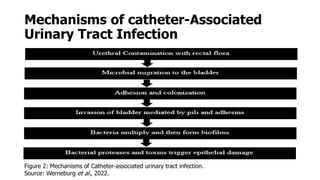
Mechanisms of catheter-Associated
Urinary Tract Infection
Figure 2: Mechanisms of Catheter-associated urinary tract infection.
Source: Werneburg et al., 2022.
Figure 3: Pathogenesis of urinary tract infections
Source: Flores-Mireles et al., 2015.
Microorganisms causing CAUTI
CAUTI with Escherichia coli
It is the most common cause of CAUTI in 24–60% patients.
Uropathogenic Escherichia coli use P fimbriae (pyelonephritis-
associated pili) to bind urinary tract endothelial cells.
Vast majority of catheter-colonizing cells (up to 88%) express
type 1 fimbriae and around 73% in Escherichia coli causing
CAUTI .
Microorganisms causing CAUTI
Proteus in CAUTI
UTIs are the most common manifestation of Proteus infection.
Prevalence of 20–45%.
Most common age group is 20–50 years
Proteus mirabilis increases the urinary pH, thus generating
calcium crystals and magnesium ammonium phosphate
precipitates.
Microorganisms causing CAUTI
Pseudomonas in CAUTI
Pseudomonas aeruginosa is an opportunistic human pathogen
that is especially adept at forming surface-associated biofilms.
Pseudomonas aeruginosa is responsible for 12% of all
nosocomial urinary tract infections (UTIs), making it the third
most common organism.
Pseudomonas aeruginosa causes CAUTIs through biofilm
formation on the surface of indwelling catheters.
Microorganisms causing CAUTI
CAUTI with Klebsiella
Klebsiella penumoniae and Klebsiella oxytoca have both been
found to be common causes of CAUTI with high rates of
antimicrobial resistance (Townsend et al., 2020).
Klebsiella pneumoniae, as a normal flora of the gastrointestinal
tract, often causes UTIs through cross-transmission.
Ikeda et al. (2018) reported extended-spectrum beta-
lactamase-producing Klebsiella pneumoniae isolated from
catheter-associated urinary tract infection.
Microorganisms causing CAUTI
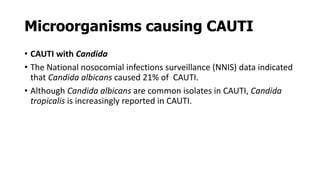
• CAUTI with Candida
• The National nosocomial infections surveillance (NNIS) data indicated
that Candida albicans caused 21% of CAUTI.
• Although Candida albicans are common isolates in CAUTI, Candida
tropicalis is increasingly reported in CAUTI.
SIGNS AND SYMPTOMS
Needing to urinate or experiencing suprapubic discomfort.
Acute or chronic pyelonephritis symptoms can appear without
the typical urinary tract symptoms.
Patients may have nonspecific symptoms such as:
Malaise
Fever
Flank pain
Anorexia
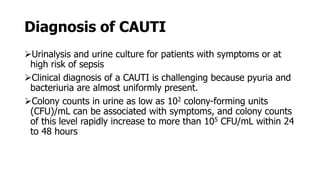
Diagnosis of CAUTI
Urinalysis and urine culture for patients with symptoms or at
high risk of sepsis
Clinical diagnosis of a CAUTI is challenging because pyuria and
bacteriuria are almost uniformly present.
Colony counts in urine as low as 102 colony-forming units
(CFU)/mL can be associated with symptoms, and colony counts
of this level rapidly increase to more than 105 CFU/mL within 24
to 48 hours
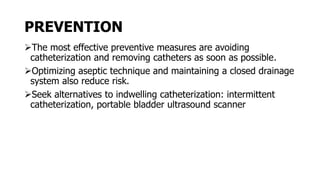
PREVENTION
The most effective preventive measures are avoiding
catheterization and removing catheters as soon as possible.
Optimizing aseptic technique and maintaining a closed drainage
system also reduce risk.
Seek alternatives to indwelling catheterization: intermittent
catheterization, portable bladder ultrasound scanner
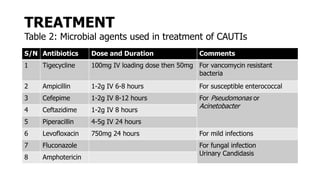
S/N Antibiotics Dose and Duration Comments
1 Tigecycline 100mg IV loading dose then 50mg For vancomycin resistant
bacteria
2 Ampicillin 1-2g IV 6-8 hours For susceptible enterococcal
3 Cefepime 1-2g IV 8-12 hours For Pseudomonas or
Acinetobacter
4 Ceftazidime 1-2g IV 8 hours
5 Piperacillin 4-5g IV 24 hours
6 Levofloxacin 750mg 24 hours For mild infections
7 Fluconazole For fungal infection
Urinary Candidasis
8 Amphotericin
TREATMENT
Table 2: Microbial agents used in treatment of CAUTIs
CONCLUSION
CAUTI is a common health-care-acquired infection caused by a
medical device. The use of an indwelling urethral catheter is
linked to an increased risk of symptomatic urinary tract infection
and bacteremia, as well as additional morbidity due to non-
infectious complications.
To reduce infections associated with the use of these devices,
infection control programs must develop, implement, and
monitor policies and practices. The use of indwelling urethral
catheters should be limited, and catheters should be removed
as soon as they are no longer needed.
THANK YOU FOR LISTENING

IBSEMINAR.pptx

  • 1.
  • 2.
    OUTLINE INTRODUCTION Catheter-associated urinary tractinfections (CAUTI) Epidemiology Risk factors Mechanisms of catheter-Associated Urinary Tract Infection Microorganisms causing CAUTI Signs and symptoms Diagnosis of CAUTI Prevention Treatment Conclusion
  • 3.
    INTRODUCTION The most commonhealthcare-associated infection and cause of secondary bloodstream infections is catheter-associated urinary tract infection (CAUTI). Despite significant advances in diagnosis, prevention, and treatment, CAUTI remains a significant healthcare burden, with alarmingly high antibiotic resistance rates. Because of the widespread use of antibiotics CAUTI organisms producing extended spectrum beta lactamase (ESBL) are have been isolated from catheter biofilm.
  • 4.
    Catheter-associated urinary tract infections(CAUTI) It is a urinary tract infection (UTI) in which a positive culture was obtained after a urinary catheter had been in place for more than two days (Podkovik et al., 2019). Patients with indwelling bladder catheters are predisposed to bacteriuria and UTIs. There is a 3 to 10% chance of developing significant bacteriuria every day the catheter is indwelling (Podkovik et al., 2019). CAUTI may be asymptomatic and symptomatic
  • 5.
    Catheter-associated urinary tract infections(CAUTI) Short term catheterization Usually by a single organism. Escherichia coli is the most frequent species isolated. Other Enterobacteriaceae (Klebsiella, Serratia, Citrobacter, Enterobacter), Pseudomonas, etc (Tambyah and Oon,2012). Long term catheterization Usually polymicrobial. Species such as Proteus mirabilis, Morganella morganii, Providencia stuartii are common (Tambyah and Oon,2012).
  • 6.
    Figure 1: Urinarytract infections (UTIs) are caused by a wide range of pathogens Source: Flores-Mireles et al., 2015
  • 7.
    EPIDEMIOLOGY Incidence Of 34.4 millionannual hospital admissions, 12-16% of all adult patients will have a urinary catheter placed. Up to 450,000 incidence of CAUTIs annually. Mortality Related to bacteremia which accounts for 0.3-3.9% of total UTIs Morbidity Spread of infection throughout urinary tract causing absesses, epididymitis.
  • 8.
    S/N Modifiable riskfactors Non-modifiable risk factors 1 Duration of catheterization Female sex 2 Non-adherence to aseptic catheter (i.e. opening closed system) Severe underlying illness 3 Lower professional training of inserter Non-surgical disease 4 Catheter insertion outside operating room Aged >50 years Diabetes mellitus RISK FACTORS Table 1: Risk factors for CAUTIs
  • 9.
    Mechanisms of catheter-Associated UrinaryTract Infection Figure 2: Mechanisms of Catheter-associated urinary tract infection. Source: Werneburg et al., 2022.
  • 10.
    Figure 3: Pathogenesisof urinary tract infections Source: Flores-Mireles et al., 2015.
  • 11.
    Microorganisms causing CAUTI CAUTIwith Escherichia coli It is the most common cause of CAUTI in 24–60% patients. Uropathogenic Escherichia coli use P fimbriae (pyelonephritis- associated pili) to bind urinary tract endothelial cells. Vast majority of catheter-colonizing cells (up to 88%) express type 1 fimbriae and around 73% in Escherichia coli causing CAUTI .
  • 12.
    Microorganisms causing CAUTI Proteusin CAUTI UTIs are the most common manifestation of Proteus infection. Prevalence of 20–45%. Most common age group is 20–50 years Proteus mirabilis increases the urinary pH, thus generating calcium crystals and magnesium ammonium phosphate precipitates.
  • 13.
    Microorganisms causing CAUTI Pseudomonasin CAUTI Pseudomonas aeruginosa is an opportunistic human pathogen that is especially adept at forming surface-associated biofilms. Pseudomonas aeruginosa is responsible for 12% of all nosocomial urinary tract infections (UTIs), making it the third most common organism. Pseudomonas aeruginosa causes CAUTIs through biofilm formation on the surface of indwelling catheters.
  • 14.
    Microorganisms causing CAUTI CAUTIwith Klebsiella Klebsiella penumoniae and Klebsiella oxytoca have both been found to be common causes of CAUTI with high rates of antimicrobial resistance (Townsend et al., 2020). Klebsiella pneumoniae, as a normal flora of the gastrointestinal tract, often causes UTIs through cross-transmission. Ikeda et al. (2018) reported extended-spectrum beta- lactamase-producing Klebsiella pneumoniae isolated from catheter-associated urinary tract infection.
  • 15.
    Microorganisms causing CAUTI •CAUTI with Candida • The National nosocomial infections surveillance (NNIS) data indicated that Candida albicans caused 21% of CAUTI. • Although Candida albicans are common isolates in CAUTI, Candida tropicalis is increasingly reported in CAUTI.
  • 16.
    SIGNS AND SYMPTOMS Needingto urinate or experiencing suprapubic discomfort. Acute or chronic pyelonephritis symptoms can appear without the typical urinary tract symptoms. Patients may have nonspecific symptoms such as: Malaise Fever Flank pain Anorexia
  • 17.
    Diagnosis of CAUTI Urinalysisand urine culture for patients with symptoms or at high risk of sepsis Clinical diagnosis of a CAUTI is challenging because pyuria and bacteriuria are almost uniformly present. Colony counts in urine as low as 102 colony-forming units (CFU)/mL can be associated with symptoms, and colony counts of this level rapidly increase to more than 105 CFU/mL within 24 to 48 hours
  • 18.
    PREVENTION The most effectivepreventive measures are avoiding catheterization and removing catheters as soon as possible. Optimizing aseptic technique and maintaining a closed drainage system also reduce risk. Seek alternatives to indwelling catheterization: intermittent catheterization, portable bladder ultrasound scanner
  • 19.
    S/N Antibiotics Doseand Duration Comments 1 Tigecycline 100mg IV loading dose then 50mg For vancomycin resistant bacteria 2 Ampicillin 1-2g IV 6-8 hours For susceptible enterococcal 3 Cefepime 1-2g IV 8-12 hours For Pseudomonas or Acinetobacter 4 Ceftazidime 1-2g IV 8 hours 5 Piperacillin 4-5g IV 24 hours 6 Levofloxacin 750mg 24 hours For mild infections 7 Fluconazole For fungal infection Urinary Candidasis 8 Amphotericin TREATMENT Table 2: Microbial agents used in treatment of CAUTIs
  • 20.
    CONCLUSION CAUTI is acommon health-care-acquired infection caused by a medical device. The use of an indwelling urethral catheter is linked to an increased risk of symptomatic urinary tract infection and bacteremia, as well as additional morbidity due to non- infectious complications. To reduce infections associated with the use of these devices, infection control programs must develop, implement, and monitor policies and practices. The use of indwelling urethral catheters should be limited, and catheters should be removed as soon as they are no longer needed.
  • 21.
    THANK YOU FORLISTENING