4-8 COMPLEX NUMBERS
Chapter 4 Quadratic Functions and Equations
©Tentinger
ESSENTIAL UNDERSTANDING AND
OBJECTIVES
   Essential Understanding: the complex numbers are
    based on a number whose square is -1

 Objectives:
 Students will be able to:
       Identify complex numbers
       Graph and perform operations using complex numbers
       Find complex number solutions to quadratic equations
IOWA CORE CURRICULUM
 Number and Quantity
 N.CN.1. Know there is a complex number I such
  that i2 = -1, and every complex number has the
  form a + bi with a and b real.
 N.CN.2. Use the relation i2 = -1 and the
  commutative, associative, and distributive
  properties to add, subtract, and multiply complex
  numbers.
 N.CN.7. Solve quadratic equations with real
  coefficients that have complex solutions
 N.CN.8 (+) Expand polynomial identities to the
  complex numbers
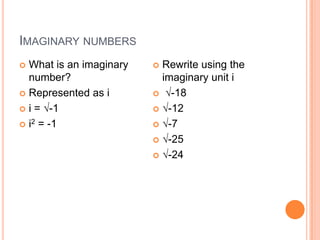
IMAGINARY NUMBERS
 What is an imaginary    Rewrite using the
  number?                  imaginary unit i
 Represented as i        √-18

 i = √-1                 √-12

 i2 = -1                 √-7

                          √-25

                          √-24
IMAGINARY NUMBERS
 Imaginary number: any number in the form a + bi,
  where a and b are real numbers and b does not
  equal zero.
 Imaginary numbers and real numbers make up the
  set of complex numbers
ABSOLUTE VALUE
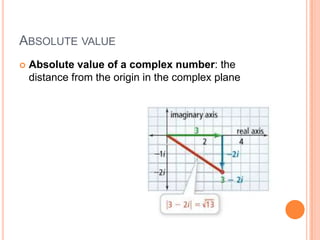
   Absolute value of a complex number: the
    distance from the origin in the complex plane
GRAPHING IN THE COMPLEX NUMBER PLANE
 The y-axis is the imaginary numbers, the x-axis is
  the real numbers
 What are the graph and absolute values of each
  number?
 5 –i


   -3 – 2i


   1 + 4i
ADDING AND SUBTRACTING
 You can define operations on the set of complex
  numbers so that when you restrict the operations to
  the subset of real numbers, you get the familiar
  operations on the real numbers.
 Adding and Subtracting Complex Numbers

 Combine the real numbers and the imaginary
  numbers
 (7-2i)+(-3+i)

 (8 + 6i)-(8-6i)

 (1+5i)-(3-2i)

 (-3+9i)+(3+9i)
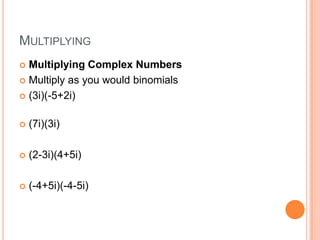
MULTIPLYING
 Multiplying Complex Numbers
 Multiply as you would binomials

 (3i)(-5+2i)


   (7i)(3i)

   (2-3i)(4+5i)

   (-4+5i)(-4-5i)
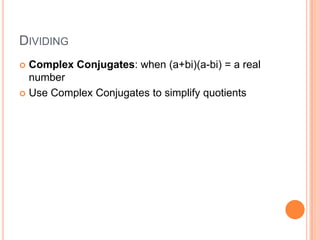
DIVIDING
 Complex Conjugates: when (a+bi)(a-bi) = a real
  number
 Use Complex Conjugates to simplify quotients
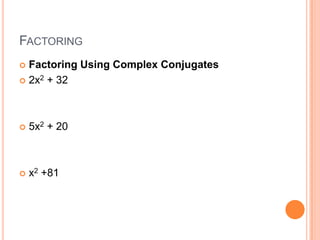
FACTORING
 Factoring Using Complex Conjugates
 2x2 + 32


   5x2 + 20


   x2 +81
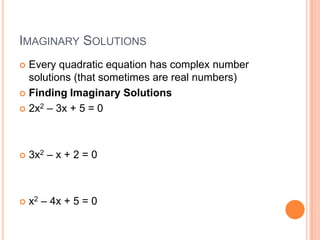
IMAGINARY SOLUTIONS
 Every quadratic equation has complex number
  solutions (that sometimes are real numbers)
 Finding Imaginary Solutions

 2x2 – 3x + 5 = 0


   3x2 – x + 2 = 0


   x2 – 4x + 5 = 0
HOMEWORK
 Pg. 253 – 254
 #9 – 69 (3s)

Alg II Unit 4-8 Quadratic Equations and Complex Numbers

  • 1.
    4-8 COMPLEX NUMBERS Chapter4 Quadratic Functions and Equations ©Tentinger
  • 2.
    ESSENTIAL UNDERSTANDING AND OBJECTIVES  Essential Understanding: the complex numbers are based on a number whose square is -1  Objectives:  Students will be able to:  Identify complex numbers  Graph and perform operations using complex numbers  Find complex number solutions to quadratic equations
  • 3.
    IOWA CORE CURRICULUM Number and Quantity  N.CN.1. Know there is a complex number I such that i2 = -1, and every complex number has the form a + bi with a and b real.  N.CN.2. Use the relation i2 = -1 and the commutative, associative, and distributive properties to add, subtract, and multiply complex numbers.  N.CN.7. Solve quadratic equations with real coefficients that have complex solutions  N.CN.8 (+) Expand polynomial identities to the complex numbers
  • 4.
    IMAGINARY NUMBERS  Whatis an imaginary  Rewrite using the number? imaginary unit i  Represented as i  √-18  i = √-1  √-12  i2 = -1  √-7  √-25  √-24
  • 5.
    IMAGINARY NUMBERS  Imaginarynumber: any number in the form a + bi, where a and b are real numbers and b does not equal zero.  Imaginary numbers and real numbers make up the set of complex numbers
  • 6.
    ABSOLUTE VALUE  Absolute value of a complex number: the distance from the origin in the complex plane
  • 7.
    GRAPHING IN THECOMPLEX NUMBER PLANE  The y-axis is the imaginary numbers, the x-axis is the real numbers  What are the graph and absolute values of each number?  5 –i  -3 – 2i  1 + 4i
  • 8.
    ADDING AND SUBTRACTING You can define operations on the set of complex numbers so that when you restrict the operations to the subset of real numbers, you get the familiar operations on the real numbers.  Adding and Subtracting Complex Numbers  Combine the real numbers and the imaginary numbers  (7-2i)+(-3+i)  (8 + 6i)-(8-6i)  (1+5i)-(3-2i)  (-3+9i)+(3+9i)
  • 9.
    MULTIPLYING  Multiplying ComplexNumbers  Multiply as you would binomials  (3i)(-5+2i)  (7i)(3i)  (2-3i)(4+5i)  (-4+5i)(-4-5i)
  • 10.
    DIVIDING  Complex Conjugates:when (a+bi)(a-bi) = a real number  Use Complex Conjugates to simplify quotients
  • 11.
    FACTORING  Factoring UsingComplex Conjugates  2x2 + 32  5x2 + 20  x2 +81
  • 12.
    IMAGINARY SOLUTIONS  Everyquadratic equation has complex number solutions (that sometimes are real numbers)  Finding Imaginary Solutions  2x2 – 3x + 5 = 0  3x2 – x + 2 = 0  x2 – 4x + 5 = 0
  • 13.
    HOMEWORK  Pg. 253– 254  #9 – 69 (3s)