Complement system
Dr Hassan Yar
The complement system
• A defensive system consisting of over 30 proteins produced by the
liver and found in circulating blood serum.
• These proteins are not immunoglobulins and their concentrations in
serum do not increase after immunization
• Complement activation (fixation) leads to lysis of cells and to the
generation of many powerful biologically active substances
Cascade
• The complement works as a cascade system:
Cascade is when one reaction triggers another reaction which trigger others
and so on. These types of systems can grow exponentially very fast.
Role of Complement in Disease
• The complement system plays a critical role in inflammation and
defense against some bacterial infections.
• Complement may also be activated during reactions against
incompatible blood transfusions, and during the damaging immune
responses that accompany autoimmune disease.
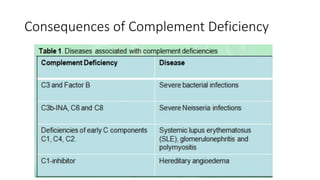
• Deficiencies of individual complement components or inhibitors of
the system can lead to a variety of diseases
Cascade Activation
• Complement proteins are often designated by an uppercase letter C
and are inactive until they are split into products.
Example: C1
• When the products are split they become active. The active products
are usually designated with a lower case a or b.
Example: C1a and C1b
Functions
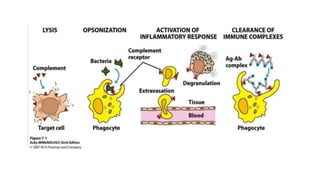
• Four Important functions:
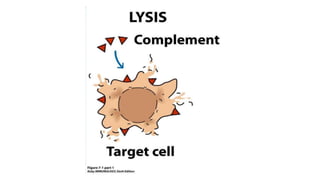
1. Lysis
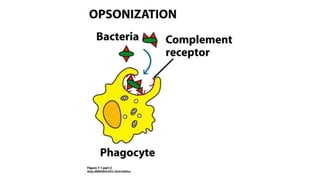
2. Opsonization
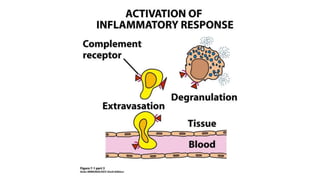
3. Activation of inflammatory response
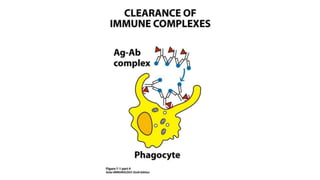
4. Clearance of immune complexes
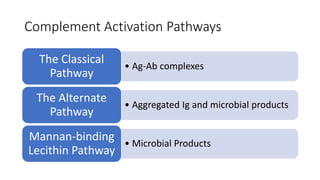
Complement Activation Pathways
• Ag-Ab complexes
The Classical
Pathway
• Aggregated Ig and microbial products
The Alternate
Pathway
• Microbial Products
Mannan-binding
Lecithin Pathway
The Classical Pathway
• Activators: Ag – Ab complexes
• Antibodies involved: IgG and IgM
• Activation in an orderly fashion of nine major protein components; C1
– C9
• Products of activation are enzymes that catalyze the subsequent step
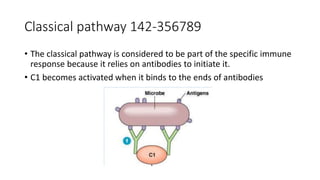
Classical pathway 142-356789
• The classical pathway is considered to be part of the specific immune
response because it relies on antibodies to initiate it.
• C1 becomes activated when it binds to the ends of antibodies
Alternative Pathway
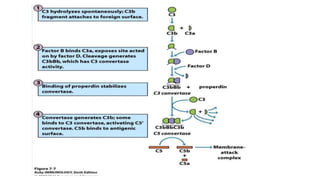
• Four components: C3, factor B, factor D, and properdin
• Triggering substances may be pathogens or Nonpathogens; bacterial
cell wall components, fungi, viruses, parasites immune complexes,
RBCs, polymers
Lectin Pathway
• Lectin is a protein that binds to carbohydrate
• MBL (mannose-binding lectin) binds to mannose on many bacterial
cells MBL is produced by liver in acute-phase inflammatory reactions
• Once MBL binds to target cell, 2 serine proteases (MASP-1, MASP-2)
bind Acts like C1
Finally what do these pathways do?
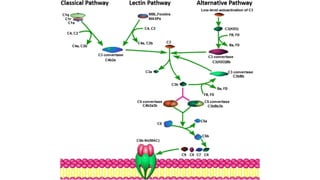
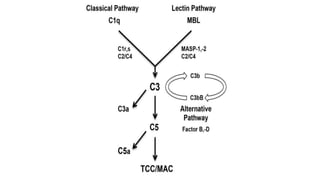
• Converge to form membrane attack complex (MAC)
• MAC forms large channel through the membrane of pathogen
• Because of the open channel ions move freely in & out!
• Cell cannot maintain osmotic stability
• Killed by
• Influx of water
• Loss of electrolytes
Where is it synthesized?
• C1: Intestinal epithelium
• C2: Macrophages
• C3: Liver
• C4: Macrophages
• C5: Spleen
• C6: Liver
• C8: Spleen
• C9: Liver
• C4, C5, C6 & C3 are Acute phase reactants
Consequences of Complement Deficiency
The End

Complement system

  • 1.
  • 2.
    The complement system •A defensive system consisting of over 30 proteins produced by the liver and found in circulating blood serum. • These proteins are not immunoglobulins and their concentrations in serum do not increase after immunization • Complement activation (fixation) leads to lysis of cells and to the generation of many powerful biologically active substances
  • 3.
    Cascade • The complementworks as a cascade system: Cascade is when one reaction triggers another reaction which trigger others and so on. These types of systems can grow exponentially very fast.
  • 4.
    Role of Complementin Disease • The complement system plays a critical role in inflammation and defense against some bacterial infections. • Complement may also be activated during reactions against incompatible blood transfusions, and during the damaging immune responses that accompany autoimmune disease. • Deficiencies of individual complement components or inhibitors of the system can lead to a variety of diseases
  • 5.
    Cascade Activation • Complementproteins are often designated by an uppercase letter C and are inactive until they are split into products. Example: C1 • When the products are split they become active. The active products are usually designated with a lower case a or b. Example: C1a and C1b
  • 6.
    Functions • Four Importantfunctions: 1. Lysis 2. Opsonization 3. Activation of inflammatory response 4. Clearance of immune complexes
  • 12.
    Complement Activation Pathways •Ag-Ab complexes The Classical Pathway • Aggregated Ig and microbial products The Alternate Pathway • Microbial Products Mannan-binding Lecithin Pathway
  • 14.
    The Classical Pathway •Activators: Ag – Ab complexes • Antibodies involved: IgG and IgM • Activation in an orderly fashion of nine major protein components; C1 – C9 • Products of activation are enzymes that catalyze the subsequent step
  • 15.
    Classical pathway 142-356789 •The classical pathway is considered to be part of the specific immune response because it relies on antibodies to initiate it. • C1 becomes activated when it binds to the ends of antibodies
  • 16.
    Alternative Pathway • Fourcomponents: C3, factor B, factor D, and properdin • Triggering substances may be pathogens or Nonpathogens; bacterial cell wall components, fungi, viruses, parasites immune complexes, RBCs, polymers
  • 18.
    Lectin Pathway • Lectinis a protein that binds to carbohydrate • MBL (mannose-binding lectin) binds to mannose on many bacterial cells MBL is produced by liver in acute-phase inflammatory reactions • Once MBL binds to target cell, 2 serine proteases (MASP-1, MASP-2) bind Acts like C1
  • 20.
    Finally what dothese pathways do? • Converge to form membrane attack complex (MAC) • MAC forms large channel through the membrane of pathogen • Because of the open channel ions move freely in & out! • Cell cannot maintain osmotic stability • Killed by • Influx of water • Loss of electrolytes
  • 21.
    Where is itsynthesized? • C1: Intestinal epithelium • C2: Macrophages • C3: Liver • C4: Macrophages • C5: Spleen • C6: Liver • C8: Spleen • C9: Liver • C4, C5, C6 & C3 are Acute phase reactants
  • 22.
  • 23.