MEDIATORS OF INFLAMMATION
Dr. D. VAMSHIKRISHNA, M.D (H)
Learning Objectives
1. What are Mediators of Inflammation?
2. What are the General Properties of
Mediators of Inflammation?
3. What are the Different Types of
Mediators?
Mediators of Inflammation.
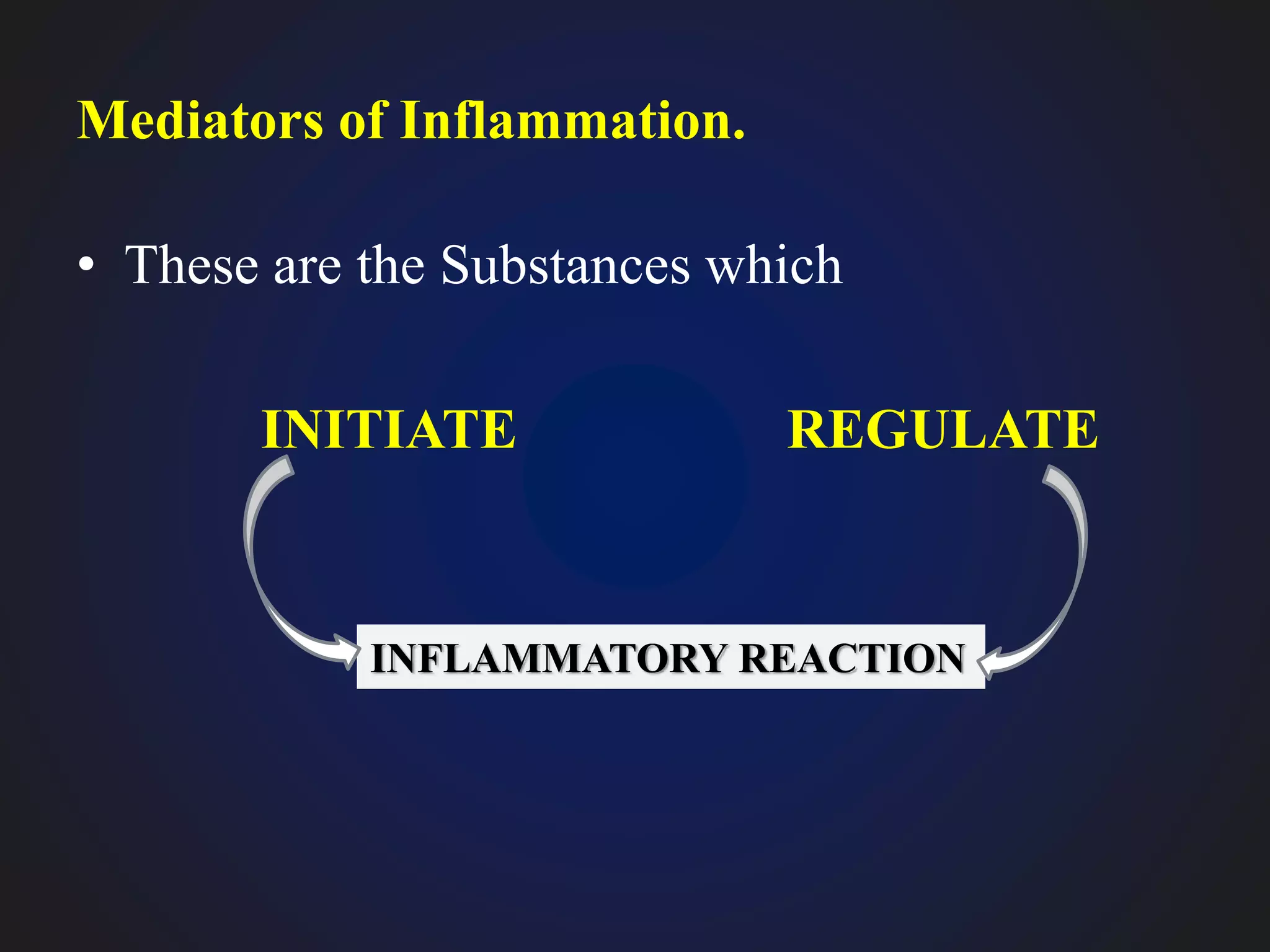
• These are the Substances which
INITIATE REGULATE
INFLAMMATORY REACTION
General Properties of Mediators of
Inflammation.
1. Mediators can be:
CELL- DERIVED PLASMA DERIVED
PREFORMED/
READYMADE
(stored in the
Granules)
DE-NOVO
(FORMED NEWLY)
Synthesized if needed
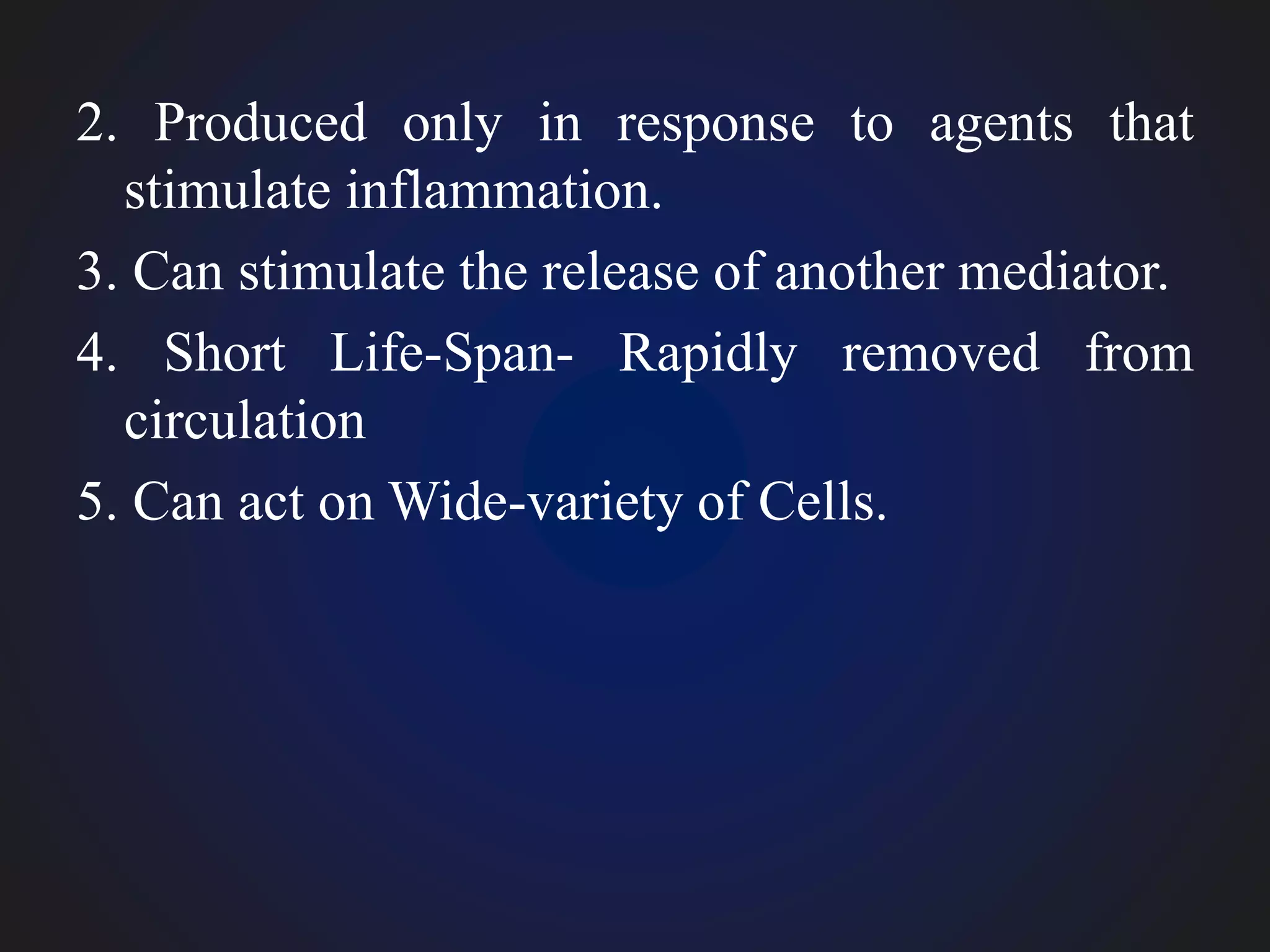
2. Produced only in response to agents that
stimulate inflammation.
3. Can stimulate the release of another mediator.
4. Short Life-Span- Rapidly removed from
circulation
5. Can act on Wide-variety of Cells.
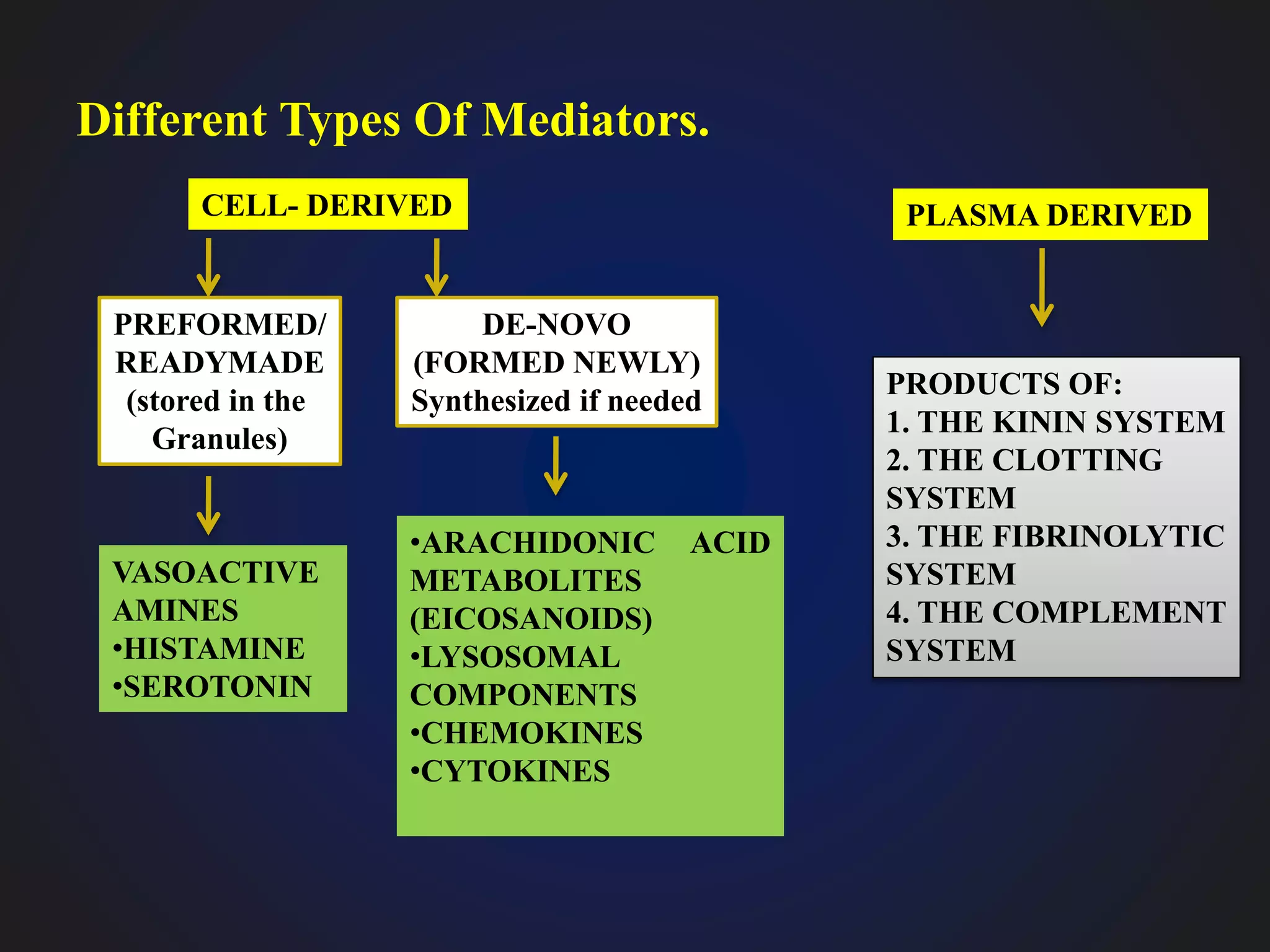
Different Types Of Mediators.
CELL- DERIVED PLASMA DERIVED
PREFORMED/
READYMADE
(stored in the
Granules)
DE-NOVO
(FORMED NEWLY)
Synthesized if needed
VASOACTIVE
AMINES
•HISTAMINE
•SEROTONIN
•ARACHIDONIC ACID
METABOLITES
(EICOSANOIDS)
•LYSOSOMAL
COMPONENTS
•CHEMOKINES
•CYTOKINES
PRODUCTS OF:
1. THE KININ SYSTEM
2. THE CLOTTING
SYSTEM
3. THE FIBRINOLYTIC
SYSTEM
4. THE COMPLEMENT
SYSTEM
VASOACTIVE AMINES
• First mediators to be released during
inflammation.
• Derived from amino acid- HISTIDINE
• They are Histamine and Serotonin
Histamine
Sources:
• Mast cells (Most imp)
• Basophils
• Platelets
Stimuli for release of Histamine:
• Heat, Cold, Irradiation, Trauma, Irritant
Chemicals, Immunologic Reactions.
• C3a, C5a- Anphylatoxins.
• Interleukins- IL-1, IL-8
Actions of Histamine:
• Increase in Vascular Permeability.
• Vasodilatation.
• Itching and Pain
• Responsible for Flare and Wheal reaction of
Skin.
Serotonin/5-Hydroxytryptamine
Sources:
• Mast cells
• Platelets
Also:
• Chromaffin cells of GIT, Spleen, Nervous
tissue
Actions of Serotonin:
• The actions of 5-HT are similar to histamine
but it is a less potent mediator of increased
vascular permeability and vasodilatation than
histamine.
2. ARACHIDONIC ACID METABOLITES
(EICOSANOIDS):
• Arachidonic acid metabolites or eicosanoids
are the most potent mediators of inflammation,
much more than oxygen free radicals.
Eicosanoids:
- Prostaglandins (D2, E2, F2-α, I2)
- Thromboxane
- Leukotrienes
- Lipoxins
Source: Tissue injury
Damage to Mast cells, Endothelial cells, Macrophages, Platelets
Ca++ Influx into cells
ACTIVATION OF PHOSPHOLIPASES
ARACHIDONIC ACID
(PRESENT IN CELL MEMBRANE)
FREE ARACHIDONIC ACID
ARACHIDONIC ACID METABOLITES
OR EICOSANOIDS
1. Cyclo-oxygenase
Pathway
2. Lipooxygenase
Pathway
Cyclo-OXygenase Pathway (COX PATHWAY)
Cyclo-oxygenase COX-1 and COX-2,
ACTIVATED ARACHIDONIC ACID
PROSTAGLANDIN ENDOPEROXIDE (PGG2).
PGH2
PGD2 PGE2 PGF2-α Prostacyclin (PGI2) Thromboxane A2 (TXA2)
Action of COX Pathway Eicosanoids:
PGD2 PGE2 PGF2-α Prostacyclin (PGI2) Thromboxane A2 (TXA2)
VASODILATATION
VASOCONSTRICTION
NORMAL BLOOD VESSEL
1. VASODILATATION
2. VASOCONSTRICTION
PGD2 PGE2 Prostacyclin (PGI2)
3. BRONCHODILATION
BRONCHODILATORS
PGF2-α
Thromboxane A2 (TXA2)
4. BRONCHOCONSTRICTION
BRONCHOCONSTRICTORS
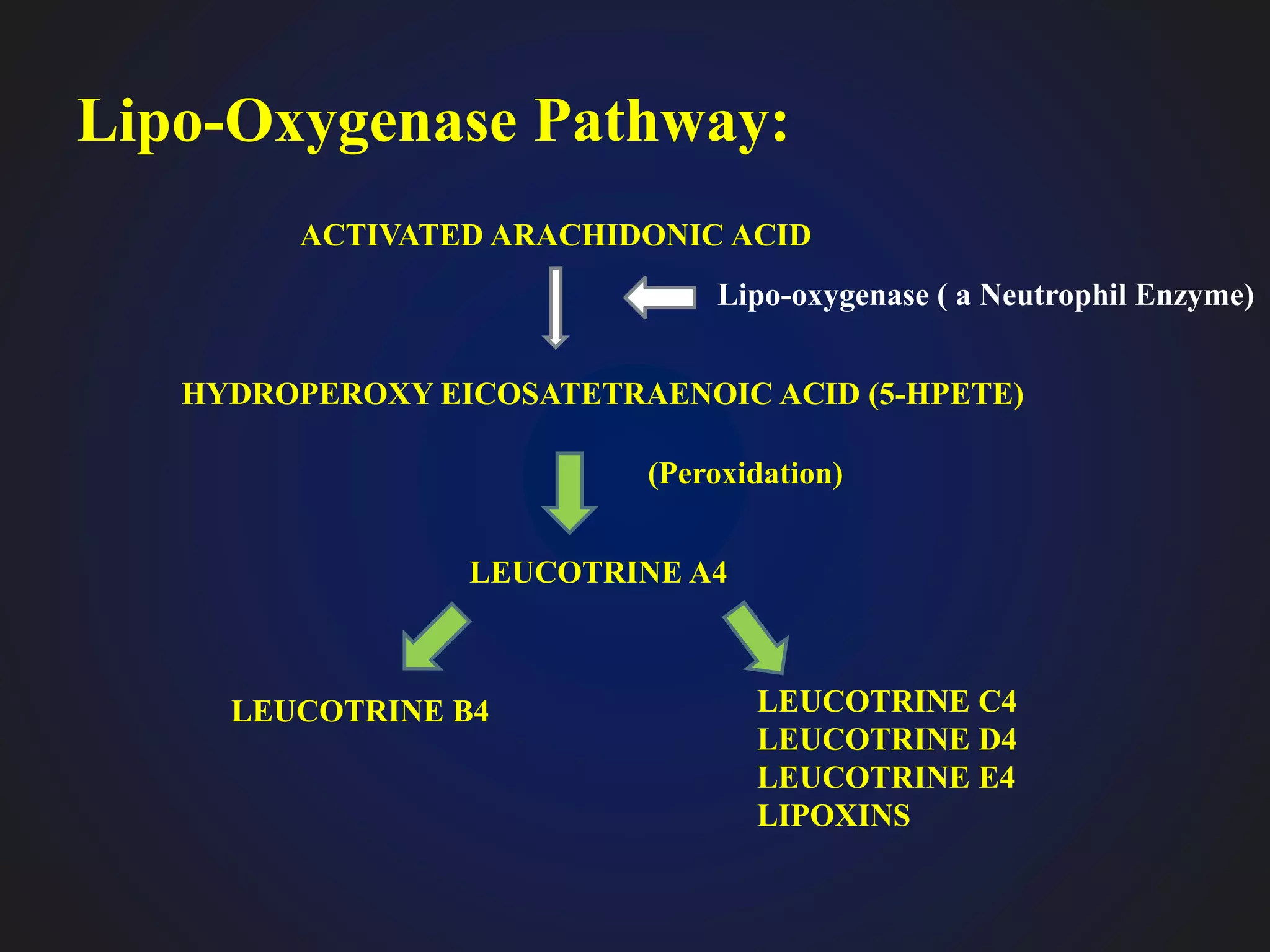
Lipo-Oxygenase Pathway:
Lipo-oxygenase ( a Neutrophil Enzyme)
ACTIVATED ARACHIDONIC ACID
HYDROPEROXY EICOSATETRAENOIC ACID (5-HPETE)
(Peroxidation)
LEUCOTRINE A4
LEUCOTRINE B4 LEUCOTRINE C4
LEUCOTRINE D4
LEUCOTRINE E4
LIPOXINS
Action of Lipo-Oxygenase Pathway Eicosanoids:
LEUCOTRINE B4
1. CHEMOTAXIS
LEUCOTRINE C4
LEUCOTRINE D4
LEUCOTRINE E4
LIPOXINS
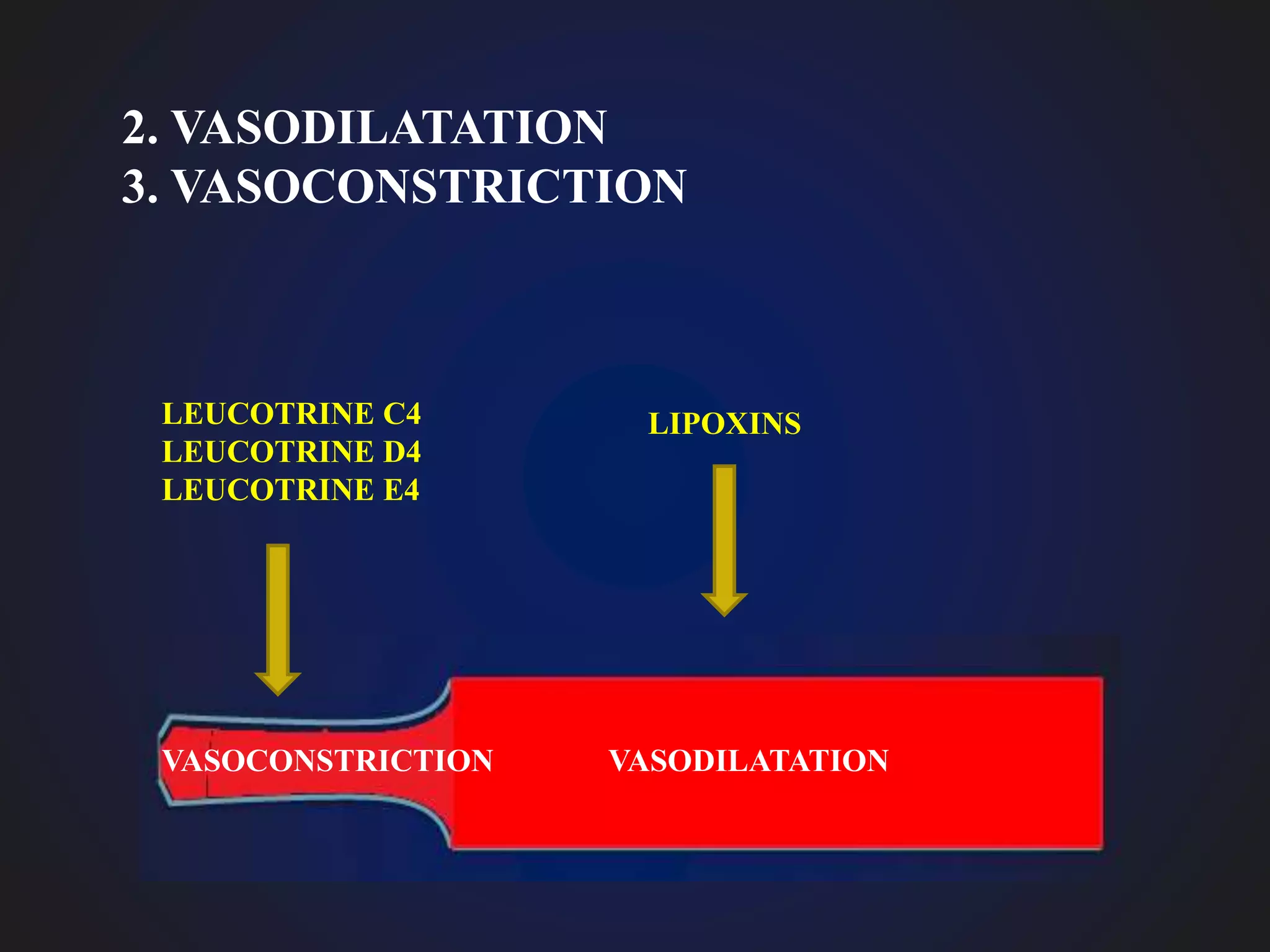
VASODILATATIONVASOCONSTRICTION
2. VASODILATATION
3. VASOCONSTRICTION
LEUCOTRINE C4
LEUCOTRINE D4
LEUCOTRINE E4
LIPOXINS
BRONCHOCONSTRICTORS
4. BRONCHOCONSTRICTION
Mediators of inflammation

Mediators of inflammation

  • 1.
    MEDIATORS OF INFLAMMATION Dr.D. VAMSHIKRISHNA, M.D (H)
  • 2.
    Learning Objectives 1. Whatare Mediators of Inflammation? 2. What are the General Properties of Mediators of Inflammation? 3. What are the Different Types of Mediators?
  • 3.
    Mediators of Inflammation. •These are the Substances which INITIATE REGULATE INFLAMMATORY REACTION
  • 4.
    General Properties ofMediators of Inflammation. 1. Mediators can be: CELL- DERIVED PLASMA DERIVED PREFORMED/ READYMADE (stored in the Granules) DE-NOVO (FORMED NEWLY) Synthesized if needed
  • 5.
    2. Produced onlyin response to agents that stimulate inflammation. 3. Can stimulate the release of another mediator. 4. Short Life-Span- Rapidly removed from circulation 5. Can act on Wide-variety of Cells.
  • 6.
    Different Types OfMediators. CELL- DERIVED PLASMA DERIVED PREFORMED/ READYMADE (stored in the Granules) DE-NOVO (FORMED NEWLY) Synthesized if needed VASOACTIVE AMINES •HISTAMINE •SEROTONIN •ARACHIDONIC ACID METABOLITES (EICOSANOIDS) •LYSOSOMAL COMPONENTS •CHEMOKINES •CYTOKINES PRODUCTS OF: 1. THE KININ SYSTEM 2. THE CLOTTING SYSTEM 3. THE FIBRINOLYTIC SYSTEM 4. THE COMPLEMENT SYSTEM
  • 7.
    VASOACTIVE AMINES • Firstmediators to be released during inflammation. • Derived from amino acid- HISTIDINE • They are Histamine and Serotonin
  • 8.
    Histamine Sources: • Mast cells(Most imp) • Basophils • Platelets
  • 9.
    Stimuli for releaseof Histamine: • Heat, Cold, Irradiation, Trauma, Irritant Chemicals, Immunologic Reactions. • C3a, C5a- Anphylatoxins. • Interleukins- IL-1, IL-8
  • 10.
    Actions of Histamine: •Increase in Vascular Permeability. • Vasodilatation. • Itching and Pain • Responsible for Flare and Wheal reaction of Skin.
  • 11.
    Serotonin/5-Hydroxytryptamine Sources: • Mast cells •Platelets Also: • Chromaffin cells of GIT, Spleen, Nervous tissue
  • 12.
    Actions of Serotonin: •The actions of 5-HT are similar to histamine but it is a less potent mediator of increased vascular permeability and vasodilatation than histamine.
  • 13.
    2. ARACHIDONIC ACIDMETABOLITES (EICOSANOIDS): • Arachidonic acid metabolites or eicosanoids are the most potent mediators of inflammation, much more than oxygen free radicals. Eicosanoids: - Prostaglandins (D2, E2, F2-α, I2) - Thromboxane - Leukotrienes - Lipoxins
  • 14.
    Source: Tissue injury Damageto Mast cells, Endothelial cells, Macrophages, Platelets Ca++ Influx into cells ACTIVATION OF PHOSPHOLIPASES ARACHIDONIC ACID (PRESENT IN CELL MEMBRANE) FREE ARACHIDONIC ACID ARACHIDONIC ACID METABOLITES OR EICOSANOIDS 1. Cyclo-oxygenase Pathway 2. Lipooxygenase Pathway
  • 15.
    Cyclo-OXygenase Pathway (COXPATHWAY) Cyclo-oxygenase COX-1 and COX-2, ACTIVATED ARACHIDONIC ACID PROSTAGLANDIN ENDOPEROXIDE (PGG2). PGH2 PGD2 PGE2 PGF2-α Prostacyclin (PGI2) Thromboxane A2 (TXA2)
  • 16.
    Action of COXPathway Eicosanoids: PGD2 PGE2 PGF2-α Prostacyclin (PGI2) Thromboxane A2 (TXA2) VASODILATATION VASOCONSTRICTION NORMAL BLOOD VESSEL 1. VASODILATATION 2. VASOCONSTRICTION
  • 17.
    PGD2 PGE2 Prostacyclin(PGI2) 3. BRONCHODILATION BRONCHODILATORS
  • 18.
    PGF2-α Thromboxane A2 (TXA2) 4.BRONCHOCONSTRICTION BRONCHOCONSTRICTORS
  • 19.
    Lipo-Oxygenase Pathway: Lipo-oxygenase (a Neutrophil Enzyme) ACTIVATED ARACHIDONIC ACID HYDROPEROXY EICOSATETRAENOIC ACID (5-HPETE) (Peroxidation) LEUCOTRINE A4 LEUCOTRINE B4 LEUCOTRINE C4 LEUCOTRINE D4 LEUCOTRINE E4 LIPOXINS
  • 20.
    Action of Lipo-OxygenasePathway Eicosanoids: LEUCOTRINE B4 1. CHEMOTAXIS
  • 21.
    LEUCOTRINE C4 LEUCOTRINE D4 LEUCOTRINEE4 LIPOXINS VASODILATATIONVASOCONSTRICTION 2. VASODILATATION 3. VASOCONSTRICTION
  • 22.
    LEUCOTRINE C4 LEUCOTRINE D4 LEUCOTRINEE4 LIPOXINS BRONCHOCONSTRICTORS 4. BRONCHOCONSTRICTION