


PATHOLOGY - I
Presented By:
Mehrwar Hijab 10380
Ayesha Zarin 10446
Faryal Ashar 10815
COMPLEMENT SYSTEM
By Mehrwar Hijab
COMPLEMENT
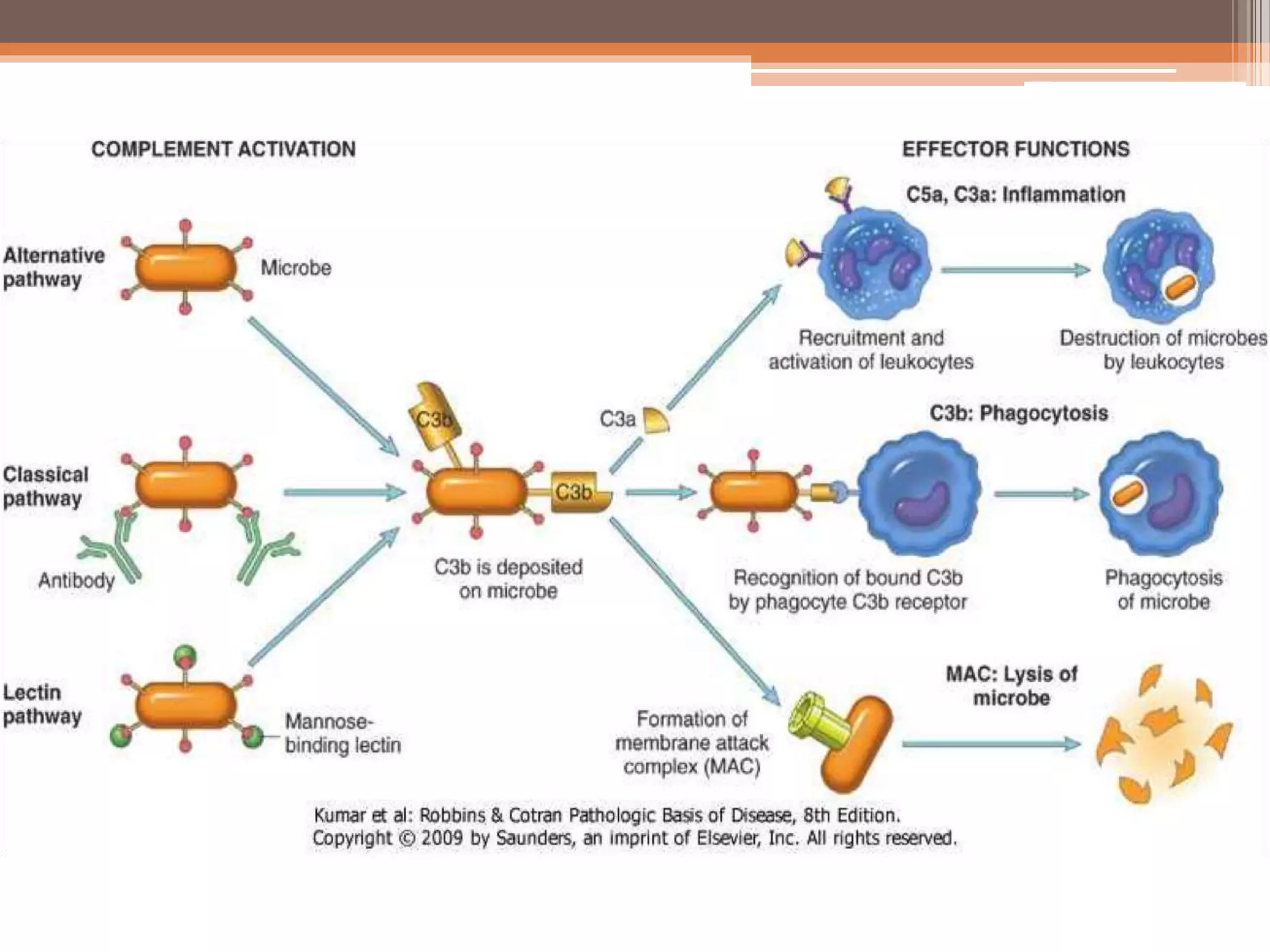
• A group of soluble proteins that activates inflammation,
opsonization and cell lysis.
• The complement proteins respond in a sequential
manner producing a cascade of reactions.
• Major components are from C1 to C9.
• Both innate and adaptive immunity for defense against
microbial agents.
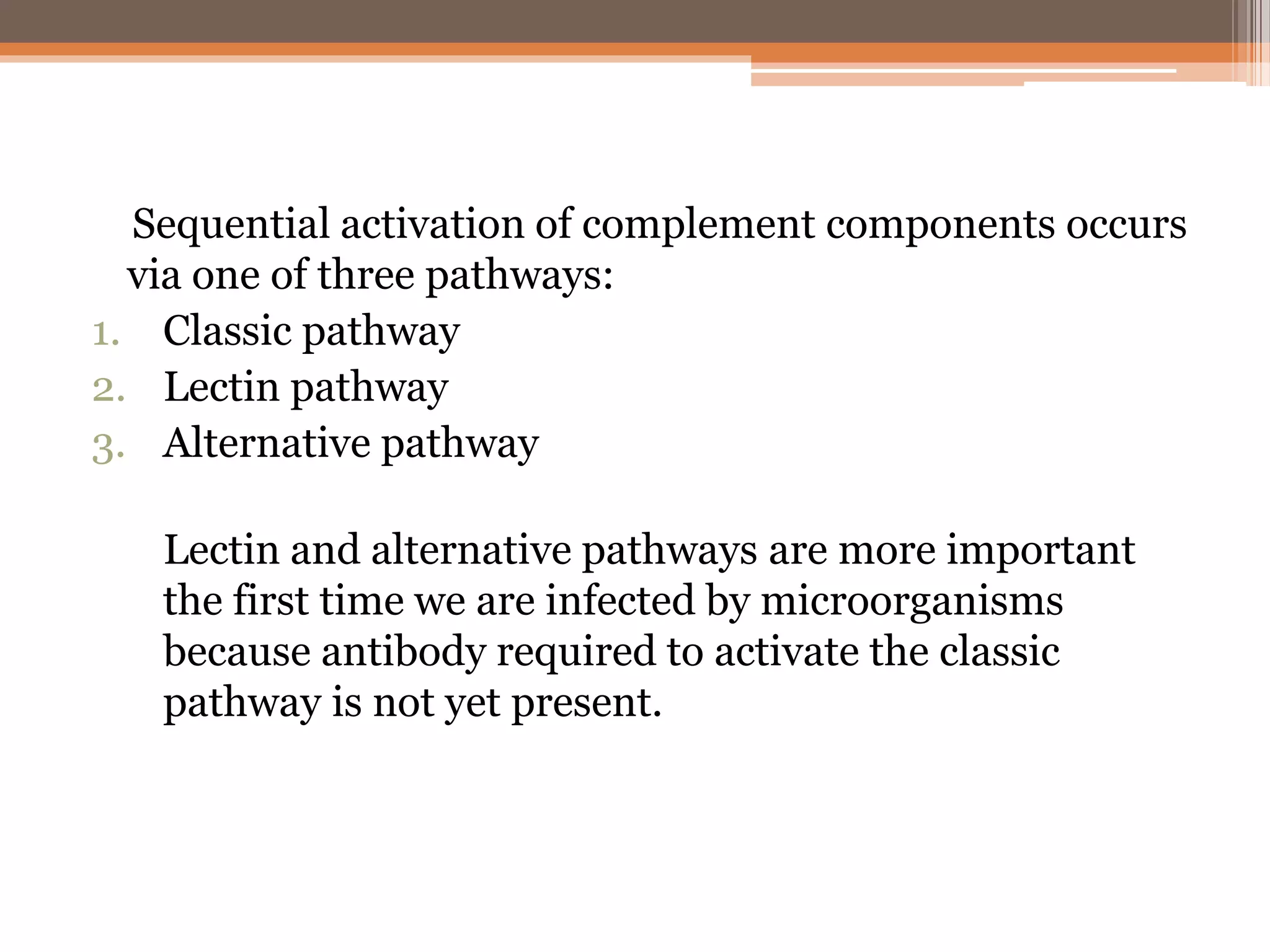
Sequential activation of complement components occurs
via one of three pathways:
1. Classic pathway
2. Lectin pathway
3. Alternative pathway
Lectin and alternative pathways are more important
the first time we are infected by microorganisms
because antibody required to activate the classic
pathway is not yet present.
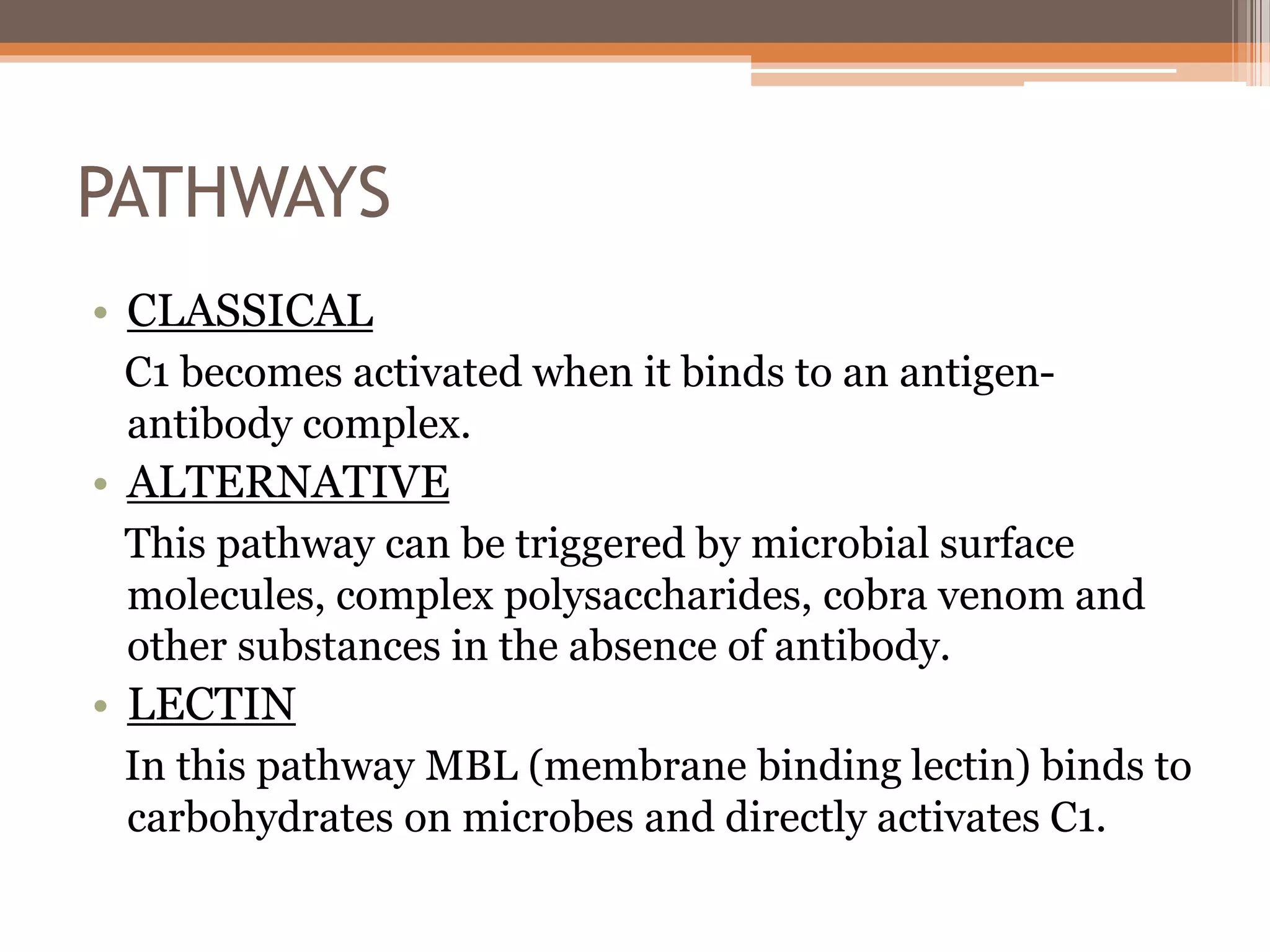
PATHWAYS
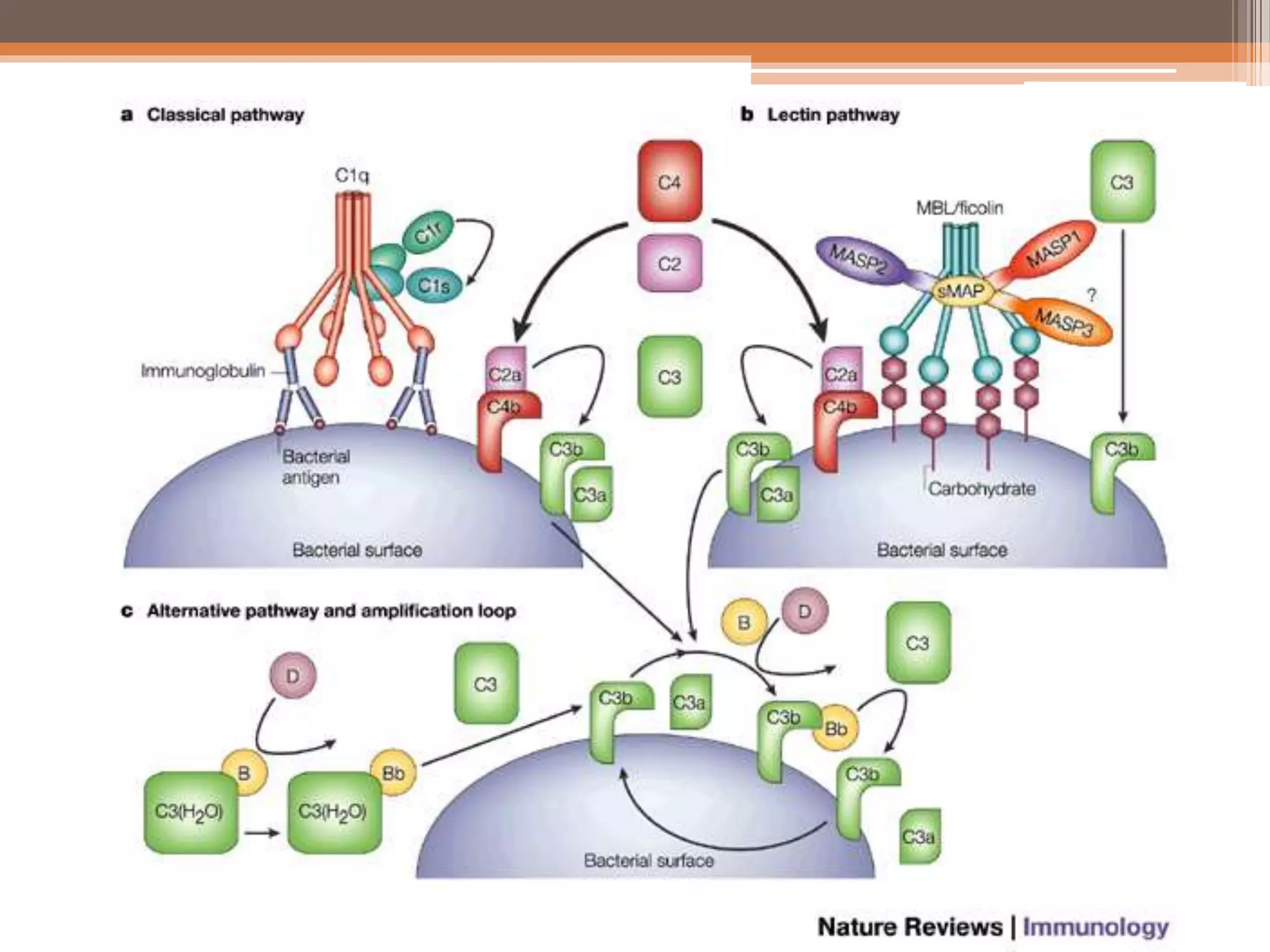
• CLASSICAL
C1 becomes activated when it binds to an antigen-
antibody complex.
• ALTERNATIVE
This pathway can be triggered by microbial surface
molecules, complex polysaccharides, cobra venom and
other substances in the absence of antibody.
• LECTIN
In this pathway MBL (membrane binding lectin) binds to
carbohydrates on microbes and directly activates C1.
MAC formation
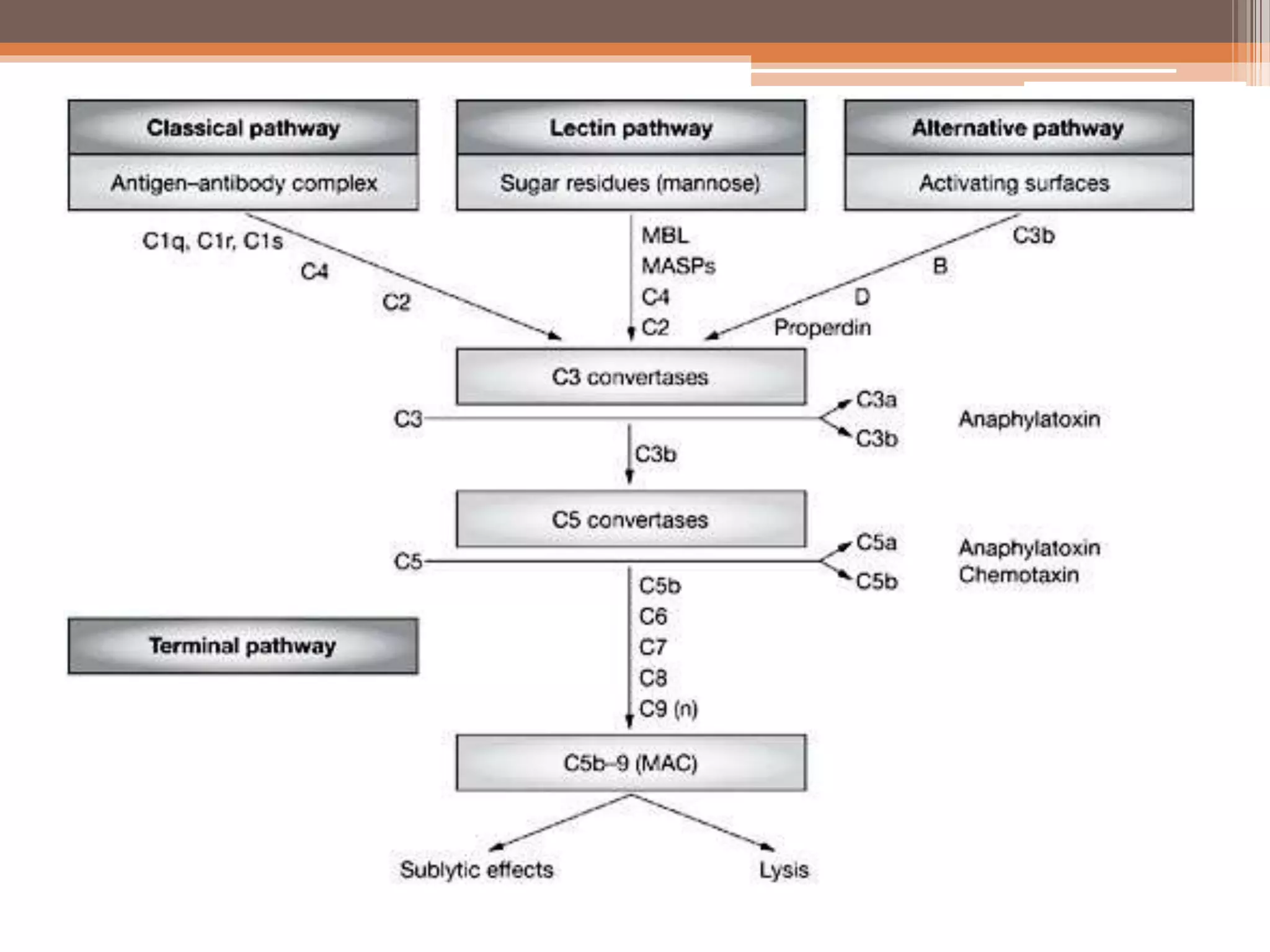
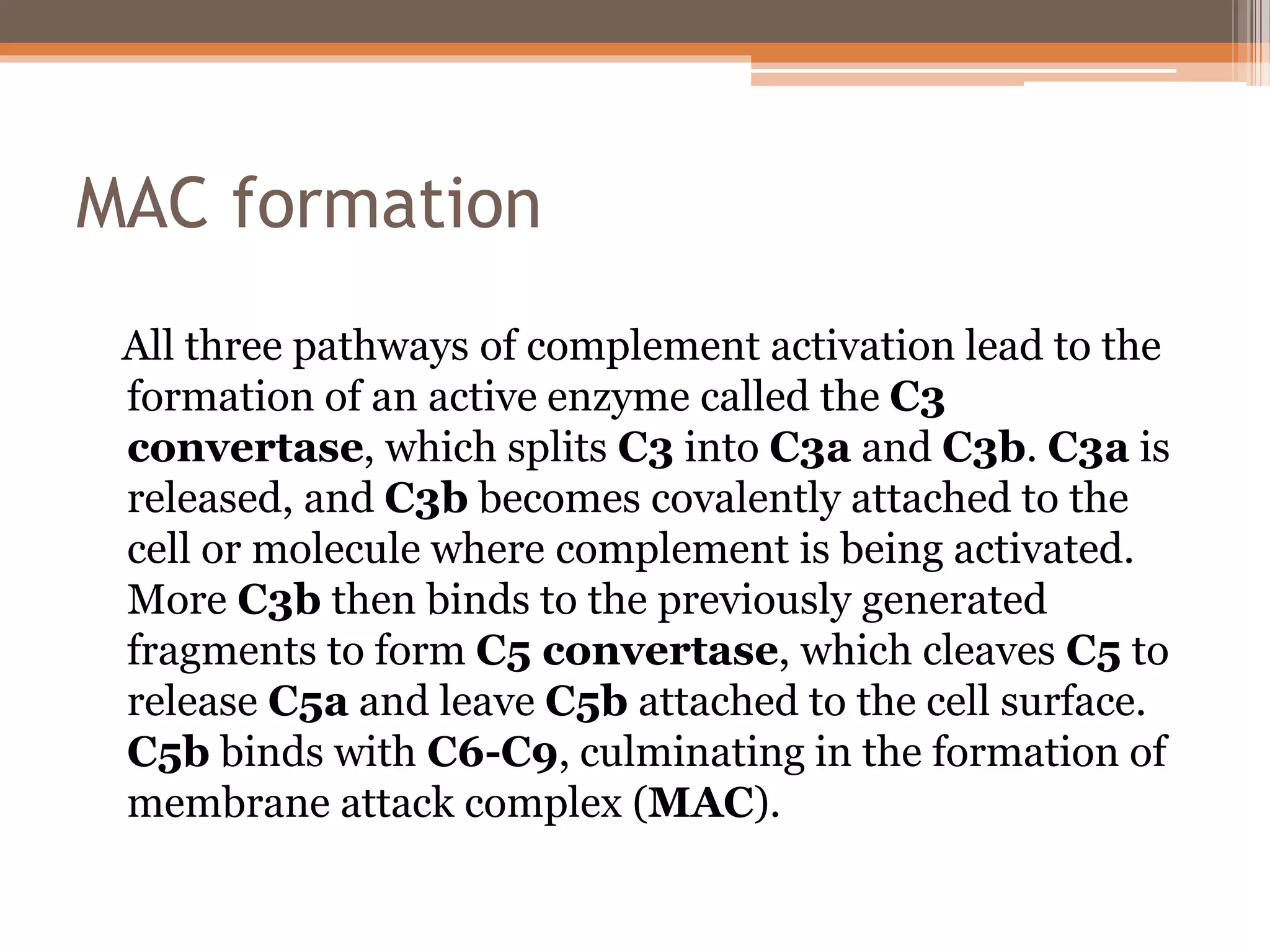
All three pathways of complement activation lead to the
formation of an active enzyme called the C3
convertase, which splits C3 into C3a and C3b. C3a is
released, and C3b becomes covalently attached to the
cell or molecule where complement is being activated.
More C3b then binds to the previously generated
fragments to form C5 convertase, which cleaves C5 to
release C5a and leave C5b attached to the cell surface.
C5b binds with C6-C9, culminating in the formation of
membrane attack complex (MAC).
FUNCTIONS
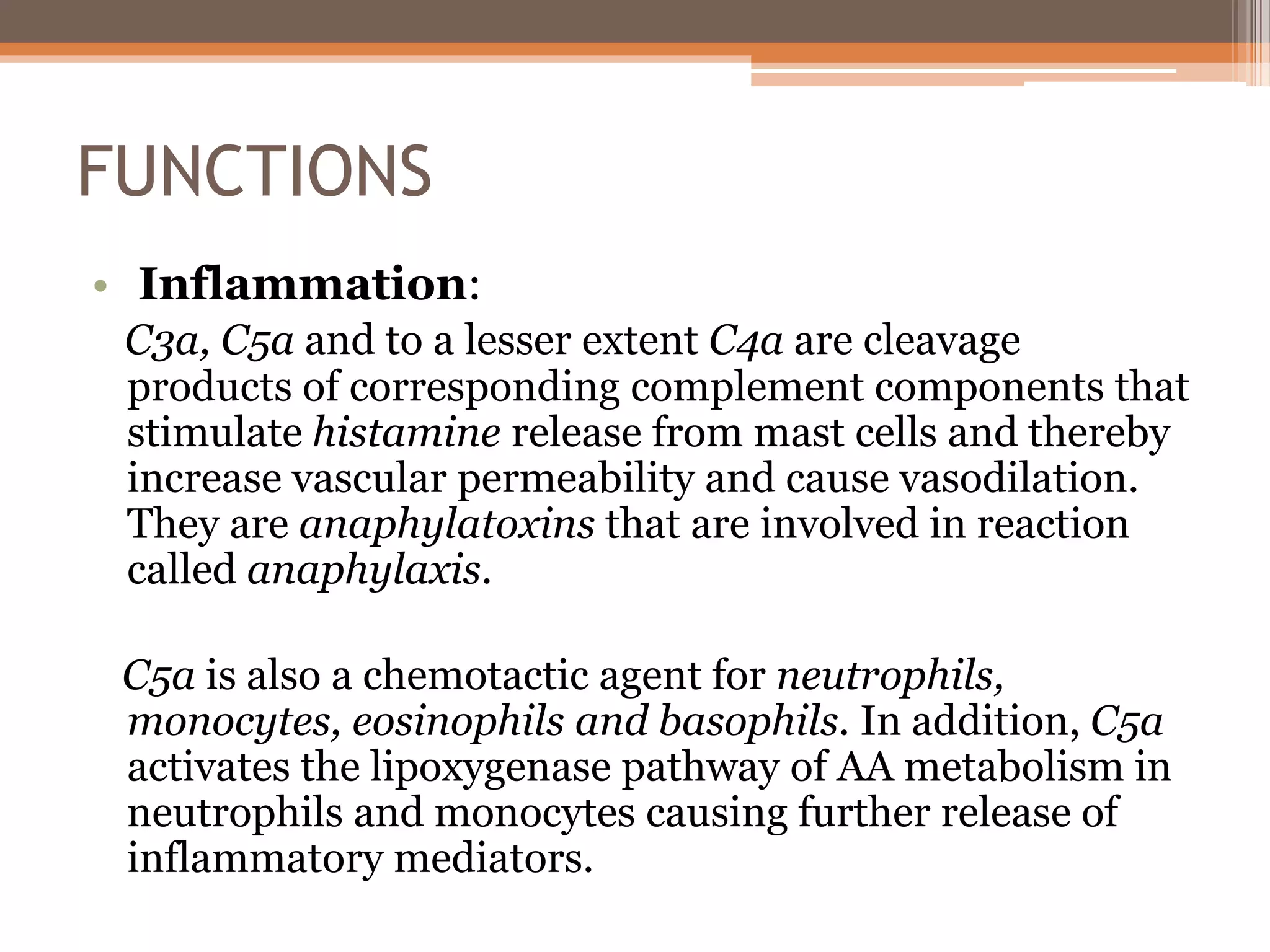
• Inflammation:
C3a, C5a and to a lesser extent C4a are cleavage
products of corresponding complement components that
stimulate histamine release from mast cells and thereby
increase vascular permeability and cause vasodilation.
They are anaphylatoxins that are involved in reaction
called anaphylaxis.
C5a is also a chemotactic agent for neutrophils,
monocytes, eosinophils and basophils. In addition, C5a
activates the lipoxygenase pathway of AA metabolism in
neutrophils and monocytes causing further release of
inflammatory mediators.
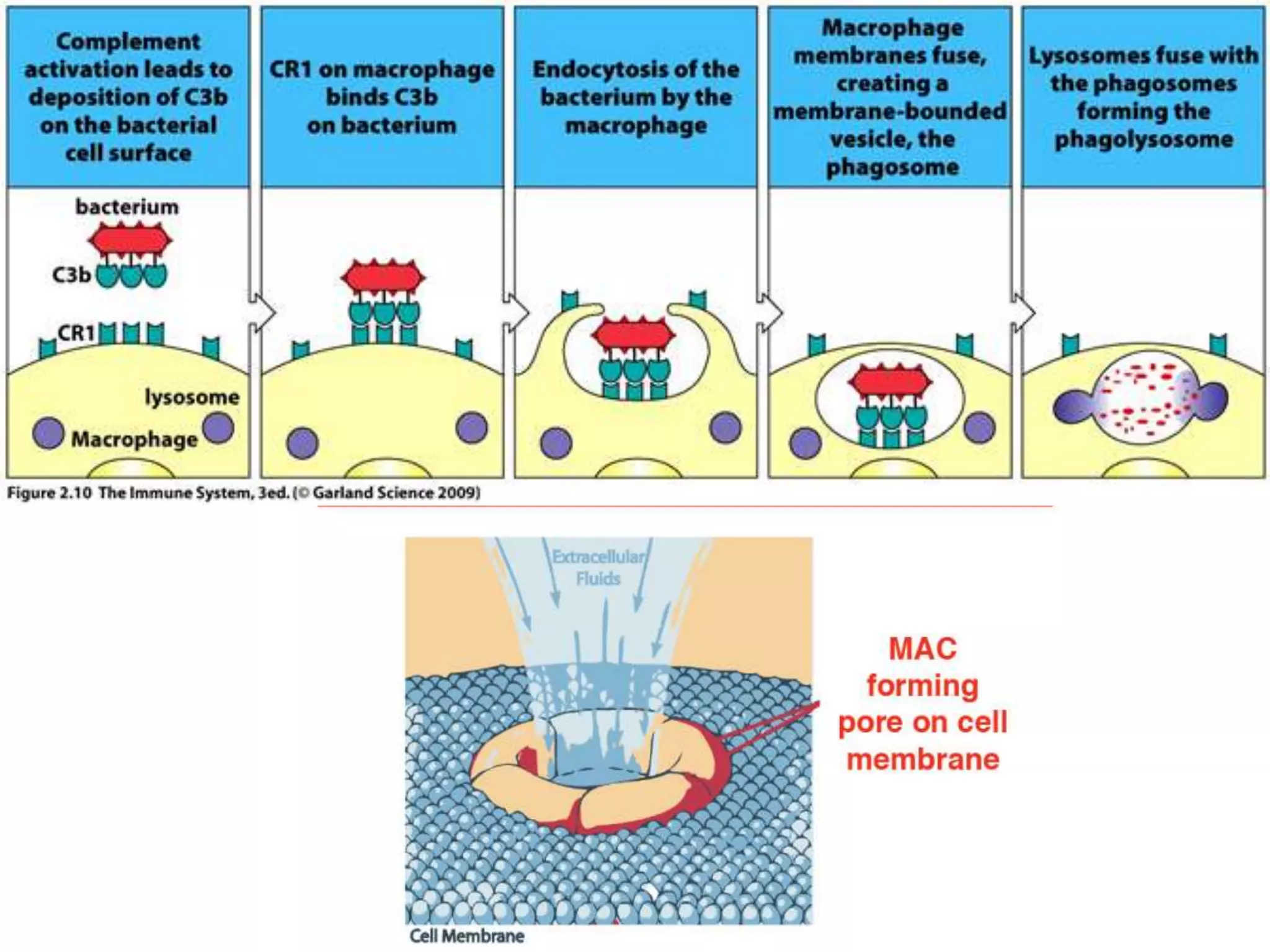
• Opsonization and phagocytosis
C3b when fixed to a microbial cell wall act as opsonins
and promote phagocytosis by neutrophils and
macrophages, which bear cell surface receptors for the
complement fragments.
• Cell lysis
The deposition of the MAC on cells make these cells
permeable to water and ions, and results in death of
cells. This role of complement is important mainly for
the killing of microbes with thin cell walls such as
Neisseria bacteria.
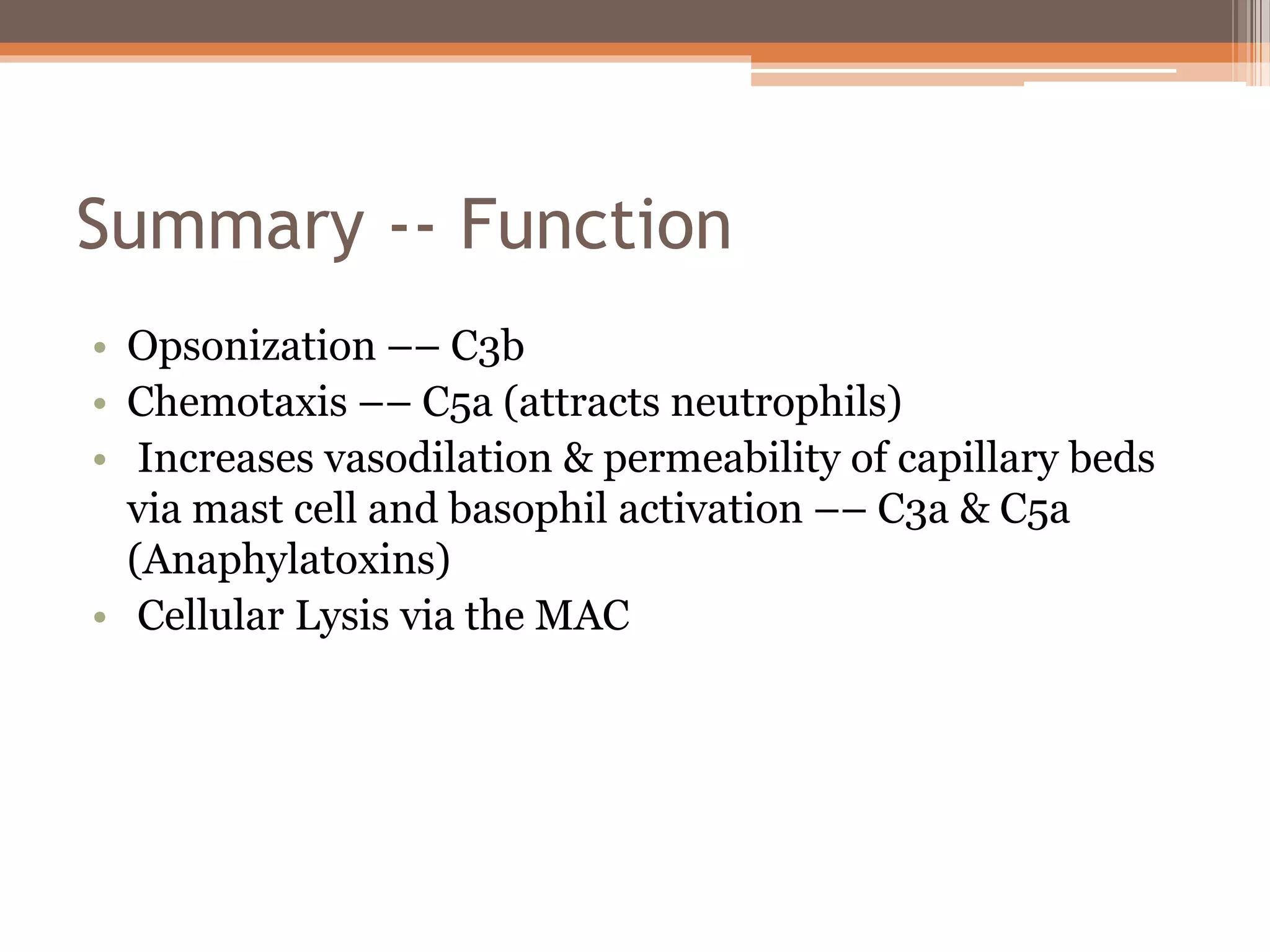
Summary -- Function
• Opsonization –– C3b
• Chemotaxis –– C5a (attracts neutrophils)
• Increases vasodilation & permeability of capillary beds
via mast cell and basophil activation –– C3a & C5a
(Anaphylatoxins)
• Cellular Lysis via the MAC
SOME REGULATORY PROTEINS
1. C1 Inhibitor (C1 INH)
• Blocks the activation of C1, the first protein of the
classical complement pathway.
• Inherited deficiency of this inhibitor is the cause of
hereditary angioedema.
2. Decay Accelerating Factors (Daf) & Cd59
• These are two proteins. DAF preventsformation of C3
convertase.
• CD59 inhibits formation of the membrane attack
complex.
• Paroxymal nocturnal hemoglobinuria can be caused
in absence of enzyme.
3. Other complement regulatory proteins proteolytically
cleave active complement components.
1. All of the following processes can be activated by complement
except
A)inflammation
B)antibody production
C)cytolysis
D)opsonization
E)none of the above
2. Opsonization is
A)a membrane attack complex lysing a bacterium by
making a hole in its membrane
B)when complement causes inflammation to occur
C)when the nine complement factors cascade in order
D)coating of a bacterium with antibody to make it more
susceptible to phagocytosis
QUIZ
3. Complement factors C5b+C6+C7+C8 make up a membrane attack
complex that results in
A)enhanced phagocytosis
B)opsonization
C)cytolysis
D)all of the above
4. Complement factors are named in the order in which they function.
A)True
B)False
5. In the classical pathway of complement activation, complement
attaches to an antigen antibody complex.
A)True
B)False
COAGULATION
By Ayesha Zarin
Products Of Coagulation
• Inflammation initiates clotting and decreases
the activity of anti coagulant.
• Coagulation and inflammation are linked
processes (i.e. inhibiting coagulation may reduce
the inflammatory reaction)
• PARs (protease activated receptors) supported
the above mentioned suggestion.
PARs
• PARs is activated by thrombin (protease that
cleaves the fibrinogen to give fibrin resulting in
clot formation) and are expressed on platelets
and leukocytes.
• Major role of PARs is platelet activation during
clotting.
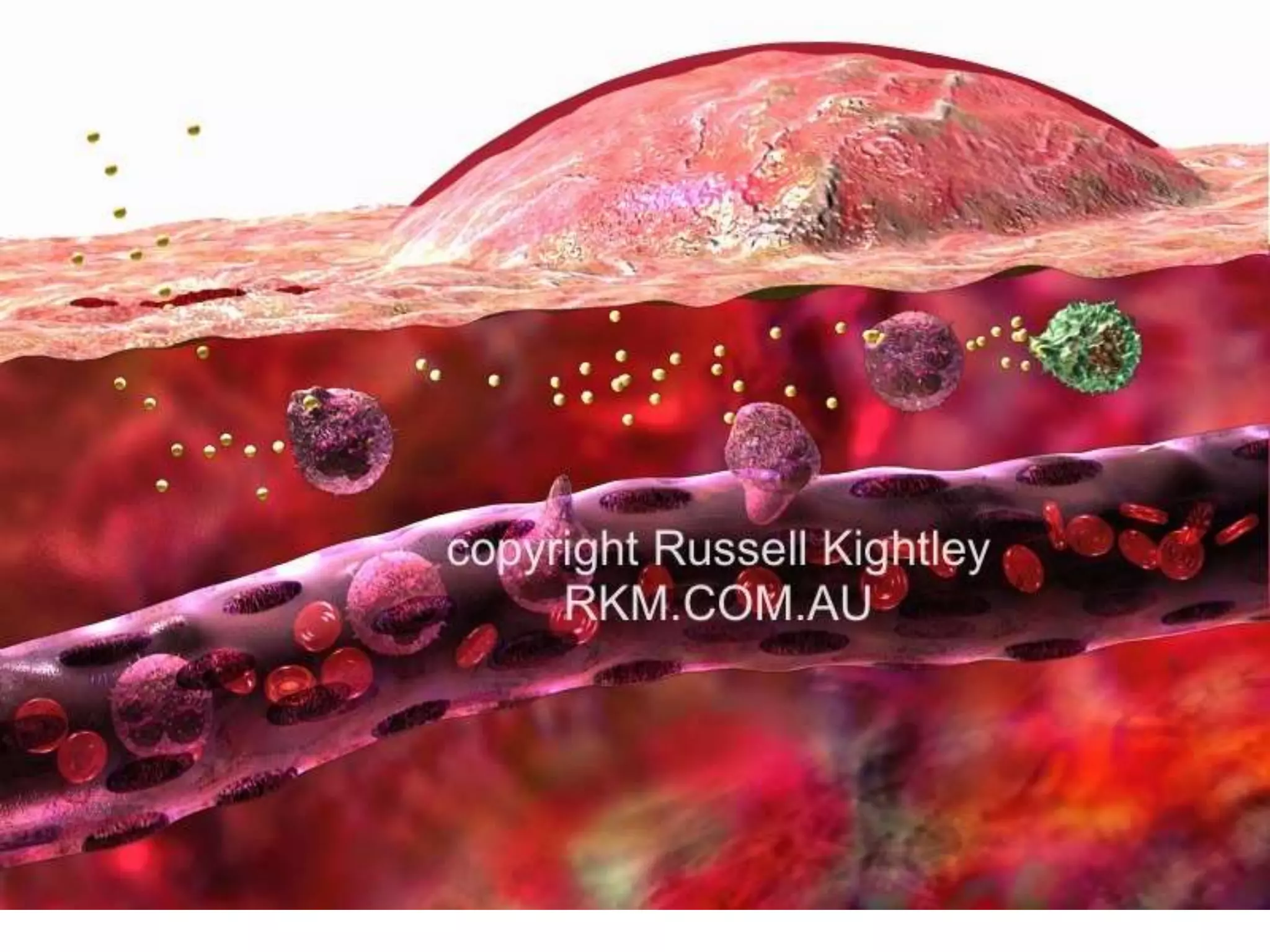
• All forms of tissue injury that lead to clotting
also induce inflammation and inflammation
causes changes in endothelial cells that increase
the likelihood of abnormal clotting.
It is still no established whether the products of
coagulation have a key role stimulating
inflammation.
KININ SYSTEM
By Faryal Ashar
Kinins
• Vasoactive peptides.
• Derived from plasma proteins called,
kinninogens.
• The enzyme kallikreins cleaves a high molecular
weight kininogen to produce bradykinin.
Bradykinins
Bradykinin increases vascular permeability
and causes contraction of smooth muscle,
dilation of blood vessels and pain when injected
into the skin.
• These are similar to those of histamine effects.
• Action is short lived.
• Quickly inactivated by kininase.
• Bradykinin has been implicated as a mediator in
some forms of allergic reactions, such as
anaphylaxis.
THANK YOU !

Complement System, Coagulation & Kinin System

  • 1.
    PATHOLOGY - I PresentedBy: Mehrwar Hijab 10380 Ayesha Zarin 10446 Faryal Ashar 10815
  • 2.
  • 3.
    COMPLEMENT • A groupof soluble proteins that activates inflammation, opsonization and cell lysis. • The complement proteins respond in a sequential manner producing a cascade of reactions. • Major components are from C1 to C9. • Both innate and adaptive immunity for defense against microbial agents.
  • 4.
    Sequential activation ofcomplement components occurs via one of three pathways: 1. Classic pathway 2. Lectin pathway 3. Alternative pathway Lectin and alternative pathways are more important the first time we are infected by microorganisms because antibody required to activate the classic pathway is not yet present.
  • 5.
    PATHWAYS • CLASSICAL C1 becomesactivated when it binds to an antigen- antibody complex. • ALTERNATIVE This pathway can be triggered by microbial surface molecules, complex polysaccharides, cobra venom and other substances in the absence of antibody. • LECTIN In this pathway MBL (membrane binding lectin) binds to carbohydrates on microbes and directly activates C1.
  • 9.
    MAC formation All threepathways of complement activation lead to the formation of an active enzyme called the C3 convertase, which splits C3 into C3a and C3b. C3a is released, and C3b becomes covalently attached to the cell or molecule where complement is being activated. More C3b then binds to the previously generated fragments to form C5 convertase, which cleaves C5 to release C5a and leave C5b attached to the cell surface. C5b binds with C6-C9, culminating in the formation of membrane attack complex (MAC).
  • 10.
    FUNCTIONS • Inflammation: C3a, C5aand to a lesser extent C4a are cleavage products of corresponding complement components that stimulate histamine release from mast cells and thereby increase vascular permeability and cause vasodilation. They are anaphylatoxins that are involved in reaction called anaphylaxis. C5a is also a chemotactic agent for neutrophils, monocytes, eosinophils and basophils. In addition, C5a activates the lipoxygenase pathway of AA metabolism in neutrophils and monocytes causing further release of inflammatory mediators.
  • 11.
    • Opsonization andphagocytosis C3b when fixed to a microbial cell wall act as opsonins and promote phagocytosis by neutrophils and macrophages, which bear cell surface receptors for the complement fragments. • Cell lysis The deposition of the MAC on cells make these cells permeable to water and ions, and results in death of cells. This role of complement is important mainly for the killing of microbes with thin cell walls such as Neisseria bacteria.
  • 13.
    Summary -- Function •Opsonization –– C3b • Chemotaxis –– C5a (attracts neutrophils) • Increases vasodilation & permeability of capillary beds via mast cell and basophil activation –– C3a & C5a (Anaphylatoxins) • Cellular Lysis via the MAC
  • 14.
    SOME REGULATORY PROTEINS 1.C1 Inhibitor (C1 INH) • Blocks the activation of C1, the first protein of the classical complement pathway. • Inherited deficiency of this inhibitor is the cause of hereditary angioedema. 2. Decay Accelerating Factors (Daf) & Cd59 • These are two proteins. DAF preventsformation of C3 convertase. • CD59 inhibits formation of the membrane attack complex. • Paroxymal nocturnal hemoglobinuria can be caused in absence of enzyme. 3. Other complement regulatory proteins proteolytically cleave active complement components.
  • 15.
    1. All ofthe following processes can be activated by complement except A)inflammation B)antibody production C)cytolysis D)opsonization E)none of the above 2. Opsonization is A)a membrane attack complex lysing a bacterium by making a hole in its membrane B)when complement causes inflammation to occur C)when the nine complement factors cascade in order D)coating of a bacterium with antibody to make it more susceptible to phagocytosis QUIZ
  • 16.
    3. Complement factorsC5b+C6+C7+C8 make up a membrane attack complex that results in A)enhanced phagocytosis B)opsonization C)cytolysis D)all of the above 4. Complement factors are named in the order in which they function. A)True B)False 5. In the classical pathway of complement activation, complement attaches to an antigen antibody complex. A)True B)False
  • 17.
  • 18.
    Products Of Coagulation •Inflammation initiates clotting and decreases the activity of anti coagulant. • Coagulation and inflammation are linked processes (i.e. inhibiting coagulation may reduce the inflammatory reaction) • PARs (protease activated receptors) supported the above mentioned suggestion.
  • 19.
    PARs • PARs isactivated by thrombin (protease that cleaves the fibrinogen to give fibrin resulting in clot formation) and are expressed on platelets and leukocytes. • Major role of PARs is platelet activation during clotting.
  • 20.
    • All formsof tissue injury that lead to clotting also induce inflammation and inflammation causes changes in endothelial cells that increase the likelihood of abnormal clotting. It is still no established whether the products of coagulation have a key role stimulating inflammation.
  • 22.
  • 23.
    Kinins • Vasoactive peptides. •Derived from plasma proteins called, kinninogens. • The enzyme kallikreins cleaves a high molecular weight kininogen to produce bradykinin.
  • 24.
    Bradykinins Bradykinin increases vascularpermeability and causes contraction of smooth muscle, dilation of blood vessels and pain when injected into the skin.
  • 25.
    • These aresimilar to those of histamine effects. • Action is short lived. • Quickly inactivated by kininase. • Bradykinin has been implicated as a mediator in some forms of allergic reactions, such as anaphylaxis.
  • 26.