BY
CH.VYSHNAVI
MSC MLT
 REGULATION
 BIOLOGICAL EFFECT
 DEFICIENCIES
 The complement system has the potential to be
extremely damaging to host tissues.
 complement control protein .
 Some complement control proteins are present
on the membranes of self-cells preventing them
from being targeted by complement.
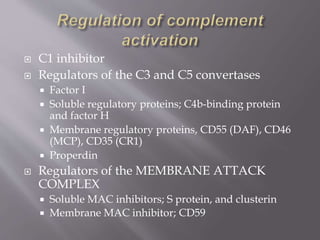
 C1 inhibitor
 Regulators of the C3 and C5 convertases
 Factor I
 Soluble regulatory proteins; C4b-binding protein
and factor H
 Membrane regulatory proteins, CD55 (DAF), CD46
(MCP), CD35 (CR1)
 Properdin
 Regulators of the MEMBRANE ATTACK
COMPLEX
 Soluble MAC inhibitors; S protein, and clusterin
 Membrane MAC inhibitor; CD59
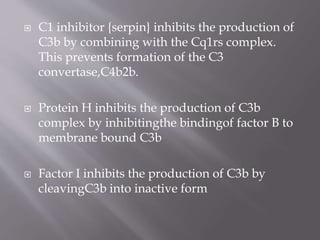
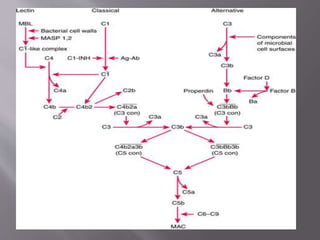
 C1 inhibitor {serpin} inhibits the production of
C3b by combining with the Cq1rs complex.
This prevents formation of the C3
convertase,C4b2b.
 Protein H inhibits the production of C3b
complex by inhibitingthe bindingof factor B to
membrane bound C3b
 Factor I inhibits the production of C3b by
cleavingC3b into inactive form
 Regulatory proteins promotes or inhibits
complementary activity and protect self cell
lysis.
 Decay acceleration factor[DAC] accelerates
break down of C3 convertase.
 Homologous restriction factor[HRF]prevents
insertion of C8 and C9 into membranes.
 The following are the basic functions of
complement:
 Opsonization – enhancing phagocytosis of
antigens
 Chemotaxis – attracting macrophages and
neutrophils
 Cell Lysis – rupturing membranes of foreign
cells
 Agglutination – clustering and binding of
pathogens together (sticking)
 Bacteriolysis and Cytolysis
 Amplification of inflammatory Response
 Hypersensitivity Reaction
 Endotoxic shock
 Immune adherence
 Opsonisation
 Autoimmune diseases
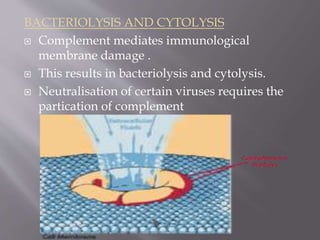
BACTERIOLYSIS AND CYTOLYSIS
 Complement mediates immunological
membrane damage .
 This results in bacteriolysis and cytolysis.
 Neutralisation of certain viruses requires the
partication of complement
AMPLIFICATION OF INFLAMMATORY
RESPONSE
 C3a and C5a are anaphylatoxic by
degranulation of mast cells to release
histamine and other mediators.
 They cause increased vascular permeability
and are also chemotactic
 C567 is chematactic and also brings about
reactive lysis
HYPERSENSITIVITY REACTIONS
 Complement participates in type 2 [cytotoxic]
and type 3[immune complex] hypersensity
reactions.
ENDOTOXIC SHOCK
 Endotoxin can activate the alternative pathway
of the complement cascade.
 In Endotoxin shock there is excessive C3
activation and platelet adherence.
 Platelet lysis and release of large amount of
platelets factor lead to DIC and
thrombocytopenia.
 Gram negative septicaemias and dengue
haemorrhagic syndrome may have a similar
pathogenesis
 Schwartzman reaction is a good model of
excessive C3 activation and depletion of
complement protects against this reaction
IMMUNE ADHERENCE
 Immune adherence – Complement bound to
antigen – antibody complexes adheres to
erythrocytes or to plateletes.
 Particles are rapidly phagocytosed – help in
eliminating the pathogenic microorganisms.
 C3 and C4 are necessary for immune
adherence.
OPSONISATION
 To facilitate the destruction of pathogens by
phagocytic cells – important function of
complement
 Phagocytic cells (macrophages, monocytes,
neutrophils and others) posses surface
receptors for C3b.
 If immune complexes have activated the
complement system, the C3b bound to them
stimulates phagocytosis and removal of
immune complexes.
AUTOIMMUNE DISEASES
 Serum complement levels are decreased in
many auto immune diseases such as Systematic
Lupus Erythematosus and Rheumatoid
arthritis
 They may therefore be involved in
pathogenesis of autoimmune diseases
 Deficiency defects are transmitted as
phenotypically autosomal-recessive traits.
 Deficiency of properdin is X-linked.
 Deficiency of the C1 inhibitor is inherited as an
autosomal dominant.
 All patients with complement deficiency are
more or less unduly susceptible to infection
and to development of immune complex
disease.
 Genetic deficiencies in classical pathway
components.
 Deficiencies in components of the alternative
pathway.
 Mutation of the gene encoding the mannose-
binding lectin (MBL).
 Deficiencies in the terminal complement
components.
 Deficiencies in complement regulatory
proteins.
 Deficiencies in complement receptors.
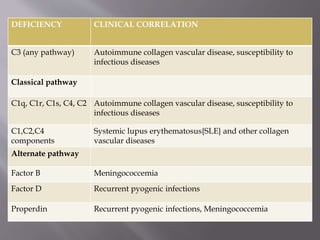
DEFICIENCY CLINICAL CORRELATION
C3 (any pathway) Autoimmune collagen vascular disease, susceptibility to
infectious diseases
Classical pathway
C1q, C1r, C1s, C4, C2 Autoimmune collagen vascular disease, susceptibility to
infectious diseases
C1,C2,C4
components
Systemic lupus erythematosus{SLE} and other collagen
vascular diseases
Alternate pathway
Factor B Meningococcemia
Factor D Recurrent pyogenic infections
Properdin Recurrent pyogenic infections, Meningococcemia
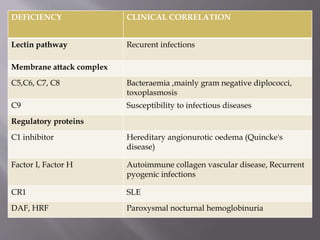
DEFICIENCY CLINICAL CORRELATION
Lectin pathway Recurent infections
Membrane attack complex
C5,C6, C7, C8 Bacteraemia ,mainly gram negative diplococci,
toxoplasmosis
C9 Susceptibility to infectious diseases
Regulatory proteins
C1 inhibitor Hereditary angionurotic oedema (Quincke's
disease)
Factor I, Factor H Autoimmune collagen vascular disease, Recurrent
pyogenic infections
CR1 SLE
DAF, HRF Paroxysmal nocturnal hemoglobinuria
Complement system

Complement system

  • 1.
  • 2.
     REGULATION  BIOLOGICALEFFECT  DEFICIENCIES
  • 3.
     The complementsystem has the potential to be extremely damaging to host tissues.  complement control protein .  Some complement control proteins are present on the membranes of self-cells preventing them from being targeted by complement.
  • 4.
     C1 inhibitor Regulators of the C3 and C5 convertases  Factor I  Soluble regulatory proteins; C4b-binding protein and factor H  Membrane regulatory proteins, CD55 (DAF), CD46 (MCP), CD35 (CR1)  Properdin  Regulators of the MEMBRANE ATTACK COMPLEX  Soluble MAC inhibitors; S protein, and clusterin  Membrane MAC inhibitor; CD59
  • 5.
     C1 inhibitor{serpin} inhibits the production of C3b by combining with the Cq1rs complex. This prevents formation of the C3 convertase,C4b2b.  Protein H inhibits the production of C3b complex by inhibitingthe bindingof factor B to membrane bound C3b  Factor I inhibits the production of C3b by cleavingC3b into inactive form
  • 6.
     Regulatory proteinspromotes or inhibits complementary activity and protect self cell lysis.  Decay acceleration factor[DAC] accelerates break down of C3 convertase.  Homologous restriction factor[HRF]prevents insertion of C8 and C9 into membranes.
  • 7.
     The followingare the basic functions of complement:  Opsonization – enhancing phagocytosis of antigens  Chemotaxis – attracting macrophages and neutrophils  Cell Lysis – rupturing membranes of foreign cells  Agglutination – clustering and binding of pathogens together (sticking)
  • 8.
     Bacteriolysis andCytolysis  Amplification of inflammatory Response  Hypersensitivity Reaction  Endotoxic shock  Immune adherence  Opsonisation  Autoimmune diseases
  • 9.
    BACTERIOLYSIS AND CYTOLYSIS Complement mediates immunological membrane damage .  This results in bacteriolysis and cytolysis.  Neutralisation of certain viruses requires the partication of complement
  • 10.
    AMPLIFICATION OF INFLAMMATORY RESPONSE C3a and C5a are anaphylatoxic by degranulation of mast cells to release histamine and other mediators.  They cause increased vascular permeability and are also chemotactic  C567 is chematactic and also brings about reactive lysis
  • 12.
    HYPERSENSITIVITY REACTIONS  Complementparticipates in type 2 [cytotoxic] and type 3[immune complex] hypersensity reactions.
  • 13.
    ENDOTOXIC SHOCK  Endotoxincan activate the alternative pathway of the complement cascade.  In Endotoxin shock there is excessive C3 activation and platelet adherence.  Platelet lysis and release of large amount of platelets factor lead to DIC and thrombocytopenia.  Gram negative septicaemias and dengue haemorrhagic syndrome may have a similar pathogenesis  Schwartzman reaction is a good model of excessive C3 activation and depletion of complement protects against this reaction
  • 14.
    IMMUNE ADHERENCE  Immuneadherence – Complement bound to antigen – antibody complexes adheres to erythrocytes or to plateletes.  Particles are rapidly phagocytosed – help in eliminating the pathogenic microorganisms.  C3 and C4 are necessary for immune adherence.
  • 15.
    OPSONISATION  To facilitatethe destruction of pathogens by phagocytic cells – important function of complement  Phagocytic cells (macrophages, monocytes, neutrophils and others) posses surface receptors for C3b.  If immune complexes have activated the complement system, the C3b bound to them stimulates phagocytosis and removal of immune complexes.
  • 16.
    AUTOIMMUNE DISEASES  Serumcomplement levels are decreased in many auto immune diseases such as Systematic Lupus Erythematosus and Rheumatoid arthritis  They may therefore be involved in pathogenesis of autoimmune diseases
  • 17.
     Deficiency defectsare transmitted as phenotypically autosomal-recessive traits.  Deficiency of properdin is X-linked.  Deficiency of the C1 inhibitor is inherited as an autosomal dominant.
  • 18.
     All patientswith complement deficiency are more or less unduly susceptible to infection and to development of immune complex disease.  Genetic deficiencies in classical pathway components.  Deficiencies in components of the alternative pathway.  Mutation of the gene encoding the mannose- binding lectin (MBL).
  • 19.
     Deficiencies inthe terminal complement components.  Deficiencies in complement regulatory proteins.  Deficiencies in complement receptors.
  • 20.
    DEFICIENCY CLINICAL CORRELATION C3(any pathway) Autoimmune collagen vascular disease, susceptibility to infectious diseases Classical pathway C1q, C1r, C1s, C4, C2 Autoimmune collagen vascular disease, susceptibility to infectious diseases C1,C2,C4 components Systemic lupus erythematosus{SLE} and other collagen vascular diseases Alternate pathway Factor B Meningococcemia Factor D Recurrent pyogenic infections Properdin Recurrent pyogenic infections, Meningococcemia
  • 21.
    DEFICIENCY CLINICAL CORRELATION Lectinpathway Recurent infections Membrane attack complex C5,C6, C7, C8 Bacteraemia ,mainly gram negative diplococci, toxoplasmosis C9 Susceptibility to infectious diseases Regulatory proteins C1 inhibitor Hereditary angionurotic oedema (Quincke's disease) Factor I, Factor H Autoimmune collagen vascular disease, Recurrent pyogenic infections CR1 SLE DAF, HRF Paroxysmal nocturnal hemoglobinuria