VIVEKANANDHA
Submitted to
Ms.S.Anandhi
Assistant Professor
PG & Research Department of Biotechnology
Vivekanandha Arts and Science College For Women
Sankari
Submitted by
SRINITHI.V
II – B.Sc Biotechnology
Vivekanandha Arts and Science College For Women
Veerachipalayam, Sankari
Assignment on “ COMPLEMENT SYSTEM ”
IMMUNE SYSTEM AND IMMUNOTECHNOLOGY
ARTS & SCIENCE COLLEGE FOR WOMEN
[An ISO 9001:2015 Certified Institution]
(Affiliated to Periyar University, Salem
Recognised Under Section 2(f) &12(B) of the UGC Act, 1956)
Veerachipalayam, Sankari West (Post) – 637 303, Sankari Tk, Salem Dt., Tamil Nadu
PG & RESEARCH DEPARTMENT OF BIOTECHNOLOGY
COMPLEMENT SYSTEM
SYNOPSIS
Introduction
Regulation
Activation
Classical pathway
Alternative pathway
Lectin pathway
Biological function
INTRODUCTION OF COMPLEMENT SYSTEM
The complement system is a group of proteins in the immune system that work together to help
protect the body against infections and diseases. It is a complex system that plays a crucial role in:
1. Marking pathogens for destruction:
Complement proteins identify and label foreign substances, making it easier for
immune cells to recognize and attack them.
2. Attracting immune cells:
Complement proteins attract immune cells, such as neutrophils and
macrophages, to the site of infection.
3. Creating holes in membranes:
Certain complement proteins can create holes in the membranes of foreign
cells, leading to their destruction.
4. Removing dead cells and debris:
Complement proteins help remove dead cells and debris from the body.The
complement system consists of over 30 proteins that work together in a cascade-like sequence.
REGULATION OF COMPLEMENT SYSTEM
The complement system is tightly regulated to prevent excessive activation, which can lead to tissue
damage and disease. Regulation occurs at multiple levels:
1. Protein inhibitors:
- C1 inhibitor (C1-INH): regulates classical pathway
- Factor H: regulates alternative pathway
- Factor I: regulates C3b and C4b
- Decay-accelerating factor (DAF): regulates C3 convertase
2. Cell surface receptors:
- Complement receptor 1 (CR1): regulates C3 convertase
- CD55 (decay-accelerating factor): regulates C3 convertase
- CD59 (protectin): prevents membrane attack complex formation
3. Soluble regulators:
- C4-binding protein (C4BP): regulates classical pathway
4. Cellular regulation:
- Phagocytic cells (e.g., neutrophils, macrophages): remove complement-
coated pathogens
- Immune cells (e.g., T cells, B cells): modulate complement activation
5. Genetic regulation:
- Genetic variants: affect complement protein levels and function
- Epigenetic modifications: influence complement gene expression
Dysregulation of the complement system can lead to:
1. Autoimmune diseases (e.g., lupus, rheumatoid arthritis)
2. Inflammatory disorders (e.g., asthma, allergic reactions)
3. Infectious diseases (e.g., meningitis, sepsis)
4. Cancer (e.g., complement-mediated tumor growth)
ACTIVATION OF COMPLEMENT SYSTEM
The complement system consists of over 30 proteins that work together in a
cascade-like sequence. There are three main pathways:
1. Classical pathway:
Activated by antibodies binding to pathogens.
2. Lectin pathway:
Activated by lectins (proteins that recognize carbohydrates)
binding to pathogens.
3. Alternative pathway:
Activated by the presence of foreign substances or pathogens.
CLASSICAL PATHWAY OF COMPLEMENT SYSTEM
The Classical Pathway of the Complement System is a crucial part of the immune system,
providing a defense against infections.
Activation:
Antigen-Antibody Complex Formation: Antibodies (IgG or IgM) bind to pathogens or foreign
substances, forming antigen-antibody complexes.
Classical Pathway Activation:
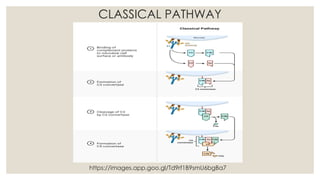
1. C1q Binding:
C1q, a protein complex, binds to the antigen-antibody complex.
2. C1r and C1s Activation:
C1q activates C1r and C1s, two serine proteases.
3. C4 and C2 Activation:
C1s cleaves C4 and C2, forming C4b and C2a.
4. C3 Convertase Formation:
C4b and C2a combine to form C3 convertase (C4b2a).
Amplification:
1. C3 Cleavage:
C3 convertase cleaves C3 into C3a and C3b.
2. C5 Convertase Formation:
C3b binds to C4b2a, forming C5 convertase (C4b2a3b).
3. C5 Cleavage:
C5 convertase cleaves C5 into C5a and C5b.
Membrane Attack Complex (MAC) Formation:
1. C5b-9 Assembly:
C5b binds to C6, C7, C8, and C9, forming the MAC.
2. Pathogen Lysis:
The MAC creates a pore in the pathogen's membrane, leading to its lysis and death.
The Classical Pathway is a critical component of the immune response, providing a powerful
mechanism for eliminating pathogens.
CLASSICAL PATHWAY
https://images.app.goo.gl/Td9rf1B9smU6bgBa7
ALTERNATIVE PATHWAY OF COMPLEMENT SYSTEM
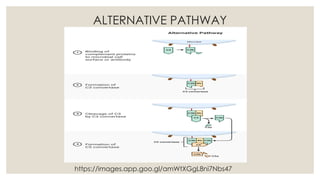
The Alternative Pathway of the Complement System is a crucial defense mechanism against infections.
Activation:
1. Spontaneous Hydrolysis:
C3, a central complement protein, undergoes spontaneous hydrolysis, forming C3(H2O).
2. Factor B Binding:
Factor B binds to C3(H2O), forming a complex.
3. Factor D Activation:
Factor D, a serine protease, activates the C3(H2O)-Factor B complex.
Amplification Loop:
1. C3b Formation:
Activated Factor B cleaves C3, forming C3b.
2. C3b Deposition:
C3b deposits on nearby surfaces, including pathogens.
3. Factor B Binding:
Factor B binds to C3b, forming a new complex.
4. Continuous Activation:
The cycle repeats, amplifying the response.
Regulation:
1. Properdin Stabilization:
Properdin stabilizes the C3bBb complex, preventing its decay.
2. Factor H Regulation:
Factor H, a regulatory protein, competes with Factor B for C3b binding, preventing excessive
activation.
Terminal Pathway:
1. C5 Cleavage:
C3bBb complex cleaves C5, forming C5a and C5b.
2. MAC Formation:
C5b assembles with C6, C7, C8, and C9, forming the Membrane Attack Complex (MAC).
3. Pathogen Lysis:
The MAC creates a pore in the pathogen's membrane, leading to its lysis and death.
The Alternative Pathway provides a continuous, low-level activation against pathogens, and is
especially important for defending against Neisseria and other Gram-negative bacteria.
ALTERNATIVE PATHWAY
https://images.app.goo.gl/amWtXGgL8ni7Nbs47
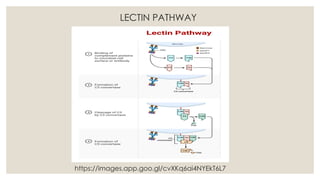
LECTIN PATHWAY OF COMPLEMENT SYSTEM
The Lectin Pathway of the Complement System is a vital defense mechanism against infections.
Activation:
1. Lectin Binding:
Lectins (e.g., MBL, Ficolin) bind to carbohydrate patterns on pathogens.
2. MASP-1 and MASP-2 Activation:
Bound lectins activate MASP-1 and MASP-2, serine proteases.
3. C4 and C2 Activation:
MASP-2 cleaves C4 and C2, forming C4b and C2a.
C3 Convertase Formation:
1. C4b2a Complex:
C4b and C2a combine to form the C3 convertase (C4b2a).
2. C3 Cleavage:
C4b2a cleaves C3 into C3a and C3b.
Amplification Loop:
1. C3b Deposition:
C3b deposits on nearby surfaces, including pathogens.
2. C3bBb Complex:
C3b binds to Factor B, forming the C3bBb complex.
3. Continuous Activation:
The cycle repeats, amplifying the response.
Terminal Pathway:
1. C5 Cleavage:
C3bBb complex cleaves C5, forming C5a and C5b.
2. MAC Formation:
C5b assembles with C6, C7, C8, and C9, forming the Membrane Attack Complex (MAC).
3. Pathogen Lysis:
The MAC creates a pore in the pathogen's membrane, leading to its lysis and death.
The Lectin Pathway recognizes carbohydrate patterns on pathogens, providing a rapid response to infections.
It works in conjunction with the Classical and Alternative Pathways to defend against a wide range of
pathogens.
LECTIN PATHWAY
https://images.app.goo.gl/cvXKq6ai4NYEkT6L7
BIOLOGICAL FUNCTIONS
The Complement System has several crucial biological functions:
1. Pathogen Elimination: Helps remove pathogens, such as bacteria, viruses,
and fungi, from the body.
2. Inflammation Regulation: Regulates inflammation by attracting immune
cells to the site of infection.
3. Immune Complex Clearance: Removes immune complexes (antigen-
antibody complexes) from the circulation.
4. Cell Lysis: Lyzes (kills) cells that are infected or damaged.
5. Opsonization: Marks pathogens for destruction by coating them with
complement proteins.
6. Antibody-Dependent Complement-Mediated Cytotoxicity (ADCC):
Enhances antibody-mediated killing of target cells.
7. Immune Response Regulation: Regulates the immune response by
modulating the activity of immune cells.
8. Tissue Repair: Contributes to tissue repair and regeneration.
9. Cancer Surveillance: Helps eliminate cancer cells.
10. Neuroprotection: Protects against neurodegenerative diseases.
The Complement System plays a vital role in protecting against infections
and maintaining immune homeostasis. Its dysregulation can lead to various
diseases, including autoimmune disorders, cancer, and neurological
conditions.
1. Murphy, K., & Weaver, C. (2016). Janeway's immunobiology (9th ed.). Garland Science.
2. Parham, P. (2020). The immune system (5th ed.). Cengage Learning.
3. Owen, J., Punt, J., & Stranford, S. (2013). Kuby immunology (7th ed.). W.H. Freeman.
4. Roitt, I., & Male, H. (2016). Immunology (9th ed.). Elsevier.
5. Abbas, A. K., Lichtman, A. H., & Pillai, S. (2021). Cellular and molecular immunology (10th ed.).
Elsevier.
6. Mahmoudi, M. (2013). Immunology made ridiculously simple (3rd ed.). MedMaster Inc.
7. Abbas, A. K., Lichtman, A. H., & Pillai, S. (2022). Basic immunology: Functions and disorders of
the immune system (6th ed.). Elsevier.
8. Coico, R., & Sunshine, G. (2015). Immunology: A short course (7th ed.). Wiley.
9. Shand, M. H. D. O. (2018). Advanced immunology. Cambridge University Press.
10.Paul, W. E. (2018). Fundamental immunology (7th ed.). Lippincott Williams & Wilkins.
Reference Books
THANK YOU!!

complement system Immune system and immunotechnology

  • 1.
    VIVEKANANDHA Submitted to Ms.S.Anandhi Assistant Professor PG& Research Department of Biotechnology Vivekanandha Arts and Science College For Women Sankari Submitted by SRINITHI.V II – B.Sc Biotechnology Vivekanandha Arts and Science College For Women Veerachipalayam, Sankari Assignment on “ COMPLEMENT SYSTEM ” IMMUNE SYSTEM AND IMMUNOTECHNOLOGY ARTS & SCIENCE COLLEGE FOR WOMEN [An ISO 9001:2015 Certified Institution] (Affiliated to Periyar University, Salem Recognised Under Section 2(f) &12(B) of the UGC Act, 1956) Veerachipalayam, Sankari West (Post) – 637 303, Sankari Tk, Salem Dt., Tamil Nadu PG & RESEARCH DEPARTMENT OF BIOTECHNOLOGY
  • 2.
  • 3.
  • 4.
    INTRODUCTION OF COMPLEMENTSYSTEM The complement system is a group of proteins in the immune system that work together to help protect the body against infections and diseases. It is a complex system that plays a crucial role in: 1. Marking pathogens for destruction: Complement proteins identify and label foreign substances, making it easier for immune cells to recognize and attack them. 2. Attracting immune cells: Complement proteins attract immune cells, such as neutrophils and macrophages, to the site of infection. 3. Creating holes in membranes: Certain complement proteins can create holes in the membranes of foreign cells, leading to their destruction. 4. Removing dead cells and debris: Complement proteins help remove dead cells and debris from the body.The complement system consists of over 30 proteins that work together in a cascade-like sequence.
  • 5.
    REGULATION OF COMPLEMENTSYSTEM The complement system is tightly regulated to prevent excessive activation, which can lead to tissue damage and disease. Regulation occurs at multiple levels: 1. Protein inhibitors: - C1 inhibitor (C1-INH): regulates classical pathway - Factor H: regulates alternative pathway - Factor I: regulates C3b and C4b - Decay-accelerating factor (DAF): regulates C3 convertase 2. Cell surface receptors: - Complement receptor 1 (CR1): regulates C3 convertase - CD55 (decay-accelerating factor): regulates C3 convertase - CD59 (protectin): prevents membrane attack complex formation 3. Soluble regulators: - C4-binding protein (C4BP): regulates classical pathway
  • 6.
    4. Cellular regulation: -Phagocytic cells (e.g., neutrophils, macrophages): remove complement- coated pathogens - Immune cells (e.g., T cells, B cells): modulate complement activation 5. Genetic regulation: - Genetic variants: affect complement protein levels and function - Epigenetic modifications: influence complement gene expression Dysregulation of the complement system can lead to: 1. Autoimmune diseases (e.g., lupus, rheumatoid arthritis) 2. Inflammatory disorders (e.g., asthma, allergic reactions) 3. Infectious diseases (e.g., meningitis, sepsis) 4. Cancer (e.g., complement-mediated tumor growth)
  • 7.
    ACTIVATION OF COMPLEMENTSYSTEM The complement system consists of over 30 proteins that work together in a cascade-like sequence. There are three main pathways: 1. Classical pathway: Activated by antibodies binding to pathogens. 2. Lectin pathway: Activated by lectins (proteins that recognize carbohydrates) binding to pathogens. 3. Alternative pathway: Activated by the presence of foreign substances or pathogens.
  • 8.
    CLASSICAL PATHWAY OFCOMPLEMENT SYSTEM The Classical Pathway of the Complement System is a crucial part of the immune system, providing a defense against infections. Activation: Antigen-Antibody Complex Formation: Antibodies (IgG or IgM) bind to pathogens or foreign substances, forming antigen-antibody complexes. Classical Pathway Activation: 1. C1q Binding: C1q, a protein complex, binds to the antigen-antibody complex. 2. C1r and C1s Activation: C1q activates C1r and C1s, two serine proteases. 3. C4 and C2 Activation: C1s cleaves C4 and C2, forming C4b and C2a. 4. C3 Convertase Formation: C4b and C2a combine to form C3 convertase (C4b2a).
  • 9.
    Amplification: 1. C3 Cleavage: C3convertase cleaves C3 into C3a and C3b. 2. C5 Convertase Formation: C3b binds to C4b2a, forming C5 convertase (C4b2a3b). 3. C5 Cleavage: C5 convertase cleaves C5 into C5a and C5b. Membrane Attack Complex (MAC) Formation: 1. C5b-9 Assembly: C5b binds to C6, C7, C8, and C9, forming the MAC. 2. Pathogen Lysis: The MAC creates a pore in the pathogen's membrane, leading to its lysis and death. The Classical Pathway is a critical component of the immune response, providing a powerful mechanism for eliminating pathogens.
  • 10.
  • 11.
    ALTERNATIVE PATHWAY OFCOMPLEMENT SYSTEM The Alternative Pathway of the Complement System is a crucial defense mechanism against infections. Activation: 1. Spontaneous Hydrolysis: C3, a central complement protein, undergoes spontaneous hydrolysis, forming C3(H2O). 2. Factor B Binding: Factor B binds to C3(H2O), forming a complex. 3. Factor D Activation: Factor D, a serine protease, activates the C3(H2O)-Factor B complex. Amplification Loop: 1. C3b Formation: Activated Factor B cleaves C3, forming C3b. 2. C3b Deposition: C3b deposits on nearby surfaces, including pathogens. 3. Factor B Binding: Factor B binds to C3b, forming a new complex. 4. Continuous Activation: The cycle repeats, amplifying the response.
  • 12.
    Regulation: 1. Properdin Stabilization: Properdinstabilizes the C3bBb complex, preventing its decay. 2. Factor H Regulation: Factor H, a regulatory protein, competes with Factor B for C3b binding, preventing excessive activation. Terminal Pathway: 1. C5 Cleavage: C3bBb complex cleaves C5, forming C5a and C5b. 2. MAC Formation: C5b assembles with C6, C7, C8, and C9, forming the Membrane Attack Complex (MAC). 3. Pathogen Lysis: The MAC creates a pore in the pathogen's membrane, leading to its lysis and death. The Alternative Pathway provides a continuous, low-level activation against pathogens, and is especially important for defending against Neisseria and other Gram-negative bacteria.
  • 13.
  • 14.
    LECTIN PATHWAY OFCOMPLEMENT SYSTEM The Lectin Pathway of the Complement System is a vital defense mechanism against infections. Activation: 1. Lectin Binding: Lectins (e.g., MBL, Ficolin) bind to carbohydrate patterns on pathogens. 2. MASP-1 and MASP-2 Activation: Bound lectins activate MASP-1 and MASP-2, serine proteases. 3. C4 and C2 Activation: MASP-2 cleaves C4 and C2, forming C4b and C2a. C3 Convertase Formation: 1. C4b2a Complex: C4b and C2a combine to form the C3 convertase (C4b2a). 2. C3 Cleavage: C4b2a cleaves C3 into C3a and C3b.
  • 15.
    Amplification Loop: 1. C3bDeposition: C3b deposits on nearby surfaces, including pathogens. 2. C3bBb Complex: C3b binds to Factor B, forming the C3bBb complex. 3. Continuous Activation: The cycle repeats, amplifying the response. Terminal Pathway: 1. C5 Cleavage: C3bBb complex cleaves C5, forming C5a and C5b. 2. MAC Formation: C5b assembles with C6, C7, C8, and C9, forming the Membrane Attack Complex (MAC). 3. Pathogen Lysis: The MAC creates a pore in the pathogen's membrane, leading to its lysis and death. The Lectin Pathway recognizes carbohydrate patterns on pathogens, providing a rapid response to infections. It works in conjunction with the Classical and Alternative Pathways to defend against a wide range of pathogens.
  • 16.
  • 17.
    BIOLOGICAL FUNCTIONS The ComplementSystem has several crucial biological functions: 1. Pathogen Elimination: Helps remove pathogens, such as bacteria, viruses, and fungi, from the body. 2. Inflammation Regulation: Regulates inflammation by attracting immune cells to the site of infection. 3. Immune Complex Clearance: Removes immune complexes (antigen- antibody complexes) from the circulation. 4. Cell Lysis: Lyzes (kills) cells that are infected or damaged. 5. Opsonization: Marks pathogens for destruction by coating them with complement proteins. 6. Antibody-Dependent Complement-Mediated Cytotoxicity (ADCC): Enhances antibody-mediated killing of target cells.
  • 18.
    7. Immune ResponseRegulation: Regulates the immune response by modulating the activity of immune cells. 8. Tissue Repair: Contributes to tissue repair and regeneration. 9. Cancer Surveillance: Helps eliminate cancer cells. 10. Neuroprotection: Protects against neurodegenerative diseases. The Complement System plays a vital role in protecting against infections and maintaining immune homeostasis. Its dysregulation can lead to various diseases, including autoimmune disorders, cancer, and neurological conditions.
  • 19.
    1. Murphy, K.,& Weaver, C. (2016). Janeway's immunobiology (9th ed.). Garland Science. 2. Parham, P. (2020). The immune system (5th ed.). Cengage Learning. 3. Owen, J., Punt, J., & Stranford, S. (2013). Kuby immunology (7th ed.). W.H. Freeman. 4. Roitt, I., & Male, H. (2016). Immunology (9th ed.). Elsevier. 5. Abbas, A. K., Lichtman, A. H., & Pillai, S. (2021). Cellular and molecular immunology (10th ed.). Elsevier. 6. Mahmoudi, M. (2013). Immunology made ridiculously simple (3rd ed.). MedMaster Inc. 7. Abbas, A. K., Lichtman, A. H., & Pillai, S. (2022). Basic immunology: Functions and disorders of the immune system (6th ed.). Elsevier. 8. Coico, R., & Sunshine, G. (2015). Immunology: A short course (7th ed.). Wiley. 9. Shand, M. H. D. O. (2018). Advanced immunology. Cambridge University Press. 10.Paul, W. E. (2018). Fundamental immunology (7th ed.). Lippincott Williams & Wilkins. Reference Books
  • 20.