Language processing:
introduction to compiler
construction
Andy D. Pimentel
Computer Systems Architecture group
andy@science.uva.nl
http://www.science.uva.nl/~andy/taalverwerking.html
About this course
• This part will address compilers for programming
languages
• Depth-first approach
– Instead of covering all compiler aspects very briefly,
we focus on particular compiler stages
– Focus: optimization and compiler back issues

• This course is complementary to the compiler
course at the VU
• Grading: (heavy) practical assignment and one
or two take-home assignments
About this course (cont’d)
• Book
– Recommended, not compulsory: Seti, Aho and
Ullman,”Compilers Principles, Techniques and Tools”
(the Dragon book)
– Old book, but still more than sufficient
– Copies of relevant chapters can be found in the library

• Sheets are available at the website
• Idem for practical/take-home assignments,
deadlines, etc.
Topics
• Compiler introduction
– General organization

• Scanning & parsing
– From a practical viewpoint: LEX and YACC

• Intermediate formats
• Optimization: techniques and algorithms
–
–
–
–
–

Local/peephole optimizations
Global and loop optimizations
Recognizing loops
Dataflow analysis
Alias analysis
Topics (cont’d)
• Code generation
– Instruction selection
– Register allocation
– Instruction scheduling: improving ILP

• Source-level optimizations
– Optimizations for cache behavior
Compilers:
general organization
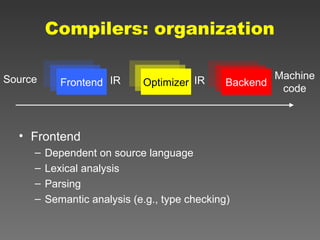
Compilers: organization
Source

Frontend IR

Optimizer IR

Machine
Backend
code

• Frontend
–
–
–
–

Dependent on source language
Lexical analysis
Parsing
Semantic analysis (e.g., type checking)
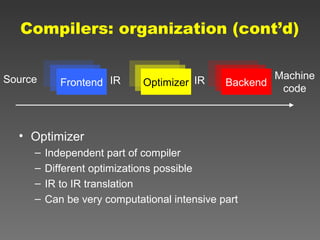
Compilers: organization (cont’d)
Source

Frontend IR

Optimizer IR

Machine
Backend
code

• Optimizer
–
–
–
–

Independent part of compiler
Different optimizations possible
IR to IR translation
Can be very computational intensive part
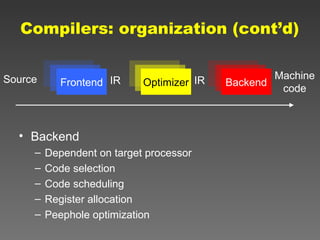
Compilers: organization (cont’d)
Source

Frontend IR

Optimizer IR

• Backend
–
–
–
–
–

Dependent on target processor
Code selection
Code scheduling
Register allocation
Peephole optimization

Machine
Backend
code
Frontend
Introduction to parsing
using LEX and YACC
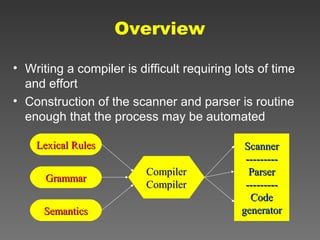
Overview
• Writing a compiler is difficult requiring lots of time
and effort
• Construction of the scanner and parser is routine
enough that the process may be automated
Lexical Rules
Grammar
Semantics

Compiler
Compiler

Scanner
--------Parser
--------Code
generator
YACC
• What is YACC ?
– Tool which will produce a parser for a given
grammar.
– YACC (Yet Another Compiler Compiler) is a program
designed to compile a LALR(1) grammar and to
produce the source code of the syntactic analyzer of
the language produced by this grammar
– Input is a grammar (rules) and actions to take upon
recognizing a rule
– Output is a C program and optionally a header file of
tokens
LEX
• Lex is a scanner generator
– Input is description of patterns and actions
– Output is a C program which contains a function yylex()
which, when called, matches patterns and performs
actions per input
– Typically, the generated scanner performs lexical
analysis and produces tokens for the (YACC-generated)
parser
LEX and YACC: a team

How to
work ?
LEX and YACC: a team
call yylex()

[0-9]+

next token is NUM

NUM ‘+’ NUM
Availability
•
•
•
•
•

lex, yacc on most UNIX systems
bison: a yacc replacement from GNU
flex: fast lexical analyzer
BSD yacc
Windows/MS-DOS versions exist
YACC

Basic Operational Sequence
gram.y
yacc

y.tab.c
cc
or gcc

a.out

File containing desired
grammar in YACC format
YACC program
C source program created by YACC

C compiler
Executable program that will parse
grammar given in gram.y
YACC File Format
Definitions
%%
Rules
%%
Supplementary Code

The identical LEX format was
actually taken from this...
Rules Section
• Is a grammar
• Example
expr : expr '+' term | term;
term : term '*' factor | factor;
factor : '(' expr ')' | ID | NUM;
Rules Section
• Normally written like this
• Example:
expr

:
|
;
term
:
|
;
factor :
|
|
;

expr '+' term
term
term '*' factor
factor
'(' expr ')'
ID
NUM
Definitions Section
Example

%{
#include <stdio.h>
#include <stdlib.h>
%}
This is called a
terminal
%token ID NUM
%start expr
The start
symbol
(non-terminal)
Sidebar
• LEX produces a function called yylex()
• YACC produces a function called yyparse()
• yyparse() expects to be able to call yylex()
• How to get yylex()?
• Write your own!
• If you don't want to write your own: Use LEX!!!
Sidebar
int yylex()
{
if(it's a num)
return NUM;
else if(it's an id)
return ID;
else if(parsing is done)
return 0;
else if(it's an error)
return -1;
}
Semantic actions
expr :
|
;
term :
|
;
factor

expr '+' term
term

{ $$ = $1 + $3; }
{ $$ = $1; }

term '*' factor
factor

{ $$ = $1 * $3; }
{ $$ = $1; }

: '(' expr ')'
| ID
| NUM
;

{ $$ = $2; }
Semantic actions (cont’d)
$1
expr :
|
;
term :
|
;
factor

expr '+' term
term

{ $$ = $1 + $3; }
{ $$ = $1; }

term '*' factor
factor

{ $$ = $1 * $3; }
{ $$ = $1; }

: '(' expr ')'
| ID
| NUM
;

{ $$ = $2; }
Semantic actions (cont’d)
expr :
|
;
term :
|
;
factor

expr '+' term
term

{ $$ = $1 + $3; }
{ $$ = $1; }

term '*' factor
factor

{ $$ = $1 * $3; }
{ $$ = $1; }

: '(' expr ')'
| ID
| NUM
;

{ $$ = $2; }

$2
Semantic actions (cont’d)
expr :
|
;
term :
|
;
factor

expr '+' term
term

{ $$ = $1 + $3; }
{ $$ = $1; }

term '*' factor
factor

{ $$ = $1 * $3; }
{ $$ = $1; }

: '(' expr ')'
| ID
| NUM
;

{ $$ = $2; }

$3
Default: $$ = $1;
Bored, lonely? Try this!
yacc -d gram.y
• Will produce:
y.tab.h

Look at this and you'll
never be unhappy again!

yacc -v gram.y
• Will produce:
y.output

Shows "State
Shows "State
Machine"®
Machine"®
Example: LEX
%{
#include <stdio.h>
#include "y.tab.h"
%}
id
[_a-zA-Z][_a-zA-Z0-9]*
wspc
[ tn]+
semi
[;]
comma
[,]
%%
int
{ return INT; }
char
{ return CHAR; }
float
{ return FLOAT; }
{comma}
{ return COMMA; }
{semi}
{ return SEMI; }
{id}
{ return ID;}
{wspc}
{;}

/* Necessary? */

scanner.l
Example: Definitions
%{
#include <stdio.h>
#include <stdlib.h>
%}
%start line
%token CHAR, COMMA, FLOAT, ID, INT, SEMI
%%

decl.y
Example: Rules
/*
*
*
*

decl.y

This production is not part of the "official"
grammar. It's primary purpose is to recover from
parser errors, so it's probably best if you leave
it here. */

line : /* lambda */
| line decl
| line error {
printf("Failure :-(n");
yyerrok;
yyclearin;
}
;
Example: Rules
decl :

type ID list { printf("Success!n"); } ;

list : COMMA ID list
| SEMI
;
type :
INT | CHAR | FLOAT
;
%%

decl.y
decl.y

Example: Supplementary Code
extern FILE *yyin;
main()
{
do {
yyparse();
} while(!feof(yyin));
}
yyerror(char *s)
{
/* Don't have to do anything! */
}
Bored, lonely? Try this!
yacc -d decl.y
• Produced
y.tab.h
#
#
#
#
#
#

define
define
define
define
define
define

CHAR 257
COMMA 258
FLOAT 259
ID 260
INT 261
SEMI 262
Symbol attributes
• Back to attribute grammars...
• Every symbol can have a value
– Might be a numeric quantity in case of a number (42)
– Might be a pointer to a string ("Hello, World!")
– Might be a pointer to a symbol table entry in case of a
variable

• When using LEX we put the value into yylval
– In complex situations yylval is a union

• Typical LEX code:
[0-9]+

{yylval = atoi(yytext); return NUM}
Symbol attributes (cont’d)
• YACC allows symbols to have multiple types of
value symbols
%union {
double dval;
int
vblno;
char* strval;
}
Symbol attributes (cont’d)
%union {
double dval;
int
vblno;
char* strval;
}

yacc -d

y.tab.h
…
extern YYSTYPE yylval;

[0-9]+

{ yylval.vblno = atoi(yytext);
return NUM;}
[A-z]+ { yylval.strval =
strdup(yytext);
return STRING;}

LEX file
include “y.tab.h”
Precedence / Association
(1) 1 – 2 - 3
(2) 1 – 2 * 3

1. 1-2-3 = (1-2)-3? or 1-(2-3)?
Define ‘-’ operator is left-association.
2. 1-2*3 = 1-(2*3)
Define “*” operator is precedent to “-” operator
Precedence /
Association
%left '+' '-'
%left '*' '/'
%noassoc UMINUS

expr :
|
|
|

expr
expr
expr
expr

‘+’
‘-’
‘*’
‘/’

expr
{ $$ = $1 + $3; }
expr
{ $$ = $1 - $3; }
expr
{ $$ = $1 * $3; }
expr { if($3==0)
yyerror(“divide 0”);
else
$$ = $1 / $3;
}
| ‘-’ expr %prec UMINUS {$$ = -$2; }
Precedence / Association
%right
%left
%left
%left

‘=‘
'<' '>' NE LE GE
'+' '-‘
'*' '/'
highest precedence
Big trick
Getting YACC & LEX to work together!
LEX & YACC

lex.yy.c

y.tab.c

cc/
gcc

a.out
Building Example
• Suppose you have a lex file called scanner.l
and a yacc file called decl.y and want parser
• Steps to build...
lex scanner.l
yacc -d decl.y
gcc -c lex.yy.c y.tab.c
gcc -o parser lex.yy.o y.tab.o -ll
Note: scanner should include in the definitions
section: #include "y.tab.h"
YACC
• Rules may be recursive
• Rules may be ambiguous
• Uses bottom-up Shift/Reduce parsing
– Get a token
– Push onto stack
– Can it be reduced (How do we know?)
• If yes: Reduce using a rule
• If no: Get another token

• YACC cannot look ahead more than one token
Shift and reducing
stmt: stmt ‘;’ stmt
| NAME ‘=‘ exp

stack:
<empty>

exp: exp ‘+’ exp
| exp ‘-’ exp
| NAME
| NUMBER

input:
a = 7; b = 3 + a + 2
Shift and reducing
stmt: stmt ‘;’ stmt
| NAME ‘=‘ exp

SHIFT!
stack:
NAME

exp: exp ‘+’ exp
| exp ‘-’ exp
| NAME
| NUMBER

input:
= 7; b = 3 + a + 2
Shift and reducing
stmt: stmt ‘;’ stmt
| NAME ‘=‘ exp

SHIFT!
stack:
NAME ‘=‘

exp: exp ‘+’ exp
| exp ‘-’ exp
| NAME
| NUMBER

input:
7; b = 3 + a + 2
Shift and reducing
stmt: stmt ‘;’ stmt
| NAME ‘=‘ exp

SHIFT!
stack:
NAME ‘=‘ 7

exp: exp ‘+’ exp
| exp ‘-’ exp
| NAME
| NUMBER

input:
; b = 3 + a + 2
Shift and reducing
stmt: stmt ‘;’ stmt
| NAME ‘=‘ exp

exp: exp ‘+’ exp

REDUCE!
stack:
NAME ‘=‘ exp

| exp ‘-’ exp
| NAME
| NUMBER

input:
; b = 3 + a + 2
Shift and reducing
stmt: stmt ‘;’ stmt
| NAME ‘=‘ exp

REDUCE!
stack:
stmt

exp: exp ‘+’ exp
| exp ‘-’ exp
| NAME
| NUMBER

input:
; b = 3 + a + 2
Shift and reducing
stmt: stmt ‘;’ stmt
| NAME ‘=‘ exp

SHIFT!
stack:
stmt ‘;’

exp: exp ‘+’ exp
| exp ‘-’ exp
| NAME
| NUMBER

input:
b = 3 + a + 2
Shift and reducing
stmt: stmt ‘;’ stmt
| NAME ‘=‘ exp

SHIFT!
stack:
stmt ‘;’ NAME

exp: exp ‘+’ exp
| exp ‘-’ exp
| NAME
| NUMBER

input:
= 3 + a + 2
Shift and reducing
stmt: stmt ‘;’ stmt
| NAME ‘=‘ exp

SHIFT!
stack:
stmt ‘;’ NAME ‘=‘

exp: exp ‘+’ exp
| exp ‘-’ exp
| NAME
| NUMBER

input:
3 + a + 2
Shift and reducing
stmt: stmt ‘;’ stmt
| NAME ‘=‘ exp

exp: exp ‘+’ exp

SHIFT!
stack:
stmt ‘;’ NAME ‘=‘
NUMBER

| exp ‘-’ exp
| NAME
| NUMBER

input:
+ a + 2
Shift and reducing
stmt: stmt ‘;’ stmt
| NAME ‘=‘ exp

exp: exp ‘+’ exp

REDUCE!
stack:
stmt ‘;’ NAME ‘=‘
exp

| exp ‘-’ exp
| NAME
| NUMBER

input:
+ a + 2
Shift and reducing
stmt: stmt ‘;’ stmt
| NAME ‘=‘ exp

exp: exp ‘+’ exp

SHIFT!
stack:
stmt ‘;’ NAME ‘=‘
exp ‘+’

| exp ‘-’ exp
| NAME
| NUMBER

input:
a + 2
Shift and reducing
stmt: stmt ‘;’ stmt
| NAME ‘=‘ exp

exp: exp ‘+’ exp

SHIFT!
stack:
stmt ‘;’ NAME ‘=‘
exp ‘+’ NAME

| exp ‘-’ exp
| NAME
| NUMBER

input:
+ 2
Shift and reducing
stmt: stmt ‘;’ stmt
| NAME ‘=‘ exp

exp: exp ‘+’ exp

REDUCE!
stack:
stmt ‘;’ NAME ‘=‘
exp ‘+’ exp

| exp ‘-’ exp
| NAME
| NUMBER

input:
+ 2
Shift and reducing
stmt: stmt ‘;’ stmt
| NAME ‘=‘ exp

exp: exp ‘+’ exp

REDUCE!
stack:
stmt ‘;’ NAME ‘=‘
exp

| exp ‘-’ exp
| NAME
| NUMBER

input:
+ 2
Shift and reducing
stmt: stmt ‘;’ stmt
| NAME ‘=‘ exp

exp: exp ‘+’ exp

SHIFT!
stack:
stmt ‘;’ NAME ‘=‘
exp ‘+’

| exp ‘-’ exp
| NAME
| NUMBER

input:
2
Shift and reducing
stmt: stmt ‘;’ stmt
| NAME ‘=‘ exp

exp: exp ‘+’ exp

SHIFT!
stack:
stmt ‘;’ NAME ‘=‘
exp ‘+’ NUMBER

| exp ‘-’ exp
| NAME
| NUMBER

input:
<empty>
Shift and reducing
stmt: stmt ‘;’ stmt
| NAME ‘=‘ exp

exp: exp ‘+’ exp
| exp ‘-’ exp
| NAME
| NUMBER

REDUCE!
stack:
stmt ‘;’ NAME ‘=‘
exp ‘+’ exp
input:
<empty>
Shift and reducing
stmt: stmt ‘;’ stmt
| NAME ‘=‘ exp

exp: exp ‘+’ exp
| exp ‘-’ exp
| NAME
| NUMBER

REDUCE!
stack:
stmt ‘;’ NAME ‘=‘
exp
input:
<empty>
Shift and reducing
stmt: stmt ‘;’ stmt
| NAME ‘=‘ exp

REDUCE!
stack:
stmt ‘;’ stmt

exp: exp ‘+’ exp
| exp ‘-’ exp
| NAME
| NUMBER

input:
<empty>
Shift and reducing
stmt: stmt ‘;’ stmt
| NAME ‘=‘ exp

REDUCE!
stack:
stmt

exp: exp ‘+’ exp
| exp ‘-’ exp
| NAME
| NUMBER

input:
<empty>
Shift and reducing
stmt: stmt ‘;’ stmt
| NAME ‘=‘ exp

DONE!
stack:
stmt

exp: exp ‘+’ exp
| exp ‘-’ exp
| NAME
| NUMBER

input:
<empty>
IF-ELSE Ambiguity
• Consider following rule:

Following state : IF expr IF expr stmt . ELSE stmt
• Two possible derivations:
IF expr IF expr stmt . ELSE stmt
IF expr IF expr stmt ELSE . stmt
IF expr IF expr stmt ELSE stmt .
IF expr stmt

IF expr IF expr stmt . ELSE stmt
IF expr stmt . ELSE stmt
IF expr stmt ELSE . stmt
IF expr stmt ELSE stmt .
IF-ELSE Ambiguity
• It is a shift/reduce conflict
• YACC will always do shift first
• Solution 1 : re-write grammar
stmt

: matched
| unmatched
;
matched: other_stmt
| IF expr THEN matched ELSE matched
;
unmatched: IF expr THEN stmt
| IF expr THEN matched ELSE unmatched
;
IF-ELSE Ambiguity
• Solution 2:
the rule has the
same precedence as
token IFX
Shift/Reduce Conflicts
• shift/reduce conflict
– occurs when a grammar is written in such a way that
a decision between shifting and reducing can not be
made.
– e.g.: IF-ELSE ambiguity

• To resolve this conflict, YACC will choose to shift
Reduce/Reduce Conflicts
• Reduce/Reduce Conflicts:
start : expr | stmt
;
expr : CONSTANT;
stmt : CONSTANT;

• YACC (Bison) resolves the conflict by
reducing using the rule that occurs earlier in
the grammar. NOT GOOD!!
• So, modify grammar to eliminate them
Error Messages
• Bad error message:
– Syntax error
– Compiler needs to give programmer a good advice

• It is better to track the line number in LEX:
void yyerror(char *s)
{
fprintf(stderr, "line %d: %sn:", yylineno, s);
}
Recursive Grammar
• Left recursion

• Right recursion

list:
item
| list ',' item
;

list:
item
| item ',' list
;

• LR parser prefers left recursion
• LL parser prefers right recursion
YACC Example
• Taken from LEX & YACC
• Simple calculator
a = 4 + 6
a
a=10
b = 7
c = a + b
c
c = 17
pressure = (78 + 34) * 16.4
$
Grammar
expression ::= expression '+' term |
expression '-' term |
term
term

::= term '*' factor |
term '/' factor |
factor

factor

::= '(' expression ')' |
'-' factor |
NUMBER |
NAME
parser.h
2

name

value

3

name

value

name

value

5

name

value

6

name

value

name

value

name

value

name

value

name

value

11

name

value

12

parser.h

value

10

struct symtab *symlook();

name

9

struct symtab {
char *name;
double value;
} symtab[NSYMS];

1

8

/* maximum number
of symbols */

value

7

#define NSYMS 20

name

4

/*
* Header for calculator program
*/

0

name

value

13

name

value

14

name

value
parser.y
%{
#include "parser.h"
#include <string.h>
%}
%union {
double dval;
struct symtab *symp;
}
%token <symp> NAME
%token <dval> NUMBER
%type <dval> expression
%type <dval> term
%type <dval> factor
%%

parser.y
statement_list:
|
;
statement:
|
;

statement 'n'
statement_list statement 'n‘

NAME '=' expression
{ $1->value = $3; }
expression
{ printf("= %gn", $1); }

expression: expression '+' term { $$ = $1 + $3; }
| expression '-' term { $$ = $1 - $3; }
term
;

parser.y
term:
|

term '*' factor { $$ = $1 * $3; }
term '/' factor { if($3 == 0.0)
yyerror("divide by zero");
else
$$ = $1 / $3;
}
| factor
;

factor:
|
|
|
;
%%

'(' expression ')' { $$ = $2; }
'-' factor
{ $$ = -$2; }
NUMBER
NAME
{ $$ = $1->value; }

parser.y
/* look up a symbol table entry, add if not present */
struct symtab *symlook(char *s) {
char *p;
struct symtab *sp;
for(sp = symtab; sp < &symtab[NSYMS]; sp++) {
/* is it already here? */
if(sp->name && !strcmp(sp->name, s))
return sp;
if(!sp->name) { /* is it free */
sp->name = strdup(s);
return sp;
}
/* otherwise continue to next */
}
yyerror("Too many symbols");
exit(1); /* cannot continue */
} /* symlook */
parser.y
yyerror(char *s)
{
printf( "yyerror: %sn", s);
}

parser.y
typedef union
{
double dval;
struct symtab *symp;
} YYSTYPE;
extern YYSTYPE yylval;
# define NAME 257
# define NUMBER 258
y.tab.h
calclexer.l
%{
#include "y.tab.h"
#include "parser.h"
#include <math.h>
%}
%%

calclexer.l
%%
([0-9]+|([0-9]*.[0-9]+)([eE][-+]?[0-9]+)?) {
yylval.dval = atof(yytext);
return NUMBER;
}
[ t] ;

/* ignore white space */

[A-Za-z][A-Za-z0-9]*

{ /* return symbol pointer */
yylval.symp = symlook(yytext);
return NAME;
}

"$"

{ return 0; /* end of input */ }

n |.
%%

return yytext[0];

calclexer.l
Makefile
LEX = lex
YACC = yacc
CC = gcc

Makefile

calcu:
y.tab.o lex.yy.o
$(CC) -o calcu y.tab.o lex.yy.o -ly -ll
y.tab.c y.tab.h: parser.y
$(YACC)
-d parser.y
y.tab.o: y.tab.c parser.h
$(CC) -c y.tab.c
lex.yy.o: y.tab.h lex.yy.c
$(CC) -c lex.yy.c
lex.yy.c: calclexer.l parser.h
$(LEX) calclexer.l

clean:

rm *.o
rm *.c
rm calcu
YACC Declaration
Summary
`%start'

Specify the grammar's start symbol

`%union‘ Declare the collection of data types that
semantic values may have
`%token‘ Declare a terminal symbol (token type
name) with no precedence or associativity specified
`%type‘ Declare the type of semantic values for a
nonterminal symbol
YACC Declaration Summary
`%right‘ Declare a terminal symbol (token type name)
that is right-associative
`%left‘ Declare a terminal symbol (token type name)
that is left-associative
`%nonassoc‘ Declare a terminal symbol (token type
name) that is nonassociative (using it in a way that
would be associative is a syntax error, e.g.:
x op. y op. z is syntax error)

Compiler Design Tutorial

  • 1.
    Language processing: introduction tocompiler construction Andy D. Pimentel Computer Systems Architecture group andy@science.uva.nl http://www.science.uva.nl/~andy/taalverwerking.html
  • 2.
    About this course •This part will address compilers for programming languages • Depth-first approach – Instead of covering all compiler aspects very briefly, we focus on particular compiler stages – Focus: optimization and compiler back issues • This course is complementary to the compiler course at the VU • Grading: (heavy) practical assignment and one or two take-home assignments
  • 3.
    About this course(cont’d) • Book – Recommended, not compulsory: Seti, Aho and Ullman,”Compilers Principles, Techniques and Tools” (the Dragon book) – Old book, but still more than sufficient – Copies of relevant chapters can be found in the library • Sheets are available at the website • Idem for practical/take-home assignments, deadlines, etc.
  • 4.
    Topics • Compiler introduction –General organization • Scanning & parsing – From a practical viewpoint: LEX and YACC • Intermediate formats • Optimization: techniques and algorithms – – – – – Local/peephole optimizations Global and loop optimizations Recognizing loops Dataflow analysis Alias analysis
  • 5.
    Topics (cont’d) • Codegeneration – Instruction selection – Register allocation – Instruction scheduling: improving ILP • Source-level optimizations – Optimizations for cache behavior
  • 6.
  • 7.
    Compilers: organization Source Frontend IR OptimizerIR Machine Backend code • Frontend – – – – Dependent on source language Lexical analysis Parsing Semantic analysis (e.g., type checking)
  • 8.
    Compilers: organization (cont’d) Source FrontendIR Optimizer IR Machine Backend code • Optimizer – – – – Independent part of compiler Different optimizations possible IR to IR translation Can be very computational intensive part
  • 9.
    Compilers: organization (cont’d) Source FrontendIR Optimizer IR • Backend – – – – – Dependent on target processor Code selection Code scheduling Register allocation Peephole optimization Machine Backend code
  • 10.
  • 11.
    Overview • Writing acompiler is difficult requiring lots of time and effort • Construction of the scanner and parser is routine enough that the process may be automated Lexical Rules Grammar Semantics Compiler Compiler Scanner --------Parser --------Code generator
  • 12.
    YACC • What isYACC ? – Tool which will produce a parser for a given grammar. – YACC (Yet Another Compiler Compiler) is a program designed to compile a LALR(1) grammar and to produce the source code of the syntactic analyzer of the language produced by this grammar – Input is a grammar (rules) and actions to take upon recognizing a rule – Output is a C program and optionally a header file of tokens
  • 13.
    LEX • Lex isa scanner generator – Input is description of patterns and actions – Output is a C program which contains a function yylex() which, when called, matches patterns and performs actions per input – Typically, the generated scanner performs lexical analysis and produces tokens for the (YACC-generated) parser
  • 14.
    LEX and YACC:a team How to work ?
  • 15.
    LEX and YACC:a team call yylex() [0-9]+ next token is NUM NUM ‘+’ NUM
  • 16.
    Availability • • • • • lex, yacc onmost UNIX systems bison: a yacc replacement from GNU flex: fast lexical analyzer BSD yacc Windows/MS-DOS versions exist
  • 17.
    YACC Basic Operational Sequence gram.y yacc y.tab.c cc orgcc a.out File containing desired grammar in YACC format YACC program C source program created by YACC C compiler Executable program that will parse grammar given in gram.y
  • 18.
    YACC File Format Definitions %% Rules %% SupplementaryCode The identical LEX format was actually taken from this...
  • 19.
    Rules Section • Isa grammar • Example expr : expr '+' term | term; term : term '*' factor | factor; factor : '(' expr ')' | ID | NUM;
  • 20.
    Rules Section • Normallywritten like this • Example: expr : | ; term : | ; factor : | | ; expr '+' term term term '*' factor factor '(' expr ')' ID NUM
  • 21.
    Definitions Section Example %{ #include <stdio.h> #include<stdlib.h> %} This is called a terminal %token ID NUM %start expr The start symbol (non-terminal)
  • 22.
    Sidebar • LEX producesa function called yylex() • YACC produces a function called yyparse() • yyparse() expects to be able to call yylex() • How to get yylex()? • Write your own! • If you don't want to write your own: Use LEX!!!
  • 23.
    Sidebar int yylex() { if(it's anum) return NUM; else if(it's an id) return ID; else if(parsing is done) return 0; else if(it's an error) return -1; }
  • 24.
    Semantic actions expr : | ; term: | ; factor expr '+' term term { $$ = $1 + $3; } { $$ = $1; } term '*' factor factor { $$ = $1 * $3; } { $$ = $1; } : '(' expr ')' | ID | NUM ; { $$ = $2; }
  • 25.
    Semantic actions (cont’d) $1 expr: | ; term : | ; factor expr '+' term term { $$ = $1 + $3; } { $$ = $1; } term '*' factor factor { $$ = $1 * $3; } { $$ = $1; } : '(' expr ')' | ID | NUM ; { $$ = $2; }
  • 26.
    Semantic actions (cont’d) expr: | ; term : | ; factor expr '+' term term { $$ = $1 + $3; } { $$ = $1; } term '*' factor factor { $$ = $1 * $3; } { $$ = $1; } : '(' expr ')' | ID | NUM ; { $$ = $2; } $2
  • 27.
    Semantic actions (cont’d) expr: | ; term : | ; factor expr '+' term term { $$ = $1 + $3; } { $$ = $1; } term '*' factor factor { $$ = $1 * $3; } { $$ = $1; } : '(' expr ')' | ID | NUM ; { $$ = $2; } $3 Default: $$ = $1;
  • 28.
    Bored, lonely? Trythis! yacc -d gram.y • Will produce: y.tab.h Look at this and you'll Look at this and you'll never be unhappy again! never be unhappy again! yacc -v gram.y • Will produce: y.output Shows "State Shows "State Machine"® Machine"®
  • 29.
    Example: LEX %{ #include <stdio.h> #include"y.tab.h" %} id [_a-zA-Z][_a-zA-Z0-9]* wspc [ tn]+ semi [;] comma [,] %% int { return INT; } char { return CHAR; } float { return FLOAT; } {comma} { return COMMA; } {semi} { return SEMI; } {id} { return ID;} {wspc} {;} /* Necessary? */ scanner.l
  • 30.
    Example: Definitions %{ #include <stdio.h> #include<stdlib.h> %} %start line %token CHAR, COMMA, FLOAT, ID, INT, SEMI %% decl.y
  • 31.
    Example: Rules /* * * * decl.y This productionis not part of the "official" grammar. It's primary purpose is to recover from parser errors, so it's probably best if you leave it here. */ line : /* lambda */ | line decl | line error { printf("Failure :-(n"); yyerrok; yyclearin; } ;
  • 32.
    Example: Rules decl : typeID list { printf("Success!n"); } ; list : COMMA ID list | SEMI ; type : INT | CHAR | FLOAT ; %% decl.y
  • 33.
    decl.y Example: Supplementary Code externFILE *yyin; main() { do { yyparse(); } while(!feof(yyin)); } yyerror(char *s) { /* Don't have to do anything! */ }
  • 34.
    Bored, lonely? Trythis! yacc -d decl.y • Produced y.tab.h # # # # # # define define define define define define CHAR 257 COMMA 258 FLOAT 259 ID 260 INT 261 SEMI 262
  • 35.
    Symbol attributes • Backto attribute grammars... • Every symbol can have a value – Might be a numeric quantity in case of a number (42) – Might be a pointer to a string ("Hello, World!") – Might be a pointer to a symbol table entry in case of a variable • When using LEX we put the value into yylval – In complex situations yylval is a union • Typical LEX code: [0-9]+ {yylval = atoi(yytext); return NUM}
  • 36.
    Symbol attributes (cont’d) •YACC allows symbols to have multiple types of value symbols %union { double dval; int vblno; char* strval; }
  • 37.
    Symbol attributes (cont’d) %union{ double dval; int vblno; char* strval; } yacc -d y.tab.h … extern YYSTYPE yylval; [0-9]+ { yylval.vblno = atoi(yytext); return NUM;} [A-z]+ { yylval.strval = strdup(yytext); return STRING;} LEX file include “y.tab.h”
  • 38.
    Precedence / Association (1)1 – 2 - 3 (2) 1 – 2 * 3 1. 1-2-3 = (1-2)-3? or 1-(2-3)? Define ‘-’ operator is left-association. 2. 1-2*3 = 1-(2*3) Define “*” operator is precedent to “-” operator
  • 39.
    Precedence / Association %left '+''-' %left '*' '/' %noassoc UMINUS expr : | | | expr expr expr expr ‘+’ ‘-’ ‘*’ ‘/’ expr { $$ = $1 + $3; } expr { $$ = $1 - $3; } expr { $$ = $1 * $3; } expr { if($3==0) yyerror(“divide 0”); else $$ = $1 / $3; } | ‘-’ expr %prec UMINUS {$$ = -$2; }
  • 40.
    Precedence / Association %right %left %left %left ‘=‘ '<''>' NE LE GE '+' '-‘ '*' '/' highest precedence
  • 41.
    Big trick Getting YACC& LEX to work together!
  • 42.
  • 43.
    Building Example • Supposeyou have a lex file called scanner.l and a yacc file called decl.y and want parser • Steps to build... lex scanner.l yacc -d decl.y gcc -c lex.yy.c y.tab.c gcc -o parser lex.yy.o y.tab.o -ll Note: scanner should include in the definitions section: #include "y.tab.h"
  • 44.
    YACC • Rules maybe recursive • Rules may be ambiguous • Uses bottom-up Shift/Reduce parsing – Get a token – Push onto stack – Can it be reduced (How do we know?) • If yes: Reduce using a rule • If no: Get another token • YACC cannot look ahead more than one token
  • 45.
    Shift and reducing stmt:stmt ‘;’ stmt | NAME ‘=‘ exp stack: <empty> exp: exp ‘+’ exp | exp ‘-’ exp | NAME | NUMBER input: a = 7; b = 3 + a + 2
  • 46.
    Shift and reducing stmt:stmt ‘;’ stmt | NAME ‘=‘ exp SHIFT! stack: NAME exp: exp ‘+’ exp | exp ‘-’ exp | NAME | NUMBER input: = 7; b = 3 + a + 2
  • 47.
    Shift and reducing stmt:stmt ‘;’ stmt | NAME ‘=‘ exp SHIFT! stack: NAME ‘=‘ exp: exp ‘+’ exp | exp ‘-’ exp | NAME | NUMBER input: 7; b = 3 + a + 2
  • 48.
    Shift and reducing stmt:stmt ‘;’ stmt | NAME ‘=‘ exp SHIFT! stack: NAME ‘=‘ 7 exp: exp ‘+’ exp | exp ‘-’ exp | NAME | NUMBER input: ; b = 3 + a + 2
  • 49.
    Shift and reducing stmt:stmt ‘;’ stmt | NAME ‘=‘ exp exp: exp ‘+’ exp REDUCE! stack: NAME ‘=‘ exp | exp ‘-’ exp | NAME | NUMBER input: ; b = 3 + a + 2
  • 50.
    Shift and reducing stmt:stmt ‘;’ stmt | NAME ‘=‘ exp REDUCE! stack: stmt exp: exp ‘+’ exp | exp ‘-’ exp | NAME | NUMBER input: ; b = 3 + a + 2
  • 51.
    Shift and reducing stmt:stmt ‘;’ stmt | NAME ‘=‘ exp SHIFT! stack: stmt ‘;’ exp: exp ‘+’ exp | exp ‘-’ exp | NAME | NUMBER input: b = 3 + a + 2
  • 52.
    Shift and reducing stmt:stmt ‘;’ stmt | NAME ‘=‘ exp SHIFT! stack: stmt ‘;’ NAME exp: exp ‘+’ exp | exp ‘-’ exp | NAME | NUMBER input: = 3 + a + 2
  • 53.
    Shift and reducing stmt:stmt ‘;’ stmt | NAME ‘=‘ exp SHIFT! stack: stmt ‘;’ NAME ‘=‘ exp: exp ‘+’ exp | exp ‘-’ exp | NAME | NUMBER input: 3 + a + 2
  • 54.
    Shift and reducing stmt:stmt ‘;’ stmt | NAME ‘=‘ exp exp: exp ‘+’ exp SHIFT! stack: stmt ‘;’ NAME ‘=‘ NUMBER | exp ‘-’ exp | NAME | NUMBER input: + a + 2
  • 55.
    Shift and reducing stmt:stmt ‘;’ stmt | NAME ‘=‘ exp exp: exp ‘+’ exp REDUCE! stack: stmt ‘;’ NAME ‘=‘ exp | exp ‘-’ exp | NAME | NUMBER input: + a + 2
  • 56.
    Shift and reducing stmt:stmt ‘;’ stmt | NAME ‘=‘ exp exp: exp ‘+’ exp SHIFT! stack: stmt ‘;’ NAME ‘=‘ exp ‘+’ | exp ‘-’ exp | NAME | NUMBER input: a + 2
  • 57.
    Shift and reducing stmt:stmt ‘;’ stmt | NAME ‘=‘ exp exp: exp ‘+’ exp SHIFT! stack: stmt ‘;’ NAME ‘=‘ exp ‘+’ NAME | exp ‘-’ exp | NAME | NUMBER input: + 2
  • 58.
    Shift and reducing stmt:stmt ‘;’ stmt | NAME ‘=‘ exp exp: exp ‘+’ exp REDUCE! stack: stmt ‘;’ NAME ‘=‘ exp ‘+’ exp | exp ‘-’ exp | NAME | NUMBER input: + 2
  • 59.
    Shift and reducing stmt:stmt ‘;’ stmt | NAME ‘=‘ exp exp: exp ‘+’ exp REDUCE! stack: stmt ‘;’ NAME ‘=‘ exp | exp ‘-’ exp | NAME | NUMBER input: + 2
  • 60.
    Shift and reducing stmt:stmt ‘;’ stmt | NAME ‘=‘ exp exp: exp ‘+’ exp SHIFT! stack: stmt ‘;’ NAME ‘=‘ exp ‘+’ | exp ‘-’ exp | NAME | NUMBER input: 2
  • 61.
    Shift and reducing stmt:stmt ‘;’ stmt | NAME ‘=‘ exp exp: exp ‘+’ exp SHIFT! stack: stmt ‘;’ NAME ‘=‘ exp ‘+’ NUMBER | exp ‘-’ exp | NAME | NUMBER input: <empty>
  • 62.
    Shift and reducing stmt:stmt ‘;’ stmt | NAME ‘=‘ exp exp: exp ‘+’ exp | exp ‘-’ exp | NAME | NUMBER REDUCE! stack: stmt ‘;’ NAME ‘=‘ exp ‘+’ exp input: <empty>
  • 63.
    Shift and reducing stmt:stmt ‘;’ stmt | NAME ‘=‘ exp exp: exp ‘+’ exp | exp ‘-’ exp | NAME | NUMBER REDUCE! stack: stmt ‘;’ NAME ‘=‘ exp input: <empty>
  • 64.
    Shift and reducing stmt:stmt ‘;’ stmt | NAME ‘=‘ exp REDUCE! stack: stmt ‘;’ stmt exp: exp ‘+’ exp | exp ‘-’ exp | NAME | NUMBER input: <empty>
  • 65.
    Shift and reducing stmt:stmt ‘;’ stmt | NAME ‘=‘ exp REDUCE! stack: stmt exp: exp ‘+’ exp | exp ‘-’ exp | NAME | NUMBER input: <empty>
  • 66.
    Shift and reducing stmt:stmt ‘;’ stmt | NAME ‘=‘ exp DONE! stack: stmt exp: exp ‘+’ exp | exp ‘-’ exp | NAME | NUMBER input: <empty>
  • 67.
    IF-ELSE Ambiguity • Considerfollowing rule: Following state : IF expr IF expr stmt . ELSE stmt • Two possible derivations: IF expr IF expr stmt . ELSE stmt IF expr IF expr stmt ELSE . stmt IF expr IF expr stmt ELSE stmt . IF expr stmt IF expr IF expr stmt . ELSE stmt IF expr stmt . ELSE stmt IF expr stmt ELSE . stmt IF expr stmt ELSE stmt .
  • 68.
    IF-ELSE Ambiguity • Itis a shift/reduce conflict • YACC will always do shift first • Solution 1 : re-write grammar stmt : matched | unmatched ; matched: other_stmt | IF expr THEN matched ELSE matched ; unmatched: IF expr THEN stmt | IF expr THEN matched ELSE unmatched ;
  • 69.
    IF-ELSE Ambiguity • Solution2: the rule has the same precedence as token IFX
  • 70.
    Shift/Reduce Conflicts • shift/reduceconflict – occurs when a grammar is written in such a way that a decision between shifting and reducing can not be made. – e.g.: IF-ELSE ambiguity • To resolve this conflict, YACC will choose to shift
  • 71.
    Reduce/Reduce Conflicts • Reduce/ReduceConflicts: start : expr | stmt ; expr : CONSTANT; stmt : CONSTANT; • YACC (Bison) resolves the conflict by reducing using the rule that occurs earlier in the grammar. NOT GOOD!! • So, modify grammar to eliminate them
  • 72.
    Error Messages • Baderror message: – Syntax error – Compiler needs to give programmer a good advice • It is better to track the line number in LEX: void yyerror(char *s) { fprintf(stderr, "line %d: %sn:", yylineno, s); }
  • 73.
    Recursive Grammar • Leftrecursion • Right recursion list: item | list ',' item ; list: item | item ',' list ; • LR parser prefers left recursion • LL parser prefers right recursion
  • 74.
    YACC Example • Takenfrom LEX & YACC • Simple calculator a = 4 + 6 a a=10 b = 7 c = a + b c c = 17 pressure = (78 + 34) * 16.4 $
  • 75.
    Grammar expression ::= expression'+' term | expression '-' term | term term ::= term '*' factor | term '/' factor | factor factor ::= '(' expression ')' | '-' factor | NUMBER | NAME
  • 76.
  • 77.
    2 name value 3 name value name value 5 name value 6 name value name value name value name value name value 11 name value 12 parser.h value 10 struct symtab *symlook(); name 9 structsymtab { char *name; double value; } symtab[NSYMS]; 1 8 /* maximum number of symbols */ value 7 #define NSYMS 20 name 4 /* * Header for calculator program */ 0 name value 13 name value 14 name value
  • 78.
  • 79.
    %{ #include "parser.h" #include <string.h> %} %union{ double dval; struct symtab *symp; } %token <symp> NAME %token <dval> NUMBER %type <dval> expression %type <dval> term %type <dval> factor %% parser.y
  • 80.
    statement_list: | ; statement: | ; statement 'n' statement_list statement'n‘ NAME '=' expression { $1->value = $3; } expression { printf("= %gn", $1); } expression: expression '+' term { $$ = $1 + $3; } | expression '-' term { $$ = $1 - $3; } term ; parser.y
  • 81.
    term: | term '*' factor{ $$ = $1 * $3; } term '/' factor { if($3 == 0.0) yyerror("divide by zero"); else $$ = $1 / $3; } | factor ; factor: | | | ; %% '(' expression ')' { $$ = $2; } '-' factor { $$ = -$2; } NUMBER NAME { $$ = $1->value; } parser.y
  • 82.
    /* look upa symbol table entry, add if not present */ struct symtab *symlook(char *s) { char *p; struct symtab *sp; for(sp = symtab; sp < &symtab[NSYMS]; sp++) { /* is it already here? */ if(sp->name && !strcmp(sp->name, s)) return sp; if(!sp->name) { /* is it free */ sp->name = strdup(s); return sp; } /* otherwise continue to next */ } yyerror("Too many symbols"); exit(1); /* cannot continue */ } /* symlook */ parser.y
  • 83.
  • 84.
    typedef union { double dval; structsymtab *symp; } YYSTYPE; extern YYSTYPE yylval; # define NAME 257 # define NUMBER 258 y.tab.h
  • 85.
  • 86.
  • 87.
    %% ([0-9]+|([0-9]*.[0-9]+)([eE][-+]?[0-9]+)?) { yylval.dval =atof(yytext); return NUMBER; } [ t] ; /* ignore white space */ [A-Za-z][A-Za-z0-9]* { /* return symbol pointer */ yylval.symp = symlook(yytext); return NAME; } "$" { return 0; /* end of input */ } n |. %% return yytext[0]; calclexer.l
  • 88.
  • 89.
    LEX = lex YACC= yacc CC = gcc Makefile calcu: y.tab.o lex.yy.o $(CC) -o calcu y.tab.o lex.yy.o -ly -ll y.tab.c y.tab.h: parser.y $(YACC) -d parser.y y.tab.o: y.tab.c parser.h $(CC) -c y.tab.c lex.yy.o: y.tab.h lex.yy.c $(CC) -c lex.yy.c lex.yy.c: calclexer.l parser.h $(LEX) calclexer.l clean: rm *.o rm *.c rm calcu
  • 90.
    YACC Declaration Summary `%start' Specify thegrammar's start symbol `%union‘ Declare the collection of data types that semantic values may have `%token‘ Declare a terminal symbol (token type name) with no precedence or associativity specified `%type‘ Declare the type of semantic values for a nonterminal symbol
  • 91.
    YACC Declaration Summary `%right‘Declare a terminal symbol (token type name) that is right-associative `%left‘ Declare a terminal symbol (token type name) that is left-associative `%nonassoc‘ Declare a terminal symbol (token type name) that is nonassociative (using it in a way that would be associative is a syntax error, e.g.: x op. y op. z is syntax error)