Tool which will produce a parser for a given grammar.
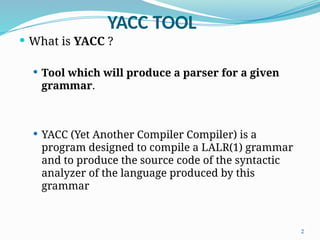
YACC (Yet Another Compiler Compiler) is a program designed to compile a LALR(1) grammar and to produce the source code of the syntactic analyzer of the language produced by this grammar.
YACC TOOL
Whatis YACC ?
Tool which will produce a parser for a given
grammar.
YACC (Yet Another Compiler Compiler) is a
program designed to compile a LALR(1) grammar
and to produce the source code of the syntactic
analyzer of the language produced by this
grammar
2
3.
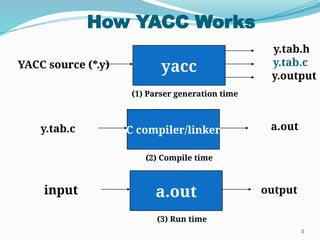
yacc
How YACC Works
(1)Parser generation time
YACC source (*.y)
y.tab.h
y.tab.c
C compiler/linker
(2) Compile time
y.tab.c a.out
a.out
(3) Run time
input output
y.output
3
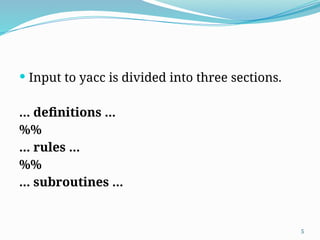
Input toyacc is divided into three sections.
... definitions ...
%%
... rules ...
%%
... subroutines ...
5
6.
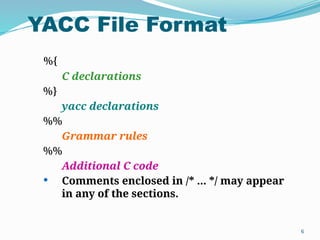
YACC File Format
6
%{
Cdeclarations
%}
yacc declarations
%%
Grammar rules
%%
Additional C code
Comments enclosed in /* ... */ may appear
in any of the sections.
7.
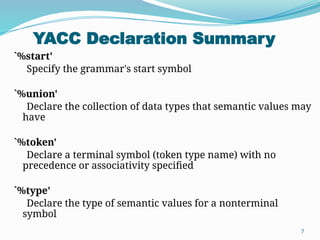
YACC Declaration Summary
7
`%start'
Specifythe grammar's start symbol
`%union'
Declare the collection of data types that semantic values may
have
`%token'
Declare a terminal symbol (token type name) with no
precedence or associativity specified
`%type'
Declare the type of semantic values for a nonterminal
symbol
8.
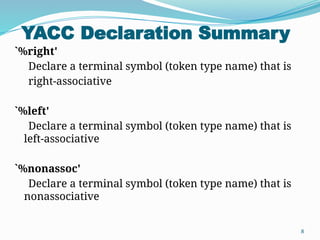
YACC Declaration Summary
8
`%right'
Declarea terminal symbol (token type name) that is
right-associative
`%left'
Declare a terminal symbol (token type name) that is
left-associative
`%nonassoc'
Declare a terminal symbol (token type name) that is
nonassociative
9.
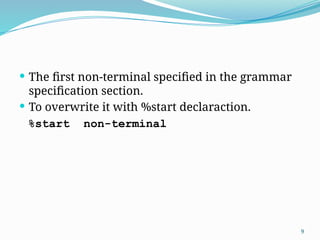
The firstnon-terminal specified in the grammar
specification section.
To overwrite it with %start declaraction.
%start non-terminal
9
10.
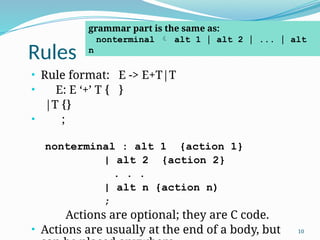
Rules
10
• Rule format:E -> E+T|T
• E: E ‘+’ T { }
|T {}
• ;
nonterminal : alt 1 {action 1}
| alt 2 {action 2}
. . .
| alt n {action n)
;
Actions are optional; they are C code.
• Actions are usually at the end of a body, but
grammar part is the same as:
nonterminal alt 1 | alt 2 | ... | alt
n
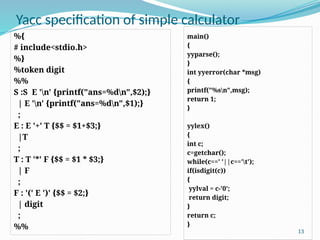
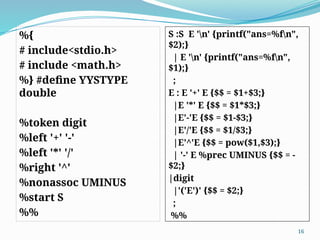
Yacc specification ofsimple calculator
%{
# include<stdio.h>
%}
%token digit
%%
S :S E 'n' {printf("ans=%dn",$2);}
| E 'n' {printf("ans=%dn",$1);}
;
E : E '+' T {$$ = $1+$3;}
|T
;
T : T '*' F {$$ = $1 * $3;}
| F
;
F : '(' E ')' {$$ = $2;}
| digit
;
%% 13
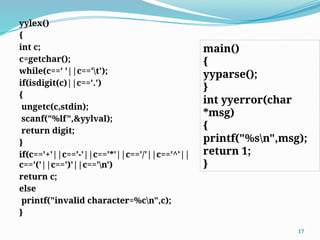
main()
{
yyparse();
}
int yyerror(char *msg)
{
printf("%sn",msg);
return 1;
}
yylex()
{
int c;
c=getchar();
while(c==' '||c=='t');
if(isdigit(c))
{
yylval = c-'0';
return digit;
}
return c;
}
14.
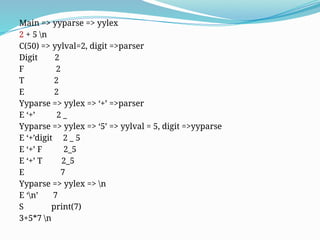
Main => yyparse=> yylex
2 + 5 n
C(50) => yylval=2, digit =>parser
Digit 2
F 2
T 2
E 2
Yyparse => yylex => ‘+’ =>parser
E ‘+’ 2 _
Yyparse => yylex => ‘5’ => yylval = 5, digit =>yyparse
E ‘+’digit 2 _ 5
E ‘+’ F 2_5
E ‘+’ T 2_5
E 7
Yyparse => yylex => n
E ‘n’ 7
S print(7)
3+5*7 n

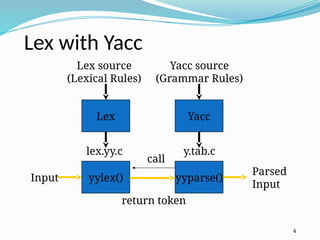
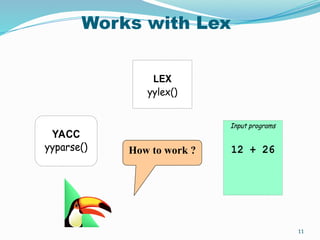
![Works with Lex
YACC
yyparse()
Input programs
12 + 26
LEX
yylex()
call yylex()
[0-9]+
next token is NUM
NUM ‘+’ NUM
12](https://image.slidesharecdn.com/compilerdesignsyntaxanalyzeryaactool-250505065037-8a589366/85/Compiler-Design_Syntax-Analyzer_Yaac-Tool-pptx-12-320.jpg)
![[root@localhost ~]# yacc -d -v f1.y
[root@localhost ~]# ls y*
y.output y.tab.c y.tab.h
[root@localhost ~]# gcc y.tab.c
[root@localhost ~]# ./a.out
2+3
ans=5
4*5+6
ans=26
[root@localhost ~]# cat y.tab.h
#define digit 257
[root@localhost ~]#
15](https://image.slidesharecdn.com/compilerdesignsyntaxanalyzeryaactool-250505065037-8a589366/85/Compiler-Design_Syntax-Analyzer_Yaac-Tool-pptx-15-320.jpg)
![[root@localhost ~]# yacc -d -v f2.y
[root@localhost ~]# gcc y.tab.c -lm
[root@localhost ~]# ./a.out
23+56.5*2
ans=136.000000
12*5.5-5^2
ans=41.000000
[root@localhost ~]#
18](https://image.slidesharecdn.com/compilerdesignsyntaxanalyzeryaactool-250505065037-8a589366/85/Compiler-Design_Syntax-Analyzer_Yaac-Tool-pptx-18-320.jpg)
![%{
# include<math.h>
# include<stdio.h>
struct symtab
{
char *name;
double val;
}SYM[20];
void disp();
struct symtab
*install_id(char *s);
%}
%union{
double v;
struct symtab *p;
} 19
%token SIN COS
%token<v> NUM
%token<p> id
%right ‘=‘
%left '+' '-'
%left '*' '/'
%nonassoc UMINUS
%type<v> E](https://image.slidesharecdn.com/compilerdesignsyntaxanalyzeryaactool-250505065037-8a589366/85/Compiler-Design_Syntax-Analyzer_Yaac-Tool-pptx-19-320.jpg)
![main()
{
yyparse();
disp();
}
int yyerror()
{
return 1;
}
void disp()
{
struct symtab *k;
for(k=SYM;k<&SYM[20];k++)
{
if(k->name)
{
printf("%st%fn",k->name,k-
>val);
} } }
21
struct symtab * install_id(char *s)
{
struct symtab *k;
for(k=SYM;k<&SYM[20];k++)
{
if(k->name&&!strcmp(k-
>name,s))
return k;
else
if(!k->name)
{
k->name=strdup(s);
return k;
}
}
}](https://image.slidesharecdn.com/compilerdesignsyntaxanalyzeryaactool-250505065037-8a589366/85/Compiler-Design_Syntax-Analyzer_Yaac-Tool-pptx-21-320.jpg)
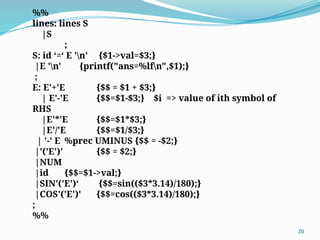
![%{
# include<stdio.h>
# include<stdlib.h>
# include "y.tab.h"
%}
num ([0-9]+)(.[0-9]+)?([eE][-+]?
[0-9]+)?
%%
"sin" {return SIN;}
“cos” {return COS;}
[A-Za-z][A-Za-z0-9]*
{yylval.p=install_id(yytext);ret
urn id;}
{num} {yylval.v=atof(yytext);
printf("ans=
%f",yylval.val);return num;}
[n] {return yytext[0];}
. {return yytext[0];} 22
%%
int yywrap()
{
return 1;
}](https://image.slidesharecdn.com/compilerdesignsyntaxanalyzeryaactool-250505065037-8a589366/85/Compiler-Design_Syntax-Analyzer_Yaac-Tool-pptx-22-320.jpg)
![[root@localhost ~]# yacc -d -v y1.y
[root@localhost ~]# lex y1.l
[root@localhost ~]# gcc -o y1 lex.yy.c y.tab.c -lm
[root@localhost ~]# ./y1
3+4*5
ans =23.000000
a=10
sin(30)
ans =0.499770
a+100
10.000000
ans =110.000000
cos(90)
ans =0.000796
name value
a 10.000000 23](https://image.slidesharecdn.com/compilerdesignsyntaxanalyzeryaactool-250505065037-8a589366/85/Compiler-Design_Syntax-Analyzer_Yaac-Tool-pptx-23-320.jpg)
![[root@localhost ~]# cat y.tab.h
#define id 257
#define SIN 258
#define COS 259
#define num 260
#define UMINUS 261
typedef union
{
struct symtab *p;
double val;
} YYSTYPE;
extern YYSTYPE yylval;
24](https://image.slidesharecdn.com/compilerdesignsyntaxanalyzeryaactool-250505065037-8a589366/85/Compiler-Design_Syntax-Analyzer_Yaac-Tool-pptx-24-320.jpg)


