COMPILER CONSTRUCTION Principles and Practice Kenneth C. Louden San Jose State University
Content INTRODUCTION SCANNING CONTEXT-FREE GRMMARS AND PARSING TOP-DOWN PARSING BOTTOM-UP PARSING SEMANTIC ANALYSIS RUNTIME ENVIRONMENT CODE GENERATION
Main References Books:   《编译原理及实践》, (美) Kenneth C. Louden 著,冯博琴、冯岚等译,机械工业出版社。 《编译程序原理与技术》, 李赣生、王华民编著,清华大学出版社。 《编译原理》, (美) Alfred V. Aho  等著,李建中、姜守旭等译,机械工业出版社。 Course Web : http://nmlab.zju.edu.cn/~compiler Email: ldm@cs.zju.edu.cn   (Prof. Lu Dongming)
1. INTRODUCTION
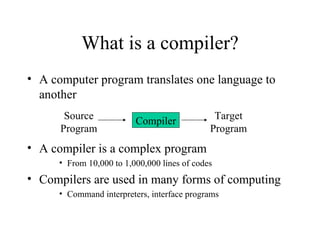
What is a compiler? A computer program translates one language to another A compiler is a complex program From 10,000 to 1,000,000 lines of codes Compilers are used in many forms of computing Command interpreters, interface programs Compiler Source Program Target Program
What is the purpose of this text This text is to provide basic knowledge Theoretical techniques, such as automata theory This text is to give necessary tools and practical experience A series of simple examples TINY, C-Minus
Main Topics  1.1 Why Compilers? A Brief History  [Open] 1.2 Programs Related to Compilers  [Open] 1.3 The Translation Process  [Open] 1.4 Major Data Structures in a Compiler  [Open] 1.5 Other Issues in Compiler Structure  [Open] 1.6 Bootstrapping and Porting  [Open] 1.7 The TINY Sample Language and Compiler  [Open] 1.8 C-Minus: A Language for a Compiler Project  [Open]
1.1 Why? A Brief History
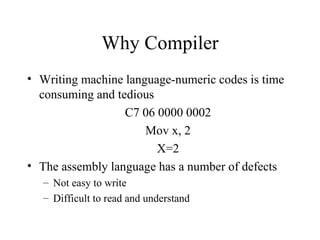
Why Compiler Writing machine language-numeric codes is time consuming and tedious C7 06 0000 0002 Mov x, 2 X=2 The assembly language has a number of defects Not easy to write Difficult to read and understand
Brief History of Compiler The  first compiler  was developed between 1954 and 1957 The FORTRAN language and its compiler by a team at IBM led by John Backus The structure of natural language was studied at about the same time by Noam Chomsky
Brief History of Compiler The related  theories and algorithms  in the 1960s and 1970s The  classification  of language: Chomsky hierarchy The  parsing  problem was pursued:  Context-free language, parsing algorithms The symbolic methods for  express ing the structure of the words of a programming language: Finite automata, Regular expressions Methods have been developed for  generating  efficient object code:  Optimization techniques or code, improvement techniques
Brief History of Compiler Programs were developed to  automate the complier  development for parsing Parser generators, such as Yacc by Steve Johnson in 1975 for the Unix system Scanner generators,  such as Lex by Mike Lesk for Unix system about same time
Brief History of Compiler Projects focused on  automating  the generation of  other parts  of a compiler Code generation was undertaken during the late 1970s and early 1980s Less success due to our less than perfect understanding of them
Brief History of Compiler Recent advances  in compiler design More  sophisticated algorithms  for inferring and/or simplifying the information contained in program, such as the unification algorithm of Hindley-Milner type checking Window-based Interactive Development Environment,  IDE,  that includes editors, linkers, debuggers, and project managers. However, the basic of compiler design have  not changed  much in the last 20 years. BACK
1.2 Programs related to Compiler
Interpreters Execute  the source program  immediately  rather than generating object code Examples: BASIC, LISP, used often in  educational or development  situations Speed of execution is  slower  than compiled code by a factor of 10 or more Share  many of their operations with compilers
Assemblers A translator for the assembly language of a particular computer Assembly language is a symbolic form of  one machine language A compiler may generate assembly language as its target language and an assembler finished the translation into object code
Linkers Collect separate object files  into  a directly  executable file Connect an object program to the code for  standard library functions  and to resource supplied by OS Becoming one of the principle activities of a compiler,  depends on OS and processor
Loaders Resolve  all re-locatable  address  relative to a given base Make executable code  more flexible Often as  part of the operating environment , rarely as an actual separate program
Preprocessors Delete  comments, include other files, and perform macro  substitutions Required by a language (as in C) or can be later add-ons that provide  additional facilities
Editors Compiler have been  bundled together with  editor and other programs into an interactive development environment ( IDE ) Oriented toward the format or structure  of the programming language, called structure-based May include some operations of a compiler,  informing some errors
Debuggers Used to  determine  execution  error  in a compiled program Keep tracks  of most or all of the source code information Halt execution at pre-specified locations called  breakpoints Must be supplied  with  appropriate  symbolic information  by the compiler
Profiles Collect  statistics on the behavior  of an object program during execution Called Times for each procedures Percentage of execution time Used to  improve  the execution speed of the program
Project Managers Coordinate the files being worked on by different people, maintain  coherent version of a program Language-independent or bundled together with a compiler Two popular project manager programs on Unix system Sccs  (Source code control system) Rcs  (revision control system) BACK
1.3 The Translation Process
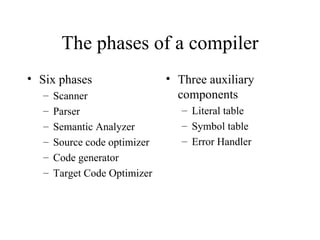
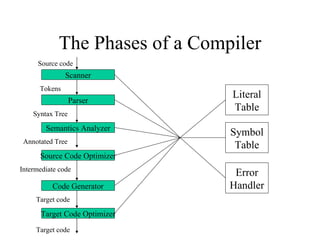
The phases of a compiler Six phases Scanner Parser Semantic Analyzer Source code optimizer Code generator Target Code Optimizer Three auxiliary components Literal table Symbol table Error Handler
The Phases of a Compiler Scanner Parser Semantics Analyzer Source Code Optimizer Code Generator Target Code Optimizer Literal Table Symbol Table Error Handler Source code Syntax Tree Annotated Tree Intermediate code Target code Target code Tokens
The Scanner Lexical analysis : it collects sequences of characters into meaningful units called tokens An example:  a[index]=4+2  a  identifier [ left bracket index  identifier ] right bracket = assignment 4 number + plus sign 2 number Other operations : it may enter literals into the literal table RETURN
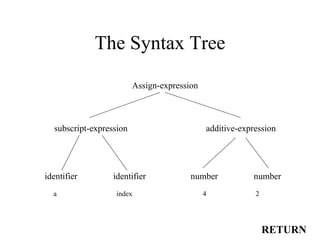
The Parser Syntax analysis : it determines the structure of the program The results of syntax analysis are a parse tree or a syntax tree An example: a[index]=4+2 Parse tree Syntax tree ( abstract syntax tree)
The Parse Tree a  index  4  2 identifier  identifier  number  number Expression  [  expression  ]  expression  +  expression subscript-expression  additive-expression expression  =  expression Assign-expression expression
The Syntax Tree RETURN a  index  4  2 identifier  identifier  number  number subscript-expression  additive-expression Assign-expression
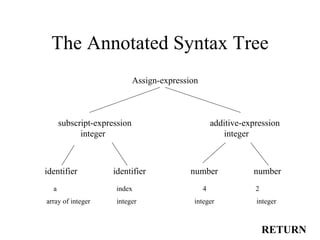
The Semantic Analyzer The semantics of a program are  its “meaning”,  as opposed to its syntax, or structure, that determines some of its running time behaviors prior to execution.  Static semantics:  declarations  and  type checking Attributes : The extra pieces of information computed by semantic analyzer  An example: a[index]=4=2 The syntax tree annotated with attributes
The Annotated Syntax Tree RETURN a  index  4  2 identifier  identifier  number  number subscript-expression  additive-expression integer  integer Assign-expression array of integer  integer  integer  integer
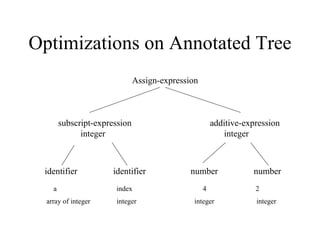
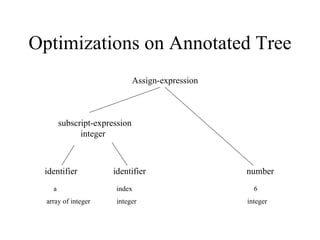
The Source Code Optimizer The  earliest point  of most optimization steps is just after semantic analysis The code improvement depends  only on the source code , and as a separate phase Individual compilers exhibit  a wide variation  in optimization kinds as well as placement An example: a[index]=4+2 Constant folding  performed directly on annotated tree Using intermediate code: three-address code, p-code
Optimizations on Annotated Tree a  index  4  2 identifier  identifier  number  number subscript-expression  additive-expression integer  integer Assign-expression array of integer  integer  integer  integer
Optimizations on Annotated Tree a  index  6 identifier  identifier  number subscript-expression  integer  Assign-expression array of integer  integer  integer
Optimization on Intermediate Code t  =  4  +  2 a[index]=t t =  6 a[index]=t a[index]=6 RETURN
The Code Generate It takes the intermediate code or IR and generates code for target machine The  properties of the target machine  become the major factor:  Using  instructions and representation  of data An example: a[index]=4+2 Code sequence  in a hypothetical assembly language
A possible code sequence a[index]=6 MOV R0, index MUL R0,2 MOV R1,&a ADD R1,R0 MOV *R1,6 RETURN
The Target Code Optimizer It improves the target code generated by the code generator: Address modes  choosing Instructions replacing As well as  redundant eliminating MOV R0, index MUL R0,2 MOV R1,&a ADD R1,R0 MOV *R1,6 MOV R0, index SHL R0 MOV &a[R1],6 BACK
1.4 Major Data Structure in a Compiler
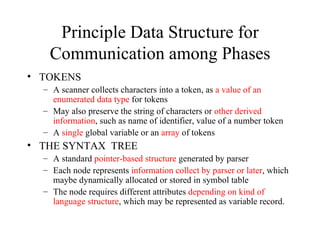
Principle Data Structure for Communication among Phases TOKENS A scanner collects characters into a token, as  a value of an enumerated data type  for tokens May also preserve the string of characters or  other derived information , such as name of identifier, value of a number token A  single  global variable or an  array  of tokens THE SYNTAX  TREE A standard  pointer-based structure  generated by parser Each node represents  information collect by parser or later , which maybe dynamically allocated or stored in symbol table The node requires different attributes  depending on kind of language structure , which may be represented as variable record.
Principle Data Structure for Communication among Phases THE SYMBOL TABLE Keeps information associated with identifiers: function, variable, constants, and data types Interacts with almost every phase of compiler. Access operation need to be constant-time One or several hash tables are often used,  THE LITERAL TABLE Stores constants and strings, reducing size of program Quick insertion and lookup are essential
Principle Data Structure for Communication among Phases INTERMEDIATE CODE Kept as an array of text string, a temporary text, or a linked list of structures, depending on kind of intermediate code (e.g. three-address code and p-code) Should be  easy for reorganization TEMPORARY FILES Holds the product of intermediate steps during compiling Solve the problem of  memory constraints or back-patch  addressed during code generation  BACK
1.5 Other Issues in Compiler Structure
The Structure of Compiler Multiple views from different angles Logical Structure Physical Structure Sequencing of the operations A major impact of the structure Reliability, efficiency Usefulness, maintainability
Analysis and Synthesis The  analysis  part of the compiler analyzes the  source program  to compute its properties Lexical analysis, syntax analysis and semantics analysis, as well as optimization More mathematical and better understood The  synthesis  part of the compiler produces the  translated codes Code generation, as well as optimization More specialized The two parts can be  changed independently  of the other
Front End and Back End The operations of the  front end depend on the source  language The scanner, parser, and semantic analyzer, as well as intermediate code synthesis The operations of the back end  depend on the target language Code generation, as well as some optimization analysis The intermediate representation is the  medium  of communication between them This structure is important for compiler  portability
Passes The repetitions to process the entire source program before generating code are referred as passes. Passes  may or may not correspond to  phases A pass often consists of several phases A compiler can be one pass, which results in efficient compilation but less efficient target code Most compilers  with optimization use more  than one pass One Pass for scanning and parsing One Pass for semantic analysis and source-level optimization The third Pass for code generation and target-level optimization
Language Definition and compilers  The  lexical and syntactic  structure of a programming language  regular expressions  context-free grammar The  semantics  of a programming language in English descriptions language reference manual, or language definition.
Language Definition and compilers  A language definition and a compiler are often  developed simultaneously The techniques have a major impact on definition The definition has a major impact on the techniques  The language to be implemented is well known and has an  existing definition This is not an easy task
Language Definition and compilers A language occasionally has it  semantics given by a formal definition  in mathematical term So-called denotational semantics in function programming community Given a mathematical proof that a compiler conforms to the definition The structure and behavior of the  runtime environment affect the compiler construction Static runtime environment Semi-dynamic or stack-based environment Fully-dynamic or heap-based environment
Compiler options and interfaces Mechanisms for interfacing  with the operation system Input and output facilities Access to the file system of the target machine Options to the user  for various purposes Specification of listing characteristic Code optimization options
Error Handling Static (or compile-time) errors must be reported by a compiler Generate meaningful error messages and resume compilation after each error Each phase of a compiler needs different kind of error handing Exception handling Generate extra code to perform suitable runtime tests to guarantee all such errors to cause an appropriate event during execution. BACK
1.6 Bootstrapping and Porting
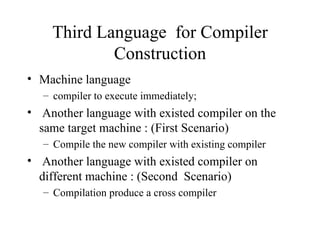
Third Language  for Compiler Construction Machine language compiler to execute immediately; Another language with existed compiler on the same target machine : (First Scenario) Compile the new compiler with existing compiler Another language with existed compiler on different machine : (Second  Scenario) Compilation produce a cross compiler
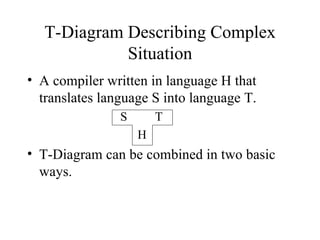
T-Diagram Describing Complex Situation A compiler written in language H that translates language S into language T. S  T H T-Diagram can be combined in two basic ways.
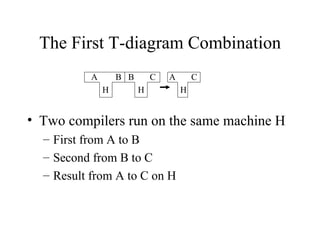
The First T-diagram Combination A  B  B  C  A  C H  H  H Two compilers run on the same machine H First from A to B Second from B to C Result from A to C on H
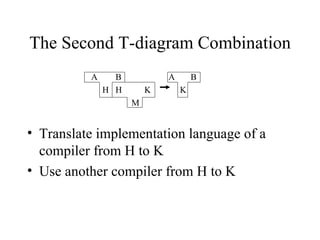
The Second T-diagram Combination A  B  A  B H  H  K  K M Translate implementation language of a compiler from H to K Use another compiler from H to K
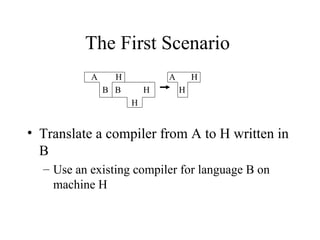
The First Scenario  A  H  A  H B  B  H  H H Translate a compiler from A to H written in B Use an existing compiler for language B on machine H
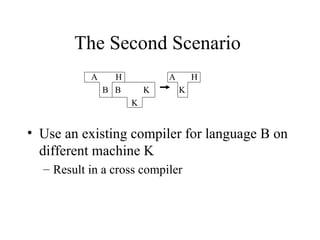
The Second Scenario  A  H  A  H B  B  K  K K Use an existing compiler for language B on different machine K Result in a cross compiler
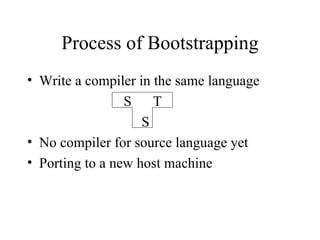
Process of Bootstrapping Write a compiler in the same language S  T S No compiler for source language yet Porting to a new host machine
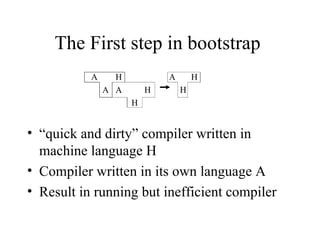
The First step in bootstrap  A  H  A  H A  A  H  H H “ quick and dirty” compiler written in machine language H Compiler written in its own language A Result in running but inefficient compiler
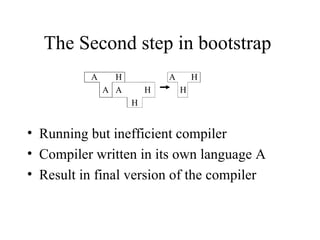
The Second step in bootstrap  A  H  A  H A  A  H  H H Running but inefficient compiler Compiler written in its own language A Result in final version of the compiler
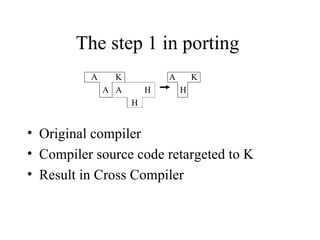
The step 1 in porting  A  K  A  K A  A  H  H H Original compiler Compiler source code retargeted to K Result in Cross Compiler
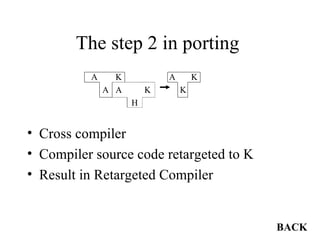
The step 2 in porting  A  K  A  K A  A  K  K H Cross compiler Compiler source code retargeted to K Result in Retargeted Compiler BACK
1.7 The TINY Sample Language and Compiler Reading this part of text as homework
1.8 C-Minus: A Language for A Compiler Project Reading this part of text as homework)
End of Chapter One Thanks Feb. 28th , 2005

Chapter One

  • 1.
    COMPILER CONSTRUCTION Principlesand Practice Kenneth C. Louden San Jose State University
  • 2.
    Content INTRODUCTION SCANNINGCONTEXT-FREE GRMMARS AND PARSING TOP-DOWN PARSING BOTTOM-UP PARSING SEMANTIC ANALYSIS RUNTIME ENVIRONMENT CODE GENERATION
  • 3.
    Main References Books: 《编译原理及实践》, (美) Kenneth C. Louden 著,冯博琴、冯岚等译,机械工业出版社。 《编译程序原理与技术》, 李赣生、王华民编著,清华大学出版社。 《编译原理》, (美) Alfred V. Aho 等著,李建中、姜守旭等译,机械工业出版社。 Course Web : http://nmlab.zju.edu.cn/~compiler Email: ldm@cs.zju.edu.cn (Prof. Lu Dongming)
  • 4.
  • 5.
    What is acompiler? A computer program translates one language to another A compiler is a complex program From 10,000 to 1,000,000 lines of codes Compilers are used in many forms of computing Command interpreters, interface programs Compiler Source Program Target Program
  • 6.
    What is thepurpose of this text This text is to provide basic knowledge Theoretical techniques, such as automata theory This text is to give necessary tools and practical experience A series of simple examples TINY, C-Minus
  • 7.
    Main Topics 1.1 Why Compilers? A Brief History [Open] 1.2 Programs Related to Compilers [Open] 1.3 The Translation Process [Open] 1.4 Major Data Structures in a Compiler [Open] 1.5 Other Issues in Compiler Structure [Open] 1.6 Bootstrapping and Porting [Open] 1.7 The TINY Sample Language and Compiler [Open] 1.8 C-Minus: A Language for a Compiler Project [Open]
  • 8.
    1.1 Why? ABrief History
  • 9.
    Why Compiler Writingmachine language-numeric codes is time consuming and tedious C7 06 0000 0002 Mov x, 2 X=2 The assembly language has a number of defects Not easy to write Difficult to read and understand
  • 10.
    Brief History ofCompiler The first compiler was developed between 1954 and 1957 The FORTRAN language and its compiler by a team at IBM led by John Backus The structure of natural language was studied at about the same time by Noam Chomsky
  • 11.
    Brief History ofCompiler The related theories and algorithms in the 1960s and 1970s The classification of language: Chomsky hierarchy The parsing problem was pursued: Context-free language, parsing algorithms The symbolic methods for express ing the structure of the words of a programming language: Finite automata, Regular expressions Methods have been developed for generating efficient object code: Optimization techniques or code, improvement techniques
  • 12.
    Brief History ofCompiler Programs were developed to automate the complier development for parsing Parser generators, such as Yacc by Steve Johnson in 1975 for the Unix system Scanner generators, such as Lex by Mike Lesk for Unix system about same time
  • 13.
    Brief History ofCompiler Projects focused on automating the generation of other parts of a compiler Code generation was undertaken during the late 1970s and early 1980s Less success due to our less than perfect understanding of them
  • 14.
    Brief History ofCompiler Recent advances in compiler design More sophisticated algorithms for inferring and/or simplifying the information contained in program, such as the unification algorithm of Hindley-Milner type checking Window-based Interactive Development Environment, IDE, that includes editors, linkers, debuggers, and project managers. However, the basic of compiler design have not changed much in the last 20 years. BACK
  • 15.
  • 16.
    Interpreters Execute the source program immediately rather than generating object code Examples: BASIC, LISP, used often in educational or development situations Speed of execution is slower than compiled code by a factor of 10 or more Share many of their operations with compilers
  • 17.
    Assemblers A translatorfor the assembly language of a particular computer Assembly language is a symbolic form of one machine language A compiler may generate assembly language as its target language and an assembler finished the translation into object code
  • 18.
    Linkers Collect separateobject files into a directly executable file Connect an object program to the code for standard library functions and to resource supplied by OS Becoming one of the principle activities of a compiler, depends on OS and processor
  • 19.
    Loaders Resolve all re-locatable address relative to a given base Make executable code more flexible Often as part of the operating environment , rarely as an actual separate program
  • 20.
    Preprocessors Delete comments, include other files, and perform macro substitutions Required by a language (as in C) or can be later add-ons that provide additional facilities
  • 21.
    Editors Compiler havebeen bundled together with editor and other programs into an interactive development environment ( IDE ) Oriented toward the format or structure of the programming language, called structure-based May include some operations of a compiler, informing some errors
  • 22.
    Debuggers Used to determine execution error in a compiled program Keep tracks of most or all of the source code information Halt execution at pre-specified locations called breakpoints Must be supplied with appropriate symbolic information by the compiler
  • 23.
    Profiles Collect statistics on the behavior of an object program during execution Called Times for each procedures Percentage of execution time Used to improve the execution speed of the program
  • 24.
    Project Managers Coordinatethe files being worked on by different people, maintain coherent version of a program Language-independent or bundled together with a compiler Two popular project manager programs on Unix system Sccs (Source code control system) Rcs (revision control system) BACK
  • 25.
  • 26.
    The phases ofa compiler Six phases Scanner Parser Semantic Analyzer Source code optimizer Code generator Target Code Optimizer Three auxiliary components Literal table Symbol table Error Handler
  • 27.
    The Phases ofa Compiler Scanner Parser Semantics Analyzer Source Code Optimizer Code Generator Target Code Optimizer Literal Table Symbol Table Error Handler Source code Syntax Tree Annotated Tree Intermediate code Target code Target code Tokens
  • 28.
    The Scanner Lexicalanalysis : it collects sequences of characters into meaningful units called tokens An example: a[index]=4+2 a identifier [ left bracket index identifier ] right bracket = assignment 4 number + plus sign 2 number Other operations : it may enter literals into the literal table RETURN
  • 29.
    The Parser Syntaxanalysis : it determines the structure of the program The results of syntax analysis are a parse tree or a syntax tree An example: a[index]=4+2 Parse tree Syntax tree ( abstract syntax tree)
  • 30.
    The Parse Treea index 4 2 identifier identifier number number Expression [ expression ] expression + expression subscript-expression additive-expression expression = expression Assign-expression expression
  • 31.
    The Syntax TreeRETURN a index 4 2 identifier identifier number number subscript-expression additive-expression Assign-expression
  • 32.
    The Semantic AnalyzerThe semantics of a program are its “meaning”, as opposed to its syntax, or structure, that determines some of its running time behaviors prior to execution. Static semantics: declarations and type checking Attributes : The extra pieces of information computed by semantic analyzer An example: a[index]=4=2 The syntax tree annotated with attributes
  • 33.
    The Annotated SyntaxTree RETURN a index 4 2 identifier identifier number number subscript-expression additive-expression integer integer Assign-expression array of integer integer integer integer
  • 34.
    The Source CodeOptimizer The earliest point of most optimization steps is just after semantic analysis The code improvement depends only on the source code , and as a separate phase Individual compilers exhibit a wide variation in optimization kinds as well as placement An example: a[index]=4+2 Constant folding performed directly on annotated tree Using intermediate code: three-address code, p-code
  • 35.
    Optimizations on AnnotatedTree a index 4 2 identifier identifier number number subscript-expression additive-expression integer integer Assign-expression array of integer integer integer integer
  • 36.
    Optimizations on AnnotatedTree a index 6 identifier identifier number subscript-expression integer Assign-expression array of integer integer integer
  • 37.
    Optimization on IntermediateCode t = 4 + 2 a[index]=t t = 6 a[index]=t a[index]=6 RETURN
  • 38.
    The Code GenerateIt takes the intermediate code or IR and generates code for target machine The properties of the target machine become the major factor: Using instructions and representation of data An example: a[index]=4+2 Code sequence in a hypothetical assembly language
  • 39.
    A possible codesequence a[index]=6 MOV R0, index MUL R0,2 MOV R1,&a ADD R1,R0 MOV *R1,6 RETURN
  • 40.
    The Target CodeOptimizer It improves the target code generated by the code generator: Address modes choosing Instructions replacing As well as redundant eliminating MOV R0, index MUL R0,2 MOV R1,&a ADD R1,R0 MOV *R1,6 MOV R0, index SHL R0 MOV &a[R1],6 BACK
  • 41.
    1.4 Major DataStructure in a Compiler
  • 42.
    Principle Data Structurefor Communication among Phases TOKENS A scanner collects characters into a token, as a value of an enumerated data type for tokens May also preserve the string of characters or other derived information , such as name of identifier, value of a number token A single global variable or an array of tokens THE SYNTAX TREE A standard pointer-based structure generated by parser Each node represents information collect by parser or later , which maybe dynamically allocated or stored in symbol table The node requires different attributes depending on kind of language structure , which may be represented as variable record.
  • 43.
    Principle Data Structurefor Communication among Phases THE SYMBOL TABLE Keeps information associated with identifiers: function, variable, constants, and data types Interacts with almost every phase of compiler. Access operation need to be constant-time One or several hash tables are often used, THE LITERAL TABLE Stores constants and strings, reducing size of program Quick insertion and lookup are essential
  • 44.
    Principle Data Structurefor Communication among Phases INTERMEDIATE CODE Kept as an array of text string, a temporary text, or a linked list of structures, depending on kind of intermediate code (e.g. three-address code and p-code) Should be easy for reorganization TEMPORARY FILES Holds the product of intermediate steps during compiling Solve the problem of memory constraints or back-patch addressed during code generation BACK
  • 45.
    1.5 Other Issuesin Compiler Structure
  • 46.
    The Structure ofCompiler Multiple views from different angles Logical Structure Physical Structure Sequencing of the operations A major impact of the structure Reliability, efficiency Usefulness, maintainability
  • 47.
    Analysis and SynthesisThe analysis part of the compiler analyzes the source program to compute its properties Lexical analysis, syntax analysis and semantics analysis, as well as optimization More mathematical and better understood The synthesis part of the compiler produces the translated codes Code generation, as well as optimization More specialized The two parts can be changed independently of the other
  • 48.
    Front End andBack End The operations of the front end depend on the source language The scanner, parser, and semantic analyzer, as well as intermediate code synthesis The operations of the back end depend on the target language Code generation, as well as some optimization analysis The intermediate representation is the medium of communication between them This structure is important for compiler portability
  • 49.
    Passes The repetitionsto process the entire source program before generating code are referred as passes. Passes may or may not correspond to phases A pass often consists of several phases A compiler can be one pass, which results in efficient compilation but less efficient target code Most compilers with optimization use more than one pass One Pass for scanning and parsing One Pass for semantic analysis and source-level optimization The third Pass for code generation and target-level optimization
  • 50.
    Language Definition andcompilers The lexical and syntactic structure of a programming language regular expressions context-free grammar The semantics of a programming language in English descriptions language reference manual, or language definition.
  • 51.
    Language Definition andcompilers A language definition and a compiler are often developed simultaneously The techniques have a major impact on definition The definition has a major impact on the techniques The language to be implemented is well known and has an existing definition This is not an easy task
  • 52.
    Language Definition andcompilers A language occasionally has it semantics given by a formal definition in mathematical term So-called denotational semantics in function programming community Given a mathematical proof that a compiler conforms to the definition The structure and behavior of the runtime environment affect the compiler construction Static runtime environment Semi-dynamic or stack-based environment Fully-dynamic or heap-based environment
  • 53.
    Compiler options andinterfaces Mechanisms for interfacing with the operation system Input and output facilities Access to the file system of the target machine Options to the user for various purposes Specification of listing characteristic Code optimization options
  • 54.
    Error Handling Static(or compile-time) errors must be reported by a compiler Generate meaningful error messages and resume compilation after each error Each phase of a compiler needs different kind of error handing Exception handling Generate extra code to perform suitable runtime tests to guarantee all such errors to cause an appropriate event during execution. BACK
  • 55.
  • 56.
    Third Language for Compiler Construction Machine language compiler to execute immediately; Another language with existed compiler on the same target machine : (First Scenario) Compile the new compiler with existing compiler Another language with existed compiler on different machine : (Second Scenario) Compilation produce a cross compiler
  • 57.
    T-Diagram Describing ComplexSituation A compiler written in language H that translates language S into language T. S T H T-Diagram can be combined in two basic ways.
  • 58.
    The First T-diagramCombination A B B C A C H H H Two compilers run on the same machine H First from A to B Second from B to C Result from A to C on H
  • 59.
    The Second T-diagramCombination A B A B H H K K M Translate implementation language of a compiler from H to K Use another compiler from H to K
  • 60.
    The First Scenario A H A H B B H H H Translate a compiler from A to H written in B Use an existing compiler for language B on machine H
  • 61.
    The Second Scenario A H A H B B K K K Use an existing compiler for language B on different machine K Result in a cross compiler
  • 62.
    Process of BootstrappingWrite a compiler in the same language S T S No compiler for source language yet Porting to a new host machine
  • 63.
    The First stepin bootstrap A H A H A A H H H “ quick and dirty” compiler written in machine language H Compiler written in its own language A Result in running but inefficient compiler
  • 64.
    The Second stepin bootstrap A H A H A A H H H Running but inefficient compiler Compiler written in its own language A Result in final version of the compiler
  • 65.
    The step 1in porting A K A K A A H H H Original compiler Compiler source code retargeted to K Result in Cross Compiler
  • 66.
    The step 2in porting A K A K A A K K H Cross compiler Compiler source code retargeted to K Result in Retargeted Compiler BACK
  • 67.
    1.7 The TINYSample Language and Compiler Reading this part of text as homework
  • 68.
    1.8 C-Minus: ALanguage for A Compiler Project Reading this part of text as homework)
  • 69.
    End of ChapterOne Thanks Feb. 28th , 2005