COMPILER DESIGN
ANKUR SRIVASTAVA ASSISTANT PROFESSOR JIT 1
Compilers:
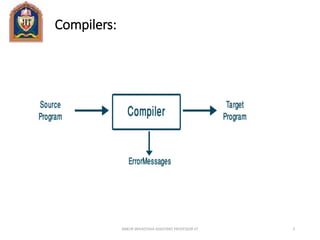
• A compiler is a program that reads a program written in one language
–– the source language –– and translates it into an equivalent
program in another language –– the target language.
• As an important part of this translation process, the compiler reports
to its user the presence of errors in the source program.
ANKUR SRIVASTAVA ASSISTANT PROFESSOR JIT 2
Compilers:
ANKUR SRIVASTAVA ASSISTANT PROFESSOR JIT 3
Compilers:
• At first glance, the variety of compilers may appear overwhelming.
• There are thousands of source languages, ranging from traditional
programming languages such as FORTRAN and Pascal to specialized
languages.
ANKUR SRIVASTAVA ASSISTANT PROFESSOR JIT 4
Compilers:
• Target languages are equally as varied;
• A target language may be another programming language, or the
machine language of any computer.
ANKUR SRIVASTAVA ASSISTANT PROFESSOR JIT 5
Compilers:
• Compilers are sometimes classified as:
• single-pass
• multi-pass
• load-and-go
• Debugging
• optimizing
ANKUR SRIVASTAVA ASSISTANT PROFESSOR JIT 6
Compilers:
• The basic tasks that any compiler must perform are essentially the
same.
• By understanding these tasks, we can construct compilers for a wide
variety of source languages and target machines using the same basic
techniques.
ANKUR SRIVASTAVA ASSISTANT PROFESSOR JIT 7
Compilers:
• Throughout the 1950’s, compilers were considered notoriously
difficult programs to write.
• The first FORTRAN compiler, for example, took 18 staff-years to
implement.
ANKUR SRIVASTAVA ASSISTANT PROFESSOR JIT 8
The Analysis-Synthesis Model of
Compilation:
• There are two parts of compilation:
• Analysis: The analysis part breaks up the source program into constituent
pieces
• Synthesis: Creates an intermediate representation of the source program.
ANKUR SRIVASTAVA ASSISTANT PROFESSOR JIT 9
The Analysis-Synthesis Model of
Compilation:
•The synthesis part constructs the desired
target program from the intermediate
representation.
ANKUR SRIVASTAVA ASSISTANT PROFESSOR JIT 10
The Analysis-Synthesis Model of
Compilation:
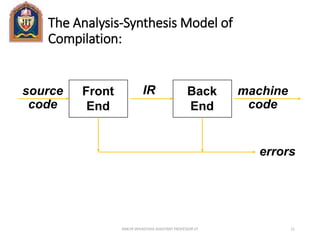
ANKUR SRIVASTAVA ASSISTANT PROFESSOR JIT 11
Front
End
Back
End
source
code
IR machine
code
errors
The Analysis-Synthesis Model of
Compilation:
• During analysis, the operations implied by the source program are
determined and recorded in a hierarchical structure called a tree.
• Often, a special kind of tree called a syntax tree is used.
ANKUR SRIVASTAVA ASSISTANT PROFESSOR JIT 12
The Analysis-Synthesis Model of
Compilation:
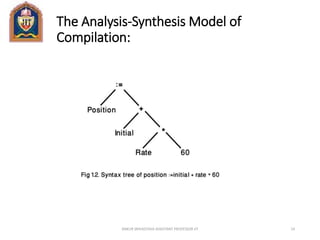
• In syntax tree each node represents an operation and the children of
the node represent the arguments of the operation.
• For example, a syntax tree of an assignment statement is shown
below.
ANKUR SRIVASTAVA ASSISTANT PROFESSOR JIT 13
The Analysis-Synthesis Model of
Compilation:
ANKUR SRIVASTAVA ASSISTANT PROFESSOR JIT 14
Analysis of the Source Program:
• In compiling, analysis consists of three phases:
• Linear Analysis:
• Hierarchical Analysis:
• Semantic Analysis:
ANKUR SRIVASTAVA ASSISTANT PROFESSOR JIT 15
Analysis of the Source Program:
• Linear Analysis:
• In which the stream of characters making up the source program is read from
left-to-right and grouped into tokens that are sequences of characters having
a collective meaning.
ANKUR SRIVASTAVA ASSISTANT PROFESSOR JIT 16
Scanning or Lexical Analysis (Linear
Analysis):
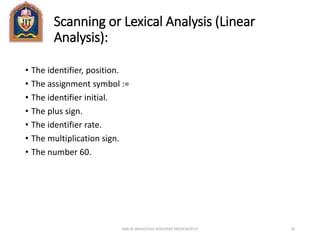
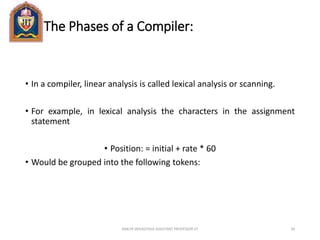
• In a compiler, linear analysis is called lexical analysis or scanning.
• For example, in lexical analysis the characters in the assignment
statement
• Position: = initial + rate * 60
• Would be grouped into the following tokens:
ANKUR SRIVASTAVA ASSISTANT PROFESSOR JIT 17
Scanning or Lexical Analysis (Linear
Analysis):
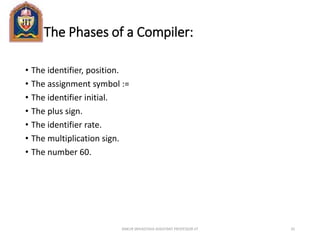
• The identifier, position.
• The assignment symbol :=
• The identifier initial.
• The plus sign.
• The identifier rate.
• The multiplication sign.
• The number 60.
ANKUR SRIVASTAVA ASSISTANT PROFESSOR JIT 18
Scanning or Lexical Analysis (Linear
Analysis):
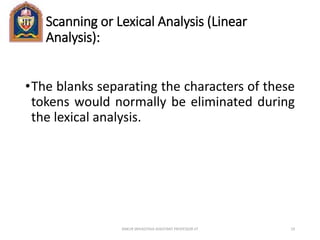
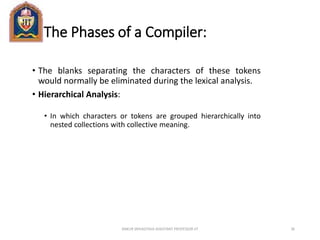
•The blanks separating the characters of these
tokens would normally be eliminated during
the lexical analysis.
ANKUR SRIVASTAVA ASSISTANT PROFESSOR JIT 19
Analysis of the Source Program:
• Hierarchical Analysis:
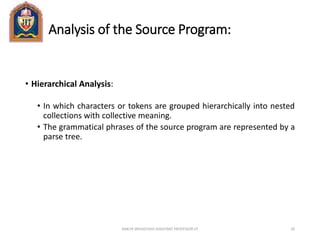
• In which characters or tokens are grouped hierarchically into nested
collections with collective meaning.
• The grammatical phrases of the source program are represented by a
parse tree.
ANKUR SRIVASTAVA ASSISTANT PROFESSOR JIT 20
Syntax Analysis or Hierarchical Analysis
(Parsing):
• Hierarchical analysis is called parsing or syntax analysis.
• It involves grouping the tokens of the source program into
grammatical phases that are used by the compiler to synthesize
output.
ANKUR SRIVASTAVA ASSISTANT PROFESSOR JIT 21
Syntax Analysis or Hierarchical
Analysis (Parsing):
ANKUR SRIVASTAVA ASSISTANT PROFESSOR JIT 22
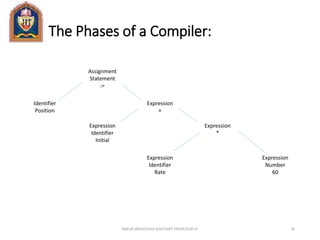
Assignment
Statement
:=
Identifier
Position
Expression
+
Expression
Identifier
Initial
Expression
*
Expression
Identifier
Rate
Expression
Number
60
Syntax Analysis or Hierarchical Analysis
(Parsing):
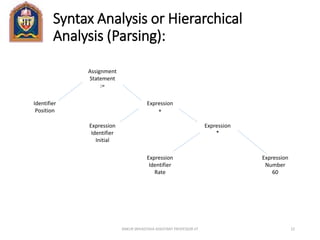
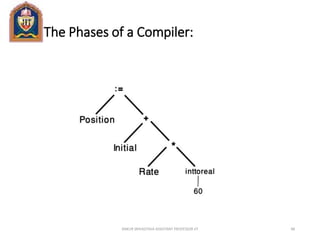
• In the expression initial + rate * 60, the phrase rate * 60 is a logical
unit because the usual conventions of arithmetic expressions tell us
that the multiplication is performed before addition.
• Because the expression initial + rate is followed by a *, it is not
grouped into a single phrase by itself
ANKUR SRIVASTAVA ASSISTANT PROFESSOR JIT 23
Syntax Analysis or Hierarchical Analysis
(Parsing):
• The hierarchical structure of a program is usually expressed by
recursive rules.
• For example, we might have the following rules, as part of the
definition of expression:
ANKUR SRIVASTAVA ASSISTANT PROFESSOR JIT 24
Syntax Analysis or Hierarchical Analysis
(Parsing):
• Any identifier is an expression.
• Any number is an expression
• If expression1 and expression2 are expressions, then so are
• Expression1 + expression2
• Expression1 * expression2
• (Expression1 )
ANKUR SRIVASTAVA ASSISTANT PROFESSOR JIT 25
Analysis of the Source Program:
• Semantic Analysis:
• In which certain checks are performed to ensure that the components of a
program fit together meaningfully.
ANKUR SRIVASTAVA ASSISTANT PROFESSOR JIT 26
Semantic Analysis:
• The semantic analysis phase checks the source
program for semantic errors and gathers type
information for the subsequent code-generation
phase.
• It uses the hierarchical structure determined by the
syntax-analysis phase to identify the operators and
operand of expressions and statements.
ANKUR SRIVASTAVA ASSISTANT PROFESSOR JIT 27
Semantic Analysis:
• An important component of semantic analysis is type checking.
• Here are the compiler checks that each operator has operands that
are permitted by the source language specification.
ANKUR SRIVASTAVA ASSISTANT PROFESSOR JIT 28
Semantic Analysis:
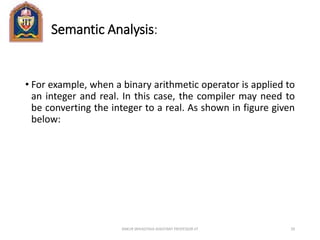
• For example, when a binary arithmetic operator is applied to
an integer and real. In this case, the compiler may need to
be converting the integer to a real. As shown in figure given
below:
ANKUR SRIVASTAVA ASSISTANT PROFESSOR JIT 29
Semantic Analysis:
ANKUR SRIVASTAVA ASSISTANT PROFESSOR JIT 30
The Phases of a Compiler:
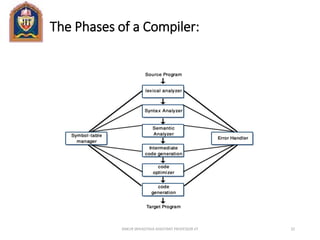
• A compiler operates in phases.
• Each of which transforms the source program from one
representation to another.
• A typical decomposition of a compiler is shown in fig given below
ANKUR SRIVASTAVA ASSISTANT PROFESSOR JIT 31
The Phases of a Compiler:
ANKUR SRIVASTAVA ASSISTANT PROFESSOR JIT 32
The Phases of a Compiler:
• Linear Analysis:
• In which the stream of characters making up the source program is read from
left-to-right and grouped into tokens that are sequences of characters having
a collective meaning.
ANKUR SRIVASTAVA ASSISTANT PROFESSOR JIT 33
The Phases of a Compiler:
• In a compiler, linear analysis is called lexical analysis or scanning.
• For example, in lexical analysis the characters in the assignment
statement
• Position: = initial + rate * 60
• Would be grouped into the following tokens:
ANKUR SRIVASTAVA ASSISTANT PROFESSOR JIT 34
The Phases of a Compiler:
• The identifier, position.
• The assignment symbol :=
• The identifier initial.
• The plus sign.
• The identifier rate.
• The multiplication sign.
• The number 60.
ANKUR SRIVASTAVA ASSISTANT PROFESSOR JIT 35
The Phases of a Compiler:
• The blanks separating the characters of these tokens
would normally be eliminated during the lexical analysis.
• Hierarchical Analysis:
• In which characters or tokens are grouped hierarchically into
nested collections with collective meaning.
ANKUR SRIVASTAVA ASSISTANT PROFESSOR JIT 36
The Phases of a Compiler:
• Hierarchical analysis is called parsing or syntax analysis.
• It involves grouping the tokens of the source program into
grammatical phases that are used by the compiler to synthesize
output.
ANKUR SRIVASTAVA ASSISTANT PROFESSOR JIT 37
The Phases of a Compiler:
•The grammatical phrases of the source program are
represented by a parse tree.
ANKUR SRIVASTAVA ASSISTANT PROFESSOR JIT 38
The Phases of a Compiler:
ANKUR SRIVASTAVA ASSISTANT PROFESSOR JIT 39
Assignment
Statement
:=
Identifier
Position
Expression
+
Expression
Identifier
Initial
Expression
*
Expression
Identifier
Rate
Expression
Number
60
The Phases of a Compiler:
• In the expression initial + rate * 60, the phrase rate * 60 is a logical
unit because the usual conventions of arithmetic expressions tell us
that the multiplication is performed before addition.
• Because the expression initial + rate is followed by a *, it is not
grouped into a single phrase by itself
ANKUR SRIVASTAVA ASSISTANT PROFESSOR JIT 40
The Phases of a Compiler:
• The hierarchical structure of a program is usually expressed by
recursive rules.
• For example, we might have the following rules, as part of the
definition of expression:
ANKUR SRIVASTAVA ASSISTANT PROFESSOR JIT 41
The Phases of a Compiler:
• Any identifier is an expression.
• Any number is an expression
• If expression1 and expression2 are expressions, then so are
• Expression1 + expression2
• Expression1 * expression2
• (Expression1 )
ANKUR SRIVASTAVA ASSISTANT PROFESSOR JIT 42
The Phases of a Compiler:
• Semantic Analysis:
• In which certain checks are performed to ensure that the components of a
program fit together meaningfully.
ANKUR SRIVASTAVA ASSISTANT PROFESSOR JIT 43
The Phases of a Compiler:
• The semantic analysis phase checks the source program for semantic
errors and gathers type information for the subsequent code-
generation phase.
ANKUR SRIVASTAVA ASSISTANT PROFESSOR JIT 44
The Phases of a Compiler:
• It uses the hierarchical structure determined by the syntax-
analysis phase to identify the operators and operand of
expressions and statements.
ANKUR SRIVASTAVA ASSISTANT PROFESSOR JIT 45
The Phases of a Compiler:
• An important component of semantic analysis is type checking.
• Here are the compiler checks that each operator has operands that
are permitted by the source language specification.
ANKUR SRIVASTAVA ASSISTANT PROFESSOR JIT 46
The Phases of a Compiler:
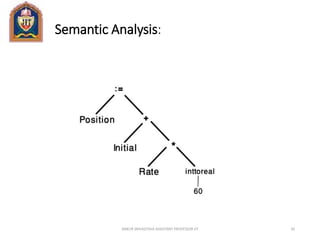
• For example, when a binary arithmetic operator is applied to an
integer and real. In this case, the compiler may need to be converting
the integer to a real. As shown in figure given below:
ANKUR SRIVASTAVA ASSISTANT PROFESSOR JIT 47
The Phases of a Compiler:
ANKUR SRIVASTAVA ASSISTANT PROFESSOR JIT 48
The Phases of a Compiler:
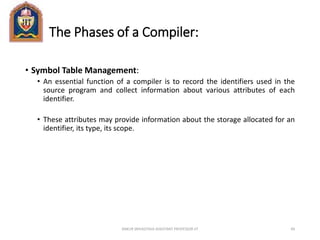
• Symbol Table Management:
• An essential function of a compiler is to record the identifiers used in the
source program and collect information about various attributes of each
identifier.
• These attributes may provide information about the storage allocated for an
identifier, its type, its scope.
ANKUR SRIVASTAVA ASSISTANT PROFESSOR JIT 49
The Phases of a Compiler:
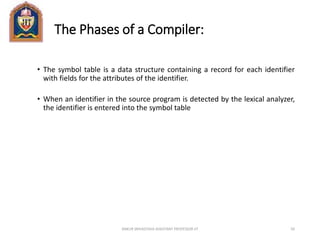
• The symbol table is a data structure containing a record for each identifier
with fields for the attributes of the identifier.
• When an identifier in the source program is detected by the lexical analyzer,
the identifier is entered into the symbol table
ANKUR SRIVASTAVA ASSISTANT PROFESSOR JIT 50
The Phases of a Compiler:
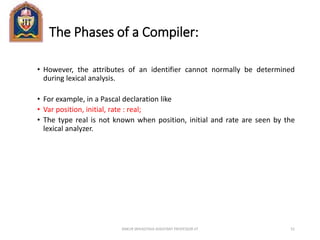
• However, the attributes of an identifier cannot normally be determined
during lexical analysis.
• For example, in a Pascal declaration like
• Var position, initial, rate : real;
• The type real is not known when position, initial and rate are seen by the
lexical analyzer.
ANKUR SRIVASTAVA ASSISTANT PROFESSOR JIT 51
The Phases of a Compiler:
• The remaining phases gets information about identifiers into the symbol
table and then use this information in various ways.
• For example, when doing semantic analysis and intermediate code
generation, we need to know what the types of identifiers are, so we can
check that the source program uses them in valid ways, and so that we can
generate the proper operations on them.
ANKUR SRIVASTAVA ASSISTANT PROFESSOR JIT 52
The Phases of a Compiler:
• The code generator typically enters and uses
detailed information about the storage assigned
to identifiers.
ANKUR SRIVASTAVA ASSISTANT PROFESSOR JIT 53
Error Detection and Reporting:
• Each phase can encounter errors.
• However, after detecting an error, a phase must somehow deal with
that error, so that compilation can proceed, allowing further errors in
the source program to be detected.
ANKUR SRIVASTAVA ASSISTANT PROFESSOR JIT 54
Error Detection and Reporting:
• A compiler that stops when it finds the first error is not as helpful as
it could be.
• The syntax and semantic analysis phases usually handle a large
fraction of the errors detectable by the compiler.
ANKUR SRIVASTAVA ASSISTANT PROFESSOR JIT 55
Error Detection and Reporting:
• Errors where the token stream violates the structure rules (syntax) of
the language are determined by the syntax analysis phase.
• The lexical phase can detect errors where the characters remaining in
the input do not form any token of the language.
ANKUR SRIVASTAVA ASSISTANT PROFESSOR JIT 56
Intermediate Code Generation:
• After Syntax and semantic analysis, some compilers generate an
explicit intermediate representation of the source program.
• We can think of this intermediate representation as a program for an
abstract machine.
ANKUR SRIVASTAVA ASSISTANT PROFESSOR JIT 57
Intermediate Code Generation:
• This intermediate representation should have two important
properties;
• it should be easy to produce,
• easy to translate into the target program.
ANKUR SRIVASTAVA ASSISTANT PROFESSOR JIT 58
Intermediate Code Generation:
• We consider an intermediate form called “three-address code,”
• which is like the assembly language for a machine in which every
memory location can act like a register.
ANKUR SRIVASTAVA ASSISTANT PROFESSOR JIT 59
Intermediate Code Generation:
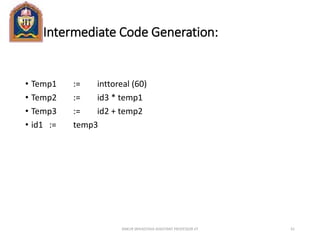
• Three-address code consists of a sequence of instructions, each of
which has at most three operands.
• The source program in (1.1) might appear in three-address code as
ANKUR SRIVASTAVA ASSISTANT PROFESSOR JIT 60
Intermediate Code Generation:
• Temp1 := inttoreal (60)
• Temp2 := id3 * temp1
• Temp3 := id2 + temp2
• id1 := temp3
ANKUR SRIVASTAVA ASSISTANT PROFESSOR JIT 61
Code Optimization:
•The code optimization phase attempts to improve
the intermediate code, so that faster-running
machine code will result.
ANKUR SRIVASTAVA ASSISTANT PROFESSOR JIT 62
Code Optimization:
• Some optimizations are trivial.
• For example, a natural algorithm generates the intermediate code
(1.3), using an instruction for each operator in the tree
representation after semantic analysis, even though there is a better
way to perform the same calculation, using the two instructions.
ANKUR SRIVASTAVA ASSISTANT PROFESSOR JIT 63
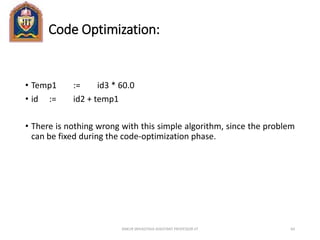
Code Optimization:
• Temp1 := id3 * 60.0
• id := id2 + temp1
• There is nothing wrong with this simple algorithm, since the problem
can be fixed during the code-optimization phase.
ANKUR SRIVASTAVA ASSISTANT PROFESSOR JIT 64
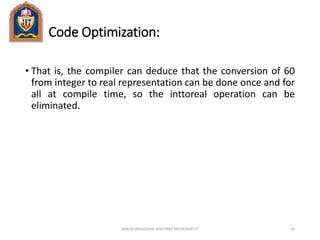
Code Optimization:
• That is, the compiler can deduce that the conversion of 60
from integer to real representation can be done once and for
all at compile time, so the inttoreal operation can be
eliminated.
ANKUR SRIVASTAVA ASSISTANT PROFESSOR JIT 65
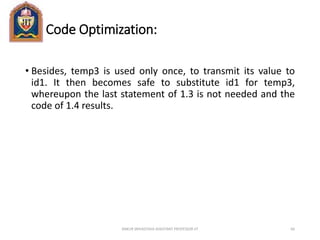
Code Optimization:
• Besides, temp3 is used only once, to transmit its value to
id1. It then becomes safe to substitute id1 for temp3,
whereupon the last statement of 1.3 is not needed and the
code of 1.4 results.
ANKUR SRIVASTAVA ASSISTANT PROFESSOR JIT 66
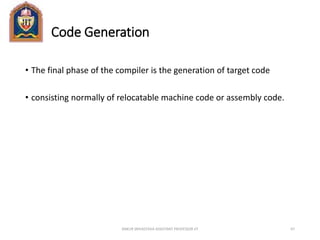
Code Generation
• The final phase of the compiler is the generation of target code
• consisting normally of relocatable machine code or assembly code.
ANKUR SRIVASTAVA ASSISTANT PROFESSOR JIT 67
Code Generation:
• Memory locations are selected for each of the variables used by the
program.
• Then, intermediate instructions are each translated into a sequence
of machine instructions that perform the same task.
• A crucial aspect is the assignment of variables to registers.
ANKUR SRIVASTAVA ASSISTANT PROFESSOR JIT 68
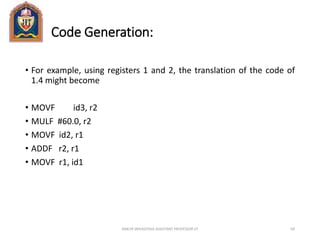
Code Generation:
• For example, using registers 1 and 2, the translation of the code of
1.4 might become
• MOVF id3, r2
• MULF #60.0, r2
• MOVF id2, r1
• ADDF r2, r1
• MOVF r1, id1
ANKUR SRIVASTAVA ASSISTANT PROFESSOR JIT 69
Code Generation
• The first and second operands of each instruction specify a source
and destination, respectively.
• The F in each instruction tells us that instructions deal with floating-
point numbers.
ANKUR SRIVASTAVA ASSISTANT PROFESSOR JIT 70
Code Generation
• This code moves the contents of the address id3 into register 2, and
then multiplies it with the real-constant 60.0.
• The # signifies that 60.0 is to be treated as a constant.
ANKUR SRIVASTAVA ASSISTANT PROFESSOR JIT 71
Code Generation
• The third instruction moves id2 into register 1 and adds to it the
value previously computed in register 2
• Finally, the value in register 1 is moved into the address of id1.
ANKUR SRIVASTAVA ASSISTANT PROFESSOR JIT 72
Cousins of the Compiler:
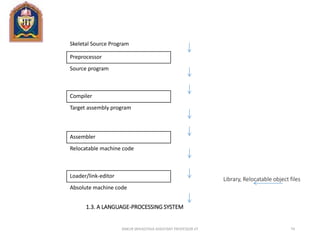
• As we saw in given figure, the input to a compiler may be produced
by one or more preprocessors, and further processing of the
compiler’s output may be needed before running machine code is
obtained.
ANKUR SRIVASTAVA ASSISTANT PROFESSOR JIT 73
Library, Relocatable object files
ANKUR SRIVASTAVA ASSISTANT PROFESSOR JIT 74
Skeletal Source Program
Preprocessor
Source program
Compiler
Target assembly program
Assembler
Relocatable machine code
Loader/link-editor
Absolute machine code
1.3. A LANGUAGE-PROCESSING SYSTEM
Cousins of the Compiler:
• Preprocessors:
• preprocessors produce input to compilers. They may perform the
following functions:
• Macro Processing:
• File inclusion:
• “Rational” Preprocessors:
• Language extensions:
ANKUR SRIVASTAVA ASSISTANT PROFESSOR JIT 75
Preprocessors:
• Macro Processing:
• A preprocessor may allow a user to define macros that are shorthand’s for
longer constructs.
ANKUR SRIVASTAVA ASSISTANT PROFESSOR JIT 76
Preprocessors:
• File inclusion:
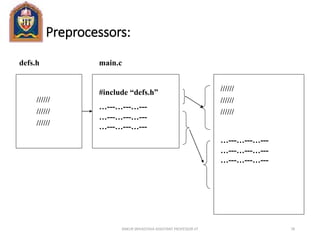
• A preprocessor may include header files into the program text.
• For example, the C preprocessor causes the contents of the file <global.h> to
replace the statement #include <global.h> when it processes a file containing
this statement.
ANKUR SRIVASTAVA ASSISTANT PROFESSOR JIT 77
Preprocessors:
ANKUR SRIVASTAVA ASSISTANT PROFESSOR JIT 78
defs.h
//////
//////
//////
main.c
#include “defs.h”
…---…---…---
…---…---…---
…---…---…---
//////
//////
//////
…---…---…---
…---…---…---
…---…---…---
Preprocessors:
• “Rational” Preprocessors:
• These processors augment older languages with more modern flow-of-
control and data-structuring facilities.
ANKUR SRIVASTAVA ASSISTANT PROFESSOR JIT 79
Preprocessors:
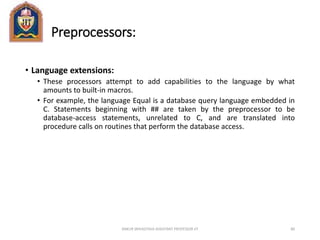
• Language extensions:
• These processors attempt to add capabilities to the language by what
amounts to built-in macros.
• For example, the language Equal is a database query language embedded in
C. Statements beginning with ## are taken by the preprocessor to be
database-access statements, unrelated to C, and are translated into
procedure calls on routines that perform the database access.
ANKUR SRIVASTAVA ASSISTANT PROFESSOR JIT 80
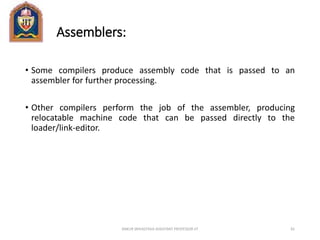
Assemblers:
• Some compilers produce assembly code that is passed to an
assembler for further processing.
• Other compilers perform the job of the assembler, producing
relocatable machine code that can be passed directly to the
loader/link-editor.
ANKUR SRIVASTAVA ASSISTANT PROFESSOR JIT 81
Assemblers:
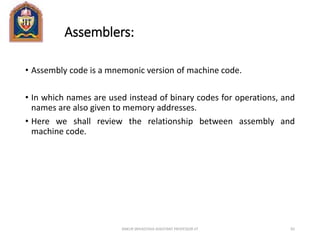
• Assembly code is a mnemonic version of machine code.
• In which names are used instead of binary codes for operations, and
names are also given to memory addresses.
• Here we shall review the relationship between assembly and
machine code.
ANKUR SRIVASTAVA ASSISTANT PROFESSOR JIT 82
Assemblers:
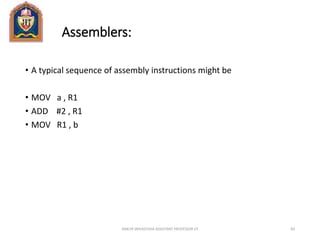
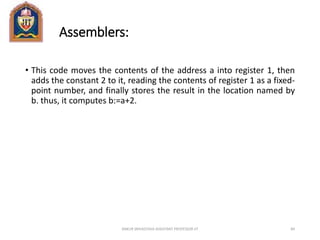
• A typical sequence of assembly instructions might be
• MOV a , R1
• ADD #2 , R1
• MOV R1 , b
ANKUR SRIVASTAVA ASSISTANT PROFESSOR JIT 83
Assemblers:
• This code moves the contents of the address a into register 1, then
adds the constant 2 to it, reading the contents of register 1 as a fixed-
point number, and finally stores the result in the location named by
b. thus, it computes b:=a+2.
ANKUR SRIVASTAVA ASSISTANT PROFESSOR JIT 84
Two-Pass Compiler:
•The simplest form of assembler makes two
passes over the input.
ANKUR SRIVASTAVA ASSISTANT PROFESSOR JIT 85
Two-Pass Compiler:
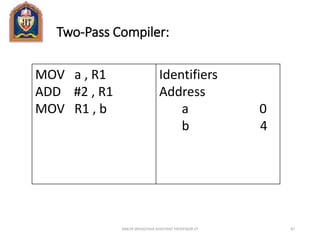
• in the first pass, all the identifiers that denote storage locations are
found and stored in a symbol table
• Identifiers are assigned storage locations as they are encountered for
the first time, so after reading 1.6, for example, the symbol table
might contain the entries shown in given below.
ANKUR SRIVASTAVA ASSISTANT PROFESSOR JIT 86
Two-Pass Compiler:
MOV a , R1
ADD #2 , R1
MOV R1 , b
Identifiers
Address
a 0
b 4
ANKUR SRIVASTAVA ASSISTANT PROFESSOR JIT 87
Two-Pass Compiler:
• In the second pass, the assembler scans the input again.
• This time, it translates each operation code into the sequence of bits
representing that operation in machine language.
• The output of the 2nd pass is usually relocatable machine code.
ANKUR SRIVASTAVA ASSISTANT PROFESSOR JIT 88
Loaders and Link-Editors:
• Usually, a program called a loader performs the
two functions of loading and link-editing.
ANKUR SRIVASTAVA ASSISTANT PROFESSOR JIT 89
Loaders and Link-Editors:
• The process of loading consists of taking relocatable
machine code, altering the relocatable addresses, and
placing the altered instructions and data in memory at the
proper location.
• The link-editor allows us to make a single program from
several files of relocatable machine code.
ANKUR SRIVASTAVA ASSISTANT PROFESSOR JIT 90
The Grouping of Phases:
ANKUR SRIVASTAVA ASSISTANT PROFESSOR JIT 91
Front and Back Ends:
• The phases are collected into a front end and a back end.
• The front end consists of those phases that depend primarily on the
source language and are largely independent of the target machine.
ANKUR SRIVASTAVA ASSISTANT PROFESSOR JIT 92
Front and Back Ends:
• These normally include lexical and syntactic analysis, the creating of
the symbol table, semantic analysis, and the generation of
intermediate code.
• A certain among of code optimization can be done by the front end
as well.
ANKUR SRIVASTAVA ASSISTANT PROFESSOR JIT 93
Front and Back Ends:
• The back end includes those portions of the compiler that depend on
the target machine.
• And generally, these portions do not depend on the source language,
depend on just the intermediate language.
• The front end also includes the error handling that goes along with
each of these phases.
ANKUR SRIVASTAVA ASSISTANT PROFESSOR JIT 94
Front and Back Ends:
• In the back end, we find aspects of the code optimization phase, and
we find code generation, along with the necessary error handling and
symbol table operations.
ANKUR SRIVASTAVA ASSISTANT PROFESSOR JIT 95
Compiler-Construction Tools:
• The compiler writer, like any programmer, can profitably use tools
such as
• Debuggers,
• Version managers,
• Profilers and so on.
ANKUR SRIVASTAVA ASSISTANT PROFESSOR JIT 96
Compiler-Construction Tools:
• In addition to these software-development
tools, other more specialized tools have
been developed for helping implement
various phases of a compiler.
ANKUR SRIVASTAVA ASSISTANT PROFESSOR JIT 97
Compiler-Construction Tools:
• Shortly after the first compilers were written, systems to help with
the compiler-writing process appeared.
• These systems have often been referred to as
• Compiler-compilers,
• Compiler-generators,
• Or Translator-writing systems.
ANKUR SRIVASTAVA ASSISTANT PROFESSOR JIT 98
Compiler-Construction Tools:
• Some general tools have been created for the automatic design of
specific compiler components.
• These tools use specialized languages for specifying and
implementing the component, and many use algorithms that are
quite sophisticated.
ANKUR SRIVASTAVA ASSISTANT PROFESSOR JIT 99
Compiler-Construction Tools:
• The most successful tools are those that hide the details of the
generation algorithm and produce components that can be easily
integrated into the remainder of a compiler.
ANKUR SRIVASTAVA ASSISTANT PROFESSOR JIT 100
Compiler-Construction Tools:
• The following is a list of some useful compiler-construction tools:
• Parser generators
• Scanner generators
• Syntax directed translation engines
• Automatic code generators
• Data-flow engines
ANKUR SRIVASTAVA ASSISTANT PROFESSOR JIT 101
Compiler-Construction Tools:
• Parser generators
• These produce syntax analyzers, normally from input that is based on a
context-free grammar.
• In early compilers, syntax analysis consumed not only a large fraction of the
running time of a compiler, but a large fraction of the intellectual effort of
writing a compiler.
• This phase is considered one of the easiest to implement.
ANKUR SRIVASTAVA ASSISTANT PROFESSOR JIT 102
Compiler-Construction Tools:
• Scanner generators:
• These tools automatically generate lexical analyzers, normally from a
specification based on regular expressions.
• The basic organization of the resulting lexical analyzer is in effect a finite
automaton.
ANKUR SRIVASTAVA ASSISTANT PROFESSOR JIT 103
Compiler-Construction Tools:
• Syntax directed translation engines:
• These produce collections of routines that walk the parse tree, generating
intermediate code.
• The basic idea is that one or more “translations” are associated with each
node of the parse tree, and each translation is defined in terms of
translations at its neighbor nodes in the tree.
ANKUR SRIVASTAVA ASSISTANT PROFESSOR JIT 104
Compiler-Construction Tools:
• Automatic code generators:
• Such a tool takes a collection of rules that define the translation of each
operation of the intermediate language into the machine language for the
target machine.
ANKUR SRIVASTAVA ASSISTANT PROFESSOR JIT 105
Data-flow engines:
• Data-flow engines:
• Much of the information needed to perform good code optimization involves
“data-flow analysis,” the gathering of information how values are transmitted
from one part of a program to each other part.
ANKUR SRIVASTAVA ASSISTANT PROFESSOR JIT 106

Compiler unit 1

  • 1.
    COMPILER DESIGN ANKUR SRIVASTAVAASSISTANT PROFESSOR JIT 1
  • 2.
    Compilers: • A compileris a program that reads a program written in one language –– the source language –– and translates it into an equivalent program in another language –– the target language. • As an important part of this translation process, the compiler reports to its user the presence of errors in the source program. ANKUR SRIVASTAVA ASSISTANT PROFESSOR JIT 2
  • 3.
  • 4.
    Compilers: • At firstglance, the variety of compilers may appear overwhelming. • There are thousands of source languages, ranging from traditional programming languages such as FORTRAN and Pascal to specialized languages. ANKUR SRIVASTAVA ASSISTANT PROFESSOR JIT 4
  • 5.
    Compilers: • Target languagesare equally as varied; • A target language may be another programming language, or the machine language of any computer. ANKUR SRIVASTAVA ASSISTANT PROFESSOR JIT 5
  • 6.
    Compilers: • Compilers aresometimes classified as: • single-pass • multi-pass • load-and-go • Debugging • optimizing ANKUR SRIVASTAVA ASSISTANT PROFESSOR JIT 6
  • 7.
    Compilers: • The basictasks that any compiler must perform are essentially the same. • By understanding these tasks, we can construct compilers for a wide variety of source languages and target machines using the same basic techniques. ANKUR SRIVASTAVA ASSISTANT PROFESSOR JIT 7
  • 8.
    Compilers: • Throughout the1950’s, compilers were considered notoriously difficult programs to write. • The first FORTRAN compiler, for example, took 18 staff-years to implement. ANKUR SRIVASTAVA ASSISTANT PROFESSOR JIT 8
  • 9.
    The Analysis-Synthesis Modelof Compilation: • There are two parts of compilation: • Analysis: The analysis part breaks up the source program into constituent pieces • Synthesis: Creates an intermediate representation of the source program. ANKUR SRIVASTAVA ASSISTANT PROFESSOR JIT 9
  • 10.
    The Analysis-Synthesis Modelof Compilation: •The synthesis part constructs the desired target program from the intermediate representation. ANKUR SRIVASTAVA ASSISTANT PROFESSOR JIT 10
  • 11.
    The Analysis-Synthesis Modelof Compilation: ANKUR SRIVASTAVA ASSISTANT PROFESSOR JIT 11 Front End Back End source code IR machine code errors
  • 12.
    The Analysis-Synthesis Modelof Compilation: • During analysis, the operations implied by the source program are determined and recorded in a hierarchical structure called a tree. • Often, a special kind of tree called a syntax tree is used. ANKUR SRIVASTAVA ASSISTANT PROFESSOR JIT 12
  • 13.
    The Analysis-Synthesis Modelof Compilation: • In syntax tree each node represents an operation and the children of the node represent the arguments of the operation. • For example, a syntax tree of an assignment statement is shown below. ANKUR SRIVASTAVA ASSISTANT PROFESSOR JIT 13
  • 14.
    The Analysis-Synthesis Modelof Compilation: ANKUR SRIVASTAVA ASSISTANT PROFESSOR JIT 14
  • 15.
    Analysis of theSource Program: • In compiling, analysis consists of three phases: • Linear Analysis: • Hierarchical Analysis: • Semantic Analysis: ANKUR SRIVASTAVA ASSISTANT PROFESSOR JIT 15
  • 16.
    Analysis of theSource Program: • Linear Analysis: • In which the stream of characters making up the source program is read from left-to-right and grouped into tokens that are sequences of characters having a collective meaning. ANKUR SRIVASTAVA ASSISTANT PROFESSOR JIT 16
  • 17.
    Scanning or LexicalAnalysis (Linear Analysis): • In a compiler, linear analysis is called lexical analysis or scanning. • For example, in lexical analysis the characters in the assignment statement • Position: = initial + rate * 60 • Would be grouped into the following tokens: ANKUR SRIVASTAVA ASSISTANT PROFESSOR JIT 17
  • 18.
    Scanning or LexicalAnalysis (Linear Analysis): • The identifier, position. • The assignment symbol := • The identifier initial. • The plus sign. • The identifier rate. • The multiplication sign. • The number 60. ANKUR SRIVASTAVA ASSISTANT PROFESSOR JIT 18
  • 19.
    Scanning or LexicalAnalysis (Linear Analysis): •The blanks separating the characters of these tokens would normally be eliminated during the lexical analysis. ANKUR SRIVASTAVA ASSISTANT PROFESSOR JIT 19
  • 20.
    Analysis of theSource Program: • Hierarchical Analysis: • In which characters or tokens are grouped hierarchically into nested collections with collective meaning. • The grammatical phrases of the source program are represented by a parse tree. ANKUR SRIVASTAVA ASSISTANT PROFESSOR JIT 20
  • 21.
    Syntax Analysis orHierarchical Analysis (Parsing): • Hierarchical analysis is called parsing or syntax analysis. • It involves grouping the tokens of the source program into grammatical phases that are used by the compiler to synthesize output. ANKUR SRIVASTAVA ASSISTANT PROFESSOR JIT 21
  • 22.
    Syntax Analysis orHierarchical Analysis (Parsing): ANKUR SRIVASTAVA ASSISTANT PROFESSOR JIT 22 Assignment Statement := Identifier Position Expression + Expression Identifier Initial Expression * Expression Identifier Rate Expression Number 60
  • 23.
    Syntax Analysis orHierarchical Analysis (Parsing): • In the expression initial + rate * 60, the phrase rate * 60 is a logical unit because the usual conventions of arithmetic expressions tell us that the multiplication is performed before addition. • Because the expression initial + rate is followed by a *, it is not grouped into a single phrase by itself ANKUR SRIVASTAVA ASSISTANT PROFESSOR JIT 23
  • 24.
    Syntax Analysis orHierarchical Analysis (Parsing): • The hierarchical structure of a program is usually expressed by recursive rules. • For example, we might have the following rules, as part of the definition of expression: ANKUR SRIVASTAVA ASSISTANT PROFESSOR JIT 24
  • 25.
    Syntax Analysis orHierarchical Analysis (Parsing): • Any identifier is an expression. • Any number is an expression • If expression1 and expression2 are expressions, then so are • Expression1 + expression2 • Expression1 * expression2 • (Expression1 ) ANKUR SRIVASTAVA ASSISTANT PROFESSOR JIT 25
  • 26.
    Analysis of theSource Program: • Semantic Analysis: • In which certain checks are performed to ensure that the components of a program fit together meaningfully. ANKUR SRIVASTAVA ASSISTANT PROFESSOR JIT 26
  • 27.
    Semantic Analysis: • Thesemantic analysis phase checks the source program for semantic errors and gathers type information for the subsequent code-generation phase. • It uses the hierarchical structure determined by the syntax-analysis phase to identify the operators and operand of expressions and statements. ANKUR SRIVASTAVA ASSISTANT PROFESSOR JIT 27
  • 28.
    Semantic Analysis: • Animportant component of semantic analysis is type checking. • Here are the compiler checks that each operator has operands that are permitted by the source language specification. ANKUR SRIVASTAVA ASSISTANT PROFESSOR JIT 28
  • 29.
    Semantic Analysis: • Forexample, when a binary arithmetic operator is applied to an integer and real. In this case, the compiler may need to be converting the integer to a real. As shown in figure given below: ANKUR SRIVASTAVA ASSISTANT PROFESSOR JIT 29
  • 30.
    Semantic Analysis: ANKUR SRIVASTAVAASSISTANT PROFESSOR JIT 30
  • 31.
    The Phases ofa Compiler: • A compiler operates in phases. • Each of which transforms the source program from one representation to another. • A typical decomposition of a compiler is shown in fig given below ANKUR SRIVASTAVA ASSISTANT PROFESSOR JIT 31
  • 32.
    The Phases ofa Compiler: ANKUR SRIVASTAVA ASSISTANT PROFESSOR JIT 32
  • 33.
    The Phases ofa Compiler: • Linear Analysis: • In which the stream of characters making up the source program is read from left-to-right and grouped into tokens that are sequences of characters having a collective meaning. ANKUR SRIVASTAVA ASSISTANT PROFESSOR JIT 33
  • 34.
    The Phases ofa Compiler: • In a compiler, linear analysis is called lexical analysis or scanning. • For example, in lexical analysis the characters in the assignment statement • Position: = initial + rate * 60 • Would be grouped into the following tokens: ANKUR SRIVASTAVA ASSISTANT PROFESSOR JIT 34
  • 35.
    The Phases ofa Compiler: • The identifier, position. • The assignment symbol := • The identifier initial. • The plus sign. • The identifier rate. • The multiplication sign. • The number 60. ANKUR SRIVASTAVA ASSISTANT PROFESSOR JIT 35
  • 36.
    The Phases ofa Compiler: • The blanks separating the characters of these tokens would normally be eliminated during the lexical analysis. • Hierarchical Analysis: • In which characters or tokens are grouped hierarchically into nested collections with collective meaning. ANKUR SRIVASTAVA ASSISTANT PROFESSOR JIT 36
  • 37.
    The Phases ofa Compiler: • Hierarchical analysis is called parsing or syntax analysis. • It involves grouping the tokens of the source program into grammatical phases that are used by the compiler to synthesize output. ANKUR SRIVASTAVA ASSISTANT PROFESSOR JIT 37
  • 38.
    The Phases ofa Compiler: •The grammatical phrases of the source program are represented by a parse tree. ANKUR SRIVASTAVA ASSISTANT PROFESSOR JIT 38
  • 39.
    The Phases ofa Compiler: ANKUR SRIVASTAVA ASSISTANT PROFESSOR JIT 39 Assignment Statement := Identifier Position Expression + Expression Identifier Initial Expression * Expression Identifier Rate Expression Number 60
  • 40.
    The Phases ofa Compiler: • In the expression initial + rate * 60, the phrase rate * 60 is a logical unit because the usual conventions of arithmetic expressions tell us that the multiplication is performed before addition. • Because the expression initial + rate is followed by a *, it is not grouped into a single phrase by itself ANKUR SRIVASTAVA ASSISTANT PROFESSOR JIT 40
  • 41.
    The Phases ofa Compiler: • The hierarchical structure of a program is usually expressed by recursive rules. • For example, we might have the following rules, as part of the definition of expression: ANKUR SRIVASTAVA ASSISTANT PROFESSOR JIT 41
  • 42.
    The Phases ofa Compiler: • Any identifier is an expression. • Any number is an expression • If expression1 and expression2 are expressions, then so are • Expression1 + expression2 • Expression1 * expression2 • (Expression1 ) ANKUR SRIVASTAVA ASSISTANT PROFESSOR JIT 42
  • 43.
    The Phases ofa Compiler: • Semantic Analysis: • In which certain checks are performed to ensure that the components of a program fit together meaningfully. ANKUR SRIVASTAVA ASSISTANT PROFESSOR JIT 43
  • 44.
    The Phases ofa Compiler: • The semantic analysis phase checks the source program for semantic errors and gathers type information for the subsequent code- generation phase. ANKUR SRIVASTAVA ASSISTANT PROFESSOR JIT 44
  • 45.
    The Phases ofa Compiler: • It uses the hierarchical structure determined by the syntax- analysis phase to identify the operators and operand of expressions and statements. ANKUR SRIVASTAVA ASSISTANT PROFESSOR JIT 45
  • 46.
    The Phases ofa Compiler: • An important component of semantic analysis is type checking. • Here are the compiler checks that each operator has operands that are permitted by the source language specification. ANKUR SRIVASTAVA ASSISTANT PROFESSOR JIT 46
  • 47.
    The Phases ofa Compiler: • For example, when a binary arithmetic operator is applied to an integer and real. In this case, the compiler may need to be converting the integer to a real. As shown in figure given below: ANKUR SRIVASTAVA ASSISTANT PROFESSOR JIT 47
  • 48.
    The Phases ofa Compiler: ANKUR SRIVASTAVA ASSISTANT PROFESSOR JIT 48
  • 49.
    The Phases ofa Compiler: • Symbol Table Management: • An essential function of a compiler is to record the identifiers used in the source program and collect information about various attributes of each identifier. • These attributes may provide information about the storage allocated for an identifier, its type, its scope. ANKUR SRIVASTAVA ASSISTANT PROFESSOR JIT 49
  • 50.
    The Phases ofa Compiler: • The symbol table is a data structure containing a record for each identifier with fields for the attributes of the identifier. • When an identifier in the source program is detected by the lexical analyzer, the identifier is entered into the symbol table ANKUR SRIVASTAVA ASSISTANT PROFESSOR JIT 50
  • 51.
    The Phases ofa Compiler: • However, the attributes of an identifier cannot normally be determined during lexical analysis. • For example, in a Pascal declaration like • Var position, initial, rate : real; • The type real is not known when position, initial and rate are seen by the lexical analyzer. ANKUR SRIVASTAVA ASSISTANT PROFESSOR JIT 51
  • 52.
    The Phases ofa Compiler: • The remaining phases gets information about identifiers into the symbol table and then use this information in various ways. • For example, when doing semantic analysis and intermediate code generation, we need to know what the types of identifiers are, so we can check that the source program uses them in valid ways, and so that we can generate the proper operations on them. ANKUR SRIVASTAVA ASSISTANT PROFESSOR JIT 52
  • 53.
    The Phases ofa Compiler: • The code generator typically enters and uses detailed information about the storage assigned to identifiers. ANKUR SRIVASTAVA ASSISTANT PROFESSOR JIT 53
  • 54.
    Error Detection andReporting: • Each phase can encounter errors. • However, after detecting an error, a phase must somehow deal with that error, so that compilation can proceed, allowing further errors in the source program to be detected. ANKUR SRIVASTAVA ASSISTANT PROFESSOR JIT 54
  • 55.
    Error Detection andReporting: • A compiler that stops when it finds the first error is not as helpful as it could be. • The syntax and semantic analysis phases usually handle a large fraction of the errors detectable by the compiler. ANKUR SRIVASTAVA ASSISTANT PROFESSOR JIT 55
  • 56.
    Error Detection andReporting: • Errors where the token stream violates the structure rules (syntax) of the language are determined by the syntax analysis phase. • The lexical phase can detect errors where the characters remaining in the input do not form any token of the language. ANKUR SRIVASTAVA ASSISTANT PROFESSOR JIT 56
  • 57.
    Intermediate Code Generation: •After Syntax and semantic analysis, some compilers generate an explicit intermediate representation of the source program. • We can think of this intermediate representation as a program for an abstract machine. ANKUR SRIVASTAVA ASSISTANT PROFESSOR JIT 57
  • 58.
    Intermediate Code Generation: •This intermediate representation should have two important properties; • it should be easy to produce, • easy to translate into the target program. ANKUR SRIVASTAVA ASSISTANT PROFESSOR JIT 58
  • 59.
    Intermediate Code Generation: •We consider an intermediate form called “three-address code,” • which is like the assembly language for a machine in which every memory location can act like a register. ANKUR SRIVASTAVA ASSISTANT PROFESSOR JIT 59
  • 60.
    Intermediate Code Generation: •Three-address code consists of a sequence of instructions, each of which has at most three operands. • The source program in (1.1) might appear in three-address code as ANKUR SRIVASTAVA ASSISTANT PROFESSOR JIT 60
  • 61.
    Intermediate Code Generation: •Temp1 := inttoreal (60) • Temp2 := id3 * temp1 • Temp3 := id2 + temp2 • id1 := temp3 ANKUR SRIVASTAVA ASSISTANT PROFESSOR JIT 61
  • 62.
    Code Optimization: •The codeoptimization phase attempts to improve the intermediate code, so that faster-running machine code will result. ANKUR SRIVASTAVA ASSISTANT PROFESSOR JIT 62
  • 63.
    Code Optimization: • Someoptimizations are trivial. • For example, a natural algorithm generates the intermediate code (1.3), using an instruction for each operator in the tree representation after semantic analysis, even though there is a better way to perform the same calculation, using the two instructions. ANKUR SRIVASTAVA ASSISTANT PROFESSOR JIT 63
  • 64.
    Code Optimization: • Temp1:= id3 * 60.0 • id := id2 + temp1 • There is nothing wrong with this simple algorithm, since the problem can be fixed during the code-optimization phase. ANKUR SRIVASTAVA ASSISTANT PROFESSOR JIT 64
  • 65.
    Code Optimization: • Thatis, the compiler can deduce that the conversion of 60 from integer to real representation can be done once and for all at compile time, so the inttoreal operation can be eliminated. ANKUR SRIVASTAVA ASSISTANT PROFESSOR JIT 65
  • 66.
    Code Optimization: • Besides,temp3 is used only once, to transmit its value to id1. It then becomes safe to substitute id1 for temp3, whereupon the last statement of 1.3 is not needed and the code of 1.4 results. ANKUR SRIVASTAVA ASSISTANT PROFESSOR JIT 66
  • 67.
    Code Generation • Thefinal phase of the compiler is the generation of target code • consisting normally of relocatable machine code or assembly code. ANKUR SRIVASTAVA ASSISTANT PROFESSOR JIT 67
  • 68.
    Code Generation: • Memorylocations are selected for each of the variables used by the program. • Then, intermediate instructions are each translated into a sequence of machine instructions that perform the same task. • A crucial aspect is the assignment of variables to registers. ANKUR SRIVASTAVA ASSISTANT PROFESSOR JIT 68
  • 69.
    Code Generation: • Forexample, using registers 1 and 2, the translation of the code of 1.4 might become • MOVF id3, r2 • MULF #60.0, r2 • MOVF id2, r1 • ADDF r2, r1 • MOVF r1, id1 ANKUR SRIVASTAVA ASSISTANT PROFESSOR JIT 69
  • 70.
    Code Generation • Thefirst and second operands of each instruction specify a source and destination, respectively. • The F in each instruction tells us that instructions deal with floating- point numbers. ANKUR SRIVASTAVA ASSISTANT PROFESSOR JIT 70
  • 71.
    Code Generation • Thiscode moves the contents of the address id3 into register 2, and then multiplies it with the real-constant 60.0. • The # signifies that 60.0 is to be treated as a constant. ANKUR SRIVASTAVA ASSISTANT PROFESSOR JIT 71
  • 72.
    Code Generation • Thethird instruction moves id2 into register 1 and adds to it the value previously computed in register 2 • Finally, the value in register 1 is moved into the address of id1. ANKUR SRIVASTAVA ASSISTANT PROFESSOR JIT 72
  • 73.
    Cousins of theCompiler: • As we saw in given figure, the input to a compiler may be produced by one or more preprocessors, and further processing of the compiler’s output may be needed before running machine code is obtained. ANKUR SRIVASTAVA ASSISTANT PROFESSOR JIT 73
  • 74.
    Library, Relocatable objectfiles ANKUR SRIVASTAVA ASSISTANT PROFESSOR JIT 74 Skeletal Source Program Preprocessor Source program Compiler Target assembly program Assembler Relocatable machine code Loader/link-editor Absolute machine code 1.3. A LANGUAGE-PROCESSING SYSTEM
  • 75.
    Cousins of theCompiler: • Preprocessors: • preprocessors produce input to compilers. They may perform the following functions: • Macro Processing: • File inclusion: • “Rational” Preprocessors: • Language extensions: ANKUR SRIVASTAVA ASSISTANT PROFESSOR JIT 75
  • 76.
    Preprocessors: • Macro Processing: •A preprocessor may allow a user to define macros that are shorthand’s for longer constructs. ANKUR SRIVASTAVA ASSISTANT PROFESSOR JIT 76
  • 77.
    Preprocessors: • File inclusion: •A preprocessor may include header files into the program text. • For example, the C preprocessor causes the contents of the file <global.h> to replace the statement #include <global.h> when it processes a file containing this statement. ANKUR SRIVASTAVA ASSISTANT PROFESSOR JIT 77
  • 78.
    Preprocessors: ANKUR SRIVASTAVA ASSISTANTPROFESSOR JIT 78 defs.h ////// ////// ////// main.c #include “defs.h” …---…---…--- …---…---…--- …---…---…--- ////// ////// ////// …---…---…--- …---…---…--- …---…---…---
  • 79.
    Preprocessors: • “Rational” Preprocessors: •These processors augment older languages with more modern flow-of- control and data-structuring facilities. ANKUR SRIVASTAVA ASSISTANT PROFESSOR JIT 79
  • 80.
    Preprocessors: • Language extensions: •These processors attempt to add capabilities to the language by what amounts to built-in macros. • For example, the language Equal is a database query language embedded in C. Statements beginning with ## are taken by the preprocessor to be database-access statements, unrelated to C, and are translated into procedure calls on routines that perform the database access. ANKUR SRIVASTAVA ASSISTANT PROFESSOR JIT 80
  • 81.
    Assemblers: • Some compilersproduce assembly code that is passed to an assembler for further processing. • Other compilers perform the job of the assembler, producing relocatable machine code that can be passed directly to the loader/link-editor. ANKUR SRIVASTAVA ASSISTANT PROFESSOR JIT 81
  • 82.
    Assemblers: • Assembly codeis a mnemonic version of machine code. • In which names are used instead of binary codes for operations, and names are also given to memory addresses. • Here we shall review the relationship between assembly and machine code. ANKUR SRIVASTAVA ASSISTANT PROFESSOR JIT 82
  • 83.
    Assemblers: • A typicalsequence of assembly instructions might be • MOV a , R1 • ADD #2 , R1 • MOV R1 , b ANKUR SRIVASTAVA ASSISTANT PROFESSOR JIT 83
  • 84.
    Assemblers: • This codemoves the contents of the address a into register 1, then adds the constant 2 to it, reading the contents of register 1 as a fixed- point number, and finally stores the result in the location named by b. thus, it computes b:=a+2. ANKUR SRIVASTAVA ASSISTANT PROFESSOR JIT 84
  • 85.
    Two-Pass Compiler: •The simplestform of assembler makes two passes over the input. ANKUR SRIVASTAVA ASSISTANT PROFESSOR JIT 85
  • 86.
    Two-Pass Compiler: • inthe first pass, all the identifiers that denote storage locations are found and stored in a symbol table • Identifiers are assigned storage locations as they are encountered for the first time, so after reading 1.6, for example, the symbol table might contain the entries shown in given below. ANKUR SRIVASTAVA ASSISTANT PROFESSOR JIT 86
  • 87.
    Two-Pass Compiler: MOV a, R1 ADD #2 , R1 MOV R1 , b Identifiers Address a 0 b 4 ANKUR SRIVASTAVA ASSISTANT PROFESSOR JIT 87
  • 88.
    Two-Pass Compiler: • Inthe second pass, the assembler scans the input again. • This time, it translates each operation code into the sequence of bits representing that operation in machine language. • The output of the 2nd pass is usually relocatable machine code. ANKUR SRIVASTAVA ASSISTANT PROFESSOR JIT 88
  • 89.
    Loaders and Link-Editors: •Usually, a program called a loader performs the two functions of loading and link-editing. ANKUR SRIVASTAVA ASSISTANT PROFESSOR JIT 89
  • 90.
    Loaders and Link-Editors: •The process of loading consists of taking relocatable machine code, altering the relocatable addresses, and placing the altered instructions and data in memory at the proper location. • The link-editor allows us to make a single program from several files of relocatable machine code. ANKUR SRIVASTAVA ASSISTANT PROFESSOR JIT 90
  • 91.
    The Grouping ofPhases: ANKUR SRIVASTAVA ASSISTANT PROFESSOR JIT 91
  • 92.
    Front and BackEnds: • The phases are collected into a front end and a back end. • The front end consists of those phases that depend primarily on the source language and are largely independent of the target machine. ANKUR SRIVASTAVA ASSISTANT PROFESSOR JIT 92
  • 93.
    Front and BackEnds: • These normally include lexical and syntactic analysis, the creating of the symbol table, semantic analysis, and the generation of intermediate code. • A certain among of code optimization can be done by the front end as well. ANKUR SRIVASTAVA ASSISTANT PROFESSOR JIT 93
  • 94.
    Front and BackEnds: • The back end includes those portions of the compiler that depend on the target machine. • And generally, these portions do not depend on the source language, depend on just the intermediate language. • The front end also includes the error handling that goes along with each of these phases. ANKUR SRIVASTAVA ASSISTANT PROFESSOR JIT 94
  • 95.
    Front and BackEnds: • In the back end, we find aspects of the code optimization phase, and we find code generation, along with the necessary error handling and symbol table operations. ANKUR SRIVASTAVA ASSISTANT PROFESSOR JIT 95
  • 96.
    Compiler-Construction Tools: • Thecompiler writer, like any programmer, can profitably use tools such as • Debuggers, • Version managers, • Profilers and so on. ANKUR SRIVASTAVA ASSISTANT PROFESSOR JIT 96
  • 97.
    Compiler-Construction Tools: • Inaddition to these software-development tools, other more specialized tools have been developed for helping implement various phases of a compiler. ANKUR SRIVASTAVA ASSISTANT PROFESSOR JIT 97
  • 98.
    Compiler-Construction Tools: • Shortlyafter the first compilers were written, systems to help with the compiler-writing process appeared. • These systems have often been referred to as • Compiler-compilers, • Compiler-generators, • Or Translator-writing systems. ANKUR SRIVASTAVA ASSISTANT PROFESSOR JIT 98
  • 99.
    Compiler-Construction Tools: • Somegeneral tools have been created for the automatic design of specific compiler components. • These tools use specialized languages for specifying and implementing the component, and many use algorithms that are quite sophisticated. ANKUR SRIVASTAVA ASSISTANT PROFESSOR JIT 99
  • 100.
    Compiler-Construction Tools: • Themost successful tools are those that hide the details of the generation algorithm and produce components that can be easily integrated into the remainder of a compiler. ANKUR SRIVASTAVA ASSISTANT PROFESSOR JIT 100
  • 101.
    Compiler-Construction Tools: • Thefollowing is a list of some useful compiler-construction tools: • Parser generators • Scanner generators • Syntax directed translation engines • Automatic code generators • Data-flow engines ANKUR SRIVASTAVA ASSISTANT PROFESSOR JIT 101
  • 102.
    Compiler-Construction Tools: • Parsergenerators • These produce syntax analyzers, normally from input that is based on a context-free grammar. • In early compilers, syntax analysis consumed not only a large fraction of the running time of a compiler, but a large fraction of the intellectual effort of writing a compiler. • This phase is considered one of the easiest to implement. ANKUR SRIVASTAVA ASSISTANT PROFESSOR JIT 102
  • 103.
    Compiler-Construction Tools: • Scannergenerators: • These tools automatically generate lexical analyzers, normally from a specification based on regular expressions. • The basic organization of the resulting lexical analyzer is in effect a finite automaton. ANKUR SRIVASTAVA ASSISTANT PROFESSOR JIT 103
  • 104.
    Compiler-Construction Tools: • Syntaxdirected translation engines: • These produce collections of routines that walk the parse tree, generating intermediate code. • The basic idea is that one or more “translations” are associated with each node of the parse tree, and each translation is defined in terms of translations at its neighbor nodes in the tree. ANKUR SRIVASTAVA ASSISTANT PROFESSOR JIT 104
  • 105.
    Compiler-Construction Tools: • Automaticcode generators: • Such a tool takes a collection of rules that define the translation of each operation of the intermediate language into the machine language for the target machine. ANKUR SRIVASTAVA ASSISTANT PROFESSOR JIT 105
  • 106.
    Data-flow engines: • Data-flowengines: • Much of the information needed to perform good code optimization involves “data-flow analysis,” the gathering of information how values are transmitted from one part of a program to each other part. ANKUR SRIVASTAVA ASSISTANT PROFESSOR JIT 106