1
Syntax Analysis
Part III
Chapter 4
Copyright Robert van Engelen, Florida State University, 2007
2
ANTLR, Yacc, and Bison
• ANTLR tool
– Generates LL(k) parsers
• Yacc (Yet Another Compiler Compiler)
– Generates LALR(1) parsers
• Bison
– Improved version of Yacc
3
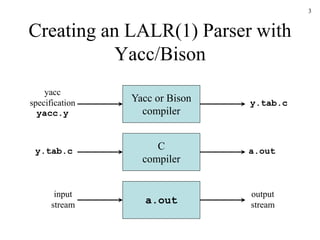
Creating an LALR(1) Parser with
Yacc/Bison
Yacc or Bison
compiler
yacc
specification
yacc.y
y.tab.c
input
stream
C
compiler
a.out
output
stream
y.tab.c
a.out
4
Yacc Specification
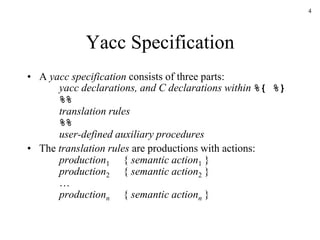
• A yacc specification consists of three parts:
yacc declarations, and C declarations within %{ %}
%%
translation rules
%%
user-defined auxiliary procedures
• The translation rules are productions with actions:
production1 { semantic action1 }
production2 { semantic action2 }
…
productionn { semantic actionn }
5
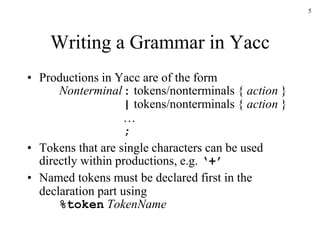
Writing a Grammar in Yacc
• Productions in Yacc are of the form
Nonterminal: tokens/nonterminals { action }
| tokens/nonterminals { action }
…
;
• Tokens that are single characters can be used
directly within productions, e.g. ‘+’
• Named tokens must be declared first in the
declaration part using
%token TokenName
6
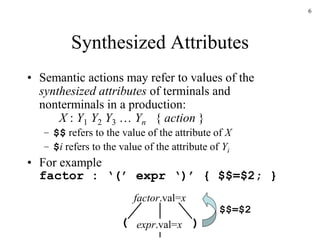
Synthesized Attributes
• Semantic actions may refer to values of the
synthesized attributes of terminals and
nonterminals in a production:
X : Y1 Y2 Y3 … Yn { action }
– $$ refers to the value of the attribute of X
– $i refers to the value of the attribute of Yi
• For example
factor : ‘(’ expr ‘)’ { $$=$2; }
factor.val=x
expr.val=x )
(
$$=$2
7
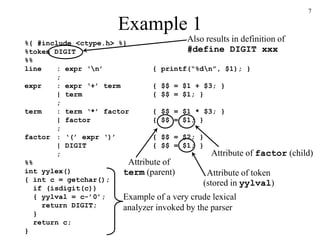
Example 1
%{ #include <ctype.h> %}
%token DIGIT
%%
line : expr ‘n’ { printf(“%dn”, $1); }
;
expr : expr ‘+’ term { $$ = $1 + $3; }
| term { $$ = $1; }
;
term : term ‘*’ factor { $$ = $1 * $3; }
| factor { $$ = $1; }
;
factor : ‘(’ expr ‘)’ { $$ = $2; }
| DIGIT { $$ = $1; }
;
%%
int yylex()
{ int c = getchar();
if (isdigit(c))
{ yylval = c-’0’;
return DIGIT;
}
return c;
}
Also results in definition of
#define DIGIT xxx
Attribute of token
(stored in yylval)
Attribute of
term (parent)
Attribute of factor (child)
Example of a very crude lexical
analyzer invoked by the parser
8
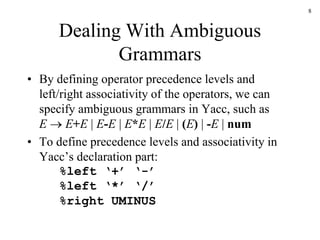
Dealing With Ambiguous
Grammars
• By defining operator precedence levels and
left/right associativity of the operators, we can
specify ambiguous grammars in Yacc, such as
E  E+E | E-E | E*E | E/E | (E) | -E | num
• To define precedence levels and associativity in
Yacc’s declaration part:
%left ‘+’ ‘-’
%left ‘*’ ‘/’
%right UMINUS
9
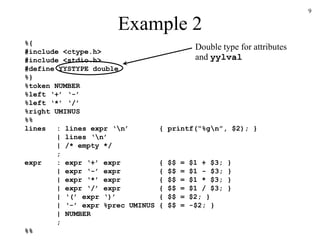
Example 2
%{
#include <ctype.h>
#include <stdio.h>
#define YYSTYPE double
%}
%token NUMBER
%left ‘+’ ‘-’
%left ‘*’ ‘/’
%right UMINUS
%%
lines : lines expr ‘n’ { printf(“%gn”, $2); }
| lines ‘n’
| /* empty */
;
expr : expr ‘+’ expr { $$ = $1 + $3; }
| expr ‘-’ expr { $$ = $1 - $3; }
| expr ‘*’ expr { $$ = $1 * $3; }
| expr ‘/’ expr { $$ = $1 / $3; }
| ‘(’ expr ‘)’ { $$ = $2; }
| ‘-’ expr %prec UMINUS { $$ = -$2; }
| NUMBER
;
%%
Double type for attributes
and yylval
10
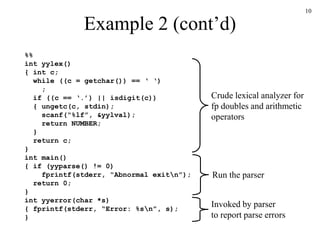
Example 2 (cont’d)
%%
int yylex()
{ int c;
while ((c = getchar()) == ‘ ‘)
;
if ((c == ‘.’) || isdigit(c))
{ ungetc(c, stdin);
scanf(“%lf”, &yylval);
return NUMBER;
}
return c;
}
int main()
{ if (yyparse() != 0)
fprintf(stderr, “Abnormal exitn”);
return 0;
}
int yyerror(char *s)
{ fprintf(stderr, “Error: %sn”, s);
}
Run the parser
Crude lexical analyzer for
fp doubles and arithmetic
operators
Invoked by parser
to report parse errors
11
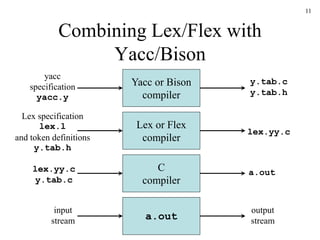
Combining Lex/Flex with
Yacc/Bison
Yacc or Bison
compiler
yacc
specification
yacc.y
lex.yy.c
y.tab.c
input
stream
C
compiler
a.out
output
stream
y.tab.c
y.tab.h
a.out
Lex or Flex
compiler
Lex specification
lex.l
and token definitions
y.tab.h
lex.yy.c
12
Lex Specification for Example 2
%option noyywrap
%{
#include “y.tab.h”
extern double yylval;
%}
number [0-9]+.?|[0-9]*.[0-9]+
%%
[ ] { /* skip blanks */ }
{number} { sscanf(yytext, “%lf”, &yylval);
return NUMBER;
}
n|. { return yytext[0]; }
Generated by Yacc, contains
#define NUMBER xxx
yacc -d example2.y
lex example2.l
gcc y.tab.c lex.yy.c
./a.out
bison -d -y example2.y
flex example2.l
gcc y.tab.c lex.yy.c
./a.out
Defined in y.tab.c
13
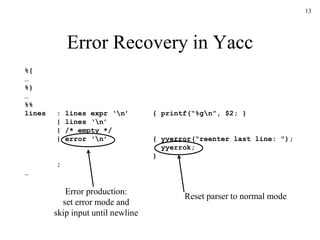
Error Recovery in Yacc
%{
…
%}
…
%%
lines : lines expr ‘n’ { printf(“%gn”, $2; }
| lines ‘n’
| /* empty */
| error ‘n’ { yyerror(“reenter last line: ”);
yyerrok;
}
;
…
Reset parser to normal mode
Error production:
set error mode and
skip input until newline

Ch4c.ppt

  • 1.
    1 Syntax Analysis Part III Chapter4 Copyright Robert van Engelen, Florida State University, 2007
  • 2.
    2 ANTLR, Yacc, andBison • ANTLR tool – Generates LL(k) parsers • Yacc (Yet Another Compiler Compiler) – Generates LALR(1) parsers • Bison – Improved version of Yacc
  • 3.
    3 Creating an LALR(1)Parser with Yacc/Bison Yacc or Bison compiler yacc specification yacc.y y.tab.c input stream C compiler a.out output stream y.tab.c a.out
  • 4.
    4 Yacc Specification • Ayacc specification consists of three parts: yacc declarations, and C declarations within %{ %} %% translation rules %% user-defined auxiliary procedures • The translation rules are productions with actions: production1 { semantic action1 } production2 { semantic action2 } … productionn { semantic actionn }
  • 5.
    5 Writing a Grammarin Yacc • Productions in Yacc are of the form Nonterminal: tokens/nonterminals { action } | tokens/nonterminals { action } … ; • Tokens that are single characters can be used directly within productions, e.g. ‘+’ • Named tokens must be declared first in the declaration part using %token TokenName
  • 6.
    6 Synthesized Attributes • Semanticactions may refer to values of the synthesized attributes of terminals and nonterminals in a production: X : Y1 Y2 Y3 … Yn { action } – $$ refers to the value of the attribute of X – $i refers to the value of the attribute of Yi • For example factor : ‘(’ expr ‘)’ { $$=$2; } factor.val=x expr.val=x ) ( $$=$2
  • 7.
    7 Example 1 %{ #include<ctype.h> %} %token DIGIT %% line : expr ‘n’ { printf(“%dn”, $1); } ; expr : expr ‘+’ term { $$ = $1 + $3; } | term { $$ = $1; } ; term : term ‘*’ factor { $$ = $1 * $3; } | factor { $$ = $1; } ; factor : ‘(’ expr ‘)’ { $$ = $2; } | DIGIT { $$ = $1; } ; %% int yylex() { int c = getchar(); if (isdigit(c)) { yylval = c-’0’; return DIGIT; } return c; } Also results in definition of #define DIGIT xxx Attribute of token (stored in yylval) Attribute of term (parent) Attribute of factor (child) Example of a very crude lexical analyzer invoked by the parser
  • 8.
    8 Dealing With Ambiguous Grammars •By defining operator precedence levels and left/right associativity of the operators, we can specify ambiguous grammars in Yacc, such as E  E+E | E-E | E*E | E/E | (E) | -E | num • To define precedence levels and associativity in Yacc’s declaration part: %left ‘+’ ‘-’ %left ‘*’ ‘/’ %right UMINUS
  • 9.
    9 Example 2 %{ #include <ctype.h> #include<stdio.h> #define YYSTYPE double %} %token NUMBER %left ‘+’ ‘-’ %left ‘*’ ‘/’ %right UMINUS %% lines : lines expr ‘n’ { printf(“%gn”, $2); } | lines ‘n’ | /* empty */ ; expr : expr ‘+’ expr { $$ = $1 + $3; } | expr ‘-’ expr { $$ = $1 - $3; } | expr ‘*’ expr { $$ = $1 * $3; } | expr ‘/’ expr { $$ = $1 / $3; } | ‘(’ expr ‘)’ { $$ = $2; } | ‘-’ expr %prec UMINUS { $$ = -$2; } | NUMBER ; %% Double type for attributes and yylval
  • 10.
    10 Example 2 (cont’d) %% intyylex() { int c; while ((c = getchar()) == ‘ ‘) ; if ((c == ‘.’) || isdigit(c)) { ungetc(c, stdin); scanf(“%lf”, &yylval); return NUMBER; } return c; } int main() { if (yyparse() != 0) fprintf(stderr, “Abnormal exitn”); return 0; } int yyerror(char *s) { fprintf(stderr, “Error: %sn”, s); } Run the parser Crude lexical analyzer for fp doubles and arithmetic operators Invoked by parser to report parse errors
  • 11.
    11 Combining Lex/Flex with Yacc/Bison Yaccor Bison compiler yacc specification yacc.y lex.yy.c y.tab.c input stream C compiler a.out output stream y.tab.c y.tab.h a.out Lex or Flex compiler Lex specification lex.l and token definitions y.tab.h lex.yy.c
  • 12.
    12 Lex Specification forExample 2 %option noyywrap %{ #include “y.tab.h” extern double yylval; %} number [0-9]+.?|[0-9]*.[0-9]+ %% [ ] { /* skip blanks */ } {number} { sscanf(yytext, “%lf”, &yylval); return NUMBER; } n|. { return yytext[0]; } Generated by Yacc, contains #define NUMBER xxx yacc -d example2.y lex example2.l gcc y.tab.c lex.yy.c ./a.out bison -d -y example2.y flex example2.l gcc y.tab.c lex.yy.c ./a.out Defined in y.tab.c
  • 13.
    13 Error Recovery inYacc %{ … %} … %% lines : lines expr ‘n’ { printf(“%gn”, $2; } | lines ‘n’ | /* empty */ | error ‘n’ { yyerror(“reenter last line: ”); yyerrok; } ; … Reset parser to normal mode Error production: set error mode and skip input until newline