
Suresh Madhavan AKAH

 The term market means any kind of arrangement
where buyers and sellers of goods, services or
resources are linked together to carry out an
exchange.
Suresh Madhavan AKAH
Market

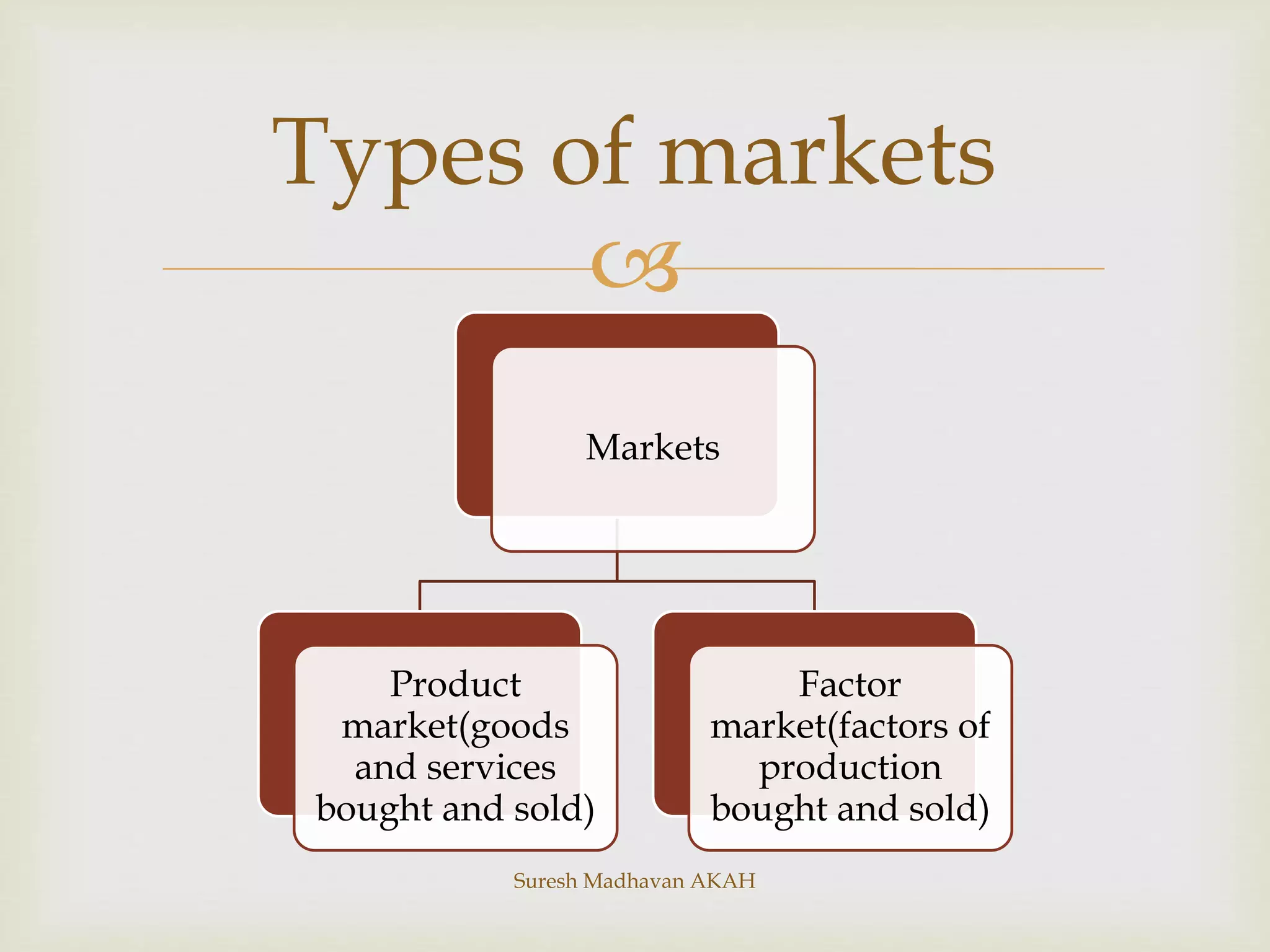
Markets
Product
market(goods
and services
bought and sold)
Factor
market(factors of
production
bought and sold)
Suresh Madhavan AKAH
Types of markets

 The competitive market is the market for a good
with large number of buyers and sellers, where the
single seller has very little or no market power.
Suresh Madhavan AKAH
Competitive markets

 Demand is concerned with the behaviour of buyers.
Demand
Suresh Madhavan AKAH

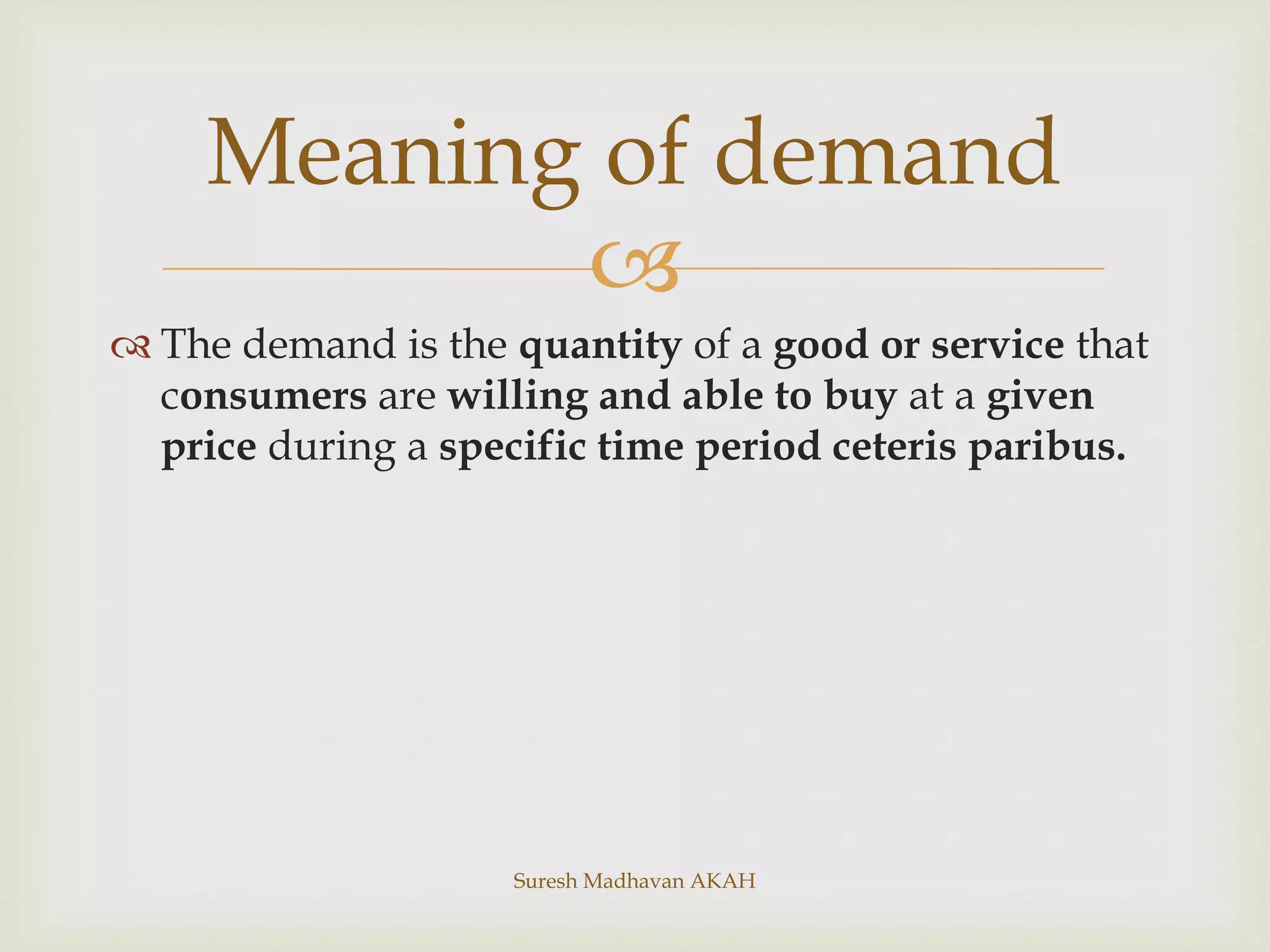
 The demand is the quantity of a good or service that
consumers are willing and able to buy at a given
price during a specific time period ceteris paribus.
Meaning of demand
Suresh Madhavan AKAH

 Willing ……want to buy.
 Able….Afford to buy.
Willingness and ability
Suresh Madhavan AKAH

 Demand schedule is a table listing the quantity
demanded at various prices
Demand Schedule
Suresh Madhavan AKAH
Price of chocolate bars $ Quantity of chocolate bars demanded
per week
5 2
4 4
3 6
2 8
1 10
Demand Schedule
Suresh Madhavan AKAH

 Price on vertical axis.
 Quantity on horizontal axis.
 It shows the relationship between price and quantity
demanded.
Drawing a demand
curve
Suresh Madhavan AKAH

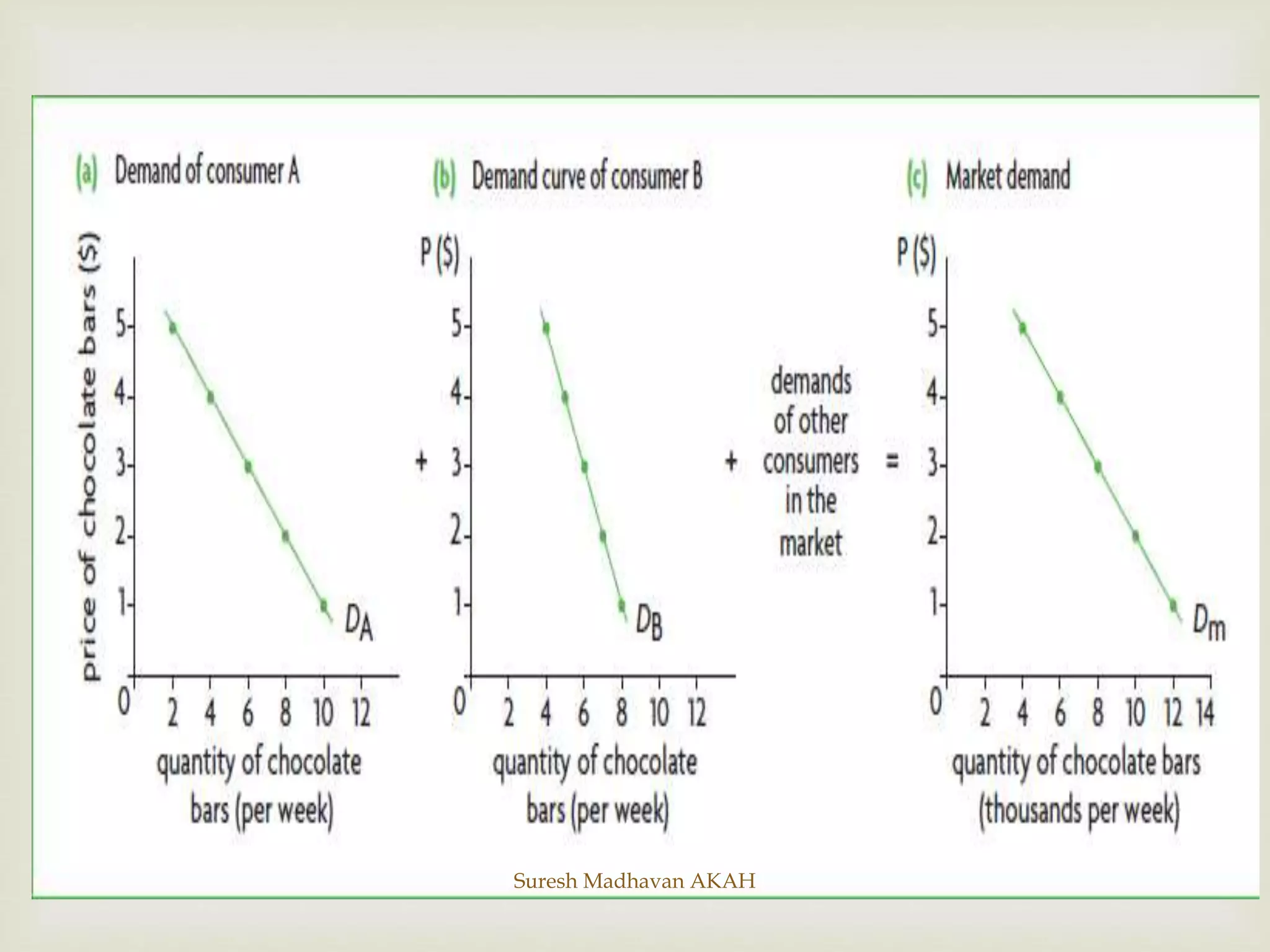
 Market demand is the sum of all individual demands
for a good.
 The market demand is also the sum of consumer’s
marginal benefits.
Market demand
Suresh Madhavan AKAH

Suresh Madhavan AKAH

Drawing a market
demand
Suresh Madhavan AKAH

 The law of demand states that as the price of a good
increases, the quantity demanded of the good
decreases, ceteris paribus.
 As the price of a good decreases, the quantity
demanded of the good increases, ceteris paribus.
 It shows the negative relationship between the two
variables of price and quantity demanded.
The law of demand
Suresh Madhavan AKAH

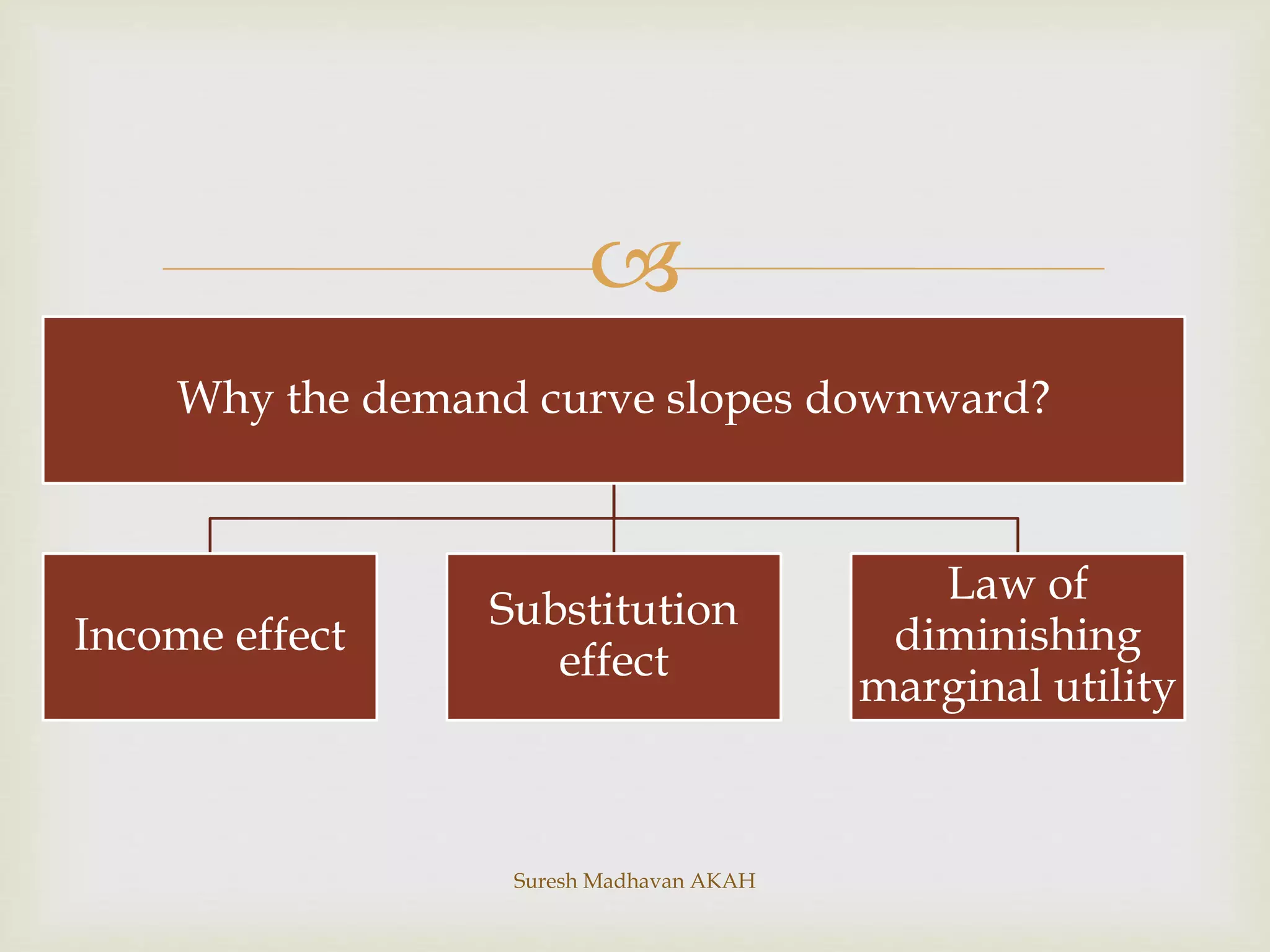
Why the demand curve slopes downward?
Income effect
Substitution
effect
Law of
diminishing
marginal utility
Suresh Madhavan AKAH

 Real income= the actual buying power of a
consumer.
 As the price of a good decreases, the quantity
demanded increases because consumers now have
more real income to spend.
The income effect
Suresh Madhavan AKAH

 As the price of a good decreases, consumers switch
from other substitute goods to this good because of
its low price. Thus the quatity demanded increases.
The substitution effect
Suresh Madhavan AKAH

 As we consume additional units of something, the
satisfaction(utility) we derive for each additional
unit(marginal unit) diminishes.
The law of diminishing
marginal utility
Suresh Madhavan AKAH

 A consumer would only buy a second or third unit
of good when the price is lower.(reflects the
diminishing utility)
 At lower prices, more are demanded.
Why do they buy more
when the price falls?
Suresh Madhavan AKAH

 These are variables other than price that can
influence demand.
 Variables assumed to be unchanging(ceteris paribus)
 These factors lead to a shift in demand curve either
leftward or rightward.(also known as demand
shifters)
Non-price determinants
of demand
Suresh Madhavan AKAH

 Income(the effect is different for normal goods and
inferior goods)
 Preferences and tastes.
 Price of substitute goods.
 Price of complementary goods.
 Demographic changes.
 Future Expectations.
 Season.
Demand shifters
Suresh Madhavan AKAH

 Normal goods are any goods for which demand
increases when income increases, and falls when
income decreases but price remains constant.
 Demand has a direct relationship with income.
Normal goods
Suresh Madhavan AKAH

 An inferior good is a good that decreases in demand
when consumer income rises.
 Demand has an inverse relationship with income.
Inferior good
Suresh Madhavan AKAH

 A product or service that satisfies the need of a
consumer that another product or service fulfills.
Substitute good
Suresh Madhavan AKAH

 A good or service that is used in conjunction with
another good or service.
Complementary goods
Suresh Madhavan AKAH

 Whenever the price of a good changes, ceteris
paribus, it leads to a movement along the demand
curve.
 It is also known as an increase or decrease in
quantity demanded.
Movement along the
demand curve
Suresh Madhavan AKAH

 An change in a non-price determinant of demand
results in a shift in the entire demand curve.
 It is also known as change in demand.
Shift of the demand
curve
Suresh Madhavan AKAH

 The Veblen goods: Thorsten Veblen’s contribution.
 Some times the quantity demanded will rise as price
rise.
 This arise from conspicuous consumption.
 (Expenditure on or consumption of luxuries on a
lavish scale in an attempt to enhance one's prestige).
Suresh Madhavan AKAH
Exceptions to the law of
demand

Suresh Madhavan AKAH
The demand for a
Veblen good.
 As the price of a Veblen
good rises, people with
high incomes begin to
buy more of the product
because it has a “snob
value”.
(the value of owning somethi
ng that is very expensive or ra
re, for the
supposed status one gains by
owning it)

 Other than the veblen goods, find the examples for
other exceptions for the law of demand.
Suresh Madhavan AKAH
Explore and Explain

 Using diagrams, show the impact of changes on the
demand curve for product A
 The number of consumers in the market for a product
increases.
 Consumer income increases and product A is an inferior
good.
 Consumer income decrease and product A is a normal
good.
 A new report claims that use of product A has harmful
effects on health.
 The price of substitute good B falls.
 The price of complementary good B increases.
Test yourself
Suresh Madhavan AKAH

 Supply is the quantity of a good or service that
producers are willing and able to offer for
sale/supply at a given price during a specific time
period, ceteris paribus.
Supply
Suresh Madhavan AKAH

 The law of supply states that as price increases, more
of a good is offered for sale by firms. As price
decreases, less of a good is offered for sale.
Suresh Madhavan AKAH
The law of supply

Suresh Madhavan AKAH
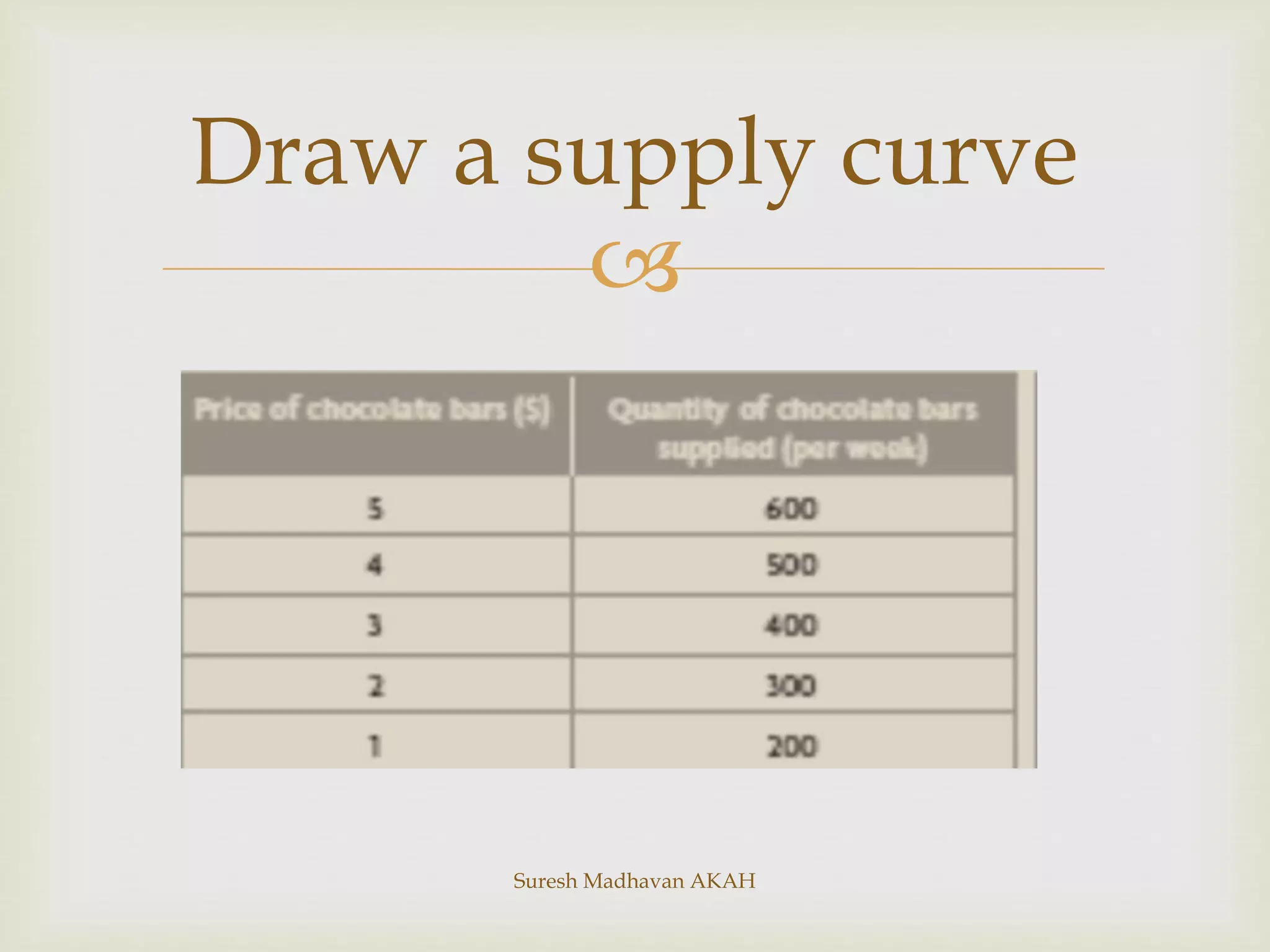
Draw a supply curve

 Market supply is the sum of all individual firm’s
supplies for a good.
Suresh Madhavan AKAH
Market supply

 Higher price is an incentive for the producers to
produce more.
 Lower price means lower profitability.
 This leads to a positive relationship between price
and quantity supplied of a good/service.
Suresh Madhavan AKAH
Why slopes upward?

 A vertical supply curve means,
even as price increases, the
quantity supplied cannot
increase; it remains constant.
 This may be due to:
 Fixed quantity of the good
supplied because there is no
time to produce more of it. Ex;
Theatre tickets in a theatre.
 There is no possibility of ever
producing more of it. Ex;
Original painting and
sculptures of famous artists.
Suresh Madhavan AKAH
The vertical supply
curve

 Any change in price leads to change in quantity
supplied, shown as the movement along the supply
curve.
 Any change in non-price determinants of supply
leads to a change in supply, represented by a shift of
supply curve.
Suresh Madhavan AKAH
Movement along the
supply curve & shift of
the supply curve

Suresh Madhavan AKAH
Change in quantity
supplied and change in
supply

 Costs of factors of production.
 Technology.
 Price of related goods: competitive supply.
 Price of related goods: joint supply.
 Producer expectations.
 Taxes(indirect or taxes on profits).
 Subsidies.
 The number of firms.
 ‘Shock’s or unpredictable events.
Suresh Madhavan AKAH
The non-price determinants
of supply(Explore and Explain)

 Using diagrams, show the impact of each of the following on the
supply curve of product A.
 (a) The number of firms in the industry producing product A
decreases.
 (b) The price of oil, a key input in the production of product A,
increases.
 (c) Firms expect that the price of product A will fall in the future.
 (d) The government grants a subsidy on each unit of A produced.
 (e) The price of product B falls, and B is in competitive supply with
A.
 (f) The price of product B increases, and B is in joint supply with A.
 (g) A new technology is adopted by firms in the industry
producing A.
Suresh Madhavan AKAH
Test your understanding

Suresh Madhavan AKAH
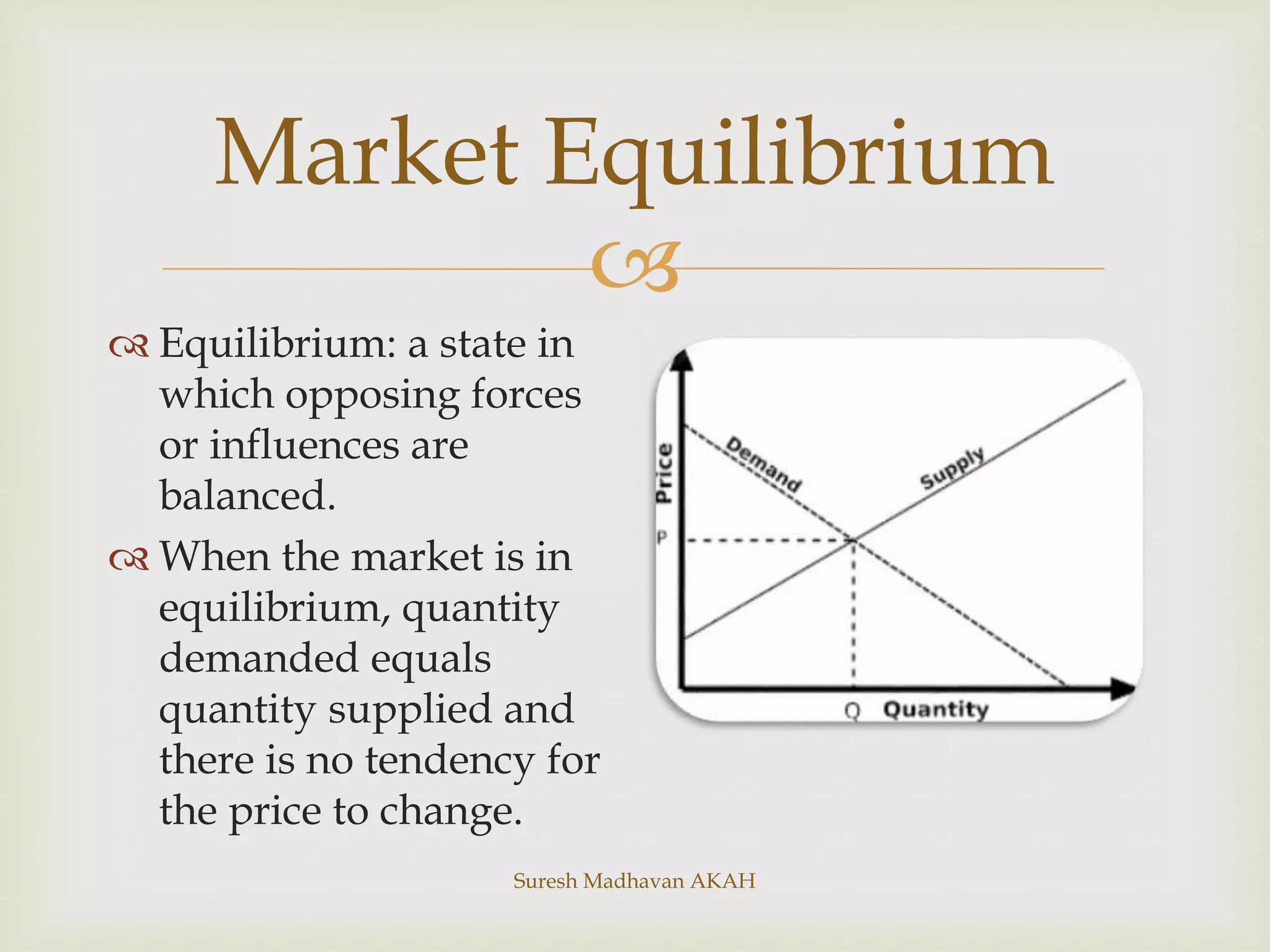
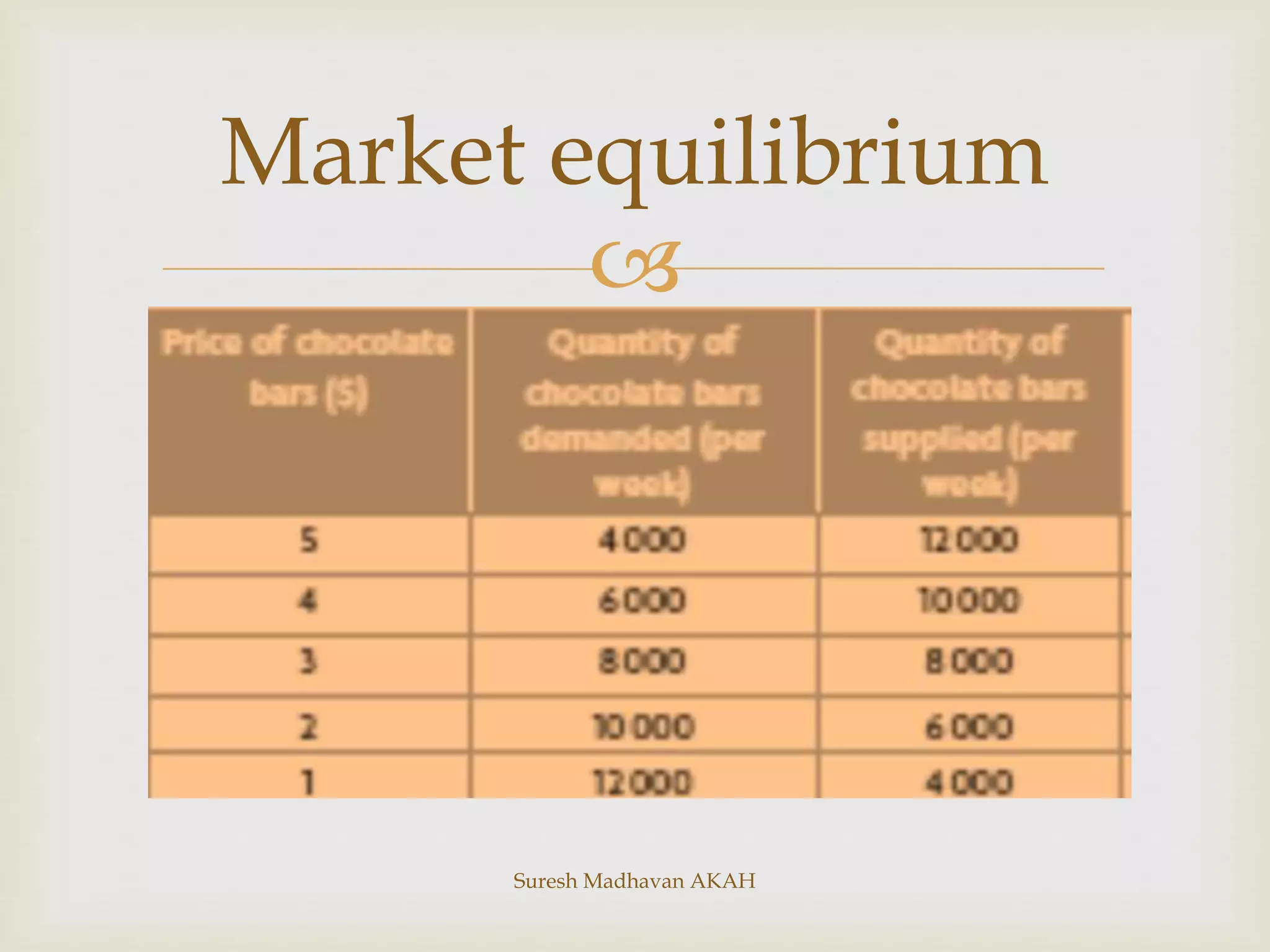
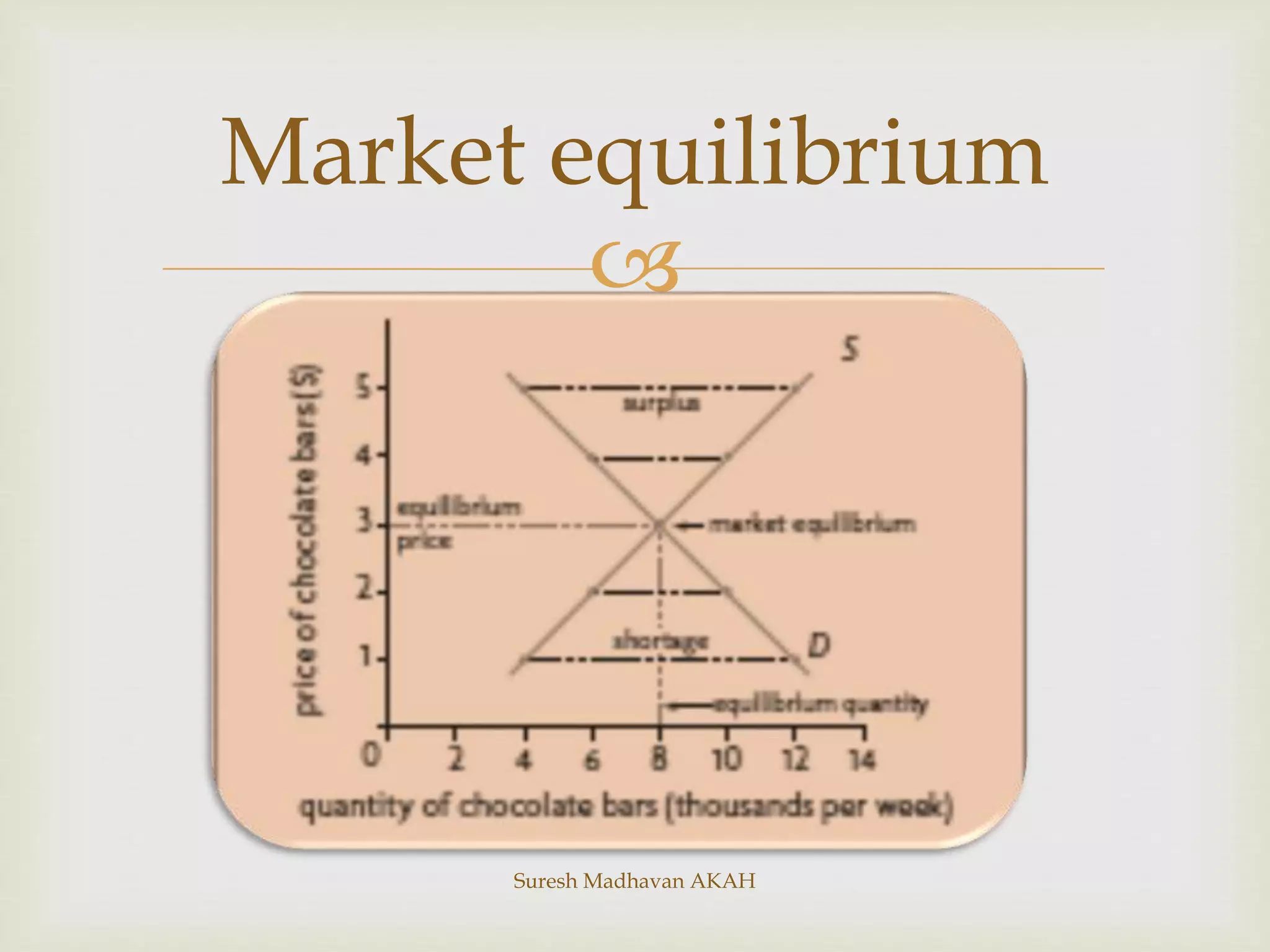
Market Equilibrium
 Equilibrium: a state in
which opposing forces
or influences are
balanced.
 When the market is in
equilibrium, quantity
demanded equals
quantity supplied and
there is no tendency for
the price to change.

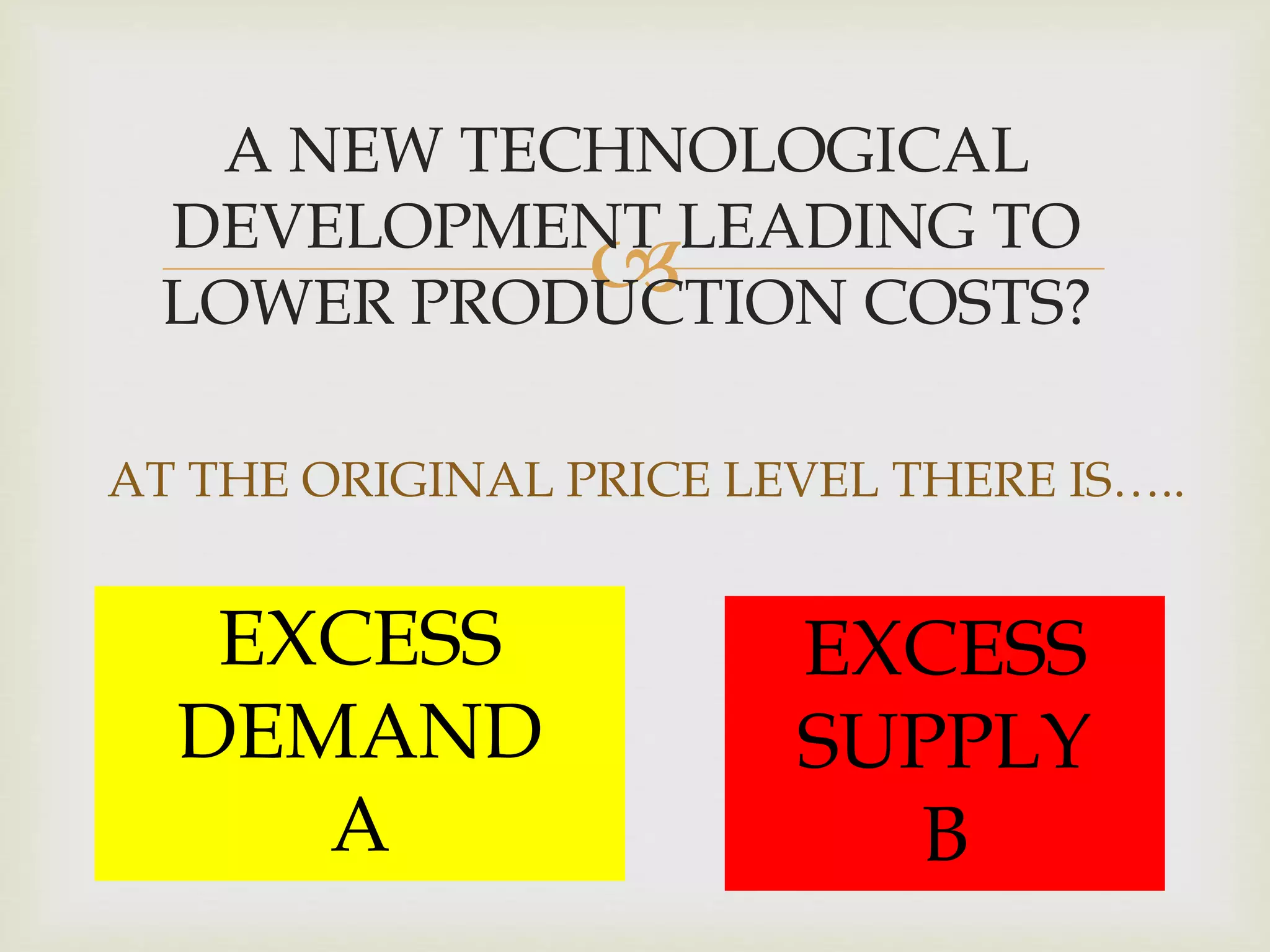
AT THE ORIGINAL PRICE LEVEL THERE IS…..
A NEW TECHNOLOGICAL
DEVELOPMENT LEADING TO
LOWER PRODUCTION COSTS?
EXCESS
DEMAND
A
EXCESS
SUPPLY
B

AT THE ORIGINAL PRICE LEVEL THERE IS…..
A RISE IN WAGE RATES IN CHINA
(WHERE MOST PRODUCTS ARE
MADE)?
EXCESS
DEMAND
A
EXCESS
SUPPLY
B

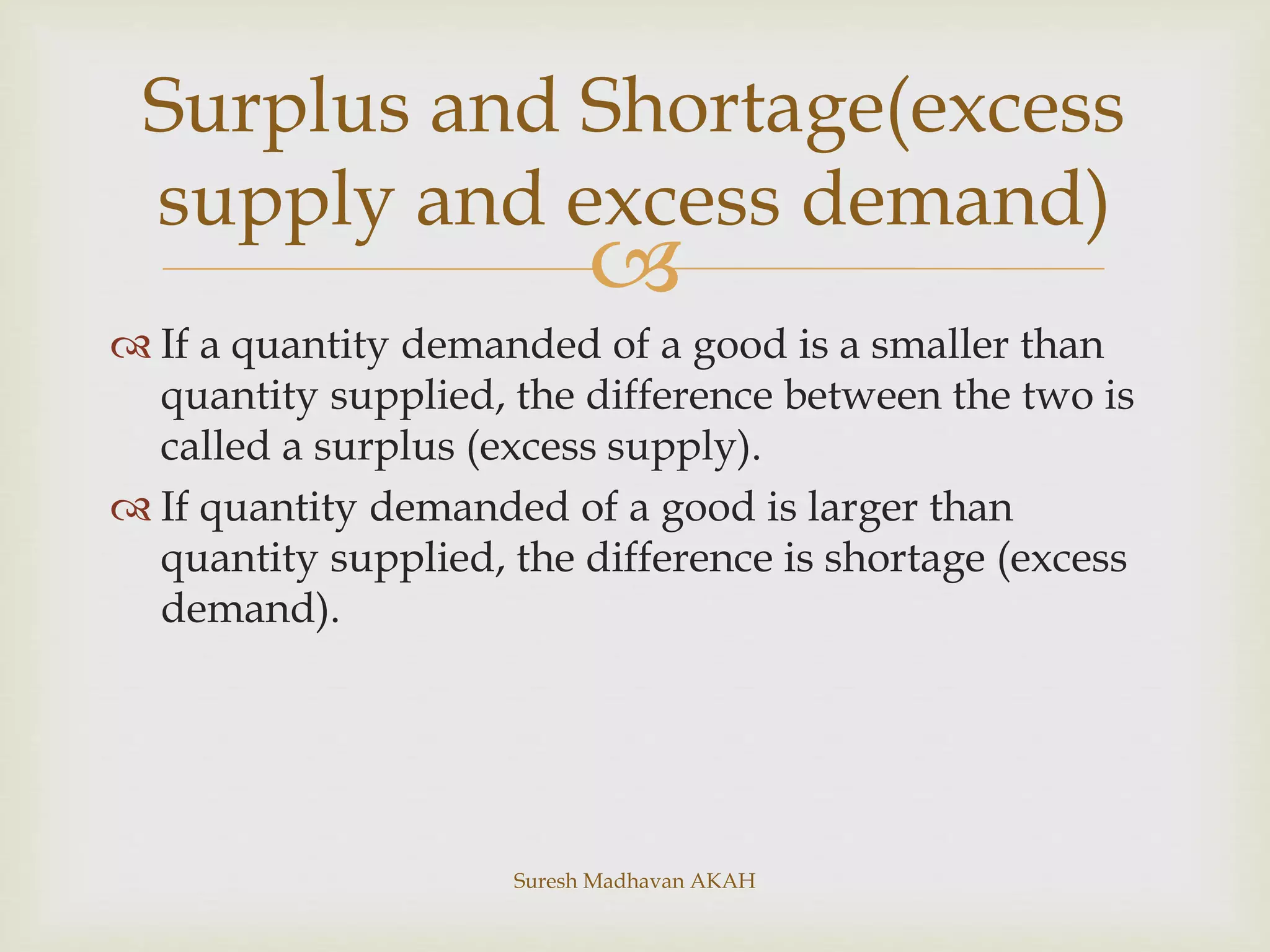
 If a quantity demanded of a good is a smaller than
quantity supplied, the difference between the two is
called a surplus (excess supply).
 If quantity demanded of a good is larger than
quantity supplied, the difference is shortage (excess
demand).
Suresh Madhavan AKAH
Surplus and Shortage(excess
supply and excess demand)

Suresh Madhavan AKAH
Market equilibrium

Suresh Madhavan AKAH
Market equilibrium

equilibrium
 where the supply and
demand curves meet
 equilibrium price:
P where QD = QS
 equilibrium quantity:
Q where QD = QS

0
20
40
60
80
100
0 100 200 300 400 500 600 700 800
Quantity (tonnes: 000s)
E
D
C
B
Aa
b
c
d
e
Supply
Demand
Price(penceperkg)
SHORTAGE
(300 000)
Shortage

0
20
40
60
80
100
0 100 200 300 400 500 600 700 800
Quantity (tonnes: 000s)
E
C
B
Aa
b
c
e
Supply
Demand
Price(penceperkg)
D dSURPLUS
(330 000)
Surplus

The Market
Price (ÂŁ)
Quantity Bought and Sold (000s)
S
D
ÂŁ5
600
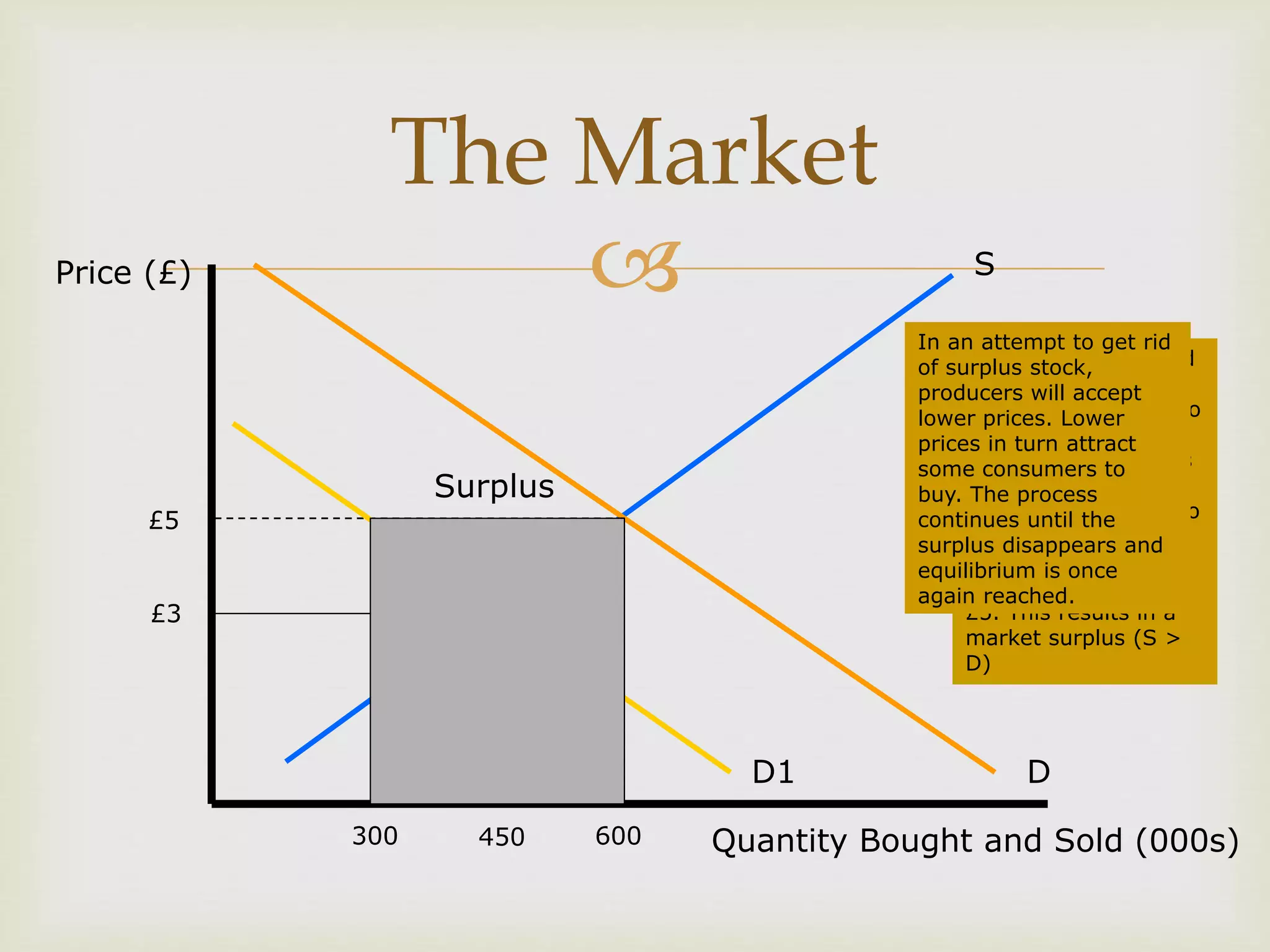
D1
300
Surplus
ÂŁ3
450
A shift in the demand
curve to the left will
reduce the demand to
300 from 600 at a
price of ÂŁ5. Suppliers
do not have the
information or time to
adjust supply
immediately and still
offer 600 for sale at
ÂŁ5. This results in a
market surplus (S >
D)
In an attempt to get rid
of surplus stock,
producers will accept
lower prices. Lower
prices in turn attract
some consumers to
buy. The process
continues until the
surplus disappears and
equilibrium is once
again reached.
The Market
Price (ÂŁ)
Quantity Bought and Sold (000s)
S
D
ÂŁ5
600
S1
100
Shortage
ÂŁ8
350
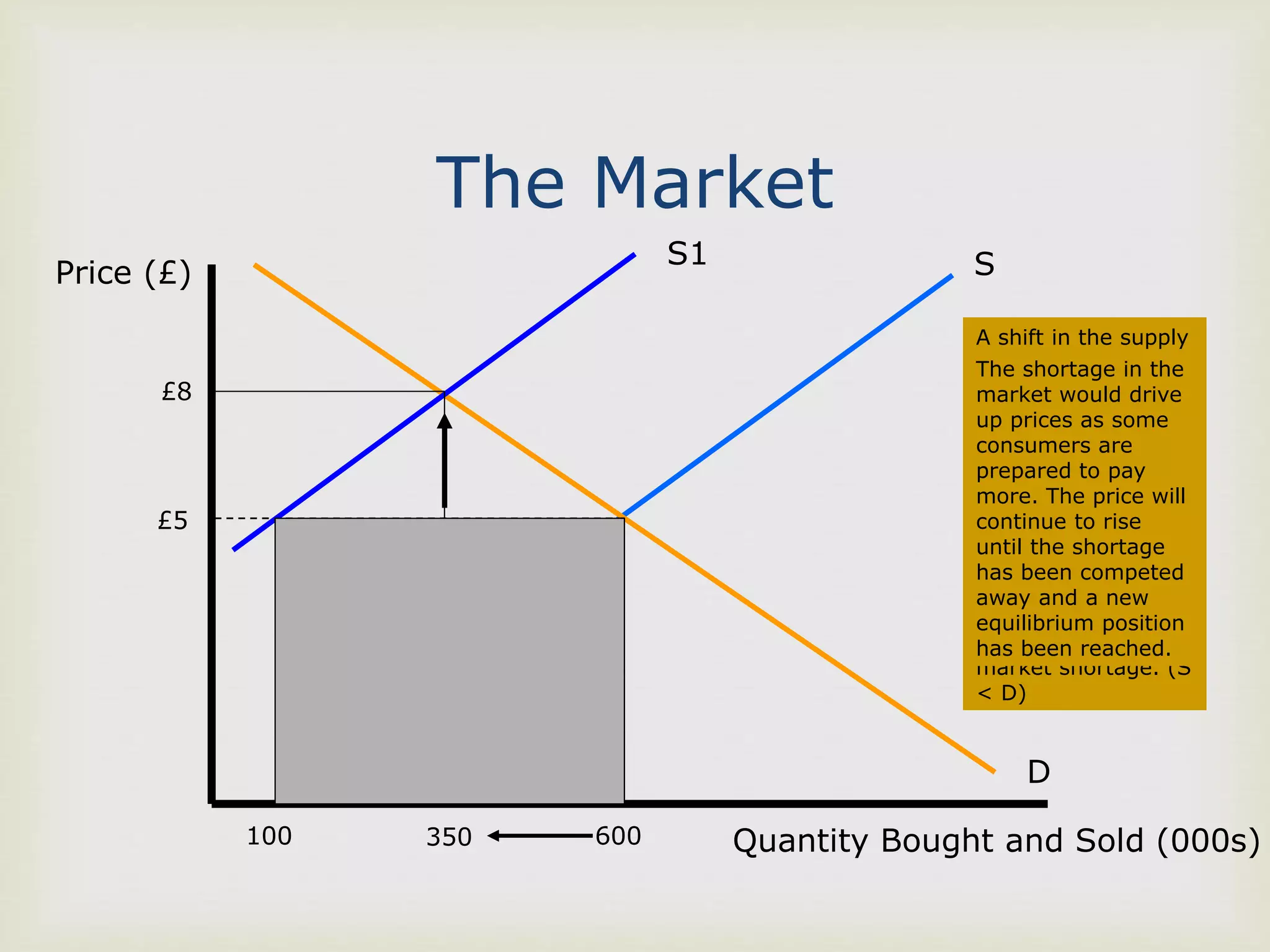
A shift in the supply
curve to the left
would lead to less
products being
available for sale at
every price.
Suppliers would
only be able to offer
100 units for sale at
a price of ÂŁ5 but
consumers still
desire to purchase
600. This creates a
market shortage. (S
< D)
The shortage in the
market would drive
up prices as some
consumers are
prepared to pay
more. The price will
continue to rise
until the shortage
has been competed
away and a new
equilibrium position
has been reached.

Suresh Madhavan AKAH
Change in demand and
new equilibrium

Suresh Madhavan AKAH
Change in supply and
new equilibrium

 Assuming a competitive market, use demand and supply
diagrams to show in each of the following cases how the
change in demand or supply for product A creates a
disequilibrium consisting of excess demand or excess supply,
and how the change in price eliminates the disequilibrium.
 (a) Consumer income increases (A is a normal good).
 (b) Consumer income falls (A is an inferior good).
 (c) There is an increase in labour costs.
 (d) The price of substitute good B falls.
 (e) The number of fi rms in the industry producing product A
increases.
 (f) A successful advertising campaign emphasises the health
benefi ts of product A.
Suresh Madhavan AKAH
Test your understanding

 Economics Course companion
 Economics for IB Diploma
 Economics Pearson Baccalaureate
 Ib economics blogspot.com
 Investopedia.com
 ibguides.com
Suresh Madhavan AKAH
References

Suresh Madhavan AKAH
Thank you

Competitive markets demand and supply

  • 1.
  • 2.
      The termmarket means any kind of arrangement where buyers and sellers of goods, services or resources are linked together to carry out an exchange. Suresh Madhavan AKAH Market
  • 3.
     Markets Product market(goods and services bought andsold) Factor market(factors of production bought and sold) Suresh Madhavan AKAH Types of markets
  • 4.
      The competitivemarket is the market for a good with large number of buyers and sellers, where the single seller has very little or no market power. Suresh Madhavan AKAH Competitive markets
  • 5.
      Demand isconcerned with the behaviour of buyers. Demand Suresh Madhavan AKAH
  • 6.
      The demandis the quantity of a good or service that consumers are willing and able to buy at a given price during a specific time period ceteris paribus. Meaning of demand Suresh Madhavan AKAH
  • 7.
      Willing ……wantto buy.  Able….Afford to buy. Willingness and ability Suresh Madhavan AKAH
  • 8.
      Demand scheduleis a table listing the quantity demanded at various prices Demand Schedule Suresh Madhavan AKAH
  • 9.
    Price of chocolatebars $ Quantity of chocolate bars demanded per week 5 2 4 4 3 6 2 8 1 10 Demand Schedule Suresh Madhavan AKAH
  • 10.
      Price onvertical axis.  Quantity on horizontal axis.  It shows the relationship between price and quantity demanded. Drawing a demand curve Suresh Madhavan AKAH
  • 11.
      Market demandis the sum of all individual demands for a good.  The market demand is also the sum of consumer’s marginal benefits. Market demand Suresh Madhavan AKAH
  • 12.
  • 13.
  • 14.
      The lawof demand states that as the price of a good increases, the quantity demanded of the good decreases, ceteris paribus.  As the price of a good decreases, the quantity demanded of the good increases, ceteris paribus.  It shows the negative relationship between the two variables of price and quantity demanded. The law of demand Suresh Madhavan AKAH
  • 15.
     Why the demandcurve slopes downward? Income effect Substitution effect Law of diminishing marginal utility Suresh Madhavan AKAH
  • 16.
      Real income=the actual buying power of a consumer.  As the price of a good decreases, the quantity demanded increases because consumers now have more real income to spend. The income effect Suresh Madhavan AKAH
  • 17.
      As theprice of a good decreases, consumers switch from other substitute goods to this good because of its low price. Thus the quatity demanded increases. The substitution effect Suresh Madhavan AKAH
  • 18.
      As weconsume additional units of something, the satisfaction(utility) we derive for each additional unit(marginal unit) diminishes. The law of diminishing marginal utility Suresh Madhavan AKAH
  • 19.
      A consumerwould only buy a second or third unit of good when the price is lower.(reflects the diminishing utility)  At lower prices, more are demanded. Why do they buy more when the price falls? Suresh Madhavan AKAH
  • 20.
      These arevariables other than price that can influence demand.  Variables assumed to be unchanging(ceteris paribus)  These factors lead to a shift in demand curve either leftward or rightward.(also known as demand shifters) Non-price determinants of demand Suresh Madhavan AKAH
  • 21.
      Income(the effectis different for normal goods and inferior goods)  Preferences and tastes.  Price of substitute goods.  Price of complementary goods.  Demographic changes.  Future Expectations.  Season. Demand shifters Suresh Madhavan AKAH
  • 22.
      Normal goodsare any goods for which demand increases when income increases, and falls when income decreases but price remains constant.  Demand has a direct relationship with income. Normal goods Suresh Madhavan AKAH
  • 23.
      An inferiorgood is a good that decreases in demand when consumer income rises.  Demand has an inverse relationship with income. Inferior good Suresh Madhavan AKAH
  • 24.
      A productor service that satisfies the need of a consumer that another product or service fulfills. Substitute good Suresh Madhavan AKAH
  • 25.
      A goodor service that is used in conjunction with another good or service. Complementary goods Suresh Madhavan AKAH
  • 26.
      Whenever theprice of a good changes, ceteris paribus, it leads to a movement along the demand curve.  It is also known as an increase or decrease in quantity demanded. Movement along the demand curve Suresh Madhavan AKAH
  • 27.
      An changein a non-price determinant of demand results in a shift in the entire demand curve.  It is also known as change in demand. Shift of the demand curve Suresh Madhavan AKAH
  • 28.
      The Veblengoods: Thorsten Veblen’s contribution.  Some times the quantity demanded will rise as price rise.  This arise from conspicuous consumption.  (Expenditure on or consumption of luxuries on a lavish scale in an attempt to enhance one's prestige). Suresh Madhavan AKAH Exceptions to the law of demand
  • 29.
     Suresh Madhavan AKAH Thedemand for a Veblen good.  As the price of a Veblen good rises, people with high incomes begin to buy more of the product because it has a “snob value”. (the value of owning somethi ng that is very expensive or ra re, for the supposed status one gains by owning it)
  • 30.
      Other thanthe veblen goods, find the examples for other exceptions for the law of demand. Suresh Madhavan AKAH Explore and Explain
  • 31.
      Using diagrams,show the impact of changes on the demand curve for product A  The number of consumers in the market for a product increases.  Consumer income increases and product A is an inferior good.  Consumer income decrease and product A is a normal good.  A new report claims that use of product A has harmful effects on health.  The price of substitute good B falls.  The price of complementary good B increases. Test yourself Suresh Madhavan AKAH
  • 32.
      Supply isthe quantity of a good or service that producers are willing and able to offer for sale/supply at a given price during a specific time period, ceteris paribus. Supply Suresh Madhavan AKAH
  • 33.
      The lawof supply states that as price increases, more of a good is offered for sale by firms. As price decreases, less of a good is offered for sale. Suresh Madhavan AKAH The law of supply
  • 34.
  • 35.
      Market supplyis the sum of all individual firm’s supplies for a good. Suresh Madhavan AKAH Market supply
  • 36.
      Higher priceis an incentive for the producers to produce more.  Lower price means lower profitability.  This leads to a positive relationship between price and quantity supplied of a good/service. Suresh Madhavan AKAH Why slopes upward?
  • 37.
      A verticalsupply curve means, even as price increases, the quantity supplied cannot increase; it remains constant.  This may be due to:  Fixed quantity of the good supplied because there is no time to produce more of it. Ex; Theatre tickets in a theatre.  There is no possibility of ever producing more of it. Ex; Original painting and sculptures of famous artists. Suresh Madhavan AKAH The vertical supply curve
  • 38.
      Any changein price leads to change in quantity supplied, shown as the movement along the supply curve.  Any change in non-price determinants of supply leads to a change in supply, represented by a shift of supply curve. Suresh Madhavan AKAH Movement along the supply curve & shift of the supply curve
  • 39.
     Suresh Madhavan AKAH Changein quantity supplied and change in supply
  • 40.
      Costs offactors of production.  Technology.  Price of related goods: competitive supply.  Price of related goods: joint supply.  Producer expectations.  Taxes(indirect or taxes on profits).  Subsidies.  The number of firms.  ‘Shock’s or unpredictable events. Suresh Madhavan AKAH The non-price determinants of supply(Explore and Explain)
  • 41.
      Using diagrams,show the impact of each of the following on the supply curve of product A.  (a) The number of firms in the industry producing product A decreases.  (b) The price of oil, a key input in the production of product A, increases.  (c) Firms expect that the price of product A will fall in the future.  (d) The government grants a subsidy on each unit of A produced.  (e) The price of product B falls, and B is in competitive supply with A.  (f) The price of product B increases, and B is in joint supply with A.  (g) A new technology is adopted by firms in the industry producing A. Suresh Madhavan AKAH Test your understanding
  • 42.
     Suresh Madhavan AKAH MarketEquilibrium  Equilibrium: a state in which opposing forces or influences are balanced.  When the market is in equilibrium, quantity demanded equals quantity supplied and there is no tendency for the price to change.
  • 44.
     AT THE ORIGINALPRICE LEVEL THERE IS….. A NEW TECHNOLOGICAL DEVELOPMENT LEADING TO LOWER PRODUCTION COSTS? EXCESS DEMAND A EXCESS SUPPLY B
  • 45.
     AT THE ORIGINALPRICE LEVEL THERE IS….. A RISE IN WAGE RATES IN CHINA (WHERE MOST PRODUCTS ARE MADE)? EXCESS DEMAND A EXCESS SUPPLY B
  • 46.
      If aquantity demanded of a good is a smaller than quantity supplied, the difference between the two is called a surplus (excess supply).  If quantity demanded of a good is larger than quantity supplied, the difference is shortage (excess demand). Suresh Madhavan AKAH Surplus and Shortage(excess supply and excess demand)
  • 47.
  • 48.
  • 49.
     equilibrium  where thesupply and demand curves meet  equilibrium price: P where QD = QS  equilibrium quantity: Q where QD = QS
  • 50.
     0 20 40 60 80 100 0 100 200300 400 500 600 700 800 Quantity (tonnes: 000s) E D C B Aa b c d e Supply Demand Price(penceperkg) SHORTAGE (300 000) Shortage
  • 51.
     0 20 40 60 80 100 0 100 200300 400 500 600 700 800 Quantity (tonnes: 000s) E C B Aa b c e Supply Demand Price(penceperkg) D dSURPLUS (330 000) Surplus
  • 52.
     The Market Price (£) QuantityBought and Sold (000s) S D £5 600 D1 300 Surplus £3 450 A shift in the demand curve to the left will reduce the demand to 300 from 600 at a price of £5. Suppliers do not have the information or time to adjust supply immediately and still offer 600 for sale at £5. This results in a market surplus (S > D) In an attempt to get rid of surplus stock, producers will accept lower prices. Lower prices in turn attract some consumers to buy. The process continues until the surplus disappears and equilibrium is once again reached.
  • 53.
    The Market Price (ÂŁ) QuantityBought and Sold (000s) S D ÂŁ5 600 S1 100 Shortage ÂŁ8 350 A shift in the supply curve to the left would lead to less products being available for sale at every price. Suppliers would only be able to offer 100 units for sale at a price of ÂŁ5 but consumers still desire to purchase 600. This creates a market shortage. (S < D) The shortage in the market would drive up prices as some consumers are prepared to pay more. The price will continue to rise until the shortage has been competed away and a new equilibrium position has been reached.
  • 54.
     Suresh Madhavan AKAH Changein demand and new equilibrium
  • 55.
     Suresh Madhavan AKAH Changein supply and new equilibrium
  • 56.
      Assuming acompetitive market, use demand and supply diagrams to show in each of the following cases how the change in demand or supply for product A creates a disequilibrium consisting of excess demand or excess supply, and how the change in price eliminates the disequilibrium.  (a) Consumer income increases (A is a normal good).  (b) Consumer income falls (A is an inferior good).  (c) There is an increase in labour costs.  (d) The price of substitute good B falls.  (e) The number of fi rms in the industry producing product A increases.  (f) A successful advertising campaign emphasises the health benefi ts of product A. Suresh Madhavan AKAH Test your understanding
  • 57.
      Economics Coursecompanion  Economics for IB Diploma  Economics Pearson Baccalaureate  Ib economics blogspot.com  Investopedia.com  ibguides.com Suresh Madhavan AKAH References
  • 58.