What is demand?
• Demand is the want or the willingness of
  consumers to buy goods and services.
Effective Demand
• When willingness to buy is backed/supported
  with the purchasing power, it becomes an

  effective demand.
Price mechanism
• Prices act as the signals for producers.
• It is based on the price signals that they
  decide how to use their scarce resources.
Quantity demanded
• The amount of a good or service consumers
  are willing and able to buy is known as the
  quantity demanded.
• Eg: Number of oranges bought per week.
Individual demand and Market
                 demand
• Individual demand: The quantity of a
  good/service that an individual is willing and
  able to buy for different prices over a
  particular period of time.
Individual demand and Market
                demand
• Market Demand: The sum of all individual
  demand or total demand for the product from
  all consumers
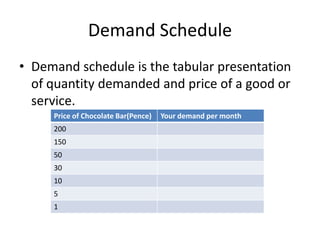
Demand Schedule
• Demand schedule is the tabular presentation
  of quantity demanded and price of a good or
  service.
     Price of Chocolate Bar(Pence)   Your demand per month
     200
     150
     50
     30
     10
     5
     1
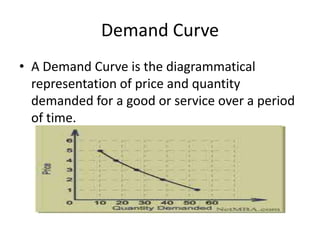
Demand Curve
• A Demand Curve is the diagrammatical
  representation of price and quantity
  demanded for a good or service over a period
  of time.
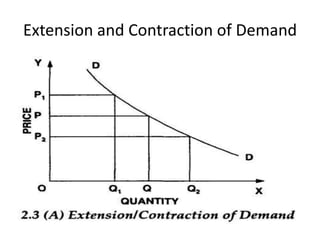
Extension and Contraction of Demand
• An extension of demand or increase in quantity
  demanded refers to the way in which demand
  changes with a fall in price, with no change in any
  other factor that could affect demand.
• A contraction of demand or decrease in quantity
  demanded refers to the way in which demand
  changes when prices rises, with no change in any
  other factor that could affect demand.
Extension and Contraction of Demand
The market demand curve
• The market demand curve for a particular
  good or service will display the demand of all
  the consumers of that commodity given a set
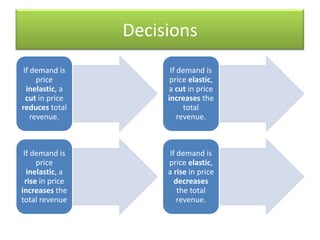
  of possible prices.
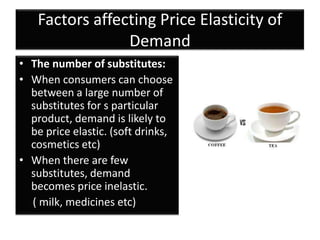
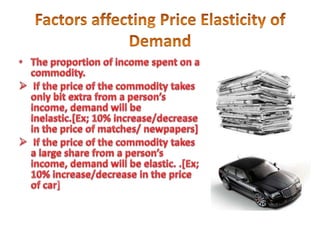
Shifts in Demand
• When there is a change in the factors
  influencing the demand other than price (like
  income, advertising, changes in population
  etc)changes, it leads to a shift in demand
  curve.
Increase in demand
• An increase in demand means that consumers now demand more
  of a product at each and every price than they did before.
• Eg: Market Demand for chocolate bars:
• Draw two demand curves for the data given.

    Price of chocolate   Original demand   Increased demand
    50                   100 000           200 000
    40                   150 000           250 000
    30                   200 000           300 000
    20                   260 000           360 000
    10                   330 000           430 000
    5                    400 000           500 000
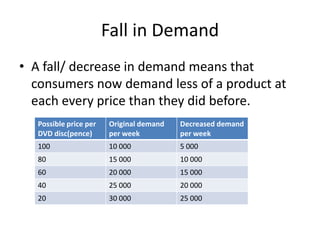
Fall in Demand
• A fall/ decrease in demand means that
  consumers now demand less of a product at
  each every price than they did before.
   Possible price per   Original demand   Decreased demand
   DVD disc(pence)      per week          per week
   100                  10 000            5 000
   80                   15 000            10 000
   60                   20 000            15 000
   40                   25 000            20 000
   20                   30 000            25 000
What causes a shift in demand?
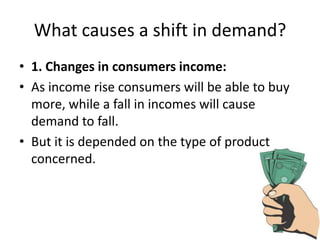
• 1. Changes in consumers income:
• As income rise consumers will be able to buy
  more, while a fall in incomes will cause
  demand to fall.
• But it is depended on the type of product
  concerned.
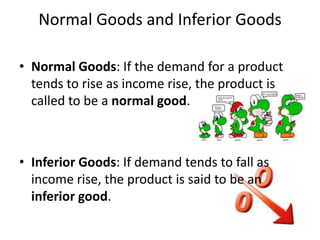
Normal Goods and Inferior Goods

• Normal Goods: If the demand for a product
  tends to rise as income rise, the product is
  called to be a normal good.


• Inferior Goods: If demand tends to fall as
  income rise, the product is said to be an
  inferior good.
What causes a shift in demand?
• 2. Changes in taxes on incomes
• Any change in the level of income tax rates
  and allowances results in a change in the
  quantity of goods and services demanded.
Disposable income:
• The income people have left to spend or save
  after taxes on their incomes have been
  deducted.
What causes a shift in demand?
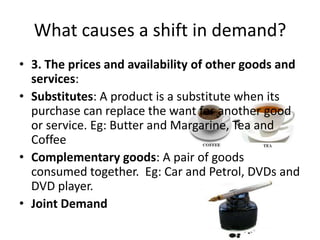
• 3. The prices and availability of other goods and
  services:
• Substitutes: A product is a substitute when its
  purchase can replace the want for another good
  or service. Eg: Butter and Margarine, Tea and
  Coffee
• Complementary goods: A pair of goods
  consumed together. Eg: Car and Petrol, DVDs and
  DVD player.
• Joint Demand
What causes a shift in demand?
• 4. Changes in tastes, habits and fashion:
• Changing tastes, habits and fashion can play a
  big change in demand.
What causes a shift in demand?
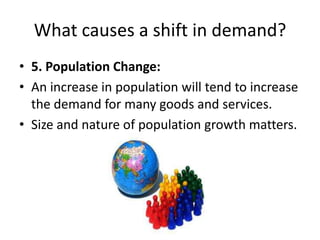
• 5. Population Change:
• An increase in population will tend to increase
  the demand for many goods and services.
• Size and nature of population growth matters.
What causes a shift in demand?
•   6. Other factors:
•   Weather
•   Interest rates
•   Changes in laws
What is supply?
• Supply refers to the amount of a good or
  service firms or producers are willing and able
  to sell at a number of possible prices.
Quantity supplied
• The amount of a good or service producers
  are willing and able to make and sell to
  consumers in a market is known as the
  quantity supplied.
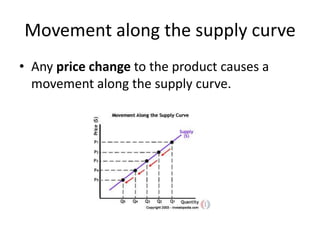
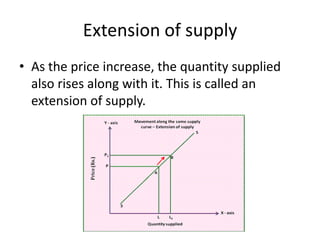
Movement along the supply curve
• Any price change to the product causes a
  movement along the supply curve.
Extension of supply
• As the price increase, the quantity supplied
  also rises along with it. This is called an
  extension of supply.
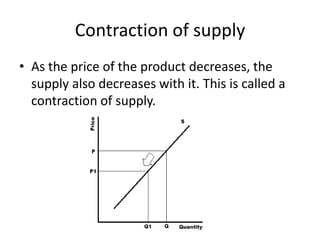
Contraction of supply
• As the price of the product decreases, the
  supply also decreases with it. This is called a
  contraction of supply.
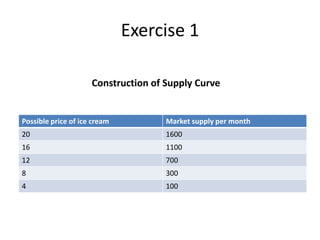
Exercise 1

                     Construction of Supply Curve


Possible price of ice cream          Market supply per month
20                                   1600
16                                   1100
12                                   700
8                                    300
4                                    100
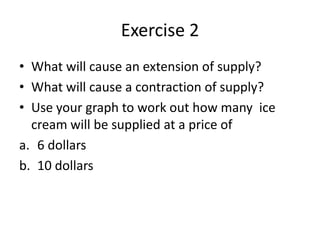
Exercise 2
• What will cause an extension of supply?
• What will cause a contraction of supply?
• Use your graph to work out how many ice
  cream will be supplied at a price of
a. 6 dollars
b. 10 dollars
Exercise 3
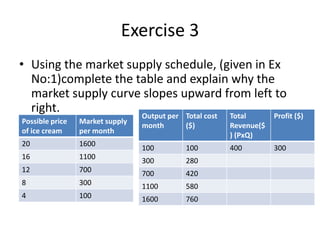
• Using the market supply schedule, (given in Ex
  No:1)complete the table and explain why the
  market supply curve slopes upward from left to
  right.
                                 Output per Total cost   Total       Profit ($)
Possible price   Market supply
                                 month      ($)          Revenue($
of ice cream     per month
                                                         ) (PxQ)
20               1600
                                 100         100         400         300
16               1100
                                 300         280
12               700             700         420
8                300             1100        580
4                100             1600        760
Shifts in Supply
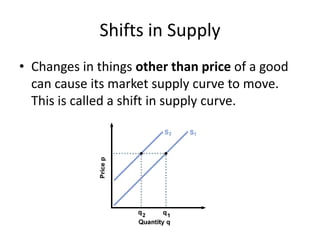
• Changes in things other than price of a good
  can cause its market supply curve to move.
  This is called a shift in supply curve.
An increase in supply
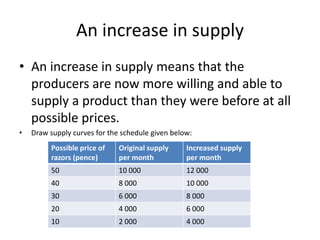
• An increase in supply means that the
  producers are now more willing and able to
  supply a product than they were before at all
  possible prices.
•   Draw supply curves for the schedule given below:
         Possible price of    Original supply     Increased supply
         razors (pence)       per month           per month
         50                   10 000              12 000
         40                   8 000               10 000
         30                   6 000               8 000
         20                   4 000               6 000
         10                   2 000               4 000
A fall in supply
• A fall in supply means that producers are now
  less willing and able to supply a product at
  each and every price than they were before at
  all possible prices.
What causes a shift in supply?
• 1. Changes in the cost of factors of
  production.
• Payments for:
•   Raw materials
•   Land
•   Labour
•   Interest
•   Tax…….
What causes a shift in supply?
• 2. Changes in price
  of other goods and
  services:
• Price acts as the
  signals.
• Resources are
  allocated to those
  goods and services
  that will yield the
  most profit.
What causes a shift in supply?
• 3. Technological advance
• Technological improvement
  improves the performance of
  machines, employees,
  production methods,
  management control, product
  quality etc.
What causes a shift in supply?
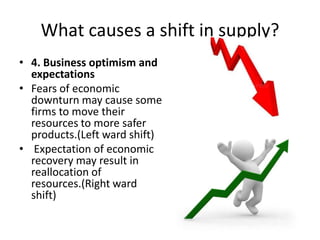
• 4. Business optimism and
  expectations
• Fears of economic
  downturn may cause some
  firms to move their
  resources to more safer
  products.(Left ward shift)
• Expectation of economic
  recovery may result in
  reallocation of
  resources.(Right ward
  shift)
What causes a shift in supply?
• 5. Global factors
• These factors can not
  be controlled by
  producers.
 Sudden climatic change
 Trade sanctions
 Wars
 Natural disasters
 Political factors
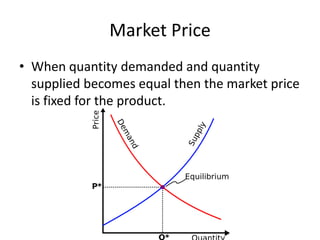
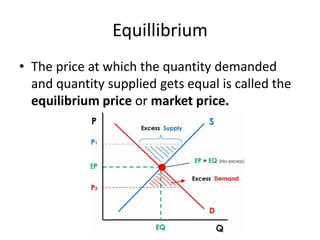
Market Price
• When quantity demanded and quantity
  supplied becomes equal then the market price
  is fixed for the product.
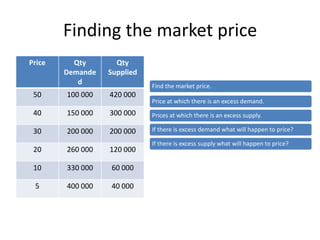
Finding the market price
Price     Qty       Qty
        Demande   Supplied
           d                 Find the market price.
 50     100 000   420 000
                             Price at which there is an excess demand.
 40     150 000   300 000    Prices at which there is an excess supply.

 30     200 000   200 000    If there is excess demand what will happen to price?

                             If there is excess supply what will happen to price?
 20     260 000   120 000

 10     330 000   60 000

 5      400 000   40 000
Equillibrium
• The price at which the quantity demanded
  and quantity supplied gets equal is called the
  equilibrium price or market price.
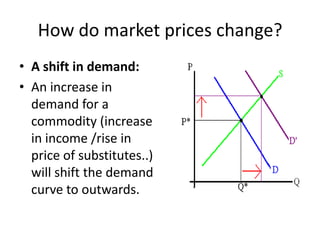
How do market prices change?
• A shift in demand:
• An increase in
  demand for a
  commodity (increase
  in income /rise in
  price of substitutes..)
  will shift the demand
  curve to outwards.
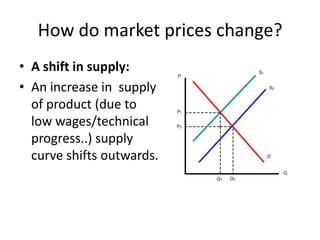
How do market prices change?
• A shift in supply:
• An increase in supply
  of product (due to
  low wages/technical
  progress..) supply
  curve shifts outwards.
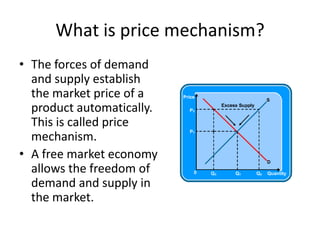
What is price mechanism?
• The forces of demand
  and supply establish
  the market price of a
  product automatically.
  This is called price
  mechanism.
• A free market economy
  allows the freedom of
  demand and supply in
  the market.
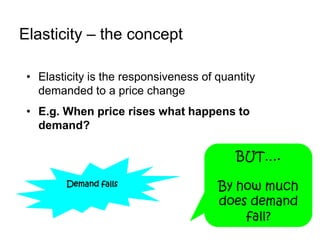
Elasticity…..how much do
    consumer’s react?
Elasticity – the concept

 • Elasticity is the responsiveness of quantity
   demanded to a price change
 • E.g. When price rises what happens to
   demand?

                                           BUT….

         Demand falls                  By how much
                                       does demand
                                           fall?
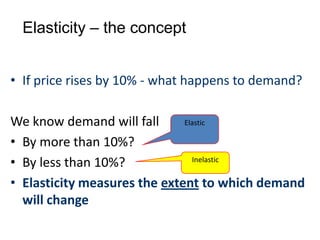
Elasticity – the concept


• If price rises by 10% - what happens to demand?

We know demand will fall      Elastic

• By more than 10%?
• By less than 10%?             Inelastic


• Elasticity measures the extent to which demand
  will change
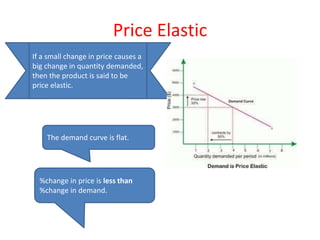
Price Elastic
If a small change in price causes a
big change in quantity demanded,
then the product is said to be
price elastic.


    The demand curve is flat.


  %change in price is less than
  %change in demand.
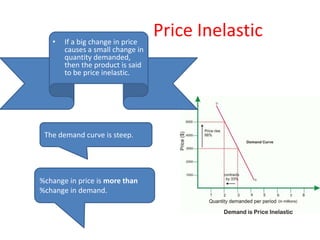
•   If a big change in price
                                  Price Inelastic
       causes a small change in
       quantity demanded,
       then the product is said
       to be price inelastic.


 The demand curve is steep.


%change in price is more than
%change in demand.
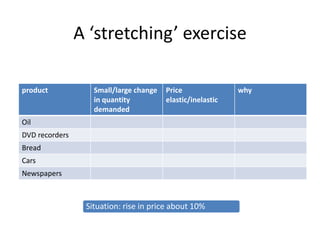
A ‘stretching’ exercise

product            Small/large change   Price               why
                   in quantity          elastic/inelastic
                   demanded
Oil
DVD recorders
Bread
Cars
Newspapers


                 Situation: rise in price about 10%
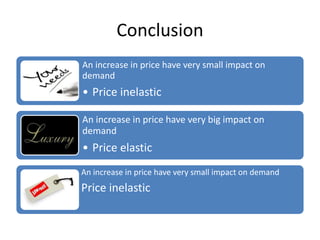
Conclusion
An increase in price have very small impact on
demand
• Price inelastic

An increase in price have very big impact on
demand
• Price elastic
An increase in price have very small impact on demand
Price inelastic
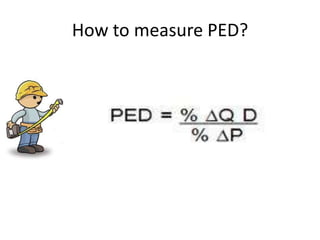
How to measure PED?
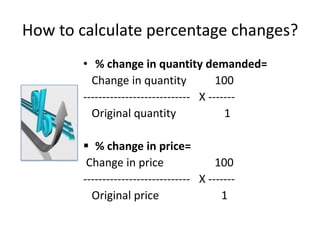
How to calculate percentage changes?
       • % change in quantity demanded=
         Change in quantity             100
       ---------------------------- X -------
         Original quantity                1

        % change in price=
        Change in price                 100
       ---------------------------- X -------
         Original price                  1
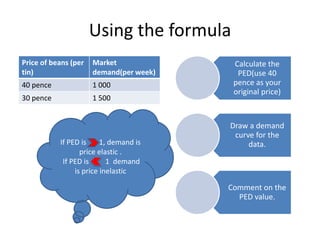
Using the formula
Price of beans (per   Market              Calculate the
tin)                  demand(per week)     PED(use 40
40 pence              1 000               pence as your
                                          original price)
30 pence              1 500


                                         Draw a demand
                                          curve for the
           If PED is     1, demand is         data.
                  price elastic .
            If PED is      1 demand
                is price inelastic

                                         Comment on the
                                           PED value.
• It is very important for a
  firm to know whether
  an increase or decrease
  in price will cause their
  total revenue to rise or
  fall.
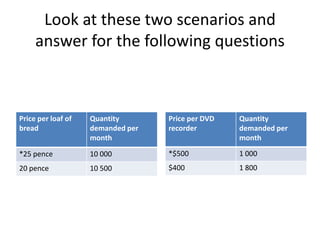
Look at these two scenarios and
     answer for the following questions


Price per loaf of   Quantity       Price per DVD   Quantity
bread               demanded per   recorder        demanded per
                    month                          month

*25 pence           10 000         *$500           1 000
20 pence            10 500         $400            1 800
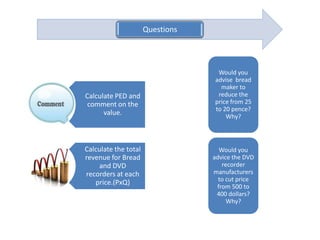
Questions


                                   Would you
                                  advise bread
                                    maker to
Calculate PED and                  reduce the
 comment on the                   price from 25
                                  to 20 pence?
      value.                          Why?


Calculate the total                 Would you
revenue for Bread                 advice the DVD
    and DVD                          recorder
recorders at each                 manufacturers
                                    to cut price
   price.(PxQ)
                                   from 500 to
                                   400 dollars?
                                       Why?
Decisions
 If demand is           If demand is
      price             price elastic,
  inelastic, a         a cut in price
  cut in price         increases the
reduces total                total
    revenue.               revenue.


 If demand is          If demand is
      price            price elastic,
  inelastic, a         a rise in price
  rise in price          decreases
increases the             the total
total revenue             revenue.
Factors affecting Price Elasticity of
                Demand
• The number of substitutes:
• When consumers can choose
  between a large number of
  substitutes for s particular
  product, demand is likely to
  be price elastic. (soft drinks,
  cosmetics etc)
• When there are few
  substitutes, demand
  becomes price inelastic.
  ( milk, medicines etc)
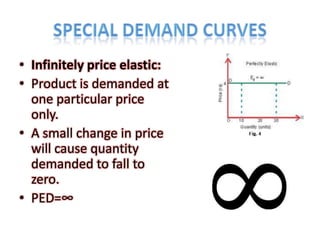
• Infinitely price elastic:
• Product is demanded at
  one particular price
  only.
• A small change in price
  will cause quantity
  demanded to fall to
  zero.
• PED=∞
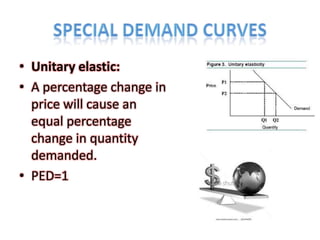
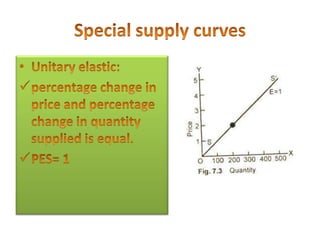
• Unitary elastic:
• A percentage change in
  price will cause an
  equal percentage
  change in quantity
  demanded.
• PED=1
Formula


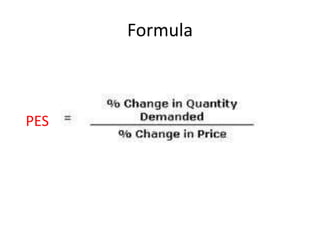
PES
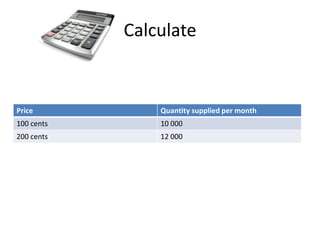
Calculate


Price           Quantity supplied per month
100 cents       10 000
200 cents       12 000
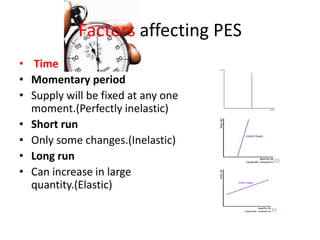
Factors affecting PES
• Time
• Momentary period
• Supply will be fixed at any one
  moment.(Perfectly inelastic)
• Short run
• Only some changes.(Inelastic)
• Long run
• Can increase in large
  quantity.(Elastic)
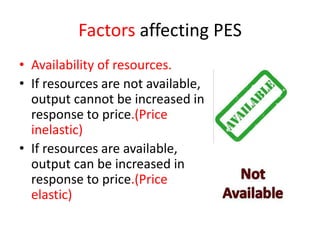
Factors affecting PES
• Availability of resources.
• If resources are not available,
  output cannot be increased in
  response to price.(Price
  inelastic)
• If resources are available,
  output can be increased in
  response to price.(Price
  elastic)
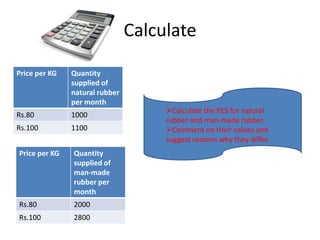
Calculate

Price per KG   Quantity
               supplied of
               natural rubber
               per month
                                     Calculate the PES for natural
Rs.80          1000
                                     rubber and man-made rubber.
Rs.100         1100                  Comment on their values and
                                     suggest reasons why they differ.
Price per KG   Quantity
               supplied of
               man-made
               rubber per
               month
Rs.80          2000
Rs.100         2800
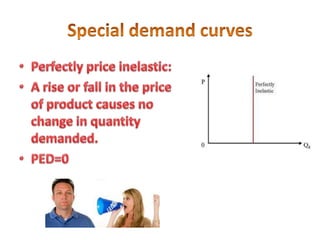
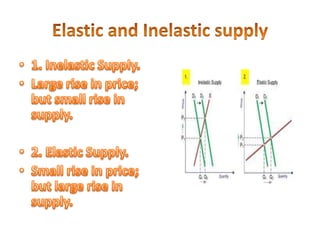
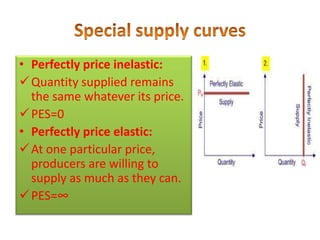
• Perfectly price inelastic:
 Quantity supplied remains
  the same whatever its price.
 PES=0
• Perfectly price elastic:
 At one particular price,
  producers are willing to
  supply as much as they can.
 PES=∞
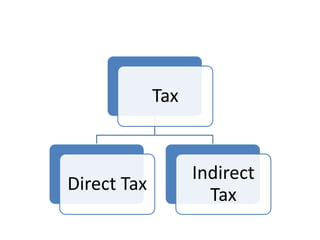
Tax


                   Indirect
Direct Tax
                     Tax
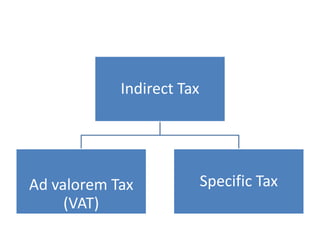
Indirect Tax


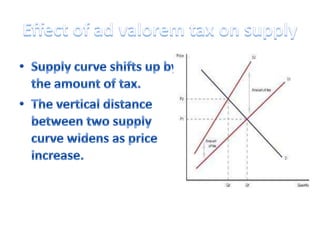
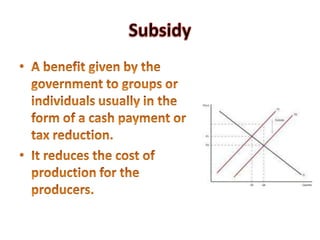
Ad valorem Tax             Specific Tax
     (VAT)
-
How prices are determined

How prices are determined

  • 2.
    What is demand? •Demand is the want or the willingness of consumers to buy goods and services.
  • 3.
    Effective Demand • Whenwillingness to buy is backed/supported with the purchasing power, it becomes an effective demand.
  • 4.
    Price mechanism • Pricesact as the signals for producers. • It is based on the price signals that they decide how to use their scarce resources.
  • 5.
    Quantity demanded • Theamount of a good or service consumers are willing and able to buy is known as the quantity demanded. • Eg: Number of oranges bought per week.
  • 6.
    Individual demand andMarket demand • Individual demand: The quantity of a good/service that an individual is willing and able to buy for different prices over a particular period of time.
  • 7.
    Individual demand andMarket demand • Market Demand: The sum of all individual demand or total demand for the product from all consumers
  • 8.
    Demand Schedule • Demandschedule is the tabular presentation of quantity demanded and price of a good or service. Price of Chocolate Bar(Pence) Your demand per month 200 150 50 30 10 5 1
  • 9.
    Demand Curve • ADemand Curve is the diagrammatical representation of price and quantity demanded for a good or service over a period of time.
  • 10.
    Extension and Contractionof Demand • An extension of demand or increase in quantity demanded refers to the way in which demand changes with a fall in price, with no change in any other factor that could affect demand. • A contraction of demand or decrease in quantity demanded refers to the way in which demand changes when prices rises, with no change in any other factor that could affect demand.
  • 11.
  • 12.
    The market demandcurve • The market demand curve for a particular good or service will display the demand of all the consumers of that commodity given a set of possible prices.
  • 13.
    Shifts in Demand •When there is a change in the factors influencing the demand other than price (like income, advertising, changes in population etc)changes, it leads to a shift in demand curve.
  • 14.
    Increase in demand •An increase in demand means that consumers now demand more of a product at each and every price than they did before. • Eg: Market Demand for chocolate bars: • Draw two demand curves for the data given. Price of chocolate Original demand Increased demand 50 100 000 200 000 40 150 000 250 000 30 200 000 300 000 20 260 000 360 000 10 330 000 430 000 5 400 000 500 000
  • 15.
    Fall in Demand •A fall/ decrease in demand means that consumers now demand less of a product at each every price than they did before. Possible price per Original demand Decreased demand DVD disc(pence) per week per week 100 10 000 5 000 80 15 000 10 000 60 20 000 15 000 40 25 000 20 000 20 30 000 25 000
  • 16.
    What causes ashift in demand? • 1. Changes in consumers income: • As income rise consumers will be able to buy more, while a fall in incomes will cause demand to fall. • But it is depended on the type of product concerned.
  • 17.
    Normal Goods andInferior Goods • Normal Goods: If the demand for a product tends to rise as income rise, the product is called to be a normal good. • Inferior Goods: If demand tends to fall as income rise, the product is said to be an inferior good.
  • 18.
    What causes ashift in demand? • 2. Changes in taxes on incomes • Any change in the level of income tax rates and allowances results in a change in the quantity of goods and services demanded. Disposable income: • The income people have left to spend or save after taxes on their incomes have been deducted.
  • 19.
    What causes ashift in demand? • 3. The prices and availability of other goods and services: • Substitutes: A product is a substitute when its purchase can replace the want for another good or service. Eg: Butter and Margarine, Tea and Coffee • Complementary goods: A pair of goods consumed together. Eg: Car and Petrol, DVDs and DVD player. • Joint Demand
  • 20.
    What causes ashift in demand? • 4. Changes in tastes, habits and fashion: • Changing tastes, habits and fashion can play a big change in demand.
  • 21.
    What causes ashift in demand? • 5. Population Change: • An increase in population will tend to increase the demand for many goods and services. • Size and nature of population growth matters.
  • 22.
    What causes ashift in demand? • 6. Other factors: • Weather • Interest rates • Changes in laws
  • 23.
    What is supply? •Supply refers to the amount of a good or service firms or producers are willing and able to sell at a number of possible prices.
  • 24.
    Quantity supplied • Theamount of a good or service producers are willing and able to make and sell to consumers in a market is known as the quantity supplied.
  • 25.
    Movement along thesupply curve • Any price change to the product causes a movement along the supply curve.
  • 26.
    Extension of supply •As the price increase, the quantity supplied also rises along with it. This is called an extension of supply.
  • 27.
    Contraction of supply •As the price of the product decreases, the supply also decreases with it. This is called a contraction of supply.
  • 28.
    Exercise 1 Construction of Supply Curve Possible price of ice cream Market supply per month 20 1600 16 1100 12 700 8 300 4 100
  • 29.
    Exercise 2 • Whatwill cause an extension of supply? • What will cause a contraction of supply? • Use your graph to work out how many ice cream will be supplied at a price of a. 6 dollars b. 10 dollars
  • 30.
    Exercise 3 • Usingthe market supply schedule, (given in Ex No:1)complete the table and explain why the market supply curve slopes upward from left to right. Output per Total cost Total Profit ($) Possible price Market supply month ($) Revenue($ of ice cream per month ) (PxQ) 20 1600 100 100 400 300 16 1100 300 280 12 700 700 420 8 300 1100 580 4 100 1600 760
  • 31.
    Shifts in Supply •Changes in things other than price of a good can cause its market supply curve to move. This is called a shift in supply curve.
  • 32.
    An increase insupply • An increase in supply means that the producers are now more willing and able to supply a product than they were before at all possible prices. • Draw supply curves for the schedule given below: Possible price of Original supply Increased supply razors (pence) per month per month 50 10 000 12 000 40 8 000 10 000 30 6 000 8 000 20 4 000 6 000 10 2 000 4 000
  • 33.
    A fall insupply • A fall in supply means that producers are now less willing and able to supply a product at each and every price than they were before at all possible prices.
  • 34.
    What causes ashift in supply? • 1. Changes in the cost of factors of production. • Payments for: • Raw materials • Land • Labour • Interest • Tax…….
  • 35.
    What causes ashift in supply? • 2. Changes in price of other goods and services: • Price acts as the signals. • Resources are allocated to those goods and services that will yield the most profit.
  • 36.
    What causes ashift in supply? • 3. Technological advance • Technological improvement improves the performance of machines, employees, production methods, management control, product quality etc.
  • 37.
    What causes ashift in supply? • 4. Business optimism and expectations • Fears of economic downturn may cause some firms to move their resources to more safer products.(Left ward shift) • Expectation of economic recovery may result in reallocation of resources.(Right ward shift)
  • 38.
    What causes ashift in supply? • 5. Global factors • These factors can not be controlled by producers.  Sudden climatic change  Trade sanctions  Wars  Natural disasters  Political factors
  • 39.
    Market Price • Whenquantity demanded and quantity supplied becomes equal then the market price is fixed for the product.
  • 40.
    Finding the marketprice Price Qty Qty Demande Supplied d Find the market price. 50 100 000 420 000 Price at which there is an excess demand. 40 150 000 300 000 Prices at which there is an excess supply. 30 200 000 200 000 If there is excess demand what will happen to price? If there is excess supply what will happen to price? 20 260 000 120 000 10 330 000 60 000 5 400 000 40 000
  • 41.
    Equillibrium • The priceat which the quantity demanded and quantity supplied gets equal is called the equilibrium price or market price.
  • 42.
    How do marketprices change? • A shift in demand: • An increase in demand for a commodity (increase in income /rise in price of substitutes..) will shift the demand curve to outwards.
  • 43.
    How do marketprices change? • A shift in supply: • An increase in supply of product (due to low wages/technical progress..) supply curve shifts outwards.
  • 44.
    What is pricemechanism? • The forces of demand and supply establish the market price of a product automatically. This is called price mechanism. • A free market economy allows the freedom of demand and supply in the market.
  • 45.
    Elasticity…..how much do consumer’s react?
  • 46.
    Elasticity – theconcept • Elasticity is the responsiveness of quantity demanded to a price change • E.g. When price rises what happens to demand? BUT…. Demand falls By how much does demand fall?
  • 47.
    Elasticity – theconcept • If price rises by 10% - what happens to demand? We know demand will fall Elastic • By more than 10%? • By less than 10%? Inelastic • Elasticity measures the extent to which demand will change
  • 48.
    Price Elastic If asmall change in price causes a big change in quantity demanded, then the product is said to be price elastic. The demand curve is flat. %change in price is less than %change in demand.
  • 49.
    If a big change in price Price Inelastic causes a small change in quantity demanded, then the product is said to be price inelastic. The demand curve is steep. %change in price is more than %change in demand.
  • 50.
    A ‘stretching’ exercise product Small/large change Price why in quantity elastic/inelastic demanded Oil DVD recorders Bread Cars Newspapers Situation: rise in price about 10%
  • 51.
    Conclusion An increase inprice have very small impact on demand • Price inelastic An increase in price have very big impact on demand • Price elastic An increase in price have very small impact on demand Price inelastic
  • 52.
  • 53.
    How to calculatepercentage changes? • % change in quantity demanded= Change in quantity 100 ---------------------------- X ------- Original quantity 1  % change in price= Change in price 100 ---------------------------- X ------- Original price 1
  • 54.
    Using the formula Priceof beans (per Market Calculate the tin) demand(per week) PED(use 40 40 pence 1 000 pence as your original price) 30 pence 1 500 Draw a demand curve for the If PED is 1, demand is data. price elastic . If PED is 1 demand is price inelastic Comment on the PED value.
  • 55.
    • It isvery important for a firm to know whether an increase or decrease in price will cause their total revenue to rise or fall.
  • 56.
    Look at thesetwo scenarios and answer for the following questions Price per loaf of Quantity Price per DVD Quantity bread demanded per recorder demanded per month month *25 pence 10 000 *$500 1 000 20 pence 10 500 $400 1 800
  • 57.
    Questions Would you advise bread maker to Calculate PED and reduce the comment on the price from 25 to 20 pence? value. Why? Calculate the total Would you revenue for Bread advice the DVD and DVD recorder recorders at each manufacturers to cut price price.(PxQ) from 500 to 400 dollars? Why?
  • 58.
    Decisions If demandis If demand is price price elastic, inelastic, a a cut in price cut in price increases the reduces total total revenue. revenue. If demand is If demand is price price elastic, inelastic, a a rise in price rise in price decreases increases the the total total revenue revenue.
  • 59.
    Factors affecting PriceElasticity of Demand • The number of substitutes: • When consumers can choose between a large number of substitutes for s particular product, demand is likely to be price elastic. (soft drinks, cosmetics etc) • When there are few substitutes, demand becomes price inelastic. ( milk, medicines etc)
  • 63.
    • Infinitely priceelastic: • Product is demanded at one particular price only. • A small change in price will cause quantity demanded to fall to zero. • PED=∞
  • 64.
    • Unitary elastic: •A percentage change in price will cause an equal percentage change in quantity demanded. • PED=1
  • 67.
  • 68.
    Calculate Price Quantity supplied per month 100 cents 10 000 200 cents 12 000
  • 69.
    Factors affecting PES •Time • Momentary period • Supply will be fixed at any one moment.(Perfectly inelastic) • Short run • Only some changes.(Inelastic) • Long run • Can increase in large quantity.(Elastic)
  • 70.
    Factors affecting PES •Availability of resources. • If resources are not available, output cannot be increased in response to price.(Price inelastic) • If resources are available, output can be increased in response to price.(Price elastic)
  • 71.
    Calculate Price per KG Quantity supplied of natural rubber per month Calculate the PES for natural Rs.80 1000 rubber and man-made rubber. Rs.100 1100 Comment on their values and suggest reasons why they differ. Price per KG Quantity supplied of man-made rubber per month Rs.80 2000 Rs.100 2800
  • 72.
    • Perfectly priceinelastic:  Quantity supplied remains the same whatever its price.  PES=0 • Perfectly price elastic:  At one particular price, producers are willing to supply as much as they can.  PES=∞
  • 75.
    Tax Indirect Direct Tax Tax
  • 76.
    Indirect Tax Ad valoremTax Specific Tax (VAT)
  • 82.