WELCOME!!!
TESDA IX
Provincial Training Center
Zamboanga Cit y
SHIELDED METAL ARC WELDING
(SMAW NCI)
268 hours/33.5 days
Trainer : ABS D. UCKUNG
INTRODUCTION
• Purpose of Training and Assessment
TO ATTAIN SUFFICIENT KNOWLEDGE, SKILLS
AND RIGHT ATTITUDE .
TO HAVE NATIONAL CERTIFICATE FOR
EMPLOYMENT AND PROMOTION
Competency-Based Training
COMPETENCY-BASED
TRAINING (CBT)
CBT is a training delivery
approach that focuses on
the competency
development of the learner
as a result of the training.
COMPETENCY-BASED TRAINING . . .
1. emphasizes most on what the learner can actually do;
2. focuses on outcomes rather than the learning process within specified
time;
3. is concerned with the attainment and application of knowledge, skills
and attitude to a specific level of competency.
WHY THE COMPETENCY-BASED
APPROACH?
Education and training must
keep pace with technology
and customer requirements.
Principles of CBT
PRINCIPLE ONE
The training is based on curriculum
developed from the competency
standards
Learning is based on the
Competency-based curriculum
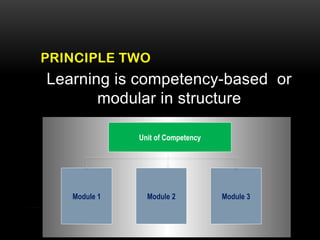
PRINCIPLE TWO
Learning is competency-based or
modular in structure
Module 1 Module 2 Module 3
Unit of Competency
PRINCIPLE THREE
Training delivery is individualized
and self-paced
Learning is done by the
learner at own pace
PRINCIPLE FOUR
Training is based on work that must
be performed
Learning is based on the
actual industry practice
PRINCIPLE FIVE
Training materials are directly related
to the competency standards and the
curriculum
CS to CBC to LMs
[CS-Competency Standards/
CBC-Competency-Based Curriculum/
LMs-Learning Materials]
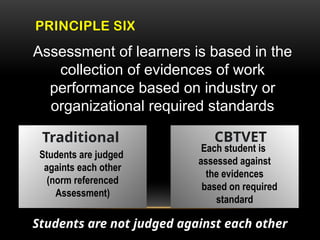
PRINCIPLE SIX
Assessment of learners is based in the
collection of evidences of work
performance based on industry or
organizational required standards
Students are judged
againts each other
(norm referenced
Assessment)
Each student is
assessed against
the evidences
based on required
standard
Traditional CBTVET
Students are not judged against each other
PRINCIPLE SEVEN
Training is based both on and off the
job components
Better learning with industry and
school partnership
PRINCIPLE EIGHT
The system allows Recognition of
Prior Learning (RPL)
Workers and Students can have prior
skills recognized
PRINCIPLE NINE
The system allows for learners to enter
and exit programs at different times and
levels and to receive an award for
competencies attained at any point.
There is flexibility for entry
and exit from programs
PRINCIPLE TEN
Approved training programs are
nationally accredited
Training programs are registered
within UTPRAS
COMPETENCY?
What is
THE ABILITY TO DO SOMETHING
WELL OR EFFECTIVELY.
A POSSESSION AND APPLICATION OF
SKILLS, KNOWLEDGE AND RIGHT ATTITUDES
TO PERFORM WORK ACTIVITIES TO THE
STANDARD EXPECTED IN THE WORKPLACE
Roles of a Trainer
 Serve as a team member to determined what is to be learned.
 Stimulates trainees motivation.
 Manages learning: a consultation rather than a provider of information; a facilitator of the learning
 Diagnose and solve learning problems
 Evaluates student achievement
 Assist learners to obtain individualized rewards
 Assist each trainee in designing a personalized plan of study
 Installs confidence in the learner by providing experience where learner may succeed
 Serves as a model for desirable work habits, attitudes and tasks performance in the occupational field
 Spend more time interacting with student on 1:1 or small group basis
 Help those who really need help
 Accepts responsibility along with the student for the tasks learned or not learned.
Roles of a Trainee
Trainee learn at their own rate within program guidelines. They may
speed up, slow down, stop or even repeat the task
Trainees may request to receive credits Trainees may select what they
want to learn and when they want to learn it, within reason.
or that they already know this done either through pre-testing or though a
review of a task list completed at another site.
Trainee may choose how they want to learn-individualized, on a one-to
one basis, in a small group, in large group or with audio-visual
Trainee are responsible for that they learn and when they learn it.
Trainee decide when they are ready to perform each task or demonstrate
mastery of learning to a job-like level of proficiency before receiving credit
for the task.
 Trainee help develop personalized prescription for learning worked out cooperatively and based
upon what the student already knows his preference for learning, learning style and other
needs.
 Trainees compete against pres job standards and not against other student and are graded on
achievement of standard or criteria of each task
 Trainees know “up front”, before instruction begins what they are expected to know and do to
complete the program.
 Trainees evaluate their own progress to see how well they are doing.
 Trainee move freely in the workshop, laboratory and or training center
 Trainees know they will be rated mainly on performance, while papers and pencil tests will be
used mainly to check their knowledge of the task.
 Trainees learn according to their interest, needs and abilities-not
 According to teacher timelines and expediency.
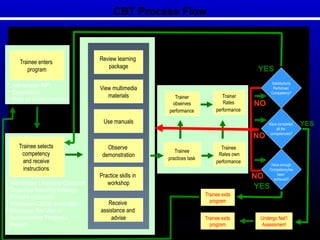
CBT Process Flow
Have enough
Competency/ies
been
achieved?
YES
YES
Trainee exits
program
Trainer
observes
performance
Trainee
practices task
Trainee
Rates own
performance
Trainer
Rates
performance
Trainee enters
program
• Administer RPL
• Orientation
• Role of trainer/trainee
Trainee selects
competency
and receive
instructions
• Administer Learning Contract
• Organize learning strategy
• Provide materials
• Introduce CBLM materials
• Introduce the Use of
Achievement Progress
Report
Review learning
package
View multimedia
materials
Use manuals
Observe
demonstration
Practice skills in
workshop
Receive
assistance and
advise
YES
Trainee exits
program
Have completed
all the
competencies?
Satisfactorily
Performed
Competency?
Undergo Nat’l
Assessment
NO
NO
NO
Competency-based
learning Material
(CBLM)
• CBLM defined…
Instructional Media that facilitates individualized
training.
Package used by the trainer/instructor and
trainee/student in competency learning.
Further defined by its part.
• .
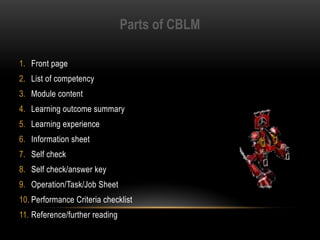
Parts of CBLM
1. Front page
2. List of competency
3. Module content
4. Learning outcome summary
5. Learning experience
6. Information sheet
7. Self check
8. Self check/answer key
9. Operation/Task/Job Sheet
10. Performance Criteria checklist
11. Reference/further reading
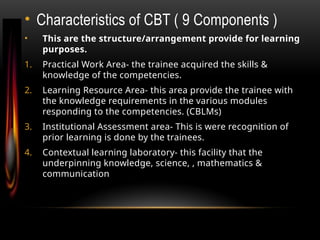
• Characteristics of CBT ( 9 Components )
• This are the structure/arrangement provide for learning
purposes.
1. Practical Work Area- the trainee acquired the skills &
knowledge of the competencies.
2. Learning Resource Area- this area provide the trainee with
the knowledge requirements in the various modules
responding to the competencies. (CBLMs)
3. Institutional Assessment area- This is were recognition of
prior learning is done by the trainees.
4. Contextual learning laboratory- this facility that the
underpinning knowledge, science, , mathematics &
communication mathematics & communication.
6. Trainers resource area- this area houses the learning
materials, the training regulation & curriculum examples.
7. Distance learning area- this are component-based work shop
component that enable learning provision outside the training
institution.
8. Computer laboratory- The used of information technology. The
trainee provided to learned and gain appropriate IT
competencies that may include word and excel.
9. Support service area
What will you learn in this
training?
What will you learn in this
training?
What will you learn in this
training?
• Participate in Workplace Communication
• Work in Team Environment
• Practice career professionalism
• Practice occupational health and safety procedures
BASIC COMPETENCIES
TEAM WORK
THE FUEL THAT ALLOWS COMMON
PEOPLE TO ATTAIN UNCOMMON
RESULTS
COMMON COMPETENCIES
• Apply Safety Practices
• Interpret Drawings and Sketches
• Perform Industry Calculations
• Contribute to Quality System
• Use Hand Tools
• Prepare Weld Materials
• Setup Welding Equipment
• Fit up Weld Materials
• Repair Welds
QUALITY
ONLY HAPPENS WHEN
YOU CARE ENOUGH TO
DO THE BEST
Assessment Methods:
• Written Test
• Demonstration
• Questioning
 Training Methods:
• Group Discussion
• Simulation
• Lecture
• Self-Learning/Self-Pace Instruction
SHIEDED METAL ARC WELDING
(SMAW NCII)
Weld Carbon Steel Plates
and Pipes using SMAW
Attitude is a little thing that
makes a BIG Difference
ATTITUDE
ALWAYS
OBSERVE
SAFETY!!!
GOODLUCK AND ENJOY THE TRAINING!

TESDA Shielded Metal And Welding presentation

  • 1.
    WELCOME!!! TESDA IX Provincial TrainingCenter Zamboanga Cit y SHIELDED METAL ARC WELDING (SMAW NCI) 268 hours/33.5 days Trainer : ABS D. UCKUNG
  • 3.
    INTRODUCTION • Purpose ofTraining and Assessment TO ATTAIN SUFFICIENT KNOWLEDGE, SKILLS AND RIGHT ATTITUDE . TO HAVE NATIONAL CERTIFICATE FOR EMPLOYMENT AND PROMOTION
  • 4.
  • 5.
    COMPETENCY-BASED TRAINING (CBT) CBT isa training delivery approach that focuses on the competency development of the learner as a result of the training.
  • 6.
    COMPETENCY-BASED TRAINING .. . 1. emphasizes most on what the learner can actually do; 2. focuses on outcomes rather than the learning process within specified time; 3. is concerned with the attainment and application of knowledge, skills and attitude to a specific level of competency.
  • 7.
    WHY THE COMPETENCY-BASED APPROACH? Educationand training must keep pace with technology and customer requirements.
  • 8.
  • 9.
    PRINCIPLE ONE The trainingis based on curriculum developed from the competency standards Learning is based on the Competency-based curriculum
  • 10.
    PRINCIPLE TWO Learning iscompetency-based or modular in structure Module 1 Module 2 Module 3 Unit of Competency
  • 11.
    PRINCIPLE THREE Training deliveryis individualized and self-paced Learning is done by the learner at own pace
  • 12.
    PRINCIPLE FOUR Training isbased on work that must be performed Learning is based on the actual industry practice
  • 13.
    PRINCIPLE FIVE Training materialsare directly related to the competency standards and the curriculum CS to CBC to LMs [CS-Competency Standards/ CBC-Competency-Based Curriculum/ LMs-Learning Materials]
  • 14.
    PRINCIPLE SIX Assessment oflearners is based in the collection of evidences of work performance based on industry or organizational required standards Students are judged againts each other (norm referenced Assessment) Each student is assessed against the evidences based on required standard Traditional CBTVET Students are not judged against each other
  • 15.
    PRINCIPLE SEVEN Training isbased both on and off the job components Better learning with industry and school partnership
  • 16.
    PRINCIPLE EIGHT The systemallows Recognition of Prior Learning (RPL) Workers and Students can have prior skills recognized
  • 17.
    PRINCIPLE NINE The systemallows for learners to enter and exit programs at different times and levels and to receive an award for competencies attained at any point. There is flexibility for entry and exit from programs
  • 18.
    PRINCIPLE TEN Approved trainingprograms are nationally accredited Training programs are registered within UTPRAS
  • 19.
  • 20.
    THE ABILITY TODO SOMETHING WELL OR EFFECTIVELY.
  • 21.
    A POSSESSION ANDAPPLICATION OF SKILLS, KNOWLEDGE AND RIGHT ATTITUDES TO PERFORM WORK ACTIVITIES TO THE STANDARD EXPECTED IN THE WORKPLACE
  • 22.
    Roles of aTrainer  Serve as a team member to determined what is to be learned.  Stimulates trainees motivation.  Manages learning: a consultation rather than a provider of information; a facilitator of the learning  Diagnose and solve learning problems  Evaluates student achievement  Assist learners to obtain individualized rewards  Assist each trainee in designing a personalized plan of study  Installs confidence in the learner by providing experience where learner may succeed  Serves as a model for desirable work habits, attitudes and tasks performance in the occupational field  Spend more time interacting with student on 1:1 or small group basis  Help those who really need help  Accepts responsibility along with the student for the tasks learned or not learned.
  • 23.
    Roles of aTrainee Trainee learn at their own rate within program guidelines. They may speed up, slow down, stop or even repeat the task Trainees may request to receive credits Trainees may select what they want to learn and when they want to learn it, within reason. or that they already know this done either through pre-testing or though a review of a task list completed at another site. Trainee may choose how they want to learn-individualized, on a one-to one basis, in a small group, in large group or with audio-visual Trainee are responsible for that they learn and when they learn it. Trainee decide when they are ready to perform each task or demonstrate mastery of learning to a job-like level of proficiency before receiving credit for the task.
  • 24.
     Trainee helpdevelop personalized prescription for learning worked out cooperatively and based upon what the student already knows his preference for learning, learning style and other needs.  Trainees compete against pres job standards and not against other student and are graded on achievement of standard or criteria of each task  Trainees know “up front”, before instruction begins what they are expected to know and do to complete the program.  Trainees evaluate their own progress to see how well they are doing.  Trainee move freely in the workshop, laboratory and or training center  Trainees know they will be rated mainly on performance, while papers and pencil tests will be used mainly to check their knowledge of the task.  Trainees learn according to their interest, needs and abilities-not  According to teacher timelines and expediency.
  • 25.
    CBT Process Flow Haveenough Competency/ies been achieved? YES YES Trainee exits program Trainer observes performance Trainee practices task Trainee Rates own performance Trainer Rates performance Trainee enters program • Administer RPL • Orientation • Role of trainer/trainee Trainee selects competency and receive instructions • Administer Learning Contract • Organize learning strategy • Provide materials • Introduce CBLM materials • Introduce the Use of Achievement Progress Report Review learning package View multimedia materials Use manuals Observe demonstration Practice skills in workshop Receive assistance and advise YES Trainee exits program Have completed all the competencies? Satisfactorily Performed Competency? Undergo Nat’l Assessment NO NO NO
  • 26.
  • 27.
    • CBLM defined… InstructionalMedia that facilitates individualized training. Package used by the trainer/instructor and trainee/student in competency learning. Further defined by its part. • .
  • 28.
    Parts of CBLM 1.Front page 2. List of competency 3. Module content 4. Learning outcome summary 5. Learning experience 6. Information sheet 7. Self check 8. Self check/answer key 9. Operation/Task/Job Sheet 10. Performance Criteria checklist 11. Reference/further reading
  • 29.
    • Characteristics ofCBT ( 9 Components ) • This are the structure/arrangement provide for learning purposes. 1. Practical Work Area- the trainee acquired the skills & knowledge of the competencies. 2. Learning Resource Area- this area provide the trainee with the knowledge requirements in the various modules responding to the competencies. (CBLMs) 3. Institutional Assessment area- This is were recognition of prior learning is done by the trainees. 4. Contextual learning laboratory- this facility that the underpinning knowledge, science, , mathematics & communication mathematics & communication.
  • 30.
    6. Trainers resourcearea- this area houses the learning materials, the training regulation & curriculum examples. 7. Distance learning area- this are component-based work shop component that enable learning provision outside the training institution. 8. Computer laboratory- The used of information technology. The trainee provided to learned and gain appropriate IT competencies that may include word and excel. 9. Support service area
  • 31.
    What will youlearn in this training? What will you learn in this training? What will you learn in this training?
  • 32.
    • Participate inWorkplace Communication • Work in Team Environment • Practice career professionalism • Practice occupational health and safety procedures BASIC COMPETENCIES
  • 33.
    TEAM WORK THE FUELTHAT ALLOWS COMMON PEOPLE TO ATTAIN UNCOMMON RESULTS
  • 34.
    COMMON COMPETENCIES • ApplySafety Practices • Interpret Drawings and Sketches • Perform Industry Calculations • Contribute to Quality System • Use Hand Tools • Prepare Weld Materials • Setup Welding Equipment • Fit up Weld Materials • Repair Welds
  • 35.
    QUALITY ONLY HAPPENS WHEN YOUCARE ENOUGH TO DO THE BEST
  • 36.
    Assessment Methods: • WrittenTest • Demonstration • Questioning  Training Methods: • Group Discussion • Simulation • Lecture • Self-Learning/Self-Pace Instruction
  • 37.
    SHIEDED METAL ARCWELDING (SMAW NCII) Weld Carbon Steel Plates and Pipes using SMAW
  • 38.
    Attitude is alittle thing that makes a BIG Difference ATTITUDE
  • 39.
  • 40.
    GOODLUCK AND ENJOYTHE TRAINING!

Editor's Notes

  • #5 Focus of CBT Delivery Approach In CBT, there is no result such as numerical rating. In CBT, the result is only either competent or not yet competent. meaning a slow learner has the same knowledge, skill and ability with the fast learner it both is rated as competent… only the time frame of the completion of the competency is different.
  • #6 Enhance the skills of the learner… aside from what he/she know, what else can he/she actually do Result is more important than the process. Application of KSA.
  • #7 1. KSA must be globally competitive.
  • #9 1. CS to CBC to Learning 2. The learning is based on the Competency Based Curriculum which is developed by the institution.
  • #11  It is a process in which the trainee performs specific tasks specified in the training modules on their own pace. The learning is individualized in which learners acquire the KSA at their own pace
  • #12  Work-based (Example: We teach what you should practice) Relevance to industry needs Should lead to gainful activities/jobs
  • #13  The learning materials were developed based on the CS to the CBC. Example: Session plan instructional sheet ( Competency Based Learning Materials (CBLM))
  • #14 (Traditional VS CBTVET) “1. The Traditional method of learning are assess through examinations like prelim etc. whereas CBT, learners are assess by qualification and by means of collecting evidences required by the competency standards.
  • #15 1.Training can be done both in the training institution and industry. 2. Know what, why and how
  • #16 Identifying RPL through interview, pre-assessment, third party report and portfolio assessment. 1. Competencies gained in life or work (application of RPL ) Competencies assessed and recognized are credited against required competencies of a qualification Example: Learners that has a prior learning in any industry, will be recognized applying the RPL system of CBT. All competencies gained prior to his enrolment in the certain institution, will be assessed and credited against required competencies of a qualification).
  • #17 Multiple entry, multiple exit Single entry (block entry), multiple exit 1. CBT program allows learners to enter and exit at any given time after finishing competency/ies required on a qualification.
  • #18 Training Regulations Certificate of Program Registration (CoPR) is nationally recognized.
  • #25 Flowchart in delivering CBT CONDUCT PRE ASSESSMENT Trainee enters the program. Recognition of prior learning should be administered in-order to determine if he/she needs to undergo all the competencies or he/she should proceed with the assessment. For instance if he has previous work experience and he can provide portfolio and other documents sufficient enough to support his claim, then he can proceed with the assessment. In the orientation, the trainer explains the CBT. The trainees will also be orient to familiarize the locations of different facilities and equipment, know whom to ask for assistance, what are the necessary tools to be used for learning, (tools pertains to different materials such as modules, books as reference, the internet if necessary, hand held gears and others.) WORKSHOP RULES AND REGULATIONS. Explain the role of trainers and trainees. (Explain that the training is competency based and it is self-paced). The trainer is there to guide, facilitate, check his work and evaluate his performance. Training is trainee-centered. FACILITATE TRAINNG SESSION The student selects one competency he wants to undergo first. Then instructions will be given. Trainer will administer learning contract, trainee to read the contract. Trainer and trainee will sign the contract (binding agreement) Strategies for learning should properly organized and explained to the trainee. Provide and explain the use of learning materials needed (curriculum based learning modules). Introduce and explain the use of Achievement Progress Report. The trainer and trainee monitor the progress per Los/Unit of Competency Learning takes place (View multimedia materials, Use manuals, Observe demonstrations, Practice skills in workshop and if necessary receive assistance and advice). CONDUCT INSTITUTIONAL ASSESSMENT Once trainee feels that he is ready to perform the task, then he can proceed. Two ways: While performing, the trainer observes his performance, check if the procedure is correct and appropriate in-order for him not to commit mistakes that will lead to equipment damage or injury to the trainee. Trainee attempts the task and rates himself and then the trainer rates the trainee. OUTPUT Competency 1: competent, selects competency 2 Completed all competencies: Undergo mandatory national assessment Whatever the result of national assessment, the trainee may exit the program Competency 1 and 2 completed: may exit the program (work experience). Enter again to take remaining competencies (may take RPL again) Not yet competent-perform/practice the activities/tasks then undergo institutional assessment