Competency-Based Learning Materials
Conducting Competency
Assessment
Printed by:
National TVET Trainers Academy
Technical Education and Skills Development Authority
ISBN 978-971-95388-3-7-0
April 2012
All rights reserved
These Competency-Based Learning Materials are
properties of the National TVET Trainers Academy.
NTTA encourages the use of the CBLMs contained
herein for education and training purposes with
appropriate credit given to NTTA. Duplication
and/or use of the CBLMs for commercial purposes
require prior written approval from NTTA
For further information, please contact
The Director
National TVET Trainers Academy
Marikina City
Telefax No.: (02)655-6577
Tel. No. : (02)655-7065
e-Mail Add. : nttatesda@yahoo.com
CBLMs on Trainers
Methodology Level I
Conduct Competency
Assessment
Date Developed:
July 2010
Date Revised:
March 2012
Document No.:
Issued by:
NTTA
Page i
of
135Developed by:
ALFONSO P. FRANCISCO
Revision No. 1
CBLMs on Trainers
Methodology Level I
Conduct Competency
Assessment
Date Developed:
July 2010
Date Revised:
March 2012
Document No.:
Issued by:
NTTA
Page ii
of ix
Developed by:
ALFONSO P. FRANCISCO
Revision No. 1
Table of Content
Table of Content ..........................................................................................................................i
How to Use This Competency-Based Learning Material ............................................................ v
Module Content......................................................................................................................... vii
Learning Experiences .................................................................................................................3
Information Sheet 1.1-1 Factors to be Considered in Organizing Assessment Activity..............4
Self-Check 1.1-1 .............................................................................................................8
Answer Key 1.1-1...........................................................................................................9
Information Sheet 1.1-2 Purpose of Assessment, Orientation, Documentation and Appointment
..................................................................................................................................................10
Self-Check 1.1-2 ...........................................................................................................12
Answer Key 1.1-2.........................................................................................................13
Information Sheet 1.1-3 Assessors Responsibility and Assessors Guide ................................14
Self-Check 1.1-3 ...........................................................................................................16
Answer Key 1.1-3.........................................................................................................17
Information Sheet No. 1.1-4 Assessment Centers Responsibility.............................................18
Self-check 1.1-4 ............................................................................................................21
Answer Key 1.1-4.........................................................................................................22
Information Sheet 1.1-5 Assessment Resources and Assessment Packages/Instruments .....23
Self-check 1.1-5 ............................................................................................................25
Answer Key 1.1-5.........................................................................................................26
Learning Outcome Summary ....................................................................................................27
Learning Experiences ...............................................................................................................29
Learning Outcome No.2 Prepare Candidate .............................................................................29
Information Sheet No. 1.2-1 Context of Assessment ................................................................30
Self-Check No. 1.2-1 .....................................................................................................32
Answer Key 1.2-1.........................................................................................................33
CBLMs on Trainers
Methodology Level I
Conduct Competency
Assessment
Date Developed:
July 2010
Date Revised:
March 2012
Document No.:
Issued by:
NTTA
Page
iii of
ixDeveloped by:
ALFONSO P. FRANCISCO
Revision No. 1
Information Sheet No. 1.2-2 Competency Standard and Assessment Guidelines....................34
Self-Check 1.2-2 ...........................................................................................................37
Answer Key 1.2.2.........................................................................................................38
Information Sheet No. 1.2-3 The Assessment Forms................................................................39
Self-Check 1.2.-2 ..........................................................................................................47
Answer Key 1.2-3.........................................................................................................48
Task Sheet 1.2-1 Preparing Candidates...................................................................................49
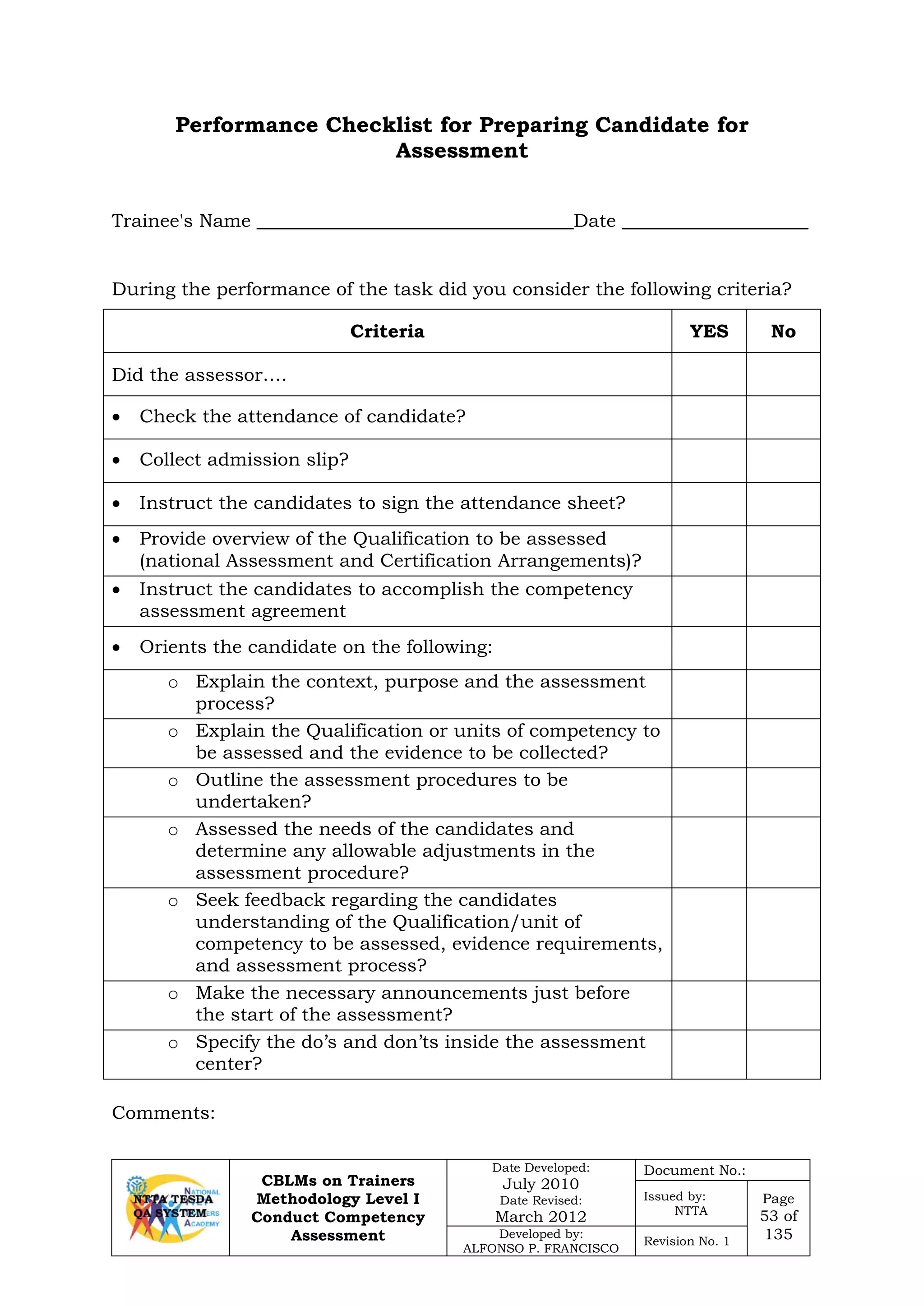
Performance Checklist for Preparing Candidate for Assessment .................................53
Learning Outcome Summary ....................................................................................................55
Learning Experiences ...............................................................................................................57
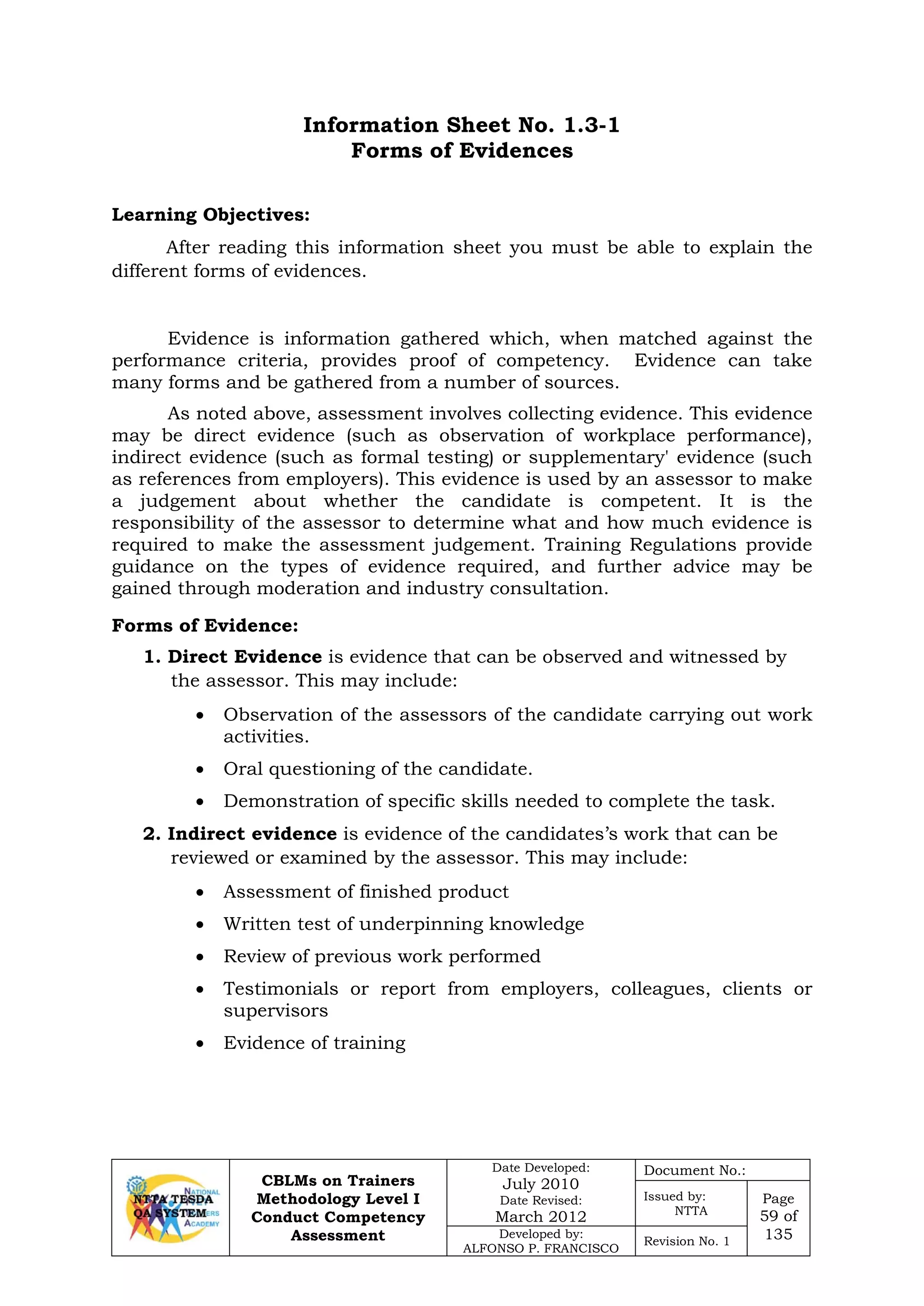
Information Sheet No. 1.3-1 Forms of Evidences......................................................................59
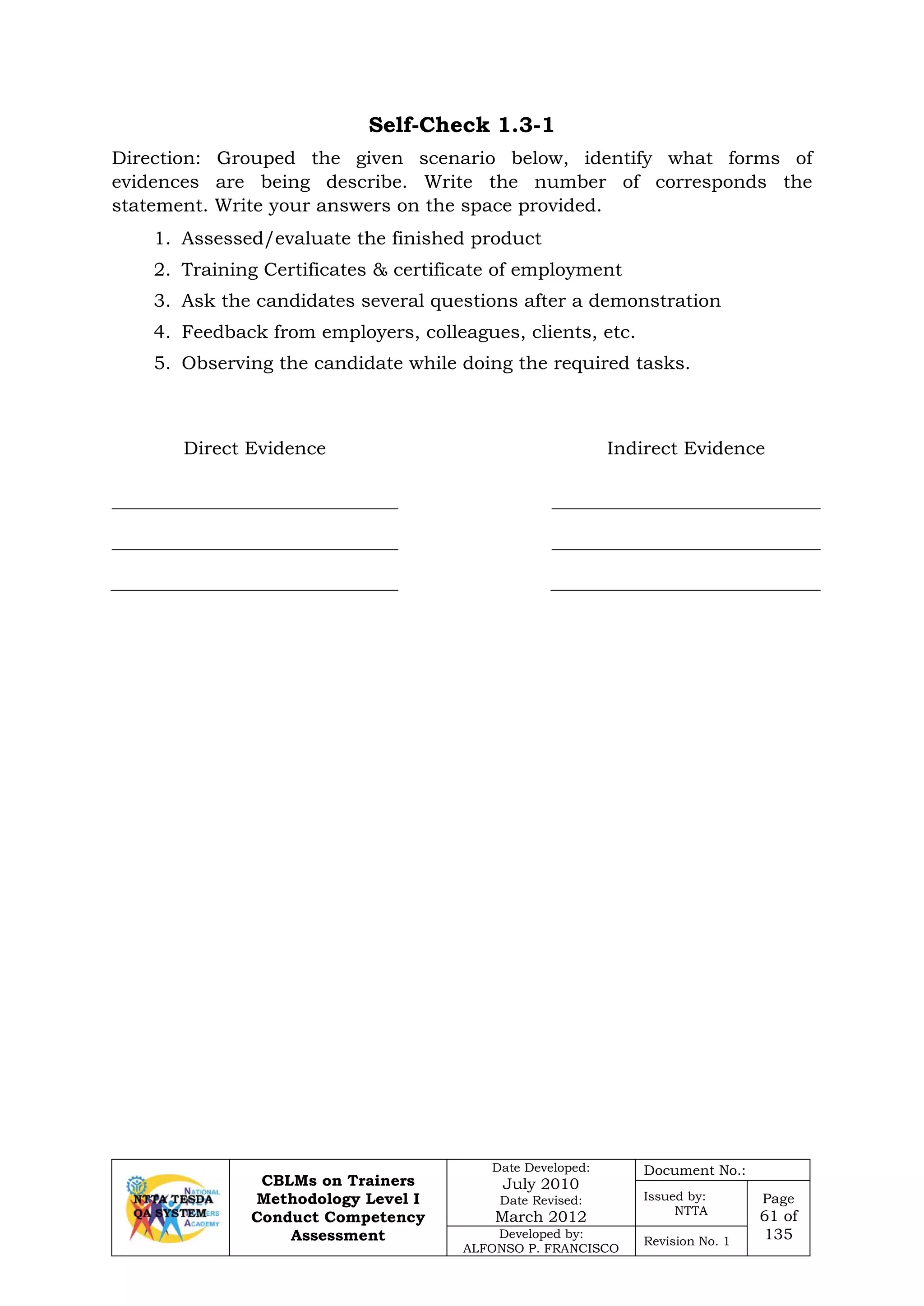
Self-Check 1.3-1 ...........................................................................................................61
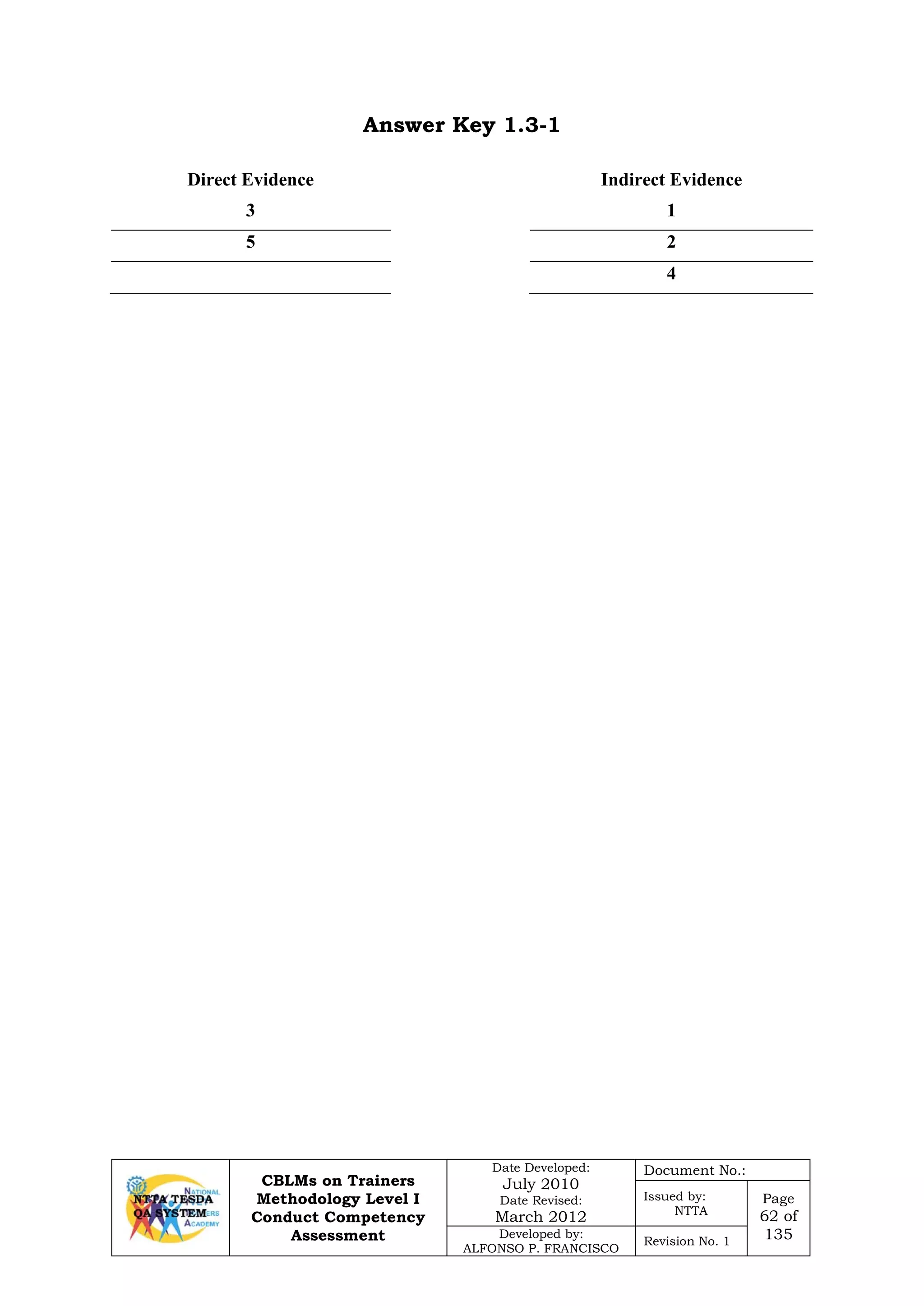
Answer Key 1.3-1.........................................................................................................62
Information Sheet No. 1.3.2 Ways of Gathering Evidence........................................................63
Self-Check 1.3-2 ...........................................................................................................71
Answer Key 1.3-2.........................................................................................................73
Information Sheet No. 1.3-3 Dimensions of Competency..........................................................74
Self-Check 1.3-3 ...........................................................................................................76
Answer Key 1.3-3.........................................................................................................77
Information Sheet No. 1.3-4 Rules of Evidence.........................................................................78
Self-Check 1.3-4 ...........................................................................................................80
Answer Key 1.3-4.........................................................................................................82
Information Sheet No. 1.3-5 Evidence Gathering Tools ............................................................83
Self-Check 1.3-5 ...........................................................................................................91
Answer Key 1.3-5.........................................................................................................92
Task Sheet 1.3-1 Gathering Evidences ....................................................................................93
Performance Checklist for Gathering Assessment Evidence ........................................94
Learning Outcome Summary ....................................................................................................96
CBLMs on Trainers
Methodology Level I
Conduct Competency
Assessment
Date Developed:
July 2010
Date Revised:
March 2012
Document No.:
Issued by:
NTTA
Page
iv of
ixDeveloped by:
ALFONSO P. FRANCISCO
Revision No. 1
Learning Experiences ...............................................................................................................97
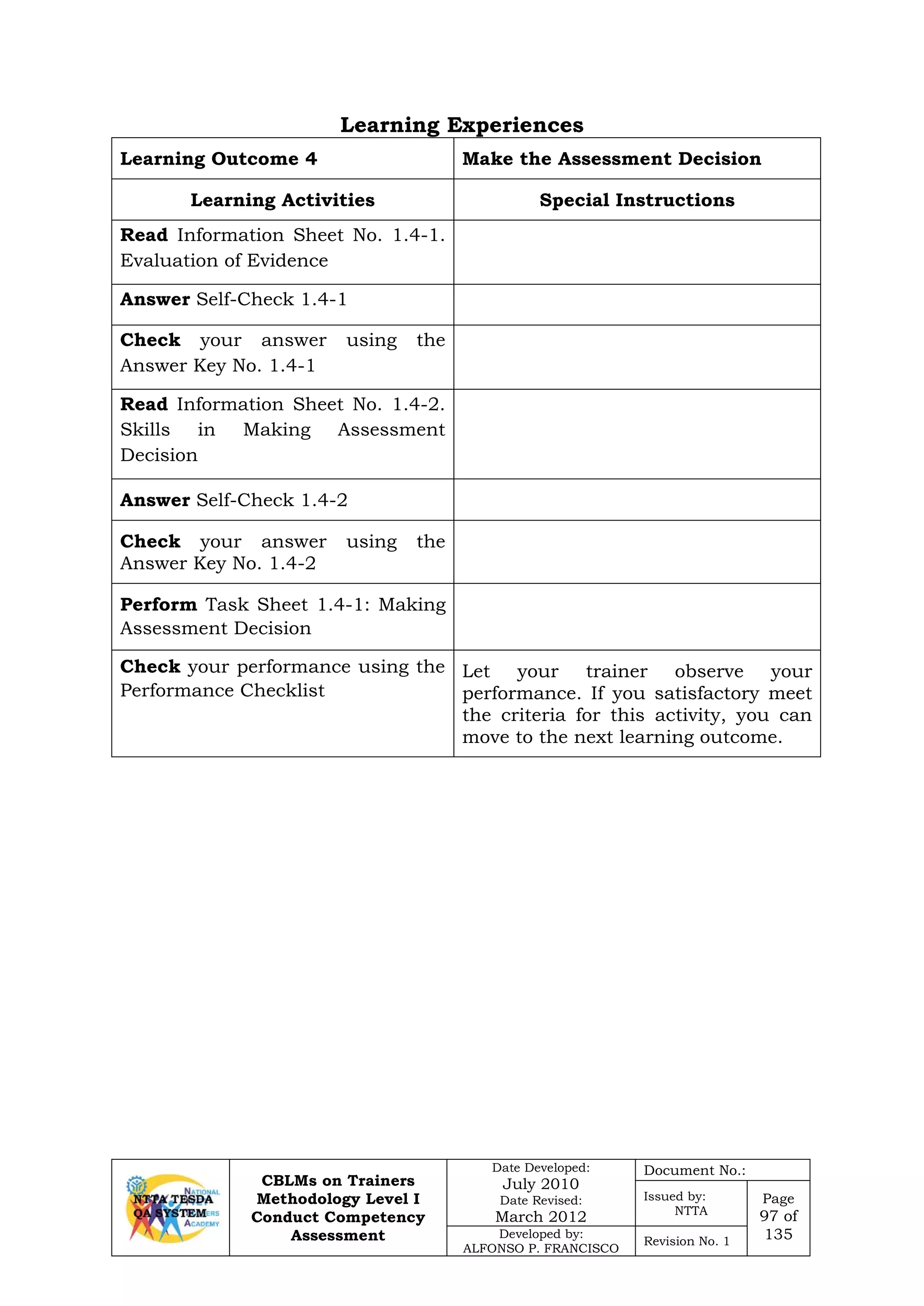
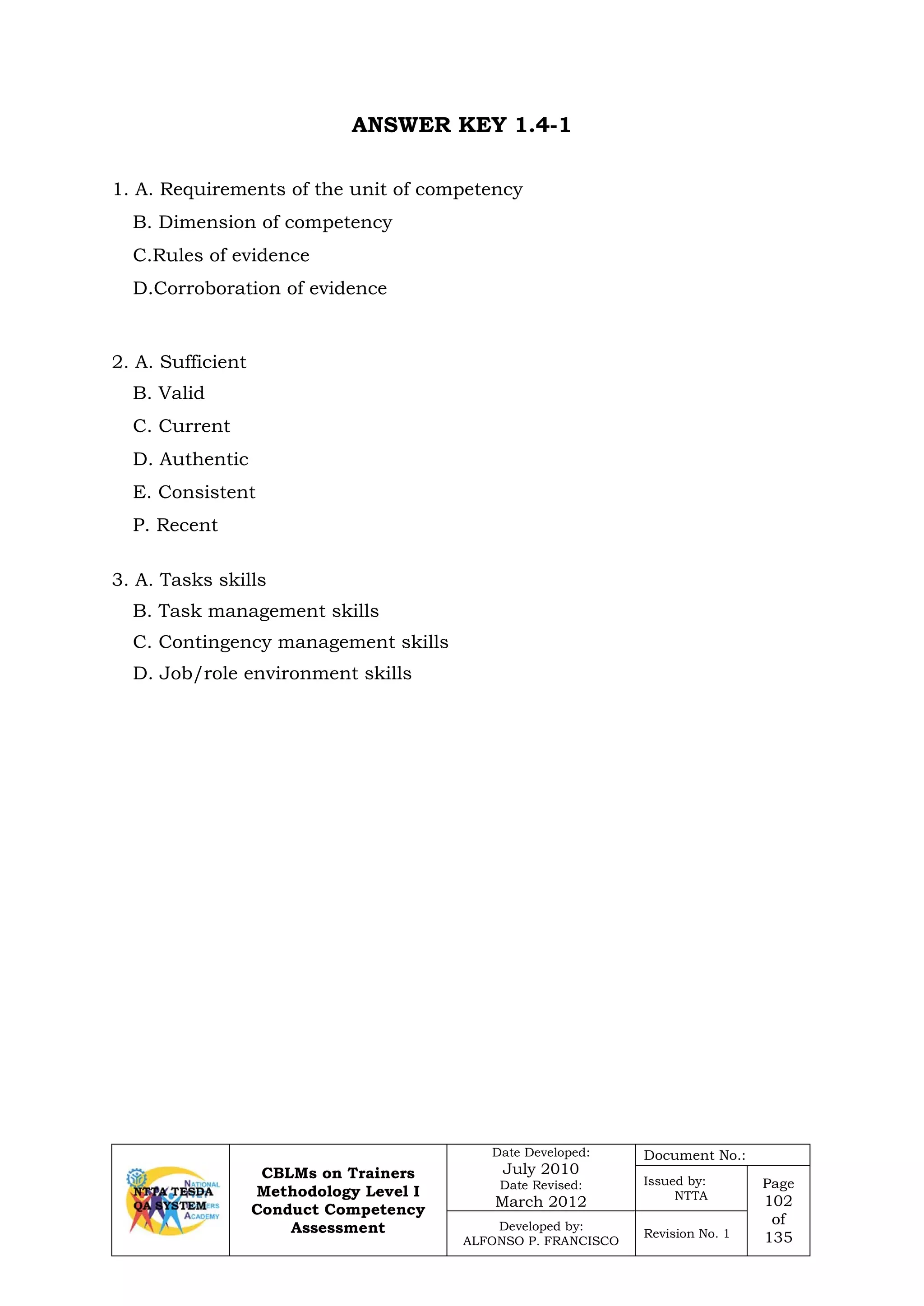
Information Sheet No. 1.4-1 Evaluation of Evidences...............................................................98
Self Check No. 1.4-1 ...................................................................................................114
Answer Key No. 1.4-1.................................................................................................102
Information Sheet No. 1.4-2 Skills in Making Assessment Decision.......................................103
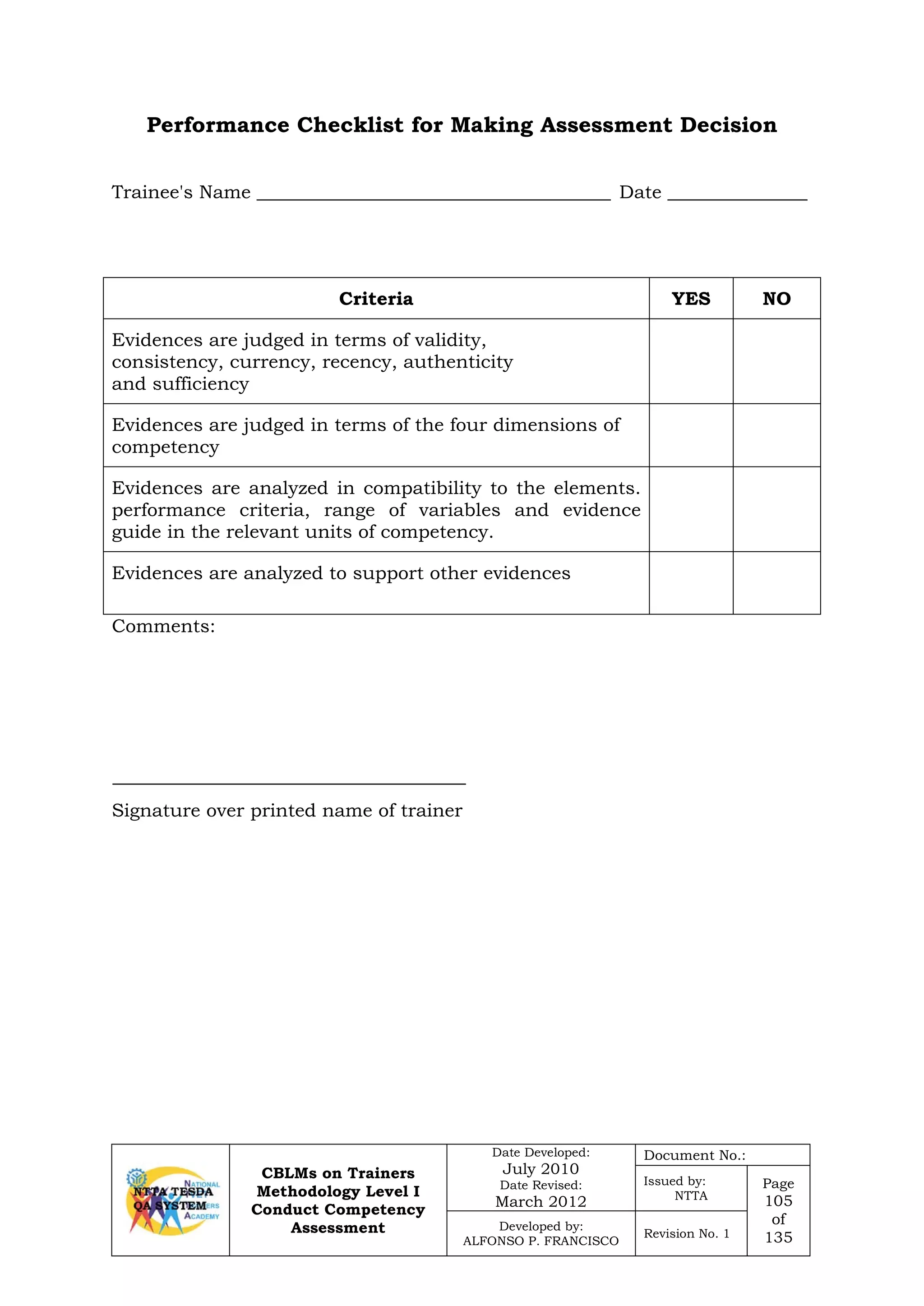
Task Sheet 4.1-1 Making Assessment Decision.....................................................................104
Performance Checklist for Making Assessment Decision ...........................................105
Learning Experiences .............................................................................................................108
Information Sheet No. 1.5-1 Forms Designed for Assessment Result ....................................109
Self Check 1.5-1 .........................................................................................................113
Answer Key No. 1.5-1.................................................................................................114
Information Sheet No. 1.5-2 Skills in Recording Assessment Results ....................................115
Task Sheet 1.5-1 Filling-up the Competency Assessment Results Summary (CARS) ............116
Procedural Checklist Filling-up the Competency Assessment Results Summary...................118
Task Sheet No 1.5-2 Recording and Reporting Assessment Results......................................120
Performance Checklist 1.5-2.......................................................................................121
Recording and Reporting Assessment Results .......................................................................121
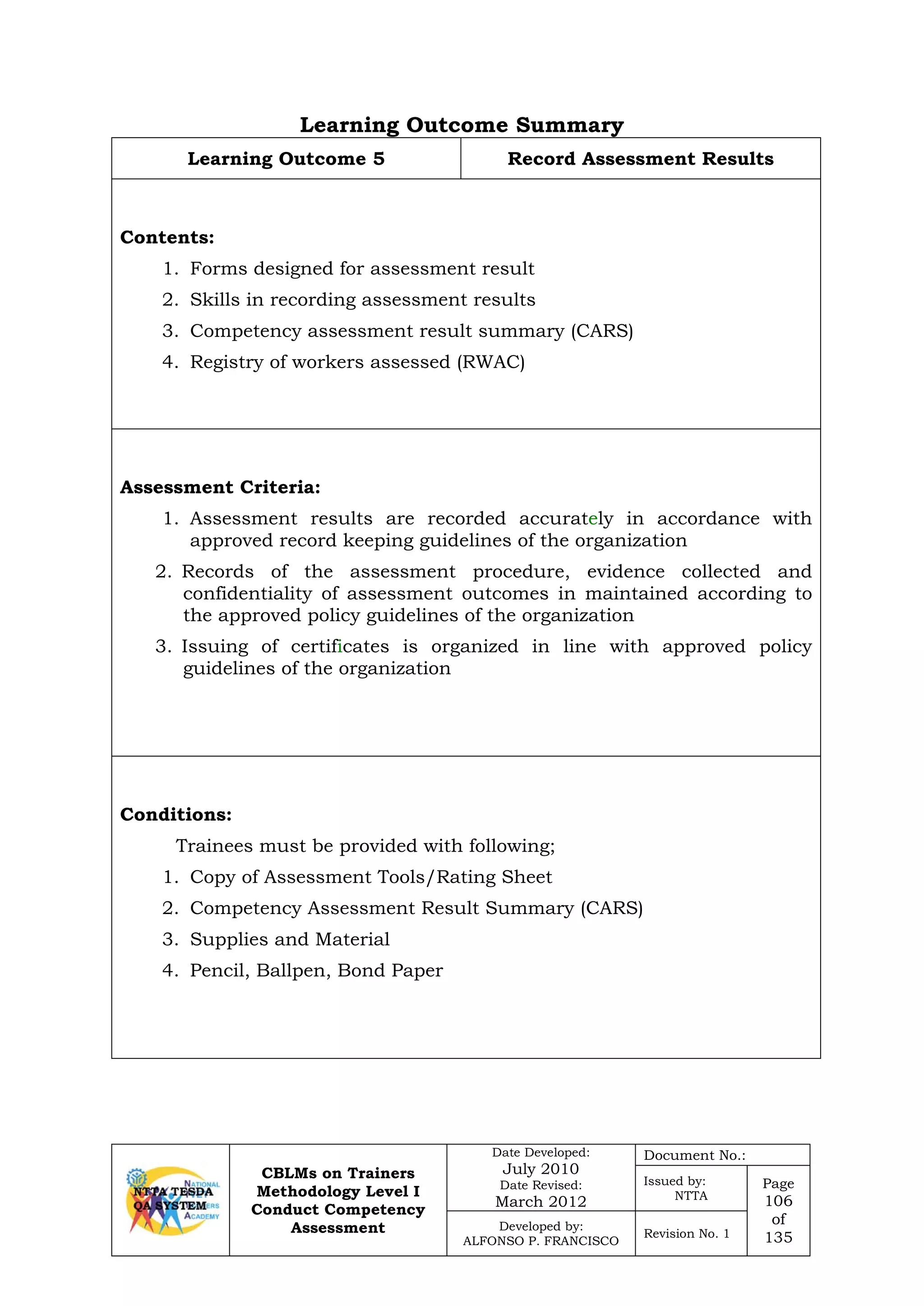
Learning Outcome Summary ..................................................................................................122
LEARNING EXPERIENCES......................................................................................................124
Information Sheet No.1.6-1 Constructive Feedback on Assessment Proceedings ..................125
Self Check 1.6-1 .........................................................................................................127
Answer Key No. 1.6-1.................................................................................................128
Information Sheet No.1.6-2 Skills in Giving Feedback ...........................................................129
Task Sheet No. 1.6-1 Providing Feedback to Candidate ........................................................130
Performance Checklist for Giving Feedback ...............................................................131
Job Sheet No. 1.1-1 Conducting Competency Assessment.....................................................132
Performance Checklist Conducting Competency Assessment ....................................133
Attachments
CBLMs on Trainers
Methodology Level I
Conduct Competency
Assessment
Date Developed:
July 2010
Date Revised:
March 2012
Document No.:
Issued by:
NTTA
Page v
of ix
Developed by:
ALFONSO P. FRANCISCO
Revision No. 1
How to Use This Competency-Based Learning Material
Welcome!
The unit of competency, "Conduct Competency Assessment", is one of
the competencies of TRAINERS METHODOLOGY LEVEL I (TM1), a course
which comprises the knowledge, skills and attitudes required for a TVET
trainer to possess.
The module, Conducting Competency Assessment, contains training
materials and activities related to identifying learner’s requirements,
preparing session plan, preparing basic instructional materials and
organizing learning and teaching activities for you to complete.
In this module, you are required to go through a series of learning
activities in order to complete each learning outcome. In each learning
outcome are Information Sheets, Self-Checks, Task Sheets and Job
Sheets. Follow and perform the activities on your own. If you have
questions, do not hesitate to ask for assistance from your facilitator.
Remember to:
• Read information sheets and complete the self-checks. Suggested
references are included to supplement the materials provided in this
module.
• Perform the Task Sheets and Job Sheets until you are confident that
your outputs conform to the Performance Criteria Checklist that
follows the sheets.
• Submit outputs of the Task Sheets and Job Sheets to your facilitator
for evaluation and recording in the Accomplishment Chart. Outputs
shall serve as your portfolio during the Institutional Competency
Evaluation. When you feel confident that you have had sufficient
practice, ask your trainer to evaluate you. The results of your
assessment will be recorded in your Progress Chart and
Accomplishment Chart.
You must pass the Institutional Competency Evaluation for this
competency before moving to another competency. A Certificate of
Achievement will be awarded to you after passing the evaluation.
CBLMs on Trainers
Methodology Level I
Conduct Competency
Assessment
Date Developed:
July 2010
Date Revised:
March 2012
Document No.:
Issued by:
NTTA
Page
vi of
ixDeveloped by:
ALFONSO P. FRANCISCO
Revision No. 1
Training Methodology I
List of Competencies
No. Unit of Competency Module Title Code
1. Plan Training Session Planning Training Session
2. Facilitate Competency-
Based Training
Facilitating Competency-
Based Training
3. Supervise Work-Based
Learning
Supervising Work-Based
Learning
4. Conduct Competency
Assessment
Conducting Competency
Assessment
5. Maintain Training
Facilities
Maintaining Training
Facilities
6. Utilize Electronic Media in
Facilitating Training
Session
Utilizing Electronic Media
in Facilitating Training
Session
CBLMs on Trainers
Methodology Level I
Conduct Competency
Assessment
Date Developed:
July 2010
Date Revised:
March 2012
Document No.:
Issued by:
NTTA
Page
vii of
ixDeveloped by:
ALFONSO P. FRANCISCO
Revision No. 1
Module Content
PROGRAM/COURSE : Trainers Methodology 1
UNIT OF COMPETENCY : Conduct Competency Assessment
MODULE : Conducting Competency Assessment
INTRODUCTION:
This module covers the knowledge, skills and attitudes in conducting
assessment. It details the requirements for organizing assessment activities,
preparing the candidate, gathering and evaluating evidence, recording
assessment outcomes and providing feedback.
LEARNING OUTCOMES
Upon completion of this module you must be able to;
• Organize assessment activities
• Prepare the candidate
• Gather evidence
• Make the assessment decision
• Record assessment results
• Provide feedback to candidates
ASSESSMENT CRITERIA:
1. Assessment activities in the workplace, training center or
assessment center are identified and organized in accordance with
the relevant Evidence Guide
2. Resources required for assessment, as specified in the Evidence
Guide and the assessment tools, are obtained, checked and arranged
within a safe and accessible assessment environment.
3. Cost of assessment and assessment process are checked to ensure
compliance with organizational policy and procedures.
4. Appropriate personnel are informed of the assessment activity in line
with organizational policy
5. The context and purpose of assessment are explained to candidates
in line with the requirements of the relevant Assessment Guidelines.
CBLMs on Trainers
Methodology Level I
Conduct Competency
Assessment
Date Developed:
July 2010
Date Revised:
March 2012
Document No.:
Issued by:
NTTA
Page
viii of
ixDeveloped by:
ALFONSO P. FRANCISCO
Revision No. 1
6. Legal and ethical responsibilities associated with the assessment
are explained to the candidates in line with the relevant Assessment
Guidelines.
7. The competency standards to be assessed and the evidence to be
collected are clearly explained to the candidate as contained in the
assessment guidelines.
8. Evidence is gathered using assessment methods specified in the
relevant Evidence guide
9. Evidence is gathered and documented in accordance with the
assessment procedures specified in the relevant Assessment
Guidelines.
10. Reasonable adjustments are incorporated in the evidence gathering
procedures, where appropriate in line with the procedures detailed
in the Assessment Guidelines.
11. Evidence is gathered and documented using the relevant
assessment tools
12. The evidence is evaluated in terms of the rules of evidence
13. The evidence is evaluated according to the dimensions of
competency
14. The assessment decision is made based on evaluation of the
evidence and the requirement of relevant unit(s) of competency.
15. Assessment results are recorded accurately in accordance with
approved record keeping guidelines of the organization
16. Records of the assessment procedure, evidence collected and
confidentiality of assessment outcomes in maintained according to
the approved policy guidelines of the organization
17. Issuing of certificates is organized in line with approved policy
guidelines of the organization
18. Clear and constructive feedback on the assessment decision is given
to the candidate in line with the relevant Assessment Guidelines.
19. Ways of overcoming any gaps in competency are explored with the
candidate.
20. The candidate is advised of available reassessment in line with
organizational policy and procedures
21. Any assessment decision disputed by the candidate is recorded and
reported promptly to appropriate personnel in line with
organizational policy and procedures.
CBLMs on Trainers
Methodology Level I
Conduct Competency
Assessment
Date Developed:
July 2010
Date Revised:
March 2012
Document No.:
Issued by:
NTTA
Page 1
of
135Developed by:
ALFONSO P. FRANCISCO
Revision No. 1
Summary of Learning Outcome
Learning Outcome No.1 Organize Assessment Activities
ASSESSMENT CRITERIA:
1. Assessment activities in the workplace, training center are identified
and organized in accordance with the relevant Evidence Guide.
2. Resources required for assessment, as specified in the Evidence
Guide and assessment tools, are obtained, checked and arrange
within a safe and accessible assessment environment.
3. Cost of assessment and assessment process are checked to ensure
compliance with organizational policy and procedures.
4. Appropriate personnel are informed of the assessment activity in line
with organizational policy.
CONTENTS:
• Factors to be considered in organizing assessment activity.
• Purpose of assessment, orientation, documentation and
appointment.
• Proponent of the assessment activity.
• Assessors responsibility and assessor's guide.
• Assessment center's responsibility.
• Assessment resources and assessment packages/instruments.
• Relevant workplace, community and school training center and
equipment.
• Standard Operating Procedures from community,
enterprise / industry.
CONDITIONS: The trainee must be provided with the following:
• PTQCS policies and guidelines in the conduct of assessment.
• Assessment orientation guide.
• Assessment documents, evidence plan/guides.
• Assessment instruments.
• Assessors guides
• List of accredited assessment center and assessor.
ASSESSMENT METHOD
• Written examination
CBLMs on Trainers
Methodology Level I
Conduct Competency
Assessment
Date Developed:
July 2010
Date Revised:
March 2012
Document No.:
Issued by:
NTTA
Page 2
of
135Developed by:
ALFONSO P. FRANCISCO
Revision No. 1
• Oral interview
• Demonstration
CBLMs on Trainers
Methodology Level I
Conduct Competency
Assessment
Date Developed:
July 2010
Date Revised:
March 2012
Document No.:
Issued by:
NTTA
Page 3
of
135Developed by:
ALFONSO P. FRANCISCO
Revision No. 1
LEARNING EXPERIENCES
Learning Outcome 1 Organize assessment activity
Learning Activities Special Instructions
Read Information Sheet No. 1.1-1.
Factors to be Considered in
Organizing Assessment Activity
Answer Self-Check 1.1-1
Check your answer using the
Answer Key No. 1.1-1
Read Information Sheet No. 1.1-2;
Purpose of Assessment,
Orientation, Documentation and
Appointment
Answer Self-Check 1.1-2
Check your answer using the
Answer Key No. 1.1-2
Read Information Sheet No. 1.1-3:
Assessors Responsibility and
Answer Self-Check 1.1-3
Check your answer using the
Answer Key No. 1.1-3
Read Information Sheet No. 1.1-4:
Assessment Centers Responsibility
Answer Self-Check 1.1-4
Check your answer using the
Answer Key Nol.1-4
Read Information Sheet No. 1.1-5:
Assessment Resources and
Assessment Packages/Instruments
Answer Self-Check 1.1-5
Check your answer using the
Answer Key No 1.1-5
CBLMs on Trainers
Methodology Level I
Conduct Competency
Assessment
Date Developed:
July 2010
Date Revised:
March 2012
Document No.:
Issued by:
NTTA
Page 4
of
135Developed by:
ALFONSO P. FRANCISCO
Revision No. 1
Information Sheet 1.1-1
Factors to be Considered in Organizing Assessment Activity
After reading this information sheet, you must be able to identify
factors to be considered in organizing assessment activity.
Assessment- It is the process of collecting evidence and making
judgments on whether competency has been achieved.
The three (3) messages that emerge from this definition of assessment
are that:
• Assessment involves the collection of evidence
• Assessments involves the making of professional judgments
• Assessment is the benchmarks for the competency standard
Planning an assessment activity is a complex exercise. As illustrated
in the diagram below, there is a wide range of factors that needs to be
considered.
Learning Objective:
Factors to be considered in planning assessment activity
PLAN AN
ASSESSMENT
ACTIVITY
Assessment
Guidelines
Competency
Standard
Dimension of
Competency
Workplace
Policies and
Procedures
Availability
of
Assessment
Center
Availability
of Candidate
Equipment
and Tools
Evidence
and
Evidence
Gathering
Tools
CBLMs on Trainers
Methodology Level I
Conduct Competency
Assessment
Date Developed:
July 2010
Date Revised:
March 2012
Document No.:
Issued by:
NTTA
Page 5
of
135Developed by:
ALFONSO P. FRANCISCO
Revision No. 1
Competency Standard
A document of nationally agreed industry statement which describes
the workplace outcomes that industry recognizes as appropriate for
competent performance. It defines the minimum required stock of
knowledge, skills and attitude a person must possess to earn a particular
qualification. It provides the benchmarks for national evaluation.
Specifically, the Evidence Guide of the unit of competency that defines
or identifies the evidences required to determine the competence of the
individual. It provides information on critical aspect of the competency,
underpinning knowledge, underpinning skills, resource implications,
assessment method and context of assessment.
If you are planning to become an assessor you must have a good
knowledge of the competency standard of your qualification for you to gather
quality evidences as listed in the assessment package.
Assessment Guidelines
The information/instructions given to the candidate and/or the
assessor regarding conditions under which the assessment should be
conducted and recorded.
The assessor must follow the relevant Assessment Guidelines in order
to ensure that:
• assessment processes are fair to all candidates
• assessment processes are implemented in a consistent manner
• assessment processes produce high quality and consistent
outcomes.
Dimension of competency
Dimensions of competency must be taken into account when an
assessor is gathering evidence of a candidate's competency for a unit, and
assessment should be designed to address these accordingly.
Competency involves successful work performance. As such it is
usually seen to comprise four dimensions, namely: task skills, task
management skills, contingency management skills and job role
environment skills.
• task skills – this involves undertaking a specific workplace
task[s].
Example: Data are entered into the computer using appropriate
application in accordance with company procedure.
• task management skills – this involves managing a number of
different tasks to complete a whole work activity.
CBLMs on Trainers
Methodology Level I
Conduct Competency
Assessment
Date Developed:
July 2010
Date Revised:
March 2012
Document No.:
Issued by:
NTTA
Page 6
of
135Developed by:
ALFONSO P. FRANCISCO
Revision No. 1
Example: Following presentation feedback on product design is
obtained from the appropriate personnel. Any modifications are
identified and incorporated into the final design.
• contingency management skills – this involves responding to
problems and irregularities when undertaking a work activity.
This may involve dealing with:
 breakdowns
 changes in routine
 unexpected or a typical results or outcomes
 difficult or dissatisfied clients
Example: Notification of shift availability, or non attendance for
shift, is given without undue delay and according to store
policies and procedures.
• job/role environment skills – this involves dealing with the
responsibilities and expectations of the work environment when
undertaking a work activity. This may involve:
 working with others
 interacting with clients and suppliers
 complying with standards operating procedures
 observing enterprise policy and procedures.
Example: Reports is prepared/completed according to company
requirements.
Workplace policies and procedures
Workplace policies often reinforce and clarify standard operating
procedure in a workplace. Assessment should include activities that are very
common in the workplace, such as safety practices, filling up of pertinent
forms and reports, etc.
Evidence gathering tools
The evidence gathering tools are the specific questions or activities
developed from the selected assessment method(s) to be used for the
assessment.
CBLMs on Trainers
Methodology Level I
Conduct Competency
Assessment
Date Developed:
July 2010
Date Revised:
March 2012
Document No.:
Issued by:
NTTA
Page 7
of
135Developed by:
ALFONSO P. FRANCISCO
Revision No. 1
Assessment centers
This is where the actual assessment should take place; it must have a
safe working condition, equipped with the resources needed to conduct
assessment.
Critical information on the resources needed to conduct an
assessment activity is located in the Resource Implications section of the
Evidence Guide of the relevant unit of competency. This section provides
details on the resources needed for the assessment activity.
It is the assessor's responsibility to ensure that the resources required
for assessment are assembled and tested prior the assessment to be
conducted. It is also the assessor’s responsiility to ensure that a safe
assessment environment is provided to the candidate. This includes
ensuring that:
• Relevant personal protective equipment is available
• Tools and equipment are in good working condition
• The assessment site complies with relevant occupational and
safety requirements.
If these conditions are not met, the assessment should not be
conducted.
If candidates are expected to bring materials or equipment to the
assessment they must be notified beforehand.
Assessment candidate
An individual seeking recognition of his/her competencies to acquire a
certification.
CBLMs on Trainers
Methodology Level I
Conduct Competency
Assessment
Date Developed:
July 2010
Date Revised:
March 2012
Document No.:
Issued by:
NTTA
Page 8
of
135Developed by:
ALFONSO P. FRANCISCO
Revision No. 1
Self-Check 1.1-1
Direction: Match the Column A with Column B. Write the letter of your
choice on the space provided. Please use capital letter only.
Column A Column B
1. This refers to the standard
procedures observed in
workplace.
A. Assessment Guidelines
2. It covers all the relevant
evidences for a unit of
competency that should be
observed and gathered
during the assessment.
B. Assessment centers
3. Refers to information given
to the candidate and to the
assessor on the required
conditions during the
conduct of assessment.
C. Dimensions of Competency
4. It provides the required
skills. knowledge and
attitude in assessing
candidate's competency.
D. Evidence Gathering Tools
5. These are the selected
activities and questions
used in gathering
evidences.
E. Unit of competency
F. Workplace policies and
procedures
CBLMs on Trainers
Methodology Level I
Conduct Competency
Assessment
Date Developed:
July 2010
Date Revised:
March 2012
Document No.:
Issued by:
NTTA
Page 9
of
135Developed by:
ALFONSO P. FRANCISCO
Revision No. 1
Answer Key 1.1-1
1. F
2. C
3. A
4. E
5. D
CBLMs on Trainers
Methodology Level I
Conduct Competency
Assessment
Date Developed:
July 2010
Date Revised:
March 2012
Document No.:
Issued by:
NTTA
Page
10 of
135Developed by:
ALFONSO P. FRANCISCO
Revision No. 1
Information Sheet 1.1-2
Purpose of Assessment, Orientation, Documentation and
Appointment
Learning Objective:
After reading this information you must be able to:
1. explain the purpose of assessment.
2. explain the purpose of assessment orientation
3. explain the purpose of documentation
4. explain the purpose of appointment
The purpose of the assessment must be clear to both the assessor and
the candidate. Properly determine if the assessment is for certification,
licensing, OH&S or skills audit.
Assessment maybe carried out for a number of purposes such as:
Qualification
One purpose of the assessment is to officially identify a persons
level of qualification. The qualifications correspond to a specific levels in
the Philippine TVET Qualifications Framework (PTQF). An individual can
be assessed against competency standards, to identify if they meet all the
requirements and thus be issued with a formal qualification. The PTQF
uses National Certificate for a qualification.
Recruitment
Assessment maybe carried out in order to recruit a person for a
particular job or job position. The criteria for the position are generally
stated as selection criteria and form the basis of the interview.
Education or training needs
Assessment can be a tool to identify training needs of employees.
This can be a tool to design relevant training programs.
Employee classification
Industry may use competency standards for employees to move
from one level to another. Subsequent to assessment against the relevant
competency standard it can be determined whether individuals have the
required competency for a corresponding level of performance.
CBLMs on Trainers
Methodology Level I
Conduct Competency
Assessment
Date Developed:
July 2010
Date Revised:
March 2012
Document No.:
Issued by:
NTTA
Page
11 of
135Developed by:
ALFONSO P. FRANCISCO
Revision No. 1
Assurance of progress
Assessment can provide feedback to trainees over a period of
learning. Assessment result can be used to modify the way in which a
training program is delivered to best suit the needs of trainees.
Recognition of Prior Learning
An important aspect of competency-based training is the
recognition of prior learning. People may already possess various
competencies gained through formal or informal learning and experience.
This competencies can be recognized through assessment.
Purpose of Assessment Orientation
The purpose of the assessment orientation is to check candidate’s
readiness for assessment.
The assessment orientation usually being done at Assessment
Centers. The candidates must be equip with the following information on;
1. Qualification for assessment
2. Assessment and certification arrangements
Purpose of Assessment Documentation
The assessment documentation provides the following;
1. candidates personal information, work experience,
education/training, and qualification
2. candidates result of the assessment
3. information on number of candidates assessed and certified on a
certain qualification; and
4. review of assessment process.
Purpose of Assessment Appointment
The assessment appointment ensures that there will be an assessor
on the scheduled date of assessment and to inform candidate on the
schedule of assessment.
CBLMs on Trainers
Methodology Level I
Conduct Competency
Assessment
Date Developed:
July 2010
Date Revised:
March 2012
Document No.:
Issued by:
NTTA
Page
12 of
135Developed by:
ALFONSO P. FRANCISCO
Revision No. 1
Self-Check 1.1-2
Direction: Read the following statements carefully. Write True if the
statement is correct and False if the statement regarding purpose of
assessment is incorrect. Write your answer on the space provided.
______1. Assessment will determine the qualification level of an individual.
______2. The result of the assessment can be used to modify the way
training program is delivered to best suit the needs of the trainees.
______3. Competency based education focus only on the learning acquired
during the duration of the training.
______4. Industry requirement for a particular job should be disregard in the
assessment.
______5. Training needs of an employee can also be determined during
assessment.
CBLMs on Trainers
Methodology Level I
Conduct Competency
Assessment
Date Developed:
July 2010
Date Revised:
March 2012
Document No.:
Issued by:
NTTA
Page
13 of
135Developed by:
ALFONSO P. FRANCISCO
Revision No. 1
Answer Key 1.1-2
1. True
2. True
3. False
4. False
5. False
CBLMs on Trainers
Methodology Level I
Conduct Competency
Assessment
Date Developed:
July 2010
Date Revised:
March 2012
Document No.:
Issued by:
NTTA
Page
14 of
135Developed by:
ALFONSO P. FRANCISCO
Revision No. 1
Information Sheet 1.1-3
Assessors Responsibility and Assessors Guide
After reading this information sheet, you must be able to;
1. identify the assessors responsibility in the assessment activity.
2. explain assessors guide
Assessors Responsibility
Plan an assessment activity,
• ensure the candidate is ready for assessment
• prepare the assessment tools or materials
• ratify assessment procedures with appropriate personnel in the
industry/workplace or training organization
• the time and place for agreed with the candidate and any other
relevant parties
• determine the needs of the candidate and any reasonable or
allowable adjustments that has to be made during assessment
• all appropriate personnel are advised of the assessment.
The assessors guide is a part of the assessment package that provides
general instructions on the conduct of assessment for a specific
qualification.
National assessment and certification arrangement
This part of the Assessors Guide explains how the candidate can be
certified on a qualification, the prerequisite for a qualification and who
are qualified to undertake the assessment
Evidence plan
Evidence plan gives information of the qualification, unit of
competency, the list of required evidences and in what ways or
assessment method the evidences will be collected.
Learning Objective:
Assessors Guide
CBLMs on Trainers
Methodology Level I
Conduct Competency
Assessment
Date Developed:
July 2010
Date Revised:
March 2012
Document No.:
Issued by:
NTTA
Page
15 of
135Developed by:
ALFONSO P. FRANCISCO
Revision No. 1
Specific Instructions for the Assessor
This informs the assessor on the qualification title, unit if
competency, time allotment, condition and feedback.
Suggested Questions and Answers for Demonstration with Oral
Questioning
This enumerates the question to be asked after the performance of
candidates demonstration of the required task and its corresponding
answers.
List of Facilities, Tools, Supplies and Materials
Specifically identifies the quantity and description of the required
facilities, tools, equipment and supplies to be used in the assessmnt.
CBLMs on Trainers
Methodology Level I
Conduct Competency
Assessment
Date Developed:
July 2010
Date Revised:
March 2012
Document No.:
Issued by:
NTTA
Page
16 of
135Developed by:
ALFONSO P. FRANCISCO
Revision No. 1
Self-Check 1.1-3
Direction: Read the following statement carefully. Write True if the
statement regarding assessors responsibility and guide is correct and False
if the statement is incorrect.
______1. The procedures used during the assessment must be ratified by
the appropriate personnel in the industry/workplace.
______2. Before the assessment, candidates must ensure the readiness of
the assessor.
______3. Assessors Guide provides information on the relevant evidence
gathering methods that will be used in gathering evidences.
______4. Other gathering methods that will be used in evaluating less
critical areas are presented in an assessment guide.
______5. The needs and any reasonable or allowable adjustments must be
identified before the start of the assessment.
CBLMs on Trainers
Methodology Level I
Conduct Competency
Assessment
Date Developed:
July 2010
Date Revised:
March 2012
Document No.:
Issued by:
NTTA
Page
17 of
135Developed by:
ALFONSO P. FRANCISCO
Revision No. 1
Answer Key 1.1-3
1. True
2. False
3. True
4. False
5. True
CBLMs on Trainers
Methodology Level I
Conduct Competency
Assessment
Date Developed:
July 2010
Date Revised:
March 2012
Document No.:
Issued by:
NTTA
Page
18 of
135Developed by:
ALFONSO P. FRANCISCO
Revision No. 1
Information Sheet No. 1.1-4
Assessment Centers Responsibility
After reading this information sheet, you must be able to explain the
assessment centers responsibility in the assessment activities.
Accredited Competency Assessment Center (ACAC) is an
establishment officially authorized by TESDA to manage the assessment of
candidates for national certification.
Assessment Center Responsibility
The Accredited Competency Assessment Center under close supervision by
TESDA shall facilitate assessment, pay the services of accredited
competency assessors and submit required reports to TESDA PO/DO and
RO.
CAC Provides Information on Assessment to Candidate
CAC Staff/Processing Officer
• Provides information on Qualifications for assessment
• Provides information on assessment and certification
arrangements
• Administers the self-assessment guide for qualification applied
for to the applicant-candidate
CAC Provides Checklist of Requirements to Applicants
AC Processing Officer
• Provides applicant-candidate the following:
 Application form
 Checklist of Requirements relevant to the Qualification
applied for
Learning Objective
CBLMs on Trainers
Methodology Level I
Conduct Competency
Assessment
Date Developed:
July 2010
Date Revised:
March 2012
Document No.:
Issued by:
NTTA
Page
19 of
135Developed by:
ALFONSO P. FRANCISCO
Revision No. 1
CAC Processing Officer Checks Completeness of Documents
AC Processing Officer
• Checks the following:
 Self Assessment Guide
 Application Form properly and completely filled-out
 Pictures; 3 pcs., colored, passport size, (3.5cm x 4.5cm
with head size ranging from 27 mm to 31 mm; white
background, with collar; and with name printed at the
back:)
CAC Collects Assessment Fee
CAC Processing Officer
• Requests applicant to pay the assessment fee after receiving the
complete documents
• Ensures that assessment fee is paid only to the authorized
person in the Assessment Center and checks Official Receipt
issued to applicant.
• Detaches Admission Slip from the Form and returns it to the
applicant
• Informs candidate of any preparation to be undertaken e.g.,
PPE, etc.
ACAC Assigns Competency Assessor
ACAC Processing Officer
• Prepares Attendance Sheet of candidate-applicants per batch
according to Qualification
• Submits schedule to CAC Manager and requests for
Competency Assessor
ACAC Manager
• Assigns Competency Assessors on rotation basis Note: Each
competency assessor shall assess a maximum of 10 candidates
per assessment schedule
• Confirms competency assessor's acceptance
• Informs TESDA PO/DO of the number of candidates scheduled
for assessment two days before the date of assessment
CBLMs on Trainers
Methodology Level I
Conduct Competency
Assessment
Date Developed:
July 2010
Date Revised:
March 2012
Document No.:
Issued by:
NTTA
Page
20 of
135Developed by:
ALFONSO P. FRANCISCO
Revision No. 1
Competency Assessor Conducts Assessment
CAC Submits Reports to PO
• Reviews the Competency Assessment Results Summary
• Application form with two pictures.
 Electronic copy and three (3) hardcopies of the Registry of
 Workers Assessed and Certified (RWAC)
 CARS
 Rating Sheets
• Post assessment results of candidates found competent
• Pays honoraria of competency assessor
CBLMs on Trainers
Methodology Level I
Conduct Competency
Assessment
Date Developed:
July 2010
Date Revised:
March 2012
Document No.:
Issued by:
NTTA
Page
21 of
135Developed by:
ALFONSO P. FRANCISCO
Revision No. 1
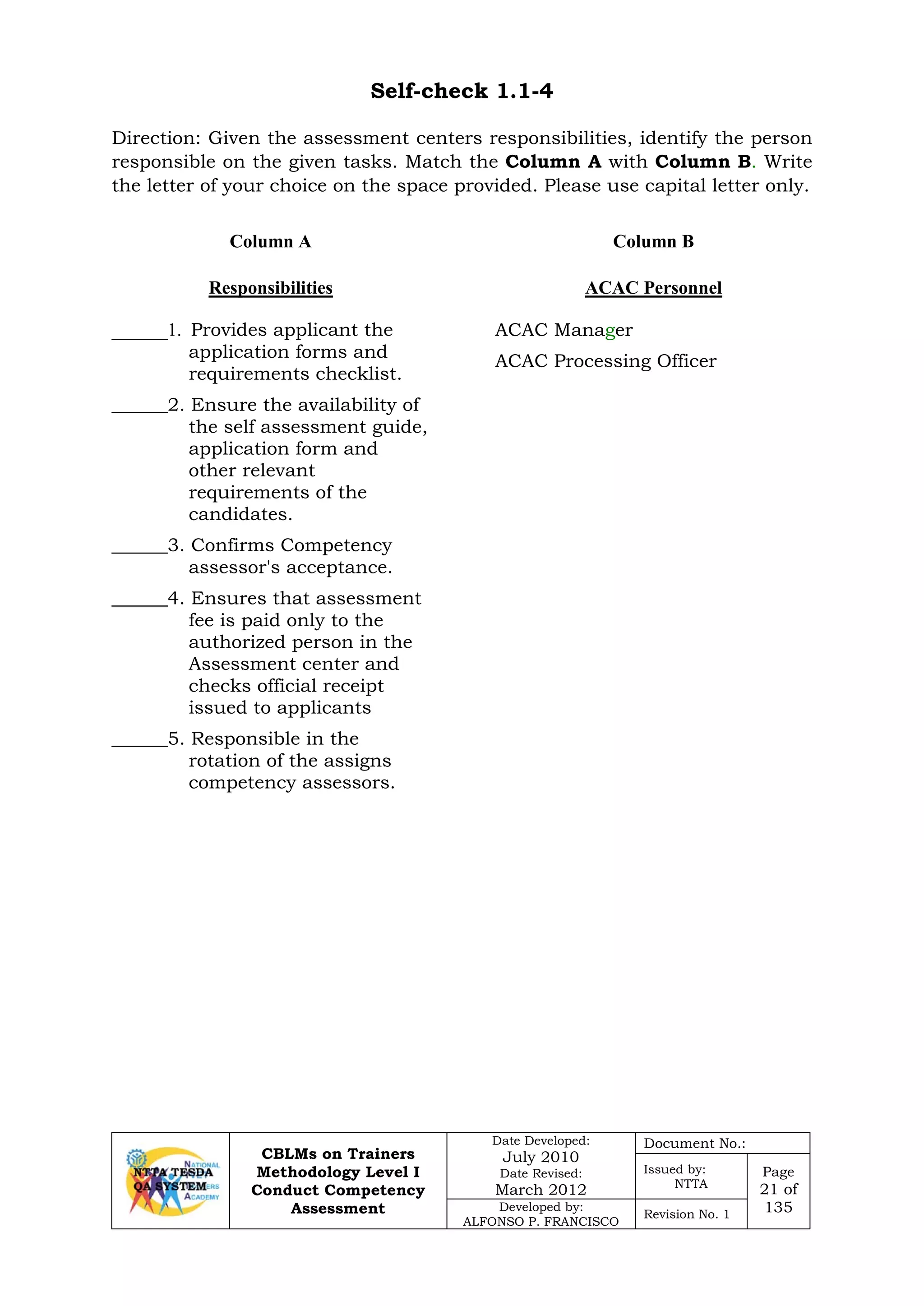
Self-check 1.1-4
Direction: Given the assessment centers responsibilities, identify the person
responsible on the given tasks. Match the Column A with Column B. Write
the letter of your choice on the space provided. Please use capital letter only.
Column A
Responsibilities
Column B
ACAC Personnel
______1. Provides applicant the
application forms and
requirements checklist.
______2. Ensure the availability of
the self assessment guide,
application form and
other relevant
requirements of the
candidates.
______3. Confirms Competency
assessor's acceptance.
______4. Ensures that assessment
fee is paid only to the
authorized person in the
Assessment center and
checks official receipt
issued to applicants
______5. Responsible in the
rotation of the assigns
competency assessors.
ACAC Manager
ACAC Processing Officer
CBLMs on Trainers
Methodology Level I
Conduct Competency
Assessment
Date Developed:
July 2010
Date Revised:
March 2012
Document No.:
Issued by:
NTTA
Page
22 of
135
Developed by:
ALFONSO P. FRANCISCO
Revision No. 1
Answer Key 1.1-4
1. B
2. B
3. A
4. B
5. A
CBLMs on Trainers
Methodology Level I
Conduct Competency
Assessment
Date Developed:
July 2010
Date Revised:
March 2012
Document No.:
Issued by:
NTTA
Page
23 of
135Developed by:
ALFONSO P. FRANCISCO
Revision No. 1
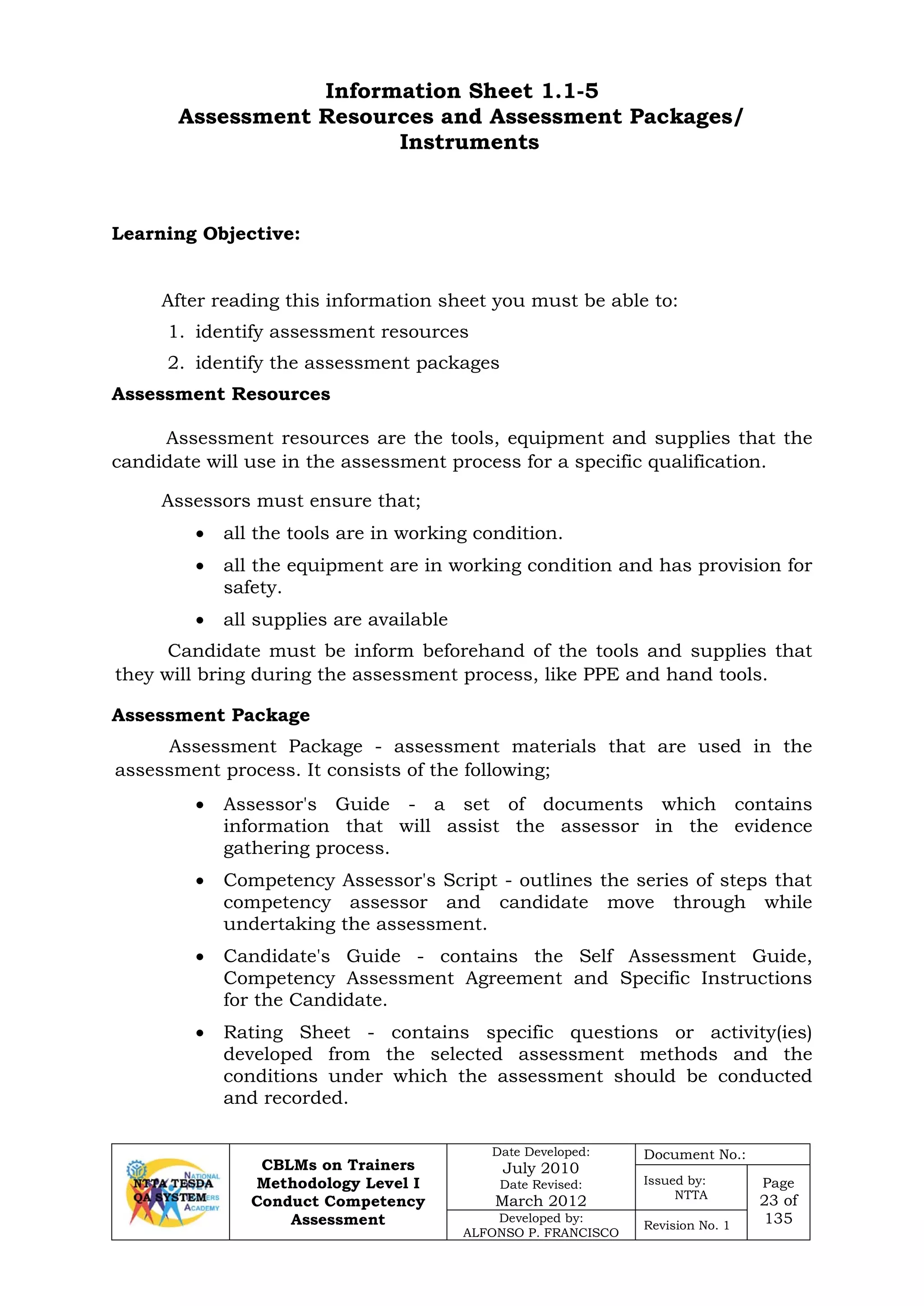
Information Sheet 1.1-5
Assessment Resources and Assessment Packages/
Instruments
After reading this information sheet you must be able to:
1. identify assessment resources
2. identify the assessment packages
Assessment Resources
Assessment resources are the tools, equipment and supplies that the
candidate will use in the assessment process for a specific qualification.
Assessors must ensure that;
• all the tools are in working condition.
• all the equipment are in working condition and has provision for
safety.
• all supplies are available
Candidate must be inform beforehand of the tools and supplies that
they will bring during the assessment process, like PPE and hand tools.
Assessment Package
Assessment Package - assessment materials that are used in the
assessment process. It consists of the following;
• Assessor's Guide - a set of documents which contains
information that will assist the assessor in the evidence
gathering process.
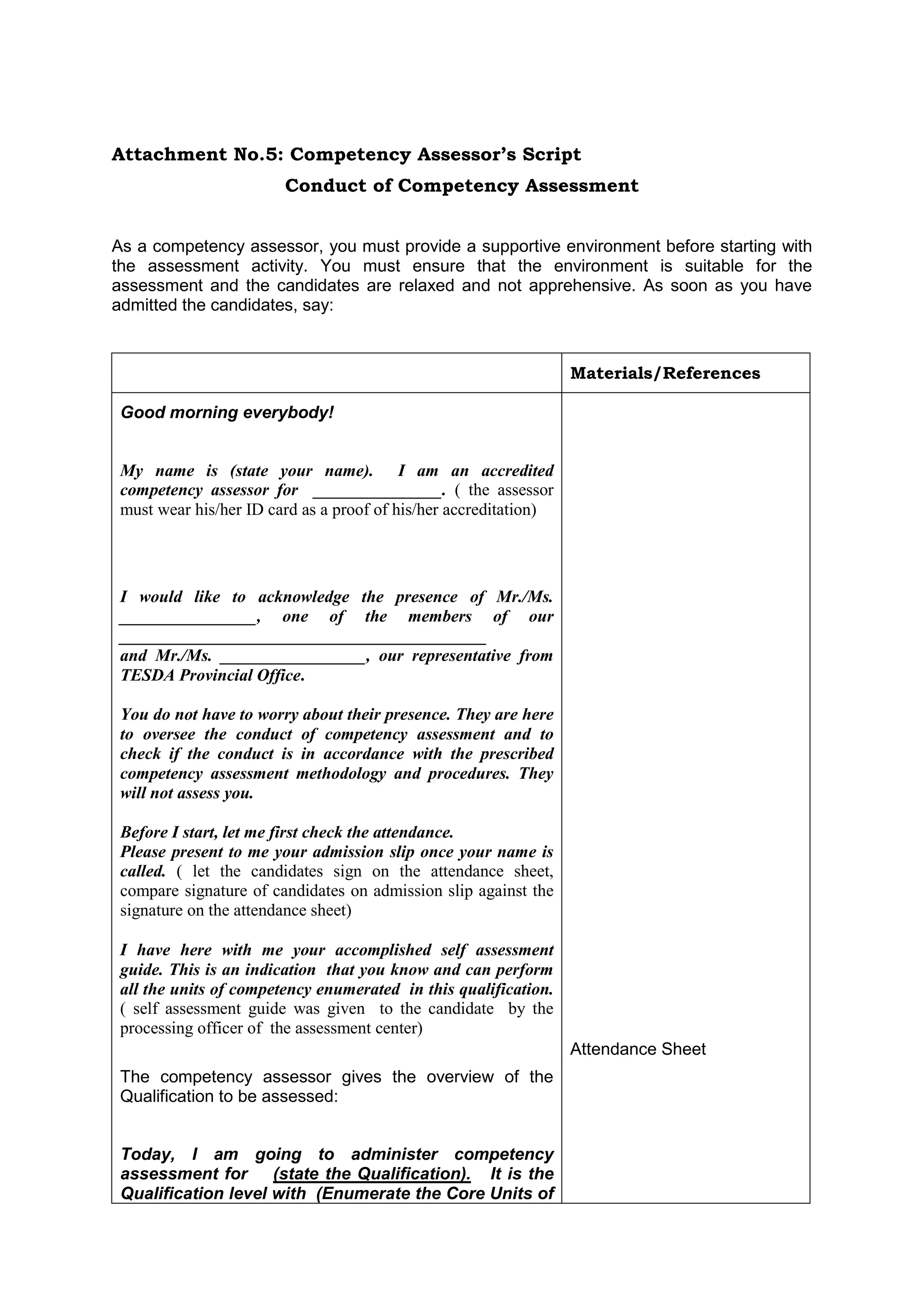
• Competency Assessor's Script - outlines the series of steps that
competency assessor and candidate move through while
undertaking the assessment.
• Candidate's Guide - contains the Self Assessment Guide,
Competency Assessment Agreement and Specific Instructions
for the Candidate.
• Rating Sheet - contains specific questions or activity(ies)
developed from the selected assessment methods and the
conditions under which the assessment should be conducted
and recorded.
Learning Objective:
CBLMs on Trainers
Methodology Level I
Conduct Competency
Assessment
Date Developed:
July 2010
Date Revised:
March 2012
Document No.:
Issued by:
NTTA
Page
24 of
135Developed by:
ALFONSO P. FRANCISCO
Revision No. 1
The assessment packages are being kept at the TESDA Provincial
Office for safekeeping. These are only issued to accredited assessment center
during the scheduled assessment.
CBLMs on Trainers
Methodology Level I
Conduct Competency
Assessment
Date Developed:
July 2010
Date Revised:
March 2012
Document No.:
Issued by:
NTTA
Page
25 of
135Developed by:
ALFONSO P. FRANCISCO
Revision No. 1
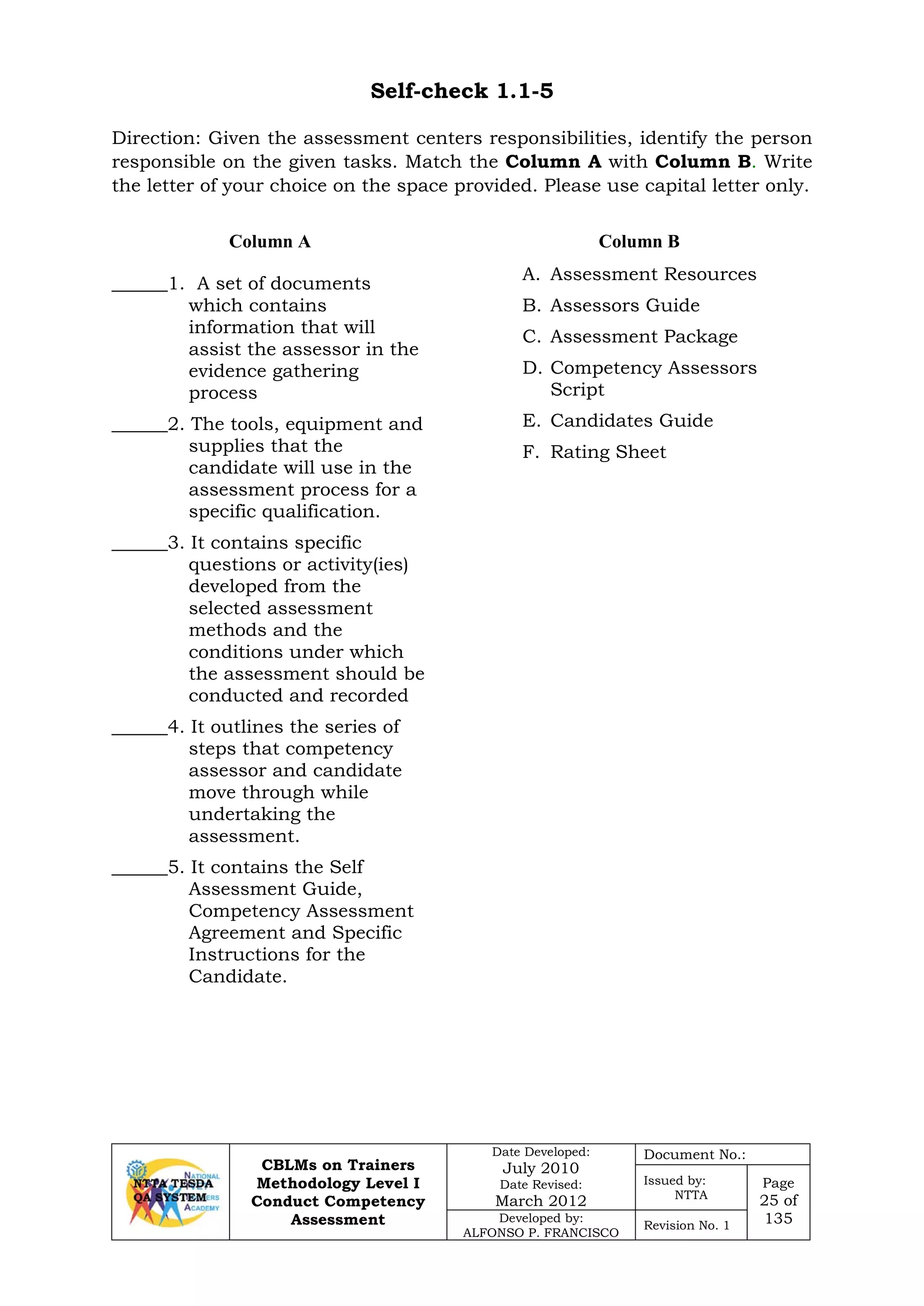
Self-check 1.1-5
Direction: Given the assessment centers responsibilities, identify the person
responsible on the given tasks. Match the Column A with Column B. Write
the letter of your choice on the space provided. Please use capital letter only.
Column A Column B
______1. A set of documents
which contains
information that will
assist the assessor in the
evidence gathering
process
______2. The tools, equipment and
supplies that the
candidate will use in the
assessment process for a
specific qualification.
______3. It contains specific
questions or activity(ies)
developed from the
selected assessment
methods and the
conditions under which
the assessment should be
conducted and recorded
______4. It outlines the series of
steps that competency
assessor and candidate
move through while
undertaking the
assessment.
______5. It contains the Self
Assessment Guide,
Competency Assessment
Agreement and Specific
Instructions for the
Candidate.
A. Assessment Resources
B. Assessors Guide
C. Assessment Package
D. Competency Assessors
Script
E. Candidates Guide
F. Rating Sheet
CBLMs on Trainers
Methodology Level I
Conduct Competency
Assessment
Date Developed:
July 2010
Date Revised:
March 2012
Document No.:
Issued by:
NTTA
Page
26 of
135Developed by:
ALFONSO P. FRANCISCO
Revision No. 1
Answer Key 1.1-5
1. B
2. A
3. F
4. D
5. E
CBLMs on Trainers
Methodology Level I
Conduct Competency
Assessment
Date Developed:
July 2010
Date Revised:
March 2012
Document No.:
Issued by:
NTTA
Page
27 of
135Developed by:
ALFONSO P. FRANCISCO
Revision No. 1
Learning Outcome Summary
Learning Outcome 2 Prepare the Candidate
Contents:
• Context of Assessment.
• Competency standards and Assessment Guidelines
• Assessment forms
Assessment Criteria:
1. The context and purpose of assessment are explained to
candidates in line with the requirements of the relevant
Assessment Guidelines.
2. The needs of the candidates are determined to establish any
allowable adjustments in the assessment procedures.
3. Information is conveyed using verbal and non-verbal language
which promote a supportive assessment environment.
4. Legal and ethical responsibilities associated with the
assessment are explained to the candidates in line with the
relevant Assessment Guidelines.
5. The competency standards to be assessed and the evidence to
be collected are clearly explained to the candidate as contained
in the assessment guidelines.
CBLMs on Trainers
Methodology Level I
Conduct Competency
Assessment
Date Developed:
July 2010
Date Revised:
March 2012
Document No.:
Issued by:
NTTA
Page
28 of
135Developed by:
ALFONSO P. FRANCISCO
Revision No. 1
Conditions
The student/trainee must be provided with the following:
• Assessment forms and application forms
• Evidence Gathering Tools
• Copy of Candidate's guide, Self-Assessment Guide
• Copy of Assessment tools/packages
• Tools, equipment, supplies and materials for the conduct of
assessment
Methodology
• Lecture
• Video presentation
• Group discussion
Assessment Method
• Written Test
• Oral Interview and questioning
• Demonstration
CBLMs on Trainers
Methodology Level I
Conduct Competency
Assessment
Date Developed:
July 2010
Date Revised:
March 2012
Document No.:
Issued by:
NTTA
Page
29 of
135Developed by:
ALFONSO P. FRANCISCO
Revision No. 1
LEARNING EXPERIENCES
Learning Outcome 2 Prepare Candidate
Learning Activities Special Instructions
Read Information Sheet No. 1.2-1.
Context of Assessment
Answer Self-Check 1.2-1
Check your answer using the
Answer Key No. 1.2-1
Read Information Sheet No. 1.2-2;
Competency Standard and
Assessment Guidelines
Answer Self-Check 1.2-2
Check your answer using the
Answer Key No. 1.2-2
Read Information Sheet No. 1.2-3:
Assessment Forms
Answer Self-Check 1.2-3
Check your answer using the
Answer Key No 1.2-3
Perform Task Sheet No. 1.2-1:
Prepare the Candidate
Check your Performance using the
Performance Checklist
Let your trainer observe how
you prepare candidate before
conducting assessment
CBLMs on Trainers
Methodology Level I
Conduct Competency
Assessment
Date Developed:
July 2010
Date Revised:
March 2012
Document No.:
Issued by:
NTTA
Page
30 of
135Developed by:
ALFONSO P. FRANCISCO
Revision No. 1
Information Sheet No. 1.2-1
Context of Assessment
Learning Objective:
After reading this information sheet you should be able to explain the
context of assessment:
When preparing a candidate for assessment it should result to
supportive assessment environment;
• Suitable for the assessment
• Candidate is relaxed and not apprehensive
• Establish rapport with candidate
• Provide overview of the process
• Advise candidate on assessment conditions
• Answer candidate questions
Preparing a candidate for assessment is an orientation activity that
will inform the candidate of the following:
• context and purpose of the assessment and the assessment
process
• competency standards to be assessed and the evidence to be
collected
• assessment procedure, the preparation which the candidate
should undertake and answer any questions
• needs and any allowable adjustments in the assessment
procedure
• understanding of the competency standards, evidence
requirements and assessment process
• readiness for assessment and decide on the time and place of
the assessment
CBLMs on Trainers
Methodology Level I
Conduct Competency
Assessment
Date Developed:
July 2010
Date Revised:
March 2012
Document No.:
Issued by:
NTTA
Page
31 of
135Developed by:
ALFONSO P. FRANCISCO
Revision No. 1
The context of assessment is the environment or setting in which the
assessment activity takes place. A combination of circumstance may be
prepared and established prior to the assessment as this will ensure that
the assessment process will take place as expected.
1. Physical setting- this maybe the workplace, an assessment center,
community project or online set-up. A venue for assessment should be
made accessible to the candidates for their convenience. The assessor
should also ensure that the assessment site is conducive for
assessment.
2. Tools, equipment and facilities- The assessor should introduce to
the candidate the different tools, equipment and facilities that will be
used in the assessment process.
3. Materials - The assessor should also introduce to the candidate the
perishable and consumables materials required during the
assessment. The assessor must also ensure that all documents
pertinent to the assessment are ready and available prior to
assessment.
4. Purpose of assessment-The assessor should have an understanding
of the purpose of assessment such as certification, licensing, OH&S,
skills audit.
5. Employment status of candidate - the assessor can ask questions to
the candidate to know if the assessment is directly related to the
candidate's work?
6. Access to support personnel - one of the things that the assessors
should do in preparing the candidate is to introduce the support staff
that will be a part of the assessment process. It can be a tool keeper or
the one who will issue to you the needed supplies or materials.
Context of Assessment
The context of assessment includes the following:
CBLMs on Trainers
Methodology Level I
Conduct Competency
Assessment
Date Developed:
July 2010
Date Revised:
March 2012
Document No.:
Issued by:
NTTA
Page
32 of
135
Developed by:
ALFONSO P. FRANCISCO
Revision No. 1
Self-Check No. 1.2-1
Direction: Identify the context of assessment. Match the Column A with
Column B. Write the letter of your choice on the space provided. Please use
capita] letter only.
Column A
Description
Column B
Context of Assessment
______1. It refers to the different
equipment and tools use
during the assessment.
______2. It pertains to the relevance
of the assessment to the
candidate's work.
______3. Refers to the venue wherein
the assessment takes
place.
______4. These are the perishable
and consumable material
required during the
assessment.
______5. It includes certification,
licensing. OH&S, skills
audit.
A. Access to support personnel
B. Employment status of
candidate
C. Materials
D. Purpose of assessment
E. Physical setting
F. Tools, Equipment and
facilities
CBLMs on Trainers
Methodology Level I
Conduct Competency
Assessment
Date Developed:
July 2010
Date Revised:
March 2012
Document No.:
Issued by:
NTTA
Page
33 of
135
Developed by:
ALFONSO P. FRANCISCO
Revision No. 1
Answer Key 1.2-1
1. F
2. B
3. E
4. C
5. D
CBLMs on Trainers
Methodology Level I
Conduct Competency
Assessment
Date Developed:
July 2010
Date Revised:
March 2012
Document No.:
Issued by:
NTTA
Page
34 of
135Developed by:
ALFONSO P. FRANCISCO
Revision No. 1
Information Sheet No. 1.2-2
Competency Standard and Assessment Guidelines
Learning Objectives:
After reading this information sheet you must be able to:
1. Explain to the candidate the competency standard to be assessed.
2. Explain the assessment guidelines.
3. Explain reasonable adjustment
The Competency Standard
The competency standard is a document that defines the
competencies required for effective performance in the workplace. It is a
written specification of the knowledge, skills and attitude required for a
peformance of job or occupation and the corresponding standard required
for these in a workplace.
Another aspect of preparing the candidate is the introduction of the
competency/ies to be assessed. The assessor must explicitly explain the
following;
• The relevant unit of competency/ies covered in the assessment.
The assessor must explain the different elements covered for
each competency.
• The evidence requirements as stipulated in the evidence guide
for each unit of competency.
Assessment Guidelines and the Assessment Process
Assessment Guidelines are being developed to support each set of
competency standards developed by TESDA. The Guidelines:
• confirm that the benchmarks for assessment are the
competency standards.
• set out the rules on how evidence will be gathered
• describe the process for designing evidence gathering tools
• describe the assessment process
• set out the assessor requirements.
CBLMs on Trainers
Methodology Level I
Conduct Competency
Assessment
Date Developed:
July 2010
Date Revised:
March 2012
Document No.:
Issued by:
NTTA
Page
35 of
135Developed by:
ALFONSO P. FRANCISCO
Revision No. 1
The assessor must follow the relevant Assessment Guidelines in order
to ensure that:
• assessment processes are fair to all candidates
• assessment processes are implemented in a consistent manner
• assessment processes produce high quality and consistent
outcomes.
Reasonable Adjustment
Reasonable adjustment, sometimes called reasonable accommodation
or allowable adjustment, is designed to ensure that all people are treated
equally in the assessment process.
This means that, wherever possible, 'reasonable' adjustments are
made to the assessment process to meet the individual needs of candidates.
For example, this may involve translating written instructions into
local dialect for candidates from non-English speaking backgrounds or
providing instructions orally rather than in writing for candidates with
limited language skills.
Adjustments are considered 'reasonable' if they do not impose an
unjustifiable hardship upon the assessment centre. In determining whether
an adjustment would impose unjustifiable hardship, the following factors
should be taken into account:
• the nature of the benefit or disadvantage likely to be
experienced by the candidate
• the effect of the disadvantage on the person concerned
• the cost of making the adjustment.
Forms of reasonable adjustment
• Translate English into local dialects
• Use oral in place of written instructions
Legal and ethical responsibilities
• Occupational Health & Safety - it is important to inform the
candidate the nature of work and the potential hazard it may
cause to him. Candidate should be reminded of the
precautionary measures; like not be allowing them to undergo
assessment if they are not wearing appropriate personal
protective equipment, or they are exhibiting unsafe actions.
• Confidentiality of the assessment process means that all
information about the assessment should be kept confidential.
The assessor must ensure that the following must be kept
secured;
CBLMs on Trainers
Methodology Level I
Conduct Competency
Assessment
Date Developed:
July 2010
Date Revised:
March 2012
Document No.:
Issued by:
NTTA
Page
36 of
135Developed by:
ALFONSO P. FRANCISCO
Revision No. 1
 Assessment Package must kept in secured place, the
assessor should ensure that all the copies of the
assessment package are retrieved after the assessment
activity. This will guarantee the integrity of the
assessment package.
 Candidate’s assessment result must also be kept
confidential to ensure candidates personal integrity. The
assessment result can only be made available to
authorized personnel, like to his supervisor or human
resource personnel where he works and to the institution
where he is actually have his training.
 Assessment procedure or process must also be kept
confidential. The assessor must inform the candidate to
refrain from giving any form of information that took place
during the assessment process.
• Free consent of candidates - Assessor must ensure that the
candidate was not pressured in any way to be assessed.
• Adheres to quality system, policies and procedures of the
workplace.
• Integrity of the assessor - assessor must not in any way make
assessment decision in favor of somebody request, be it the
candidate, a close acquaintance/friend, or even powerful people.
The decision must be solely based on the result of the
assessment.
• Appeal Process - appeal for reassessment to gain an
independent second opinion will apply in cases where a
candidate is judged as "Not yet competent" and believes they
have been incorrectly assessed. The underlying principles of an
appeal process include:
 a natural justice for a candidate, to avoid unfair treatment
or an assessors' error of judgment;
 an incentive to quality and consistent performance bv
assessors;
 assurance to employers and candidates of the objectivity
of the assessment system.
CBLMs on Trainers
Methodology Level I
Conduct Competency
Assessment
Date Developed:
July 2010
Date Revised:
March 2012
Document No.:
Issued by:
NTTA
Page
37 of
135Developed by:
ALFONSO P. FRANCISCO
Revision No. 1
Self-Check 1.2-2
Direction: Read the following statement carefully. Write True if the
statement regarding assessors responsibility and guide is correct and False
if the statement is incorrect.
______1. The evidence gathering process is identified in the assessment
guidelines.
______2. The competency/ies to be assessed will be disclosed to the
candidates after the assessment process.
______3. Assessment Guidelines must be followed by the assessor to ensure
inconsistency in the process of assessment.
______4. Established assessment processes must be fair to all candidates.
______5. Adjustment are considered reasonable if they do not impose an
unjustifiable hardship upon the assessment center.
______6. The result of the assessment will be made available for public
information.
______7. In making decisions, assessor must consider the family background
and the capability of the candidate to provide extra fee for his/her
service.
______8. Reasonable accommodation is designed to ensure that all people
are treated equally in the assessment process.
______9. Those who failed in the assessment may appeal for reassessment.
______10. Assessor may translate English into the local dialect of the
candidate if necessary.
True or False
CBLMs on Trainers
Methodology Level I
Conduct Competency
Assessment
Date Developed:
July 2010
Date Revised:
March 2012
Document No.:
Issued by:
NTTA
Page
38 of
135Developed by:
ALFONSO P. FRANCISCO
Revision No. 1
Answer Key 1.2.2
1. True
2. False
3. False
4. True
5. True
6. False
7. False
8. True
9. True
10. True
CBLMs on Trainers
Methodology Level I
Conduct Competency
Assessment
Date Developed:
July 2010
Date Revised:
March 2012
Document No.:
Issued by:
NTTA
Page
39 of
135Developed by:
ALFONSO P. FRANCISCO
Revision No. 1
Information Sheet No. 1.2-3
The Assessment Forms
Learning Objective
After reading this information sheet, you must be able to identify the
different assessment forms.
Assessment Forms
Assessors must be aware of the different assessment forms being used
in the assessment process. The following are the forms used in the
assessment process;
• Candidates Application Form
The candidates Application Form is filled up by the candidate
upon undergoing orientation at the assessment center, pertinent
data will be given by the candidate, such as his/her personal
profile, education, work experience. This form also includes the
admission slip that the candidate will have to bring during the
scheduled assessment.
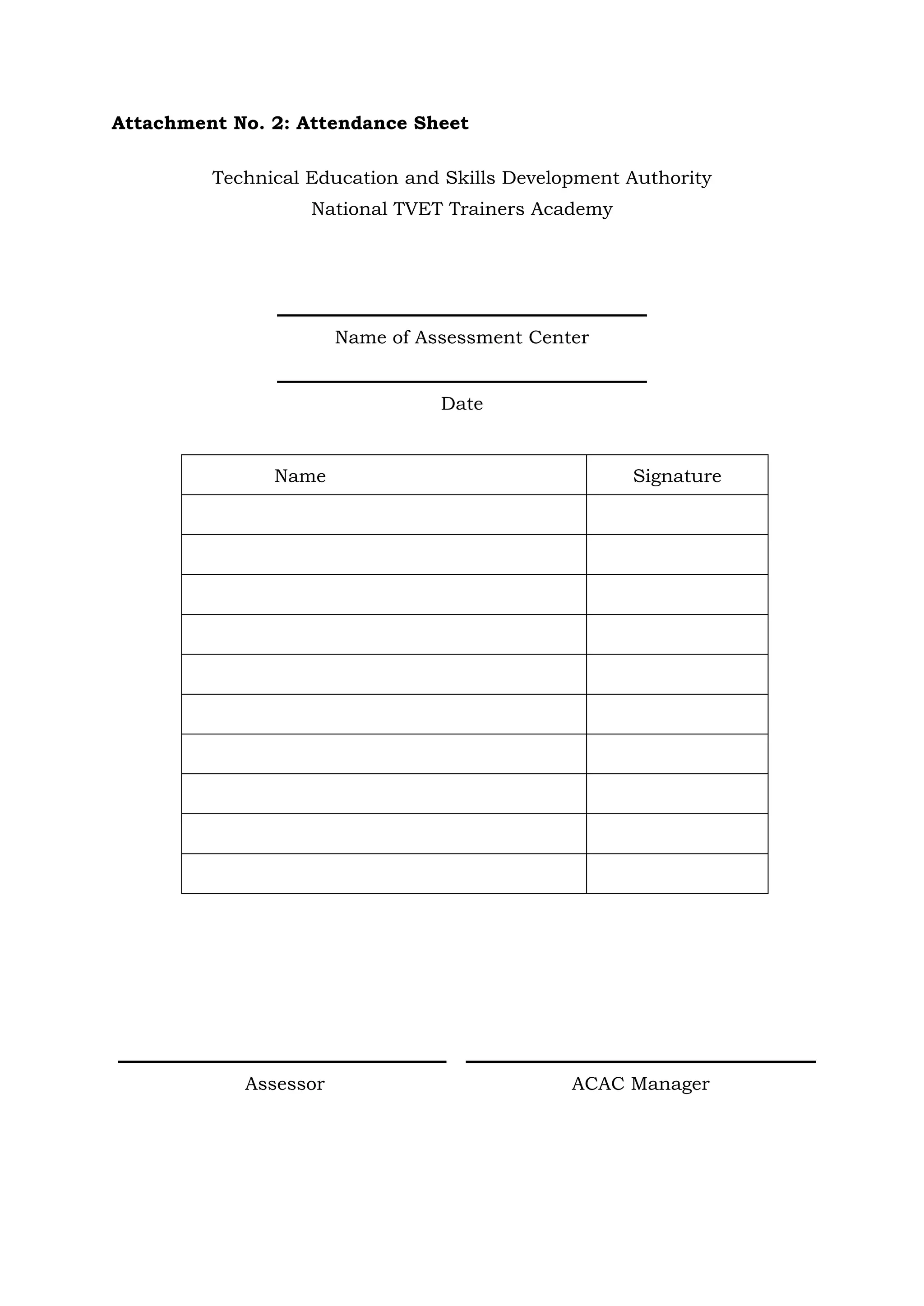
• Attendance Sheet is one of the required forms that the assessor
should have to bring during the actual assessment. The
candidate should fill up this attendance sheet to confirm that he
is present during the assessment.
• Competency Assessment Agreement refers to the document
which is concurred by the candidate and the assessor regarding
the requirements of assessment.
• Registry of Workers Assessed and Certified refers to a record
that contains the documentation of the results of assessment
and as a basis for national certification.
• Competency Assessment Results Summary refers to the
consolidated assessment decisions made by the competency
assessor which indicates the overall performance of the
candidate during the assessment process.
• Assessment Package - assessment materials that are used in
the assessment process. It consists of the following; 1)
Assessor's Guide; 2) Competency Assessor's Script; 3)
Candidate's Guide; and 4) Rating sheet.
CBLMs on Trainers
Methodology Level I
Conduct Competency
Assessment
Date Developed:
July 2010
Date Revised:
March 2012
Document No.:
Issued by:
NTTA
Page
40 of
135Developed by:
ALFONSO P. FRANCISCO
Revision No. 1
Technical Education and Skills Development Authority
Pangasiwaan sa Edukasyong Teknikal at Pagpapaunlad ng Kasanayan
AA PP PP LL II CC AA TT II OO NN FF OO RR MM
v
Name of School/Training Center/Company:
Address
Title of Assessment applied for:
 Full Qualification  COC
1. Client Type
 TVET graduate  Industry worker  SCEP
2. Profile
2.1. Name:
Last First Middle
2.2. Mailing Address:
Number, Street Barangay District
City Province Region Zip Code
2.3. Mother’s Name 2.4. Father’s Name
2.5. Sex 2.6. Civil Status 2.7. Contact Number(s)
2.8. Highest Educational
Attainment
2.9. Employment Status
 Male  Single Tel:  Elementary graduate  Casual  Probationary
 Female  Married Cellular:  HS graduate  Contractual  Regular
 Window/er e-mail :  TVET graduate  Job Order  Permanent
 Separated Fax::  College level If Student  Self-employed
Others:  College graduate  Trainee/OJT
 Post graduate  Others, pls specify
 Others: ___________
2.10. Birth date: 2.11. Birth place: 2.12. Age:
Applicant’s Signature
Picture,
colored
Passport size
White
background
Date
CBLMs on Trainers
Methodology Level I
Conduct Competency
Assessment
Date Developed:
July 2010
Date Revised:
March 2012
Document No.:
Issued by:
NTTA
Page
41 of
135Developed by:
ALFONSO P. FRANCISCO
Revision No. 1
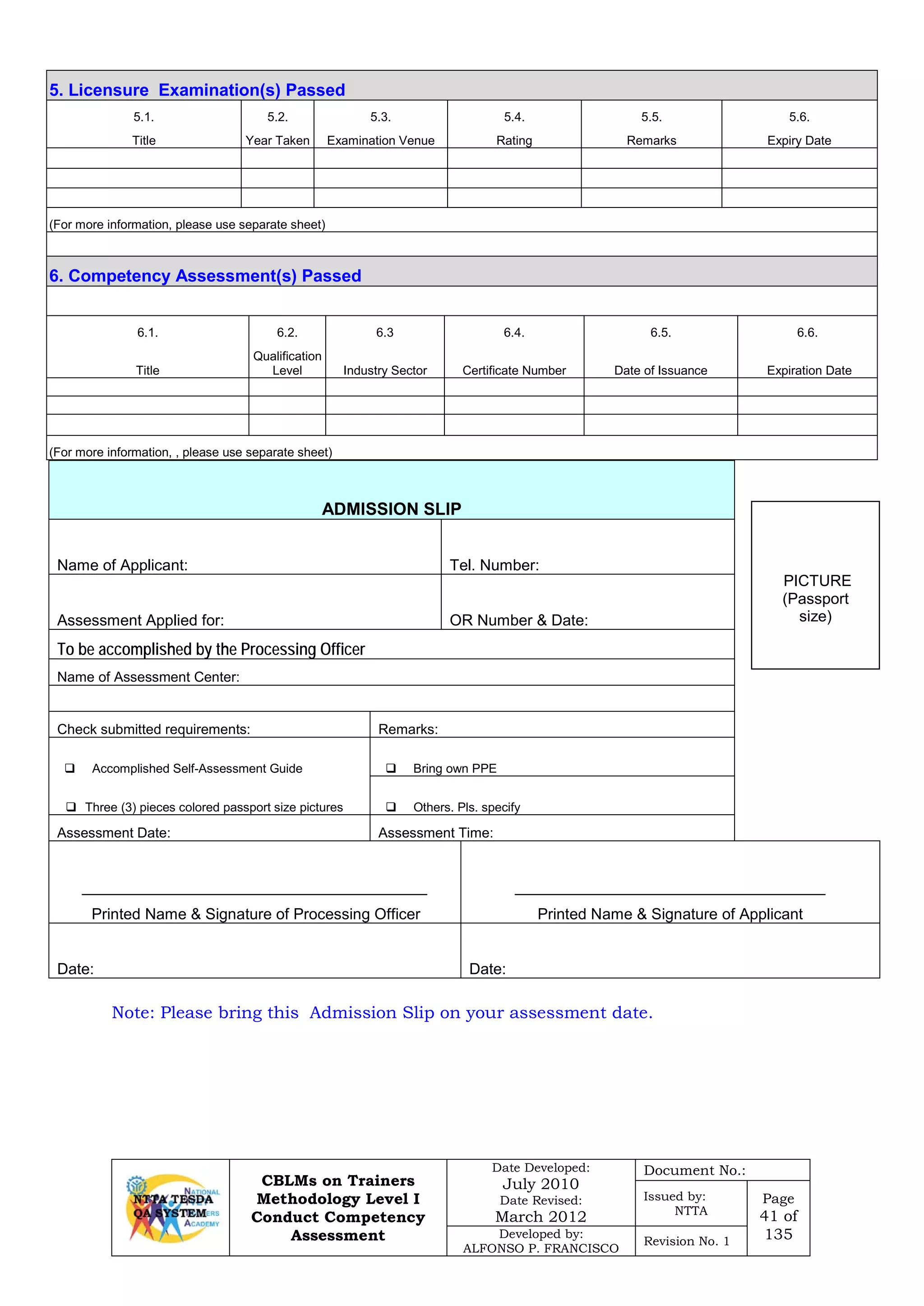
ADMISSION SLIP
Name of Applicant: Tel. Number:
Assessment Applied for: OR Number & Date:
To be accomplished by the Processing Officer
Name of Assessment Center:
Check submitted requirements: Remarks:
 Accomplished Self-Assessment Guide  Bring own PPE
 Three (3) pieces colored passport size pictures  Others. Pls. specify
Assessment Date: Assessment Time:
________________________________________
Printed Name & Signature of Processing Officer
____________________________________
Printed Name & Signature of Applicant
Date: Date:
Note: Please bring this Admission Slip on your assessment date.
5. Licensure Examination(s) Passed
5.1. 5.2. 5.3. 5.4. 5.5. 5.6.
Title Year Taken Examination Venue Rating Remarks Expiry Date
(For more information, please use separate sheet)
6. Competency Assessment(s) Passed
6.1. 6.2. 6.3 6.4. 6.5. 6.6.
Title
Qualification
Level Industry Sector Certificate Number Date of Issuance Expiration Date
(For more information, , please use separate sheet)
PICTURE
(Passport
size)
CBLMs on Trainers
Methodology Level I
Conduct Competency
Assessment
Date Developed:
July 2010
Date Revised:
March 2012
Document No.:
Issued by:
NTTA
Page
42 of
135Developed by:
ALFONSO P. FRANCISCO
Revision No. 1
Technical Education and Skills Development Authority
National TVET Trainers Academy
Name of Assessment Center
Date
Name Signature
Assessor ACAC Manager
Sample Attendance Sheet
CBLMs on Trainers
Methodology Level I
Conduct Competency
Assessment
Date Developed:
July 2010
Date Revised:
March 2012
Document No.:
Issued by:
NTTA
Page
43 of
135Developed by:
ALFONSO P. FRANCISCO
Revision No. 1
Sample COMPETENCY ASSESSMENT AGREEMENT
Candidate’s Name:
Assessor’s Name:
Qualification: RAC SERVICING (PACU/CRE) NC II
Units of Competency to be
Assessed:
BASIC UNITS
• Participate in Workplace Communication
• Work in Team Environment
• Practice Career Professionalism
• Practice Occupational Health and Safety Procedures
COMMON UNITS
• Perform mensuration and calculation
• Prepare materials and tools
• Observes procedures, specifications and manual of
instruction
• Perform basic benchwork
• Perform basic electrical works
• Maintain tools and equipment
• Perform housekeeping and safety practices
• Document work accomplished
CORE UNITS
• Survey site for installation
• Install PACU/CRE
• Install PACU/CRE piping systems
• Install PACU/CRE electrical systems
• Service and maintain PACU/CRE units
• Troubleshoot PACU/CRE systems
• Recover and recycle refrigerant in PACU/CRE systems
• Repair and retrofit PACU/CRE systems and its
accessories
• Perform start-up and commissioning for PACU/CRE
systems
YES NO
• Have the context and purpose of assessment been explained?
• Have the qualification and units of competency been explained
CBLMs on Trainers
Methodology Level I
Conduct Competency
Assessment
Date Developed:
July 2010
Date Revised:
March 2012
Document No.:
Issued by:
NTTA
Page
44 of
135Developed by:
ALFONSO P. FRANCISCO
Revision No. 1
• Do you understand the assessment procedure and evidence to
be collected?
• Have your rights and appeal system been explained?
• Have you discussed any special needs to be considered during
assessment?
I agree to undertake assessment in the knowledge that information gathered will only
be used for professional development purposes and can only be accessed by
concerned assessment personnel and my manager/supervisor.
Candidate’s Signature: Date:
Assessor’s Signature: Date:
CBLMs on Trainers
Methodology Level I
Conduct Competency
Assessment
Date Developed:
July 2010
Date Revised:
March 2012
Document No.:
Issued by:
NTTA
Page
45 of
135Developed by:
ALFONSO P. FRANCISCO
Revision No. 1
CBLMs on Trainers
Methodology Level I
Conduct Competency
Assessment
Date Developed:
July 2010
Date Revised:
March 2012
Document No.:
Issued by:
NTTA
Page
46 of
135Developed by:
ALFONSO P. FRANCISCO
Revision No. 1
Competency Assessment Result Summary
Candidate’s Name:
Assessor’s Name:
Title of Qualification / Cluster of
Units of Competency
Assessment Center: Date:
The performance of the candidate in the following unit(s) of competency and
corresponding methods
Satisfactory Not Satisfactory
Units of Competency
1.
2.
3.
Note: Satisfactory Performance shall only be given to candidate who demonstrated successfully all the competencies
identified in the above-named Qualification/Cluster of Units of Competency
Recommendation:  For issuance of NC/COC
(Indicate title of COC, if full
Qualification is not met)
 For submission of
additional documents
Specify: _______________
______________________
 For re-assessment (pls.
specify)
Did the candidate overall performance meet the required evidences/standards?
 YES  NO
OVERALL EVALUATION  Competent  Not Yet Competent
General Comments [Strengths/Improvements needed]
Candidate’s signature: Date:
Assessor’s signature: Date:
Assessment Center Manager
Signature:
Date:
CBLMs on Trainers
Methodology Level I
Conduct Competency
Assessment
Date Developed:
July 2010
Date Revised:
March 2012
Document No.:
Issued by:
NTTA
Page
47 of
135Developed by:
ALFONSO P. FRANCISCO
Revision No. 1
Self-Check 1.2.-2
Direction; Identify the forms being used in the assessment. Match the
Column A with Column B. Write the letter of your choice on the space
provided. Please use capital letter only.
Column A
Definition
Column B
6.
_____ 1. It is the consolidated
assessment decisions on
the overall performance
of the candidate.
Assessment Forms
_____ 2. It is compose of the
Assessor's Guide,
Competency Assessor's
Script, Candidate's Guide
and Rating Sheet-
_____ 3. Document that must
be completed by the
candidate upon
undergoing orientation.
_____ 4. This form will serve as an
evidence that the
candidate i s present
during the actual
conduct of the
assessment.
_____ 5. It is the basis for the
national certification. It
contains the
documentation of the
results of assessment.
A. Attendance Sheet
B. Assessment Package
C. Candidate Application Form
D. Competency Assessment
Agreement Form
E. Competency Assessment
Results Summary
F. Registry of Workers
Assessed and Certified
CBLMs on Trainers
Methodology Level I
Conduct Competency
Assessment
Date Developed:
July 2010
Date Revised:
March 2012
Document No.:
Issued by:
NTTA
Page
48 of
135Developed by:
ALFONSO P. FRANCISCO
Revision No. 1
Answer Key 1.2-3
1. E
2. B
3. C
4. A
5. F
CBLMs on Trainers
Methodology Level I
Conduct Competency
Assessment
Date Developed:
July 2010
Date Revised:
March 2012
Document No.:
Issued by:
NTTA
Page
49 of
135Developed by:
ALFONSO P. FRANCISCO
Revision No. 1
Task Sheet 1.2-1
Preparing Candidates
Given a candidate, competency assessment agreement, pencil and ball
pen you are to role play on preparing candidate for assessment following the
procedure listed below.
One of the most important phase of conducting assessment is to
prepare the candidate for assessment before the assessor starts to gather
evidences. Remember, as a competency assessor, you must provide a
supportive environment before starting with the assessment activity. You
must ensure that the environment is suitable for the assessment and the
candidates are relaxed and not apprehensive.
Prepare candidate for assessment following the steps listed below
1. Explain the context and purpose of assessment to candidates in line
with the requirements of the relevant Assessment Guidelines.
2. Determine the needs of the candidates to establish any allowable
adjustments in the assessment procedures.
3. Convey information using verbal and non-verbal language to promote
a supportive assessment environment.
4. Explain the legal and ethical responsibilities associated with the
assessment to the candidates in line with the relevant Assessment
Guidelines.
5. Explain the competency standards to be assessed and the evidence to
be collected to the candidate as contained in the assessment
guidelines.
Performance Objective
CBLMs on Trainers
Methodology Level I
Conduct Competency
Assessment
Date Developed:
July 2010
Date Revised:
March 2012
Document No.:
Issued by:
NTTA
Page
50 of
135Developed by:
ALFONSO P. FRANCISCO
Revision No. 1
Below is a part of the assessors script that can guide you in preparing
the candidate.
Materials/References
Good morning everybody!
My name is (state your name). I am an
accredited competency assessor for
_______________. ( the assessor must wear his/her
ID card as a proof of his/her accreditation)
I would like to acknowledge the presence of
Mr./Ms. ________________, one of the members of
our ___________________________________________
and Mr./Ms. _________________, our
representative from TESDA Provincial Office.
You do not have to worry about their presence.
They are here to oversee the conduct of
competency assessment and to check if the
conduct is in accordance with the prescribed
competency assessment methodology and
procedures. They will not assess you.
Before I start, let me first check the
attendance.
Please present to me your admission slip once
your name is called. ( let the candidates sign on
the attendance sheet, compare signature of
candidates on admission slip against the signature
on the attendance sheet)
I have here with me your accomplished self
assessment guide. This is an indication that
you know and can perform all the units of
competency enumerated in this qualification. (
self assessment guide was given to the candidate
by the processing officer of the assessment center)
The competency assessor gives the overview of the
Qualification to be assessed:
Today, I am going to administer competency
assessment for (state the Qualification). It is
the Qualification level with (Enumerate the
Core Units of Competencies . Core Competencies
Attendance Sheet
CBLMs on Trainers
Methodology Level I
Conduct Competency
Assessment
Date Developed:
July 2010
Date Revised:
March 2012
Document No.:
Issued by:
NTTA
Page
51 of
135Developed by:
ALFONSO P. FRANCISCO
Revision No. 1
namely:
1. ______________________
2. _______________________
3. ________________________
OR
These ____________________ core units are
clustered to form one (1) assessment package
for full Qualification / ----------------------- clustered
units of Competency which is --------------------------------
--------. It covers the following:
Relevant Qualification /
units of competency
Relevant National
Assessment and
Certification Arrangements
Relevant copy of National
Assessment Package for
Full Qualification
Clustered Units of
Competency
( Certificate of
Competency)
The competency assessor orients/briefs the
candidates. Explains the following:
• context and purpose of assessment
• qualification/units of competency to be
assessed
• tasks to be performed and the evidence to be
collected
• assessment procedures to be undertaken
• needs of the candidates to be considered
during assessment
• allowable/reasonable adjustments in the
assessment procedure
(the competency assessor can conduct
orientation to at least ten (10) candidates)
Relevant Copy of
CS/Qualification
Copy of National
Assessment package for
full Qualification
( National Certificate)
Clustered Units of
Competency
( Certificate of
Competency)
CBLMs on Trainers
Methodology Level I
Conduct Competency
Assessment
Date Developed:
July 2010
Date Revised:
March 2012
Document No.:
Issued by:
NTTA
Page
52 of
135Developed by:
ALFONSO P. FRANCISCO
Revision No. 1
Do you have any questions or clarifications?
If none, I will now distribute the Competency
Assessment Agreement sheets. Please read the
instructions carefully and answer all the
questions outlined in the document.
If you need assistance, I will be more than
willing to assist you.
(The competency assessor explains and guides the
candidates in accomplishing the Competency
Assessment Agreement sheet)
Competency Assessment
Agreement Sheet
After the candidate is through with accomplishing
the Competency Assessment Agreement sheet, you
will review the answers and will give feedback to
the candidates.
You now assign a number to the candidates
(candidate #1, candidate # 2, candidate #3) . . . . .
and give instruction that candidate #1 will be the
first to enter the assessment room. The other
candidates will have to wait at the waiting area.
Accomplished Competency
Assessment Agreement
sheet
CBLMs on Trainers
Methodology Level I
Conduct Competency
Assessment
Date Developed:
July 2010
Date Revised:
March 2012
Document No.:
Issued by:
NTTA
Page
53 of
135Developed by:
ALFONSO P. FRANCISCO
Revision No. 1
Performance Checklist for Preparing Candidate for
Assessment
Trainee's Name __________________________________Date ____________________
During the performance of the task did you consider the following criteria?
Criteria YES No
Did the assessor….
• Check the attendance of candidate?
• Collect admission slip?
• Instruct the candidates to sign the attendance sheet?
• Provide overview of the Qualification to be assessed
(national Assessment and Certification Arrangements)?
• Instruct the candidates to accomplish the competency
assessment agreement
• Orients the candidate on the following:
o Explain the context, purpose and the assessment
process?
o Explain the Qualification or units of competency to
be assessed and the evidence to be collected?
o Outline the assessment procedures to be
undertaken?
o Assessed the needs of the candidates and
determine any allowable adjustments in the
assessment procedure?
o Seek feedback regarding the candidates
understanding of the Qualification/unit of
competency to be assessed, evidence requirements,
and assessment process?
o Make the necessary announcements just before
the start of the assessment?
o Specify the do’s and don’ts inside the assessment
center?
Comments:
CBLMs on Trainers
Methodology Level I
Conduct Competency
Assessment
Date Developed:
July 2010
Date Revised:
March 2012
Document No.:
Issued by:
NTTA
Page
54 of
135Developed by:
ALFONSO P. FRANCISCO
Revision No. 1
Signature over printed name of trainer
CBLMs on Trainers
Methodology Level I
Conduct Competency
Assessment
Date Developed:
July 2010
Date Revised:
March 2012
Document No.:
Issued by:
NTTA
Page
55 of
135Developed by:
ALFONSO P. FRANCISCO
Revision No. 1
Learning Outcome Summary
Learning Outcome 3 Gather evidence
Contents:
• Different forms of evidence
• Methods of Gathering Evidence
• Rules of evidence and dimensions of competency
• Evidence gathering process, methods and Tools
• Skills in gathering evidence
• Application of various assessment method
• Assessment packages/tools and Assessment Guidelines
• Assessment Rating Sheets
Assessment Criteria:
1. Evidence is gathered using assessment methods specified in the
relevant Evidence guide
2. Evidence is gathered and documented in accordance with the
assessment procedures specified in the relevant Assessment
Guidelines.
3. Reasonable adjustments are incorporated in the evidence gathering
procedures, where appropriate in line with the procedures detailed in
the Assessment Guidelines.
4. Evidence is gathered and documented using the relevant assessment
tools
Conditions:
The student/trainee must be provided with the following:
 Copy of Evidence Gathering Tools
 Supplies and Material
 Workplace, tools and equipment
 Pencil, Ballpen, Bond Paper
 Rating Sheet
CBLMs on Trainers
Methodology Level I
Conduct Competency
Assessment
Date Developed:
July 2010
Date Revised:
March 2012
Document No.:
Issued by:
NTTA
Page
56 of
135Developed by:
ALFONSO P. FRANCISCO
Revision No. 1
Methodology:
 Lecture
 Video presentation
 Group discussion
Assessment Method:
 Written test
 Oral Interview
 Direct observation
 Demonstration
CBLMs on Trainers
Methodology Level I
Conduct Competency
Assessment
Date Developed:
July 2010
Date Revised:
March 2012
Document No.:
Issued by:
NTTA
Page
57 of
135Developed by:
ALFONSO P. FRANCISCO
Revision No. 1
LEARNING EXPERIENCES
Learning Outcome 3 Gather evidence
Learning Activities Special Instructions
Read Information Sheet No. 1.3-1
Different Forms of Evidence
Answer Self-Check 1.3-1
Check your answer using the
Answer Key No. 1-3-1
Read Information Sheet No. 1.3-2:
Ways of Gathering Evidence
Answer Self-Check 1.3-2
Check your answer using the
Answer Key No. 1.3-2
Read Information Sheet No. 1.3-3:
Dimensions of Competency
Answer Self-Check 1.3-3
Check your answer using the
Answer Key No. 1.3-3
Read Information Sheet No. 1.3-4:
Rules of Evidence
Answer Self-Check 1.3-4
Check your answer using the
Answer Key No. 1.3-4
Read Information Sheet No. 1.3-5:
Evidence Gathering Tools
Answer Self-Check 1.3-5
Check your answer using the
Answer Key No. 1.3-5
Perform Task Sheet No. 1.3-1
Your Trainer will check your
performance using the performance
CBLMs on Trainers
Methodology Level I
Conduct Competency
Assessment
Date Developed:
July 2010
Date Revised:
March 2012
Document No.:
Issued by:
NTTA
Page
58 of
135Developed by:
ALFONSO P. FRANCISCO
Revision No. 1
Gather Evidence Checklist.
If your performance meets the
criteria set for this activity, you can
move to the next learning outcome
CBLMs on Trainers
Methodology Level I
Conduct Competency
Assessment
Date Developed:
July 2010
Date Revised:
March 2012
Document No.:
Issued by:
NTTA
Page
59 of
135Developed by:
ALFONSO P. FRANCISCO
Revision No. 1
Information Sheet No. 1.3-1
Forms of Evidences
Learning Objectives:
After reading this information sheet you must be able to explain the
different forms of evidences.
Evidence is information gathered which, when matched against the
performance criteria, provides proof of competency. Evidence can take
many forms and be gathered from a number of sources.
As noted above, assessment involves collecting evidence. This evidence
may be direct evidence (such as observation of workplace performance),
indirect evidence (such as formal testing) or supplementary' evidence (such
as references from employers). This evidence is used by an assessor to make
a judgement about whether the candidate is competent. It is the
responsibility of the assessor to determine what and how much evidence is
required to make the assessment judgement. Training Regulations provide
guidance on the types of evidence required, and further advice may be
gained through moderation and industry consultation.
Forms of Evidence:
1. Direct Evidence is evidence that can be observed and witnessed by
the assessor. This may include:
• Observation of the assessors of the candidate carrying out work
activities.
• Oral questioning of the candidate.
• Demonstration of specific skills needed to complete the task.
2. Indirect evidence is evidence of the candidates’s work that can be
reviewed or examined by the assessor. This may include:
• Assessment of finished product
• Written test of underpinning knowledge
• Review of previous work performed
• Testimonials or report from employers, colleagues, clients or
supervisors
• Evidence of training
CBLMs on Trainers
Methodology Level I
Conduct Competency
Assessment
Date Developed:
July 2010
Date Revised:
March 2012
Document No.:
Issued by:
NTTA
Page
60 of
135Developed by:
ALFONSO P. FRANCISCO
Revision No. 1
Method of Gathering Evidence
There are various way of gathering evidence. Among these are:
• Multiple observations by the assessors of the candidate carrying
out the work activities
• Demonstration of specific skills needed to complete the task
• Assessment of technical qualities or finished product
• Written test of underpinning knowledge
• Oral questioning of candidates
• Reference from previous employer
CBLMs on Trainers
Methodology Level I
Conduct Competency
Assessment
Date Developed:
July 2010
Date Revised:
March 2012
Document No.:
Issued by:
NTTA
Page
61 of
135Developed by:
ALFONSO P. FRANCISCO
Revision No. 1
Self-Check 1.3-1
Direction: Grouped the given scenario below, identify what forms of
evidences are being describe. Write the number of corresponds the
statement. Write your answers on the space provided.
1. Assessed/evaluate the finished product
2. Training Certificates & certificate of employment
3. Ask the candidates several questions after a demonstration
4. Feedback from employers, colleagues, clients, etc.
5. Observing the candidate while doing the required tasks.
Direct Evidence Indirect Evidence
CBLMs on Trainers
Methodology Level I
Conduct Competency
Assessment
Date Developed:
July 2010
Date Revised:
March 2012
Document No.:
Issued by:
NTTA
Page
62 of
135Developed by:
ALFONSO P. FRANCISCO
Revision No. 1
Answer Key 1.3-1
Direct Evidence Indirect Evidence
3 1
5 2
4
CBLMs on Trainers
Methodology Level I
Conduct Competency
Assessment
Date Developed:
July 2010
Date Revised:
March 2012
Document No.:
Issued by:
NTTA
Page
63 of
135Developed by:
ALFONSO P. FRANCISCO
Revision No. 1
Information Sheet No. 1.3.2
Ways of Gathering Evidence
After reading this information you must be able to explain the
different ways of gathering evidence.
After knowing the forms of evidences, you will be introduced to the
different ways of gathering evidences. This lesson will equip you with the
different ways of gathering evidences and will give the tips on how to use
this evidences.
Observation
Observation is a key form of evidence gathering in the actual
workplace. When the picture of competence is developed within a
workplace context it is easy to find opportunities for observing work
performance. However, there are situations in which it might not be
possible or it may be inappropriate to use observation. For example:
• work activities that occur irregularly, take place over an
extended period of time or are difficult to observe (this may
include work activities such as dealing with an emergency
situation, planning a process or managing a team task)
• work activities that involve issues of privacy and confidentiality,
such as counselling, providing feedback to team members on
work performance or dealing with confidential or private client
information
• situations where it may be culturally inappropriate to observe
the activity
In these situations alternative forms of evidence will be required,
such as structured activities, third party feedback.
Observation should aim to collect evidence of all components of
competency, including key competencies, dimensions of competency,
safety and quality.
When conducting an observation, the assessor should:
• use observation as an opportunity to observe practical skills as
well as attitudes, underpinning knowledge, key competencies
and dimensions of competency
• include a range of work activities
Learning Objectives:
Ways of Gathering Evidence
CBLMs on Trainers
Methodology Level I
Conduct Competency
Assessment
Date Developed:
July 2010
Date Revised:
March 2012
Document No.:
Issued by:
NTTA
Page
64 of
135Developed by:
ALFONSO P. FRANCISCO
Revision No. 1
• supplement observation with questioning or an interview, to
draw out the way in which underpinning knowledge, key
competencies and the dimensions of competency are being
applied in practice
• consider other forms of supporting evidence which show how
the candidate has prepared or planned for the task
• remember that the candidate might feel nervous while being
observed
• use a checklist to record that the candidate has performed all
required tasks.
Demonstration
For logistical reasons such as safety, expense or time, it is not
always possible for assessors to observe a process during real work time.
Therefore, it may be necessary for the candidate to demonstrate the
process at another time or location. For example, it may not be possible
for the candidate to demonstrate machine shutdown procedures during
normal work hours. So the assessor may ask the candidate to
demonstrate this skill out of working hours or at another site, such as an
Accredited Competency Assessment Center (ACAC), using similar
machinery.
Demonstrations can be used in a wide range of situations, such as:
• showing how to use specific functions of a computer package
• showing safe lifting procedures for different types of loads
• showing how to use an equipment in a range of situations
• giving a verbal presentation to a group.
In implementing a demonstration the assessor should:
• check that the demonstration complies with the information in
the Training Regulation,
• including the elements and performance criteria, range
statement and evidence guide
• equipment used is safe and reflects the type of equipment
currently used in the industry
• conduct the demonstration at a site which reflects conditions in
the workplace (Accredited Competency Assessment Center)
• set realistic expectations, for example, time limits and quality
specifications
• use materials and applications that are relevant to the
workplace and the unit of competency
CBLMs on Trainers
Methodology Level I
Conduct Competency
Assessment
Date Developed:
July 2010
Date Revised:
March 2012
Document No.:
Issued by:
NTTA
Page
65 of
135Developed by:
ALFONSO P. FRANCISCO
Revision No. 1
Third party reporting
There are some situations in which workplace evidence is required
but it is not possible for the assessor to directly observe the candidate at
work. For example, the work activities may be at a remote location,
involve issues of privacy or confidentiality, only occur rarely or may be
conducted at a location where safety is compromised if another person is
present.
Situations in which an assessor may not be able to observe the
candidate include:
• while it may be possible to see a security guard carry out the
mechanical operations required to use a gun, it is unlikely that
the assessor will be able to observe the officer using the weapon
appropriately in real life situations
• in some situations assessments have to be carried out in
distance mode because it is not possible for the assessor to visit
the workplace to observe the candidate.
In each of these situations, the evidence will need to be collected by
an observer or a third party, who may be the security officer or the work
supervisor.
The assessor should select the best person to observe the
candidate and prepare materials which help the observer to provide
relevant feedback on the candidate’s performance that is directly related
to the relevant unit(s) of competency.
It is important to remember that the assessment decision is made
by the assessor, not the third party observer.
• Questioning is an evidence gathering technique that is widely
used in competency based assessment. Questions may be asked
orally or in a written format. Answers to questions
• provide evidence of underpinning knowledge, application of
skills and the capacity of the candidate to transfer knowledge
and skill to different contexts.
Questioning may be used to determine:
• why the candidate does particular activities or tasks at work
• the candidate’s responsibilities at work
• the candidate’s understanding of legislative and safety
requirements that impact on activities or tasks at work
• the candidate’s understanding of workplace procedures
• whether the candidate is able to transfer skills to other contexts
and situations
Questioning
CBLMs on Trainers
Methodology Level I
Conduct Competency
Assessment
Date Developed:
July 2010
Date Revised:
March 2012
Document No.:
Issued by:
NTTA
Page
66 of
135Developed by:
ALFONSO P. FRANCISCO
Revision No. 1
• what the candidate would do if something different or unusual
happened or if something went wrong.
Oral questioning
• Oral questioning involves the assessor asking the candidate a
number of questions about real, simulated or hypothetical
situations. The questions may be preset. Alternatively, assessors
may develop their own set of questions to suit the context of the
assessment and the requirements of the competency standard.
• Oral questioning complements real time/real work observations
and structured activities as it provides a means of probing the
candidates understanding of the work. Oral questioning: is a
valuable tool for collecting evidence of underpinning knowledge
and its application across a wide range of contexts
• can be used where written questioning might not be appropriate
due to literacy and language problems (in particular, to confirm
the candidate’s understanding of the question and to probe for
further information if the candidate’s response is not sufficient)
• can be standardised to enhance validity and reliability
• provides immediate information about the candidate’s
knowledge and understanding to assist in determining what
other evidence may need to be collected.
Although questioning is a valuable tool for collecting evidence,
assessors need to be aware that the correct questioning techniques need
to be used to avoid asking leading questions, mistakenly answering
questions or giving clues to the required responses. Assessors also need
to be aware that some candidates may not be able to visualise or
conceptualise hypothetical situations and that questioning may favour
those with good communication skills. To ensure that oral questioning is
effective, the questions need to be well planned and structured. The
following tips will provide assessors with guidelines for structuring and
asking questions.
Hints for effective questioning
The assessor should:
• keep questions short and focused on one key concept
• ensure that questions are formal and structured
• test the questions to check that they are not ambiguous
• use open-ended questions such as ‘what if…?’ and ‘why…?’,
rather than closed questions
• keep questions clear and straightforward and ask one at a time
• link the questions to work experience
CBLMs on Trainers
Methodology Level I
Conduct Competency
Assessment
Date Developed:
July 2010
Date Revised:
March 2012
Document No.:
Issued by:
NTTA
Page
67 of
135Developed by:
ALFONSO P. FRANCISCO
Revision No. 1
• use words that the candidate will understand
• look at the candidate when asking questions
• ensure that the candidate understands the questions
• ask the candidate to clarify an answer if the assessor does not
understand the response
• confirm the response by saying the answer back in the
candidate’s own words
• document responses on a checklist or recording sheet
• time questions so that the candidate is not interrupted while
carrying out a task that requires full concentration
• encourage a conversational approach when appropriate, to put
the candidate at ease and also to make the questioning flow
with the task
• use questions or statements as prompts for keeping focused on
the purpose of the questions and the kind of evidence being
collected
• keep questions flexible and adjust language to a suitable level
• listen carefully to the answers for opportunities to find
unexpected evidence
• follow up responses with further questions, if useful, to draw
out more evidence or to make links between knowledge areas
• make up a list of acceptable responses to ensure reliability of
assessments
Recording responses
It is important for the assessor to have a record of the questions
asked and an indication of the suitability of the responses given by the
candidate. If the candidate’s response is insufficient the assessor should
record why on the recording sheet or checklist. This provides information
that can be used later, if necessary, to explain to the candidate where
skills and/or underpinning knowledge need to be developed to achieve
the required competence.
Written test can be useful for assessing underpinning knowledge
and for supplementing evidence gathered through real time/real work
and structured activities.
Written test can be asked under test situations or as part of a
structured activity.
Written test
CBLMs on Trainers
Methodology Level I
Conduct Competency
Assessment
Date Developed:
July 2010
Date Revised:
March 2012
Document No.:
Issued by:
NTTA
Page
68 of
135Developed by:
ALFONSO P. FRANCISCO
Revision No. 1
Assessing written questions
An assessment guide, containing acceptable responses to
questions, should be developed for all written test given to the candidate,
whether the questions are set under test conditions or not. It is good
practice to write the expected response(s) to a question as the question is
being written. Developing responses to questions helps to ensure that the
answers are assessed objectively and consistently, increasing the
reliability and validity of the assessment.
What is a portfolio?
A portfolio contains individual pieces of evidence demonstrating
work outputs that have been collected by the candidate. The items are
usually produced over a period of time and come from different sources.
A well-constructed portfolio incorporates a selection of evidence that is
clearly benchmarked against the relevant unit(s) of competency and
indicates consistent performance of work activities in accordance with
workplace standards.
As indicated below, portfolios may be organised and presented in a
variety of forms:
Portfolio evidence
Portfolios can include a wide variety of evidence. In many cases
evidence will come from the candidate’s day to day work. However, the
portfolio can also include evidence from other work situations, previously
certificated learning and other activities such as recreational pursuits.
This evidence may derive from either current performance or past
achievements.
The evidence presented in a portfolio must be valid. That is, it must
relate to the elements, performance criteria, range statement and
evidence guide of the relevant unit(s) of competency. It must be sufficient
and current, demonstrating that the candidate is competent across the
full range of activities described in the relevant unit(s).
Portfolio materials
Form of evidence Application
Transcripts of
records,
certificates
Provides evidence of prior education or training
completed on or off-the-job.
Assessment
feedback or
completed
checklists
Provides evidence of on-the-job performance,
observers’ comments and future action as a result
of assessment.
Written Provides evidence of the candidate’s job
Portfolios
CBLMs on Trainers
Methodology Level I
Conduct Competency
Assessment
Date Developed:
July 2010
Date Revised:
March 2012
Document No.:
Issued by:
NTTA
Page
69 of
135Developed by:
ALFONSO P. FRANCISCO
Revision No. 1
statements or
references
performance, responsibilities, achievements and
skills levels.
Job descriptions Provides evidence of prior work experience
Work journals Provides evidence of tasks, activities or other
achievements accomplished by the candidate in
the course of days or weeks at the workplace or in
a community/volunteer role.
Work samples, for
example
reports, letters,
designs
Provides evidence of the candidate’s ability to do
part or whole of work tasks or processes
Finished
products, for
example
tools completed
Provides evidence of candidate’s ability to produce
a product
or service.
Product
descriptions or
specifications
Provides evidence that the candidate is aware of
the inputs,
outputs or standards required to produce a
product or provide
a service.
Statutory
declarations
Provides evidence that work samples are the
candidate’s own work.
Portfolios may contain both direct and indirect evidence. A portfolio
may include work samples produced by the candidate, performance
evidence such as photographs and video tapes and reports describing
what the candidate has been observed doing in the past. It may also
contain written evidence describing what the candidate would do in
response to emergencies, breakdowns or other contingencies (supplied by
the candidate).
There are no set rules about the proportion of direct evidence to
indirect evidence in a portfolio. The importance attached to any given
item of evidence varies according to its context, age and whether or not it
is supported by other evidence.
Evaluating a portfolio
The provision of workplace documents, work samples and other
records in a portfolio does not mean that the candidate is competent.
This is the responsibility of the assessor. In evaluating a portfolio the
assessor should:
• seek verification of the role of the candidate from others who
have witnessed the events documented
• interpret the currency of the material and the way that the
candidate applies the skills in the present context
CBLMs on Trainers
Methodology Level I
Conduct Competency
Assessment
Date Developed:
July 2010
Date Revised:
March 2012
Document No.:
Issued by:
NTTA
Page
70 of
135Developed by:
ALFONSO P. FRANCISCO
Revision No. 1
• obtain explanations of the material from the candidate to clarify
the context and relevance to the unit(s) of competency involved
(this may be achieved by interviewing the candidate)
• evaluate the contents of the portfolio using a holistic approach
(rather than taking an atomistic approach by checking each
item in the portfolio against the unit requirements, assessors
should consider evidence as a whole or in large integrated
pieces. The benefits of this approach are that it is less time-
consuming and allows assessors to concentrate on those areas
where there are perceived gaps in the evidence).
CBLMs on Trainers
Methodology Level I
Conduct Competency
Assessment
Date Developed:
July 2010
Date Revised:
March 2012
Document No.:
Issued by:
NTTA
Page
71 of
135Developed by:
ALFONSO P. FRANCISCO
Revision No. 1
Self-Check 1.3-2
Direction: Read the following statement carefully. Choose the best answer
from the given options. Write the letter of your choice on the space provided.
Please use capital letter only.
______1. A way of gathering evidences which is useful for assessing
underpinning knowledge and for supplementing evidence gathered
through real time/real work and structured activities.
A. Demonstration
B. Portfolio
C. Questioning
D. Written test
______2. An evidence that may include work samples produced by the
candidate, performance evidence such as photographs and video
tapes and reports.
A. Demonstration
B. Observation
C. Portfolio
D. Written test
______3. This evidence gathering technique provide evidence of underpinning
knowledge, application of skills and the capacity of the candidate to
transfer knowledge and skill to different contexts.
A. Demonstration
B. Portfolio
C. Questioning
D. Written test
Multiple Choice
CBLMs on Trainers
Methodology Level I
Conduct Competency
Assessment
Date Developed:
July 2010
Date Revised:
March 2012
Document No.:
Issued by:
NTTA
Page
72 of
135Developed by:
ALFONSO P. FRANCISCO
Revision No. 1
______4. A key form of gathering evidence that can be use as an opportunity
to observe practical skills as well as attitudes, underpinning
knowledge, key competencies and dimensions of competency.
A. Demonstration
B. Observation
C. Third party report
D. Written test
______5. A way of gathering evidences wherein the assessor should select the
best person to observe the candidate and prepare materials which
help the observer to provide relevant feedback on the candidate’s
performance that is directly related to the relevant unit(s) of
competency.
A. Demonstration
B. Observation
C. Third party report
D. Written test
CBLMs on Trainers
Methodology Level I
Conduct Competency
Assessment
Date Developed:
July 2010
Date Revised:
March 2012
Document No.:
Issued by:
NTTA
Page
73 of
135Developed by:
ALFONSO P. FRANCISCO
Revision No. 1
Answer Key 1.3-2
1. D
2. C
3. C
4. B
5. C
CBLMs on Trainers
Methodology Level I
Conduct Competency
Assessment
Date Developed:
July 2010
Date Revised:
March 2012
Document No.:
Issued by:
NTTA
Page
74 of
135Developed by:
ALFONSO P. FRANCISCO
Revision No. 1
Information Sheet No. 1.3-3
Dimensions of Competency
After reading this information sheet, you must be able to explain the
dimensions of competency.
Dimensions of competency must be taken into account when an
assessor is gathering evidence of a candidate's competency for a unit,
and assessment should be designed to address these accordingly.
Case studies, questions, simulated work events, and "what if
scenarios are useful strategies for assessors to use to assist candidates to
acquire and demonstrate these capabilities.
Working with the dimensions of competency highlights some
critical points for assessors:
• It's important to know what's inside a unit of competency -more
than just the performance criteria.
• Having a good understanding of what the work involves also
helps an assessor interpret the unit of competency.
• Watching a person use their skills is not enough. It's critical for
assessors to ask questions that explore the candidate's
knowledge of the job and their ability to solve problems.
Incorporate and assess dimensions of competency
Effective workplace performance requires not only isolated
technical skills, but the knowledge and attitudes lo apply those skills in
routine and non-routine situations. People are considered to be
competent when they are able to apply their knowledge and skills to
successfully complete work activities in a range of situations and
environments.
Learning Objectives:
CBLMs on Trainers
Methodology Level I
Conduct Competency
Assessment
Date Developed:
July 2010
Date Revised:
March 2012
Document No.:
Issued by:
NTTA
Page
75 of
135Developed by:
ALFONSO P. FRANCISCO
Revision No. 1
The four dimensions of competency are:
• task skills – this involves undertaking a specific workplace
task[s].
Assessor needs to collect evidence that the candidate can do the
individual actions as well as the whole task.
Example: Data are entered into the computer using appropriate
application in accordance with company procedure.
• task management skills – this involves managing a number of
different tasks to complete a whole work activity.
Assessor gather evidence that the candidates can provide
evidence that they can work efficiently to meet deadlines, handle
a sequence of interrelated tasks and progress smoothly between
tasks.
Example: Following presentation feedback on product design is
obtained from the appropriate personnel. Any modifications are
identified and incorporated into the final design.
• contingency management skills – this involves responding to
problems and irregularities when undertaking a work activity.
This may involve dealing with:
 breakdowns
 changes in routine
 unexpected or a typical results or outcomes
 difficult or dissatisfied clients
Assessor needs to collect evidences that the candidates can
respond to problems and irregularities while performing a work
activity.
Example: Notification of shift availability, or non attendance for
shift, is given without undue delay and according to store policies
and procedures.
• job/role environment skills – this involves dealing with the
responsibilities and expectations of the work environment when
undertaking a work activity.
Assessor must collect evidences that the candidate can;
 work with others
 interact with clients and suppliers
 comply with standards operating procedures
 observe enterprise policy and procedures.
Example: Reports are prepared/ completed according to
company requirements.
CBLMs on Trainers
Methodology Level I
Conduct Competency
Assessment
Date Developed:
July 2010
Date Revised:
March 2012
Document No.:
Issued by:
NTTA
Page
76 of
135Developed by:
ALFONSO P. FRANCISCO
Revision No. 1
Self-Check 1.3-3
Direction: With the given criteria below, identify what type of Dimension of
Competency is measured. Match the Column A with Column B. Write the letter of
your choice on the space provided. Please use capital letter only.
Column A
Criteria
Column B
Dimension of Competency
_____ 1. Faulty wine is replaced with
new one should the guest
disapproved its taste.
_____ 2. Report on testing procedure,
including faults and repair is
completed in line with SOPs.
_____ 3. Fruits are picked using
picking poles.
_____ 4. Tools with wear and
corrosions are segregated
and treated according to
maintenance plan and
procedures.
_____ 5. Boars are trained to mount
sows/dummy
A. Contingency Management
Skills
B. Critical Skills
C. Job/Role Environment
Skills
D. Task Skills
E. Task Management Skills
CBLMs on Trainers
Methodology Level I
Conduct Competency
Assessment
Date Developed:
July 2010
Date Revised:
March 2012
Document No.:
Issued by:
NTTA
Page
77 of
135Developed by:
ALFONSO P. FRANCISCO
Revision No. 1
Answer Key 1.3-3
1. A
2. C
3. D
4. E
5. D
CBLMs on Trainers
Methodology Level I
Conduct Competency
Assessment
Date Developed:
July 2010
Date Revised:
March 2012
Document No.:
Issued by:
NTTA
Page
78 of
135Developed by:
ALFONSO P. FRANCISCO
Revision No. 1
Information Sheet No. 1.3-4
Rules of Evidence
After reading this information sheet, you must be able to explain the
rules of evidence.
After you gather evidences, there is a need to make an assessment
decision and one of the thing you have to consider in making your decision
is the rules of evidence.
When evaluating evidence in order to make a decision of competence,
the assessor must ensure that the evidence provided satisfies the Rules of
Evidence.
They are the rules by which an assessor justifies his/her assessment
decision. Each piece of evidence must be valid, authentic and current to be
considered acceptable evidence. There must also be sufficient evidence
overall, to allow an assessor to make a judgement of competence. (Linked to
the sufficiency rule is a requirement, that the assessor must be confident
that the candidate can perform the competency consistently.
Valid
To ensure evidence is valid, you as the assessor must be confident
that each piece of evidence collected:
• demonstrates relevant outcomes and performance requirements
of the Unit of Competency
• covers the relevant breadth and depth of the Unit of
Competency (including knowledge and skills, dimensions of
competency, evidence guide etc)
• reflects current industry- standards
Authentic
Authenticity relates to ensuring that each piece of evidence is
from the candidate and not another person - that the assessor is
confident that it is the candidates own work.
Where a judgement relies on indirect or supplementary forms of
evidence or the direct evidence is not directly observable, other
complementary evidence may be needed to support authenticity-
Procedures can be established to support the authenticity of
evidence which include'.
• observation of work in progress
Learning Objectives:
CBLMs on Trainers
Methodology Level I
Conduct Competency
Assessment
Date Developed:
July 2010
Date Revised:
March 2012
Document No.:
Issued by:
NTTA
Page
79 of
135Developed by:
ALFONSO P. FRANCISCO
Revision No. 1
• submission of training records
• third party verification
Current
Currency relates to the age of the evidence presented by a
candidate to demonstrate that they are still competent. Competency
requires each piece of evidence provided must:
• reflect the candidates current knowledge and/or skills in the
relevant aspect of work
• establish that the candidate can meet the requirements of the
current version of the relevant Unit/s of Competency and
industry standards
Sufficient
Sufficiency relates to the quality and quantity of evidence assessed.
It requires collection of enough appropriate evidence to ensure that all
aspects of competency have been satisfied.
Applying the sufficiency rule to evidence means that the
combination of all evidence provided must;
• demonstrate the outcomes and performance requirements of the
Unit of Competency
• cover the breadth and depth of the Unit of Competency
(including knowledge and skills, dimensions of competency,
range of variables, evidence guide etc)
• allow the assessor to be confident that the candidate can
perform the competency consistently
Consistent
Does the evidence :
• show that the candidate consistently meets the standards under
workplace conditions rather than showing a one - off
demonstration of the standards?
• Incorporate multiple items of evidence?
Recent
Recency relates to the age of evidence in relationship to current
version of the relevant unit of competency.
CBLMs on Trainers
Methodology Level I
Conduct Competency
Assessment
Date Developed:
July 2010
Date Revised:
March 2012
Document No.:
Issued by:
NTTA
Page
80 of
135Developed by:
ALFONSO P. FRANCISCO
Revision No. 1
Self-Check 1.3-4
Direction; Read the following questions carefully. Identify the rules uf
evidence being observed. Choose the best answer from the given options.
Write the letter of your choice on the space provided. Please use capital
letter only.
______1. Is the evidence related to the current version of the standards?
A. Authentic
B. Current
C. Sufficient
D. Valid
______2. Is the evidence less than five years old?
A. Consistent
B. Current
C. Recent
D. Sufficient
______3. Does the evidence cover the full range of the elements and
performance criteria?
A. Authentic
B. Current
C. Sufficient
D. Valid
______4. Does the evidence incorporate multiple items of evidence?
A. Consistent
B. Recent
C. Sufficient
D. Valid
CBLMs on Trainers
Methodology Level I
Conduct Competency
Assessment
Date Developed:
July 2010
Date Revised:
March 2012
Document No.:
Issued by:
NTTA
Page
81 of
135Developed by:
ALFONSO P. FRANCISCO
Revision No. 1
______5. Is the evidence of the candidate's own work or contribution?
A. Authentic
B. Consistent
C. Recent
D. Sufficient
CBLMs on Trainers
Methodology Level I
Conduct Competency
Assessment
Date Developed:
July 2010
Date Revised:
March 2012
Document No.:
Issued by:
NTTA
Page
82 of
135Developed by:
ALFONSO P. FRANCISCO
Revision No. 1
Answer Key 1.3-4
1. D
2. C
3. C
4. A
5. A
CBLMs on Trainers
Methodology Level I
Conduct Competency
Assessment
Date Developed:
July 2010
Date Revised:
March 2012
Document No.:
Issued by:
NTTA
Page
83 of
135Developed by:
ALFONSO P. FRANCISCO
Revision No. 1
Information Sheet No. 1.3-5
Evidence Gathering Tools
Learning Objectives
After reading this information sheet you must be able to identify the
different evidence gathering tools.
Evidence Gathering Tools
Observation checklist
An observation checklist is useful when observing performance in
both real-work situations or in simulated environments where candidates
are able to demonstrate skills, application of workplace procedures,
including OHS.
An observation checklist enables the assessor to observe in a
focused way, to take structured notes that can be referred to when
making the assessment decision, to provide informed feedback to
candidates, and to enhance the objectivity of the assessment decision.
Observation is not appropriate for ...
• activities that occur irregularly, take place over an extended
period of time or are difficult to observe
• activities that require privacy and confidentiality
• situations where it may be culturally inappropriate to observe
the activity
• situations where workplace safety may be compromised.
CBLMs on Trainers
Methodology Level I
Conduct Competency
Assessment
Date Developed:
July 2010
Date Revised:
March 2012
Document No.:
Issued by:
NTTA
Page
84 of
135Developed by:
ALFONSO P. FRANCISCO
Revision No. 1
DEMONSTRATION
Candidate name:
Assessor name:
Project-Based Assessment:
Qualification:
Date of assessment:
Time of assessment:
Instructions for demonstration
Given the necessary materials, tools and equipment, the candidate must be able
--------------------------------------------------------------------------------------------------------------in
______ hours.
Materials and equipment
(Please refer to the CS)
OBSERVATION  to show if evidence is
demonstrated
During the demonstration of skills, did the
candidate:
Yes No N/A
•   
•   
•   
•   
•   
•   
•   
•   
•   
•   
•   
The candidate’s demonstration was:
Satisfactory  Not Satisfactory 
Sample observation checklist with questioning
CBLMs on Trainers
Methodology Level I
Conduct Competency
Assessment
Date Developed:
July 2010
Date Revised:
March 2012
Document No.:
Issued by:
NTTA
Page
85 of
135Developed by:
ALFONSO P. FRANCISCO
Revision No. 1
QUESTIONS
Questions to probe the candidate’s underpinning knowledge
Satisfactory
response
Extension/Reflection Questions Yes No
1.  
2.  
3.  
4.  
Safety Questions
5.  
6.  
7.  
8.  
Contingency Questions
9.  
10.  
11.  
12.  
Infrequent Events
13.  
14.  
15.  
16.  
Rules and Regulations
17.  
18.  
19.  
20.  
The candidate’s underpinning knowledge
was:
 Satisfactory  Not
Satisfactory
CBLMs on Trainers
Methodology Level I
Conduct Competency
Assessment
Date Developed:
July 2010
Date Revised:
March 2012
Document No.:
Issued by:
NTTA
Page
86 of
135Developed by:
ALFONSO P. FRANCISCO
Revision No. 1
Feedback to candidate
General comments [Strengths / Improvements needed]
Candidate signature: Date:
Assessor signature: Date:
Questioning
Asking questions is a widely used teaching, learning and
assessment technique. Tools that you might develop to support this
methodology include:
• oral questioning
• written questions
• interviews
• questionnaires
Oral questioning is a common assessment technique, which is
used in a number of situations. It does not involve a large investment of
time, and responses lo oral questions provide useful evidence of:
• a candidate's technical knowledge
• their understanding of workplace procedures, legislation and
safety requirements.
Questioning allows you to probe to obtain clarification,
confirmation or supplementation when needed. For example, responses
to "what would you do if..." questions are effective ways of determining
whether a candidate is able lo deal effectively with contingencies (an
important dimension of competency) and to anticipate and pre-empt
problems that may arise out of the work process.
Oral questioning may also be a reasonable way to accommodate a
candidate's need for consideration of their language and literacy skill
levels. Remember that the assessment should not demand higher
literacy, language or communication skills than those required for the job
itself.
Questioning is appropriate for .,.
• Times when observation cannot be used
CBLMs on Trainers
Methodology Level I
Conduct Competency
Assessment
Date Developed:
July 2010
Date Revised:
March 2012
Document No.:
Issued by:
NTTA
Page
87 of
135Developed by:
ALFONSO P. FRANCISCO
Revision No. 1
• Verifying observations
• Underpinning knowledge
• Dimensions of competency
Third party Report
Third party evidence is evidence gathered from workplace
supervisors, peers and others to support an assessment decision. An
assessor cannot always observe a candidate over a period of time and
some competencies are difficult to assess by observation alone. Therefore
gathering third party evidence can be an essential part of the assessment
process.
A portfolio is a collection of materials prepared by a candidate to
demonstrate their knowledge, skills and understanding. It has often been
used as a tool for candidates seeking RPL. New streamlined approaches
to RPL encourage assessment methods that reduce the previous reliance
on paper-based evidence and provide opportunity for candidates to
gather evidence of their competency in a range of ways that better match
the requirements of the unit/units.
Increasingly, methods that are being used to gather evidence for
RPL mirror assessment methods that are used in a training program.
These include self-assessment, interview processes and/or direct
observation either on the job in the workplace, or in a simulated
environment.
If you elect to use portfolios, as part of the evidence on which you
base your assessment judgement, your guidelines for candidates need to
leave no doubt as to the intended purpose and expected composition of
the portfolio." Portfolios can be time-consuming to compile and to assess,
so if you elect to use this methodology, you need to exercise care in
developing precise guidelines.
Portfolio
CBLMs on Trainers
Methodology Level I
Conduct Competency
Assessment
Date Developed:
July 2010
Date Revised:
March 2012
Document No.:
Issued by:
NTTA
Page
88 of
135Developed by:
ALFONSO P. FRANCISCO
Revision No. 1
Sample Portfolio Record Sheet
PORTFOLIO RECORD SHEET
Candidate name:
Assessor name:
Competency Standards:
Unit of Competency:
Item number
Type of evidence
[insert information in the column]
The evidence shows that I ……
•
•
•
•
•
•
•
•
•
•
•
•
•
I declare that all evidence presented is my own work and accurately represents my abilities.
Candidate signature: Date:
CBLMs on Trainers
Methodology Level I
Conduct Competency
Assessment
Date Developed:
July 2010
Date Revised:
March 2012
Document No.:
Issued by:
NTTA
Page
89 of
135Developed by:
ALFONSO P. FRANCISCO
Revision No. 1
PORTFOLIO EVALUATION FORM
Candidate name:
Assessor name:
Competency Standards:
Unit of Competency:
The evidence provided by the candidate is:
 Valid  authentic  sufficient  current
The contents of the portfolio provided satisfactory evidence that the candidate [tick the
box]:
Item
no[s]
• 
• 
• 
• 
• 
• 
• 
• 
• 
• 
• 
• 
• 
• 
CBLMs on Trainers
Methodology Level I
Conduct Competency
Assessment
Date Developed:
July 2010
Date Revised:
March 2012
Document No.:
Issued by:
NTTA
Page
90 of
135Developed by:
ALFONSO P. FRANCISCO
Revision No. 1
For each of the evidence gathering methods there is a
corresponding evidence gathering tools such as:
Evidence Gathering Methods Evidence Gathering Tools
Written test Multiple Choice, Matching type,
True or False
Oral Questioning Checklist
Observation Observation checklist
Demonstration Demonstration Checklist
Portfolio Portfolio assessment checklist
CBLMs on Trainers
Methodology Level I
Conduct Competency
Assessment
Date Developed:
July 2010
Date Revised:
March 2012
Document No.:
Issued by:
NTTA
Page
91 of
135Developed by:
ALFONSO P. FRANCISCO
Revision No. 1
Self-Check 1.3-5
Direction: Complete the table, identify the evidence gathering method and
tools applicable in the given scenarios.
Scenario Evidence
Gathering
Method
Evidence
Gathering
Tools
1. The candidate is inside the
room sitting in the chair,
holding his pen and after a
few seconds write down his
answer in the provided
answer sheet.
2. The candidate is beside a
desktop, he is showing the
different parts of a desktop.
He is using some hand and
body gestures to show how to
use the equipment.
3. The assessor is checking the
training certificate,
employment certificate that the
candidate has submitted. The
assessor ensure that the
documents were obtained
within 5 years.
4. After the simulation, the
assessor ask the candidate
some questions for
clarification.
5. The trainee was sent to an
institution for training, and
for the trainee to experience
the real situation in a
workplace
CBLMs on Trainers
Methodology Level I
Conduct Competency
Assessment
Date Developed:
July 2010
Date Revised:
March 2012
Document No.:
Issued by:
NTTA
Page
92 of
135Developed by:
ALFONSO P. FRANCISCO
Revision No. 1
Answer Key 1.3-5
Scenario Evidence
Gathering
Method
Evidence
Gathering
Tools
1. The candidate is inside the
room sitting in the chair,
holding his pen and after a
few seconds write down his
answer in the provided
answer sheet.
Writtent Test Multiple choice,
Matching type,
True or False,
etc.
2. The candidate is beside a
desktop, he is showing the
different parts of a desktop.
He is using some hand and
body gestures to show how to
use the equipment.
Demonstration Demonstration
checklist
3. The assessor is checking the
training certificate,
employment certificate that
the candidate has submitted.
The assessor ensure that the
documents were obtained
within 5 years.
Portfolio Portfolio
Assessment
Checklist
4. After the simulation, the
assessor ask the candidate
some questions for
clarification.
Oral Questioning Checklist
5. The trainee was sent to an
institution for training, and
for the trainee to experience
the real situation in a
workplace
On-the-job
observation
On-the-job
observation
checklist
CBLMs on Trainers
Methodology Level I
Conduct Competency
Assessment
Date Developed:
July 2010
Date Revised:
March 2012
Document No.:
Issued by:
NTTA
Page
93 of
135Developed by:
ALFONSO P. FRANCISCO
Revision No. 1
Task Sheet 1.3-1
Gathering Evidences
Performance Objective
Given a candidate, a copy of the evidence gathering tools, rating
sheet and a wriing tools, you are to role play how to gather evidence
following the listed steps.
Gather evidences following the steps listed below
• Gather evidences in compatibility to the elements, performance
criteria, range of variables and evidence guide in the relevant
units of competency.
• Gather evidences in terms of validity, consistency, currency,
recency, authenticity and sufficiency
• Gather evidences in terms of the four dimensions of
competency.
• Gather other evidences to support other evidences
CBLMs on Trainers
Methodology Level I
Conduct Competency
Assessment
Date Developed:
July 2010
Date Revised:
March 2012
Document No.:
Issued by:
NTTA
Page
94 of
135Developed by:
ALFONSO P. FRANCISCO
Revision No. 1
Performance Checklist for Gathering Assessment Evidence
Trainee's Name ____________________________________ Date _______________
During the gathering of assessment evidences did the you consider the listed
criteria
Criteria YES NO
Evidences are gathered in terms of validity,
consistency, currency, recency, authenticity and
sufficiency
Evidences are gathered in terms of the four dimensions
of competency.
Evidences are gathered in compatibility to the
elements, performance criteria, range of variables and
evidence guide in the relevant units of competency.
Evidences are gathered to support other evidences
Provide the candidates with complete materials, tools and
equipment required to complete the task?
Administer the assessment in accordance with competency-
based assessment methodology?
Give specific instructions to the candidate clearly and
slowly?
Observe carefully the specified time limits provided in the
assessment package
Translate written and verbal instructions from English into
local dialects as needed?
Allow the candidate to raise questions before the start of the
assessment?
CBLMs on Trainers
Methodology Level I
Conduct Competency
Assessment
Date Developed:
July 2010
Date Revised:
March 2012
Document No.:
Issued by:
NTTA
Page
95 of
135Developed by:
ALFONSO P. FRANCISCO
Revision No. 1
Stay at the assessment area during the entire duration of
the assessment activity?
Stop the candidate accident is imminent?
Record details of evidence collected and make judgement
about the candidate’s competence based on collected
evidence?
Comments:
Signature over printed name of trainer
CBLMs on Trainers
Methodology Level I
Conduct Competency
Assessment
Date Developed:
July 2010
Date Revised:
March 2012
Document No.:
Issued by:
NTTA
Page
96 of
135Developed by:
ALFONSO P. FRANCISCO
Revision No. 1
Learning Outcome Summary
Learning Outcome 4 Make the assessment decision
Contents:
• Rules of Evidence
• Dimensions of competency and Assessment Guidelines
• Evaluation of Evidence
• Rating Sheets
• Skills in making assessment decision
Assessment Criteria:
1. The evidence is evaluated in terms of the rules of evidence
2. The evidence is evaluated according to the dimensions of
competency
3. The assessment decision is made based on evaluation of the
evidence and the requirement of relevant unit(s) of competency.
Conditions:
Trainees must be provided with following:
• Copy of Evidence Gathering Tools
• Rating Sheet
• Supplies and Material
• Pencil, Ballpen, Bond Paper
Assessment Method:
• Written test
• Interview
• Direct observation
CBLMs on Trainers
Methodology Level I
Conduct Competency
Assessment
Date Developed:
July 2010
Date Revised:
March 2012
Document No.:
Issued by:
NTTA
Page
97 of
135Developed by:
ALFONSO P. FRANCISCO
Revision No. 1
Learning Experiences
Learning Outcome 4 Make the Assessment Decision
Learning Activities Special Instructions
Read Information Sheet No. 1.4-1.
Evaluation of Evidence
Answer Self-Check 1.4-1
Check your answer using the
Answer Key No. 1.4-1
Read Information Sheet No. 1.4-2.
Skills in Making Assessment
Decision
Answer Self-Check 1.4-2
Check your answer using the
Answer Key No. 1.4-2
Perform Task Sheet 1.4-1: Making
Assessment Decision
Check your performance using the
Performance Checklist
Let your trainer observe your
performance. If you satisfactory meet
the criteria for this activity, you can
move to the next learning outcome.
CBLMs on Trainers
Methodology Level I
Conduct Competency
Assessment
Date Developed:
July 2010
Date Revised:
March 2012
Document No.:
Issued by:
NTTA
Page
98 of
135Developed by:
ALFONSO P. FRANCISCO
Revision No. 1
Information Sheet No. 1.4-1
Evaluation of Evidences
Learning Objective
After reading this information sheet, you must be able to explain the
evaluation of evidence based on the dimensions of competency, rules of
evidence and the requiremnts of the competency/ies in making assessment
decision.
Once the evidence has been collected, it should be compared with the
relevant unit(s) of competency to make the assessment decision. If the
assessment process has been valid, reliable, fair, and flexible and the
evidence meets the rules of evidence, then the decision making should be
straightforward.
It will finally come down to the assessor’s honest appraisal of the
evidence. Sometimes the candidate has provided all the evidence required
and it matches the requirements for competency but the assessor still feels
unsure. Alternatively, the candidate may seem competent, but has not met
all the requirements for competence specified in the evidence gathering
tools. In this case it may be a case of reviewing the process.
In making assessment decisions, the assessor must consider the
following :
Dimensions of competency
In evaluating the evidence, the assessor should examine each of he
dimensions of competency to ensure all aspects are demonstrated within
the evidence. This involves asking four key questions.
1. Did the candidate demonstrate the appropriate task skills?
• Check the evidence to ensure that the candidate carried out the
work tasks according to workplace procedures.
2. Did the candidate demonstrate the appropriate task management
skills?
• Check the evidence to ensure the candidate has appropriate
skills in selecting equipment, planning, coordinating, organising
and prioritising.
3. Did the candidate demonstrate the appropriate contingency
management skills?
• Check the evidence to ensure that the candidate knows how to
deal with unplanned events, emergencies and breakdowns.
4. Did the candidate demonstrate the appropriate job/role environment
skills?
CBLMs on Trainers
Methodology Level I
Conduct Competency
Assessment
Date Developed:
July 2010
Date Revised:
March 2012
Document No.:
Issued by:
NTTA
Page
99 of
135Developed by:
ALFONSO P. FRANCISCO
Revision No. 1
• Check the evidence to ensure that the candidate is aware of
enterprise policies and procedures, functions effectively in the
workplace and contributes to the organization’s quality system.
Rules of evidence
The final check is that the evidence meets the rules of evidence.
Assessors need to ensure that the evidence:
1. reflects the skills and knowledge described in the relevant unit(s) of
competency
2. shows application of the skills in the context described in the range
statement
3. indicates that skills and knowledge are applied in real workplace
situations
4. demonstrates competence over a period of time
5. demonstrates repeatable competency
6. is corroborated
7. is the work of the candidate
8. is able to be verified
9. demonstrates the current skills and knowledge of the candidate.
Requirements of the unit of competency
Does the evidence match the requirements of the elements and
performance criteria? Does the evidence address the critical aspects of
competence and the underpinning knowledge and skill requirements of
the units of competence? This involves answering the following questions:
1. Does the candidate show the relevant level of knowledge and skills?
2. Can the candidate apply the appropriate level of problem solving and
information processing skills?
3. Is the candidate able to demonstrate the appropriate level of
responsibility for the candidate’s own work and that of others?
Corroboration of evidence
Does one piece of evidence support other pieces of evidence and
help to build a 'picture' of competent performance. For example is the
assessor's observation of the candidate supported by a supervisor's
reference, an example of a work product or the candidate's response to
oral questions.
CBLMs on Trainers
Methodology Level I
Conduct Competency
Assessment
Date Developed:
July 2010
Date Revised:
March 2012
Document No.:
Issued by:
NTTA
Page
100
of
135
Developed by:
ALFONSO P. FRANCISCO
Revision No. 1
CORROBORATION OF EVIDENCE
The above illustration shows the interrelationship of the evidences that can
be gathered from the assessment activity
WORK
SAMPLE
INTERVIEW WITH
EMPLOYER TO CHECK
CONSISTENT
PERFORMANCE
SKILL TEST TO
GATHER EVIDENCE ON
SPECIFIC SKILLS OR
APPLICATION
OBSERVATION OF
WORK PERFORMANCE
TRAINING
RECORD
CLIENT
REFERENCE
CBLMs on Trainers
Methodology Level I
Conduct Competency
Assessment
Date Developed:
July 2010
Date Revised:
March 2012
Document No.:
Issued by:
NTTA
Page
101
of
135
Developed by:
ALFONSO P. FRANCISCO
Revision No. 1
SELF CHECK 1.4-1
Enumeration; Give the following factors that an assessor is considering in
making a decision.
1. What are the factors considered in making assessment decision?
2. What are the rules of use in evaluating evidences?
3. Enumerate the dimensions of competency.
CBLMs on Trainers
Methodology Level I
Conduct Competency
Assessment
Date Developed:
July 2010
Date Revised:
March 2012
Document No.:
Issued by:
NTTA
Page
102
of
135
Developed by:
ALFONSO P. FRANCISCO
Revision No. 1
ANSWER KEY 1.4-1
1. A. Requirements of the unit of competency
B. Dimension of competency
C.Rules of evidence
D.Corroboration of evidence
2. A. Sufficient
B. Valid
C. Current
D. Authentic
E. Consistent
P. Recent
3. A. Tasks skills
B. Task management skills
C. Contingency management skills
D. Job/role environment skills
CBLMs on Trainers
Methodology Level I
Conduct Competency
Assessment
Date Developed:
July 2010
Date Revised:
March 2012
Document No.:
Issued by:
NTTA
Page
103
of
135
Developed by:
ALFONSO P. FRANCISCO
Revision No. 1
Information Sheet No. 1.4-2
Skills in Making Assessment Decision
After reading this information sheet, you must be able to identify
the assessors skills in making assessment decision.
When making your judgment about competency, be clear about the
reasons for reaching your decision. These reasons will form the basis of your
feedback to the candidate.
If you have difficulty making your decision based on evidence that the
candidate has provided, this may be due to the type of evidence you decided
on. If you cannot make a decision about competency you should ask the
candidate to submit further evidence. If after submission you can now make
decision, do so, but recommend for the revision of the assessment activities.
Skills in Making Assessment Decision
After gathering the evidence, the assessor needs to make a judgment
of competence. The assessor must have a good knowledge of observing the
candidate and keep notes of unusual conditions or situation during the
entire conduct of assessment.
1. The assessor must have a good knowledge of how to collect
appropriate evidence and match compatibility to the elements,
performance criteria, range of variables and evidence guide in the
relevant units of competency.
2. The assessor must have a good knowledge of judging the evidence in
terms of the four dimensions of competency - task skills, task
management skills, contingency management skills and job/ role
environment skills.
3. The assessor must have a good knowledge of judging the evidence in
terms of the rules of evidence - task skills, task management skills,
contingency management skills and job/ role • environment skills.
4. The assessor must have a good knowledge in analyzing a piece of
evidence to support other pieces of evidence and help to build a
candidates "picture" of competent performance.
Learning Objectives
CBLMs on Trainers
Methodology Level I
Conduct Competency
Assessment
Date Developed:
July 2010
Date Revised:
March 2012
Document No.:
Issued by:
NTTA
Page
104
of
135
Developed by:
ALFONSO P. FRANCISCO
Revision No. 1
Task Sheet 4.1-1
Making Assessment Decision
Given a candidate, copy of evidence gathering tools, rating sheet,
pencil, bond paper you must make an assessment decision following the
listed criteria below.
After gathering evidences, make assessment decision following the
criteria listed below
1. Analyze evidences in compatibility to the elements, performance
criteria, range of variables and evidence guide in the relevant units
of competency.
2. Judge evidences in terms of validity, consistency, currency, recency,
authenticity and sufficiency
3. Judge evidences in terms of the four dimensions of competency.
4. Analyze other evidences to support other evidences
Performance Objective
CBLMs on Trainers
Methodology Level I
Conduct Competency
Assessment
Date Developed:
July 2010
Date Revised:
March 2012
Document No.:
Issued by:
NTTA
Page
105
of
135
Developed by:
ALFONSO P. FRANCISCO
Revision No. 1
Performance Checklist for Making Assessment Decision
Trainee's Name ______________________________________ Date _______________
Criteria YES NO
Evidences are judged in terms of validity,
consistency, currency, recency, authenticity
and sufficiency
Evidences are judged in terms of the four dimensions of
competency
Evidences are analyzed in compatibility to the elements.
performance criteria, range of variables and evidence
guide in the relevant units of competency.
Evidences are analyzed to support other evidences
Comments:
Signature over printed name of trainer
CBLMs on Trainers
Methodology Level I
Conduct Competency
Assessment
Date Developed:
July 2010
Date Revised:
March 2012
Document No.:
Issued by:
NTTA
Page
106
of
135
Developed by:
ALFONSO P. FRANCISCO
Revision No. 1
Learning Outcome Summary
Learning Outcome 5 Record Assessment Results
Contents:
1. Forms designed for assessment result
2. Skills in recording assessment results
3. Competency assessment result summary (CARS)
4. Registry of workers assessed (RWAC)
Assessment Criteria:
1. Assessment results are recorded accurately in accordance with
approved record keeping guidelines of the organization
2. Records of the assessment procedure, evidence collected and
confidentiality of assessment outcomes in maintained according to
the approved policy guidelines of the organization
3. Issuing of certificates is organized in line with approved policy
guidelines of the organization
Conditions:
Trainees must be provided with following;
1. Copy of Assessment Tools/Rating Sheet
2. Competency Assessment Result Summary (CARS)
3. Supplies and Material
4. Pencil, Ballpen, Bond Paper
CBLMs on Trainers
Methodology Level I
Conduct Competency
Assessment
Date Developed:
July 2010
Date Revised:
March 2012
Document No.:
Issued by:
NTTA
Page
107
of
135
Developed by:
ALFONSO P. FRANCISCO
Revision No. 1
Assessment Method:
1. Written test
2. Interview
3. Direct observation
4. Demonstration
CBLMs on Trainers
Methodology Level I
Conduct Competency
Assessment
Date Developed:
July 2010
Date Revised:
March 2012
Document No.:
Issued by:
NTTA
Page
108
of
135
Developed by:
ALFONSO P. FRANCISCO
Revision No. 1
LEARNING EXPERIENCES
Learning Outcome 5 Record assessment result
Learning Activities Special Instructions
Read Information Sheet No. 1.5-1.
Forms Designed for Assessment
Result
Answer Self-Check 1.5-1
Check your answer using the
Answer Key No. 1.5-1
Read Information Sheet No. 6.4-2:
Skills in Recording Assessment
Results
Perform Task Sheet No 1.5-1:
Filling-up Competency Assessments
Summary Results
Check your performance using the
performance checklist
Let your trainer check your
performance using the performance
criteria.
Perform Task Sheet No 1.5-2:
Recording and Reporting Assessment
Results
Check your performance using the
performance checklist
Let your trainer check your
performance using the performance
criteria.
CBLMs on Trainers
Methodology Level I
Conduct Competency
Assessment
Date Developed:
July 2010
Date Revised:
March 2012
Document No.:
Issued by:
NTTA
Page
109
of
135
Developed by:
ALFONSO P. FRANCISCO
Revision No. 1
Information Sheet No. 1.5-1
Forms Designed for Assessment Result
Learning Objectives
After reading this information sheet you must be able to identify the
different forms designed for assessment results.
This information sheet deals with the forms needed to record the
assessment results. After gathering and making assessment decision you
are now to prepare the records of the assessment results.
Why are records important?
The conduct of competency assessment need to keep records for a
number of reasons. These include:
1. requirements of Competency Assessment of TESDA Policy and
Procedure
2. providing statistical information
3. providing copies of outcomes for candidates in case of lost
Competency Assessment Results Summary
4. providing data for review of competency assessment process
Forms for Assessment Results
1. Rating Sheets – refers to a document that contains specific questions
or activity (ies) developed from the selected assessment methods and
the conditions under which the assessment evidences are recorded.
2. Competency Assessment Results Summary - refers to the
consolidated assessment decisions made by the competency
assessor which indicates the overall performance of the candidate
during the assessment process
3. Registry of Workers Assessed and Certified (RWAC) - refers to a
record that contains the documentation of the results of assessment
and as a basis for national certification.
4. Attendance Sheet - refers to a record that contains the list of
candidates who are present during the conduct of competency
assessment.
CBLMs on Trainers
Methodology Level I
Conduct Competency
Assessment
Date Developed:
July 2010
Date Revised:
March 2012
Document No.:
Issued by:
NTTA
Page
110
of
135
Developed by:
ALFONSO P. FRANCISCO
Revision No. 1
COMPETENCY ASSESSMENT RESULTS SUMMARY
Candidate’s Name:
Assessor’s Name:
Title of Qualification / Cluster of
Units of Competency
Assessment Center: Date:
The performance of the candidate in the following unit(s) of competency and
corresponding methods
Satisfactory Not Satisfactory
Units of Competency
4.
5.
Note: Satisfactory Performance shall only be given to candidate who demonstrated successfully all the competencies
identified in the above-named Qualification/Cluster of Units of Competency
Recommendation:  For issuance of NC/COC
(Indicate title of COC, if full
Qualification is not met)
 For submission of
additional documents
Specify: _______________
______________________
 For re-assessment (pls.
specify)
Did the candidate overall performance meet the required evidences/standards?
 YES  NO
OVERALL EVALUATION  Competent  Not Yet Competent
General Comments [Strengths/Improvements needed]
Candidate’s signature: Date:
Assessor’s signature: Date:
Assessment Center Manager
Signature:
Date:
CANDIDATE’S COPY (Please present this form when you claim your NC/COC)
COMPETENCY ASSESSMENT RESULTS SUMMARY
Name of Candidate: Date:
Name of Assessment Center: Date:
Assessment Results:
 Competent  Not Yet Competent
Recommendation:  For issuance of NC/COC
(Indicate title of COC, if full
Qualification is not met)
 For submission of
additional documents
Specify:
 For re-assessment (pls.
specify)
Assessed by: _____________________________
Name and Signature
Attested by: __________________________
Name and Signature
Date: Date:
CBLMs on Trainers
Methodology Level I
Conduct Competency
Assessment
Date Developed:
July 2010
Date Revised:
March 2012
Document No.:
Issued by:
NTTA
Page
111
of
135
Developed by:
ALFONSO P. FRANCISCO
Revision No. 1
Attendance Sheet
Technical Education and Skills Development Authority
National TVET Trainers Academy
Name of Assessment Center
Date
Name Signature
Assessor ACAC Manager
CBLMs on Trainers
Methodology Level I
Conduct Competency
Assessment
Date Developed:
July 2010
Date Revised:
March 2012
Document No.:
Issued by:
NTTA
Page
112
of
135
Developed by:
ALFONSO P. FRANCISCO
Revision No. 1
Registry of Workers Assessed
CBLMs on Trainers
Methodology Level I
Conduct Competency
Assessment
Date Developed:
July 2010
Date Revised:
March 2012
Document No.:
Issued by:
NTTA
Page
113
of
135
Developed by:
ALFONSO P. FRANCISCO
Revision No. 1
Self Check 1.5-1
Multiple Choice: Read each statement carefully, select the answer from the
choices listed to identify the forms required for recording. Write your answer
on the space provided before each number.
______1. A form that contains the list of candidates who are present during
the conduct of competency assessment.
A. Attendance sheet
B. Competency Assessment Results Summary
C. Rating Sheet
D. Registry of Workers Assessed and Certified
______2. A form that contains the consolidated assessment decisions made
by the competency assessor which indicates the overall performance
of the candidate during the assessment process.
A. Attendance sheet
B. Competency Assessment Results Summary
C. Rating Sheet
D. Registry of Workers Assessed and Certified
______3. A document that contains specific questions or activity(ies)
developed under which the assessment evidences are recorded.
A. Attendance sheet
B. Competency Assessment Results Summary
C. Rating Sheet
D. Registry of Workers Assessed and Certified
CBLMs on Trainers
Methodology Level I
Conduct Competency
Assessment
Date Developed:
July 2010
Date Revised:
March 2012
Document No.:
Issued by:
NTTA
Page
114
of
135
Developed by:
ALFONSO P. FRANCISCO
Revision No. 1
Answer Key No. 1.5-1
1. A
2. D
3. C
CBLMs on Trainers
Methodology Level I
Conduct Competency
Assessment
Date Developed:
July 2010
Date Revised:
March 2012
Document No.:
Issued by:
NTTA
Page
115
of
135
Developed by:
ALFONSO P. FRANCISCO
Revision No. 1
Information Sheet No. 1.5-2
Skills in Recording Assessment Results
Learning Objective:
After reading this information sheet you must identify the assessor’s
skills in recording assessment results.
Assessors Skills in Recording Assessment Results
1. The assessor must have a good understanding of;
• the recording and reporting guidelines.
As an assessor you must be well knowledgeable of the recording
guidelines as prescribed by TESDA policy procedure on
competency assessment.
• the other requirements of the assessment process (portfolio).
A portfolio requirement is a means of filling the assessment
gaps. A good knowledge of what other evidences to be reported
is must to reinforce other evidences.
• filling up the relevant, assessment forms (e.g. assessment
checklist, competency assessment results summary, etc.).
Assessors must be aware of how to fill up assessment forms to
serve its purpose, if not the assessment result might be
jeopardize. If you are not familiar with what to do ask the
assistance of other assessor who are then familiar with the
assessment forms.
• the completeness of the assessment records for reporting.
Assessors should be aware of the completeness of its
assessment documents to avoid problems processing the
candidate’s certification.
CBLMs on Trainers
Methodology Level I
Conduct Competency
Assessment
Date Developed:
July 2010
Date Revised:
March 2012
Document No.:
Issued by:
NTTA
Page
116
of
135
Developed by:
ALFONSO P. FRANCISCO
Revision No. 1
Task Sheet 1.5-1
Filling-up the Competency Assessment Results Summary
(CARS)
Performance Objective:
Given Competency Assessment Results Summary and a writing tool,
you must be able to fill-up the forms correctly following the listed
information or action required.
1
2
3
4
5
6
7
8
9
10
11
12
13
14
15
16
17
18
CBLMs on Trainers
Methodology Level I
Conduct Competency
Assessment
Date Developed:
July 2010
Date Revised:
March 2012
Document No.:
Issued by:
NTTA
Page
117
of
135
Developed by:
ALFONSO P. FRANCISCO
Revision No. 1
Procedure in filling-up the Competency Assessment Results
Summary (CARS)
It is the task of the competency assessor to ensure the correctness
and completeness of the Competency Assessment Results Summary
(CARS). Simply follow the listed steps below to fill up the CARS.
1. Write completely and legibly the candidates name.
2. Write legibly the assessors name.
3. Write legibly the title of the qualification that had been assessed, eg.;
Electrical Installation and Maintenance NC II
4. Write legibly the name of assessment center where the assessment
took place.
5. Write the date of assessment.
6. List down the unit of competency/ies covered during the assessment.
7. Indicate on this column the candidates performance whether
satisfactory or not satisfactory.
8. Tick this check box if the recommendation is for issuance of National
Certificate (NC) or Certificate of Competency (COC)
9. Tick this check box if the candidate is recommended to submit
additional document and specify the title of the document.
10. Tick this check box if there is a need for the candidate for re-
assessment
11. Tick the YES check box if the candidate performance meets the
required evidences/standard, if not tick the NO check box.
12. Tick the competent check box if the candidates overall evaluation is
competent, for not yet competent tick the not yet competent check
box.
13. Write a general comment for the candidate.
14. Let the candidate affix his/her signature on this area.
15. Affix the assessors’ signature on this area.
16. Let the ACAC Manager affix his/her signature in this area
17. Write the corresponding date of the assessment.
CBLMs on Trainers
Methodology Level I
Conduct Competency
Assessment
Date Developed:
July 2010
Date Revised:
March 2012
Document No.:
Issued by:
NTTA
Page
118
of
135
Developed by:
ALFONSO P. FRANCISCO
Revision No. 1
Procedural Checklist
Filling-up the Competency Assessment Results Summary
During the performance of the task, did you considered the following
criteria?
Criteria YES NO
1. Write completely and legibly the candidates name.
2. Write legibly the assessors name.
3. Write legibly the title of the qualification that had
been assessed, eg.; Electrical Installation and
Maintenance NC II
4. Write legibly the name of assessment center
where the assessment took place.
5. Write the date of assessment.
6. List down the unit of competency/ies covered
during the assessment.
7. Indicate the candidates performance whether
satisfactory or not satisfactory.
8. Tick check box if the recommendation is for
issuance of National Certificate (NC) or Certificate
of Competency (COC)
9. Tick the check box if the candidate is
recommended to submit additional document and
specify the title of the document.
10. Tick the check box if there is a need for the
candidate for re-assessment.
11. Tick the YES check box if the candidate
performance meets the required
evidences/standard, if not tick the NO check box.
12. Tick the competent check box if the candidates
overall evaluation is competent, for not yet
competent tick the not yet competent check box.
13. Write a general comment for the candidate.
14. Let the candidate affix his/her signature.
15. Affix the assessors’ signature on this area
16. Let the ACAC Manager affix his/her signature.
17. Write the corresponding date of the assessment
CBLMs on Trainers
Methodology Level I
Conduct Competency
Assessment
Date Developed:
July 2010
Date Revised:
March 2012
Document No.:
Issued by:
NTTA
Page
119
of
135
Developed by:
ALFONSO P. FRANCISCO
Revision No. 1
Comments:
Signature over printed name of trainer
CBLMs on Trainers
Methodology Level I
Conduct Competency
Assessment
Date Developed:
July 2010
Date Revised:
March 2012
Document No.:
Issued by:
NTTA
Page
120
of
135
Developed by:
ALFONSO P. FRANCISCO
Revision No. 1
Task Sheet No 1.5-2
Recording and Reporting Assessment Results
Given a candidate, rating sheets and writing tools, you must record
and report assessment results in accordance to the prescribe TESDA Policy
and Procedure on Competency Assessment.
After learning all the required forms for recording and reporting
competency assessment results, you will be introduced on the step by step
procedure in reporting and recording assessment results.
Procedure in recording and reporting assessment results
Prepare the necessary assessment reports
1. Record the assessment outcome using the prescribed rating
sheet
2. Ensure Rating Sheets are signed by the candidate after
providing feedback
3. Maintain records of the assessment procedures, evidence
collected and assessment outcome
4. Accomplish the Competency Assessment Results Summary
 Recommend issuance of national certificate/ certificate
of competency if candidate is found Competent
 Recommend re-assessment if candidate is found Not Yet
Competent
5. Submits to CAC Manager assessment reports and
documents including:
 Rating Sheets corresponding to the number of copies
issued
 Accomplished Attendance Sheet
 CARS
Performance Objective:
CBLMs on Trainers
Methodology Level I
Conduct Competency
Assessment
Date Developed:
July 2010
Date Revised:
March 2012
Document No.:
Issued by:
NTTA
Page
121
of
135
Developed by:
ALFONSO P. FRANCISCO
Revision No. 1
Performance Checklist 1.5-2
Recording and Reporting Assessment Results
During the performance of the task, did you considered the following
criteria?
Criteria YES NO
1. Record the assessment outcome using the
prescribed rating sheet
2. Ensure Rating Sheets are signed by the candidate
after providing feedback
3. Maintain records of the assessment procedures,
evidence collected and assessment outcome
4. Accomplish the Competency Assessment Results
Summary
5. Recommend issuance of national certificate/
certificate of competency if candidate is found
Competent
6. Recommend re-assessment if candidate is found
Not Yet Competent
7. Submits to CAC Manager assessment reports
and documents.
Comments:
Signature over printed name of trainer
CBLMs on Trainers
Methodology Level I
Conduct Competency
Assessment
Date Developed:
July 2010
Date Revised:
March 2012
Document No.:
Issued by:
NTTA
Page
122
of
135
Developed by:
ALFONSO P. FRANCISCO
Revision No. 1
Learning Outcome Summary
Learning Outcome 6 Provide Feedback to Candidate
Contents:
• Constructive Feedback on assessment proceedings
• Skills in giving feedbacks
Assessment Criteria:
1. Clear and constructive feedback on the assessment decision is given
to the candidate in line with the relevant Assessment Guidelines.
2. Ways of overcoming any gaps in competency are explored with the
candidate.
3. The candidate is advised of available reassessment in line with
organizational policy and procedures
4. Any assessment decision disputed by the candidate is recorded and
reported promptly to appropriate personnel in line with organizational
policy and procedures.
Conditions:
The student/trainee must be provided with the following:
1. Copy of assessment tools
2. Copy rating sheet
3. Competency assessment result summary (CARS)
4. Supplies and material
5. Pencil, ballpen, bond paper
CBLMs on Trainers
Methodology Level I
Conduct Competency
Assessment
Date Developed:
July 2010
Date Revised:
March 2012
Document No.:
Issued by:
NTTA
Page
123
of
135
Developed by:
ALFONSO P. FRANCISCO
Revision No. 1
Assessment Method:
1. Written test
2. Interview
3. Direct observation
4. Demonstration
CBLMs on Trainers
Methodology Level I
Conduct Competency
Assessment
Date Developed:
July 2010
Date Revised:
March 2012
Document No.:
Issued by:
NTTA
Page
124
of
135
Developed by:
ALFONSO P. FRANCISCO
Revision No. 1
LEARNING EXPERIENCES
Learning Outcome 6 Provide Feedback to Candidate
Learning Activities Special Instructions
Read Information Sheet No. 1.6-1.
Constructive Feedback on
Assessment Proceedings
Answer Self-Check 1.6-1
Check your answer using the
Answer Key No. 1.6-1
Read Information Sheet No. 1-6-2:
Skills in Giving Feedback
Perform Task Sheet No 1.5-2:
Recording and Reporting Assessment
Results
Check your performance using the
performance checklist
Let your trainer check your
performance using the performance
criteria.
CBLMs on Trainers
Methodology Level I
Conduct Competency
Assessment
Date Developed:
July 2010
Date Revised:
March 2012
Document No.:
Issued by:
NTTA
Page
125
of
135
Developed by:
ALFONSO P. FRANCISCO
Revision No. 1
Information Sheet No.1.6-1
Constructive Feedback on Assessment Proceedings
Learning Objectives:
After reading this information sheet you must be able to explain how
to give constructive feedback to the candidate.
Feedback is process of identifying assessment outcomes and
explaining them to the candidate. It includes describing:
1. Assessment process
2. Assessor’s techniques
3. Assessment decisions
4. Follow up actions
How to give constructive feedback on assessment proceedings;
1. Ask the candidate to judge how well he or she performed
2. Reinforce positive aspects of the assessment
3. Ask the candidate to suggest areas for improvement
4. Give feedback as soon as possible
Effective feedback should be given as soon as possible. The longer the
delay between the candidates assessment and feedback, the longer they will
they will continue to have some misconceptions. Also, delay reduce the
relationship between candidates performance and the feedback, and the
candidate might not remember what they are thinking during the evaluation
1. Discuss areas for improvement in detail
2. Discuss need for further evidence
3. Inform candidate of your proposal final decision
4. Work out ways in which the gaps from the assessment maybe filled
5. Remind the candidate of the next procedures. E.g. recording
information, signing the assessment forms
6. Ask the how you can improve assessment for other candidates in the
future.
CBLMs on Trainers
Methodology Level I
Conduct Competency
Assessment
Date Developed:
July 2010
Date Revised:
March 2012
Document No.:
Issued by:
NTTA
Page
126
of
135
Developed by:
ALFONSO P. FRANCISCO
Revision No. 1
Tips for feedback on negative assessment
1. Be as positive without raising any false expectations.
2. Be as precise about the gaps in the candidate’s competence
3. Identify whether any part(s) of the assessment need be repeated and,
if so, which parts.
4. Emphasize and explain the results
5. Suggest further learning or practice to fix the gaps.
6. Arrange further opportunity for candidate to complete assessment
requirements
Assessor must be careful in providing negative feedback on the
performance of the candidate, as much as he could, present negative
feedback in creative way. Avoid the use of words that will lower self-esteem
and confidence of the candidate.
CBLMs on Trainers
Methodology Level I
Conduct Competency
Assessment
Date Developed:
July 2010
Date Revised:
March 2012
Document No.:
Issued by:
NTTA
Page
127
of
135
Developed by:
ALFONSO P. FRANCISCO
Revision No. 1
Self Check 1.6-1
Direction: Read each statement carefully. Write T if the statement is
correct and F if the stamement is false. Write your answer on the space
provided before each number.
______1. When giving negative feedback you can use words that can lower
self-esteem of the candidate.
______2. Feedback is process of identifying assessment outcomes.
______3. Avoid emphasizing and explaining the results to the candidate
when feedbacking negative assessment.
______4. When giving feedback the assessor must be as positive without
raising any false expectations.
______5. In giving feedback the assessor may ask the candidate to judge how
well he or she performed.
True or False
CBLMs on Trainers
Methodology Level I
Conduct Competency
Assessment
Date Developed:
July 2010
Date Revised:
March 2012
Document No.:
Issued by:
NTTA
Page
128
of
135
Developed by:
ALFONSO P. FRANCISCO
Revision No. 1
Answer Key No. 1.6-1
1. F
2. T
3. F
4. T
5. T
CBLMs on Trainers
Methodology Level I
Conduct Competency
Assessment
Date Developed:
July 2010
Date Revised:
March 2012
Document No.:
Issued by:
NTTA
Page
129
of
135
Developed by:
ALFONSO P. FRANCISCO
Revision No. 1
Information Sheet No.1.6-2
Skills in Giving Feedback
Learning Objective:
After reading this information sheet, you must be able to identify the
assessor skills in giving assessment feedback.
Skills in giving feedback
Assessors must be well versed in providing assessment feedback to
candidate. In order to do this he must have the following skills in giving
assessment feedback.
1. The assessor must be good in providing clear and constructive
feedback on assessment decision.
2. Assessor must have a good understanding of exploring any gaps in
the competency.
3. Assessor must be good in advising candidate reassessment
procedure in line with organizational policy and procedures.
4. Assessor must be good in recording and reporting assessment
decision disputed by the candidate.
5. The assessor must be knowledgeable on the procedure in claiming
COC/NC at TESDA PO/DO.
CBLMs on Trainers
Methodology Level I
Conduct Competency
Assessment
Date Developed:
July 2010
Date Revised:
March 2012
Document No.:
Issued by:
NTTA
Page
130
of
135
Developed by:
ALFONSO P. FRANCISCO
Revision No. 1
Task Sheet No. 1.6-1
Providing Feedback to Candidate
Given a candidate provide feedback to the candidate based on the
assessment results you have prepared on the previous learning outcome.
Now that you have recorded the results of the assessment outcomes,
you will now give the feedback to your candidate. Here is the procedure of
providing feedback.
Provide Feedback on the Assessment
1. Provide feedback on the outcomes of the Assessment process. This
includes providing the candidate with:
• clear and constructive feedback on the assessment decision
• information on ways of overcoming any identified gaps in
competency revealed by the assessment
• the opportunity to discuss the assessment process and outcome
• information on reassessment process, when required
• procedure in claiming COC/NC at TESDA PO/DO.
Performance Objective:
CBLMs on Trainers
Methodology Level I
Conduct Competency
Assessment
Date Developed:
July 2010
Date Revised:
March 2012
Document No.:
Issued by:
NTTA
Page
131
of
135
Developed by:
ALFONSO P. FRANCISCO
Revision No. 1
Performance Checklist for Giving Feedback
Trainee’s Name __________________________________ Date: _________________
During the performance of the task, did you considered the following
criteria?
Criteria YES NO
1. clear and constructive feedback is given to
the candidate using appropriate language
and strategies
2. feedback includes guidance on overcoming
gaps in competency or further goals or
training opportunities if appropriate
3. the candidate is given information on
reassessment opportunities and the appeals
process
4. record and report results of competency
assessment following the prescribe
organizational procedure
5. record and report assessment decision
disputed by the candidate.
6. explain the procedure in claiming NC/COC
at DO/PO
CBLMs on Trainers
Methodology Level I
Conduct Competency
Assessment
Date Developed:
July 2010
Date Revised:
March 2012
Document No.:
Issued by:
NTTA
Page
132
of
135
Developed by:
ALFONSO P. FRANCISCO
Revision No. 1
Job Sheet No. 1.1-1
Conducting Competency Assessment
Given a candidate, assessment venue, assessment package and writing tools
you are to conduct assessment of your qualification, following the procedure
presented in this module.
1. Prepare candidate
2. Gather evidence
3. Make assessment decision
4. Record assessment results
5. Provide feedback to candidates
Your trainer will evaluate your performance using the performance
checklist.
Performance Criteria:
Procedure:
CBLMs on Trainers
Methodology Level I
Conduct Competency
Assessment
Date Developed:
July 2010
Date Revised:
March 2012
Document No.:
Issued by:
NTTA
Page
133
of
135
Developed by:
ALFONSO P. FRANCISCO
Revision No. 1
Performance Checklist
Conducting Competency Assessment
Trainees’s Name: _____________________________________ Date _____________
During the performance of the task, did you considered the following
criteria?
Criteria YES NO
• Check the attendance of candidate?
• Collect admission slip?
• Instruct the candidates to sign the attendance sheet?
• Check self assessment guide?
• Provide overview of the Qualification to be assessed
(national Assessment and Certification Arrangements)?
• Orients the candidate on the following:
o Explain the context, purpose and the assessment
process?
o Explain the Qualification or units of competency
to be assessed and the evidence to be collected?
o Outline the assessment procedures to be
undertaken?
o Assessed the needs of the candidates and
determine any allowable adjustments in the
assessment procedure?
o Seek feedback regarding the candidates
understanding of the Qualification/unit of
competency to be assessed, evidence
requirements, and assessment process?
o Make the necessary announcements just before
the start of the assessment?
o Specify the do’s and don’ts inside the assessment
center?
o Instruct the candidates to accomplish the
competency assessment agreement
During the assessment
• Provide the candidates with complete materials, tools
and equipment required to complete the task?
• Administer the assessment in accordance with
competency-based assessment methodology?
• Give specific instructions to the candidate clearly and
slowly?
CBLMs on Trainers
Methodology Level I
Conduct Competency
Assessment
Date Developed:
July 2010
Date Revised:
March 2012
Document No.:
Issued by:
NTTA
Page
134
of
135
Developed by:
ALFONSO P. FRANCISCO
Revision No. 1
• Observe carefully the specified time limits provided in
the assessment package
• Translate written and verbal instructions from English
into local dialects as needed?
• Allow the candidate to raise questions before the start of
the assessment?
• Stay at the assessment area during the entire duration
of the assessment activity?
• Stop the candidate accident is imminent?
• Record details of evidence collected and make judgement
about the candidate’s competence based on collected
evidence?
Post assessment
• Provide feedback on the outcome of the assessment
process? This includes providing the candidate with:
o Clear and constructive feedback on the
assessment decision
o Information on ways of overcoming any identified
gaps in competency revealed by assessment
o Information on reassessment process if applicable
• Prepare the following assessment reports?
o Record the assessment outcome using the
prescribed rating sheet
o Make sure the report or rating sheets are properly
signed by him and the candidate
o Endorse assessment result/outcomes to the
Assessment center manager
o Prepare recommendations for the issuance of
National Certificate/Certificate of Competency.
Attachments
Attachment 1. Application Form
2. Attendance Sheet
3. Registry of Workers Assessed and Certified
4. Observation Checklist with Questioning
5. Assessors Script
Attachment No. 1. Assessment Form
Technical Education and Skills Development Authority
Pangasiwaan sa Edukasyong Teknikal at Pagpapaunlad ng Kasanayan
AA PP PP LL II CC AA TT II OO NN FF OO RR MM
v
Name of School/Training Center/Company:
Address
Title of Assessment applied for:
 Full Qualification  COC
1. Client Type
 TVET graduate  Industry worker  SCEP
2. Profile
2.1. Name:
Last First Middle
2.2. Mailing Address:
Number, Street Barangay District
City Province Region Zip Code
2.3. Mother’s Name 2.4. Father’s Name
2.5. Sex 2.6. Civil Status 2.7. Contact Number(s)
2.8. Highest Educational
Attainment
2.9. Employment Status
 Male  Single Tel:  Elementary graduate  Casual  Probationary
 Female  Married Cellular:  HS graduate  Contractual  Regular
 Window/er e-mail :  TVET graduate  Job Order  Permanent
 Separated Fax::  College level If Student  Self-employed
Others:  College graduate  Trainee/OJT
 Post graduate  Others, pls specify
 Others: ___________
2.10. Birth date: 2.11. Birth place: 2.12. Age:
DateApplicant’s Signature
Picture,
colored
Passport size
White
background
ADMISSION SLIP
Name of Applicant: Tel. Number:
Assessment Applied for: OR Number & Date:
To be accomplished by the Processing Officer
Name of Assessment Center:
Check submitted requirements: Remarks:
 Accomplished Self-Assessment Guide  Bring own PPE
 Three (3) pieces colored passport size pictures  Others. Pls. specify
Assessment Date: Assessment Time:
________________________________________
Printed Name & Signature of Processing Officer
____________________________________
Printed Name & Signature of Applicant
Date: Date:
Note: Please bring this Admission Slip on your assessment date.
5. Licensure Examination(s) Passed
5.1. 5.2. 5.3. 5.4. 5.5. 5.6.
Title Year Taken Examination Venue Rating Remarks Expiry Date
(For more information, please use separate sheet)
6. Competency Assessment(s) Passed
6.1. 6.2. 6.3 6.4. 6.5. 6.6.
Title
Qualification
Level Industry Sector Certificate Number Date of Issuance Expiration Date
(For more information, , please use separate sheet)
PICTURE
(Passport
size)
Attachment No. 2: Attendance Sheet
Technical Education and Skills Development Authority
National TVET Trainers Academy
Name of Assessment Center
Date
Name Signature
Assessor ACAC Manager
Attachment No.3: Registry of Workers Assessed and Certified (RWAC)
Attachment No. 4. Competency Assessment Result (CARS)
Competency Assessment Result Summary
Candidate’s Name:
Assessor’s Name:
Title of Qualification / Cluster of
Units of Competency
Assessment Center: Date:
The performance of the candidate in the following unit(s) of competency and
corresponding methods
Satisfactory Not Satisfactory
Units of Competency
6.
7.
8.
Note: Satisfactory Performance shall only be given to candidate who demonstrated successfully all the competencies
identified in the above-named Qualification/Cluster of Units of Competency
Recommendation:  For issuance of NC/COC
(Indicate title of COC, if full
Qualification is not met)
 For submission of
additional documents
Specify: _______________
______________________
 For re-assessment (pls.
specify)
Did the candidate overall performance meet the required evidences/standards?
 YES  NO
OVERALL EVALUATION  Competent  Not Yet Competent
General Comments [Strengths/Improvements needed]
Candidate’s signature: Date:
Assessor’s signature: Date:
Assessment Center Manager
Signature:
Date:
Attachment No. 4: Sample observation checklist with questioning
DEMONSTRATION
Candidate name:
Assessor name:
Project-Based Assessment:
Qualification:
Date of assessment:
Time of assessment:
Instructions for demonstration
Given the necessary materials, tools and equipment, the candidate must be able
--------------------------------------------------------------------------------------------------------------in
______ hours.
Materials and equipment
(Please refer to the CS)
OBSERVATION  to show if evidence is
demonstrated
During the demonstration of skills, did the
candidate:
Yes No N/A
•   
•   
•   
•   
•   
•   
•   
•   
•   
The candidate’s demonstration was:
Satisfactory  Not Satisfactory 
QUESTIONS
Questions to probe the candidate’s underpinning knowledge
Satisfactory
response
Extension/Reflection Questions Yes No
1.  
2.  
3.  
4.  
Safety Questions
5.  
6.  
7.  
8.  
Contingency Questions
9.  
10.  
11.  
12.  
Infrequent Events
13.  
14.  
15.  
16.  
Rules and Regulations
17.  
18.  
19.  
20.  
The candidate’s underpinning knowledge
was:
 Satisfactory  Not
Satisfactory
Feedback to candidate
General comments [Strengths / Improvements needed]
Candidate signature: Date:
Assessor signature: Date:
Attachment No.5: Competency Assessor’s Script
Conduct of Competency Assessment
As a competency assessor, you must provide a supportive environment before starting with
the assessment activity. You must ensure that the environment is suitable for the
assessment and the candidates are relaxed and not apprehensive. As soon as you have
admitted the candidates, say:
Materials/References
Good morning everybody!
My name is (state your name). I am an accredited
competency assessor for _______________. ( the assessor
must wear his/her ID card as a proof of his/her accreditation)
I would like to acknowledge the presence of Mr./Ms.
________________, one of the members of our
___________________________________________
and Mr./Ms. _________________, our representative from
TESDA Provincial Office.
You do not have to worry about their presence. They are here
to oversee the conduct of competency assessment and to
check if the conduct is in accordance with the prescribed
competency assessment methodology and procedures. They
will not assess you.
Before I start, let me first check the attendance.
Please present to me your admission slip once your name is
called. ( let the candidates sign on the attendance sheet,
compare signature of candidates on admission slip against the
signature on the attendance sheet)
I have here with me your accomplished self assessment
guide. This is an indication that you know and can perform
all the units of competency enumerated in this qualification.
( self assessment guide was given to the candidate by the
processing officer of the assessment center)
The competency assessor gives the overview of the
Qualification to be assessed:
Today, I am going to administer competency
assessment for (state the Qualification). It is the
Qualification level with (Enumerate the Core Units of
Attendance Sheet
Competencies . Core Competencies namely:
6. ______________________
2. _______________________
3. ________________________
OR
These ____________________ core units are
clustered to form one (1) assessment package for
full Qualification / ----------------------- clustered units of
Competency which is ----------------------------------------.
It covers the following:
Accomplished Self
Assessment Guide Sheet
Relevant Qualification / units
of competency
Relevant National
Assessment and Certification
Arrangements
Relevant copy of National
Assessment Package for Full
Qualification
Clustered Units of
Competency
( Certificate of Competency)
The competency assessor orients/briefs the candidates.
Explains the following:
• context and purpose of assessment
• qualification/units of competency to be assessed
• tasks to be performed and the evidence to be
collected
• assessment procedures to be undertaken
• needs of the candidates to be considered during
assessment
• allowable/reasonable adjustments in the
assessment procedure
(the competency assessor can conduct orientation to
at least ten (10) candidates)
Relevant Copy of
CS/Qualification
Copy of National Assessment
package for full Qualification
( National Certificate)
Clustered Units of
Competency
( Certificate of Competency)
Do you have any questions or clarifications?
If none, I will now distribute the Competency
Assessment Agreement sheets. Please read the
instructions carefully and answer all the questions
outlined in the document.
If you need assistance, I will be more than willing to
assist you.
(The competency assessor explains and guides the
candidates in accomplishing the Competency
Assessment Agreement sheet)
Competency Assessment
Agreement Sheet
After the candidate is through with accomplishing the
Competency Assessment Agreement sheet, you will
review the answers and will give feedback to the
candidates.
You now assign a number to the candidates
(candidate #1, candidate # 2, candidate #3) . . . . . and
give instruction that candidate #1 will be the first to enter
the assessment room. The other candidates will have to
wait at the waiting area.
Accomplished Competency
Assessment Agreement sheet
Administer the Assessment
• You now instruct candidate # 1 to enter the
assessment room.( to be followed by candidate #
2 , # 3 etc.)
• Provide the candidate with all materials, tools
and equipment required to complete the tasks.
• At this point, you give the Specific Instructions to
the candidate clearly and slowly.
Specific Instructions:
1. Using the materials, tools and equipment,
you are required to perform the tasks within
_________hours. I will be observing you
while you are performing the tasks.
2. After your demonstration, I will ask you some
questions related to your demonstration.
3. You may call me when there is a need for me
to translate or explain items for clarification.
4. After the questioning portion, I will give you
feedback about your performance.
5. Any questions/clarifications? If there are no
more questions, you may start now.
(the assessor sets the stop watch)
Note:
• While the candidate performs the activity you must
- remind candidate to observe safety precautions
- stop candidate if accident is imminent
- keep notes of unusual conditions during the
assessment
Relevant Assessment
Package
Rating Sheets
Provide Feedback on the assessment
Mr./Ms./ Mrs. (state the name of the candidate), you
were
( give the strong points of the candidate followed by
the weak points)
( If the candidate was found to be competent say):
You performed the tasks within the standard
requirements of the Qualification.
Note: Present the rating sheets to the candidate to affix
his signature on the candidate’s signature portion. This
is a proof that he accepts your assessment decision.
You can get your National Certificate/Certificate of
Competency from the ( state the Provincial Office, the
date ,and the focal person)
Note: Give a copy of the accomplished Competency
Assessment Results Summary to the candidate (Make
sure that the document is signed by the candidate in the
appropriate space then affix your signature.)
If the candidate was found not competent say:
Mr / Ms / Mrs.(state the name) I am sorry you were not
able to perform within the standard requirements of the
Qualification. You have to review/ practice the activities
related to the competency requirements of the
Qualification further.
You come back after a month for reassessment or when
you feel confident enough that you have acquired the
competence. Don’t worry you will only be reassessed on
the part of the activity that you were found to be not yet
competent.
Note: Give a copy of the accomplished Competency
Assessment Results Summary to the candidate (Make
sure that the document is signed by the candidate in the
appropriate space then affix your signature.)
Complete the rating sheets together with other
documents and submit these to the Manager of the
assessment center.
Rating Sheets
Bibliography
TESDA Policy Procedure: Competency Assessment and Certification,
CACO, 2008.
Training Package Assessment Material Kit
Mendenilla, Marjorie G., etal.,
, Ratio Pty Ltd, DETYA-
ANTA-VETASSESS, 2001.
AM1 Learning Modules, TESDA NCR
and TEVSAPHIL
TTeecchhnniiccaall EEdduuccaattiioonn aanndd SSkkiillllss DDeevveellooppmmeenntt AAuutthhoorriittyy
NNaattiioonnaall TTVVEETT TTrraaiinneerrss AAccaaddeemmyy
VVAALLIIDDAATTIIOONN OOFF CCOOMMPPEETTEENNCCYY--BBAASSEEDD LLEEAARRNNIINNGG MMAATTEERRIIAALLSS ((CCBBLLMMss))
QQUUEESSTTIIOONNNNAAIIRREE
Introduction:
The National TVET Trainers Academy (NTTA) of the Technical Education and Skills
Development Authority (TESDA) is undertaking continuous validation of the herein contained
Competency-Based Learning Materials (CBLMs), through their actual use, for purposes of
improving the CBLMs.
The users of these CBLMs are encouraged to give their valuable comments and
recommendations to meet the given purpose. The patience and diligence of the users in
answering every item of the questionnaire are requested. All responses shall be treated with
confidentiality. As found acceptable, the indicated comments and recommendations would
be considered in the process of improvement of the materials.
Instruction:
The questionnaire is divided into two parts. Part I requires a more detailed and in-
depth analysis of the materials in order to obtain important notes which would greatly
contribute to their improvement. Part II is more general in approach in gathering comments
on the CBLMs.
Please tick the box corresponding to your answer. If you tick NO, please write your
comments, suggestions and observations on the space provided.
Please accomplish the Validation Instrument and submit to your trainer/facilitator at
the end of the training.
Module Title :_______________________________________________________________
Name:____________________________________________________________________
Last First M.I.
Position/Designation:__________________ No. of Years of Experience as Trainer _______
Title of Qualification Earned:___________________________________________________
Educational Attainment:______________________________________________________
Training Institution/ Company__________________________________________________
Address: __________________________________________________________________
Tel/CP Nos. ________________________ E-mail Address: _________________________
Signature:_________________________________ Date:__________________________
PART I
1) COVER PAGE:
Is the Cover Page reflective of the Qualification being addressed by the CBLM?
If the answer is NO, please indicate your suggestion/observation.
_________________________________________________________________________
_________________________________________________________________________
_________________________________________________________________________
2) Table of Contents: Does the Table of Contents list in sequential order
all the materials in the module?
_______________________________________________________
_______________________________________________________
_______________________________________________________
_______________________________________________________
3) How to use this Competency-Based Learning Materials: Does it give
clear directions on how to use the CBLMs?
_______________________________________________________
_______________________________________________________
_______________________________________________________
_______________________________________________________
4) List of Competencies: Does it include all the competencies covered by
the Qualification and highlight the competency being addressed by the
module?
_______________________________________________________
_______________________________________________________
_______________________________________________________
_______________________________________________________
YES NO
YES NO
YES NO
YES NO
5) Module Content: Does this page include the following items: a) Program/Course
Title; b) Unit of Competency; c) Module Title; d) Introduction; e) Summary of Learning
Outcomes; and Summary of Assessment Criteria?
If NO, please specify which part is NOT included in
the Module Content.
________________________________________________________________________
________________________________________________________________________
________________________________________________________________________
6) Learning Outcome Summary: Does the content of the Learning Outcome Summary
give you a clear outline of the Contents, Assessment Criteria, Conditions, and
Assessment Methods per Learning Outcome?
If NO, please specify which part of the Learning
Outcome Summary is not clear to you and give us
your suggestion.
________________________________________________________________________
________________________________________________________________________
________________________________________________________________________
7) Learning Experience: Does this page provide a clear instruction on how to proceed
with the learning activities for a specific Learning Outcome?
If NO, please specify which part of the Learning
Experience is not clear and in order.
________________________________________________________________________
________________________________________________________________________
________________________________________________________________________
8) Are the Information Sheets readable, easy to understand and address the knowledge
requirements of the specific Learning Outcome?
If NO, please specify which Information Sheet is not
an appropriate learning content.
_________________________________________________________________________
_________________________________________________________________________
_________________________________________________________________________
NO
YES
NO
YES
NO
YES
NO
YES
9) Are the Information Sheets sufficient enough to attain the knowledge required in the
assessment criteria of the specific Learning Outcome?
If NO, please write the suggested content to attain the required
knowledge in the assessment criteria for the specific LO.
LO1:_____________________________________________________________________
LO2:_____________________________________________________________________
LO3:_____________________________________________________________________
LO4:_____________________________________________________________________
LO5:_____________________________________________________________________
LO6:_____________________________________________________________________
10) Are the directions and test items included in the Self-Checks clear and relevant to
measure the knowledge learned from the Information Sheets?
If NO, please specify which Self-Check does
not give clear direction and relevant test
items.
_________________________________________________________________________
_________________________________________________________________________
_________________________________________________________________________
_________________________________________________________________________
11) Are the Task/Operation/Job Sheets in sequential order, easy to understand and lead
to the acquisition of the skills required by the learning outcome/competency?
If NO, please specify which
Task/Operation/Job Sheets are:
a) NOT in sequential order:
______________________________________________________________________
______________________________________________________________________
______________________________________________________________________
b) NOT easy to understand
______________________________________________________________________
______________________________________________________________________
______________________________________________________________________
c) Will NOT lead to the acquisition of skills necessary for the LO/competency
______________________________________________________________________
______________________________________________________________________
______________________________________________________________________
YES
NO
YES
NO
YES
NO
12) Are the Procedural/Performance Criteria Checklists available, sufficient and valid in
reference to Operation/Task/Job Sheets?
If NO, please specify the Procedural/Performance Criteria
Checklist which is NOT
a) Available
______________________________________________________________________
______________________________________________________________________
______________________________________________________________________
b) Sufficient
______________________________________________________________________
______________________________________________________________________
______________________________________________________________________
c) Valid
______________________________________________________________________
______________________________________________________________________
______________________________________________________________________
PART II
Checklist of CBLMs
Rate the CBLMs against each of the following criteria. Tick [ / ] the NO or YES
box beside each item to indicate how well the materials meet the given criterion. Write
your comments on the space provided to substantiate your answer.
Yes No Comments
1. The learning materials contain the following
basic components:
a. Clear directions for using the learning
materials;
b. Rationale/Introduction explaining the
purpose and importance of the skill or
knowledge being covered;
c. Statement of learning outcomes;
d. Clear and complete explanation of the
activities to be achieved per learning
outcome;
e. Instructions Sheet/Reference to other
materials containing needed information;
f. Instrument for immediate feedback;
g. Checklist designed to measure trainee’s
performance
YES
NO
Yes No Comments
2. The learning materials also contain the
following components:
a. Listing of Pre-requisites
b. Definition of Terms
c. Information Sheets
d. Task/Operation Sheets
e. Job Sheets
f. Self-Checks
g. Answer Key
3. The learning materials are either self-
contained or resource-based. The latter
requires the learner to refer to specified
reference materials to deepen the learnings.
4. The learning materials contain various
activities to suit trainee’s learning style
5. The learning materials provide opportunities
for trainees to interact with others
6. Supplementary enrichment activities are
provided to meet trainees needs and
interests.
Other Comments/Suggestions:
_________________________________________________________________________
_________________________________________________________________________
________________________________________________________________________
_________________________________________________________________________
_________________________________________________________________________
_________________________________________________________________________
_________________________________________________________________________
_________________________________________________________________________
_________________________________________________________________________
_________________________________________________________________________
Thank you for your patience and diligence in answering every item
of the questionnaire, as requested.
- from the NTTA Family -
Mr. R.M. Mirasol Ms. L.I. De Guzman Mr. J.M. Casas Mr. R.B. Mueden
Ms. R.C. Agub Ms. K.V. Aguilar Mr. A.P. Francisco Mr. L.A. Ladia
Ms. P.V. Lucas Ms. A.P. Panem Mr. N.M. Pascual
Dir. F. B. Zurbano
Director
Developers:
Administrative Support:
The Competency-Based Learning Materials contained herein
support the development of the competency Conduct Competency
Assessment, which is one of the competencies of a Technical
Education and Skills Development trainer under the Trainers
Methodology Level I Qualification, in reference to the Philippine TVET
Trainers Qualification Framework.
The PTTQF is the system that establishes the structure and
specifies the competency standards, as bases for certification of TESD
trainers given different roles and qualification levels as follows: TM Level
I: Trainer/Assessor; TM Level II: Training Designer/Developer; TM Level
III: Training Mentor; and TM Level IV: Master Trainer.
The competencies under the TM Level I Qualification include the
following:
Deliver Training Session
• Plan Training Sessions;
• Facilitate Learning Sessions;
• Supervise Work-Based Learning;
• Utilize Electronic Media in Facilitating Training;
• Maintain Training Facilities; and
Conduct Competency Assessment.
Technical Education and Skills Development Authority
National TVET Trainers Academy
The National TVET Trainers Academy of the Technical Education and Skills Development
Authority leads in training and development of TESD trainers aligned to industry requirements. The
NTTA is highly recognized for its global expertise, state-of-the-art training technologies and
innovative programs and services, whose graduates are sought for employment both local and
overseas.
The NTTA serves the TESD trainers by providing them with continuous and integrated
programs that help them attain the appropriate qualification. By doing this, it helps TESDA
achieves its purpose of providing quality TESD; and drives the Authority’s economic model
through proactively responding to TESD trainers’ training needs based on industry demands.
Continuously, the NTTA improves its programs to exceed its customers’ satisfaction level.
Its programs are also explicitly designed such that other than graduates, secondary output training
materials are produced resulting to savings tantamount to materials development cost. In addition,
the NTTA empowers its regional counterparts and manages them to produce “multiplier effect” to
extend its reach and expand service coverage. Likewise, it constantly provides its counterparts
with technical assistance to standardize training delivery, thus ascertain program quality.
For inquiries, please contact:
The Director, NTTA
Telefax No. (02)655-6577/Tel. No. (02) 655-7065
nttatesda@yahoo.com

Conduct competency assessment

  • 2.
  • 3.
    Printed by: National TVETTrainers Academy Technical Education and Skills Development Authority ISBN 978-971-95388-3-7-0 April 2012 All rights reserved These Competency-Based Learning Materials are properties of the National TVET Trainers Academy. NTTA encourages the use of the CBLMs contained herein for education and training purposes with appropriate credit given to NTTA. Duplication and/or use of the CBLMs for commercial purposes require prior written approval from NTTA For further information, please contact The Director National TVET Trainers Academy Marikina City Telefax No.: (02)655-6577 Tel. No. : (02)655-7065 e-Mail Add. : nttatesda@yahoo.com
  • 5.
    CBLMs on Trainers MethodologyLevel I Conduct Competency Assessment Date Developed: July 2010 Date Revised: March 2012 Document No.: Issued by: NTTA Page i of 135Developed by: ALFONSO P. FRANCISCO Revision No. 1
  • 6.
    CBLMs on Trainers MethodologyLevel I Conduct Competency Assessment Date Developed: July 2010 Date Revised: March 2012 Document No.: Issued by: NTTA Page ii of ix Developed by: ALFONSO P. FRANCISCO Revision No. 1 Table of Content Table of Content ..........................................................................................................................i How to Use This Competency-Based Learning Material ............................................................ v Module Content......................................................................................................................... vii Learning Experiences .................................................................................................................3 Information Sheet 1.1-1 Factors to be Considered in Organizing Assessment Activity..............4 Self-Check 1.1-1 .............................................................................................................8 Answer Key 1.1-1...........................................................................................................9 Information Sheet 1.1-2 Purpose of Assessment, Orientation, Documentation and Appointment ..................................................................................................................................................10 Self-Check 1.1-2 ...........................................................................................................12 Answer Key 1.1-2.........................................................................................................13 Information Sheet 1.1-3 Assessors Responsibility and Assessors Guide ................................14 Self-Check 1.1-3 ...........................................................................................................16 Answer Key 1.1-3.........................................................................................................17 Information Sheet No. 1.1-4 Assessment Centers Responsibility.............................................18 Self-check 1.1-4 ............................................................................................................21 Answer Key 1.1-4.........................................................................................................22 Information Sheet 1.1-5 Assessment Resources and Assessment Packages/Instruments .....23 Self-check 1.1-5 ............................................................................................................25 Answer Key 1.1-5.........................................................................................................26 Learning Outcome Summary ....................................................................................................27 Learning Experiences ...............................................................................................................29 Learning Outcome No.2 Prepare Candidate .............................................................................29 Information Sheet No. 1.2-1 Context of Assessment ................................................................30 Self-Check No. 1.2-1 .....................................................................................................32 Answer Key 1.2-1.........................................................................................................33
  • 7.
    CBLMs on Trainers MethodologyLevel I Conduct Competency Assessment Date Developed: July 2010 Date Revised: March 2012 Document No.: Issued by: NTTA Page iii of ixDeveloped by: ALFONSO P. FRANCISCO Revision No. 1 Information Sheet No. 1.2-2 Competency Standard and Assessment Guidelines....................34 Self-Check 1.2-2 ...........................................................................................................37 Answer Key 1.2.2.........................................................................................................38 Information Sheet No. 1.2-3 The Assessment Forms................................................................39 Self-Check 1.2.-2 ..........................................................................................................47 Answer Key 1.2-3.........................................................................................................48 Task Sheet 1.2-1 Preparing Candidates...................................................................................49 Performance Checklist for Preparing Candidate for Assessment .................................53 Learning Outcome Summary ....................................................................................................55 Learning Experiences ...............................................................................................................57 Information Sheet No. 1.3-1 Forms of Evidences......................................................................59 Self-Check 1.3-1 ...........................................................................................................61 Answer Key 1.3-1.........................................................................................................62 Information Sheet No. 1.3.2 Ways of Gathering Evidence........................................................63 Self-Check 1.3-2 ...........................................................................................................71 Answer Key 1.3-2.........................................................................................................73 Information Sheet No. 1.3-3 Dimensions of Competency..........................................................74 Self-Check 1.3-3 ...........................................................................................................76 Answer Key 1.3-3.........................................................................................................77 Information Sheet No. 1.3-4 Rules of Evidence.........................................................................78 Self-Check 1.3-4 ...........................................................................................................80 Answer Key 1.3-4.........................................................................................................82 Information Sheet No. 1.3-5 Evidence Gathering Tools ............................................................83 Self-Check 1.3-5 ...........................................................................................................91 Answer Key 1.3-5.........................................................................................................92 Task Sheet 1.3-1 Gathering Evidences ....................................................................................93 Performance Checklist for Gathering Assessment Evidence ........................................94 Learning Outcome Summary ....................................................................................................96
  • 8.
    CBLMs on Trainers MethodologyLevel I Conduct Competency Assessment Date Developed: July 2010 Date Revised: March 2012 Document No.: Issued by: NTTA Page iv of ixDeveloped by: ALFONSO P. FRANCISCO Revision No. 1 Learning Experiences ...............................................................................................................97 Information Sheet No. 1.4-1 Evaluation of Evidences...............................................................98 Self Check No. 1.4-1 ...................................................................................................114 Answer Key No. 1.4-1.................................................................................................102 Information Sheet No. 1.4-2 Skills in Making Assessment Decision.......................................103 Task Sheet 4.1-1 Making Assessment Decision.....................................................................104 Performance Checklist for Making Assessment Decision ...........................................105 Learning Experiences .............................................................................................................108 Information Sheet No. 1.5-1 Forms Designed for Assessment Result ....................................109 Self Check 1.5-1 .........................................................................................................113 Answer Key No. 1.5-1.................................................................................................114 Information Sheet No. 1.5-2 Skills in Recording Assessment Results ....................................115 Task Sheet 1.5-1 Filling-up the Competency Assessment Results Summary (CARS) ............116 Procedural Checklist Filling-up the Competency Assessment Results Summary...................118 Task Sheet No 1.5-2 Recording and Reporting Assessment Results......................................120 Performance Checklist 1.5-2.......................................................................................121 Recording and Reporting Assessment Results .......................................................................121 Learning Outcome Summary ..................................................................................................122 LEARNING EXPERIENCES......................................................................................................124 Information Sheet No.1.6-1 Constructive Feedback on Assessment Proceedings ..................125 Self Check 1.6-1 .........................................................................................................127 Answer Key No. 1.6-1.................................................................................................128 Information Sheet No.1.6-2 Skills in Giving Feedback ...........................................................129 Task Sheet No. 1.6-1 Providing Feedback to Candidate ........................................................130 Performance Checklist for Giving Feedback ...............................................................131 Job Sheet No. 1.1-1 Conducting Competency Assessment.....................................................132 Performance Checklist Conducting Competency Assessment ....................................133 Attachments
  • 9.
    CBLMs on Trainers MethodologyLevel I Conduct Competency Assessment Date Developed: July 2010 Date Revised: March 2012 Document No.: Issued by: NTTA Page v of ix Developed by: ALFONSO P. FRANCISCO Revision No. 1 How to Use This Competency-Based Learning Material Welcome! The unit of competency, "Conduct Competency Assessment", is one of the competencies of TRAINERS METHODOLOGY LEVEL I (TM1), a course which comprises the knowledge, skills and attitudes required for a TVET trainer to possess. The module, Conducting Competency Assessment, contains training materials and activities related to identifying learner’s requirements, preparing session plan, preparing basic instructional materials and organizing learning and teaching activities for you to complete. In this module, you are required to go through a series of learning activities in order to complete each learning outcome. In each learning outcome are Information Sheets, Self-Checks, Task Sheets and Job Sheets. Follow and perform the activities on your own. If you have questions, do not hesitate to ask for assistance from your facilitator. Remember to: • Read information sheets and complete the self-checks. Suggested references are included to supplement the materials provided in this module. • Perform the Task Sheets and Job Sheets until you are confident that your outputs conform to the Performance Criteria Checklist that follows the sheets. • Submit outputs of the Task Sheets and Job Sheets to your facilitator for evaluation and recording in the Accomplishment Chart. Outputs shall serve as your portfolio during the Institutional Competency Evaluation. When you feel confident that you have had sufficient practice, ask your trainer to evaluate you. The results of your assessment will be recorded in your Progress Chart and Accomplishment Chart. You must pass the Institutional Competency Evaluation for this competency before moving to another competency. A Certificate of Achievement will be awarded to you after passing the evaluation.
  • 10.
    CBLMs on Trainers MethodologyLevel I Conduct Competency Assessment Date Developed: July 2010 Date Revised: March 2012 Document No.: Issued by: NTTA Page vi of ixDeveloped by: ALFONSO P. FRANCISCO Revision No. 1 Training Methodology I List of Competencies No. Unit of Competency Module Title Code 1. Plan Training Session Planning Training Session 2. Facilitate Competency- Based Training Facilitating Competency- Based Training 3. Supervise Work-Based Learning Supervising Work-Based Learning 4. Conduct Competency Assessment Conducting Competency Assessment 5. Maintain Training Facilities Maintaining Training Facilities 6. Utilize Electronic Media in Facilitating Training Session Utilizing Electronic Media in Facilitating Training Session
  • 11.
    CBLMs on Trainers MethodologyLevel I Conduct Competency Assessment Date Developed: July 2010 Date Revised: March 2012 Document No.: Issued by: NTTA Page vii of ixDeveloped by: ALFONSO P. FRANCISCO Revision No. 1 Module Content PROGRAM/COURSE : Trainers Methodology 1 UNIT OF COMPETENCY : Conduct Competency Assessment MODULE : Conducting Competency Assessment INTRODUCTION: This module covers the knowledge, skills and attitudes in conducting assessment. It details the requirements for organizing assessment activities, preparing the candidate, gathering and evaluating evidence, recording assessment outcomes and providing feedback. LEARNING OUTCOMES Upon completion of this module you must be able to; • Organize assessment activities • Prepare the candidate • Gather evidence • Make the assessment decision • Record assessment results • Provide feedback to candidates ASSESSMENT CRITERIA: 1. Assessment activities in the workplace, training center or assessment center are identified and organized in accordance with the relevant Evidence Guide 2. Resources required for assessment, as specified in the Evidence Guide and the assessment tools, are obtained, checked and arranged within a safe and accessible assessment environment. 3. Cost of assessment and assessment process are checked to ensure compliance with organizational policy and procedures. 4. Appropriate personnel are informed of the assessment activity in line with organizational policy 5. The context and purpose of assessment are explained to candidates in line with the requirements of the relevant Assessment Guidelines.
  • 12.
    CBLMs on Trainers MethodologyLevel I Conduct Competency Assessment Date Developed: July 2010 Date Revised: March 2012 Document No.: Issued by: NTTA Page viii of ixDeveloped by: ALFONSO P. FRANCISCO Revision No. 1 6. Legal and ethical responsibilities associated with the assessment are explained to the candidates in line with the relevant Assessment Guidelines. 7. The competency standards to be assessed and the evidence to be collected are clearly explained to the candidate as contained in the assessment guidelines. 8. Evidence is gathered using assessment methods specified in the relevant Evidence guide 9. Evidence is gathered and documented in accordance with the assessment procedures specified in the relevant Assessment Guidelines. 10. Reasonable adjustments are incorporated in the evidence gathering procedures, where appropriate in line with the procedures detailed in the Assessment Guidelines. 11. Evidence is gathered and documented using the relevant assessment tools 12. The evidence is evaluated in terms of the rules of evidence 13. The evidence is evaluated according to the dimensions of competency 14. The assessment decision is made based on evaluation of the evidence and the requirement of relevant unit(s) of competency. 15. Assessment results are recorded accurately in accordance with approved record keeping guidelines of the organization 16. Records of the assessment procedure, evidence collected and confidentiality of assessment outcomes in maintained according to the approved policy guidelines of the organization 17. Issuing of certificates is organized in line with approved policy guidelines of the organization 18. Clear and constructive feedback on the assessment decision is given to the candidate in line with the relevant Assessment Guidelines. 19. Ways of overcoming any gaps in competency are explored with the candidate. 20. The candidate is advised of available reassessment in line with organizational policy and procedures 21. Any assessment decision disputed by the candidate is recorded and reported promptly to appropriate personnel in line with organizational policy and procedures.
  • 13.
    CBLMs on Trainers MethodologyLevel I Conduct Competency Assessment Date Developed: July 2010 Date Revised: March 2012 Document No.: Issued by: NTTA Page 1 of 135Developed by: ALFONSO P. FRANCISCO Revision No. 1 Summary of Learning Outcome Learning Outcome No.1 Organize Assessment Activities ASSESSMENT CRITERIA: 1. Assessment activities in the workplace, training center are identified and organized in accordance with the relevant Evidence Guide. 2. Resources required for assessment, as specified in the Evidence Guide and assessment tools, are obtained, checked and arrange within a safe and accessible assessment environment. 3. Cost of assessment and assessment process are checked to ensure compliance with organizational policy and procedures. 4. Appropriate personnel are informed of the assessment activity in line with organizational policy. CONTENTS: • Factors to be considered in organizing assessment activity. • Purpose of assessment, orientation, documentation and appointment. • Proponent of the assessment activity. • Assessors responsibility and assessor's guide. • Assessment center's responsibility. • Assessment resources and assessment packages/instruments. • Relevant workplace, community and school training center and equipment. • Standard Operating Procedures from community, enterprise / industry. CONDITIONS: The trainee must be provided with the following: • PTQCS policies and guidelines in the conduct of assessment. • Assessment orientation guide. • Assessment documents, evidence plan/guides. • Assessment instruments. • Assessors guides • List of accredited assessment center and assessor. ASSESSMENT METHOD • Written examination
  • 14.
    CBLMs on Trainers MethodologyLevel I Conduct Competency Assessment Date Developed: July 2010 Date Revised: March 2012 Document No.: Issued by: NTTA Page 2 of 135Developed by: ALFONSO P. FRANCISCO Revision No. 1 • Oral interview • Demonstration
  • 15.
    CBLMs on Trainers MethodologyLevel I Conduct Competency Assessment Date Developed: July 2010 Date Revised: March 2012 Document No.: Issued by: NTTA Page 3 of 135Developed by: ALFONSO P. FRANCISCO Revision No. 1 LEARNING EXPERIENCES Learning Outcome 1 Organize assessment activity Learning Activities Special Instructions Read Information Sheet No. 1.1-1. Factors to be Considered in Organizing Assessment Activity Answer Self-Check 1.1-1 Check your answer using the Answer Key No. 1.1-1 Read Information Sheet No. 1.1-2; Purpose of Assessment, Orientation, Documentation and Appointment Answer Self-Check 1.1-2 Check your answer using the Answer Key No. 1.1-2 Read Information Sheet No. 1.1-3: Assessors Responsibility and Answer Self-Check 1.1-3 Check your answer using the Answer Key No. 1.1-3 Read Information Sheet No. 1.1-4: Assessment Centers Responsibility Answer Self-Check 1.1-4 Check your answer using the Answer Key Nol.1-4 Read Information Sheet No. 1.1-5: Assessment Resources and Assessment Packages/Instruments Answer Self-Check 1.1-5 Check your answer using the Answer Key No 1.1-5
  • 16.
    CBLMs on Trainers MethodologyLevel I Conduct Competency Assessment Date Developed: July 2010 Date Revised: March 2012 Document No.: Issued by: NTTA Page 4 of 135Developed by: ALFONSO P. FRANCISCO Revision No. 1 Information Sheet 1.1-1 Factors to be Considered in Organizing Assessment Activity After reading this information sheet, you must be able to identify factors to be considered in organizing assessment activity. Assessment- It is the process of collecting evidence and making judgments on whether competency has been achieved. The three (3) messages that emerge from this definition of assessment are that: • Assessment involves the collection of evidence • Assessments involves the making of professional judgments • Assessment is the benchmarks for the competency standard Planning an assessment activity is a complex exercise. As illustrated in the diagram below, there is a wide range of factors that needs to be considered. Learning Objective: Factors to be considered in planning assessment activity PLAN AN ASSESSMENT ACTIVITY Assessment Guidelines Competency Standard Dimension of Competency Workplace Policies and Procedures Availability of Assessment Center Availability of Candidate Equipment and Tools Evidence and Evidence Gathering Tools
  • 17.
    CBLMs on Trainers MethodologyLevel I Conduct Competency Assessment Date Developed: July 2010 Date Revised: March 2012 Document No.: Issued by: NTTA Page 5 of 135Developed by: ALFONSO P. FRANCISCO Revision No. 1 Competency Standard A document of nationally agreed industry statement which describes the workplace outcomes that industry recognizes as appropriate for competent performance. It defines the minimum required stock of knowledge, skills and attitude a person must possess to earn a particular qualification. It provides the benchmarks for national evaluation. Specifically, the Evidence Guide of the unit of competency that defines or identifies the evidences required to determine the competence of the individual. It provides information on critical aspect of the competency, underpinning knowledge, underpinning skills, resource implications, assessment method and context of assessment. If you are planning to become an assessor you must have a good knowledge of the competency standard of your qualification for you to gather quality evidences as listed in the assessment package. Assessment Guidelines The information/instructions given to the candidate and/or the assessor regarding conditions under which the assessment should be conducted and recorded. The assessor must follow the relevant Assessment Guidelines in order to ensure that: • assessment processes are fair to all candidates • assessment processes are implemented in a consistent manner • assessment processes produce high quality and consistent outcomes. Dimension of competency Dimensions of competency must be taken into account when an assessor is gathering evidence of a candidate's competency for a unit, and assessment should be designed to address these accordingly. Competency involves successful work performance. As such it is usually seen to comprise four dimensions, namely: task skills, task management skills, contingency management skills and job role environment skills. • task skills – this involves undertaking a specific workplace task[s]. Example: Data are entered into the computer using appropriate application in accordance with company procedure. • task management skills – this involves managing a number of different tasks to complete a whole work activity.
  • 18.
    CBLMs on Trainers MethodologyLevel I Conduct Competency Assessment Date Developed: July 2010 Date Revised: March 2012 Document No.: Issued by: NTTA Page 6 of 135Developed by: ALFONSO P. FRANCISCO Revision No. 1 Example: Following presentation feedback on product design is obtained from the appropriate personnel. Any modifications are identified and incorporated into the final design. • contingency management skills – this involves responding to problems and irregularities when undertaking a work activity. This may involve dealing with:  breakdowns  changes in routine  unexpected or a typical results or outcomes  difficult or dissatisfied clients Example: Notification of shift availability, or non attendance for shift, is given without undue delay and according to store policies and procedures. • job/role environment skills – this involves dealing with the responsibilities and expectations of the work environment when undertaking a work activity. This may involve:  working with others  interacting with clients and suppliers  complying with standards operating procedures  observing enterprise policy and procedures. Example: Reports is prepared/completed according to company requirements. Workplace policies and procedures Workplace policies often reinforce and clarify standard operating procedure in a workplace. Assessment should include activities that are very common in the workplace, such as safety practices, filling up of pertinent forms and reports, etc. Evidence gathering tools The evidence gathering tools are the specific questions or activities developed from the selected assessment method(s) to be used for the assessment.
  • 19.
    CBLMs on Trainers MethodologyLevel I Conduct Competency Assessment Date Developed: July 2010 Date Revised: March 2012 Document No.: Issued by: NTTA Page 7 of 135Developed by: ALFONSO P. FRANCISCO Revision No. 1 Assessment centers This is where the actual assessment should take place; it must have a safe working condition, equipped with the resources needed to conduct assessment. Critical information on the resources needed to conduct an assessment activity is located in the Resource Implications section of the Evidence Guide of the relevant unit of competency. This section provides details on the resources needed for the assessment activity. It is the assessor's responsibility to ensure that the resources required for assessment are assembled and tested prior the assessment to be conducted. It is also the assessor’s responsiility to ensure that a safe assessment environment is provided to the candidate. This includes ensuring that: • Relevant personal protective equipment is available • Tools and equipment are in good working condition • The assessment site complies with relevant occupational and safety requirements. If these conditions are not met, the assessment should not be conducted. If candidates are expected to bring materials or equipment to the assessment they must be notified beforehand. Assessment candidate An individual seeking recognition of his/her competencies to acquire a certification.
  • 20.
    CBLMs on Trainers MethodologyLevel I Conduct Competency Assessment Date Developed: July 2010 Date Revised: March 2012 Document No.: Issued by: NTTA Page 8 of 135Developed by: ALFONSO P. FRANCISCO Revision No. 1 Self-Check 1.1-1 Direction: Match the Column A with Column B. Write the letter of your choice on the space provided. Please use capital letter only. Column A Column B 1. This refers to the standard procedures observed in workplace. A. Assessment Guidelines 2. It covers all the relevant evidences for a unit of competency that should be observed and gathered during the assessment. B. Assessment centers 3. Refers to information given to the candidate and to the assessor on the required conditions during the conduct of assessment. C. Dimensions of Competency 4. It provides the required skills. knowledge and attitude in assessing candidate's competency. D. Evidence Gathering Tools 5. These are the selected activities and questions used in gathering evidences. E. Unit of competency F. Workplace policies and procedures
  • 21.
    CBLMs on Trainers MethodologyLevel I Conduct Competency Assessment Date Developed: July 2010 Date Revised: March 2012 Document No.: Issued by: NTTA Page 9 of 135Developed by: ALFONSO P. FRANCISCO Revision No. 1 Answer Key 1.1-1 1. F 2. C 3. A 4. E 5. D
  • 22.
    CBLMs on Trainers MethodologyLevel I Conduct Competency Assessment Date Developed: July 2010 Date Revised: March 2012 Document No.: Issued by: NTTA Page 10 of 135Developed by: ALFONSO P. FRANCISCO Revision No. 1 Information Sheet 1.1-2 Purpose of Assessment, Orientation, Documentation and Appointment Learning Objective: After reading this information you must be able to: 1. explain the purpose of assessment. 2. explain the purpose of assessment orientation 3. explain the purpose of documentation 4. explain the purpose of appointment The purpose of the assessment must be clear to both the assessor and the candidate. Properly determine if the assessment is for certification, licensing, OH&S or skills audit. Assessment maybe carried out for a number of purposes such as: Qualification One purpose of the assessment is to officially identify a persons level of qualification. The qualifications correspond to a specific levels in the Philippine TVET Qualifications Framework (PTQF). An individual can be assessed against competency standards, to identify if they meet all the requirements and thus be issued with a formal qualification. The PTQF uses National Certificate for a qualification. Recruitment Assessment maybe carried out in order to recruit a person for a particular job or job position. The criteria for the position are generally stated as selection criteria and form the basis of the interview. Education or training needs Assessment can be a tool to identify training needs of employees. This can be a tool to design relevant training programs. Employee classification Industry may use competency standards for employees to move from one level to another. Subsequent to assessment against the relevant competency standard it can be determined whether individuals have the required competency for a corresponding level of performance.
  • 23.
    CBLMs on Trainers MethodologyLevel I Conduct Competency Assessment Date Developed: July 2010 Date Revised: March 2012 Document No.: Issued by: NTTA Page 11 of 135Developed by: ALFONSO P. FRANCISCO Revision No. 1 Assurance of progress Assessment can provide feedback to trainees over a period of learning. Assessment result can be used to modify the way in which a training program is delivered to best suit the needs of trainees. Recognition of Prior Learning An important aspect of competency-based training is the recognition of prior learning. People may already possess various competencies gained through formal or informal learning and experience. This competencies can be recognized through assessment. Purpose of Assessment Orientation The purpose of the assessment orientation is to check candidate’s readiness for assessment. The assessment orientation usually being done at Assessment Centers. The candidates must be equip with the following information on; 1. Qualification for assessment 2. Assessment and certification arrangements Purpose of Assessment Documentation The assessment documentation provides the following; 1. candidates personal information, work experience, education/training, and qualification 2. candidates result of the assessment 3. information on number of candidates assessed and certified on a certain qualification; and 4. review of assessment process. Purpose of Assessment Appointment The assessment appointment ensures that there will be an assessor on the scheduled date of assessment and to inform candidate on the schedule of assessment.
  • 24.
    CBLMs on Trainers MethodologyLevel I Conduct Competency Assessment Date Developed: July 2010 Date Revised: March 2012 Document No.: Issued by: NTTA Page 12 of 135Developed by: ALFONSO P. FRANCISCO Revision No. 1 Self-Check 1.1-2 Direction: Read the following statements carefully. Write True if the statement is correct and False if the statement regarding purpose of assessment is incorrect. Write your answer on the space provided. ______1. Assessment will determine the qualification level of an individual. ______2. The result of the assessment can be used to modify the way training program is delivered to best suit the needs of the trainees. ______3. Competency based education focus only on the learning acquired during the duration of the training. ______4. Industry requirement for a particular job should be disregard in the assessment. ______5. Training needs of an employee can also be determined during assessment.
  • 25.
    CBLMs on Trainers MethodologyLevel I Conduct Competency Assessment Date Developed: July 2010 Date Revised: March 2012 Document No.: Issued by: NTTA Page 13 of 135Developed by: ALFONSO P. FRANCISCO Revision No. 1 Answer Key 1.1-2 1. True 2. True 3. False 4. False 5. False
  • 26.
    CBLMs on Trainers MethodologyLevel I Conduct Competency Assessment Date Developed: July 2010 Date Revised: March 2012 Document No.: Issued by: NTTA Page 14 of 135Developed by: ALFONSO P. FRANCISCO Revision No. 1 Information Sheet 1.1-3 Assessors Responsibility and Assessors Guide After reading this information sheet, you must be able to; 1. identify the assessors responsibility in the assessment activity. 2. explain assessors guide Assessors Responsibility Plan an assessment activity, • ensure the candidate is ready for assessment • prepare the assessment tools or materials • ratify assessment procedures with appropriate personnel in the industry/workplace or training organization • the time and place for agreed with the candidate and any other relevant parties • determine the needs of the candidate and any reasonable or allowable adjustments that has to be made during assessment • all appropriate personnel are advised of the assessment. The assessors guide is a part of the assessment package that provides general instructions on the conduct of assessment for a specific qualification. National assessment and certification arrangement This part of the Assessors Guide explains how the candidate can be certified on a qualification, the prerequisite for a qualification and who are qualified to undertake the assessment Evidence plan Evidence plan gives information of the qualification, unit of competency, the list of required evidences and in what ways or assessment method the evidences will be collected. Learning Objective: Assessors Guide
  • 27.
    CBLMs on Trainers MethodologyLevel I Conduct Competency Assessment Date Developed: July 2010 Date Revised: March 2012 Document No.: Issued by: NTTA Page 15 of 135Developed by: ALFONSO P. FRANCISCO Revision No. 1 Specific Instructions for the Assessor This informs the assessor on the qualification title, unit if competency, time allotment, condition and feedback. Suggested Questions and Answers for Demonstration with Oral Questioning This enumerates the question to be asked after the performance of candidates demonstration of the required task and its corresponding answers. List of Facilities, Tools, Supplies and Materials Specifically identifies the quantity and description of the required facilities, tools, equipment and supplies to be used in the assessmnt.
  • 28.
    CBLMs on Trainers MethodologyLevel I Conduct Competency Assessment Date Developed: July 2010 Date Revised: March 2012 Document No.: Issued by: NTTA Page 16 of 135Developed by: ALFONSO P. FRANCISCO Revision No. 1 Self-Check 1.1-3 Direction: Read the following statement carefully. Write True if the statement regarding assessors responsibility and guide is correct and False if the statement is incorrect. ______1. The procedures used during the assessment must be ratified by the appropriate personnel in the industry/workplace. ______2. Before the assessment, candidates must ensure the readiness of the assessor. ______3. Assessors Guide provides information on the relevant evidence gathering methods that will be used in gathering evidences. ______4. Other gathering methods that will be used in evaluating less critical areas are presented in an assessment guide. ______5. The needs and any reasonable or allowable adjustments must be identified before the start of the assessment.
  • 29.
    CBLMs on Trainers MethodologyLevel I Conduct Competency Assessment Date Developed: July 2010 Date Revised: March 2012 Document No.: Issued by: NTTA Page 17 of 135Developed by: ALFONSO P. FRANCISCO Revision No. 1 Answer Key 1.1-3 1. True 2. False 3. True 4. False 5. True
  • 30.
    CBLMs on Trainers MethodologyLevel I Conduct Competency Assessment Date Developed: July 2010 Date Revised: March 2012 Document No.: Issued by: NTTA Page 18 of 135Developed by: ALFONSO P. FRANCISCO Revision No. 1 Information Sheet No. 1.1-4 Assessment Centers Responsibility After reading this information sheet, you must be able to explain the assessment centers responsibility in the assessment activities. Accredited Competency Assessment Center (ACAC) is an establishment officially authorized by TESDA to manage the assessment of candidates for national certification. Assessment Center Responsibility The Accredited Competency Assessment Center under close supervision by TESDA shall facilitate assessment, pay the services of accredited competency assessors and submit required reports to TESDA PO/DO and RO. CAC Provides Information on Assessment to Candidate CAC Staff/Processing Officer • Provides information on Qualifications for assessment • Provides information on assessment and certification arrangements • Administers the self-assessment guide for qualification applied for to the applicant-candidate CAC Provides Checklist of Requirements to Applicants AC Processing Officer • Provides applicant-candidate the following:  Application form  Checklist of Requirements relevant to the Qualification applied for Learning Objective
  • 31.
    CBLMs on Trainers MethodologyLevel I Conduct Competency Assessment Date Developed: July 2010 Date Revised: March 2012 Document No.: Issued by: NTTA Page 19 of 135Developed by: ALFONSO P. FRANCISCO Revision No. 1 CAC Processing Officer Checks Completeness of Documents AC Processing Officer • Checks the following:  Self Assessment Guide  Application Form properly and completely filled-out  Pictures; 3 pcs., colored, passport size, (3.5cm x 4.5cm with head size ranging from 27 mm to 31 mm; white background, with collar; and with name printed at the back:) CAC Collects Assessment Fee CAC Processing Officer • Requests applicant to pay the assessment fee after receiving the complete documents • Ensures that assessment fee is paid only to the authorized person in the Assessment Center and checks Official Receipt issued to applicant. • Detaches Admission Slip from the Form and returns it to the applicant • Informs candidate of any preparation to be undertaken e.g., PPE, etc. ACAC Assigns Competency Assessor ACAC Processing Officer • Prepares Attendance Sheet of candidate-applicants per batch according to Qualification • Submits schedule to CAC Manager and requests for Competency Assessor ACAC Manager • Assigns Competency Assessors on rotation basis Note: Each competency assessor shall assess a maximum of 10 candidates per assessment schedule • Confirms competency assessor's acceptance • Informs TESDA PO/DO of the number of candidates scheduled for assessment two days before the date of assessment
  • 32.
    CBLMs on Trainers MethodologyLevel I Conduct Competency Assessment Date Developed: July 2010 Date Revised: March 2012 Document No.: Issued by: NTTA Page 20 of 135Developed by: ALFONSO P. FRANCISCO Revision No. 1 Competency Assessor Conducts Assessment CAC Submits Reports to PO • Reviews the Competency Assessment Results Summary • Application form with two pictures.  Electronic copy and three (3) hardcopies of the Registry of  Workers Assessed and Certified (RWAC)  CARS  Rating Sheets • Post assessment results of candidates found competent • Pays honoraria of competency assessor
  • 33.
    CBLMs on Trainers MethodologyLevel I Conduct Competency Assessment Date Developed: July 2010 Date Revised: March 2012 Document No.: Issued by: NTTA Page 21 of 135Developed by: ALFONSO P. FRANCISCO Revision No. 1 Self-check 1.1-4 Direction: Given the assessment centers responsibilities, identify the person responsible on the given tasks. Match the Column A with Column B. Write the letter of your choice on the space provided. Please use capital letter only. Column A Responsibilities Column B ACAC Personnel ______1. Provides applicant the application forms and requirements checklist. ______2. Ensure the availability of the self assessment guide, application form and other relevant requirements of the candidates. ______3. Confirms Competency assessor's acceptance. ______4. Ensures that assessment fee is paid only to the authorized person in the Assessment center and checks official receipt issued to applicants ______5. Responsible in the rotation of the assigns competency assessors. ACAC Manager ACAC Processing Officer
  • 34.
    CBLMs on Trainers MethodologyLevel I Conduct Competency Assessment Date Developed: July 2010 Date Revised: March 2012 Document No.: Issued by: NTTA Page 22 of 135 Developed by: ALFONSO P. FRANCISCO Revision No. 1 Answer Key 1.1-4 1. B 2. B 3. A 4. B 5. A
  • 35.
    CBLMs on Trainers MethodologyLevel I Conduct Competency Assessment Date Developed: July 2010 Date Revised: March 2012 Document No.: Issued by: NTTA Page 23 of 135Developed by: ALFONSO P. FRANCISCO Revision No. 1 Information Sheet 1.1-5 Assessment Resources and Assessment Packages/ Instruments After reading this information sheet you must be able to: 1. identify assessment resources 2. identify the assessment packages Assessment Resources Assessment resources are the tools, equipment and supplies that the candidate will use in the assessment process for a specific qualification. Assessors must ensure that; • all the tools are in working condition. • all the equipment are in working condition and has provision for safety. • all supplies are available Candidate must be inform beforehand of the tools and supplies that they will bring during the assessment process, like PPE and hand tools. Assessment Package Assessment Package - assessment materials that are used in the assessment process. It consists of the following; • Assessor's Guide - a set of documents which contains information that will assist the assessor in the evidence gathering process. • Competency Assessor's Script - outlines the series of steps that competency assessor and candidate move through while undertaking the assessment. • Candidate's Guide - contains the Self Assessment Guide, Competency Assessment Agreement and Specific Instructions for the Candidate. • Rating Sheet - contains specific questions or activity(ies) developed from the selected assessment methods and the conditions under which the assessment should be conducted and recorded. Learning Objective:
  • 36.
    CBLMs on Trainers MethodologyLevel I Conduct Competency Assessment Date Developed: July 2010 Date Revised: March 2012 Document No.: Issued by: NTTA Page 24 of 135Developed by: ALFONSO P. FRANCISCO Revision No. 1 The assessment packages are being kept at the TESDA Provincial Office for safekeeping. These are only issued to accredited assessment center during the scheduled assessment.
  • 37.
    CBLMs on Trainers MethodologyLevel I Conduct Competency Assessment Date Developed: July 2010 Date Revised: March 2012 Document No.: Issued by: NTTA Page 25 of 135Developed by: ALFONSO P. FRANCISCO Revision No. 1 Self-check 1.1-5 Direction: Given the assessment centers responsibilities, identify the person responsible on the given tasks. Match the Column A with Column B. Write the letter of your choice on the space provided. Please use capital letter only. Column A Column B ______1. A set of documents which contains information that will assist the assessor in the evidence gathering process ______2. The tools, equipment and supplies that the candidate will use in the assessment process for a specific qualification. ______3. It contains specific questions or activity(ies) developed from the selected assessment methods and the conditions under which the assessment should be conducted and recorded ______4. It outlines the series of steps that competency assessor and candidate move through while undertaking the assessment. ______5. It contains the Self Assessment Guide, Competency Assessment Agreement and Specific Instructions for the Candidate. A. Assessment Resources B. Assessors Guide C. Assessment Package D. Competency Assessors Script E. Candidates Guide F. Rating Sheet
  • 38.
    CBLMs on Trainers MethodologyLevel I Conduct Competency Assessment Date Developed: July 2010 Date Revised: March 2012 Document No.: Issued by: NTTA Page 26 of 135Developed by: ALFONSO P. FRANCISCO Revision No. 1 Answer Key 1.1-5 1. B 2. A 3. F 4. D 5. E
  • 39.
    CBLMs on Trainers MethodologyLevel I Conduct Competency Assessment Date Developed: July 2010 Date Revised: March 2012 Document No.: Issued by: NTTA Page 27 of 135Developed by: ALFONSO P. FRANCISCO Revision No. 1 Learning Outcome Summary Learning Outcome 2 Prepare the Candidate Contents: • Context of Assessment. • Competency standards and Assessment Guidelines • Assessment forms Assessment Criteria: 1. The context and purpose of assessment are explained to candidates in line with the requirements of the relevant Assessment Guidelines. 2. The needs of the candidates are determined to establish any allowable adjustments in the assessment procedures. 3. Information is conveyed using verbal and non-verbal language which promote a supportive assessment environment. 4. Legal and ethical responsibilities associated with the assessment are explained to the candidates in line with the relevant Assessment Guidelines. 5. The competency standards to be assessed and the evidence to be collected are clearly explained to the candidate as contained in the assessment guidelines.
  • 40.
    CBLMs on Trainers MethodologyLevel I Conduct Competency Assessment Date Developed: July 2010 Date Revised: March 2012 Document No.: Issued by: NTTA Page 28 of 135Developed by: ALFONSO P. FRANCISCO Revision No. 1 Conditions The student/trainee must be provided with the following: • Assessment forms and application forms • Evidence Gathering Tools • Copy of Candidate's guide, Self-Assessment Guide • Copy of Assessment tools/packages • Tools, equipment, supplies and materials for the conduct of assessment Methodology • Lecture • Video presentation • Group discussion Assessment Method • Written Test • Oral Interview and questioning • Demonstration
  • 41.
    CBLMs on Trainers MethodologyLevel I Conduct Competency Assessment Date Developed: July 2010 Date Revised: March 2012 Document No.: Issued by: NTTA Page 29 of 135Developed by: ALFONSO P. FRANCISCO Revision No. 1 LEARNING EXPERIENCES Learning Outcome 2 Prepare Candidate Learning Activities Special Instructions Read Information Sheet No. 1.2-1. Context of Assessment Answer Self-Check 1.2-1 Check your answer using the Answer Key No. 1.2-1 Read Information Sheet No. 1.2-2; Competency Standard and Assessment Guidelines Answer Self-Check 1.2-2 Check your answer using the Answer Key No. 1.2-2 Read Information Sheet No. 1.2-3: Assessment Forms Answer Self-Check 1.2-3 Check your answer using the Answer Key No 1.2-3 Perform Task Sheet No. 1.2-1: Prepare the Candidate Check your Performance using the Performance Checklist Let your trainer observe how you prepare candidate before conducting assessment
  • 42.
    CBLMs on Trainers MethodologyLevel I Conduct Competency Assessment Date Developed: July 2010 Date Revised: March 2012 Document No.: Issued by: NTTA Page 30 of 135Developed by: ALFONSO P. FRANCISCO Revision No. 1 Information Sheet No. 1.2-1 Context of Assessment Learning Objective: After reading this information sheet you should be able to explain the context of assessment: When preparing a candidate for assessment it should result to supportive assessment environment; • Suitable for the assessment • Candidate is relaxed and not apprehensive • Establish rapport with candidate • Provide overview of the process • Advise candidate on assessment conditions • Answer candidate questions Preparing a candidate for assessment is an orientation activity that will inform the candidate of the following: • context and purpose of the assessment and the assessment process • competency standards to be assessed and the evidence to be collected • assessment procedure, the preparation which the candidate should undertake and answer any questions • needs and any allowable adjustments in the assessment procedure • understanding of the competency standards, evidence requirements and assessment process • readiness for assessment and decide on the time and place of the assessment
  • 43.
    CBLMs on Trainers MethodologyLevel I Conduct Competency Assessment Date Developed: July 2010 Date Revised: March 2012 Document No.: Issued by: NTTA Page 31 of 135Developed by: ALFONSO P. FRANCISCO Revision No. 1 The context of assessment is the environment or setting in which the assessment activity takes place. A combination of circumstance may be prepared and established prior to the assessment as this will ensure that the assessment process will take place as expected. 1. Physical setting- this maybe the workplace, an assessment center, community project or online set-up. A venue for assessment should be made accessible to the candidates for their convenience. The assessor should also ensure that the assessment site is conducive for assessment. 2. Tools, equipment and facilities- The assessor should introduce to the candidate the different tools, equipment and facilities that will be used in the assessment process. 3. Materials - The assessor should also introduce to the candidate the perishable and consumables materials required during the assessment. The assessor must also ensure that all documents pertinent to the assessment are ready and available prior to assessment. 4. Purpose of assessment-The assessor should have an understanding of the purpose of assessment such as certification, licensing, OH&S, skills audit. 5. Employment status of candidate - the assessor can ask questions to the candidate to know if the assessment is directly related to the candidate's work? 6. Access to support personnel - one of the things that the assessors should do in preparing the candidate is to introduce the support staff that will be a part of the assessment process. It can be a tool keeper or the one who will issue to you the needed supplies or materials. Context of Assessment The context of assessment includes the following:
  • 44.
    CBLMs on Trainers MethodologyLevel I Conduct Competency Assessment Date Developed: July 2010 Date Revised: March 2012 Document No.: Issued by: NTTA Page 32 of 135 Developed by: ALFONSO P. FRANCISCO Revision No. 1 Self-Check No. 1.2-1 Direction: Identify the context of assessment. Match the Column A with Column B. Write the letter of your choice on the space provided. Please use capita] letter only. Column A Description Column B Context of Assessment ______1. It refers to the different equipment and tools use during the assessment. ______2. It pertains to the relevance of the assessment to the candidate's work. ______3. Refers to the venue wherein the assessment takes place. ______4. These are the perishable and consumable material required during the assessment. ______5. It includes certification, licensing. OH&S, skills audit. A. Access to support personnel B. Employment status of candidate C. Materials D. Purpose of assessment E. Physical setting F. Tools, Equipment and facilities
  • 45.
    CBLMs on Trainers MethodologyLevel I Conduct Competency Assessment Date Developed: July 2010 Date Revised: March 2012 Document No.: Issued by: NTTA Page 33 of 135 Developed by: ALFONSO P. FRANCISCO Revision No. 1 Answer Key 1.2-1 1. F 2. B 3. E 4. C 5. D
  • 46.
    CBLMs on Trainers MethodologyLevel I Conduct Competency Assessment Date Developed: July 2010 Date Revised: March 2012 Document No.: Issued by: NTTA Page 34 of 135Developed by: ALFONSO P. FRANCISCO Revision No. 1 Information Sheet No. 1.2-2 Competency Standard and Assessment Guidelines Learning Objectives: After reading this information sheet you must be able to: 1. Explain to the candidate the competency standard to be assessed. 2. Explain the assessment guidelines. 3. Explain reasonable adjustment The Competency Standard The competency standard is a document that defines the competencies required for effective performance in the workplace. It is a written specification of the knowledge, skills and attitude required for a peformance of job or occupation and the corresponding standard required for these in a workplace. Another aspect of preparing the candidate is the introduction of the competency/ies to be assessed. The assessor must explicitly explain the following; • The relevant unit of competency/ies covered in the assessment. The assessor must explain the different elements covered for each competency. • The evidence requirements as stipulated in the evidence guide for each unit of competency. Assessment Guidelines and the Assessment Process Assessment Guidelines are being developed to support each set of competency standards developed by TESDA. The Guidelines: • confirm that the benchmarks for assessment are the competency standards. • set out the rules on how evidence will be gathered • describe the process for designing evidence gathering tools • describe the assessment process • set out the assessor requirements.
  • 47.
    CBLMs on Trainers MethodologyLevel I Conduct Competency Assessment Date Developed: July 2010 Date Revised: March 2012 Document No.: Issued by: NTTA Page 35 of 135Developed by: ALFONSO P. FRANCISCO Revision No. 1 The assessor must follow the relevant Assessment Guidelines in order to ensure that: • assessment processes are fair to all candidates • assessment processes are implemented in a consistent manner • assessment processes produce high quality and consistent outcomes. Reasonable Adjustment Reasonable adjustment, sometimes called reasonable accommodation or allowable adjustment, is designed to ensure that all people are treated equally in the assessment process. This means that, wherever possible, 'reasonable' adjustments are made to the assessment process to meet the individual needs of candidates. For example, this may involve translating written instructions into local dialect for candidates from non-English speaking backgrounds or providing instructions orally rather than in writing for candidates with limited language skills. Adjustments are considered 'reasonable' if they do not impose an unjustifiable hardship upon the assessment centre. In determining whether an adjustment would impose unjustifiable hardship, the following factors should be taken into account: • the nature of the benefit or disadvantage likely to be experienced by the candidate • the effect of the disadvantage on the person concerned • the cost of making the adjustment. Forms of reasonable adjustment • Translate English into local dialects • Use oral in place of written instructions Legal and ethical responsibilities • Occupational Health & Safety - it is important to inform the candidate the nature of work and the potential hazard it may cause to him. Candidate should be reminded of the precautionary measures; like not be allowing them to undergo assessment if they are not wearing appropriate personal protective equipment, or they are exhibiting unsafe actions. • Confidentiality of the assessment process means that all information about the assessment should be kept confidential. The assessor must ensure that the following must be kept secured;
  • 48.
    CBLMs on Trainers MethodologyLevel I Conduct Competency Assessment Date Developed: July 2010 Date Revised: March 2012 Document No.: Issued by: NTTA Page 36 of 135Developed by: ALFONSO P. FRANCISCO Revision No. 1  Assessment Package must kept in secured place, the assessor should ensure that all the copies of the assessment package are retrieved after the assessment activity. This will guarantee the integrity of the assessment package.  Candidate’s assessment result must also be kept confidential to ensure candidates personal integrity. The assessment result can only be made available to authorized personnel, like to his supervisor or human resource personnel where he works and to the institution where he is actually have his training.  Assessment procedure or process must also be kept confidential. The assessor must inform the candidate to refrain from giving any form of information that took place during the assessment process. • Free consent of candidates - Assessor must ensure that the candidate was not pressured in any way to be assessed. • Adheres to quality system, policies and procedures of the workplace. • Integrity of the assessor - assessor must not in any way make assessment decision in favor of somebody request, be it the candidate, a close acquaintance/friend, or even powerful people. The decision must be solely based on the result of the assessment. • Appeal Process - appeal for reassessment to gain an independent second opinion will apply in cases where a candidate is judged as "Not yet competent" and believes they have been incorrectly assessed. The underlying principles of an appeal process include:  a natural justice for a candidate, to avoid unfair treatment or an assessors' error of judgment;  an incentive to quality and consistent performance bv assessors;  assurance to employers and candidates of the objectivity of the assessment system.
  • 49.
    CBLMs on Trainers MethodologyLevel I Conduct Competency Assessment Date Developed: July 2010 Date Revised: March 2012 Document No.: Issued by: NTTA Page 37 of 135Developed by: ALFONSO P. FRANCISCO Revision No. 1 Self-Check 1.2-2 Direction: Read the following statement carefully. Write True if the statement regarding assessors responsibility and guide is correct and False if the statement is incorrect. ______1. The evidence gathering process is identified in the assessment guidelines. ______2. The competency/ies to be assessed will be disclosed to the candidates after the assessment process. ______3. Assessment Guidelines must be followed by the assessor to ensure inconsistency in the process of assessment. ______4. Established assessment processes must be fair to all candidates. ______5. Adjustment are considered reasonable if they do not impose an unjustifiable hardship upon the assessment center. ______6. The result of the assessment will be made available for public information. ______7. In making decisions, assessor must consider the family background and the capability of the candidate to provide extra fee for his/her service. ______8. Reasonable accommodation is designed to ensure that all people are treated equally in the assessment process. ______9. Those who failed in the assessment may appeal for reassessment. ______10. Assessor may translate English into the local dialect of the candidate if necessary. True or False
  • 50.
    CBLMs on Trainers MethodologyLevel I Conduct Competency Assessment Date Developed: July 2010 Date Revised: March 2012 Document No.: Issued by: NTTA Page 38 of 135Developed by: ALFONSO P. FRANCISCO Revision No. 1 Answer Key 1.2.2 1. True 2. False 3. False 4. True 5. True 6. False 7. False 8. True 9. True 10. True
  • 51.
    CBLMs on Trainers MethodologyLevel I Conduct Competency Assessment Date Developed: July 2010 Date Revised: March 2012 Document No.: Issued by: NTTA Page 39 of 135Developed by: ALFONSO P. FRANCISCO Revision No. 1 Information Sheet No. 1.2-3 The Assessment Forms Learning Objective After reading this information sheet, you must be able to identify the different assessment forms. Assessment Forms Assessors must be aware of the different assessment forms being used in the assessment process. The following are the forms used in the assessment process; • Candidates Application Form The candidates Application Form is filled up by the candidate upon undergoing orientation at the assessment center, pertinent data will be given by the candidate, such as his/her personal profile, education, work experience. This form also includes the admission slip that the candidate will have to bring during the scheduled assessment. • Attendance Sheet is one of the required forms that the assessor should have to bring during the actual assessment. The candidate should fill up this attendance sheet to confirm that he is present during the assessment. • Competency Assessment Agreement refers to the document which is concurred by the candidate and the assessor regarding the requirements of assessment. • Registry of Workers Assessed and Certified refers to a record that contains the documentation of the results of assessment and as a basis for national certification. • Competency Assessment Results Summary refers to the consolidated assessment decisions made by the competency assessor which indicates the overall performance of the candidate during the assessment process. • Assessment Package - assessment materials that are used in the assessment process. It consists of the following; 1) Assessor's Guide; 2) Competency Assessor's Script; 3) Candidate's Guide; and 4) Rating sheet.
  • 52.
    CBLMs on Trainers MethodologyLevel I Conduct Competency Assessment Date Developed: July 2010 Date Revised: March 2012 Document No.: Issued by: NTTA Page 40 of 135Developed by: ALFONSO P. FRANCISCO Revision No. 1 Technical Education and Skills Development Authority Pangasiwaan sa Edukasyong Teknikal at Pagpapaunlad ng Kasanayan AA PP PP LL II CC AA TT II OO NN FF OO RR MM v Name of School/Training Center/Company: Address Title of Assessment applied for:  Full Qualification  COC 1. Client Type  TVET graduate  Industry worker  SCEP 2. Profile 2.1. Name: Last First Middle 2.2. Mailing Address: Number, Street Barangay District City Province Region Zip Code 2.3. Mother’s Name 2.4. Father’s Name 2.5. Sex 2.6. Civil Status 2.7. Contact Number(s) 2.8. Highest Educational Attainment 2.9. Employment Status  Male  Single Tel:  Elementary graduate  Casual  Probationary  Female  Married Cellular:  HS graduate  Contractual  Regular  Window/er e-mail :  TVET graduate  Job Order  Permanent  Separated Fax::  College level If Student  Self-employed Others:  College graduate  Trainee/OJT  Post graduate  Others, pls specify  Others: ___________ 2.10. Birth date: 2.11. Birth place: 2.12. Age: Applicant’s Signature Picture, colored Passport size White background Date
  • 53.
    CBLMs on Trainers MethodologyLevel I Conduct Competency Assessment Date Developed: July 2010 Date Revised: March 2012 Document No.: Issued by: NTTA Page 41 of 135Developed by: ALFONSO P. FRANCISCO Revision No. 1 ADMISSION SLIP Name of Applicant: Tel. Number: Assessment Applied for: OR Number & Date: To be accomplished by the Processing Officer Name of Assessment Center: Check submitted requirements: Remarks:  Accomplished Self-Assessment Guide  Bring own PPE  Three (3) pieces colored passport size pictures  Others. Pls. specify Assessment Date: Assessment Time: ________________________________________ Printed Name & Signature of Processing Officer ____________________________________ Printed Name & Signature of Applicant Date: Date: Note: Please bring this Admission Slip on your assessment date. 5. Licensure Examination(s) Passed 5.1. 5.2. 5.3. 5.4. 5.5. 5.6. Title Year Taken Examination Venue Rating Remarks Expiry Date (For more information, please use separate sheet) 6. Competency Assessment(s) Passed 6.1. 6.2. 6.3 6.4. 6.5. 6.6. Title Qualification Level Industry Sector Certificate Number Date of Issuance Expiration Date (For more information, , please use separate sheet) PICTURE (Passport size)
  • 54.
    CBLMs on Trainers MethodologyLevel I Conduct Competency Assessment Date Developed: July 2010 Date Revised: March 2012 Document No.: Issued by: NTTA Page 42 of 135Developed by: ALFONSO P. FRANCISCO Revision No. 1 Technical Education and Skills Development Authority National TVET Trainers Academy Name of Assessment Center Date Name Signature Assessor ACAC Manager Sample Attendance Sheet
  • 55.
    CBLMs on Trainers MethodologyLevel I Conduct Competency Assessment Date Developed: July 2010 Date Revised: March 2012 Document No.: Issued by: NTTA Page 43 of 135Developed by: ALFONSO P. FRANCISCO Revision No. 1 Sample COMPETENCY ASSESSMENT AGREEMENT Candidate’s Name: Assessor’s Name: Qualification: RAC SERVICING (PACU/CRE) NC II Units of Competency to be Assessed: BASIC UNITS • Participate in Workplace Communication • Work in Team Environment • Practice Career Professionalism • Practice Occupational Health and Safety Procedures COMMON UNITS • Perform mensuration and calculation • Prepare materials and tools • Observes procedures, specifications and manual of instruction • Perform basic benchwork • Perform basic electrical works • Maintain tools and equipment • Perform housekeeping and safety practices • Document work accomplished CORE UNITS • Survey site for installation • Install PACU/CRE • Install PACU/CRE piping systems • Install PACU/CRE electrical systems • Service and maintain PACU/CRE units • Troubleshoot PACU/CRE systems • Recover and recycle refrigerant in PACU/CRE systems • Repair and retrofit PACU/CRE systems and its accessories • Perform start-up and commissioning for PACU/CRE systems YES NO • Have the context and purpose of assessment been explained? • Have the qualification and units of competency been explained
  • 56.
    CBLMs on Trainers MethodologyLevel I Conduct Competency Assessment Date Developed: July 2010 Date Revised: March 2012 Document No.: Issued by: NTTA Page 44 of 135Developed by: ALFONSO P. FRANCISCO Revision No. 1 • Do you understand the assessment procedure and evidence to be collected? • Have your rights and appeal system been explained? • Have you discussed any special needs to be considered during assessment? I agree to undertake assessment in the knowledge that information gathered will only be used for professional development purposes and can only be accessed by concerned assessment personnel and my manager/supervisor. Candidate’s Signature: Date: Assessor’s Signature: Date:
  • 57.
    CBLMs on Trainers MethodologyLevel I Conduct Competency Assessment Date Developed: July 2010 Date Revised: March 2012 Document No.: Issued by: NTTA Page 45 of 135Developed by: ALFONSO P. FRANCISCO Revision No. 1
  • 58.
    CBLMs on Trainers MethodologyLevel I Conduct Competency Assessment Date Developed: July 2010 Date Revised: March 2012 Document No.: Issued by: NTTA Page 46 of 135Developed by: ALFONSO P. FRANCISCO Revision No. 1 Competency Assessment Result Summary Candidate’s Name: Assessor’s Name: Title of Qualification / Cluster of Units of Competency Assessment Center: Date: The performance of the candidate in the following unit(s) of competency and corresponding methods Satisfactory Not Satisfactory Units of Competency 1. 2. 3. Note: Satisfactory Performance shall only be given to candidate who demonstrated successfully all the competencies identified in the above-named Qualification/Cluster of Units of Competency Recommendation:  For issuance of NC/COC (Indicate title of COC, if full Qualification is not met)  For submission of additional documents Specify: _______________ ______________________  For re-assessment (pls. specify) Did the candidate overall performance meet the required evidences/standards?  YES  NO OVERALL EVALUATION  Competent  Not Yet Competent General Comments [Strengths/Improvements needed] Candidate’s signature: Date: Assessor’s signature: Date: Assessment Center Manager Signature: Date:
  • 59.
    CBLMs on Trainers MethodologyLevel I Conduct Competency Assessment Date Developed: July 2010 Date Revised: March 2012 Document No.: Issued by: NTTA Page 47 of 135Developed by: ALFONSO P. FRANCISCO Revision No. 1 Self-Check 1.2.-2 Direction; Identify the forms being used in the assessment. Match the Column A with Column B. Write the letter of your choice on the space provided. Please use capital letter only. Column A Definition Column B 6. _____ 1. It is the consolidated assessment decisions on the overall performance of the candidate. Assessment Forms _____ 2. It is compose of the Assessor's Guide, Competency Assessor's Script, Candidate's Guide and Rating Sheet- _____ 3. Document that must be completed by the candidate upon undergoing orientation. _____ 4. This form will serve as an evidence that the candidate i s present during the actual conduct of the assessment. _____ 5. It is the basis for the national certification. It contains the documentation of the results of assessment. A. Attendance Sheet B. Assessment Package C. Candidate Application Form D. Competency Assessment Agreement Form E. Competency Assessment Results Summary F. Registry of Workers Assessed and Certified
  • 60.
    CBLMs on Trainers MethodologyLevel I Conduct Competency Assessment Date Developed: July 2010 Date Revised: March 2012 Document No.: Issued by: NTTA Page 48 of 135Developed by: ALFONSO P. FRANCISCO Revision No. 1 Answer Key 1.2-3 1. E 2. B 3. C 4. A 5. F
  • 61.
    CBLMs on Trainers MethodologyLevel I Conduct Competency Assessment Date Developed: July 2010 Date Revised: March 2012 Document No.: Issued by: NTTA Page 49 of 135Developed by: ALFONSO P. FRANCISCO Revision No. 1 Task Sheet 1.2-1 Preparing Candidates Given a candidate, competency assessment agreement, pencil and ball pen you are to role play on preparing candidate for assessment following the procedure listed below. One of the most important phase of conducting assessment is to prepare the candidate for assessment before the assessor starts to gather evidences. Remember, as a competency assessor, you must provide a supportive environment before starting with the assessment activity. You must ensure that the environment is suitable for the assessment and the candidates are relaxed and not apprehensive. Prepare candidate for assessment following the steps listed below 1. Explain the context and purpose of assessment to candidates in line with the requirements of the relevant Assessment Guidelines. 2. Determine the needs of the candidates to establish any allowable adjustments in the assessment procedures. 3. Convey information using verbal and non-verbal language to promote a supportive assessment environment. 4. Explain the legal and ethical responsibilities associated with the assessment to the candidates in line with the relevant Assessment Guidelines. 5. Explain the competency standards to be assessed and the evidence to be collected to the candidate as contained in the assessment guidelines. Performance Objective
  • 62.
    CBLMs on Trainers MethodologyLevel I Conduct Competency Assessment Date Developed: July 2010 Date Revised: March 2012 Document No.: Issued by: NTTA Page 50 of 135Developed by: ALFONSO P. FRANCISCO Revision No. 1 Below is a part of the assessors script that can guide you in preparing the candidate. Materials/References Good morning everybody! My name is (state your name). I am an accredited competency assessor for _______________. ( the assessor must wear his/her ID card as a proof of his/her accreditation) I would like to acknowledge the presence of Mr./Ms. ________________, one of the members of our ___________________________________________ and Mr./Ms. _________________, our representative from TESDA Provincial Office. You do not have to worry about their presence. They are here to oversee the conduct of competency assessment and to check if the conduct is in accordance with the prescribed competency assessment methodology and procedures. They will not assess you. Before I start, let me first check the attendance. Please present to me your admission slip once your name is called. ( let the candidates sign on the attendance sheet, compare signature of candidates on admission slip against the signature on the attendance sheet) I have here with me your accomplished self assessment guide. This is an indication that you know and can perform all the units of competency enumerated in this qualification. ( self assessment guide was given to the candidate by the processing officer of the assessment center) The competency assessor gives the overview of the Qualification to be assessed: Today, I am going to administer competency assessment for (state the Qualification). It is the Qualification level with (Enumerate the Core Units of Competencies . Core Competencies Attendance Sheet
  • 63.
    CBLMs on Trainers MethodologyLevel I Conduct Competency Assessment Date Developed: July 2010 Date Revised: March 2012 Document No.: Issued by: NTTA Page 51 of 135Developed by: ALFONSO P. FRANCISCO Revision No. 1 namely: 1. ______________________ 2. _______________________ 3. ________________________ OR These ____________________ core units are clustered to form one (1) assessment package for full Qualification / ----------------------- clustered units of Competency which is -------------------------------- --------. It covers the following: Relevant Qualification / units of competency Relevant National Assessment and Certification Arrangements Relevant copy of National Assessment Package for Full Qualification Clustered Units of Competency ( Certificate of Competency) The competency assessor orients/briefs the candidates. Explains the following: • context and purpose of assessment • qualification/units of competency to be assessed • tasks to be performed and the evidence to be collected • assessment procedures to be undertaken • needs of the candidates to be considered during assessment • allowable/reasonable adjustments in the assessment procedure (the competency assessor can conduct orientation to at least ten (10) candidates) Relevant Copy of CS/Qualification Copy of National Assessment package for full Qualification ( National Certificate) Clustered Units of Competency ( Certificate of Competency)
  • 64.
    CBLMs on Trainers MethodologyLevel I Conduct Competency Assessment Date Developed: July 2010 Date Revised: March 2012 Document No.: Issued by: NTTA Page 52 of 135Developed by: ALFONSO P. FRANCISCO Revision No. 1 Do you have any questions or clarifications? If none, I will now distribute the Competency Assessment Agreement sheets. Please read the instructions carefully and answer all the questions outlined in the document. If you need assistance, I will be more than willing to assist you. (The competency assessor explains and guides the candidates in accomplishing the Competency Assessment Agreement sheet) Competency Assessment Agreement Sheet After the candidate is through with accomplishing the Competency Assessment Agreement sheet, you will review the answers and will give feedback to the candidates. You now assign a number to the candidates (candidate #1, candidate # 2, candidate #3) . . . . . and give instruction that candidate #1 will be the first to enter the assessment room. The other candidates will have to wait at the waiting area. Accomplished Competency Assessment Agreement sheet
  • 65.
    CBLMs on Trainers MethodologyLevel I Conduct Competency Assessment Date Developed: July 2010 Date Revised: March 2012 Document No.: Issued by: NTTA Page 53 of 135Developed by: ALFONSO P. FRANCISCO Revision No. 1 Performance Checklist for Preparing Candidate for Assessment Trainee's Name __________________________________Date ____________________ During the performance of the task did you consider the following criteria? Criteria YES No Did the assessor…. • Check the attendance of candidate? • Collect admission slip? • Instruct the candidates to sign the attendance sheet? • Provide overview of the Qualification to be assessed (national Assessment and Certification Arrangements)? • Instruct the candidates to accomplish the competency assessment agreement • Orients the candidate on the following: o Explain the context, purpose and the assessment process? o Explain the Qualification or units of competency to be assessed and the evidence to be collected? o Outline the assessment procedures to be undertaken? o Assessed the needs of the candidates and determine any allowable adjustments in the assessment procedure? o Seek feedback regarding the candidates understanding of the Qualification/unit of competency to be assessed, evidence requirements, and assessment process? o Make the necessary announcements just before the start of the assessment? o Specify the do’s and don’ts inside the assessment center? Comments:
  • 66.
    CBLMs on Trainers MethodologyLevel I Conduct Competency Assessment Date Developed: July 2010 Date Revised: March 2012 Document No.: Issued by: NTTA Page 54 of 135Developed by: ALFONSO P. FRANCISCO Revision No. 1 Signature over printed name of trainer
  • 67.
    CBLMs on Trainers MethodologyLevel I Conduct Competency Assessment Date Developed: July 2010 Date Revised: March 2012 Document No.: Issued by: NTTA Page 55 of 135Developed by: ALFONSO P. FRANCISCO Revision No. 1 Learning Outcome Summary Learning Outcome 3 Gather evidence Contents: • Different forms of evidence • Methods of Gathering Evidence • Rules of evidence and dimensions of competency • Evidence gathering process, methods and Tools • Skills in gathering evidence • Application of various assessment method • Assessment packages/tools and Assessment Guidelines • Assessment Rating Sheets Assessment Criteria: 1. Evidence is gathered using assessment methods specified in the relevant Evidence guide 2. Evidence is gathered and documented in accordance with the assessment procedures specified in the relevant Assessment Guidelines. 3. Reasonable adjustments are incorporated in the evidence gathering procedures, where appropriate in line with the procedures detailed in the Assessment Guidelines. 4. Evidence is gathered and documented using the relevant assessment tools Conditions: The student/trainee must be provided with the following:  Copy of Evidence Gathering Tools  Supplies and Material  Workplace, tools and equipment  Pencil, Ballpen, Bond Paper  Rating Sheet
  • 68.
    CBLMs on Trainers MethodologyLevel I Conduct Competency Assessment Date Developed: July 2010 Date Revised: March 2012 Document No.: Issued by: NTTA Page 56 of 135Developed by: ALFONSO P. FRANCISCO Revision No. 1 Methodology:  Lecture  Video presentation  Group discussion Assessment Method:  Written test  Oral Interview  Direct observation  Demonstration
  • 69.
    CBLMs on Trainers MethodologyLevel I Conduct Competency Assessment Date Developed: July 2010 Date Revised: March 2012 Document No.: Issued by: NTTA Page 57 of 135Developed by: ALFONSO P. FRANCISCO Revision No. 1 LEARNING EXPERIENCES Learning Outcome 3 Gather evidence Learning Activities Special Instructions Read Information Sheet No. 1.3-1 Different Forms of Evidence Answer Self-Check 1.3-1 Check your answer using the Answer Key No. 1-3-1 Read Information Sheet No. 1.3-2: Ways of Gathering Evidence Answer Self-Check 1.3-2 Check your answer using the Answer Key No. 1.3-2 Read Information Sheet No. 1.3-3: Dimensions of Competency Answer Self-Check 1.3-3 Check your answer using the Answer Key No. 1.3-3 Read Information Sheet No. 1.3-4: Rules of Evidence Answer Self-Check 1.3-4 Check your answer using the Answer Key No. 1.3-4 Read Information Sheet No. 1.3-5: Evidence Gathering Tools Answer Self-Check 1.3-5 Check your answer using the Answer Key No. 1.3-5 Perform Task Sheet No. 1.3-1 Your Trainer will check your performance using the performance
  • 70.
    CBLMs on Trainers MethodologyLevel I Conduct Competency Assessment Date Developed: July 2010 Date Revised: March 2012 Document No.: Issued by: NTTA Page 58 of 135Developed by: ALFONSO P. FRANCISCO Revision No. 1 Gather Evidence Checklist. If your performance meets the criteria set for this activity, you can move to the next learning outcome
  • 71.
    CBLMs on Trainers MethodologyLevel I Conduct Competency Assessment Date Developed: July 2010 Date Revised: March 2012 Document No.: Issued by: NTTA Page 59 of 135Developed by: ALFONSO P. FRANCISCO Revision No. 1 Information Sheet No. 1.3-1 Forms of Evidences Learning Objectives: After reading this information sheet you must be able to explain the different forms of evidences. Evidence is information gathered which, when matched against the performance criteria, provides proof of competency. Evidence can take many forms and be gathered from a number of sources. As noted above, assessment involves collecting evidence. This evidence may be direct evidence (such as observation of workplace performance), indirect evidence (such as formal testing) or supplementary' evidence (such as references from employers). This evidence is used by an assessor to make a judgement about whether the candidate is competent. It is the responsibility of the assessor to determine what and how much evidence is required to make the assessment judgement. Training Regulations provide guidance on the types of evidence required, and further advice may be gained through moderation and industry consultation. Forms of Evidence: 1. Direct Evidence is evidence that can be observed and witnessed by the assessor. This may include: • Observation of the assessors of the candidate carrying out work activities. • Oral questioning of the candidate. • Demonstration of specific skills needed to complete the task. 2. Indirect evidence is evidence of the candidates’s work that can be reviewed or examined by the assessor. This may include: • Assessment of finished product • Written test of underpinning knowledge • Review of previous work performed • Testimonials or report from employers, colleagues, clients or supervisors • Evidence of training
  • 72.
    CBLMs on Trainers MethodologyLevel I Conduct Competency Assessment Date Developed: July 2010 Date Revised: March 2012 Document No.: Issued by: NTTA Page 60 of 135Developed by: ALFONSO P. FRANCISCO Revision No. 1 Method of Gathering Evidence There are various way of gathering evidence. Among these are: • Multiple observations by the assessors of the candidate carrying out the work activities • Demonstration of specific skills needed to complete the task • Assessment of technical qualities or finished product • Written test of underpinning knowledge • Oral questioning of candidates • Reference from previous employer
  • 73.
    CBLMs on Trainers MethodologyLevel I Conduct Competency Assessment Date Developed: July 2010 Date Revised: March 2012 Document No.: Issued by: NTTA Page 61 of 135Developed by: ALFONSO P. FRANCISCO Revision No. 1 Self-Check 1.3-1 Direction: Grouped the given scenario below, identify what forms of evidences are being describe. Write the number of corresponds the statement. Write your answers on the space provided. 1. Assessed/evaluate the finished product 2. Training Certificates & certificate of employment 3. Ask the candidates several questions after a demonstration 4. Feedback from employers, colleagues, clients, etc. 5. Observing the candidate while doing the required tasks. Direct Evidence Indirect Evidence
  • 74.
    CBLMs on Trainers MethodologyLevel I Conduct Competency Assessment Date Developed: July 2010 Date Revised: March 2012 Document No.: Issued by: NTTA Page 62 of 135Developed by: ALFONSO P. FRANCISCO Revision No. 1 Answer Key 1.3-1 Direct Evidence Indirect Evidence 3 1 5 2 4
  • 75.
    CBLMs on Trainers MethodologyLevel I Conduct Competency Assessment Date Developed: July 2010 Date Revised: March 2012 Document No.: Issued by: NTTA Page 63 of 135Developed by: ALFONSO P. FRANCISCO Revision No. 1 Information Sheet No. 1.3.2 Ways of Gathering Evidence After reading this information you must be able to explain the different ways of gathering evidence. After knowing the forms of evidences, you will be introduced to the different ways of gathering evidences. This lesson will equip you with the different ways of gathering evidences and will give the tips on how to use this evidences. Observation Observation is a key form of evidence gathering in the actual workplace. When the picture of competence is developed within a workplace context it is easy to find opportunities for observing work performance. However, there are situations in which it might not be possible or it may be inappropriate to use observation. For example: • work activities that occur irregularly, take place over an extended period of time or are difficult to observe (this may include work activities such as dealing with an emergency situation, planning a process or managing a team task) • work activities that involve issues of privacy and confidentiality, such as counselling, providing feedback to team members on work performance or dealing with confidential or private client information • situations where it may be culturally inappropriate to observe the activity In these situations alternative forms of evidence will be required, such as structured activities, third party feedback. Observation should aim to collect evidence of all components of competency, including key competencies, dimensions of competency, safety and quality. When conducting an observation, the assessor should: • use observation as an opportunity to observe practical skills as well as attitudes, underpinning knowledge, key competencies and dimensions of competency • include a range of work activities Learning Objectives: Ways of Gathering Evidence
  • 76.
    CBLMs on Trainers MethodologyLevel I Conduct Competency Assessment Date Developed: July 2010 Date Revised: March 2012 Document No.: Issued by: NTTA Page 64 of 135Developed by: ALFONSO P. FRANCISCO Revision No. 1 • supplement observation with questioning or an interview, to draw out the way in which underpinning knowledge, key competencies and the dimensions of competency are being applied in practice • consider other forms of supporting evidence which show how the candidate has prepared or planned for the task • remember that the candidate might feel nervous while being observed • use a checklist to record that the candidate has performed all required tasks. Demonstration For logistical reasons such as safety, expense or time, it is not always possible for assessors to observe a process during real work time. Therefore, it may be necessary for the candidate to demonstrate the process at another time or location. For example, it may not be possible for the candidate to demonstrate machine shutdown procedures during normal work hours. So the assessor may ask the candidate to demonstrate this skill out of working hours or at another site, such as an Accredited Competency Assessment Center (ACAC), using similar machinery. Demonstrations can be used in a wide range of situations, such as: • showing how to use specific functions of a computer package • showing safe lifting procedures for different types of loads • showing how to use an equipment in a range of situations • giving a verbal presentation to a group. In implementing a demonstration the assessor should: • check that the demonstration complies with the information in the Training Regulation, • including the elements and performance criteria, range statement and evidence guide • equipment used is safe and reflects the type of equipment currently used in the industry • conduct the demonstration at a site which reflects conditions in the workplace (Accredited Competency Assessment Center) • set realistic expectations, for example, time limits and quality specifications • use materials and applications that are relevant to the workplace and the unit of competency
  • 77.
    CBLMs on Trainers MethodologyLevel I Conduct Competency Assessment Date Developed: July 2010 Date Revised: March 2012 Document No.: Issued by: NTTA Page 65 of 135Developed by: ALFONSO P. FRANCISCO Revision No. 1 Third party reporting There are some situations in which workplace evidence is required but it is not possible for the assessor to directly observe the candidate at work. For example, the work activities may be at a remote location, involve issues of privacy or confidentiality, only occur rarely or may be conducted at a location where safety is compromised if another person is present. Situations in which an assessor may not be able to observe the candidate include: • while it may be possible to see a security guard carry out the mechanical operations required to use a gun, it is unlikely that the assessor will be able to observe the officer using the weapon appropriately in real life situations • in some situations assessments have to be carried out in distance mode because it is not possible for the assessor to visit the workplace to observe the candidate. In each of these situations, the evidence will need to be collected by an observer or a third party, who may be the security officer or the work supervisor. The assessor should select the best person to observe the candidate and prepare materials which help the observer to provide relevant feedback on the candidate’s performance that is directly related to the relevant unit(s) of competency. It is important to remember that the assessment decision is made by the assessor, not the third party observer. • Questioning is an evidence gathering technique that is widely used in competency based assessment. Questions may be asked orally or in a written format. Answers to questions • provide evidence of underpinning knowledge, application of skills and the capacity of the candidate to transfer knowledge and skill to different contexts. Questioning may be used to determine: • why the candidate does particular activities or tasks at work • the candidate’s responsibilities at work • the candidate’s understanding of legislative and safety requirements that impact on activities or tasks at work • the candidate’s understanding of workplace procedures • whether the candidate is able to transfer skills to other contexts and situations Questioning
  • 78.
    CBLMs on Trainers MethodologyLevel I Conduct Competency Assessment Date Developed: July 2010 Date Revised: March 2012 Document No.: Issued by: NTTA Page 66 of 135Developed by: ALFONSO P. FRANCISCO Revision No. 1 • what the candidate would do if something different or unusual happened or if something went wrong. Oral questioning • Oral questioning involves the assessor asking the candidate a number of questions about real, simulated or hypothetical situations. The questions may be preset. Alternatively, assessors may develop their own set of questions to suit the context of the assessment and the requirements of the competency standard. • Oral questioning complements real time/real work observations and structured activities as it provides a means of probing the candidates understanding of the work. Oral questioning: is a valuable tool for collecting evidence of underpinning knowledge and its application across a wide range of contexts • can be used where written questioning might not be appropriate due to literacy and language problems (in particular, to confirm the candidate’s understanding of the question and to probe for further information if the candidate’s response is not sufficient) • can be standardised to enhance validity and reliability • provides immediate information about the candidate’s knowledge and understanding to assist in determining what other evidence may need to be collected. Although questioning is a valuable tool for collecting evidence, assessors need to be aware that the correct questioning techniques need to be used to avoid asking leading questions, mistakenly answering questions or giving clues to the required responses. Assessors also need to be aware that some candidates may not be able to visualise or conceptualise hypothetical situations and that questioning may favour those with good communication skills. To ensure that oral questioning is effective, the questions need to be well planned and structured. The following tips will provide assessors with guidelines for structuring and asking questions. Hints for effective questioning The assessor should: • keep questions short and focused on one key concept • ensure that questions are formal and structured • test the questions to check that they are not ambiguous • use open-ended questions such as ‘what if…?’ and ‘why…?’, rather than closed questions • keep questions clear and straightforward and ask one at a time • link the questions to work experience
  • 79.
    CBLMs on Trainers MethodologyLevel I Conduct Competency Assessment Date Developed: July 2010 Date Revised: March 2012 Document No.: Issued by: NTTA Page 67 of 135Developed by: ALFONSO P. FRANCISCO Revision No. 1 • use words that the candidate will understand • look at the candidate when asking questions • ensure that the candidate understands the questions • ask the candidate to clarify an answer if the assessor does not understand the response • confirm the response by saying the answer back in the candidate’s own words • document responses on a checklist or recording sheet • time questions so that the candidate is not interrupted while carrying out a task that requires full concentration • encourage a conversational approach when appropriate, to put the candidate at ease and also to make the questioning flow with the task • use questions or statements as prompts for keeping focused on the purpose of the questions and the kind of evidence being collected • keep questions flexible and adjust language to a suitable level • listen carefully to the answers for opportunities to find unexpected evidence • follow up responses with further questions, if useful, to draw out more evidence or to make links between knowledge areas • make up a list of acceptable responses to ensure reliability of assessments Recording responses It is important for the assessor to have a record of the questions asked and an indication of the suitability of the responses given by the candidate. If the candidate’s response is insufficient the assessor should record why on the recording sheet or checklist. This provides information that can be used later, if necessary, to explain to the candidate where skills and/or underpinning knowledge need to be developed to achieve the required competence. Written test can be useful for assessing underpinning knowledge and for supplementing evidence gathered through real time/real work and structured activities. Written test can be asked under test situations or as part of a structured activity. Written test
  • 80.
    CBLMs on Trainers MethodologyLevel I Conduct Competency Assessment Date Developed: July 2010 Date Revised: March 2012 Document No.: Issued by: NTTA Page 68 of 135Developed by: ALFONSO P. FRANCISCO Revision No. 1 Assessing written questions An assessment guide, containing acceptable responses to questions, should be developed for all written test given to the candidate, whether the questions are set under test conditions or not. It is good practice to write the expected response(s) to a question as the question is being written. Developing responses to questions helps to ensure that the answers are assessed objectively and consistently, increasing the reliability and validity of the assessment. What is a portfolio? A portfolio contains individual pieces of evidence demonstrating work outputs that have been collected by the candidate. The items are usually produced over a period of time and come from different sources. A well-constructed portfolio incorporates a selection of evidence that is clearly benchmarked against the relevant unit(s) of competency and indicates consistent performance of work activities in accordance with workplace standards. As indicated below, portfolios may be organised and presented in a variety of forms: Portfolio evidence Portfolios can include a wide variety of evidence. In many cases evidence will come from the candidate’s day to day work. However, the portfolio can also include evidence from other work situations, previously certificated learning and other activities such as recreational pursuits. This evidence may derive from either current performance or past achievements. The evidence presented in a portfolio must be valid. That is, it must relate to the elements, performance criteria, range statement and evidence guide of the relevant unit(s) of competency. It must be sufficient and current, demonstrating that the candidate is competent across the full range of activities described in the relevant unit(s). Portfolio materials Form of evidence Application Transcripts of records, certificates Provides evidence of prior education or training completed on or off-the-job. Assessment feedback or completed checklists Provides evidence of on-the-job performance, observers’ comments and future action as a result of assessment. Written Provides evidence of the candidate’s job Portfolios
  • 81.
    CBLMs on Trainers MethodologyLevel I Conduct Competency Assessment Date Developed: July 2010 Date Revised: March 2012 Document No.: Issued by: NTTA Page 69 of 135Developed by: ALFONSO P. FRANCISCO Revision No. 1 statements or references performance, responsibilities, achievements and skills levels. Job descriptions Provides evidence of prior work experience Work journals Provides evidence of tasks, activities or other achievements accomplished by the candidate in the course of days or weeks at the workplace or in a community/volunteer role. Work samples, for example reports, letters, designs Provides evidence of the candidate’s ability to do part or whole of work tasks or processes Finished products, for example tools completed Provides evidence of candidate’s ability to produce a product or service. Product descriptions or specifications Provides evidence that the candidate is aware of the inputs, outputs or standards required to produce a product or provide a service. Statutory declarations Provides evidence that work samples are the candidate’s own work. Portfolios may contain both direct and indirect evidence. A portfolio may include work samples produced by the candidate, performance evidence such as photographs and video tapes and reports describing what the candidate has been observed doing in the past. It may also contain written evidence describing what the candidate would do in response to emergencies, breakdowns or other contingencies (supplied by the candidate). There are no set rules about the proportion of direct evidence to indirect evidence in a portfolio. The importance attached to any given item of evidence varies according to its context, age and whether or not it is supported by other evidence. Evaluating a portfolio The provision of workplace documents, work samples and other records in a portfolio does not mean that the candidate is competent. This is the responsibility of the assessor. In evaluating a portfolio the assessor should: • seek verification of the role of the candidate from others who have witnessed the events documented • interpret the currency of the material and the way that the candidate applies the skills in the present context
  • 82.
    CBLMs on Trainers MethodologyLevel I Conduct Competency Assessment Date Developed: July 2010 Date Revised: March 2012 Document No.: Issued by: NTTA Page 70 of 135Developed by: ALFONSO P. FRANCISCO Revision No. 1 • obtain explanations of the material from the candidate to clarify the context and relevance to the unit(s) of competency involved (this may be achieved by interviewing the candidate) • evaluate the contents of the portfolio using a holistic approach (rather than taking an atomistic approach by checking each item in the portfolio against the unit requirements, assessors should consider evidence as a whole or in large integrated pieces. The benefits of this approach are that it is less time- consuming and allows assessors to concentrate on those areas where there are perceived gaps in the evidence).
  • 83.
    CBLMs on Trainers MethodologyLevel I Conduct Competency Assessment Date Developed: July 2010 Date Revised: March 2012 Document No.: Issued by: NTTA Page 71 of 135Developed by: ALFONSO P. FRANCISCO Revision No. 1 Self-Check 1.3-2 Direction: Read the following statement carefully. Choose the best answer from the given options. Write the letter of your choice on the space provided. Please use capital letter only. ______1. A way of gathering evidences which is useful for assessing underpinning knowledge and for supplementing evidence gathered through real time/real work and structured activities. A. Demonstration B. Portfolio C. Questioning D. Written test ______2. An evidence that may include work samples produced by the candidate, performance evidence such as photographs and video tapes and reports. A. Demonstration B. Observation C. Portfolio D. Written test ______3. This evidence gathering technique provide evidence of underpinning knowledge, application of skills and the capacity of the candidate to transfer knowledge and skill to different contexts. A. Demonstration B. Portfolio C. Questioning D. Written test Multiple Choice
  • 84.
    CBLMs on Trainers MethodologyLevel I Conduct Competency Assessment Date Developed: July 2010 Date Revised: March 2012 Document No.: Issued by: NTTA Page 72 of 135Developed by: ALFONSO P. FRANCISCO Revision No. 1 ______4. A key form of gathering evidence that can be use as an opportunity to observe practical skills as well as attitudes, underpinning knowledge, key competencies and dimensions of competency. A. Demonstration B. Observation C. Third party report D. Written test ______5. A way of gathering evidences wherein the assessor should select the best person to observe the candidate and prepare materials which help the observer to provide relevant feedback on the candidate’s performance that is directly related to the relevant unit(s) of competency. A. Demonstration B. Observation C. Third party report D. Written test
  • 85.
    CBLMs on Trainers MethodologyLevel I Conduct Competency Assessment Date Developed: July 2010 Date Revised: March 2012 Document No.: Issued by: NTTA Page 73 of 135Developed by: ALFONSO P. FRANCISCO Revision No. 1 Answer Key 1.3-2 1. D 2. C 3. C 4. B 5. C
  • 86.
    CBLMs on Trainers MethodologyLevel I Conduct Competency Assessment Date Developed: July 2010 Date Revised: March 2012 Document No.: Issued by: NTTA Page 74 of 135Developed by: ALFONSO P. FRANCISCO Revision No. 1 Information Sheet No. 1.3-3 Dimensions of Competency After reading this information sheet, you must be able to explain the dimensions of competency. Dimensions of competency must be taken into account when an assessor is gathering evidence of a candidate's competency for a unit, and assessment should be designed to address these accordingly. Case studies, questions, simulated work events, and "what if scenarios are useful strategies for assessors to use to assist candidates to acquire and demonstrate these capabilities. Working with the dimensions of competency highlights some critical points for assessors: • It's important to know what's inside a unit of competency -more than just the performance criteria. • Having a good understanding of what the work involves also helps an assessor interpret the unit of competency. • Watching a person use their skills is not enough. It's critical for assessors to ask questions that explore the candidate's knowledge of the job and their ability to solve problems. Incorporate and assess dimensions of competency Effective workplace performance requires not only isolated technical skills, but the knowledge and attitudes lo apply those skills in routine and non-routine situations. People are considered to be competent when they are able to apply their knowledge and skills to successfully complete work activities in a range of situations and environments. Learning Objectives:
  • 87.
    CBLMs on Trainers MethodologyLevel I Conduct Competency Assessment Date Developed: July 2010 Date Revised: March 2012 Document No.: Issued by: NTTA Page 75 of 135Developed by: ALFONSO P. FRANCISCO Revision No. 1 The four dimensions of competency are: • task skills – this involves undertaking a specific workplace task[s]. Assessor needs to collect evidence that the candidate can do the individual actions as well as the whole task. Example: Data are entered into the computer using appropriate application in accordance with company procedure. • task management skills – this involves managing a number of different tasks to complete a whole work activity. Assessor gather evidence that the candidates can provide evidence that they can work efficiently to meet deadlines, handle a sequence of interrelated tasks and progress smoothly between tasks. Example: Following presentation feedback on product design is obtained from the appropriate personnel. Any modifications are identified and incorporated into the final design. • contingency management skills – this involves responding to problems and irregularities when undertaking a work activity. This may involve dealing with:  breakdowns  changes in routine  unexpected or a typical results or outcomes  difficult or dissatisfied clients Assessor needs to collect evidences that the candidates can respond to problems and irregularities while performing a work activity. Example: Notification of shift availability, or non attendance for shift, is given without undue delay and according to store policies and procedures. • job/role environment skills – this involves dealing with the responsibilities and expectations of the work environment when undertaking a work activity. Assessor must collect evidences that the candidate can;  work with others  interact with clients and suppliers  comply with standards operating procedures  observe enterprise policy and procedures. Example: Reports are prepared/ completed according to company requirements.
  • 88.
    CBLMs on Trainers MethodologyLevel I Conduct Competency Assessment Date Developed: July 2010 Date Revised: March 2012 Document No.: Issued by: NTTA Page 76 of 135Developed by: ALFONSO P. FRANCISCO Revision No. 1 Self-Check 1.3-3 Direction: With the given criteria below, identify what type of Dimension of Competency is measured. Match the Column A with Column B. Write the letter of your choice on the space provided. Please use capital letter only. Column A Criteria Column B Dimension of Competency _____ 1. Faulty wine is replaced with new one should the guest disapproved its taste. _____ 2. Report on testing procedure, including faults and repair is completed in line with SOPs. _____ 3. Fruits are picked using picking poles. _____ 4. Tools with wear and corrosions are segregated and treated according to maintenance plan and procedures. _____ 5. Boars are trained to mount sows/dummy A. Contingency Management Skills B. Critical Skills C. Job/Role Environment Skills D. Task Skills E. Task Management Skills
  • 89.
    CBLMs on Trainers MethodologyLevel I Conduct Competency Assessment Date Developed: July 2010 Date Revised: March 2012 Document No.: Issued by: NTTA Page 77 of 135Developed by: ALFONSO P. FRANCISCO Revision No. 1 Answer Key 1.3-3 1. A 2. C 3. D 4. E 5. D
  • 90.
    CBLMs on Trainers MethodologyLevel I Conduct Competency Assessment Date Developed: July 2010 Date Revised: March 2012 Document No.: Issued by: NTTA Page 78 of 135Developed by: ALFONSO P. FRANCISCO Revision No. 1 Information Sheet No. 1.3-4 Rules of Evidence After reading this information sheet, you must be able to explain the rules of evidence. After you gather evidences, there is a need to make an assessment decision and one of the thing you have to consider in making your decision is the rules of evidence. When evaluating evidence in order to make a decision of competence, the assessor must ensure that the evidence provided satisfies the Rules of Evidence. They are the rules by which an assessor justifies his/her assessment decision. Each piece of evidence must be valid, authentic and current to be considered acceptable evidence. There must also be sufficient evidence overall, to allow an assessor to make a judgement of competence. (Linked to the sufficiency rule is a requirement, that the assessor must be confident that the candidate can perform the competency consistently. Valid To ensure evidence is valid, you as the assessor must be confident that each piece of evidence collected: • demonstrates relevant outcomes and performance requirements of the Unit of Competency • covers the relevant breadth and depth of the Unit of Competency (including knowledge and skills, dimensions of competency, evidence guide etc) • reflects current industry- standards Authentic Authenticity relates to ensuring that each piece of evidence is from the candidate and not another person - that the assessor is confident that it is the candidates own work. Where a judgement relies on indirect or supplementary forms of evidence or the direct evidence is not directly observable, other complementary evidence may be needed to support authenticity- Procedures can be established to support the authenticity of evidence which include'. • observation of work in progress Learning Objectives:
  • 91.
    CBLMs on Trainers MethodologyLevel I Conduct Competency Assessment Date Developed: July 2010 Date Revised: March 2012 Document No.: Issued by: NTTA Page 79 of 135Developed by: ALFONSO P. FRANCISCO Revision No. 1 • submission of training records • third party verification Current Currency relates to the age of the evidence presented by a candidate to demonstrate that they are still competent. Competency requires each piece of evidence provided must: • reflect the candidates current knowledge and/or skills in the relevant aspect of work • establish that the candidate can meet the requirements of the current version of the relevant Unit/s of Competency and industry standards Sufficient Sufficiency relates to the quality and quantity of evidence assessed. It requires collection of enough appropriate evidence to ensure that all aspects of competency have been satisfied. Applying the sufficiency rule to evidence means that the combination of all evidence provided must; • demonstrate the outcomes and performance requirements of the Unit of Competency • cover the breadth and depth of the Unit of Competency (including knowledge and skills, dimensions of competency, range of variables, evidence guide etc) • allow the assessor to be confident that the candidate can perform the competency consistently Consistent Does the evidence : • show that the candidate consistently meets the standards under workplace conditions rather than showing a one - off demonstration of the standards? • Incorporate multiple items of evidence? Recent Recency relates to the age of evidence in relationship to current version of the relevant unit of competency.
  • 92.
    CBLMs on Trainers MethodologyLevel I Conduct Competency Assessment Date Developed: July 2010 Date Revised: March 2012 Document No.: Issued by: NTTA Page 80 of 135Developed by: ALFONSO P. FRANCISCO Revision No. 1 Self-Check 1.3-4 Direction; Read the following questions carefully. Identify the rules uf evidence being observed. Choose the best answer from the given options. Write the letter of your choice on the space provided. Please use capital letter only. ______1. Is the evidence related to the current version of the standards? A. Authentic B. Current C. Sufficient D. Valid ______2. Is the evidence less than five years old? A. Consistent B. Current C. Recent D. Sufficient ______3. Does the evidence cover the full range of the elements and performance criteria? A. Authentic B. Current C. Sufficient D. Valid ______4. Does the evidence incorporate multiple items of evidence? A. Consistent B. Recent C. Sufficient D. Valid
  • 93.
    CBLMs on Trainers MethodologyLevel I Conduct Competency Assessment Date Developed: July 2010 Date Revised: March 2012 Document No.: Issued by: NTTA Page 81 of 135Developed by: ALFONSO P. FRANCISCO Revision No. 1 ______5. Is the evidence of the candidate's own work or contribution? A. Authentic B. Consistent C. Recent D. Sufficient
  • 94.
    CBLMs on Trainers MethodologyLevel I Conduct Competency Assessment Date Developed: July 2010 Date Revised: March 2012 Document No.: Issued by: NTTA Page 82 of 135Developed by: ALFONSO P. FRANCISCO Revision No. 1 Answer Key 1.3-4 1. D 2. C 3. C 4. A 5. A
  • 95.
    CBLMs on Trainers MethodologyLevel I Conduct Competency Assessment Date Developed: July 2010 Date Revised: March 2012 Document No.: Issued by: NTTA Page 83 of 135Developed by: ALFONSO P. FRANCISCO Revision No. 1 Information Sheet No. 1.3-5 Evidence Gathering Tools Learning Objectives After reading this information sheet you must be able to identify the different evidence gathering tools. Evidence Gathering Tools Observation checklist An observation checklist is useful when observing performance in both real-work situations or in simulated environments where candidates are able to demonstrate skills, application of workplace procedures, including OHS. An observation checklist enables the assessor to observe in a focused way, to take structured notes that can be referred to when making the assessment decision, to provide informed feedback to candidates, and to enhance the objectivity of the assessment decision. Observation is not appropriate for ... • activities that occur irregularly, take place over an extended period of time or are difficult to observe • activities that require privacy and confidentiality • situations where it may be culturally inappropriate to observe the activity • situations where workplace safety may be compromised.
  • 96.
    CBLMs on Trainers MethodologyLevel I Conduct Competency Assessment Date Developed: July 2010 Date Revised: March 2012 Document No.: Issued by: NTTA Page 84 of 135Developed by: ALFONSO P. FRANCISCO Revision No. 1 DEMONSTRATION Candidate name: Assessor name: Project-Based Assessment: Qualification: Date of assessment: Time of assessment: Instructions for demonstration Given the necessary materials, tools and equipment, the candidate must be able --------------------------------------------------------------------------------------------------------------in ______ hours. Materials and equipment (Please refer to the CS) OBSERVATION  to show if evidence is demonstrated During the demonstration of skills, did the candidate: Yes No N/A •    •    •    •    •    •    •    •    •    •    •    The candidate’s demonstration was: Satisfactory  Not Satisfactory  Sample observation checklist with questioning
  • 97.
    CBLMs on Trainers MethodologyLevel I Conduct Competency Assessment Date Developed: July 2010 Date Revised: March 2012 Document No.: Issued by: NTTA Page 85 of 135Developed by: ALFONSO P. FRANCISCO Revision No. 1 QUESTIONS Questions to probe the candidate’s underpinning knowledge Satisfactory response Extension/Reflection Questions Yes No 1.   2.   3.   4.   Safety Questions 5.   6.   7.   8.   Contingency Questions 9.   10.   11.   12.   Infrequent Events 13.   14.   15.   16.   Rules and Regulations 17.   18.   19.   20.   The candidate’s underpinning knowledge was:  Satisfactory  Not Satisfactory
  • 98.
    CBLMs on Trainers MethodologyLevel I Conduct Competency Assessment Date Developed: July 2010 Date Revised: March 2012 Document No.: Issued by: NTTA Page 86 of 135Developed by: ALFONSO P. FRANCISCO Revision No. 1 Feedback to candidate General comments [Strengths / Improvements needed] Candidate signature: Date: Assessor signature: Date: Questioning Asking questions is a widely used teaching, learning and assessment technique. Tools that you might develop to support this methodology include: • oral questioning • written questions • interviews • questionnaires Oral questioning is a common assessment technique, which is used in a number of situations. It does not involve a large investment of time, and responses lo oral questions provide useful evidence of: • a candidate's technical knowledge • their understanding of workplace procedures, legislation and safety requirements. Questioning allows you to probe to obtain clarification, confirmation or supplementation when needed. For example, responses to "what would you do if..." questions are effective ways of determining whether a candidate is able lo deal effectively with contingencies (an important dimension of competency) and to anticipate and pre-empt problems that may arise out of the work process. Oral questioning may also be a reasonable way to accommodate a candidate's need for consideration of their language and literacy skill levels. Remember that the assessment should not demand higher literacy, language or communication skills than those required for the job itself. Questioning is appropriate for .,. • Times when observation cannot be used
  • 99.
    CBLMs on Trainers MethodologyLevel I Conduct Competency Assessment Date Developed: July 2010 Date Revised: March 2012 Document No.: Issued by: NTTA Page 87 of 135Developed by: ALFONSO P. FRANCISCO Revision No. 1 • Verifying observations • Underpinning knowledge • Dimensions of competency Third party Report Third party evidence is evidence gathered from workplace supervisors, peers and others to support an assessment decision. An assessor cannot always observe a candidate over a period of time and some competencies are difficult to assess by observation alone. Therefore gathering third party evidence can be an essential part of the assessment process. A portfolio is a collection of materials prepared by a candidate to demonstrate their knowledge, skills and understanding. It has often been used as a tool for candidates seeking RPL. New streamlined approaches to RPL encourage assessment methods that reduce the previous reliance on paper-based evidence and provide opportunity for candidates to gather evidence of their competency in a range of ways that better match the requirements of the unit/units. Increasingly, methods that are being used to gather evidence for RPL mirror assessment methods that are used in a training program. These include self-assessment, interview processes and/or direct observation either on the job in the workplace, or in a simulated environment. If you elect to use portfolios, as part of the evidence on which you base your assessment judgement, your guidelines for candidates need to leave no doubt as to the intended purpose and expected composition of the portfolio." Portfolios can be time-consuming to compile and to assess, so if you elect to use this methodology, you need to exercise care in developing precise guidelines. Portfolio
  • 100.
    CBLMs on Trainers MethodologyLevel I Conduct Competency Assessment Date Developed: July 2010 Date Revised: March 2012 Document No.: Issued by: NTTA Page 88 of 135Developed by: ALFONSO P. FRANCISCO Revision No. 1 Sample Portfolio Record Sheet PORTFOLIO RECORD SHEET Candidate name: Assessor name: Competency Standards: Unit of Competency: Item number Type of evidence [insert information in the column] The evidence shows that I …… • • • • • • • • • • • • • I declare that all evidence presented is my own work and accurately represents my abilities. Candidate signature: Date:
  • 101.
    CBLMs on Trainers MethodologyLevel I Conduct Competency Assessment Date Developed: July 2010 Date Revised: March 2012 Document No.: Issued by: NTTA Page 89 of 135Developed by: ALFONSO P. FRANCISCO Revision No. 1 PORTFOLIO EVALUATION FORM Candidate name: Assessor name: Competency Standards: Unit of Competency: The evidence provided by the candidate is:  Valid  authentic  sufficient  current The contents of the portfolio provided satisfactory evidence that the candidate [tick the box]: Item no[s] •  •  •  •  •  •  •  •  •  •  •  •  •  • 
  • 102.
    CBLMs on Trainers MethodologyLevel I Conduct Competency Assessment Date Developed: July 2010 Date Revised: March 2012 Document No.: Issued by: NTTA Page 90 of 135Developed by: ALFONSO P. FRANCISCO Revision No. 1 For each of the evidence gathering methods there is a corresponding evidence gathering tools such as: Evidence Gathering Methods Evidence Gathering Tools Written test Multiple Choice, Matching type, True or False Oral Questioning Checklist Observation Observation checklist Demonstration Demonstration Checklist Portfolio Portfolio assessment checklist
  • 103.
    CBLMs on Trainers MethodologyLevel I Conduct Competency Assessment Date Developed: July 2010 Date Revised: March 2012 Document No.: Issued by: NTTA Page 91 of 135Developed by: ALFONSO P. FRANCISCO Revision No. 1 Self-Check 1.3-5 Direction: Complete the table, identify the evidence gathering method and tools applicable in the given scenarios. Scenario Evidence Gathering Method Evidence Gathering Tools 1. The candidate is inside the room sitting in the chair, holding his pen and after a few seconds write down his answer in the provided answer sheet. 2. The candidate is beside a desktop, he is showing the different parts of a desktop. He is using some hand and body gestures to show how to use the equipment. 3. The assessor is checking the training certificate, employment certificate that the candidate has submitted. The assessor ensure that the documents were obtained within 5 years. 4. After the simulation, the assessor ask the candidate some questions for clarification. 5. The trainee was sent to an institution for training, and for the trainee to experience the real situation in a workplace
  • 104.
    CBLMs on Trainers MethodologyLevel I Conduct Competency Assessment Date Developed: July 2010 Date Revised: March 2012 Document No.: Issued by: NTTA Page 92 of 135Developed by: ALFONSO P. FRANCISCO Revision No. 1 Answer Key 1.3-5 Scenario Evidence Gathering Method Evidence Gathering Tools 1. The candidate is inside the room sitting in the chair, holding his pen and after a few seconds write down his answer in the provided answer sheet. Writtent Test Multiple choice, Matching type, True or False, etc. 2. The candidate is beside a desktop, he is showing the different parts of a desktop. He is using some hand and body gestures to show how to use the equipment. Demonstration Demonstration checklist 3. The assessor is checking the training certificate, employment certificate that the candidate has submitted. The assessor ensure that the documents were obtained within 5 years. Portfolio Portfolio Assessment Checklist 4. After the simulation, the assessor ask the candidate some questions for clarification. Oral Questioning Checklist 5. The trainee was sent to an institution for training, and for the trainee to experience the real situation in a workplace On-the-job observation On-the-job observation checklist
  • 105.
    CBLMs on Trainers MethodologyLevel I Conduct Competency Assessment Date Developed: July 2010 Date Revised: March 2012 Document No.: Issued by: NTTA Page 93 of 135Developed by: ALFONSO P. FRANCISCO Revision No. 1 Task Sheet 1.3-1 Gathering Evidences Performance Objective Given a candidate, a copy of the evidence gathering tools, rating sheet and a wriing tools, you are to role play how to gather evidence following the listed steps. Gather evidences following the steps listed below • Gather evidences in compatibility to the elements, performance criteria, range of variables and evidence guide in the relevant units of competency. • Gather evidences in terms of validity, consistency, currency, recency, authenticity and sufficiency • Gather evidences in terms of the four dimensions of competency. • Gather other evidences to support other evidences
  • 106.
    CBLMs on Trainers MethodologyLevel I Conduct Competency Assessment Date Developed: July 2010 Date Revised: March 2012 Document No.: Issued by: NTTA Page 94 of 135Developed by: ALFONSO P. FRANCISCO Revision No. 1 Performance Checklist for Gathering Assessment Evidence Trainee's Name ____________________________________ Date _______________ During the gathering of assessment evidences did the you consider the listed criteria Criteria YES NO Evidences are gathered in terms of validity, consistency, currency, recency, authenticity and sufficiency Evidences are gathered in terms of the four dimensions of competency. Evidences are gathered in compatibility to the elements, performance criteria, range of variables and evidence guide in the relevant units of competency. Evidences are gathered to support other evidences Provide the candidates with complete materials, tools and equipment required to complete the task? Administer the assessment in accordance with competency- based assessment methodology? Give specific instructions to the candidate clearly and slowly? Observe carefully the specified time limits provided in the assessment package Translate written and verbal instructions from English into local dialects as needed? Allow the candidate to raise questions before the start of the assessment?
  • 107.
    CBLMs on Trainers MethodologyLevel I Conduct Competency Assessment Date Developed: July 2010 Date Revised: March 2012 Document No.: Issued by: NTTA Page 95 of 135Developed by: ALFONSO P. FRANCISCO Revision No. 1 Stay at the assessment area during the entire duration of the assessment activity? Stop the candidate accident is imminent? Record details of evidence collected and make judgement about the candidate’s competence based on collected evidence? Comments: Signature over printed name of trainer
  • 108.
    CBLMs on Trainers MethodologyLevel I Conduct Competency Assessment Date Developed: July 2010 Date Revised: March 2012 Document No.: Issued by: NTTA Page 96 of 135Developed by: ALFONSO P. FRANCISCO Revision No. 1 Learning Outcome Summary Learning Outcome 4 Make the assessment decision Contents: • Rules of Evidence • Dimensions of competency and Assessment Guidelines • Evaluation of Evidence • Rating Sheets • Skills in making assessment decision Assessment Criteria: 1. The evidence is evaluated in terms of the rules of evidence 2. The evidence is evaluated according to the dimensions of competency 3. The assessment decision is made based on evaluation of the evidence and the requirement of relevant unit(s) of competency. Conditions: Trainees must be provided with following: • Copy of Evidence Gathering Tools • Rating Sheet • Supplies and Material • Pencil, Ballpen, Bond Paper Assessment Method: • Written test • Interview • Direct observation
  • 109.
    CBLMs on Trainers MethodologyLevel I Conduct Competency Assessment Date Developed: July 2010 Date Revised: March 2012 Document No.: Issued by: NTTA Page 97 of 135Developed by: ALFONSO P. FRANCISCO Revision No. 1 Learning Experiences Learning Outcome 4 Make the Assessment Decision Learning Activities Special Instructions Read Information Sheet No. 1.4-1. Evaluation of Evidence Answer Self-Check 1.4-1 Check your answer using the Answer Key No. 1.4-1 Read Information Sheet No. 1.4-2. Skills in Making Assessment Decision Answer Self-Check 1.4-2 Check your answer using the Answer Key No. 1.4-2 Perform Task Sheet 1.4-1: Making Assessment Decision Check your performance using the Performance Checklist Let your trainer observe your performance. If you satisfactory meet the criteria for this activity, you can move to the next learning outcome.
  • 110.
    CBLMs on Trainers MethodologyLevel I Conduct Competency Assessment Date Developed: July 2010 Date Revised: March 2012 Document No.: Issued by: NTTA Page 98 of 135Developed by: ALFONSO P. FRANCISCO Revision No. 1 Information Sheet No. 1.4-1 Evaluation of Evidences Learning Objective After reading this information sheet, you must be able to explain the evaluation of evidence based on the dimensions of competency, rules of evidence and the requiremnts of the competency/ies in making assessment decision. Once the evidence has been collected, it should be compared with the relevant unit(s) of competency to make the assessment decision. If the assessment process has been valid, reliable, fair, and flexible and the evidence meets the rules of evidence, then the decision making should be straightforward. It will finally come down to the assessor’s honest appraisal of the evidence. Sometimes the candidate has provided all the evidence required and it matches the requirements for competency but the assessor still feels unsure. Alternatively, the candidate may seem competent, but has not met all the requirements for competence specified in the evidence gathering tools. In this case it may be a case of reviewing the process. In making assessment decisions, the assessor must consider the following : Dimensions of competency In evaluating the evidence, the assessor should examine each of he dimensions of competency to ensure all aspects are demonstrated within the evidence. This involves asking four key questions. 1. Did the candidate demonstrate the appropriate task skills? • Check the evidence to ensure that the candidate carried out the work tasks according to workplace procedures. 2. Did the candidate demonstrate the appropriate task management skills? • Check the evidence to ensure the candidate has appropriate skills in selecting equipment, planning, coordinating, organising and prioritising. 3. Did the candidate demonstrate the appropriate contingency management skills? • Check the evidence to ensure that the candidate knows how to deal with unplanned events, emergencies and breakdowns. 4. Did the candidate demonstrate the appropriate job/role environment skills?
  • 111.
    CBLMs on Trainers MethodologyLevel I Conduct Competency Assessment Date Developed: July 2010 Date Revised: March 2012 Document No.: Issued by: NTTA Page 99 of 135Developed by: ALFONSO P. FRANCISCO Revision No. 1 • Check the evidence to ensure that the candidate is aware of enterprise policies and procedures, functions effectively in the workplace and contributes to the organization’s quality system. Rules of evidence The final check is that the evidence meets the rules of evidence. Assessors need to ensure that the evidence: 1. reflects the skills and knowledge described in the relevant unit(s) of competency 2. shows application of the skills in the context described in the range statement 3. indicates that skills and knowledge are applied in real workplace situations 4. demonstrates competence over a period of time 5. demonstrates repeatable competency 6. is corroborated 7. is the work of the candidate 8. is able to be verified 9. demonstrates the current skills and knowledge of the candidate. Requirements of the unit of competency Does the evidence match the requirements of the elements and performance criteria? Does the evidence address the critical aspects of competence and the underpinning knowledge and skill requirements of the units of competence? This involves answering the following questions: 1. Does the candidate show the relevant level of knowledge and skills? 2. Can the candidate apply the appropriate level of problem solving and information processing skills? 3. Is the candidate able to demonstrate the appropriate level of responsibility for the candidate’s own work and that of others? Corroboration of evidence Does one piece of evidence support other pieces of evidence and help to build a 'picture' of competent performance. For example is the assessor's observation of the candidate supported by a supervisor's reference, an example of a work product or the candidate's response to oral questions.
  • 112.
    CBLMs on Trainers MethodologyLevel I Conduct Competency Assessment Date Developed: July 2010 Date Revised: March 2012 Document No.: Issued by: NTTA Page 100 of 135 Developed by: ALFONSO P. FRANCISCO Revision No. 1 CORROBORATION OF EVIDENCE The above illustration shows the interrelationship of the evidences that can be gathered from the assessment activity WORK SAMPLE INTERVIEW WITH EMPLOYER TO CHECK CONSISTENT PERFORMANCE SKILL TEST TO GATHER EVIDENCE ON SPECIFIC SKILLS OR APPLICATION OBSERVATION OF WORK PERFORMANCE TRAINING RECORD CLIENT REFERENCE
  • 113.
    CBLMs on Trainers MethodologyLevel I Conduct Competency Assessment Date Developed: July 2010 Date Revised: March 2012 Document No.: Issued by: NTTA Page 101 of 135 Developed by: ALFONSO P. FRANCISCO Revision No. 1 SELF CHECK 1.4-1 Enumeration; Give the following factors that an assessor is considering in making a decision. 1. What are the factors considered in making assessment decision? 2. What are the rules of use in evaluating evidences? 3. Enumerate the dimensions of competency.
  • 114.
    CBLMs on Trainers MethodologyLevel I Conduct Competency Assessment Date Developed: July 2010 Date Revised: March 2012 Document No.: Issued by: NTTA Page 102 of 135 Developed by: ALFONSO P. FRANCISCO Revision No. 1 ANSWER KEY 1.4-1 1. A. Requirements of the unit of competency B. Dimension of competency C.Rules of evidence D.Corroboration of evidence 2. A. Sufficient B. Valid C. Current D. Authentic E. Consistent P. Recent 3. A. Tasks skills B. Task management skills C. Contingency management skills D. Job/role environment skills
  • 115.
    CBLMs on Trainers MethodologyLevel I Conduct Competency Assessment Date Developed: July 2010 Date Revised: March 2012 Document No.: Issued by: NTTA Page 103 of 135 Developed by: ALFONSO P. FRANCISCO Revision No. 1 Information Sheet No. 1.4-2 Skills in Making Assessment Decision After reading this information sheet, you must be able to identify the assessors skills in making assessment decision. When making your judgment about competency, be clear about the reasons for reaching your decision. These reasons will form the basis of your feedback to the candidate. If you have difficulty making your decision based on evidence that the candidate has provided, this may be due to the type of evidence you decided on. If you cannot make a decision about competency you should ask the candidate to submit further evidence. If after submission you can now make decision, do so, but recommend for the revision of the assessment activities. Skills in Making Assessment Decision After gathering the evidence, the assessor needs to make a judgment of competence. The assessor must have a good knowledge of observing the candidate and keep notes of unusual conditions or situation during the entire conduct of assessment. 1. The assessor must have a good knowledge of how to collect appropriate evidence and match compatibility to the elements, performance criteria, range of variables and evidence guide in the relevant units of competency. 2. The assessor must have a good knowledge of judging the evidence in terms of the four dimensions of competency - task skills, task management skills, contingency management skills and job/ role environment skills. 3. The assessor must have a good knowledge of judging the evidence in terms of the rules of evidence - task skills, task management skills, contingency management skills and job/ role • environment skills. 4. The assessor must have a good knowledge in analyzing a piece of evidence to support other pieces of evidence and help to build a candidates "picture" of competent performance. Learning Objectives
  • 116.
    CBLMs on Trainers MethodologyLevel I Conduct Competency Assessment Date Developed: July 2010 Date Revised: March 2012 Document No.: Issued by: NTTA Page 104 of 135 Developed by: ALFONSO P. FRANCISCO Revision No. 1 Task Sheet 4.1-1 Making Assessment Decision Given a candidate, copy of evidence gathering tools, rating sheet, pencil, bond paper you must make an assessment decision following the listed criteria below. After gathering evidences, make assessment decision following the criteria listed below 1. Analyze evidences in compatibility to the elements, performance criteria, range of variables and evidence guide in the relevant units of competency. 2. Judge evidences in terms of validity, consistency, currency, recency, authenticity and sufficiency 3. Judge evidences in terms of the four dimensions of competency. 4. Analyze other evidences to support other evidences Performance Objective
  • 117.
    CBLMs on Trainers MethodologyLevel I Conduct Competency Assessment Date Developed: July 2010 Date Revised: March 2012 Document No.: Issued by: NTTA Page 105 of 135 Developed by: ALFONSO P. FRANCISCO Revision No. 1 Performance Checklist for Making Assessment Decision Trainee's Name ______________________________________ Date _______________ Criteria YES NO Evidences are judged in terms of validity, consistency, currency, recency, authenticity and sufficiency Evidences are judged in terms of the four dimensions of competency Evidences are analyzed in compatibility to the elements. performance criteria, range of variables and evidence guide in the relevant units of competency. Evidences are analyzed to support other evidences Comments: Signature over printed name of trainer
  • 118.
    CBLMs on Trainers MethodologyLevel I Conduct Competency Assessment Date Developed: July 2010 Date Revised: March 2012 Document No.: Issued by: NTTA Page 106 of 135 Developed by: ALFONSO P. FRANCISCO Revision No. 1 Learning Outcome Summary Learning Outcome 5 Record Assessment Results Contents: 1. Forms designed for assessment result 2. Skills in recording assessment results 3. Competency assessment result summary (CARS) 4. Registry of workers assessed (RWAC) Assessment Criteria: 1. Assessment results are recorded accurately in accordance with approved record keeping guidelines of the organization 2. Records of the assessment procedure, evidence collected and confidentiality of assessment outcomes in maintained according to the approved policy guidelines of the organization 3. Issuing of certificates is organized in line with approved policy guidelines of the organization Conditions: Trainees must be provided with following; 1. Copy of Assessment Tools/Rating Sheet 2. Competency Assessment Result Summary (CARS) 3. Supplies and Material 4. Pencil, Ballpen, Bond Paper
  • 119.
    CBLMs on Trainers MethodologyLevel I Conduct Competency Assessment Date Developed: July 2010 Date Revised: March 2012 Document No.: Issued by: NTTA Page 107 of 135 Developed by: ALFONSO P. FRANCISCO Revision No. 1 Assessment Method: 1. Written test 2. Interview 3. Direct observation 4. Demonstration
  • 120.
    CBLMs on Trainers MethodologyLevel I Conduct Competency Assessment Date Developed: July 2010 Date Revised: March 2012 Document No.: Issued by: NTTA Page 108 of 135 Developed by: ALFONSO P. FRANCISCO Revision No. 1 LEARNING EXPERIENCES Learning Outcome 5 Record assessment result Learning Activities Special Instructions Read Information Sheet No. 1.5-1. Forms Designed for Assessment Result Answer Self-Check 1.5-1 Check your answer using the Answer Key No. 1.5-1 Read Information Sheet No. 6.4-2: Skills in Recording Assessment Results Perform Task Sheet No 1.5-1: Filling-up Competency Assessments Summary Results Check your performance using the performance checklist Let your trainer check your performance using the performance criteria. Perform Task Sheet No 1.5-2: Recording and Reporting Assessment Results Check your performance using the performance checklist Let your trainer check your performance using the performance criteria.
  • 121.
    CBLMs on Trainers MethodologyLevel I Conduct Competency Assessment Date Developed: July 2010 Date Revised: March 2012 Document No.: Issued by: NTTA Page 109 of 135 Developed by: ALFONSO P. FRANCISCO Revision No. 1 Information Sheet No. 1.5-1 Forms Designed for Assessment Result Learning Objectives After reading this information sheet you must be able to identify the different forms designed for assessment results. This information sheet deals with the forms needed to record the assessment results. After gathering and making assessment decision you are now to prepare the records of the assessment results. Why are records important? The conduct of competency assessment need to keep records for a number of reasons. These include: 1. requirements of Competency Assessment of TESDA Policy and Procedure 2. providing statistical information 3. providing copies of outcomes for candidates in case of lost Competency Assessment Results Summary 4. providing data for review of competency assessment process Forms for Assessment Results 1. Rating Sheets – refers to a document that contains specific questions or activity (ies) developed from the selected assessment methods and the conditions under which the assessment evidences are recorded. 2. Competency Assessment Results Summary - refers to the consolidated assessment decisions made by the competency assessor which indicates the overall performance of the candidate during the assessment process 3. Registry of Workers Assessed and Certified (RWAC) - refers to a record that contains the documentation of the results of assessment and as a basis for national certification. 4. Attendance Sheet - refers to a record that contains the list of candidates who are present during the conduct of competency assessment.
  • 122.
    CBLMs on Trainers MethodologyLevel I Conduct Competency Assessment Date Developed: July 2010 Date Revised: March 2012 Document No.: Issued by: NTTA Page 110 of 135 Developed by: ALFONSO P. FRANCISCO Revision No. 1 COMPETENCY ASSESSMENT RESULTS SUMMARY Candidate’s Name: Assessor’s Name: Title of Qualification / Cluster of Units of Competency Assessment Center: Date: The performance of the candidate in the following unit(s) of competency and corresponding methods Satisfactory Not Satisfactory Units of Competency 4. 5. Note: Satisfactory Performance shall only be given to candidate who demonstrated successfully all the competencies identified in the above-named Qualification/Cluster of Units of Competency Recommendation:  For issuance of NC/COC (Indicate title of COC, if full Qualification is not met)  For submission of additional documents Specify: _______________ ______________________  For re-assessment (pls. specify) Did the candidate overall performance meet the required evidences/standards?  YES  NO OVERALL EVALUATION  Competent  Not Yet Competent General Comments [Strengths/Improvements needed] Candidate’s signature: Date: Assessor’s signature: Date: Assessment Center Manager Signature: Date: CANDIDATE’S COPY (Please present this form when you claim your NC/COC) COMPETENCY ASSESSMENT RESULTS SUMMARY Name of Candidate: Date: Name of Assessment Center: Date: Assessment Results:  Competent  Not Yet Competent Recommendation:  For issuance of NC/COC (Indicate title of COC, if full Qualification is not met)  For submission of additional documents Specify:  For re-assessment (pls. specify) Assessed by: _____________________________ Name and Signature Attested by: __________________________ Name and Signature Date: Date:
  • 123.
    CBLMs on Trainers MethodologyLevel I Conduct Competency Assessment Date Developed: July 2010 Date Revised: March 2012 Document No.: Issued by: NTTA Page 111 of 135 Developed by: ALFONSO P. FRANCISCO Revision No. 1 Attendance Sheet Technical Education and Skills Development Authority National TVET Trainers Academy Name of Assessment Center Date Name Signature Assessor ACAC Manager
  • 124.
    CBLMs on Trainers MethodologyLevel I Conduct Competency Assessment Date Developed: July 2010 Date Revised: March 2012 Document No.: Issued by: NTTA Page 112 of 135 Developed by: ALFONSO P. FRANCISCO Revision No. 1 Registry of Workers Assessed
  • 125.
    CBLMs on Trainers MethodologyLevel I Conduct Competency Assessment Date Developed: July 2010 Date Revised: March 2012 Document No.: Issued by: NTTA Page 113 of 135 Developed by: ALFONSO P. FRANCISCO Revision No. 1 Self Check 1.5-1 Multiple Choice: Read each statement carefully, select the answer from the choices listed to identify the forms required for recording. Write your answer on the space provided before each number. ______1. A form that contains the list of candidates who are present during the conduct of competency assessment. A. Attendance sheet B. Competency Assessment Results Summary C. Rating Sheet D. Registry of Workers Assessed and Certified ______2. A form that contains the consolidated assessment decisions made by the competency assessor which indicates the overall performance of the candidate during the assessment process. A. Attendance sheet B. Competency Assessment Results Summary C. Rating Sheet D. Registry of Workers Assessed and Certified ______3. A document that contains specific questions or activity(ies) developed under which the assessment evidences are recorded. A. Attendance sheet B. Competency Assessment Results Summary C. Rating Sheet D. Registry of Workers Assessed and Certified
  • 126.
    CBLMs on Trainers MethodologyLevel I Conduct Competency Assessment Date Developed: July 2010 Date Revised: March 2012 Document No.: Issued by: NTTA Page 114 of 135 Developed by: ALFONSO P. FRANCISCO Revision No. 1 Answer Key No. 1.5-1 1. A 2. D 3. C
  • 127.
    CBLMs on Trainers MethodologyLevel I Conduct Competency Assessment Date Developed: July 2010 Date Revised: March 2012 Document No.: Issued by: NTTA Page 115 of 135 Developed by: ALFONSO P. FRANCISCO Revision No. 1 Information Sheet No. 1.5-2 Skills in Recording Assessment Results Learning Objective: After reading this information sheet you must identify the assessor’s skills in recording assessment results. Assessors Skills in Recording Assessment Results 1. The assessor must have a good understanding of; • the recording and reporting guidelines. As an assessor you must be well knowledgeable of the recording guidelines as prescribed by TESDA policy procedure on competency assessment. • the other requirements of the assessment process (portfolio). A portfolio requirement is a means of filling the assessment gaps. A good knowledge of what other evidences to be reported is must to reinforce other evidences. • filling up the relevant, assessment forms (e.g. assessment checklist, competency assessment results summary, etc.). Assessors must be aware of how to fill up assessment forms to serve its purpose, if not the assessment result might be jeopardize. If you are not familiar with what to do ask the assistance of other assessor who are then familiar with the assessment forms. • the completeness of the assessment records for reporting. Assessors should be aware of the completeness of its assessment documents to avoid problems processing the candidate’s certification.
  • 128.
    CBLMs on Trainers MethodologyLevel I Conduct Competency Assessment Date Developed: July 2010 Date Revised: March 2012 Document No.: Issued by: NTTA Page 116 of 135 Developed by: ALFONSO P. FRANCISCO Revision No. 1 Task Sheet 1.5-1 Filling-up the Competency Assessment Results Summary (CARS) Performance Objective: Given Competency Assessment Results Summary and a writing tool, you must be able to fill-up the forms correctly following the listed information or action required. 1 2 3 4 5 6 7 8 9 10 11 12 13 14 15 16 17 18
  • 129.
    CBLMs on Trainers MethodologyLevel I Conduct Competency Assessment Date Developed: July 2010 Date Revised: March 2012 Document No.: Issued by: NTTA Page 117 of 135 Developed by: ALFONSO P. FRANCISCO Revision No. 1 Procedure in filling-up the Competency Assessment Results Summary (CARS) It is the task of the competency assessor to ensure the correctness and completeness of the Competency Assessment Results Summary (CARS). Simply follow the listed steps below to fill up the CARS. 1. Write completely and legibly the candidates name. 2. Write legibly the assessors name. 3. Write legibly the title of the qualification that had been assessed, eg.; Electrical Installation and Maintenance NC II 4. Write legibly the name of assessment center where the assessment took place. 5. Write the date of assessment. 6. List down the unit of competency/ies covered during the assessment. 7. Indicate on this column the candidates performance whether satisfactory or not satisfactory. 8. Tick this check box if the recommendation is for issuance of National Certificate (NC) or Certificate of Competency (COC) 9. Tick this check box if the candidate is recommended to submit additional document and specify the title of the document. 10. Tick this check box if there is a need for the candidate for re- assessment 11. Tick the YES check box if the candidate performance meets the required evidences/standard, if not tick the NO check box. 12. Tick the competent check box if the candidates overall evaluation is competent, for not yet competent tick the not yet competent check box. 13. Write a general comment for the candidate. 14. Let the candidate affix his/her signature on this area. 15. Affix the assessors’ signature on this area. 16. Let the ACAC Manager affix his/her signature in this area 17. Write the corresponding date of the assessment.
  • 130.
    CBLMs on Trainers MethodologyLevel I Conduct Competency Assessment Date Developed: July 2010 Date Revised: March 2012 Document No.: Issued by: NTTA Page 118 of 135 Developed by: ALFONSO P. FRANCISCO Revision No. 1 Procedural Checklist Filling-up the Competency Assessment Results Summary During the performance of the task, did you considered the following criteria? Criteria YES NO 1. Write completely and legibly the candidates name. 2. Write legibly the assessors name. 3. Write legibly the title of the qualification that had been assessed, eg.; Electrical Installation and Maintenance NC II 4. Write legibly the name of assessment center where the assessment took place. 5. Write the date of assessment. 6. List down the unit of competency/ies covered during the assessment. 7. Indicate the candidates performance whether satisfactory or not satisfactory. 8. Tick check box if the recommendation is for issuance of National Certificate (NC) or Certificate of Competency (COC) 9. Tick the check box if the candidate is recommended to submit additional document and specify the title of the document. 10. Tick the check box if there is a need for the candidate for re-assessment. 11. Tick the YES check box if the candidate performance meets the required evidences/standard, if not tick the NO check box. 12. Tick the competent check box if the candidates overall evaluation is competent, for not yet competent tick the not yet competent check box. 13. Write a general comment for the candidate. 14. Let the candidate affix his/her signature. 15. Affix the assessors’ signature on this area 16. Let the ACAC Manager affix his/her signature. 17. Write the corresponding date of the assessment
  • 131.
    CBLMs on Trainers MethodologyLevel I Conduct Competency Assessment Date Developed: July 2010 Date Revised: March 2012 Document No.: Issued by: NTTA Page 119 of 135 Developed by: ALFONSO P. FRANCISCO Revision No. 1 Comments: Signature over printed name of trainer
  • 132.
    CBLMs on Trainers MethodologyLevel I Conduct Competency Assessment Date Developed: July 2010 Date Revised: March 2012 Document No.: Issued by: NTTA Page 120 of 135 Developed by: ALFONSO P. FRANCISCO Revision No. 1 Task Sheet No 1.5-2 Recording and Reporting Assessment Results Given a candidate, rating sheets and writing tools, you must record and report assessment results in accordance to the prescribe TESDA Policy and Procedure on Competency Assessment. After learning all the required forms for recording and reporting competency assessment results, you will be introduced on the step by step procedure in reporting and recording assessment results. Procedure in recording and reporting assessment results Prepare the necessary assessment reports 1. Record the assessment outcome using the prescribed rating sheet 2. Ensure Rating Sheets are signed by the candidate after providing feedback 3. Maintain records of the assessment procedures, evidence collected and assessment outcome 4. Accomplish the Competency Assessment Results Summary  Recommend issuance of national certificate/ certificate of competency if candidate is found Competent  Recommend re-assessment if candidate is found Not Yet Competent 5. Submits to CAC Manager assessment reports and documents including:  Rating Sheets corresponding to the number of copies issued  Accomplished Attendance Sheet  CARS Performance Objective:
  • 133.
    CBLMs on Trainers MethodologyLevel I Conduct Competency Assessment Date Developed: July 2010 Date Revised: March 2012 Document No.: Issued by: NTTA Page 121 of 135 Developed by: ALFONSO P. FRANCISCO Revision No. 1 Performance Checklist 1.5-2 Recording and Reporting Assessment Results During the performance of the task, did you considered the following criteria? Criteria YES NO 1. Record the assessment outcome using the prescribed rating sheet 2. Ensure Rating Sheets are signed by the candidate after providing feedback 3. Maintain records of the assessment procedures, evidence collected and assessment outcome 4. Accomplish the Competency Assessment Results Summary 5. Recommend issuance of national certificate/ certificate of competency if candidate is found Competent 6. Recommend re-assessment if candidate is found Not Yet Competent 7. Submits to CAC Manager assessment reports and documents. Comments: Signature over printed name of trainer
  • 134.
    CBLMs on Trainers MethodologyLevel I Conduct Competency Assessment Date Developed: July 2010 Date Revised: March 2012 Document No.: Issued by: NTTA Page 122 of 135 Developed by: ALFONSO P. FRANCISCO Revision No. 1 Learning Outcome Summary Learning Outcome 6 Provide Feedback to Candidate Contents: • Constructive Feedback on assessment proceedings • Skills in giving feedbacks Assessment Criteria: 1. Clear and constructive feedback on the assessment decision is given to the candidate in line with the relevant Assessment Guidelines. 2. Ways of overcoming any gaps in competency are explored with the candidate. 3. The candidate is advised of available reassessment in line with organizational policy and procedures 4. Any assessment decision disputed by the candidate is recorded and reported promptly to appropriate personnel in line with organizational policy and procedures. Conditions: The student/trainee must be provided with the following: 1. Copy of assessment tools 2. Copy rating sheet 3. Competency assessment result summary (CARS) 4. Supplies and material 5. Pencil, ballpen, bond paper
  • 135.
    CBLMs on Trainers MethodologyLevel I Conduct Competency Assessment Date Developed: July 2010 Date Revised: March 2012 Document No.: Issued by: NTTA Page 123 of 135 Developed by: ALFONSO P. FRANCISCO Revision No. 1 Assessment Method: 1. Written test 2. Interview 3. Direct observation 4. Demonstration
  • 136.
    CBLMs on Trainers MethodologyLevel I Conduct Competency Assessment Date Developed: July 2010 Date Revised: March 2012 Document No.: Issued by: NTTA Page 124 of 135 Developed by: ALFONSO P. FRANCISCO Revision No. 1 LEARNING EXPERIENCES Learning Outcome 6 Provide Feedback to Candidate Learning Activities Special Instructions Read Information Sheet No. 1.6-1. Constructive Feedback on Assessment Proceedings Answer Self-Check 1.6-1 Check your answer using the Answer Key No. 1.6-1 Read Information Sheet No. 1-6-2: Skills in Giving Feedback Perform Task Sheet No 1.5-2: Recording and Reporting Assessment Results Check your performance using the performance checklist Let your trainer check your performance using the performance criteria.
  • 137.
    CBLMs on Trainers MethodologyLevel I Conduct Competency Assessment Date Developed: July 2010 Date Revised: March 2012 Document No.: Issued by: NTTA Page 125 of 135 Developed by: ALFONSO P. FRANCISCO Revision No. 1 Information Sheet No.1.6-1 Constructive Feedback on Assessment Proceedings Learning Objectives: After reading this information sheet you must be able to explain how to give constructive feedback to the candidate. Feedback is process of identifying assessment outcomes and explaining them to the candidate. It includes describing: 1. Assessment process 2. Assessor’s techniques 3. Assessment decisions 4. Follow up actions How to give constructive feedback on assessment proceedings; 1. Ask the candidate to judge how well he or she performed 2. Reinforce positive aspects of the assessment 3. Ask the candidate to suggest areas for improvement 4. Give feedback as soon as possible Effective feedback should be given as soon as possible. The longer the delay between the candidates assessment and feedback, the longer they will they will continue to have some misconceptions. Also, delay reduce the relationship between candidates performance and the feedback, and the candidate might not remember what they are thinking during the evaluation 1. Discuss areas for improvement in detail 2. Discuss need for further evidence 3. Inform candidate of your proposal final decision 4. Work out ways in which the gaps from the assessment maybe filled 5. Remind the candidate of the next procedures. E.g. recording information, signing the assessment forms 6. Ask the how you can improve assessment for other candidates in the future.
  • 138.
    CBLMs on Trainers MethodologyLevel I Conduct Competency Assessment Date Developed: July 2010 Date Revised: March 2012 Document No.: Issued by: NTTA Page 126 of 135 Developed by: ALFONSO P. FRANCISCO Revision No. 1 Tips for feedback on negative assessment 1. Be as positive without raising any false expectations. 2. Be as precise about the gaps in the candidate’s competence 3. Identify whether any part(s) of the assessment need be repeated and, if so, which parts. 4. Emphasize and explain the results 5. Suggest further learning or practice to fix the gaps. 6. Arrange further opportunity for candidate to complete assessment requirements Assessor must be careful in providing negative feedback on the performance of the candidate, as much as he could, present negative feedback in creative way. Avoid the use of words that will lower self-esteem and confidence of the candidate.
  • 139.
    CBLMs on Trainers MethodologyLevel I Conduct Competency Assessment Date Developed: July 2010 Date Revised: March 2012 Document No.: Issued by: NTTA Page 127 of 135 Developed by: ALFONSO P. FRANCISCO Revision No. 1 Self Check 1.6-1 Direction: Read each statement carefully. Write T if the statement is correct and F if the stamement is false. Write your answer on the space provided before each number. ______1. When giving negative feedback you can use words that can lower self-esteem of the candidate. ______2. Feedback is process of identifying assessment outcomes. ______3. Avoid emphasizing and explaining the results to the candidate when feedbacking negative assessment. ______4. When giving feedback the assessor must be as positive without raising any false expectations. ______5. In giving feedback the assessor may ask the candidate to judge how well he or she performed. True or False
  • 140.
    CBLMs on Trainers MethodologyLevel I Conduct Competency Assessment Date Developed: July 2010 Date Revised: March 2012 Document No.: Issued by: NTTA Page 128 of 135 Developed by: ALFONSO P. FRANCISCO Revision No. 1 Answer Key No. 1.6-1 1. F 2. T 3. F 4. T 5. T
  • 141.
    CBLMs on Trainers MethodologyLevel I Conduct Competency Assessment Date Developed: July 2010 Date Revised: March 2012 Document No.: Issued by: NTTA Page 129 of 135 Developed by: ALFONSO P. FRANCISCO Revision No. 1 Information Sheet No.1.6-2 Skills in Giving Feedback Learning Objective: After reading this information sheet, you must be able to identify the assessor skills in giving assessment feedback. Skills in giving feedback Assessors must be well versed in providing assessment feedback to candidate. In order to do this he must have the following skills in giving assessment feedback. 1. The assessor must be good in providing clear and constructive feedback on assessment decision. 2. Assessor must have a good understanding of exploring any gaps in the competency. 3. Assessor must be good in advising candidate reassessment procedure in line with organizational policy and procedures. 4. Assessor must be good in recording and reporting assessment decision disputed by the candidate. 5. The assessor must be knowledgeable on the procedure in claiming COC/NC at TESDA PO/DO.
  • 142.
    CBLMs on Trainers MethodologyLevel I Conduct Competency Assessment Date Developed: July 2010 Date Revised: March 2012 Document No.: Issued by: NTTA Page 130 of 135 Developed by: ALFONSO P. FRANCISCO Revision No. 1 Task Sheet No. 1.6-1 Providing Feedback to Candidate Given a candidate provide feedback to the candidate based on the assessment results you have prepared on the previous learning outcome. Now that you have recorded the results of the assessment outcomes, you will now give the feedback to your candidate. Here is the procedure of providing feedback. Provide Feedback on the Assessment 1. Provide feedback on the outcomes of the Assessment process. This includes providing the candidate with: • clear and constructive feedback on the assessment decision • information on ways of overcoming any identified gaps in competency revealed by the assessment • the opportunity to discuss the assessment process and outcome • information on reassessment process, when required • procedure in claiming COC/NC at TESDA PO/DO. Performance Objective:
  • 143.
    CBLMs on Trainers MethodologyLevel I Conduct Competency Assessment Date Developed: July 2010 Date Revised: March 2012 Document No.: Issued by: NTTA Page 131 of 135 Developed by: ALFONSO P. FRANCISCO Revision No. 1 Performance Checklist for Giving Feedback Trainee’s Name __________________________________ Date: _________________ During the performance of the task, did you considered the following criteria? Criteria YES NO 1. clear and constructive feedback is given to the candidate using appropriate language and strategies 2. feedback includes guidance on overcoming gaps in competency or further goals or training opportunities if appropriate 3. the candidate is given information on reassessment opportunities and the appeals process 4. record and report results of competency assessment following the prescribe organizational procedure 5. record and report assessment decision disputed by the candidate. 6. explain the procedure in claiming NC/COC at DO/PO
  • 144.
    CBLMs on Trainers MethodologyLevel I Conduct Competency Assessment Date Developed: July 2010 Date Revised: March 2012 Document No.: Issued by: NTTA Page 132 of 135 Developed by: ALFONSO P. FRANCISCO Revision No. 1 Job Sheet No. 1.1-1 Conducting Competency Assessment Given a candidate, assessment venue, assessment package and writing tools you are to conduct assessment of your qualification, following the procedure presented in this module. 1. Prepare candidate 2. Gather evidence 3. Make assessment decision 4. Record assessment results 5. Provide feedback to candidates Your trainer will evaluate your performance using the performance checklist. Performance Criteria: Procedure:
  • 145.
    CBLMs on Trainers MethodologyLevel I Conduct Competency Assessment Date Developed: July 2010 Date Revised: March 2012 Document No.: Issued by: NTTA Page 133 of 135 Developed by: ALFONSO P. FRANCISCO Revision No. 1 Performance Checklist Conducting Competency Assessment Trainees’s Name: _____________________________________ Date _____________ During the performance of the task, did you considered the following criteria? Criteria YES NO • Check the attendance of candidate? • Collect admission slip? • Instruct the candidates to sign the attendance sheet? • Check self assessment guide? • Provide overview of the Qualification to be assessed (national Assessment and Certification Arrangements)? • Orients the candidate on the following: o Explain the context, purpose and the assessment process? o Explain the Qualification or units of competency to be assessed and the evidence to be collected? o Outline the assessment procedures to be undertaken? o Assessed the needs of the candidates and determine any allowable adjustments in the assessment procedure? o Seek feedback regarding the candidates understanding of the Qualification/unit of competency to be assessed, evidence requirements, and assessment process? o Make the necessary announcements just before the start of the assessment? o Specify the do’s and don’ts inside the assessment center? o Instruct the candidates to accomplish the competency assessment agreement During the assessment • Provide the candidates with complete materials, tools and equipment required to complete the task? • Administer the assessment in accordance with competency-based assessment methodology? • Give specific instructions to the candidate clearly and slowly?
  • 146.
    CBLMs on Trainers MethodologyLevel I Conduct Competency Assessment Date Developed: July 2010 Date Revised: March 2012 Document No.: Issued by: NTTA Page 134 of 135 Developed by: ALFONSO P. FRANCISCO Revision No. 1 • Observe carefully the specified time limits provided in the assessment package • Translate written and verbal instructions from English into local dialects as needed? • Allow the candidate to raise questions before the start of the assessment? • Stay at the assessment area during the entire duration of the assessment activity? • Stop the candidate accident is imminent? • Record details of evidence collected and make judgement about the candidate’s competence based on collected evidence? Post assessment • Provide feedback on the outcome of the assessment process? This includes providing the candidate with: o Clear and constructive feedback on the assessment decision o Information on ways of overcoming any identified gaps in competency revealed by assessment o Information on reassessment process if applicable • Prepare the following assessment reports? o Record the assessment outcome using the prescribed rating sheet o Make sure the report or rating sheets are properly signed by him and the candidate o Endorse assessment result/outcomes to the Assessment center manager o Prepare recommendations for the issuance of National Certificate/Certificate of Competency.
  • 147.
    Attachments Attachment 1. ApplicationForm 2. Attendance Sheet 3. Registry of Workers Assessed and Certified 4. Observation Checklist with Questioning 5. Assessors Script
  • 148.
    Attachment No. 1.Assessment Form Technical Education and Skills Development Authority Pangasiwaan sa Edukasyong Teknikal at Pagpapaunlad ng Kasanayan AA PP PP LL II CC AA TT II OO NN FF OO RR MM v Name of School/Training Center/Company: Address Title of Assessment applied for:  Full Qualification  COC 1. Client Type  TVET graduate  Industry worker  SCEP 2. Profile 2.1. Name: Last First Middle 2.2. Mailing Address: Number, Street Barangay District City Province Region Zip Code 2.3. Mother’s Name 2.4. Father’s Name 2.5. Sex 2.6. Civil Status 2.7. Contact Number(s) 2.8. Highest Educational Attainment 2.9. Employment Status  Male  Single Tel:  Elementary graduate  Casual  Probationary  Female  Married Cellular:  HS graduate  Contractual  Regular  Window/er e-mail :  TVET graduate  Job Order  Permanent  Separated Fax::  College level If Student  Self-employed Others:  College graduate  Trainee/OJT  Post graduate  Others, pls specify  Others: ___________ 2.10. Birth date: 2.11. Birth place: 2.12. Age: DateApplicant’s Signature Picture, colored Passport size White background
  • 149.
    ADMISSION SLIP Name ofApplicant: Tel. Number: Assessment Applied for: OR Number & Date: To be accomplished by the Processing Officer Name of Assessment Center: Check submitted requirements: Remarks:  Accomplished Self-Assessment Guide  Bring own PPE  Three (3) pieces colored passport size pictures  Others. Pls. specify Assessment Date: Assessment Time: ________________________________________ Printed Name & Signature of Processing Officer ____________________________________ Printed Name & Signature of Applicant Date: Date: Note: Please bring this Admission Slip on your assessment date. 5. Licensure Examination(s) Passed 5.1. 5.2. 5.3. 5.4. 5.5. 5.6. Title Year Taken Examination Venue Rating Remarks Expiry Date (For more information, please use separate sheet) 6. Competency Assessment(s) Passed 6.1. 6.2. 6.3 6.4. 6.5. 6.6. Title Qualification Level Industry Sector Certificate Number Date of Issuance Expiration Date (For more information, , please use separate sheet) PICTURE (Passport size)
  • 150.
    Attachment No. 2:Attendance Sheet Technical Education and Skills Development Authority National TVET Trainers Academy Name of Assessment Center Date Name Signature Assessor ACAC Manager
  • 151.
    Attachment No.3: Registryof Workers Assessed and Certified (RWAC)
  • 152.
    Attachment No. 4.Competency Assessment Result (CARS) Competency Assessment Result Summary Candidate’s Name: Assessor’s Name: Title of Qualification / Cluster of Units of Competency Assessment Center: Date: The performance of the candidate in the following unit(s) of competency and corresponding methods Satisfactory Not Satisfactory Units of Competency 6. 7. 8. Note: Satisfactory Performance shall only be given to candidate who demonstrated successfully all the competencies identified in the above-named Qualification/Cluster of Units of Competency Recommendation:  For issuance of NC/COC (Indicate title of COC, if full Qualification is not met)  For submission of additional documents Specify: _______________ ______________________  For re-assessment (pls. specify) Did the candidate overall performance meet the required evidences/standards?  YES  NO OVERALL EVALUATION  Competent  Not Yet Competent General Comments [Strengths/Improvements needed] Candidate’s signature: Date: Assessor’s signature: Date: Assessment Center Manager Signature: Date:
  • 153.
    Attachment No. 4:Sample observation checklist with questioning DEMONSTRATION Candidate name: Assessor name: Project-Based Assessment: Qualification: Date of assessment: Time of assessment: Instructions for demonstration Given the necessary materials, tools and equipment, the candidate must be able --------------------------------------------------------------------------------------------------------------in ______ hours. Materials and equipment (Please refer to the CS) OBSERVATION  to show if evidence is demonstrated During the demonstration of skills, did the candidate: Yes No N/A •    •    •    •    •    •    •    •    •    The candidate’s demonstration was: Satisfactory  Not Satisfactory 
  • 154.
    QUESTIONS Questions to probethe candidate’s underpinning knowledge Satisfactory response Extension/Reflection Questions Yes No 1.   2.   3.   4.   Safety Questions 5.   6.   7.   8.   Contingency Questions 9.   10.   11.   12.   Infrequent Events 13.   14.   15.   16.   Rules and Regulations 17.   18.   19.   20.   The candidate’s underpinning knowledge was:  Satisfactory  Not Satisfactory
  • 155.
    Feedback to candidate Generalcomments [Strengths / Improvements needed] Candidate signature: Date: Assessor signature: Date:
  • 156.
    Attachment No.5: CompetencyAssessor’s Script Conduct of Competency Assessment As a competency assessor, you must provide a supportive environment before starting with the assessment activity. You must ensure that the environment is suitable for the assessment and the candidates are relaxed and not apprehensive. As soon as you have admitted the candidates, say: Materials/References Good morning everybody! My name is (state your name). I am an accredited competency assessor for _______________. ( the assessor must wear his/her ID card as a proof of his/her accreditation) I would like to acknowledge the presence of Mr./Ms. ________________, one of the members of our ___________________________________________ and Mr./Ms. _________________, our representative from TESDA Provincial Office. You do not have to worry about their presence. They are here to oversee the conduct of competency assessment and to check if the conduct is in accordance with the prescribed competency assessment methodology and procedures. They will not assess you. Before I start, let me first check the attendance. Please present to me your admission slip once your name is called. ( let the candidates sign on the attendance sheet, compare signature of candidates on admission slip against the signature on the attendance sheet) I have here with me your accomplished self assessment guide. This is an indication that you know and can perform all the units of competency enumerated in this qualification. ( self assessment guide was given to the candidate by the processing officer of the assessment center) The competency assessor gives the overview of the Qualification to be assessed: Today, I am going to administer competency assessment for (state the Qualification). It is the Qualification level with (Enumerate the Core Units of Attendance Sheet
  • 157.
    Competencies . CoreCompetencies namely: 6. ______________________ 2. _______________________ 3. ________________________ OR These ____________________ core units are clustered to form one (1) assessment package for full Qualification / ----------------------- clustered units of Competency which is ----------------------------------------. It covers the following: Accomplished Self Assessment Guide Sheet Relevant Qualification / units of competency Relevant National Assessment and Certification Arrangements Relevant copy of National Assessment Package for Full Qualification Clustered Units of Competency ( Certificate of Competency) The competency assessor orients/briefs the candidates. Explains the following: • context and purpose of assessment • qualification/units of competency to be assessed • tasks to be performed and the evidence to be collected • assessment procedures to be undertaken • needs of the candidates to be considered during assessment • allowable/reasonable adjustments in the assessment procedure (the competency assessor can conduct orientation to at least ten (10) candidates) Relevant Copy of CS/Qualification Copy of National Assessment package for full Qualification ( National Certificate) Clustered Units of Competency ( Certificate of Competency)
  • 158.
    Do you haveany questions or clarifications? If none, I will now distribute the Competency Assessment Agreement sheets. Please read the instructions carefully and answer all the questions outlined in the document. If you need assistance, I will be more than willing to assist you. (The competency assessor explains and guides the candidates in accomplishing the Competency Assessment Agreement sheet) Competency Assessment Agreement Sheet After the candidate is through with accomplishing the Competency Assessment Agreement sheet, you will review the answers and will give feedback to the candidates. You now assign a number to the candidates (candidate #1, candidate # 2, candidate #3) . . . . . and give instruction that candidate #1 will be the first to enter the assessment room. The other candidates will have to wait at the waiting area. Accomplished Competency Assessment Agreement sheet
  • 159.
    Administer the Assessment •You now instruct candidate # 1 to enter the assessment room.( to be followed by candidate # 2 , # 3 etc.) • Provide the candidate with all materials, tools and equipment required to complete the tasks. • At this point, you give the Specific Instructions to the candidate clearly and slowly. Specific Instructions: 1. Using the materials, tools and equipment, you are required to perform the tasks within _________hours. I will be observing you while you are performing the tasks. 2. After your demonstration, I will ask you some questions related to your demonstration. 3. You may call me when there is a need for me to translate or explain items for clarification. 4. After the questioning portion, I will give you feedback about your performance. 5. Any questions/clarifications? If there are no more questions, you may start now. (the assessor sets the stop watch) Note: • While the candidate performs the activity you must - remind candidate to observe safety precautions - stop candidate if accident is imminent - keep notes of unusual conditions during the assessment Relevant Assessment Package Rating Sheets Provide Feedback on the assessment Mr./Ms./ Mrs. (state the name of the candidate), you were ( give the strong points of the candidate followed by the weak points) ( If the candidate was found to be competent say): You performed the tasks within the standard
  • 160.
    requirements of theQualification. Note: Present the rating sheets to the candidate to affix his signature on the candidate’s signature portion. This is a proof that he accepts your assessment decision. You can get your National Certificate/Certificate of Competency from the ( state the Provincial Office, the date ,and the focal person) Note: Give a copy of the accomplished Competency Assessment Results Summary to the candidate (Make sure that the document is signed by the candidate in the appropriate space then affix your signature.) If the candidate was found not competent say: Mr / Ms / Mrs.(state the name) I am sorry you were not able to perform within the standard requirements of the Qualification. You have to review/ practice the activities related to the competency requirements of the Qualification further. You come back after a month for reassessment or when you feel confident enough that you have acquired the competence. Don’t worry you will only be reassessed on the part of the activity that you were found to be not yet competent. Note: Give a copy of the accomplished Competency Assessment Results Summary to the candidate (Make sure that the document is signed by the candidate in the appropriate space then affix your signature.) Complete the rating sheets together with other documents and submit these to the Manager of the assessment center. Rating Sheets
  • 162.
    Bibliography TESDA Policy Procedure:Competency Assessment and Certification, CACO, 2008. Training Package Assessment Material Kit Mendenilla, Marjorie G., etal., , Ratio Pty Ltd, DETYA- ANTA-VETASSESS, 2001. AM1 Learning Modules, TESDA NCR and TEVSAPHIL
  • 163.
    TTeecchhnniiccaall EEdduuccaattiioonn aannddSSkkiillllss DDeevveellooppmmeenntt AAuutthhoorriittyy NNaattiioonnaall TTVVEETT TTrraaiinneerrss AAccaaddeemmyy VVAALLIIDDAATTIIOONN OOFF CCOOMMPPEETTEENNCCYY--BBAASSEEDD LLEEAARRNNIINNGG MMAATTEERRIIAALLSS ((CCBBLLMMss)) QQUUEESSTTIIOONNNNAAIIRREE Introduction: The National TVET Trainers Academy (NTTA) of the Technical Education and Skills Development Authority (TESDA) is undertaking continuous validation of the herein contained Competency-Based Learning Materials (CBLMs), through their actual use, for purposes of improving the CBLMs. The users of these CBLMs are encouraged to give their valuable comments and recommendations to meet the given purpose. The patience and diligence of the users in answering every item of the questionnaire are requested. All responses shall be treated with confidentiality. As found acceptable, the indicated comments and recommendations would be considered in the process of improvement of the materials. Instruction: The questionnaire is divided into two parts. Part I requires a more detailed and in- depth analysis of the materials in order to obtain important notes which would greatly contribute to their improvement. Part II is more general in approach in gathering comments on the CBLMs. Please tick the box corresponding to your answer. If you tick NO, please write your comments, suggestions and observations on the space provided. Please accomplish the Validation Instrument and submit to your trainer/facilitator at the end of the training. Module Title :_______________________________________________________________ Name:____________________________________________________________________ Last First M.I. Position/Designation:__________________ No. of Years of Experience as Trainer _______ Title of Qualification Earned:___________________________________________________ Educational Attainment:______________________________________________________ Training Institution/ Company__________________________________________________ Address: __________________________________________________________________ Tel/CP Nos. ________________________ E-mail Address: _________________________ Signature:_________________________________ Date:__________________________
  • 164.
    PART I 1) COVERPAGE: Is the Cover Page reflective of the Qualification being addressed by the CBLM? If the answer is NO, please indicate your suggestion/observation. _________________________________________________________________________ _________________________________________________________________________ _________________________________________________________________________ 2) Table of Contents: Does the Table of Contents list in sequential order all the materials in the module? _______________________________________________________ _______________________________________________________ _______________________________________________________ _______________________________________________________ 3) How to use this Competency-Based Learning Materials: Does it give clear directions on how to use the CBLMs? _______________________________________________________ _______________________________________________________ _______________________________________________________ _______________________________________________________ 4) List of Competencies: Does it include all the competencies covered by the Qualification and highlight the competency being addressed by the module? _______________________________________________________ _______________________________________________________ _______________________________________________________ _______________________________________________________ YES NO YES NO YES NO YES NO
  • 165.
    5) Module Content:Does this page include the following items: a) Program/Course Title; b) Unit of Competency; c) Module Title; d) Introduction; e) Summary of Learning Outcomes; and Summary of Assessment Criteria? If NO, please specify which part is NOT included in the Module Content. ________________________________________________________________________ ________________________________________________________________________ ________________________________________________________________________ 6) Learning Outcome Summary: Does the content of the Learning Outcome Summary give you a clear outline of the Contents, Assessment Criteria, Conditions, and Assessment Methods per Learning Outcome? If NO, please specify which part of the Learning Outcome Summary is not clear to you and give us your suggestion. ________________________________________________________________________ ________________________________________________________________________ ________________________________________________________________________ 7) Learning Experience: Does this page provide a clear instruction on how to proceed with the learning activities for a specific Learning Outcome? If NO, please specify which part of the Learning Experience is not clear and in order. ________________________________________________________________________ ________________________________________________________________________ ________________________________________________________________________ 8) Are the Information Sheets readable, easy to understand and address the knowledge requirements of the specific Learning Outcome? If NO, please specify which Information Sheet is not an appropriate learning content. _________________________________________________________________________ _________________________________________________________________________ _________________________________________________________________________ NO YES NO YES NO YES NO YES
  • 166.
    9) Are theInformation Sheets sufficient enough to attain the knowledge required in the assessment criteria of the specific Learning Outcome? If NO, please write the suggested content to attain the required knowledge in the assessment criteria for the specific LO. LO1:_____________________________________________________________________ LO2:_____________________________________________________________________ LO3:_____________________________________________________________________ LO4:_____________________________________________________________________ LO5:_____________________________________________________________________ LO6:_____________________________________________________________________ 10) Are the directions and test items included in the Self-Checks clear and relevant to measure the knowledge learned from the Information Sheets? If NO, please specify which Self-Check does not give clear direction and relevant test items. _________________________________________________________________________ _________________________________________________________________________ _________________________________________________________________________ _________________________________________________________________________ 11) Are the Task/Operation/Job Sheets in sequential order, easy to understand and lead to the acquisition of the skills required by the learning outcome/competency? If NO, please specify which Task/Operation/Job Sheets are: a) NOT in sequential order: ______________________________________________________________________ ______________________________________________________________________ ______________________________________________________________________ b) NOT easy to understand ______________________________________________________________________ ______________________________________________________________________ ______________________________________________________________________ c) Will NOT lead to the acquisition of skills necessary for the LO/competency ______________________________________________________________________ ______________________________________________________________________ ______________________________________________________________________ YES NO YES NO YES NO
  • 167.
    12) Are theProcedural/Performance Criteria Checklists available, sufficient and valid in reference to Operation/Task/Job Sheets? If NO, please specify the Procedural/Performance Criteria Checklist which is NOT a) Available ______________________________________________________________________ ______________________________________________________________________ ______________________________________________________________________ b) Sufficient ______________________________________________________________________ ______________________________________________________________________ ______________________________________________________________________ c) Valid ______________________________________________________________________ ______________________________________________________________________ ______________________________________________________________________ PART II Checklist of CBLMs Rate the CBLMs against each of the following criteria. Tick [ / ] the NO or YES box beside each item to indicate how well the materials meet the given criterion. Write your comments on the space provided to substantiate your answer. Yes No Comments 1. The learning materials contain the following basic components: a. Clear directions for using the learning materials; b. Rationale/Introduction explaining the purpose and importance of the skill or knowledge being covered; c. Statement of learning outcomes; d. Clear and complete explanation of the activities to be achieved per learning outcome; e. Instructions Sheet/Reference to other materials containing needed information; f. Instrument for immediate feedback; g. Checklist designed to measure trainee’s performance YES NO
  • 168.
    Yes No Comments 2.The learning materials also contain the following components: a. Listing of Pre-requisites b. Definition of Terms c. Information Sheets d. Task/Operation Sheets e. Job Sheets f. Self-Checks g. Answer Key 3. The learning materials are either self- contained or resource-based. The latter requires the learner to refer to specified reference materials to deepen the learnings. 4. The learning materials contain various activities to suit trainee’s learning style 5. The learning materials provide opportunities for trainees to interact with others 6. Supplementary enrichment activities are provided to meet trainees needs and interests. Other Comments/Suggestions: _________________________________________________________________________ _________________________________________________________________________ ________________________________________________________________________ _________________________________________________________________________ _________________________________________________________________________ _________________________________________________________________________ _________________________________________________________________________ _________________________________________________________________________ _________________________________________________________________________ _________________________________________________________________________ Thank you for your patience and diligence in answering every item of the questionnaire, as requested. - from the NTTA Family -
  • 169.
    Mr. R.M. MirasolMs. L.I. De Guzman Mr. J.M. Casas Mr. R.B. Mueden Ms. R.C. Agub Ms. K.V. Aguilar Mr. A.P. Francisco Mr. L.A. Ladia Ms. P.V. Lucas Ms. A.P. Panem Mr. N.M. Pascual Dir. F. B. Zurbano Director Developers: Administrative Support:
  • 170.
    The Competency-Based LearningMaterials contained herein support the development of the competency Conduct Competency Assessment, which is one of the competencies of a Technical Education and Skills Development trainer under the Trainers Methodology Level I Qualification, in reference to the Philippine TVET Trainers Qualification Framework. The PTTQF is the system that establishes the structure and specifies the competency standards, as bases for certification of TESD trainers given different roles and qualification levels as follows: TM Level I: Trainer/Assessor; TM Level II: Training Designer/Developer; TM Level III: Training Mentor; and TM Level IV: Master Trainer. The competencies under the TM Level I Qualification include the following: Deliver Training Session • Plan Training Sessions; • Facilitate Learning Sessions; • Supervise Work-Based Learning; • Utilize Electronic Media in Facilitating Training; • Maintain Training Facilities; and Conduct Competency Assessment. Technical Education and Skills Development Authority National TVET Trainers Academy The National TVET Trainers Academy of the Technical Education and Skills Development Authority leads in training and development of TESD trainers aligned to industry requirements. The NTTA is highly recognized for its global expertise, state-of-the-art training technologies and innovative programs and services, whose graduates are sought for employment both local and overseas. The NTTA serves the TESD trainers by providing them with continuous and integrated programs that help them attain the appropriate qualification. By doing this, it helps TESDA achieves its purpose of providing quality TESD; and drives the Authority’s economic model through proactively responding to TESD trainers’ training needs based on industry demands. Continuously, the NTTA improves its programs to exceed its customers’ satisfaction level. Its programs are also explicitly designed such that other than graduates, secondary output training materials are produced resulting to savings tantamount to materials development cost. In addition, the NTTA empowers its regional counterparts and manages them to produce “multiplier effect” to extend its reach and expand service coverage. Likewise, it constantly provides its counterparts with technical assistance to standardize training delivery, thus ascertain program quality. For inquiries, please contact: The Director, NTTA Telefax No. (02)655-6577/Tel. No. (02) 655-7065 nttatesda@yahoo.com