Chari Leader Kelley, LearningCounts
Ellen Marie Murphy, Ivy Bridge College
David Shulman, Broward College
June 11, 2013
Competency-based Learning
and OER
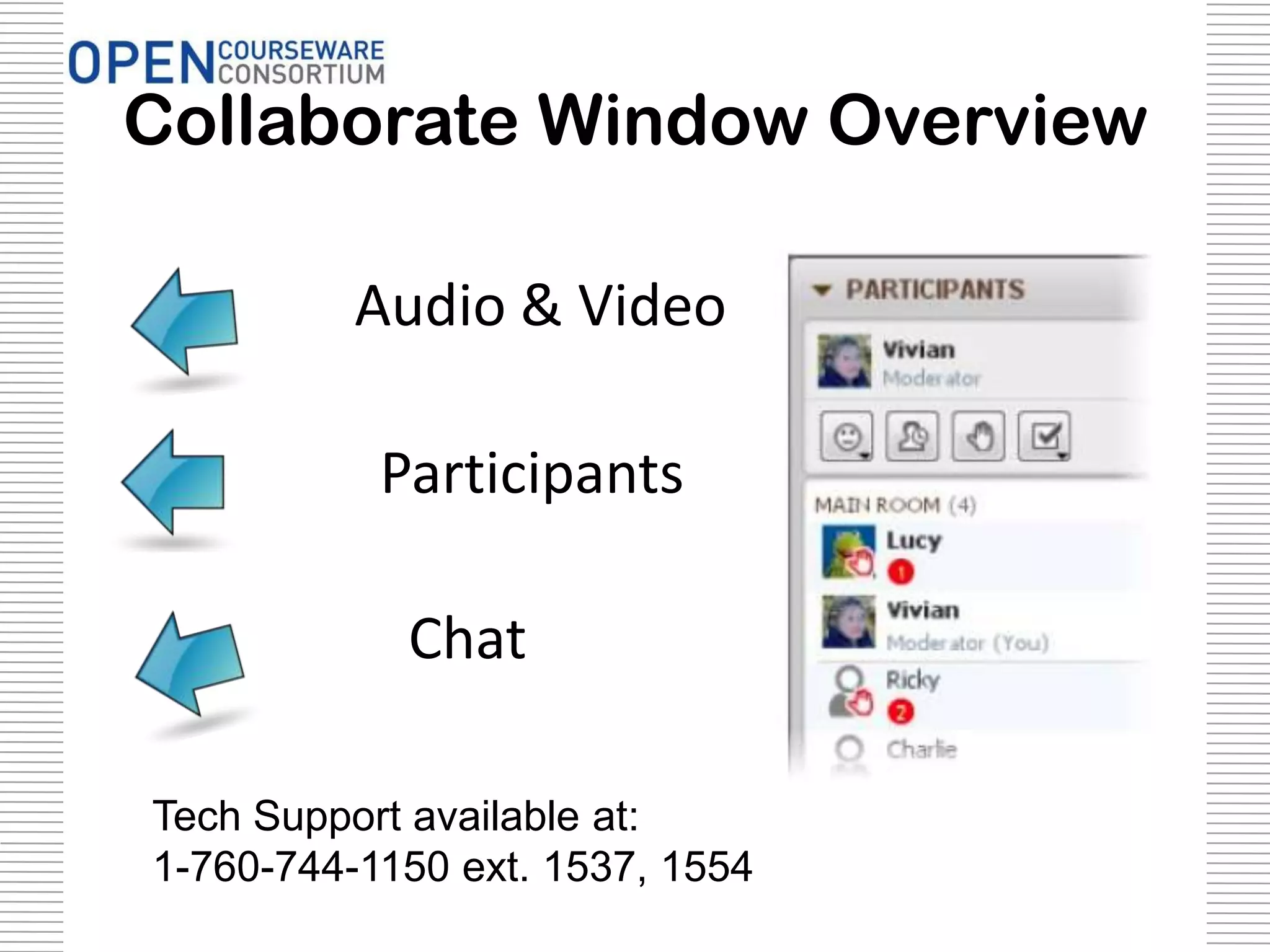
Collaborate Window Overview
Audio & Video
Participants
Chat
Tech Support available at:
1-760-744-1150 ext. 1537, 1554
Welcome
Please introduce yourself in the chat
window. Tell us how you heard about
today’s webinar?
– Una Daly, moderator
• Community College Outreach Director at
OCW Consortium
Agenda
• CCCOER Introduction
• LearningCounts Project at CAEL
• Personalized Learning and OER at
Ivy Bridge College AltiusEd
• Broward College’s Competency-based
MOOC and OER Initiatives
• Q & A
CCCOER Mission
• Promote adoption of OER to enhance
teaching and learning
–Expand access to education
–Support professional development
–Advance community college mission
Funded by the William & Flora
Hewlett Foundation
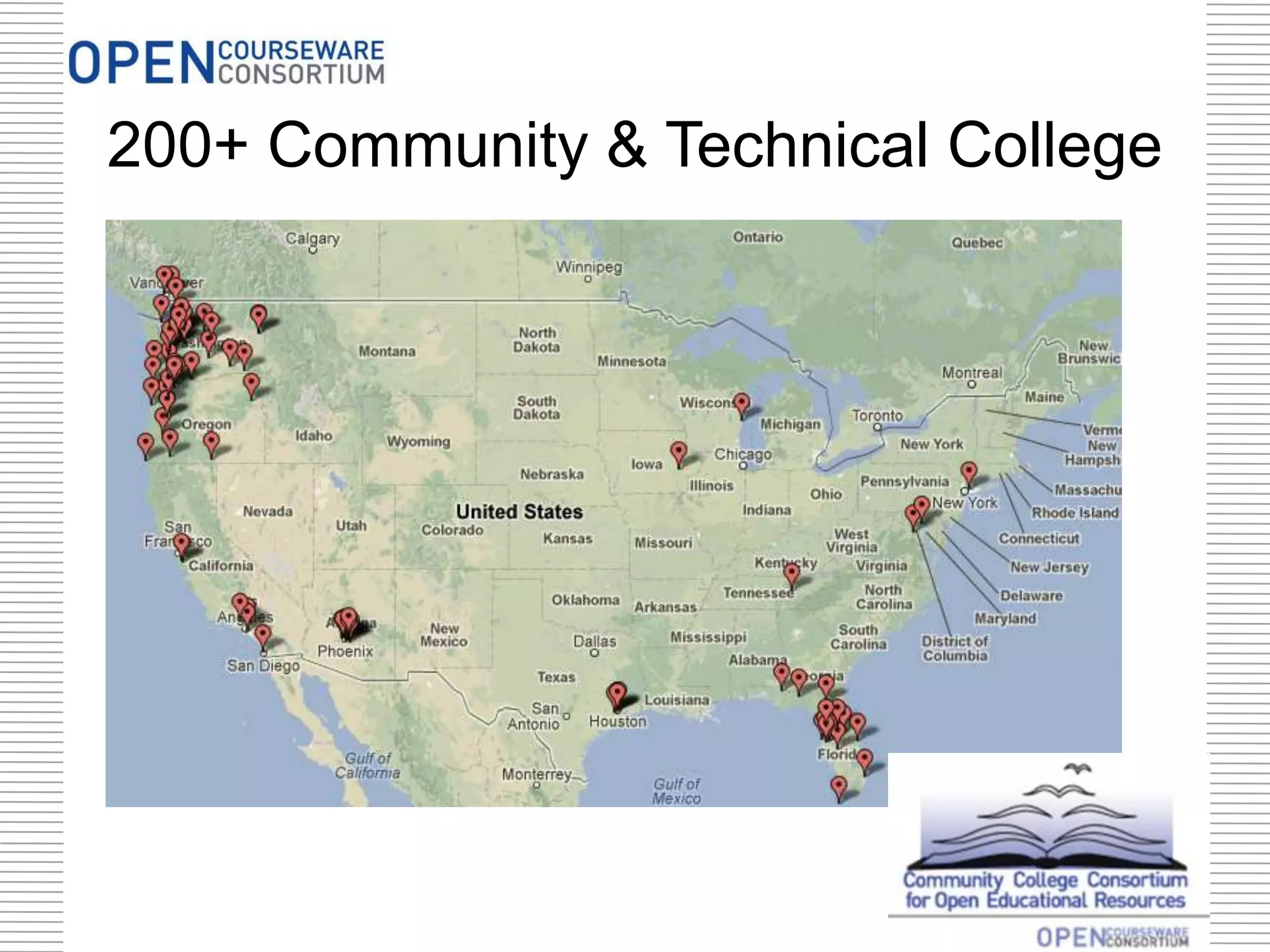
200+ Community & Technical College
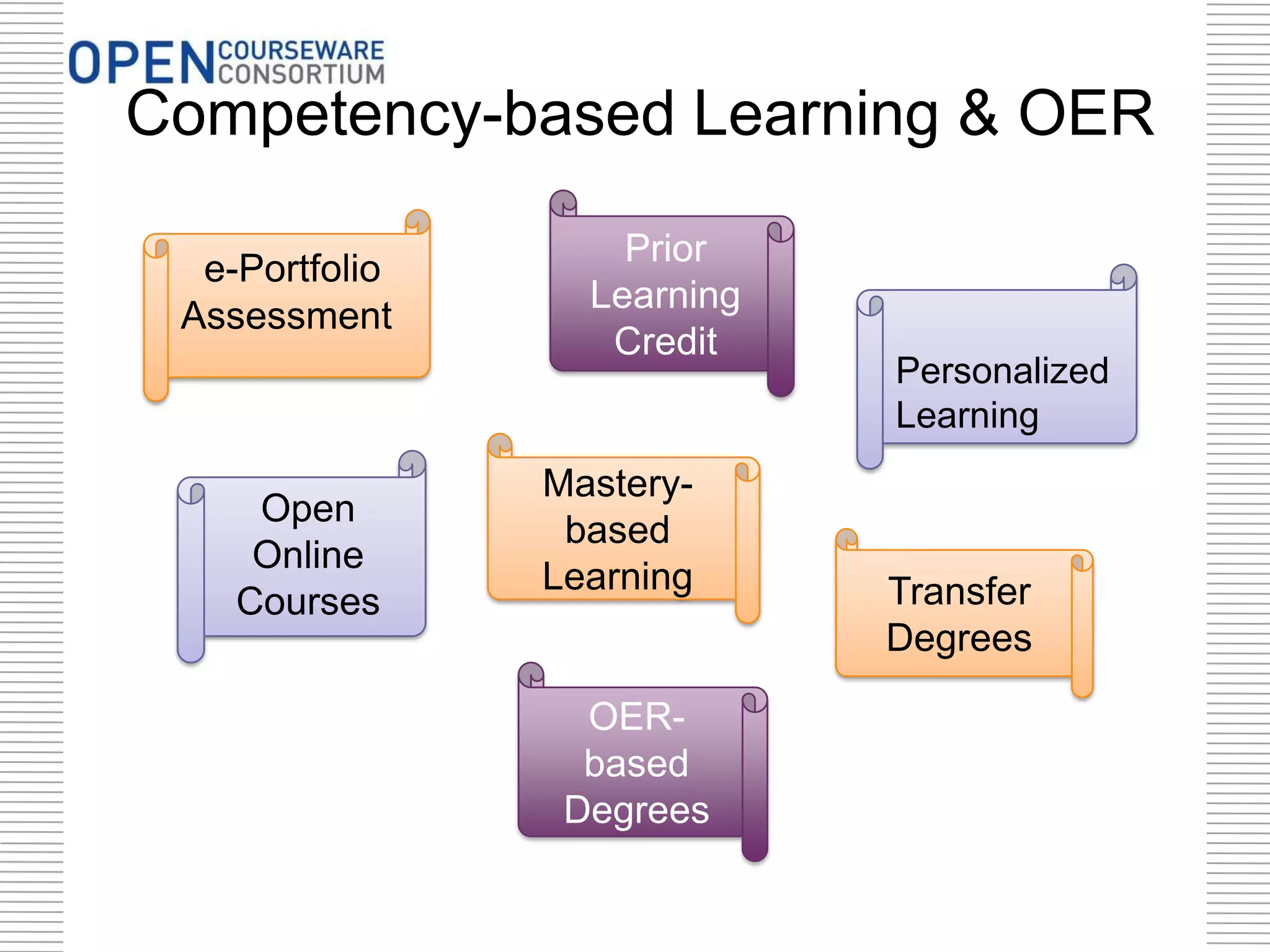
Competency-based Learning & OER
e-Portfolio
Assessment
Mastery-
based
Learning
Open
Online
Courses
Personalized
Learning
Transfer
Degrees
Prior
Learning
Credit
OER-
based
Degrees
Prior Learning Assessment & OER
Dr. Chari Leader Kelley
Vice-president LearningCounts.org
Council of Adult & Experiential Learning (CAEL)
OER + PLA = Student Success
T O D AY ’ S P R I O R L E A R N I N G
A S S E S S M E N T A N D H O W T O
L E V E R A G E I T W I T H O E R
J U N E 1 1 , 2 0 1 3
Council for Adult and Experiential Learning
A 501(c)(3) non-profit, international organization with nearly
40 years of lifelong learning experience
National leader in PLA best practices, research, and writing
Dedicated to removing barriers to adult learning
Recognized by regional accrediting bodies
L E A R N I N G C O U N T S . O R G 11
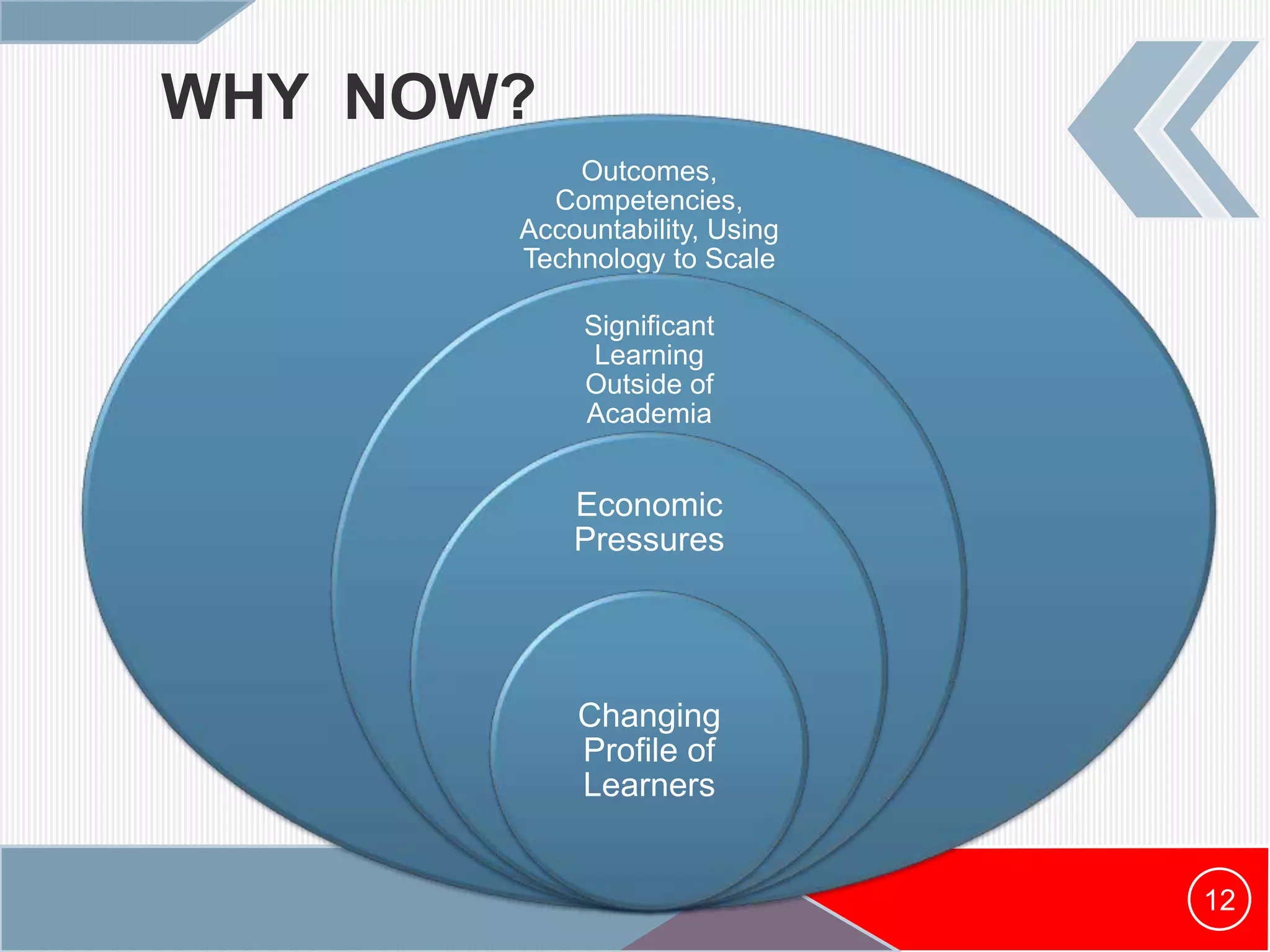
WHY NOW?
Outcomes,
Competencies,
Accountability, Using
Technology to Scale
Significant
Learning
Outside of
Academia
Economic
Pressures
Changing
Profile of
Learners
12
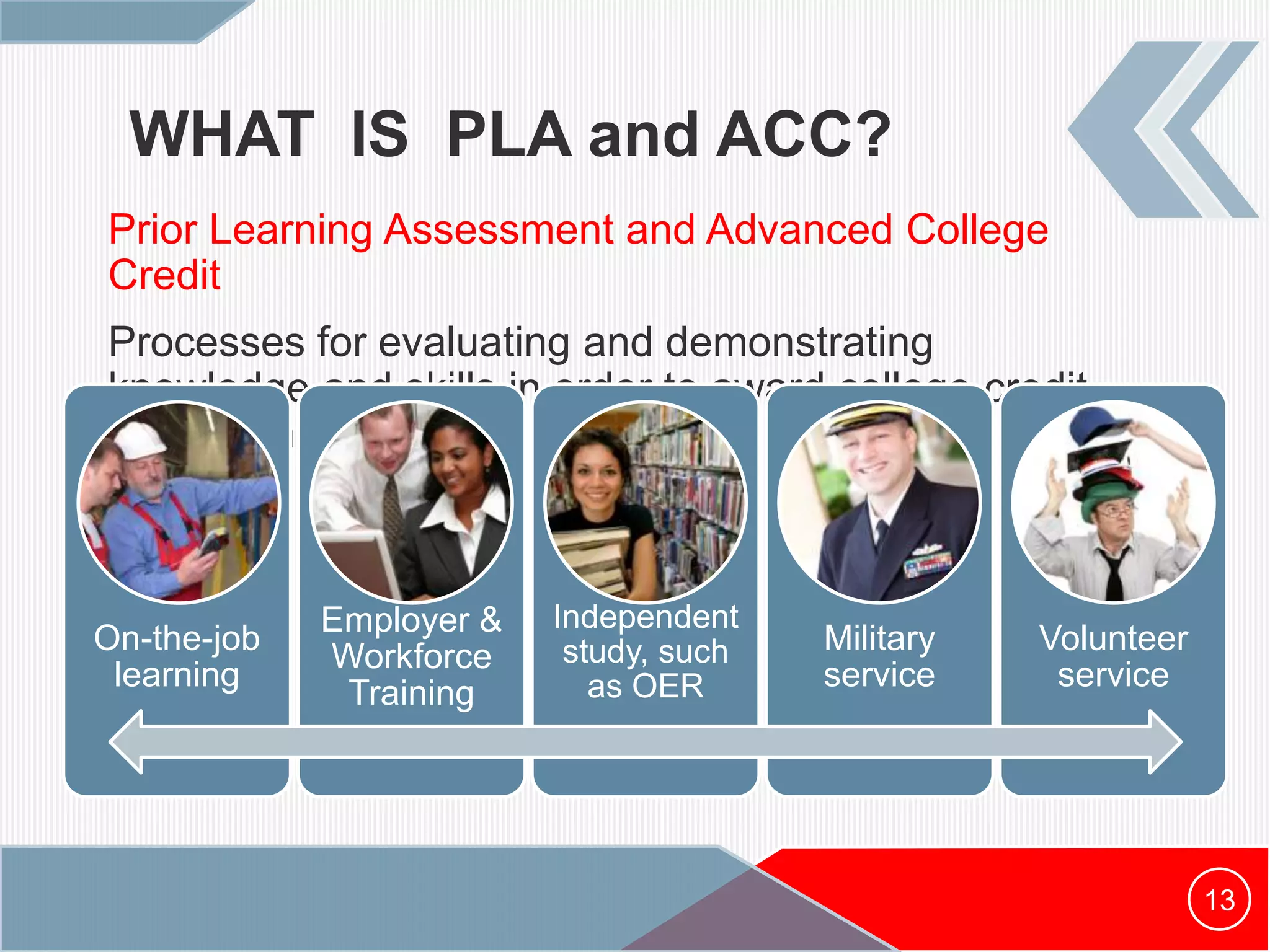
WHAT IS PLA and ACC?
Prior Learning Assessment and Advanced College
Credit
Processes for evaluating and demonstrating
knowledge and skills in order to award college credit
for learning from:
On-the-job
learning
Employer &
Workforce
Training
Independent
study, such
as OER
Military
service
Volunteer
service
13
WHY CPL/PLA?
o Degree/credential completion initiatives
o Focus on retention and persistence
o Leverage learning toward credentials
o Reduce time to completion
o Reduce student debt
o Maintain academic standards and integrity
o Greater availability of free learning
opportunities
o Technology to enable scaling
14
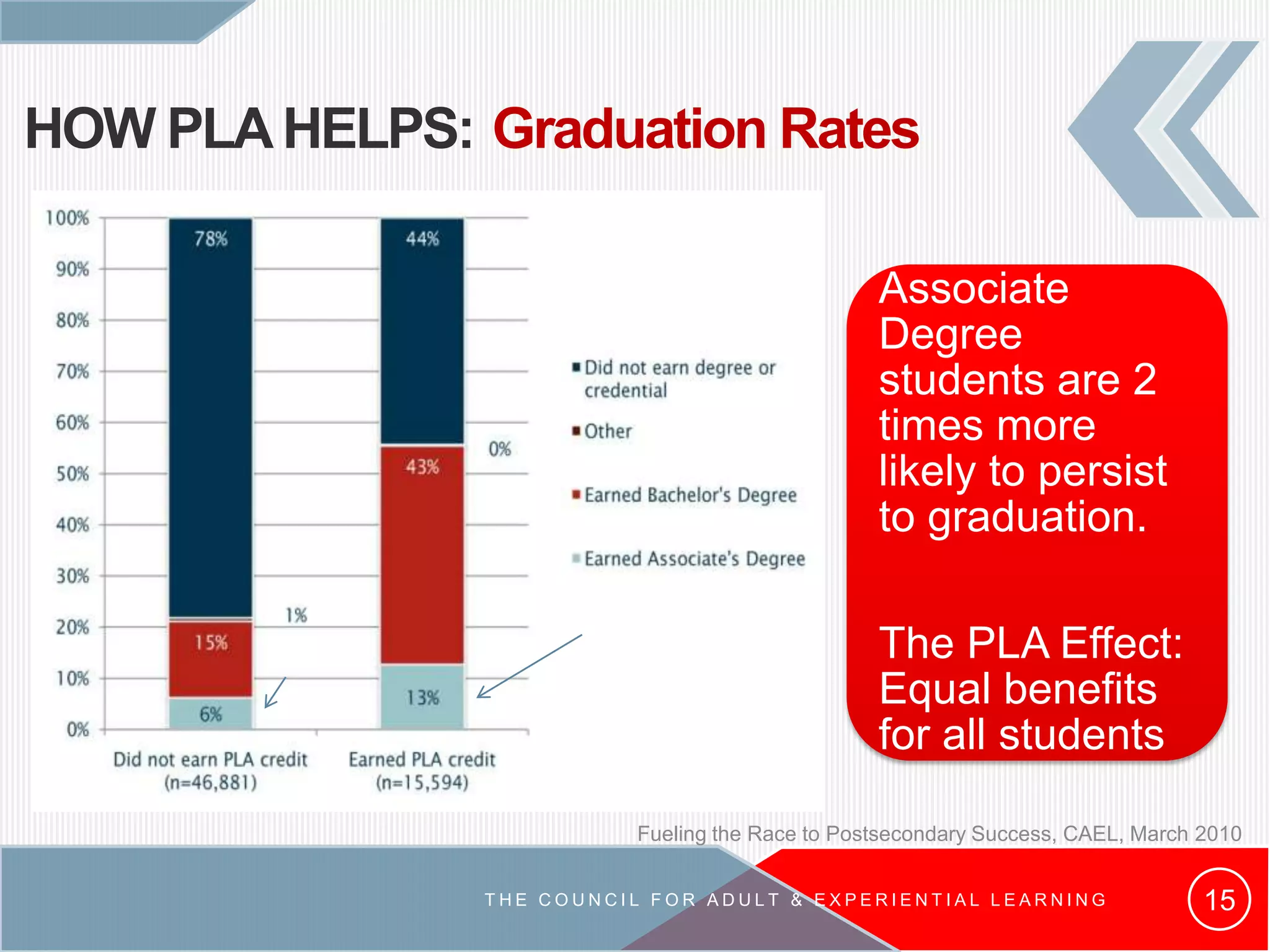
HOW PLAHELPS: Graduation Rates
Associate
Degree
students are 2
times more
likely to persist
to graduation.
The PLA Effect:
Equal benefits
for all students
Fueling the Race to Postsecondary Success, CAEL, March 2010
15T H E C O U N C I L F O R A D U L T & E X P E R I E N T I A L L E A R N I N G
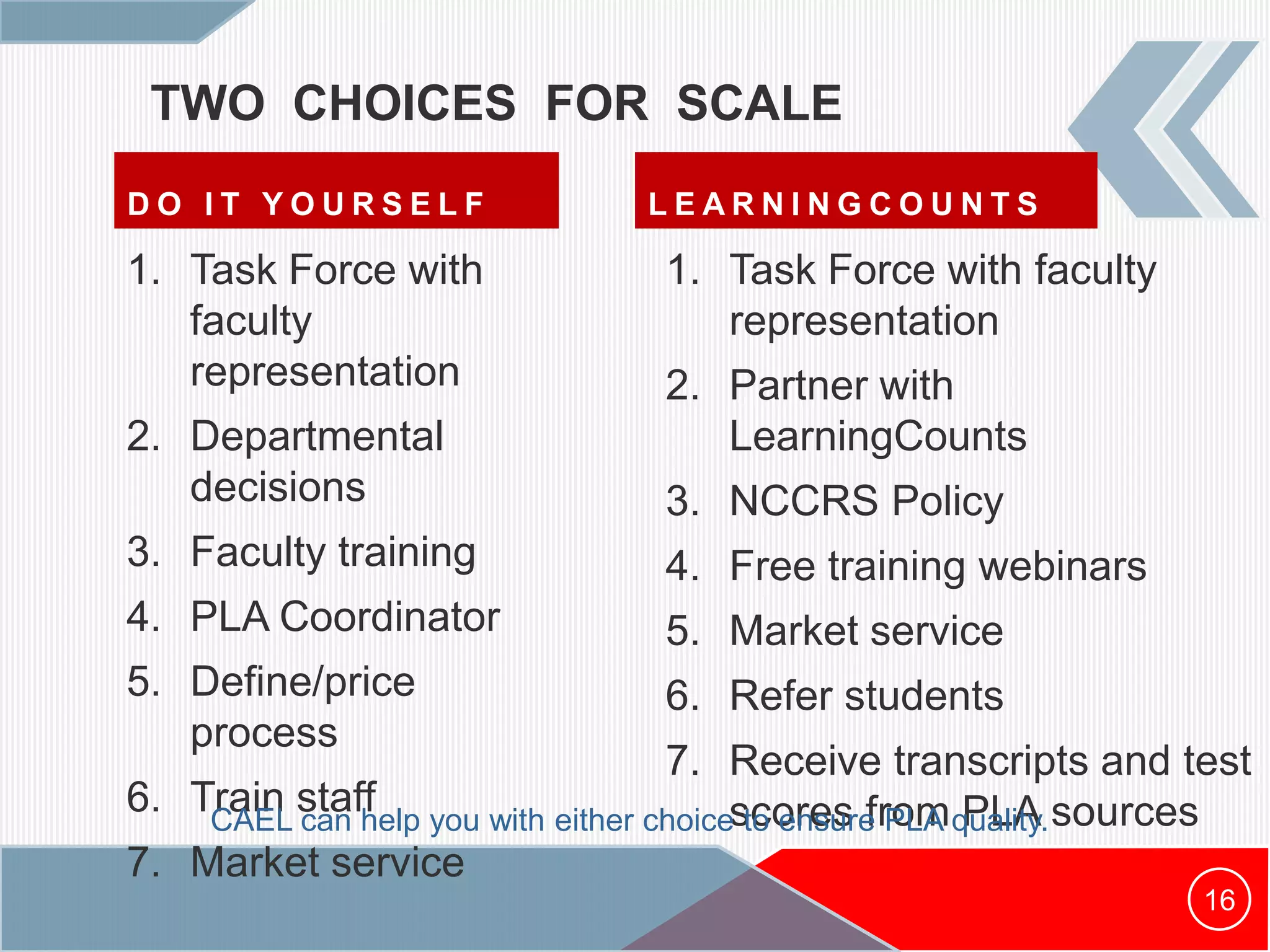
TWO CHOICES FOR SCALE
D O I T Y O U R S E L F
1. Task Force with
faculty
representation
2. Departmental
decisions
3. Faculty training
4. PLA Coordinator
5. Define/price
process
6. Train staff
7. Market service
L E A R N I N G C O U N T S
1. Task Force with faculty
representation
2. Partner with
LearningCounts
3. NCCRS Policy
4. Free training webinars
5. Market service
6. Refer students
7. Receive transcripts and test
scores from PLA sources
16
CAEL can help you with either choice to ensure PLA quality.
THE PERFECT COMBINATION
17
Students who learn from free web
content, like the Saylor
Foundation courses, MOOCs,
Khan Academy, and the
thousands of other learning
resources on the web, can earn
college credit for their college-
level learning at the most
innovative, only online “at scale”
prior learning assessment center
adhering to CAEL’s
Quality Principles for
Prior Learning
Assessment!
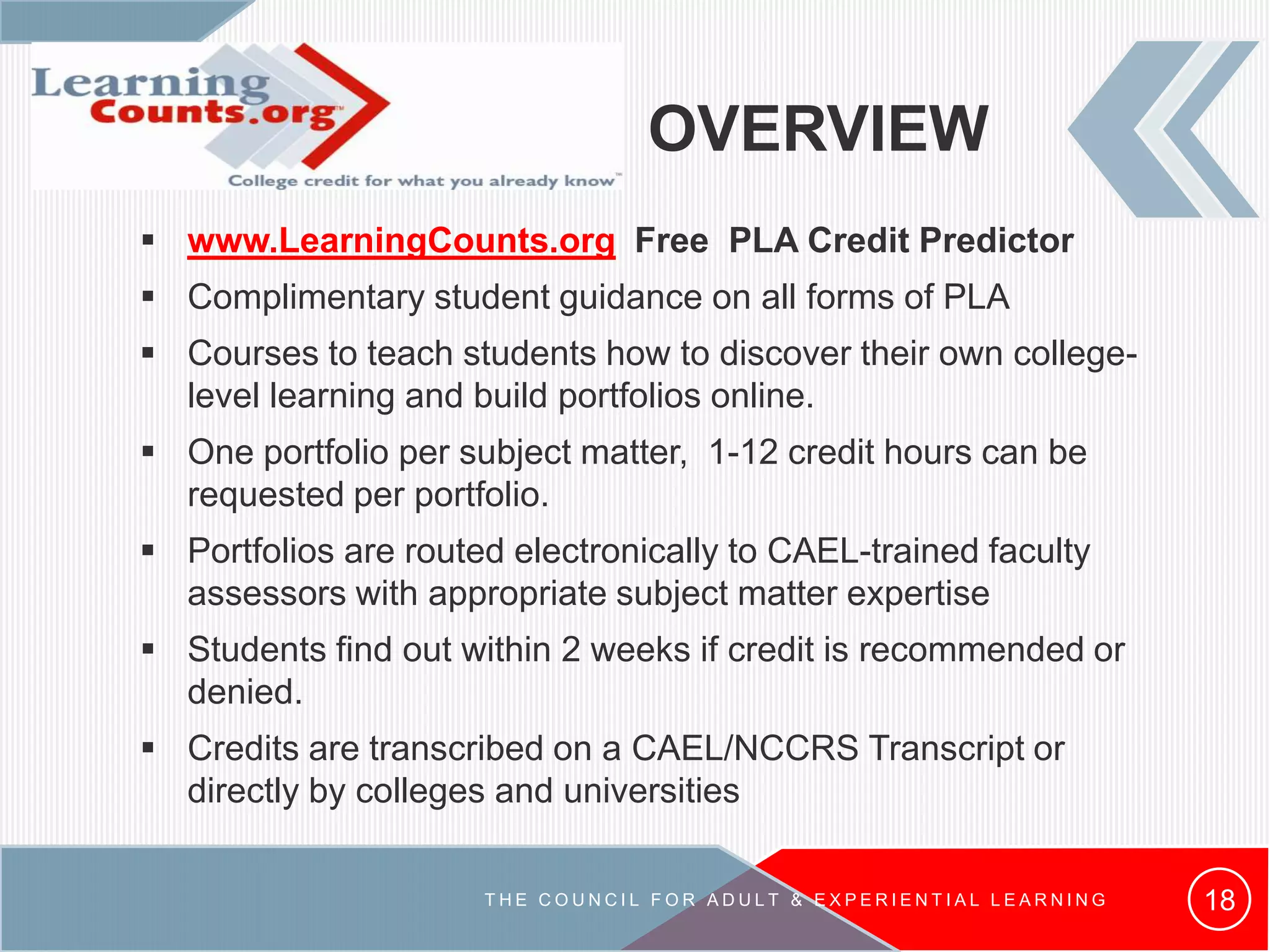
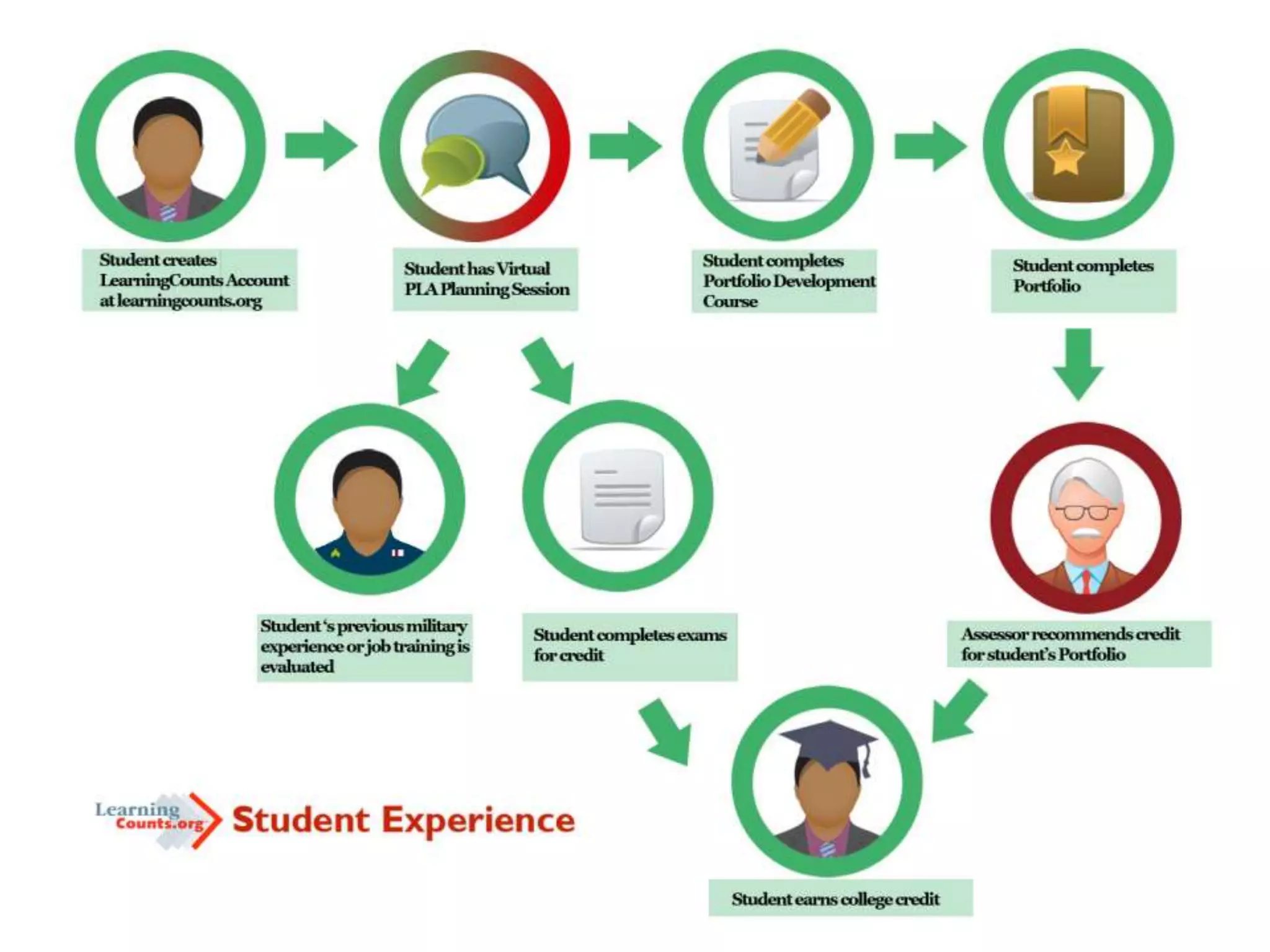
OVERVIEW
 www.LearningCounts.org Free PLA Credit Predictor
 Complimentary student guidance on all forms of PLA
 Courses to teach students how to discover their own college-
level learning and build portfolios online.
 One portfolio per subject matter, 1-12 credit hours can be
requested per portfolio.
 Portfolios are routed electronically to CAEL-trained faculty
assessors with appropriate subject matter expertise
 Students find out within 2 weeks if credit is recommended or
denied.
 Credits are transcribed on a CAEL/NCCRS Transcript or
directly by colleges and universities
18T H E C O U N C I L F O R A D U L T & E X P E R I E N T I A L L E A R N I N G
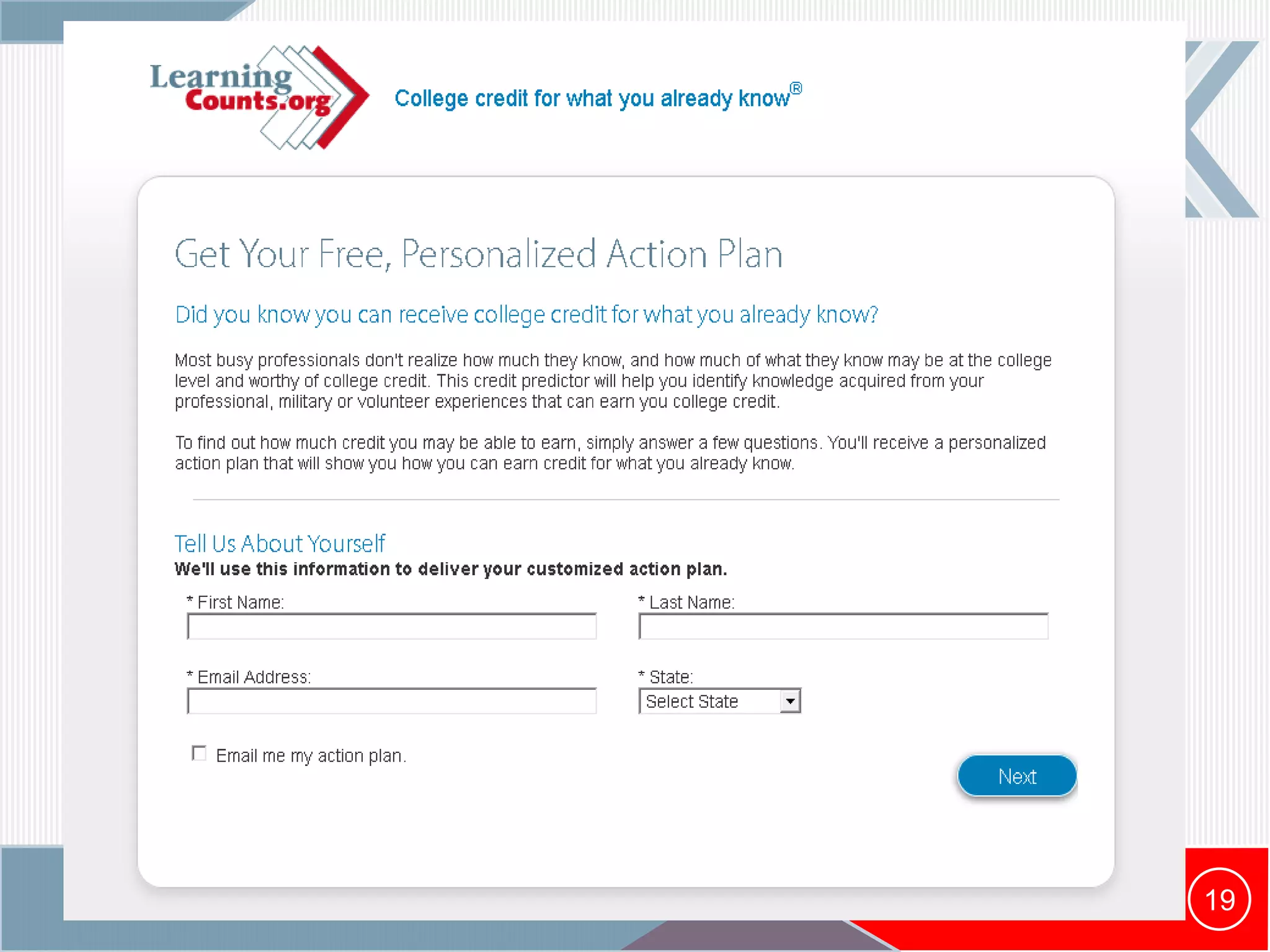
PLA COLLEGE CREDIT
PREDICTOR TOOL
19
L E A R N I N G C O U N T S . O R G 20
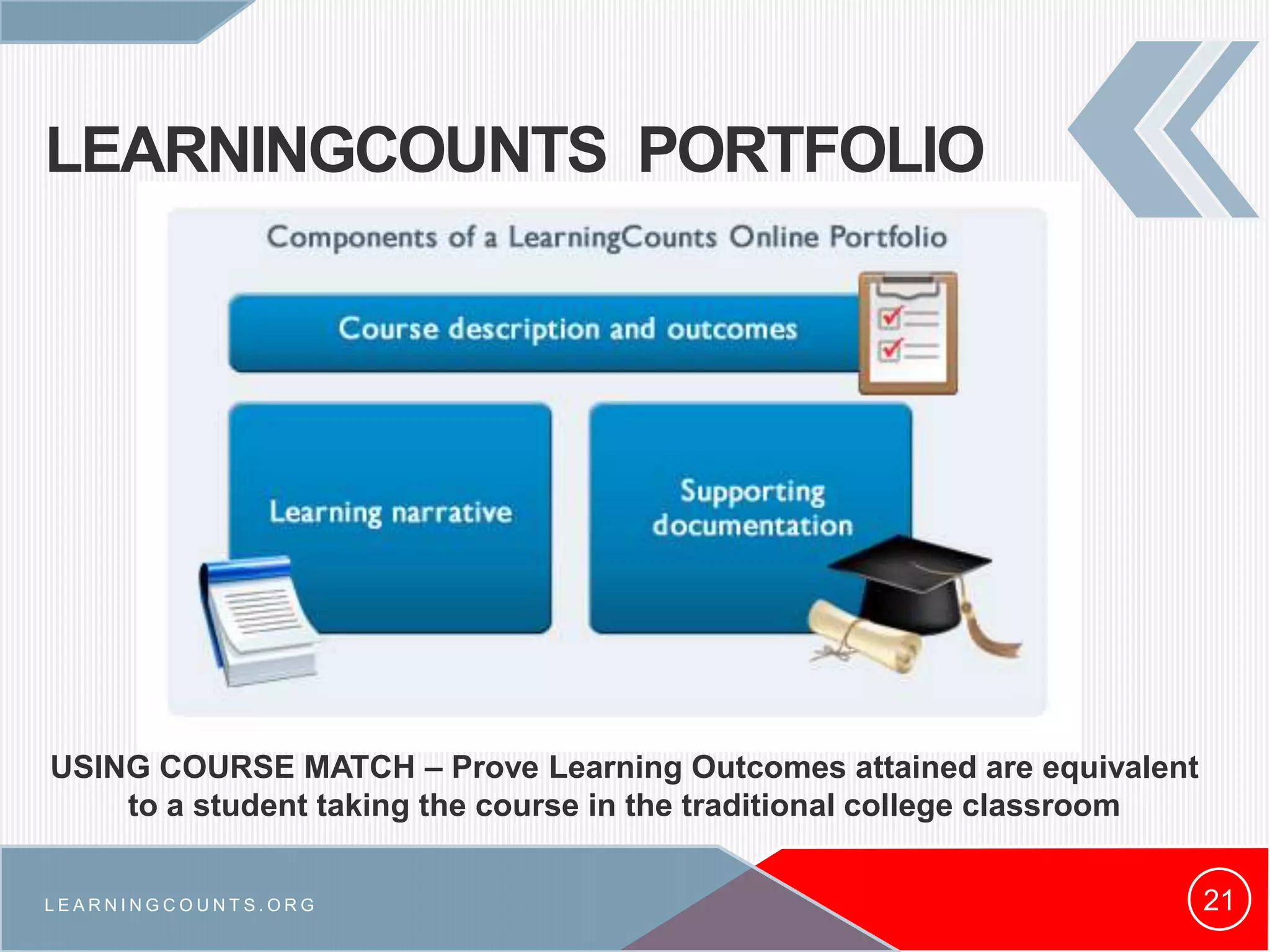
LEARNINGCOUNTS PORTFOLIO
21
USING COURSE MATCH – Prove Learning Outcomes attained are equivalent
to a student taking the course in the traditional college classroom
L E A R N I N G C O U N T S . O R G
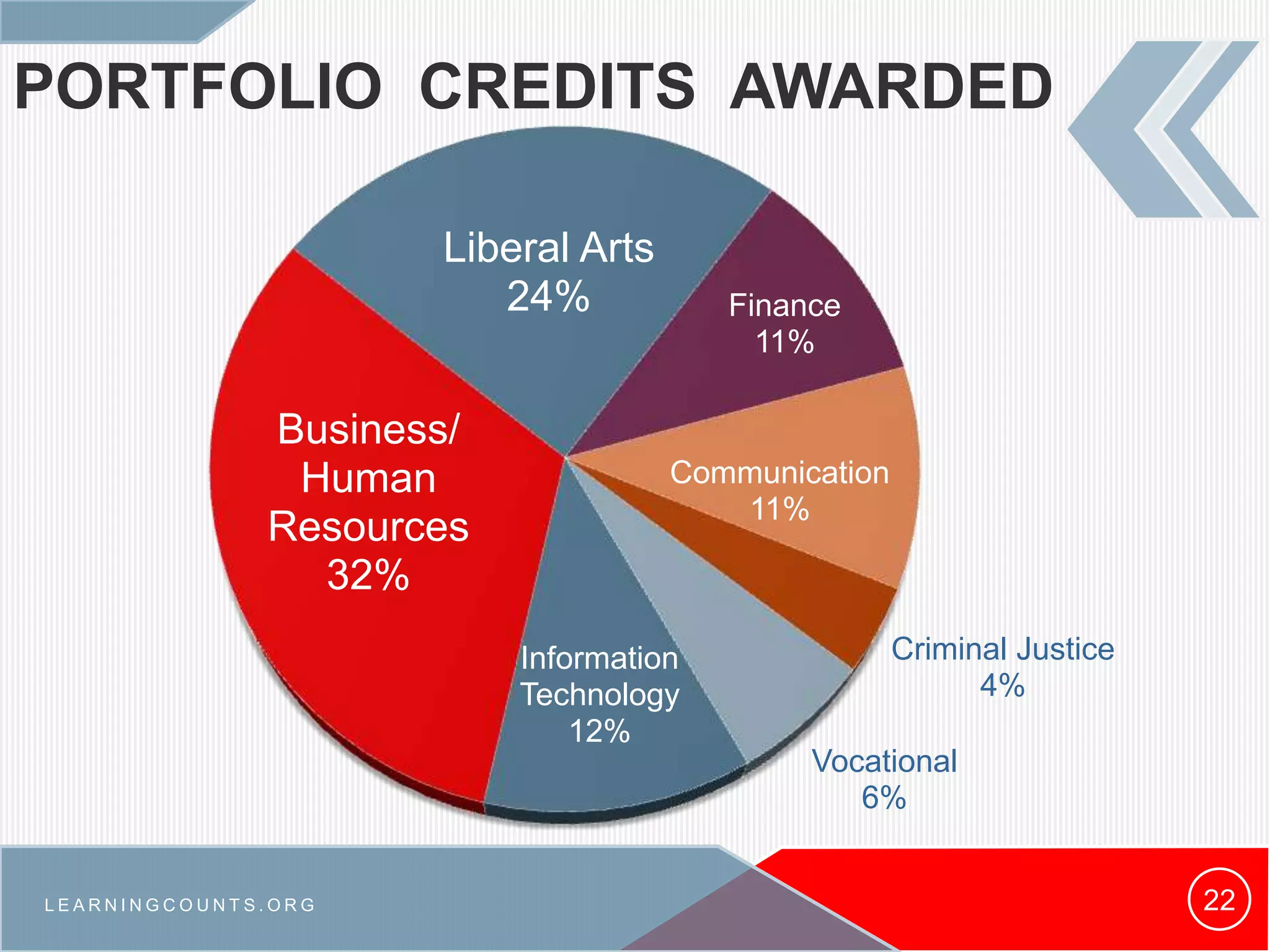
PORTFOLIO CREDITS AWARDED
22
Information
Technology
12%
Business/
Human
Resources
32%
Liberal Arts
24% Finance
11%
Communication
11%
Criminal Justice
4%
Vocational
6%
L E A R N I N G C O U N T S . O R G
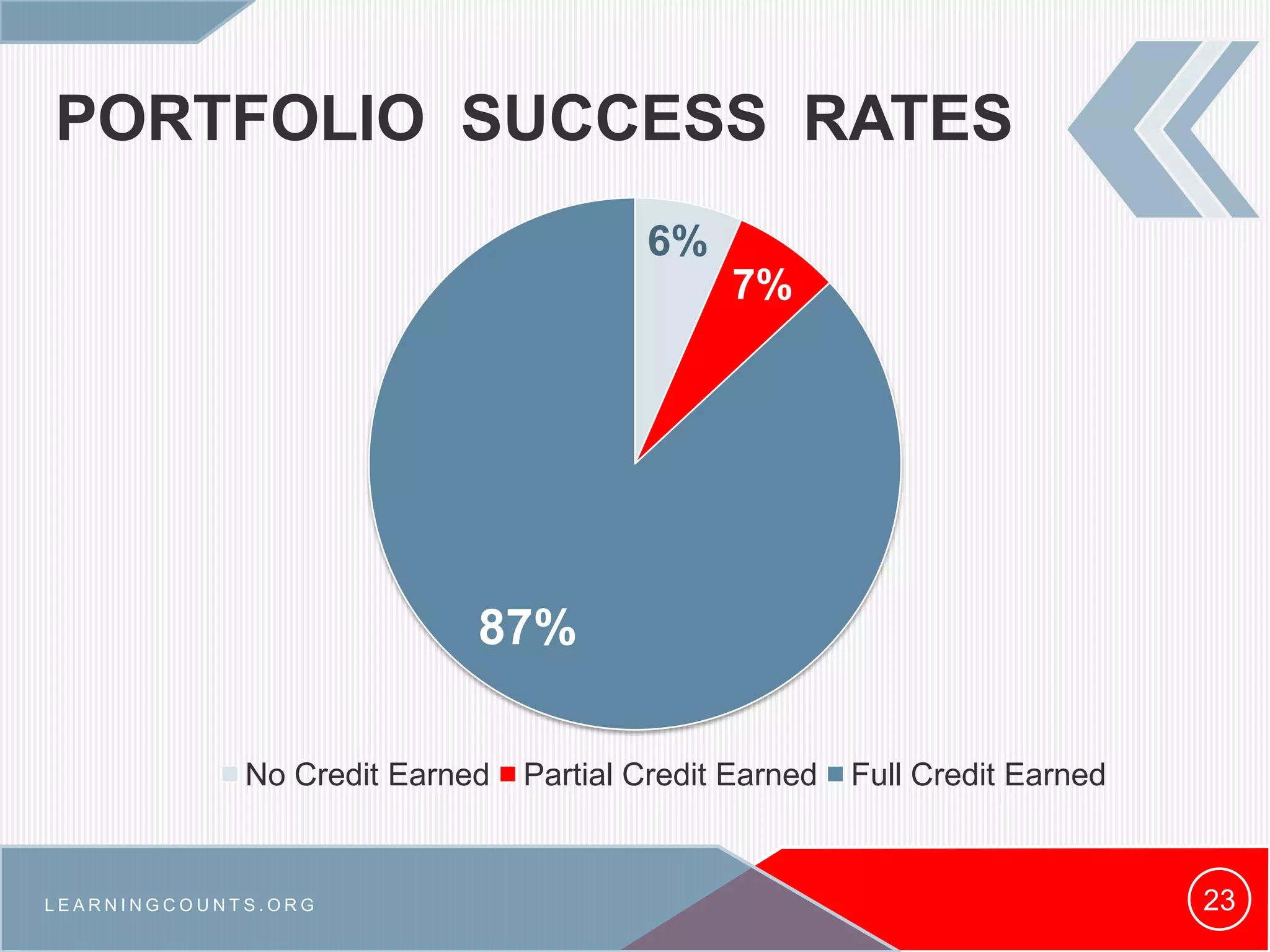
PORTFOLIO SUCCESS RATES
L E A R N I N G C O U N T S . O R G 23
6%
7%
87%
No Credit Earned Partial Credit Earned Full Credit Earned
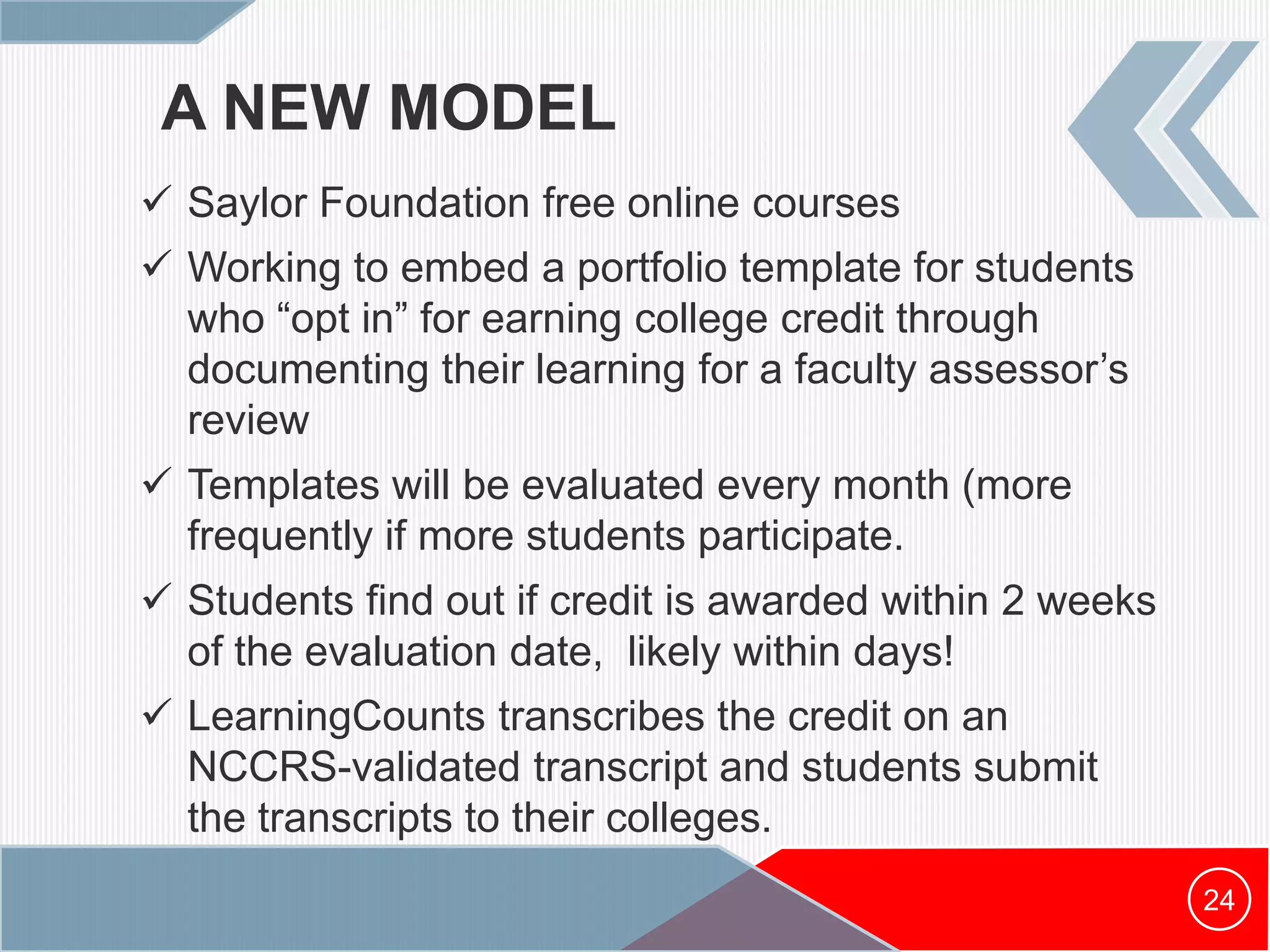
A NEW MODEL
 Saylor Foundation free online courses
 Working to embed a portfolio template for students
who “opt in” for earning college credit through
documenting their learning for a faculty assessor’s
review
 Templates will be evaluated every month (more
frequently if more students participate.
 Students find out if credit is awarded within 2 weeks
of the evaluation date, likely within days!
 LearningCounts transcribes the credit on an
NCCRS-validated transcript and students submit
the transcripts to their colleges.
24
BECOME A PARTNER!
 It’s easy! We do all of the work for you.
 Refer students to us.
 We guide your students in choosing
exams, requesting ACE, NCCRS, or military
transcripts; and through portfolio development and
assessment.
 Our credit recommendations are determined by
faculty assessors trained by CAEL with subject
matter expertise to determine if credit can be
awarded.
 Make sure your transfer policy includes acceptance
of NCCRS credit recommendation.
 We work with TAACCCT Grants! 25
MAKING A DIFFERENCE!
26
27
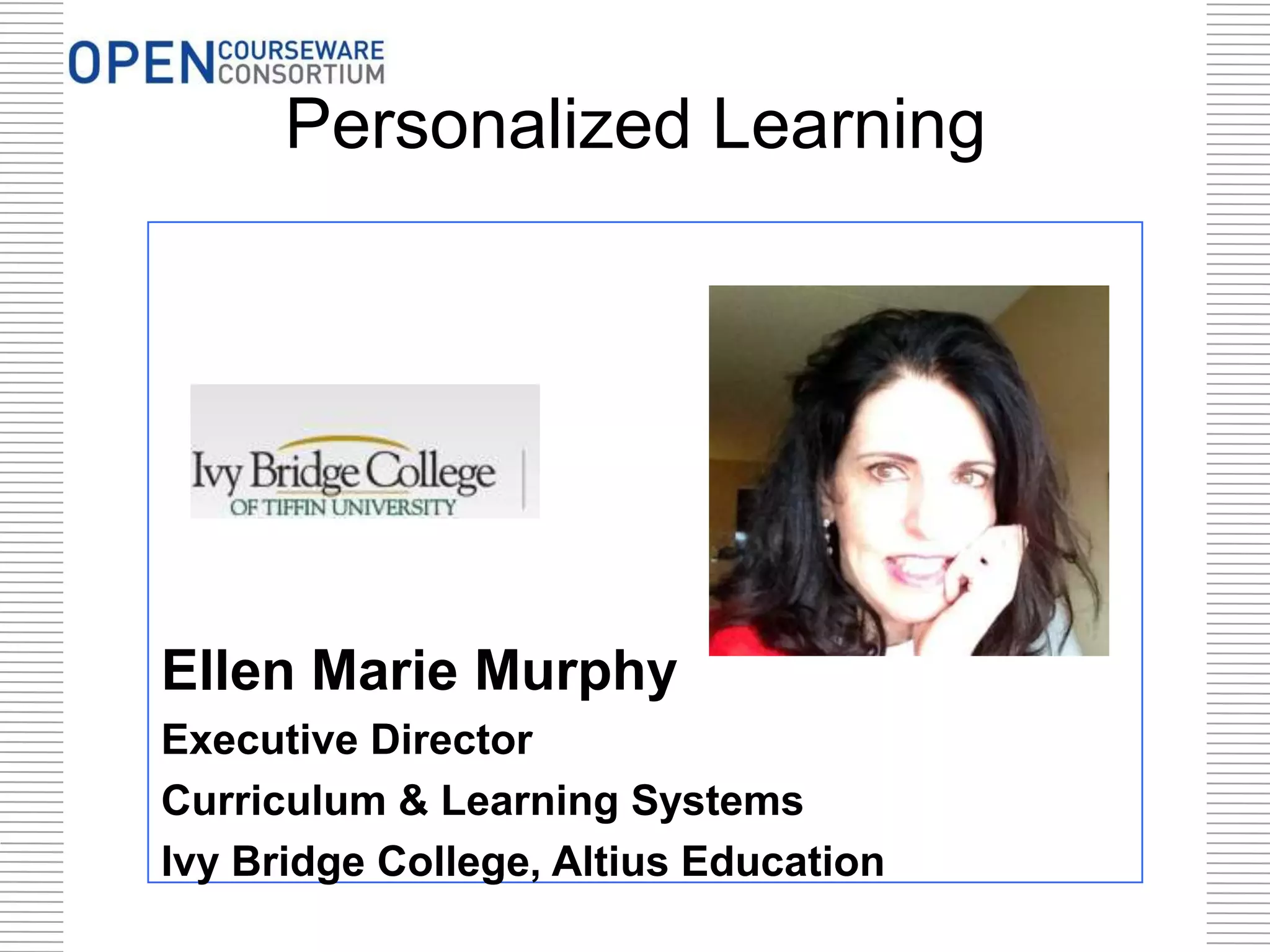
Personalized Learning
Ellen Marie Murphy
Executive Director
Curriculum & Learning Systems
Ivy Bridge College, Altius Education
Competency-based
learning and OERs
Ellen Marie Murphy
June 11, 2013
Previous experience
• Degree Planning
• Education Planning
• Planning and Finalizing Your Degree Program
• Independent Studies—can include OERs
• Assessment of Prior Learning (PLA)—assessment
of badges and use of OERs
•Self-directed placement
•Adaptive English
•Self paced
•Helix
Ivy Bridge
•Survey
•Read a text
•Write a paragraph
•Asked to reflect
•Review the syllabus
•Review a “B” paper
Self-directed placement
•All homework open all semester
•Can finish early
•Can go back and continue to improve
Competency Math—self pacing
•Relies on Faculty for adaptation
•Foundation for self-directed learning
•Builds metacognitive skills
Gates Grant
Fundamentals of College Writing
•Personalization
•Horizontal Competencies: collaboration, critical
thinking, metacognition
•Horizontal competencies: writing, reading, etc
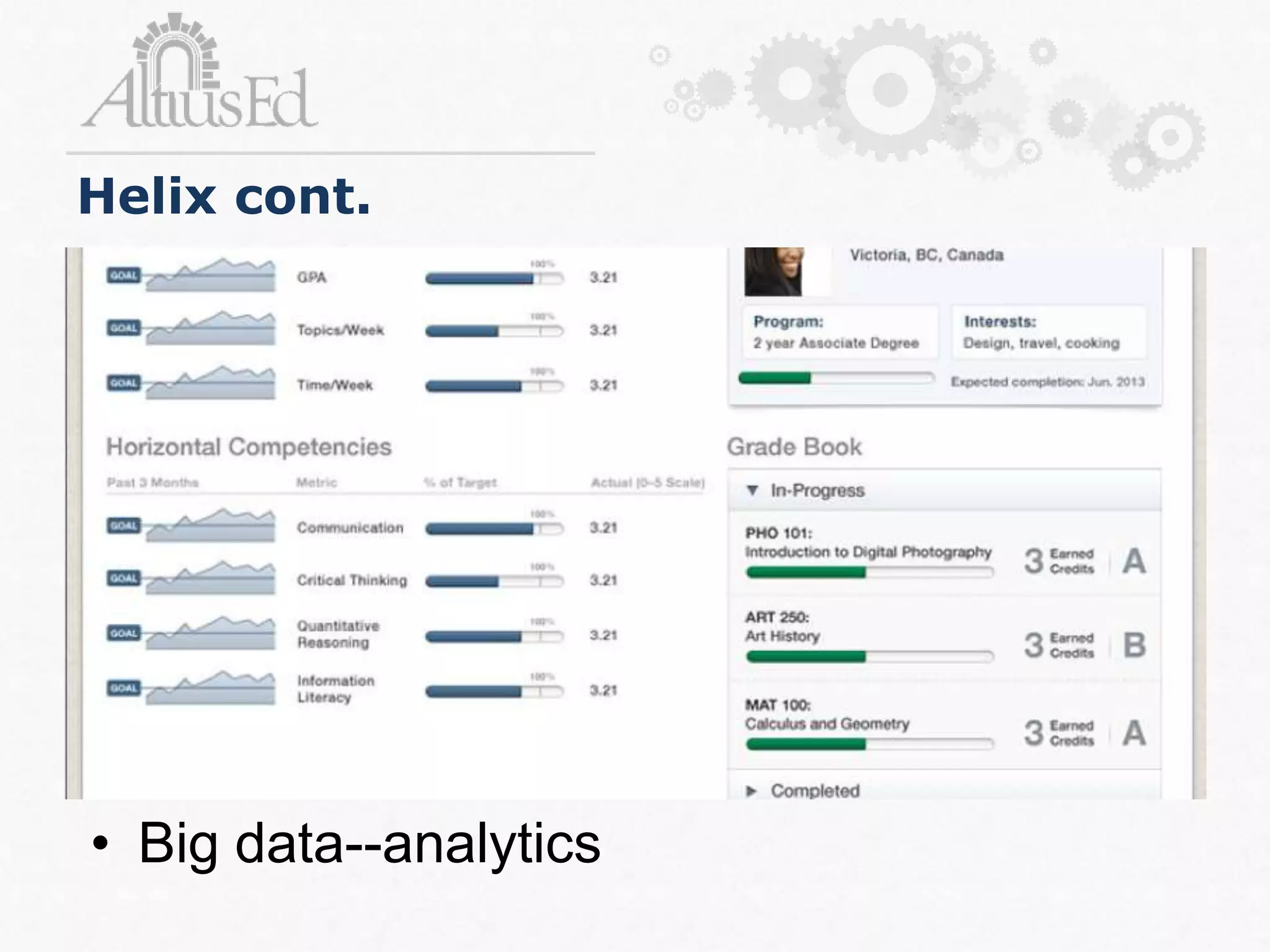
Helix
Helix cont.
• Big data--analytics
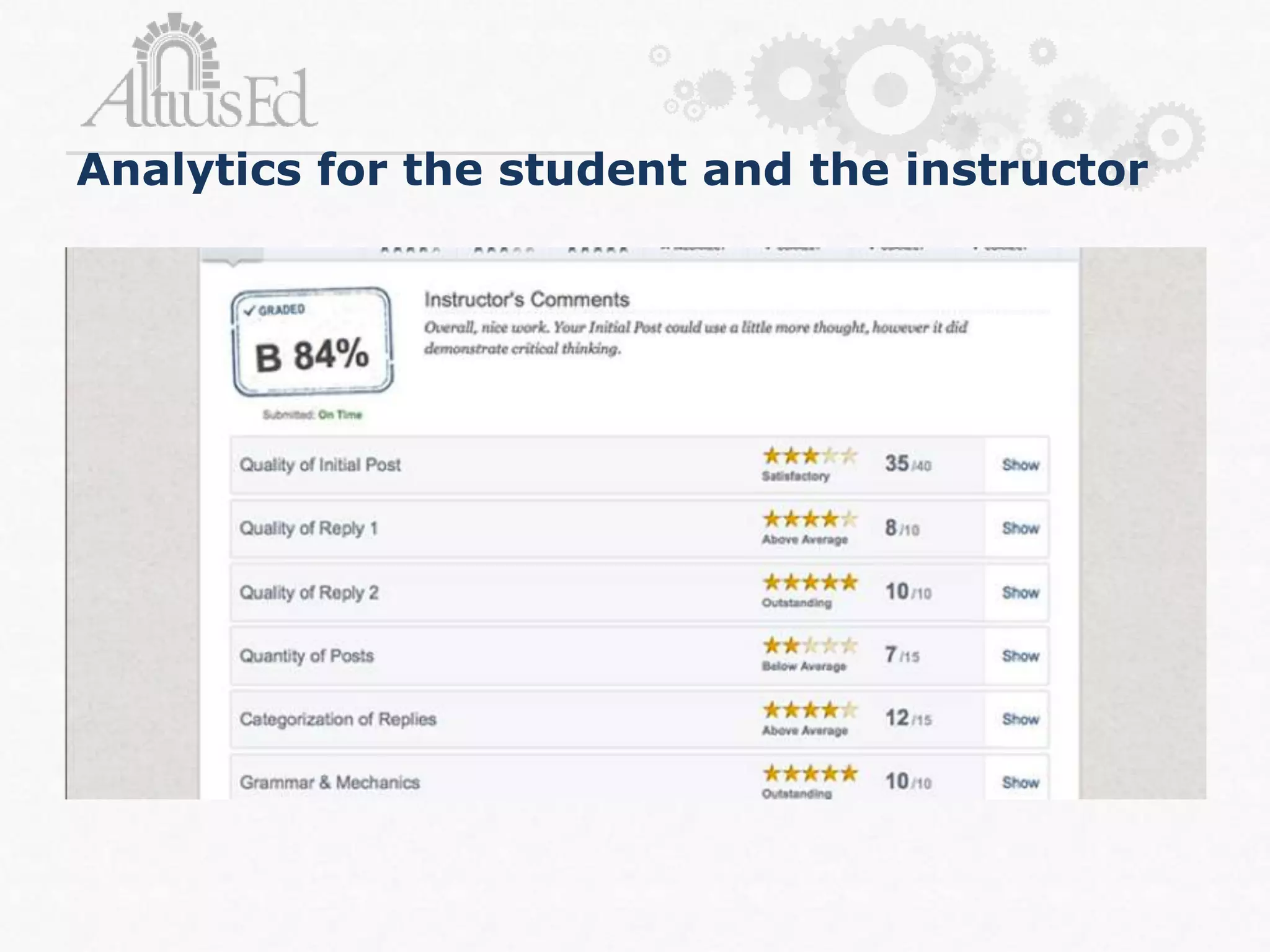
Analytics for the student and the instructor
•Currently in the process of looking to hire an
individual whose main job will be to provide
advanced OER sourcing capabilities
•Job title: Materials Liaison
On OERs
Competency-based and OER
Initiatives
Dr. David Shulman
Associate Vice President
Broward College Online & Instructional
Technology
In the beginning…
1990’s Miami-Dade County Public Schools
Competency Based Curriculum Correlated to
the Sunshine State Standards and the Grade
Level Expectations
IBM Learning Village & MDCPS
OERs for district teachers, aligned with grade
level and competencies
Competency-based
and OER Initiatives
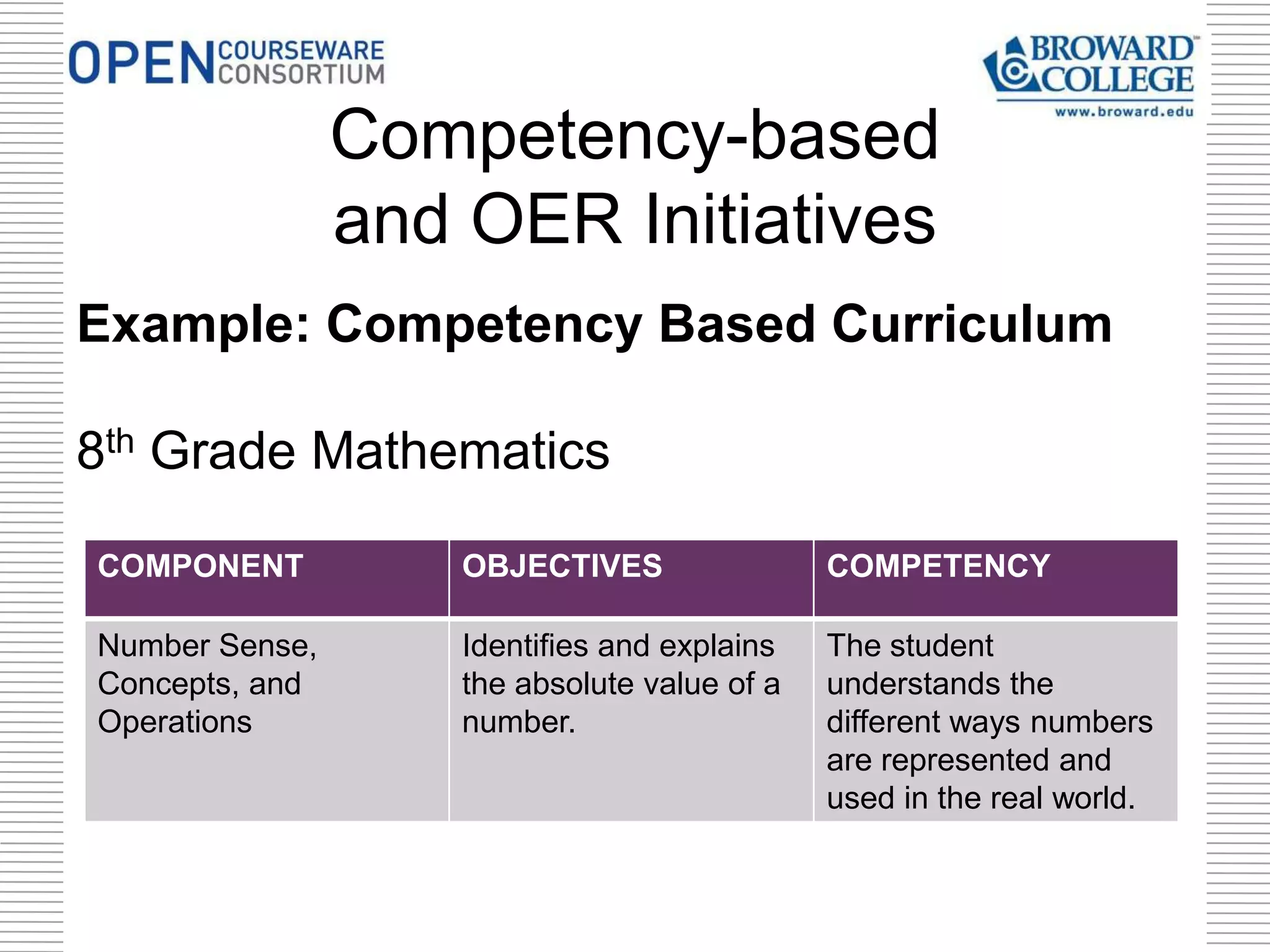
Example: Competency Based Curriculum
8th Grade Mathematics
Competency-based
and OER Initiatives
COMPONENT OBJECTIVES COMPETENCY
Number Sense,
Concepts, and
Operations
Identifies and explains
the absolute value of a
number.
The student
understands the
different ways numbers
are represented and
used in the real world.
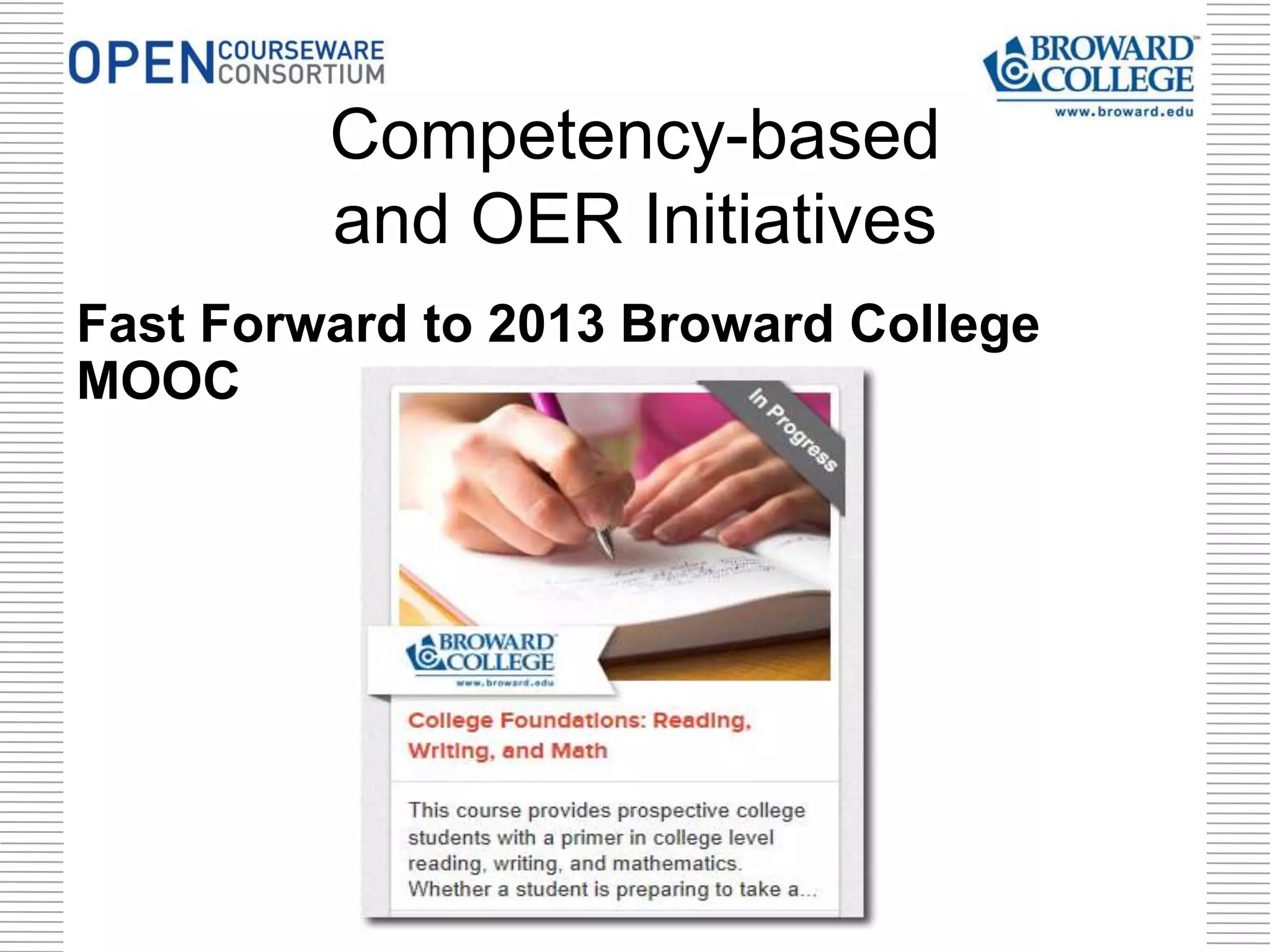
Fast Forward to 2013 Broward College
MOOC
Competency-based
and OER Initiatives
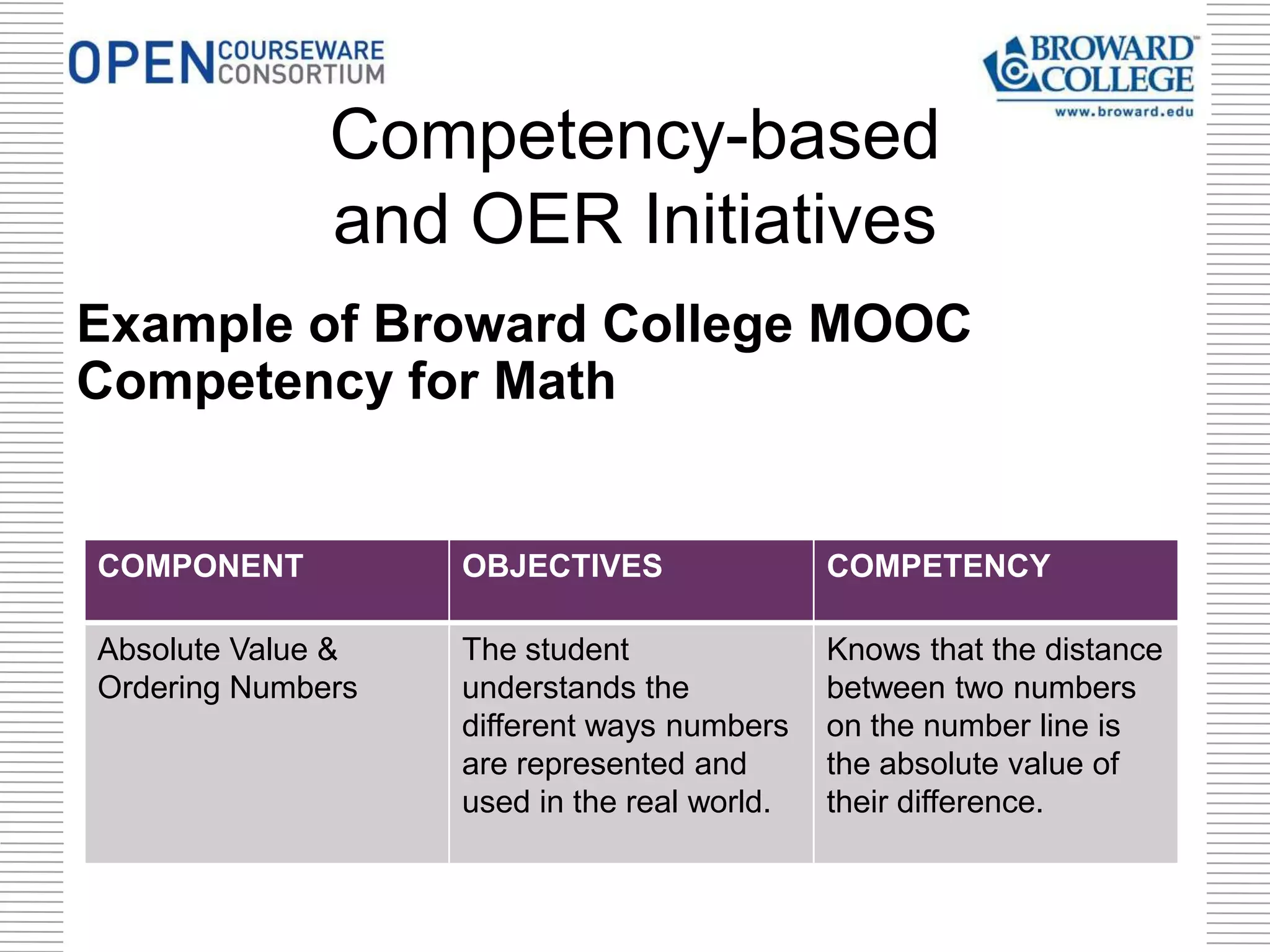
Example of Broward College MOOC
Competency for Math
Competency-based
and OER Initiatives
COMPONENT OBJECTIVES COMPETENCY
Absolute Value &
Ordering Numbers
The student
understands the
different ways numbers
are represented and
used in the real world.
Knows that the distance
between two numbers
on the number line is
the absolute value of
their difference.
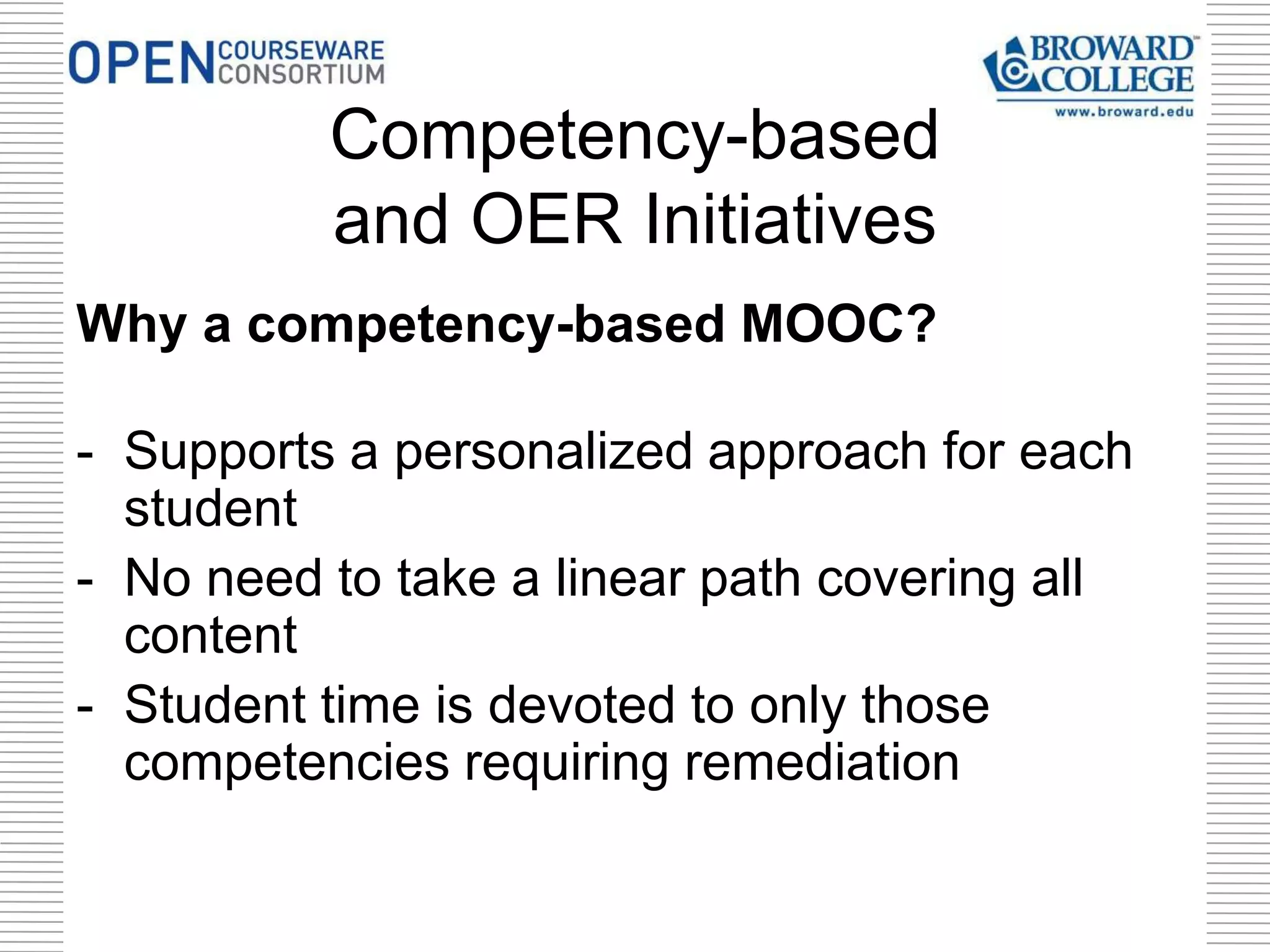
Why a competency-based MOOC?
- Supports a personalized approach for each
student
- No need to take a linear path covering all
content
- Student time is devoted to only those
competencies requiring remediation
Competency-based
and OER Initiatives
Why a competency-based MOOC?
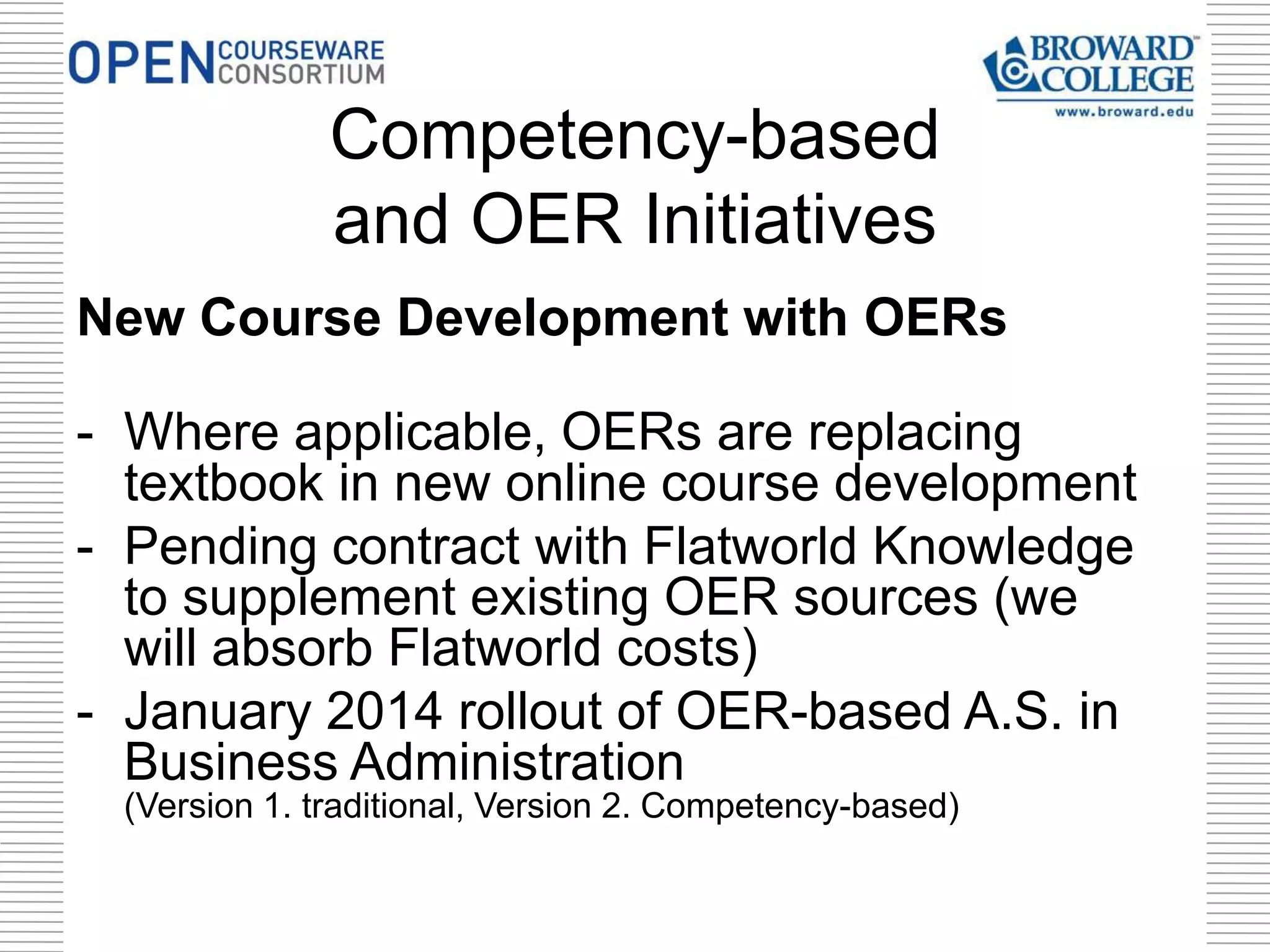
- Three subject matter expert faculty can
assist students (over 760) at any point in
their progress
- No textbook is used, only OERs specific to
each competency
Competency-based
and OER Initiatives
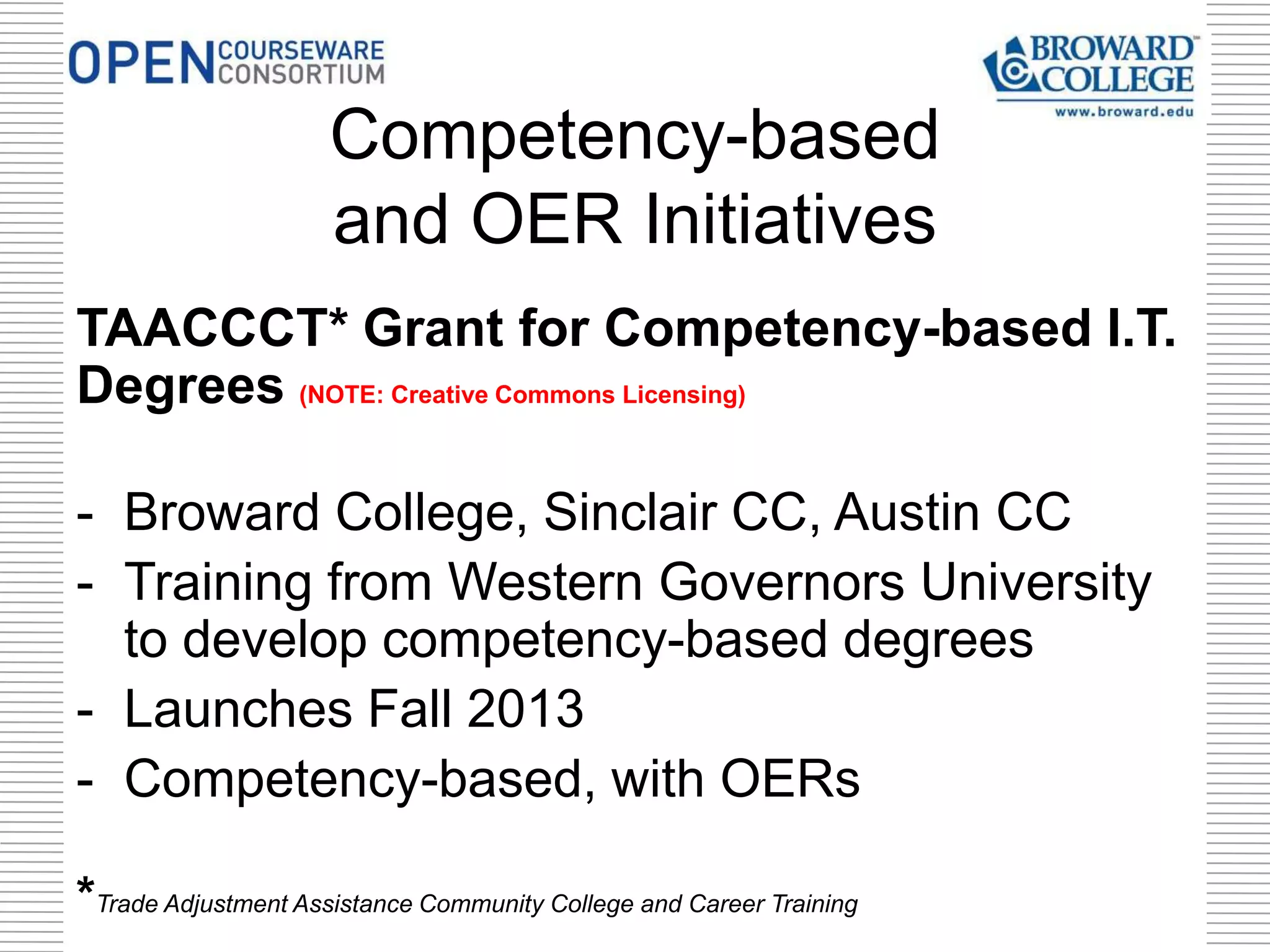
New Course Development with OERs
- Where applicable, OERs are replacing
textbook in new online course development
- Pending contract with Flatworld Knowledge
to supplement existing OER sources (we
will absorb Flatworld costs)
- January 2014 rollout of OER-based A.S. in
Business Administration
(Version 1. traditional, Version 2. Competency-based)
Competency-based
and OER Initiatives
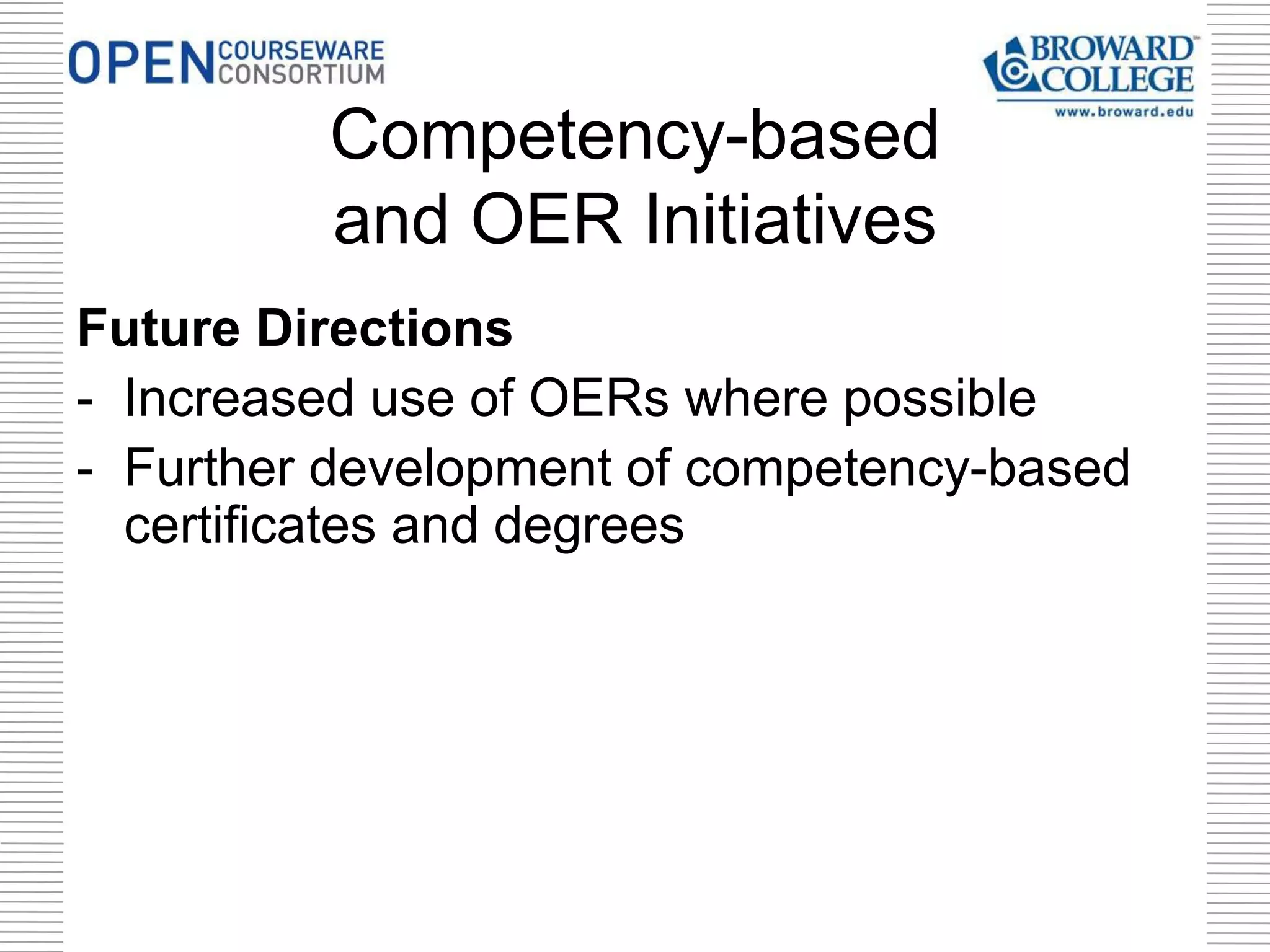
TAACCCT* Grant for Competency-based I.T.
Degrees (NOTE: Creative Commons Licensing)
- Broward College, Sinclair CC, Austin CC
- Training from Western Governors University
to develop competency-based degrees
- Launches Fall 2013
- Competency-based, with OERs
*Trade Adjustment Assistance Community College and Career Training
Competency-based
and OER Initiatives
Future Directions
- Increased use of OERs where possible
- Further development of competency-based
certificates and degrees
Competency-based
and OER Initiatives
Join Us at
OCW Consortium
• Information: Stay in the loop on
issues in open education.
• Collaboration: Participate in
community, attend webinars, join our advisory
board.
• Collective Visibility: Gain global exposure
through OCWC’s website and shared media
• Direction: Provide direct input to OCWC’s
focus on community colleges.
Help us choose fall webinars …
A. Finding open textbooks
B. Going mobile with OER
C. MOOCs at Community Colleges
D. Universal Design and OER
E. TAACCCT and other OER Projects
F.Other (please type in chat window)
Stay in the Loop
• Upcoming Conferences
- Online Teaching Conference (June 20-21)
- Open Education Conference (Nov 6-8)
• CCCOER Advisory group meets monthly
– http://oerconsortium.org
Thank you for attending!
Please type your question in the chat window or
raise your hand to speak
Contact Information
Una Daly unatdaly@ocwconsortium.org
Chari Leader Kelley cleader-kelley@cael.org
Ellen Marie Murphy murphy.ellenmarie@gmail.com
David Shulman dshulman@broward.edu
Share
http://www.flickr.com/photos/opensourceway/4424154829/in/photostream/
IMG_4591 http://www.flickr.com/photos/bionicteaching/4700979984/ cc-by-sa
La belle tzigane http://www.flickr.com/photos/joyoflife/21063837 cc-by-sa
Asian Library Interior 5 http://www.flickr.com/photos/ubclibrary/453351638/ cc-by-nc-sa
Petru http://www.flickr.com/photos/joyoflife/23724427/ cc-by-nc-sa
Opensourceways http://www.flickr.com/photos/opensourceway/4371000710/ cc-by-sa
Photo credits:

Competency based learning and OER webinar

  • 1.
    Chari Leader Kelley,LearningCounts Ellen Marie Murphy, Ivy Bridge College David Shulman, Broward College June 11, 2013 Competency-based Learning and OER
  • 2.
    Collaborate Window Overview Audio& Video Participants Chat Tech Support available at: 1-760-744-1150 ext. 1537, 1554
  • 3.
    Welcome Please introduce yourselfin the chat window. Tell us how you heard about today’s webinar? – Una Daly, moderator • Community College Outreach Director at OCW Consortium
  • 5.
    Agenda • CCCOER Introduction •LearningCounts Project at CAEL • Personalized Learning and OER at Ivy Bridge College AltiusEd • Broward College’s Competency-based MOOC and OER Initiatives • Q & A
  • 6.
    CCCOER Mission • Promoteadoption of OER to enhance teaching and learning –Expand access to education –Support professional development –Advance community college mission Funded by the William & Flora Hewlett Foundation
  • 7.
    200+ Community &Technical College
  • 8.
    Competency-based Learning &OER e-Portfolio Assessment Mastery- based Learning Open Online Courses Personalized Learning Transfer Degrees Prior Learning Credit OER- based Degrees
  • 9.
    Prior Learning Assessment& OER Dr. Chari Leader Kelley Vice-president LearningCounts.org Council of Adult & Experiential Learning (CAEL)
  • 10.
    OER + PLA= Student Success T O D AY ’ S P R I O R L E A R N I N G A S S E S S M E N T A N D H O W T O L E V E R A G E I T W I T H O E R J U N E 1 1 , 2 0 1 3
  • 11.
    Council for Adultand Experiential Learning A 501(c)(3) non-profit, international organization with nearly 40 years of lifelong learning experience National leader in PLA best practices, research, and writing Dedicated to removing barriers to adult learning Recognized by regional accrediting bodies L E A R N I N G C O U N T S . O R G 11
  • 12.
    WHY NOW? Outcomes, Competencies, Accountability, Using Technologyto Scale Significant Learning Outside of Academia Economic Pressures Changing Profile of Learners 12
  • 13.
    WHAT IS PLAand ACC? Prior Learning Assessment and Advanced College Credit Processes for evaluating and demonstrating knowledge and skills in order to award college credit for learning from: On-the-job learning Employer & Workforce Training Independent study, such as OER Military service Volunteer service 13
  • 14.
    WHY CPL/PLA? o Degree/credentialcompletion initiatives o Focus on retention and persistence o Leverage learning toward credentials o Reduce time to completion o Reduce student debt o Maintain academic standards and integrity o Greater availability of free learning opportunities o Technology to enable scaling 14
  • 15.
    HOW PLAHELPS: GraduationRates Associate Degree students are 2 times more likely to persist to graduation. The PLA Effect: Equal benefits for all students Fueling the Race to Postsecondary Success, CAEL, March 2010 15T H E C O U N C I L F O R A D U L T & E X P E R I E N T I A L L E A R N I N G
  • 16.
    TWO CHOICES FORSCALE D O I T Y O U R S E L F 1. Task Force with faculty representation 2. Departmental decisions 3. Faculty training 4. PLA Coordinator 5. Define/price process 6. Train staff 7. Market service L E A R N I N G C O U N T S 1. Task Force with faculty representation 2. Partner with LearningCounts 3. NCCRS Policy 4. Free training webinars 5. Market service 6. Refer students 7. Receive transcripts and test scores from PLA sources 16 CAEL can help you with either choice to ensure PLA quality.
  • 17.
    THE PERFECT COMBINATION 17 Studentswho learn from free web content, like the Saylor Foundation courses, MOOCs, Khan Academy, and the thousands of other learning resources on the web, can earn college credit for their college- level learning at the most innovative, only online “at scale” prior learning assessment center adhering to CAEL’s Quality Principles for Prior Learning Assessment!
  • 18.
    OVERVIEW  www.LearningCounts.org FreePLA Credit Predictor  Complimentary student guidance on all forms of PLA  Courses to teach students how to discover their own college- level learning and build portfolios online.  One portfolio per subject matter, 1-12 credit hours can be requested per portfolio.  Portfolios are routed electronically to CAEL-trained faculty assessors with appropriate subject matter expertise  Students find out within 2 weeks if credit is recommended or denied.  Credits are transcribed on a CAEL/NCCRS Transcript or directly by colleges and universities 18T H E C O U N C I L F O R A D U L T & E X P E R I E N T I A L L E A R N I N G
  • 19.
  • 20.
    L E AR N I N G C O U N T S . O R G 20
  • 21.
    LEARNINGCOUNTS PORTFOLIO 21 USING COURSEMATCH – Prove Learning Outcomes attained are equivalent to a student taking the course in the traditional college classroom L E A R N I N G C O U N T S . O R G
  • 22.
    PORTFOLIO CREDITS AWARDED 22 Information Technology 12% Business/ Human Resources 32% LiberalArts 24% Finance 11% Communication 11% Criminal Justice 4% Vocational 6% L E A R N I N G C O U N T S . O R G
  • 23.
    PORTFOLIO SUCCESS RATES LE A R N I N G C O U N T S . O R G 23 6% 7% 87% No Credit Earned Partial Credit Earned Full Credit Earned
  • 24.
    A NEW MODEL Saylor Foundation free online courses  Working to embed a portfolio template for students who “opt in” for earning college credit through documenting their learning for a faculty assessor’s review  Templates will be evaluated every month (more frequently if more students participate.  Students find out if credit is awarded within 2 weeks of the evaluation date, likely within days!  LearningCounts transcribes the credit on an NCCRS-validated transcript and students submit the transcripts to their colleges. 24
  • 25.
    BECOME A PARTNER! It’s easy! We do all of the work for you.  Refer students to us.  We guide your students in choosing exams, requesting ACE, NCCRS, or military transcripts; and through portfolio development and assessment.  Our credit recommendations are determined by faculty assessors trained by CAEL with subject matter expertise to determine if credit can be awarded.  Make sure your transfer policy includes acceptance of NCCRS credit recommendation.  We work with TAACCCT Grants! 25
  • 26.
  • 27.
  • 28.
    Personalized Learning Ellen MarieMurphy Executive Director Curriculum & Learning Systems Ivy Bridge College, Altius Education
  • 29.
    Competency-based learning and OERs EllenMarie Murphy June 11, 2013
  • 30.
    Previous experience • DegreePlanning • Education Planning • Planning and Finalizing Your Degree Program • Independent Studies—can include OERs • Assessment of Prior Learning (PLA)—assessment of badges and use of OERs
  • 31.
  • 32.
    •Survey •Read a text •Writea paragraph •Asked to reflect •Review the syllabus •Review a “B” paper Self-directed placement
  • 33.
    •All homework openall semester •Can finish early •Can go back and continue to improve Competency Math—self pacing
  • 34.
    •Relies on Facultyfor adaptation •Foundation for self-directed learning •Builds metacognitive skills Gates Grant Fundamentals of College Writing
  • 35.
    •Personalization •Horizontal Competencies: collaboration,critical thinking, metacognition •Horizontal competencies: writing, reading, etc Helix
  • 36.
    Helix cont. • Bigdata--analytics
  • 37.
    Analytics for thestudent and the instructor
  • 38.
    •Currently in theprocess of looking to hire an individual whose main job will be to provide advanced OER sourcing capabilities •Job title: Materials Liaison On OERs
  • 39.
    Competency-based and OER Initiatives Dr.David Shulman Associate Vice President Broward College Online & Instructional Technology
  • 40.
    In the beginning… 1990’sMiami-Dade County Public Schools Competency Based Curriculum Correlated to the Sunshine State Standards and the Grade Level Expectations IBM Learning Village & MDCPS OERs for district teachers, aligned with grade level and competencies Competency-based and OER Initiatives
  • 41.
    Example: Competency BasedCurriculum 8th Grade Mathematics Competency-based and OER Initiatives COMPONENT OBJECTIVES COMPETENCY Number Sense, Concepts, and Operations Identifies and explains the absolute value of a number. The student understands the different ways numbers are represented and used in the real world.
  • 42.
    Fast Forward to2013 Broward College MOOC Competency-based and OER Initiatives
  • 43.
    Example of BrowardCollege MOOC Competency for Math Competency-based and OER Initiatives COMPONENT OBJECTIVES COMPETENCY Absolute Value & Ordering Numbers The student understands the different ways numbers are represented and used in the real world. Knows that the distance between two numbers on the number line is the absolute value of their difference.
  • 44.
    Why a competency-basedMOOC? - Supports a personalized approach for each student - No need to take a linear path covering all content - Student time is devoted to only those competencies requiring remediation Competency-based and OER Initiatives
  • 45.
    Why a competency-basedMOOC? - Three subject matter expert faculty can assist students (over 760) at any point in their progress - No textbook is used, only OERs specific to each competency Competency-based and OER Initiatives
  • 46.
    New Course Developmentwith OERs - Where applicable, OERs are replacing textbook in new online course development - Pending contract with Flatworld Knowledge to supplement existing OER sources (we will absorb Flatworld costs) - January 2014 rollout of OER-based A.S. in Business Administration (Version 1. traditional, Version 2. Competency-based) Competency-based and OER Initiatives
  • 47.
    TAACCCT* Grant forCompetency-based I.T. Degrees (NOTE: Creative Commons Licensing) - Broward College, Sinclair CC, Austin CC - Training from Western Governors University to develop competency-based degrees - Launches Fall 2013 - Competency-based, with OERs *Trade Adjustment Assistance Community College and Career Training Competency-based and OER Initiatives
  • 48.
    Future Directions - Increaseduse of OERs where possible - Further development of competency-based certificates and degrees Competency-based and OER Initiatives
  • 49.
    Join Us at OCWConsortium • Information: Stay in the loop on issues in open education. • Collaboration: Participate in community, attend webinars, join our advisory board. • Collective Visibility: Gain global exposure through OCWC’s website and shared media • Direction: Provide direct input to OCWC’s focus on community colleges.
  • 50.
    Help us choosefall webinars … A. Finding open textbooks B. Going mobile with OER C. MOOCs at Community Colleges D. Universal Design and OER E. TAACCCT and other OER Projects F.Other (please type in chat window)
  • 51.
    Stay in theLoop • Upcoming Conferences - Online Teaching Conference (June 20-21) - Open Education Conference (Nov 6-8) • CCCOER Advisory group meets monthly – http://oerconsortium.org
  • 52.
    Thank you forattending! Please type your question in the chat window or raise your hand to speak Contact Information Una Daly unatdaly@ocwconsortium.org Chari Leader Kelley cleader-kelley@cael.org Ellen Marie Murphy murphy.ellenmarie@gmail.com David Shulman dshulman@broward.edu
  • 53.
    Share http://www.flickr.com/photos/opensourceway/4424154829/in/photostream/ IMG_4591 http://www.flickr.com/photos/bionicteaching/4700979984/ cc-by-sa Labelle tzigane http://www.flickr.com/photos/joyoflife/21063837 cc-by-sa Asian Library Interior 5 http://www.flickr.com/photos/ubclibrary/453351638/ cc-by-nc-sa Petru http://www.flickr.com/photos/joyoflife/23724427/ cc-by-nc-sa Opensourceways http://www.flickr.com/photos/opensourceway/4371000710/ cc-by-sa Photo credits:

Editor's Notes

  • #3 ELLUMINATE/CCC Conference Opening Script [Start recording…] Welcome to the ________ Webinar for DAY, MONTH, YEAR [sponsored by]. [If applicable] Today’s guests come to us from _______ in ____, ___. I will introduce them shortly, but first I want to go over a few details about this [Elluminate/CCC Confer] session for those who are new to [Elluminate/CCC Confer].DetailsAt the upper left of your screen, you should see the Participants window, which lists the participants in this session. You can use the icons underneath this window to:Raise your hand if you have a question or comment and you wish to speakThere are also happy and sad faces and an applaud icon Below the Participants window is the Chat window to the center-left of this screen where you can type a question or comment into the box at any time. You can also send a private message to another participant at any time, but please be aware that moderators can see all private messages.Below the chat area is the Audio window in the bottom left of the screen. Click on the raised your hand button to let us know you would like to speak. You can use a head set or your phone for audio chat. If you are using a microphone and have been recognized to speak, Click the button with the microphone on it and begin speaking. Remember to click the button again when you finish speaking so that someone else can have a turn. You can control your mic and volume levels with the sliders. And if you are having trouble with your headset or microphone, you can access the Audio Setup Wizard from the Tools menu on the top toolbar. From Tools, select Audio, and then Audio Setup Wizard, and follow the on-screen instructions.[CCC Confer ONLY] If you are using the telephone to speak, Click on the phone handset below the microphone and audio volume sliders. The call-number and pin will then appear in a dialog box.
  • #20 College Credit predictor tool link for quick demoDiscuss the lead gen, aspects of it.# of Partner Plus/Partners, Affiliatedenhanced image for caelreinforcing leadership position
  • #22 STEP 3 - Whichever course is chosen, both lead to the same portfolio process and high quality assessment. Emphasize the attainment of learning outcomes, skills and competencies at the college-level. Make sure we mention the small pilot on competencies and we are moving toward the dual transcript, competencies.
  • #23 Explain what a difference this makes for students. One portfolio can be up to 12 credit hours in the same subject area, $250 per portfolio. The student saves time and money and is validated.
  • #24 Talk about LearningCounts assessors, all with appropriate faculty credentials, trained by CAEL, use a common rubric. Talk about how we assure quality. Inter-rater reliability checks. We welcome faculty from our Partner institutions.
  • #31 Prior to coming to Ivy Bridge/Altius, I was at ESC. Una asked that I speak a bit about competency-based learning at ESC as well as Ivy Bridge…
  • #33 Students pick their own English when they place Positive response from students. Choices are Eng100, Eng140, Eng141 (which is the equivalence of Comp I)
  • #35 Though technology-facilitated, relies heavily on faculty for adaptation.The basic course components will be as follows:Diagnostic pre-test and initial writing assignment to determine skill building focusLive weekly 1-on-1 meetings with the instructor where adaptive path is assigned leveraging pre-determined course adaptation guidelines, based on performance on diagnostic, previous assignments, and metacognitive assessmentSkill builder modules – assignments adapted weekly for personalized, targeted skill development Adapted assignment pace - If previous week’s writing assignment is successful, student will move to next assignment. If not yet showing targeted skill mastery, supporting skill building exercises will be assigned, and student will instead work to revise the previous assignment Skill building support - adapted in level of scaffolding, including self-study, supplemental resources, and tutoringMetacognitive assessments – students rate level of effort and level of confidence as part of the diagnostic and feedback process analyze data on a weekly basis to direct students on an individual pathway through the course. All instructors will also participate in a course feedback loop to bring to light class improvements and effective adaptive strategies.
  • #36 Allows students to move more quickly through material they already knowUse storytelling—provides the learning in a real world contextCourses that are not time dependent—choice of paceDiscuss Discussion board—students must choose if their reply is contributing more information, agreeing, or disagreeing… develop metacognition, and critical thinking. Analytics are gathered…Rubric developed to measure competencies across the students program (horizontal). One way is with multiple rubrics (teaching professor assess core content, but another professor may be sent the material to use another rubric to grade the writing) Developing grading workshops for faculty for norming expectations.Big data and new types of analytics allow us to track competencies, and analyze course