OER and Competency-based
Education
Tom Caswell, Learning Objects
Kiri Johnson, Lord Fairfax Community College, VA
Mark Jenkins, Washington State Board Community &
Technical Colleges
Dec 2nd, 2015, 10:00 am PST
Unless otherwise indicated, this presentation is licensed CC-BY 4.0
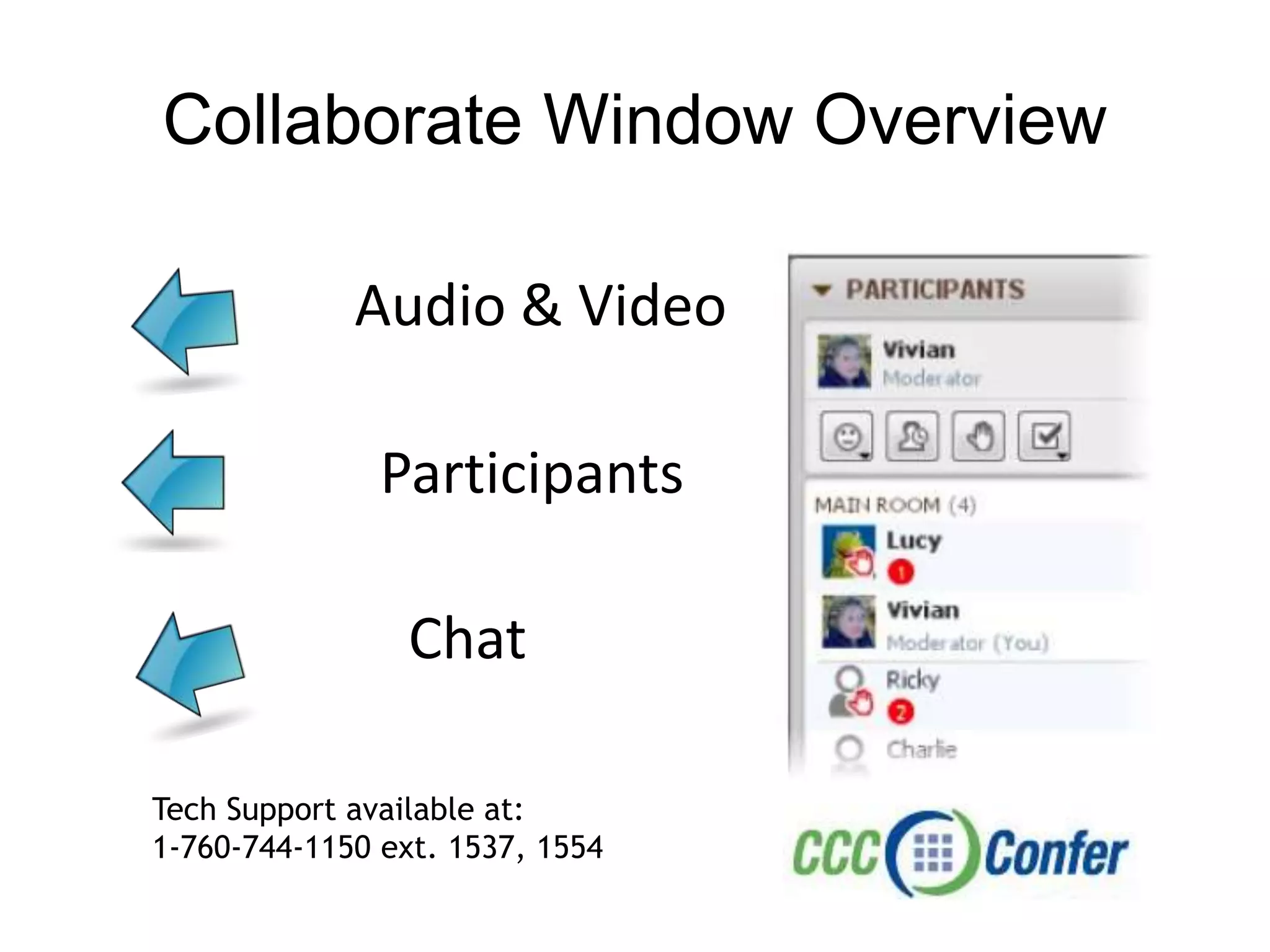
Collaborate Window Overview
Audio & Video
Participants
Chat
Tech Support available at:
1-760-744-1150 ext. 1537, 1554
Agenda
• Introductions
• CCCOER Overview
• Competency-based Education (CBE):
Delivering Improved Learning Outcomes
• Knowledge to Work Project, LFCC
• OER + CBE Business Degree, SBCTC
• Q & A
Welcome
Please introduce yourself in the chat window
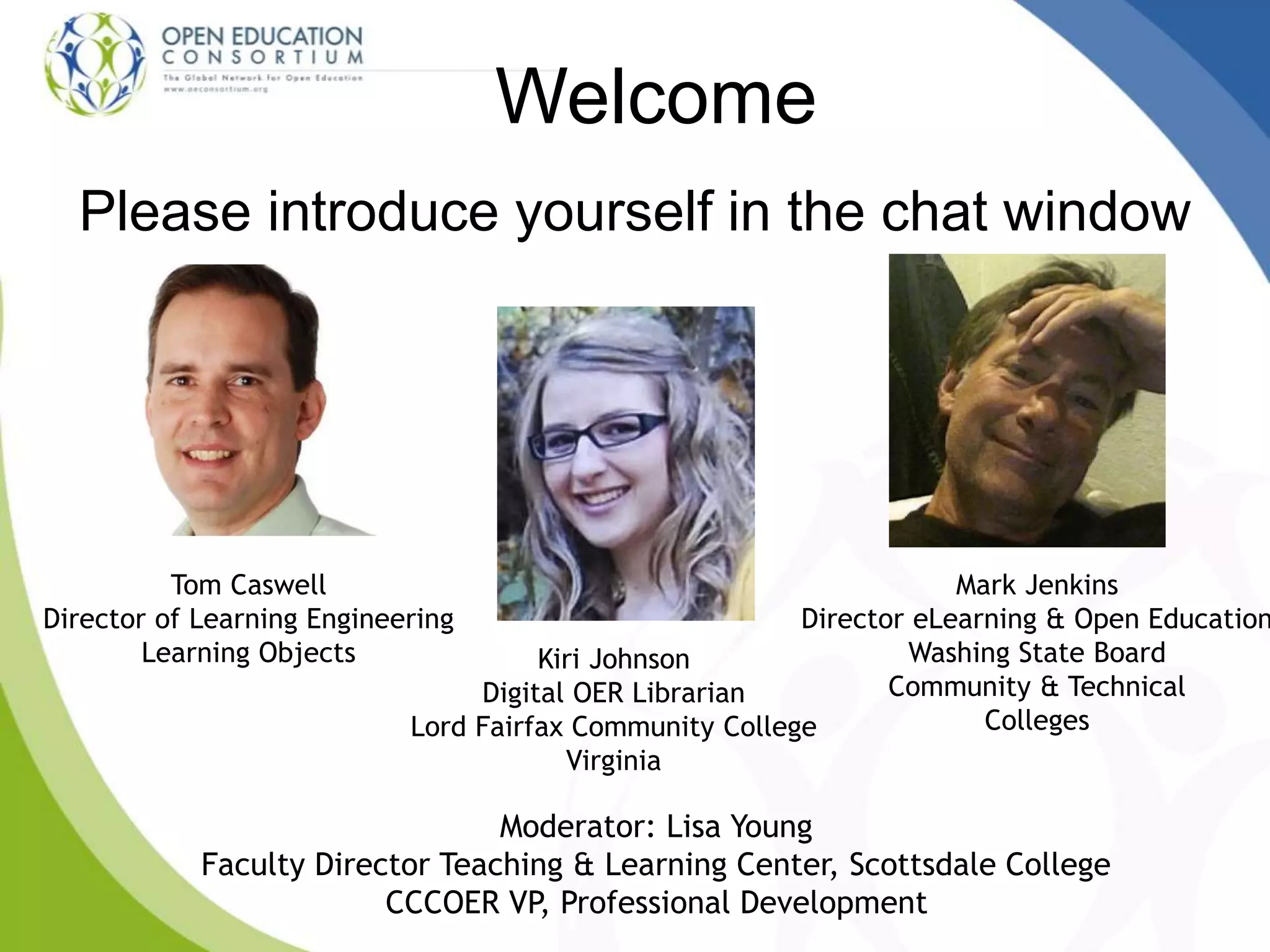
Tom Caswell
Director of Learning Engineering
Learning Objects
Moderator: Lisa Young
Faculty Director Teaching & Learning Center, Scottsdale College
CCCOER VP, Professional Development
Mark Jenkins
Director eLearning & Open Education
Washing State Board
Community & Technical
Colleges
Kiri Johnson
Digital OER Librarian
Lord Fairfax Community College
Virginia
• Expand access to high-
quality open materials
• Support faculty choice
and development
• Improve student success
Community College Consortium
for OER (CCCOER)
http://oerconsortium.org
Come In, We're Open gary simmons
cc-by-nc-sa flickr
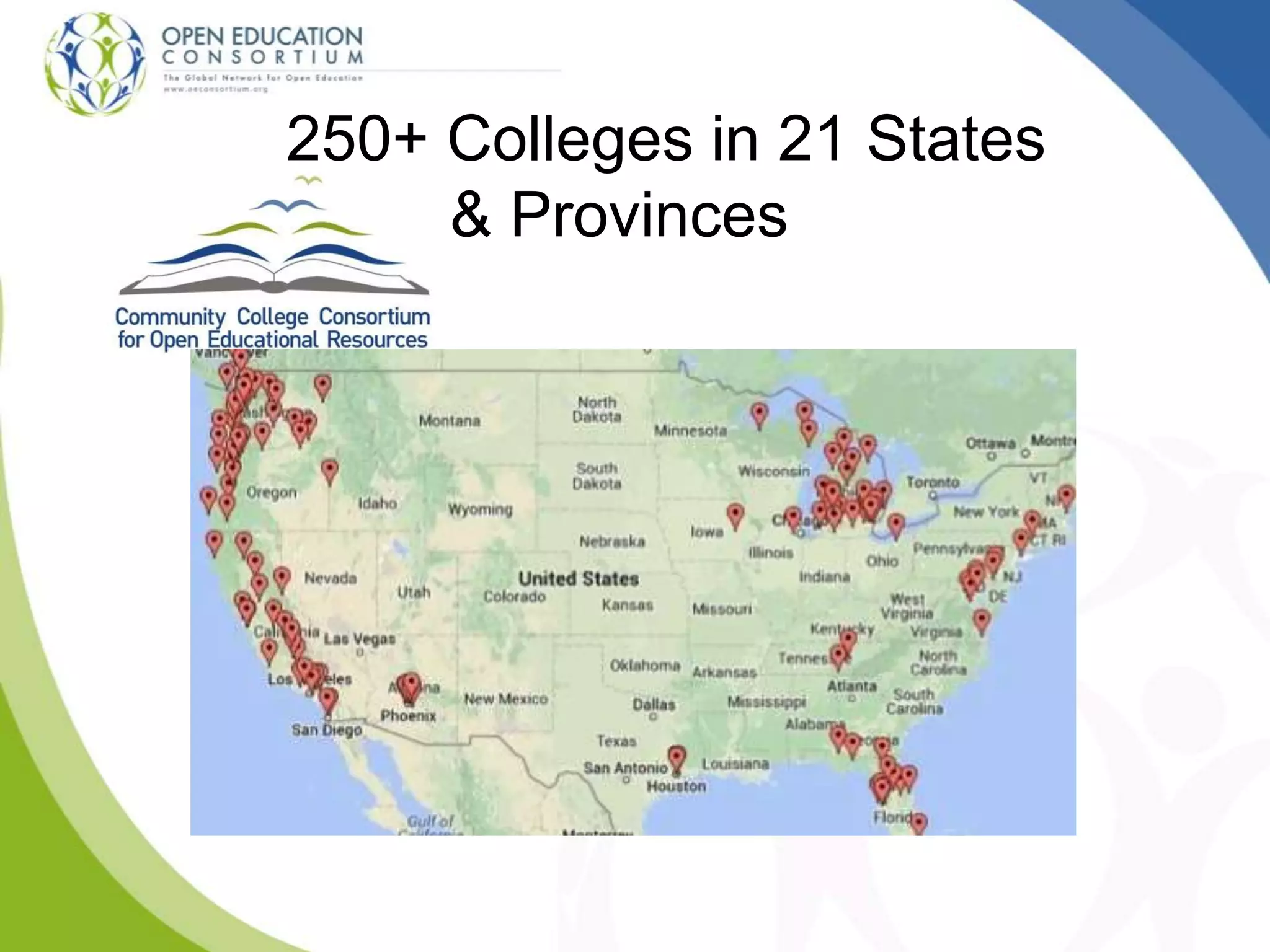
250+ Colleges in 21 States
& Provinces
Competency-based Education:
Delivering Better Learning Outcomes
Tom Caswell
Director of Learning Engineering
Personal Introduction
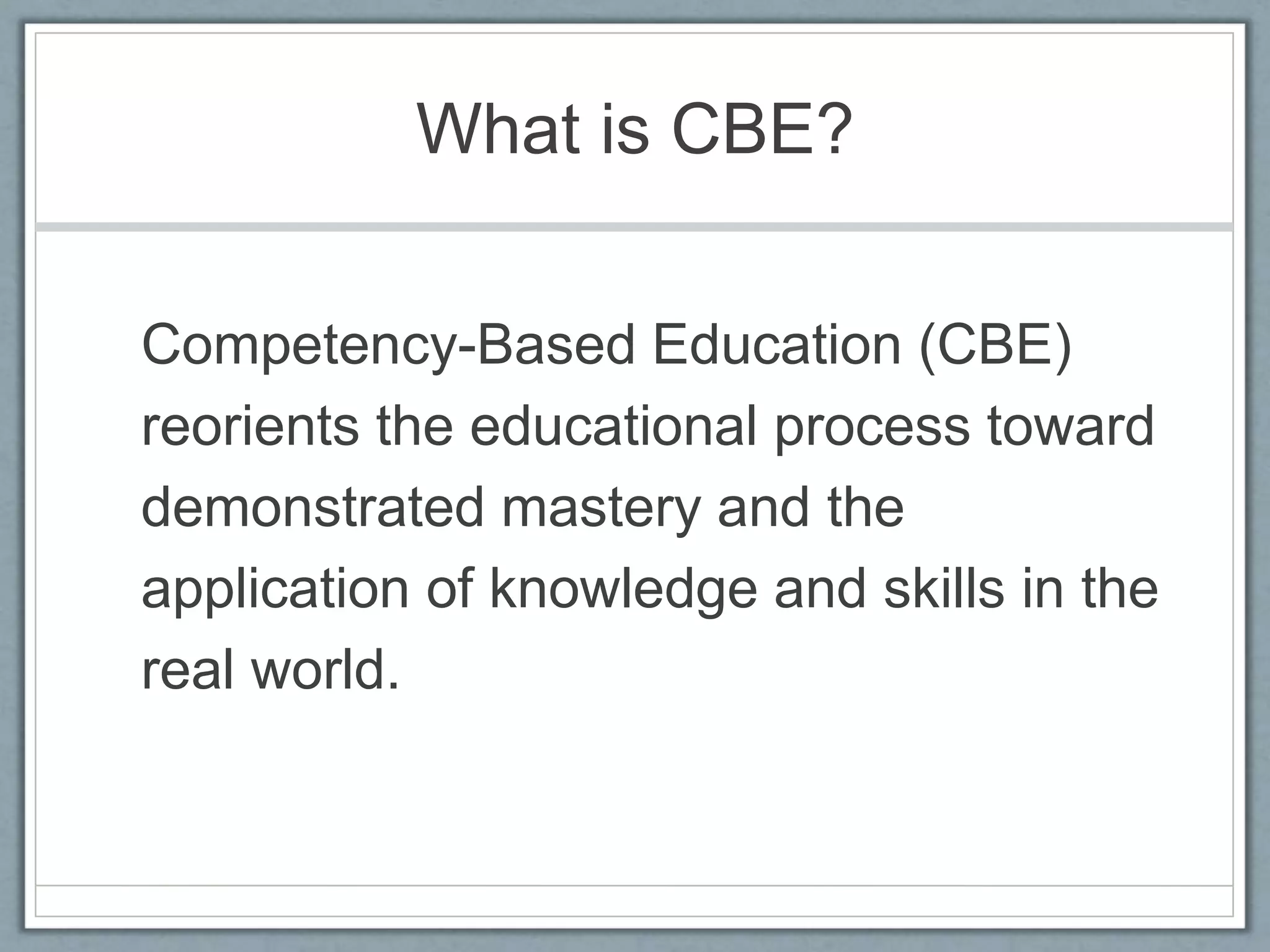
What is CBE?
Competency-Based Education (CBE)
reorients the educational process toward
demonstrated mastery and the
application of knowledge and skills in the
real world.
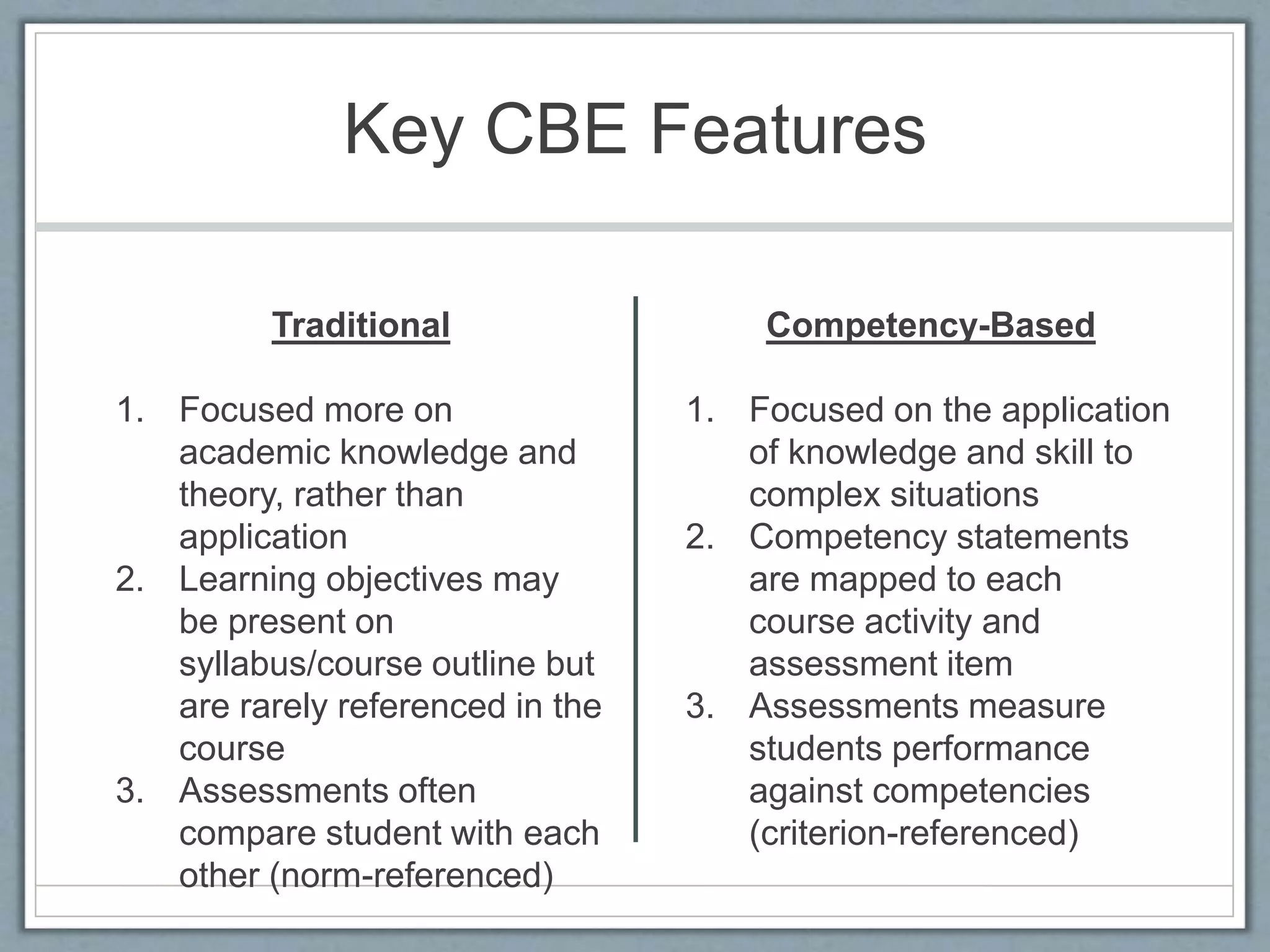
Key CBE Features
Traditional
1. Focused more on
academic knowledge and
theory, rather than
application
2. Learning objectives may
be present on
syllabus/course outline but
are rarely referenced in the
course
3. Assessments often
compare student with each
other (norm-referenced)
Competency-Based
1. Focused on the application
of knowledge and skill to
complex situations
2. Competency statements
are mapped to each
course activity and
assessment item
3. Assessments measure
students performance
against competencies
(criterion-referenced)
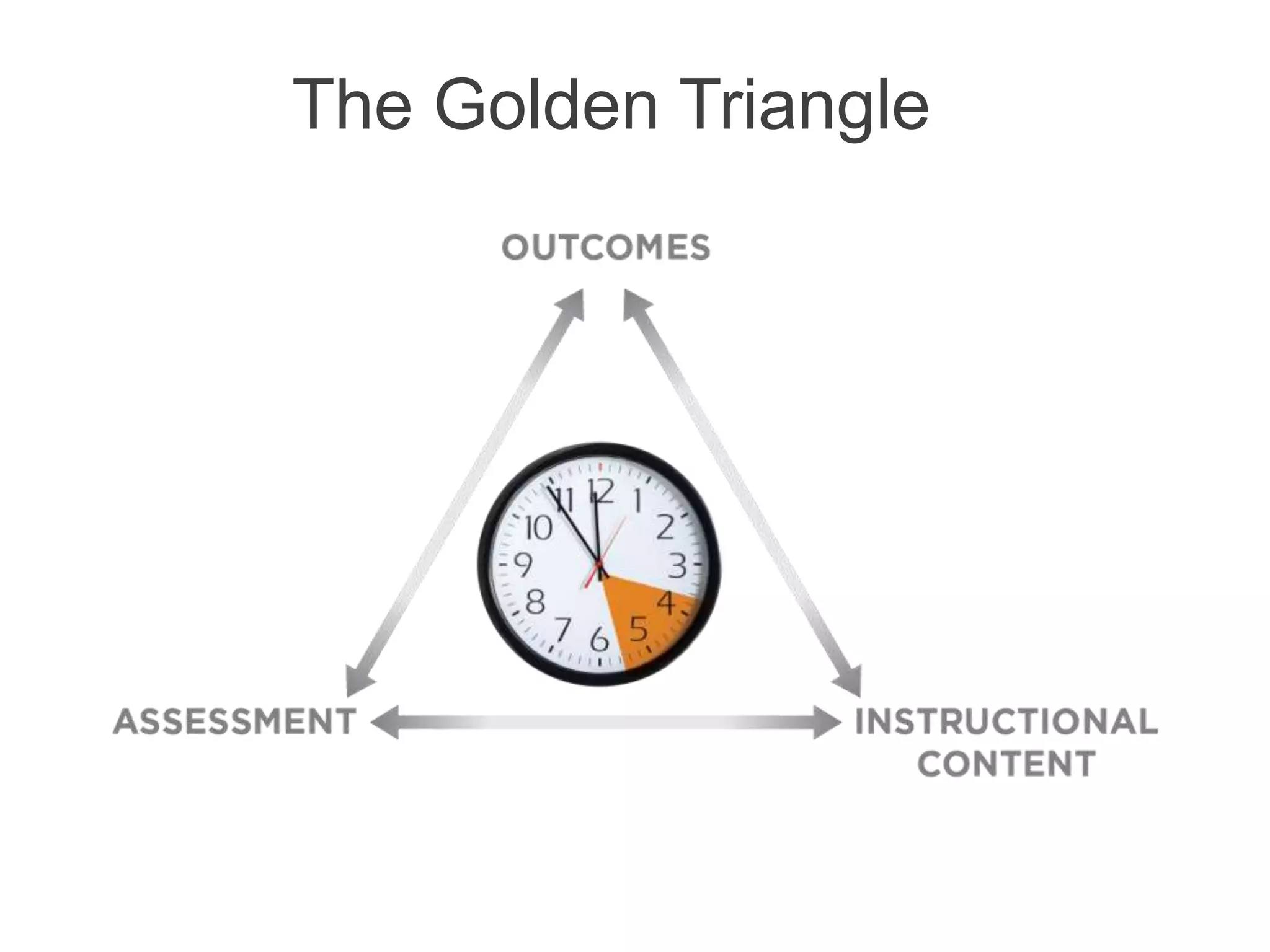
The Golden Triangle
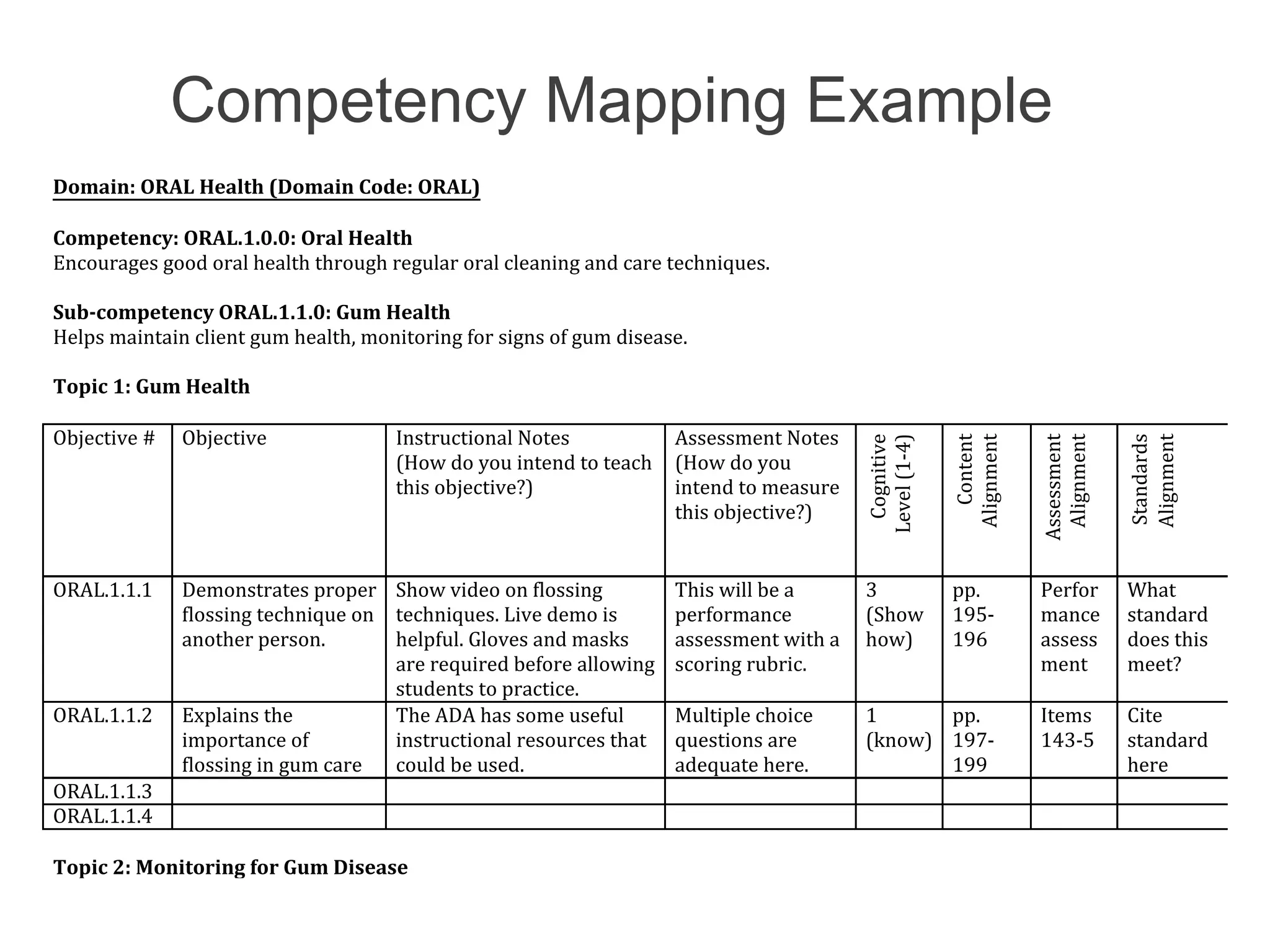
Competency Mapping Example
Domain: ORAL Health (Domain Code: ORAL)
Competency: ORAL.1.0.0: Oral Health
Encourages good oral health through regular oral cleaning and care techniques.
Sub-competency ORAL.1.1.0: Gum Health
Helps maintain client gum health, monitoring for signs of gum disease.
Topic 1: Gum Health
Objective # Objective Instructional Notes
(How do you intend to teach
this objective?)
Assessment Notes
(How do you
intend to measure
this objective?)
Cognitive
Level(1-4)
Content
Alignment
Assessment
Alignment
Standards
Alignment
ORAL.1.1.1 Demonstrates proper
flossing technique on
another person.
Show video on flossing
techniques. Live demo is
helpful. Gloves and masks
are required before allowing
students to practice.
This will be a
performance
assessment with a
scoring rubric.
3
(Show
how)
pp.
195-
196
Perfor
mance
assess
ment
What
standard
does this
meet?
ORAL.1.1.2 Explains the
importance of
flossing in gum care
The ADA has some useful
instructional resources that
could be used.
Multiple choice
questions are
adequate here.
1
(know)
pp.
197-
199
Items
143-5
Cite
standard
here
ORAL.1.1.3
ORAL.1.1.4
Topic 2: Monitoring for Gum Disease
Who Is Doing CBE?
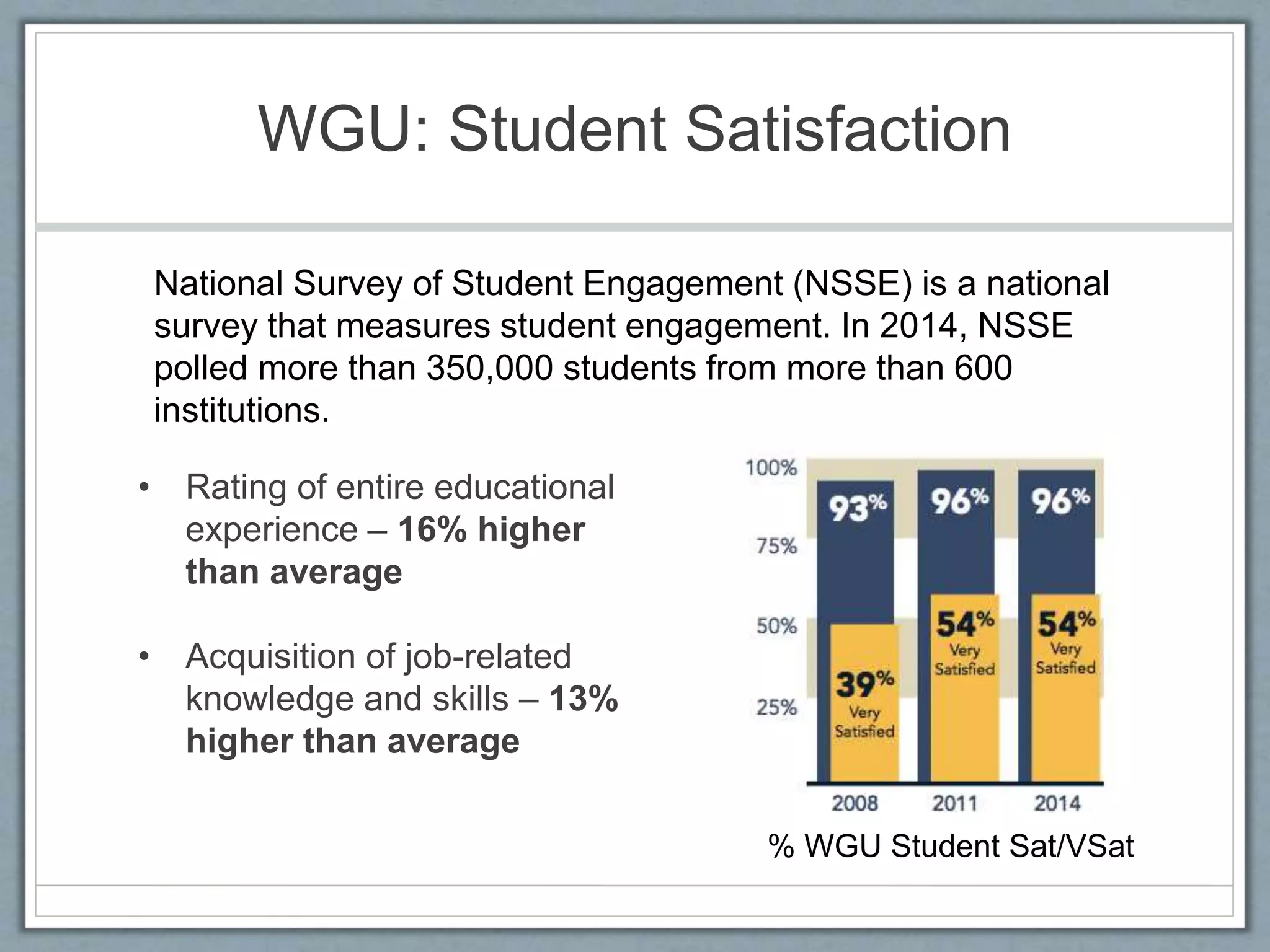
WGU: Student Satisfaction
• Rating of entire educational
experience – 16% higher
than average
• Acquisition of job-related
knowledge and skills – 13%
higher than average
National Survey of Student Engagement (NSSE) is a national
survey that measures student engagement. In 2014, NSSE
polled more than 350,000 students from more than 600
institutions.
% WGU Student Sat/VSat
WGU: Employer Satisfaction
From a 2014 Survey of 300 Employers by Harris Poll:
• 99% said that WGU graduates meet or exceed
expectations; 92% said WGU graduates exceed
expectations.
• 94% rated WGU graduates’ job performance as good as
or better than the job performance of other graduates;
53% rated WGU graduates better than other
graduates.
• 96% said that their WGU graduates were prepared for
their jobs; 89% said WGU graduates were very well or
extremely well prepared.
Thank you
Tom Caswell
caswell.tom@gmail.com
http://tomcaswell.com/consulting
Knowledge to Work
knowledgetowork.com
Kiri Johnson
Digital Librarian
Kiri Johnson
Digital Librarian
Knowledge to Work (K2W)
Lord Fairfax Community College
www.knowledgetowork.com
Direct assessment
competency-based
education (CBE)
with prior learning
assessment (PLA)
Health Information Management
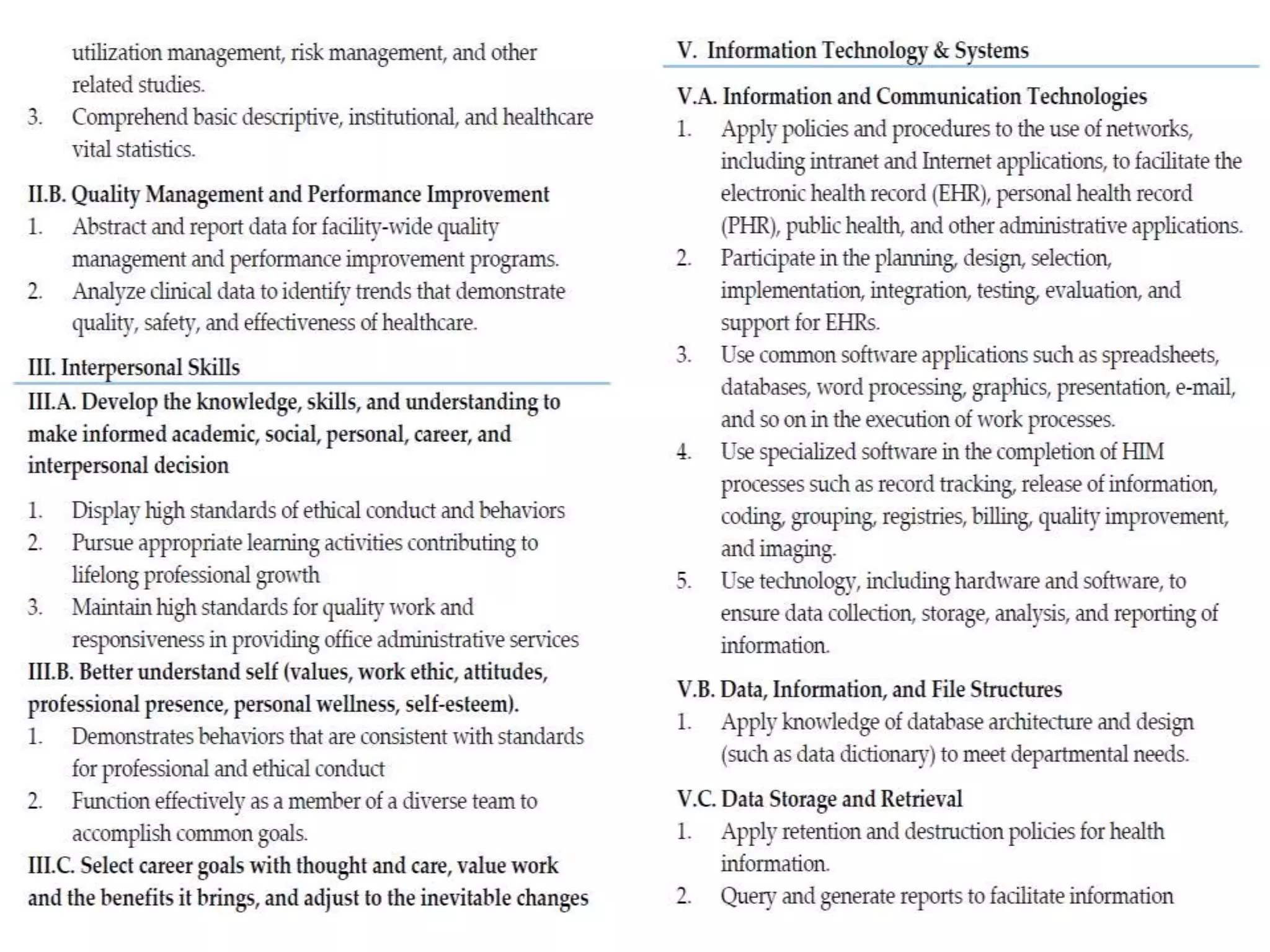
• Associate of Applied Science in Health Information Management
• Career Studies Certificate in Hospital Facility Coding
Information Systems Technology
• Associate of Applied Science in Information Systems
Technology
• Career Studies Certificate in Cyber Security
• Career Studies Certificate in Networking Specialist
Administrative Support Technology
• Career Studies Certificate in Information Processing Technician
• Certificate in Office Systems Assistant
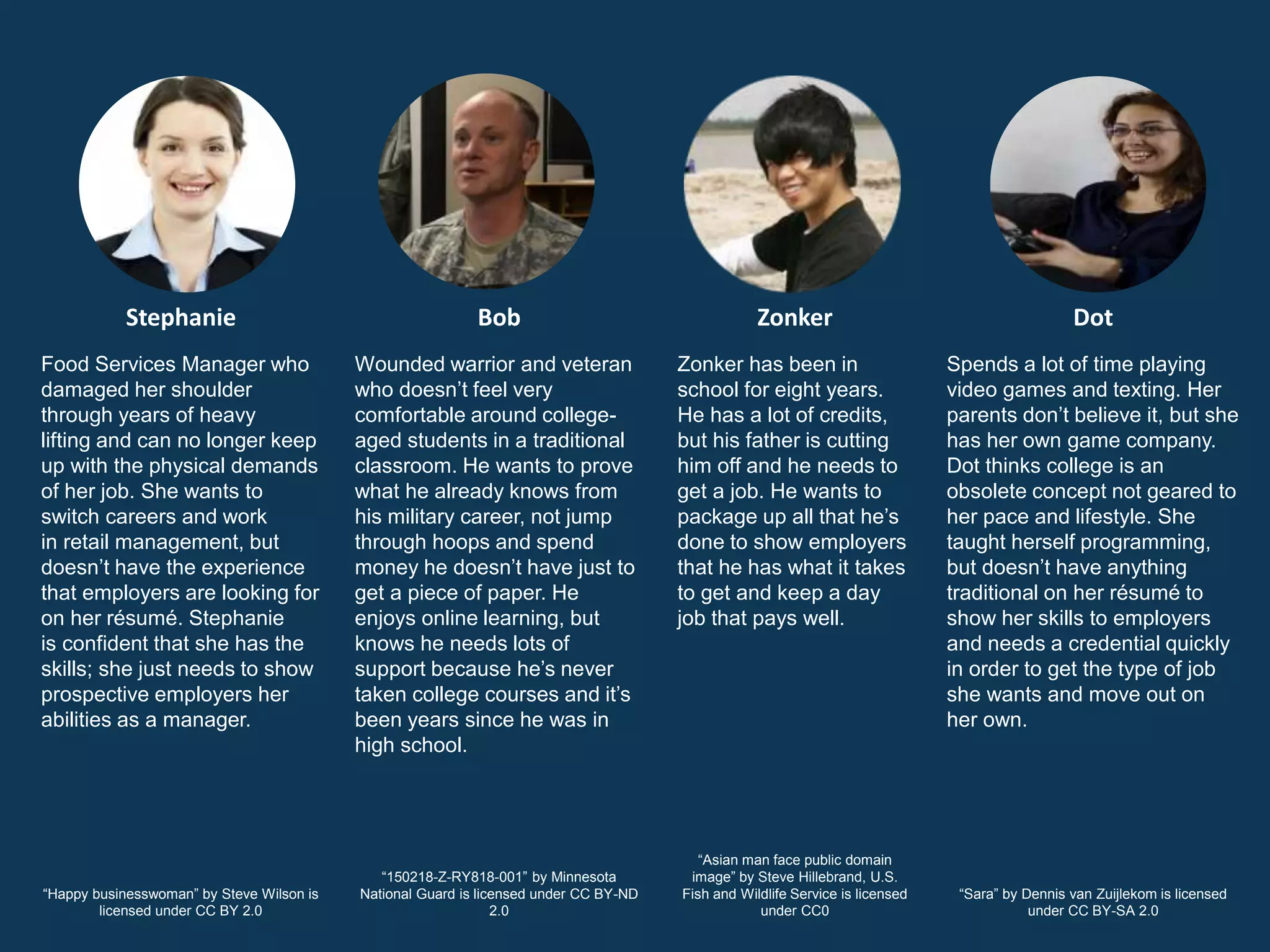
Stephanie Bob Zonker Dot
Food Services Manager who
damaged her shoulder
through years of heavy
lifting and can no longer keep
up with the physical demands
of her job. She wants to
switch careers and work
in retail management, but
doesn’t have the experience
that employers are looking for
on her résumé. Stephanie
is confident that she has the
skills; she just needs to show
prospective employers her
abilities as a manager.
Wounded warrior and veteran
who doesn’t feel very
comfortable around college-
aged students in a traditional
classroom. He wants to prove
what he already knows from
his military career, not jump
through hoops and spend
money he doesn’t have just to
get a piece of paper. He
enjoys online learning, but
knows he needs lots of
support because he’s never
taken college courses and it’s
been years since he was in
high school.
Zonker has been in
school for eight years.
He has a lot of credits,
but his father is cutting
him off and he needs to
get a job. He wants to
package up all that he’s
done to show employers
that he has what it takes
to get and keep a day
job that pays well.
Spends a lot of time playing
video games and texting. Her
parents don’t believe it, but she
has her own game company.
Dot thinks college is an
obsolete concept not geared to
her pace and lifestyle. She
taught herself programming,
but doesn’t have anything
traditional on her résumé to
show her skills to employers
and needs a credential quickly
in order to get the type of job
she wants and move out on
her own.
“Happy businesswoman” by Steve Wilson is
licensed under CC BY 2.0
“150218-Z-RY818-001” by Minnesota
National Guard is licensed under CC BY-ND
2.0
“Asian man face public domain
image” by Steve Hillebrand, U.S.
Fish and Wildlife Service is licensed
under CC0
“Sara” by Dennis van Zuijlekom is licensed
under CC BY-SA 2.0
Why OER?
Kiri Johnson, K2W Digital Librarian
kjohnson2@lfcc.edu
(540) 868-9746
John Milam, K2W Executive Director
jmilam@lfcc.edu
(540) 868-7249
OER + CBE
Business Transfer Degree
Mark Jenkins
Director of eLearning & Open Education
Washington’s
OER + CBE Degree Program
Mark Jenkins, Director
eLearning & Open Education, SBCTC
Who We Are
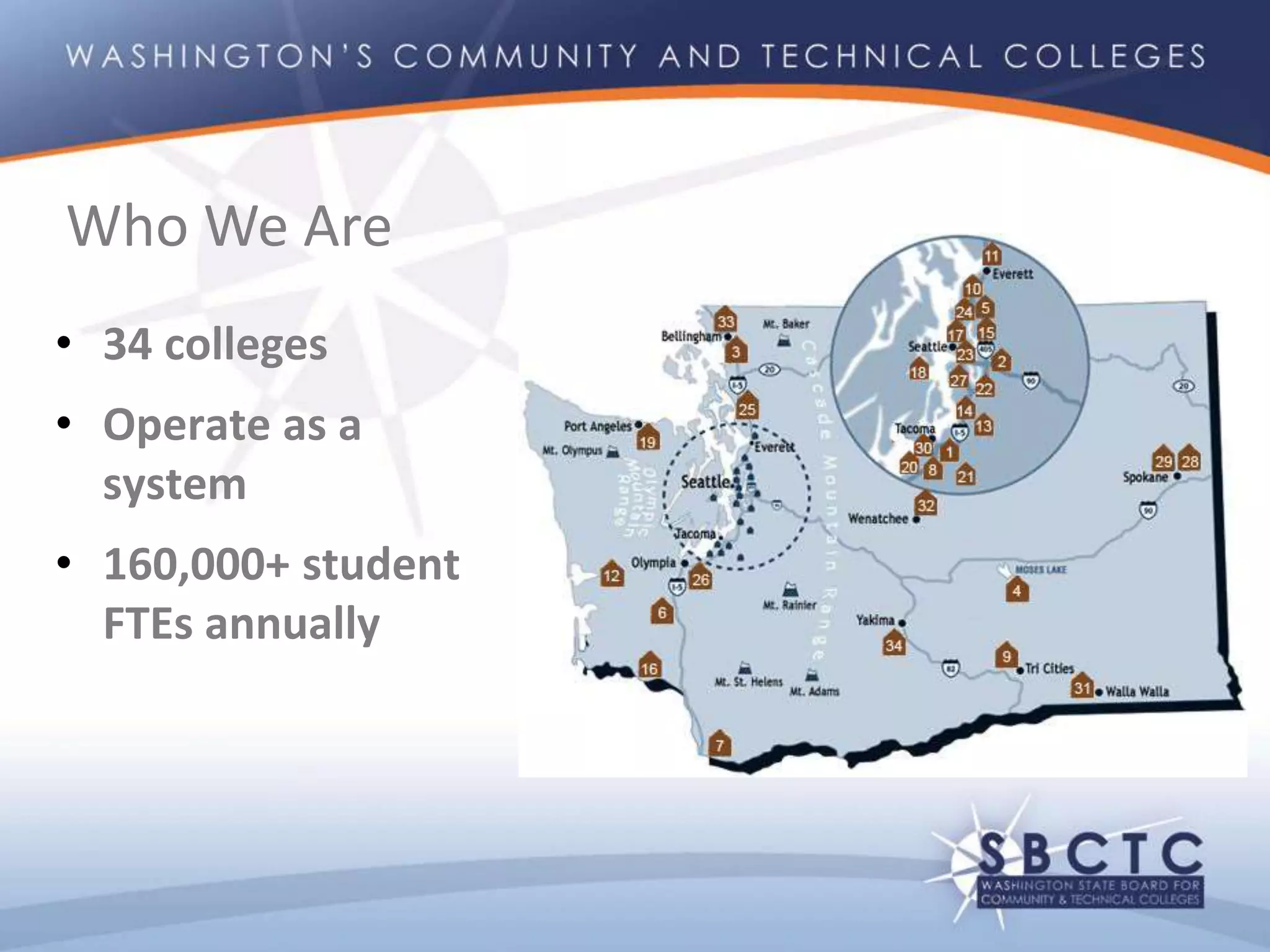
• 34 colleges
• Operate as a
system
• 160,000+ student
FTEs annually
• Business transfer degree shared system-wide
• OER content sourced and supported by Lumen Learning
• Students must demonstrate mastery of explicit competencies to
receive credit
• Students receive constant support based on their individual
learning needs
• Learning, not time, is the determining factor
CBE Program Concept
Focusing Event: SBCTC Legislative Presentation, Jan. 2014
https://app.leg.wa.gov/CMD/Handler.ashx?MethodName=getdocumentcontent&docume
ntId=EDi-X3rydFI&att=false
Target Population
Demographic
Shifts
• Fewer 15-19 year-
olds coming up
• Growth in 20-44
year-olds
Needs &
Opportunities
• Nearly 1 million
Washingtonians with
some college, no
degree
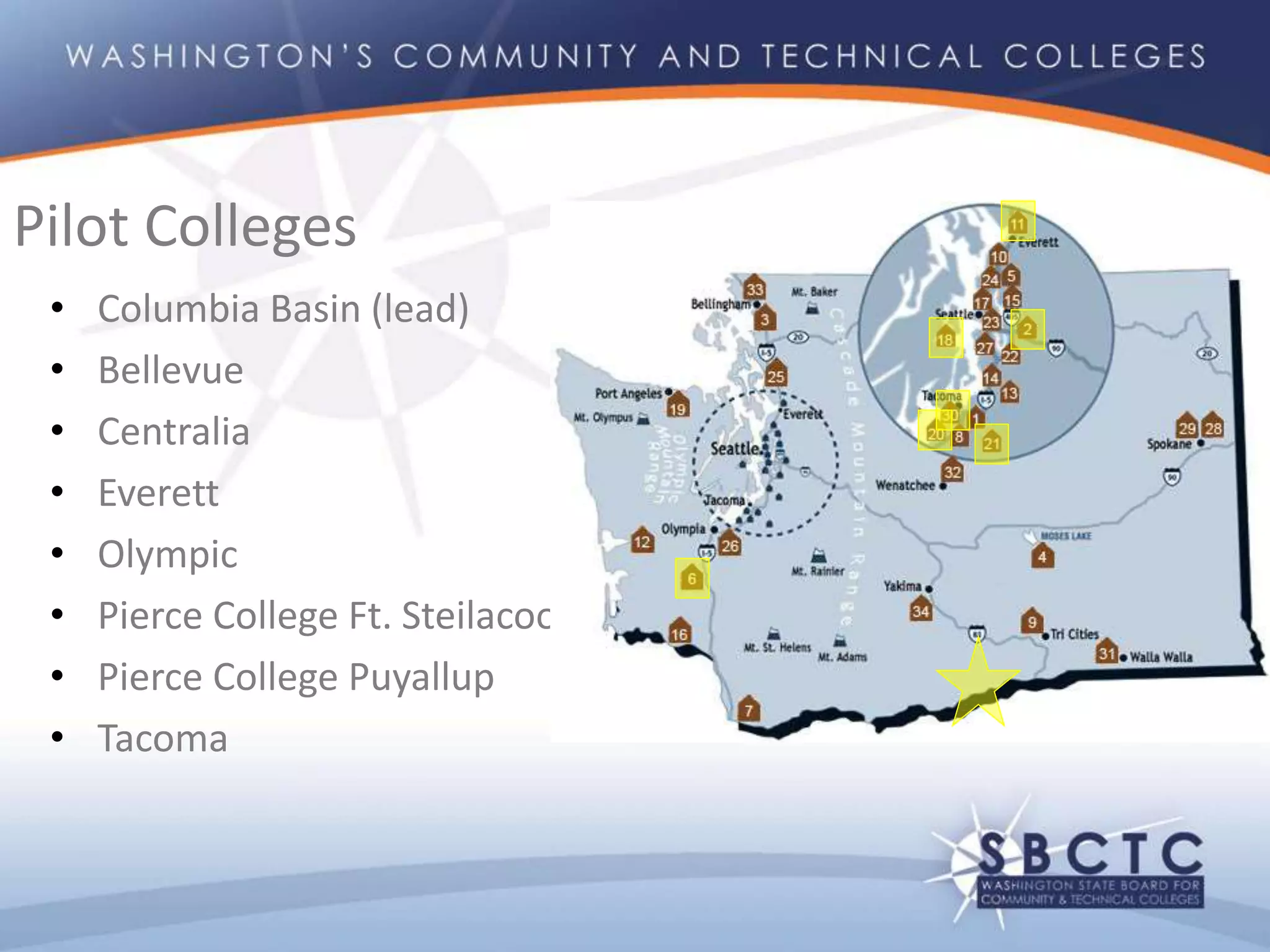
• Columbia Basin (lead)
• Bellevue
• Centralia
• Everett
• Olympic
• Pierce College Ft. Steilacoom
• Pierce College Puyallup
• Tacoma
Pilot Colleges
Why Build as a System?
Build on Existing
Assets
• Strong transfer
agreements
• Shared course system
(WAOL)
• Shared LMS (Canvas)
• Common eLearning tools
• Commitment to OER
• Western eTutoring
Consortium
• AskWA
Optimize Shared
Resources
• Share initial
development costs
• Share staffing to support
self-paced students
• Centralize hiring, staffing
for pilot program
• Students “belong” to
college where they enroll
• Developing the right staffing model to support student
success in a self-paced program;
• Funding development as a system;
• Keeping the cost attractive to students;
• Updating and validating the curriculum.
Challenges
• Student Profile: Some college or work experience;
• Advisors: “Intrusive” advisors at each college;
• Completion coaches: Encourage progress; remove
barriers;
• Teaching faculty: Instructors within discipline who
teach and assess.
Right People / Right Roles
Funding
• SBCTC, CBC & Eight Pilot Colleges form a
consortium for start-up investment;
Shared system assets for courses &
technology:
• WAOL shared programming;
• Common learning management system
• Common direct transfer agreements.
Funding & Sustainability
• Six-month terms, no ceiling on achievement;
• Exclusive use of open educational resources
(OER).
Managing Student Cost
• Open courses using open educational resources and
emerging mastery technology;
• Curated by teaching faculty with technical
assistance from Lumen & SBCTC;
• Openly published using CC BY licensing
• Commitment to continuous, evidence-based
improvement.
Open Educational Content
• Create and Refine Program level rules and policy based
on pilot experience;
• Continuous improvement of alignment between OER
content and assessment;
• Develop evidentiary models to represent student
progress and success to system governance;
• Recruit & market internally to bring new ‘investor
colleges’ to the table;
• Coordinate and disseminate shared marketing resources
and best practices;
• Develop & extend workforce relationships
• Scale, scale, scale
Next Steps & New Challenges
Mark Jenkins, Director, eLearning | Open Education
Washington State Board for Community & Technical Colleges
mjenkins@sbctc.edu
Thank You!
Dec 9 @
11 am PST, 2:00 pm EST
Welcome to our new colleges
Open Ed Conference Recap
Other Topics
Dec 9 Advisory Meeting
Thank you for coming!
Contact Info:
Lisa Young: lisa.young@scottsdalecc.edu
Tom Caswell: caswell.tom@gmail.com
Kiri D. Johnson: KJohnson2@lfcc.edu
Mark Jenkins: mjenkins@sbctc.edu
Questions?

OER and Competency-based Education

  • 1.
    OER and Competency-based Education TomCaswell, Learning Objects Kiri Johnson, Lord Fairfax Community College, VA Mark Jenkins, Washington State Board Community & Technical Colleges Dec 2nd, 2015, 10:00 am PST Unless otherwise indicated, this presentation is licensed CC-BY 4.0
  • 2.
    Collaborate Window Overview Audio& Video Participants Chat Tech Support available at: 1-760-744-1150 ext. 1537, 1554
  • 3.
    Agenda • Introductions • CCCOEROverview • Competency-based Education (CBE): Delivering Improved Learning Outcomes • Knowledge to Work Project, LFCC • OER + CBE Business Degree, SBCTC • Q & A
  • 4.
    Welcome Please introduce yourselfin the chat window Tom Caswell Director of Learning Engineering Learning Objects Moderator: Lisa Young Faculty Director Teaching & Learning Center, Scottsdale College CCCOER VP, Professional Development Mark Jenkins Director eLearning & Open Education Washing State Board Community & Technical Colleges Kiri Johnson Digital OER Librarian Lord Fairfax Community College Virginia
  • 5.
    • Expand accessto high- quality open materials • Support faculty choice and development • Improve student success Community College Consortium for OER (CCCOER) http://oerconsortium.org Come In, We're Open gary simmons cc-by-nc-sa flickr
  • 6.
    250+ Colleges in21 States & Provinces
  • 7.
    Competency-based Education: Delivering BetterLearning Outcomes Tom Caswell Director of Learning Engineering
  • 8.
  • 9.
    What is CBE? Competency-BasedEducation (CBE) reorients the educational process toward demonstrated mastery and the application of knowledge and skills in the real world.
  • 10.
    Key CBE Features Traditional 1.Focused more on academic knowledge and theory, rather than application 2. Learning objectives may be present on syllabus/course outline but are rarely referenced in the course 3. Assessments often compare student with each other (norm-referenced) Competency-Based 1. Focused on the application of knowledge and skill to complex situations 2. Competency statements are mapped to each course activity and assessment item 3. Assessments measure students performance against competencies (criterion-referenced)
  • 11.
  • 12.
    Competency Mapping Example Domain:ORAL Health (Domain Code: ORAL) Competency: ORAL.1.0.0: Oral Health Encourages good oral health through regular oral cleaning and care techniques. Sub-competency ORAL.1.1.0: Gum Health Helps maintain client gum health, monitoring for signs of gum disease. Topic 1: Gum Health Objective # Objective Instructional Notes (How do you intend to teach this objective?) Assessment Notes (How do you intend to measure this objective?) Cognitive Level(1-4) Content Alignment Assessment Alignment Standards Alignment ORAL.1.1.1 Demonstrates proper flossing technique on another person. Show video on flossing techniques. Live demo is helpful. Gloves and masks are required before allowing students to practice. This will be a performance assessment with a scoring rubric. 3 (Show how) pp. 195- 196 Perfor mance assess ment What standard does this meet? ORAL.1.1.2 Explains the importance of flossing in gum care The ADA has some useful instructional resources that could be used. Multiple choice questions are adequate here. 1 (know) pp. 197- 199 Items 143-5 Cite standard here ORAL.1.1.3 ORAL.1.1.4 Topic 2: Monitoring for Gum Disease
  • 13.
  • 14.
    WGU: Student Satisfaction •Rating of entire educational experience – 16% higher than average • Acquisition of job-related knowledge and skills – 13% higher than average National Survey of Student Engagement (NSSE) is a national survey that measures student engagement. In 2014, NSSE polled more than 350,000 students from more than 600 institutions. % WGU Student Sat/VSat
  • 15.
    WGU: Employer Satisfaction Froma 2014 Survey of 300 Employers by Harris Poll: • 99% said that WGU graduates meet or exceed expectations; 92% said WGU graduates exceed expectations. • 94% rated WGU graduates’ job performance as good as or better than the job performance of other graduates; 53% rated WGU graduates better than other graduates. • 96% said that their WGU graduates were prepared for their jobs; 89% said WGU graduates were very well or extremely well prepared.
  • 16.
  • 17.
  • 18.
    Kiri Johnson Digital Librarian Knowledgeto Work (K2W) Lord Fairfax Community College www.knowledgetowork.com
  • 19.
  • 20.
    Health Information Management •Associate of Applied Science in Health Information Management • Career Studies Certificate in Hospital Facility Coding Information Systems Technology • Associate of Applied Science in Information Systems Technology • Career Studies Certificate in Cyber Security • Career Studies Certificate in Networking Specialist Administrative Support Technology • Career Studies Certificate in Information Processing Technician • Certificate in Office Systems Assistant
  • 22.
    Stephanie Bob ZonkerDot Food Services Manager who damaged her shoulder through years of heavy lifting and can no longer keep up with the physical demands of her job. She wants to switch careers and work in retail management, but doesn’t have the experience that employers are looking for on her résumé. Stephanie is confident that she has the skills; she just needs to show prospective employers her abilities as a manager. Wounded warrior and veteran who doesn’t feel very comfortable around college- aged students in a traditional classroom. He wants to prove what he already knows from his military career, not jump through hoops and spend money he doesn’t have just to get a piece of paper. He enjoys online learning, but knows he needs lots of support because he’s never taken college courses and it’s been years since he was in high school. Zonker has been in school for eight years. He has a lot of credits, but his father is cutting him off and he needs to get a job. He wants to package up all that he’s done to show employers that he has what it takes to get and keep a day job that pays well. Spends a lot of time playing video games and texting. Her parents don’t believe it, but she has her own game company. Dot thinks college is an obsolete concept not geared to her pace and lifestyle. She taught herself programming, but doesn’t have anything traditional on her résumé to show her skills to employers and needs a credential quickly in order to get the type of job she wants and move out on her own. “Happy businesswoman” by Steve Wilson is licensed under CC BY 2.0 “150218-Z-RY818-001” by Minnesota National Guard is licensed under CC BY-ND 2.0 “Asian man face public domain image” by Steve Hillebrand, U.S. Fish and Wildlife Service is licensed under CC0 “Sara” by Dennis van Zuijlekom is licensed under CC BY-SA 2.0
  • 28.
  • 29.
    Kiri Johnson, K2WDigital Librarian kjohnson2@lfcc.edu (540) 868-9746 John Milam, K2W Executive Director jmilam@lfcc.edu (540) 868-7249
  • 30.
    OER + CBE BusinessTransfer Degree Mark Jenkins Director of eLearning & Open Education
  • 31.
    Washington’s OER + CBEDegree Program Mark Jenkins, Director eLearning & Open Education, SBCTC
  • 32.
    Who We Are •34 colleges • Operate as a system • 160,000+ student FTEs annually
  • 33.
    • Business transferdegree shared system-wide • OER content sourced and supported by Lumen Learning • Students must demonstrate mastery of explicit competencies to receive credit • Students receive constant support based on their individual learning needs • Learning, not time, is the determining factor CBE Program Concept
  • 34.
    Focusing Event: SBCTCLegislative Presentation, Jan. 2014 https://app.leg.wa.gov/CMD/Handler.ashx?MethodName=getdocumentcontent&docume ntId=EDi-X3rydFI&att=false Target Population Demographic Shifts • Fewer 15-19 year- olds coming up • Growth in 20-44 year-olds Needs & Opportunities • Nearly 1 million Washingtonians with some college, no degree
  • 35.
    • Columbia Basin(lead) • Bellevue • Centralia • Everett • Olympic • Pierce College Ft. Steilacoom • Pierce College Puyallup • Tacoma Pilot Colleges
  • 36.
    Why Build asa System? Build on Existing Assets • Strong transfer agreements • Shared course system (WAOL) • Shared LMS (Canvas) • Common eLearning tools • Commitment to OER • Western eTutoring Consortium • AskWA Optimize Shared Resources • Share initial development costs • Share staffing to support self-paced students • Centralize hiring, staffing for pilot program • Students “belong” to college where they enroll
  • 37.
    • Developing theright staffing model to support student success in a self-paced program; • Funding development as a system; • Keeping the cost attractive to students; • Updating and validating the curriculum. Challenges
  • 38.
    • Student Profile:Some college or work experience; • Advisors: “Intrusive” advisors at each college; • Completion coaches: Encourage progress; remove barriers; • Teaching faculty: Instructors within discipline who teach and assess. Right People / Right Roles
  • 39.
    Funding • SBCTC, CBC& Eight Pilot Colleges form a consortium for start-up investment; Shared system assets for courses & technology: • WAOL shared programming; • Common learning management system • Common direct transfer agreements. Funding & Sustainability
  • 40.
    • Six-month terms,no ceiling on achievement; • Exclusive use of open educational resources (OER). Managing Student Cost
  • 41.
    • Open coursesusing open educational resources and emerging mastery technology; • Curated by teaching faculty with technical assistance from Lumen & SBCTC; • Openly published using CC BY licensing • Commitment to continuous, evidence-based improvement. Open Educational Content
  • 42.
    • Create andRefine Program level rules and policy based on pilot experience; • Continuous improvement of alignment between OER content and assessment; • Develop evidentiary models to represent student progress and success to system governance; • Recruit & market internally to bring new ‘investor colleges’ to the table; • Coordinate and disseminate shared marketing resources and best practices; • Develop & extend workforce relationships • Scale, scale, scale Next Steps & New Challenges
  • 43.
    Mark Jenkins, Director,eLearning | Open Education Washington State Board for Community & Technical Colleges mjenkins@sbctc.edu Thank You!
  • 44.
    Dec 9 @ 11am PST, 2:00 pm EST Welcome to our new colleges Open Ed Conference Recap Other Topics Dec 9 Advisory Meeting
  • 45.
    Thank you forcoming! Contact Info: Lisa Young: lisa.young@scottsdalecc.edu Tom Caswell: caswell.tom@gmail.com Kiri D. Johnson: KJohnson2@lfcc.edu Mark Jenkins: mjenkins@sbctc.edu Questions?

Editor's Notes

  • #3 ELLUMINATE/CCC Conference Opening Script   [Start recording…] Welcome to the ________ Webinar for DAY, MONTH, YEAR [sponsored by]. [If applicable] Today’s guests come to us from _______ in ____, ___. I will introduce them shortly, but first I want to go over a few details about this [Elluminate/CCC Confer] session for those who are new to [Elluminate/CCC Confer]. Details At the upper left of your screen, you should see the Participants window, which lists the participants in this session. You can use the icons underneath this window to: Raise your hand if you have a question or comment and you wish to speak There are also happy and sad faces and an applaud icon Below the Participants window is the Chat window to the center-left of this screen where you can type a question or comment into the box at any time. You can also send a private message to another participant at any time, but please be aware that moderators can see all private messages. Below the chat area is the Audio window in the bottom left of the screen. Click on the raised your hand button to let us know you would like to speak. You can use a head set or your phone for audio chat. If you are using a microphone and have been recognized to speak, Click the button with the microphone on it and begin speaking. Remember to click the button again when you finish speaking so that someone else can have a turn. You can control your mic and volume levels with the sliders. And if you are having trouble with your headset or microphone, you can access the Audio Setup Wizard from the Tools menu on the top toolbar. From Tools, select Audio, and then Audio Setup Wizard, and follow the on-screen instructions. [CCC Confer ONLY] If you are using the telephone to speak, Click on the phone handset below the microphone and audio volume sliders. The call-number and pin will then appear in a dialog box.
  • #6 The Community College Consortium for OER is a community of practice dedicated to promoting the adoption and development of open educational resources to enhance teaching and learning. We were founded to support the community college mission of open access through creating awareness and development of openly licensed, low-cost education materials to make college more affordable and accessible for students. We provide regularly scheduled online and face-2-face workshops for faculty and staff who are engaged in OER projects.
  • #10 Source: Johnstone and Soares. “Principles for Developing Competency-Based Education Programs “ 2014
  • #11 Source: Johnstone and Soares. “Principles for Developing Competency-Based Education Programs “ 2014
  • #12 Mapping outcomes to assessments and content
  • #15 Source: 2014 National Survey of Student Engagement (NSSE)
  • #16 Source: 2014 Survey of 300 Employers by Harris Poll
  • #33 Describe system; Describe Agency role Mention the Culture of Sharing
  • #34 Process – system wide information and consensus building, a decision by the presidents to pursue the project, assistance and training from WGU. A system wide task force resulting in a recommendation to fund the project. Columbia Basin assumed the role of lead college on the project Investment by the state board and Columbia Basin Partnership with
  • #35 Reduced population growth in 15-19 year olds in the next 10 years Increased growth in 20-44 year olds with some college Almost 1 million Washingtonians have some college, no degree
  • #36 8 Pilot Colleges have signed on to be part of the pilot – Columbia Basin—lead Bellevue Centralia Everett Olympic Pierce College Ft. Steilacoom Pierce College Puyallup Tacoma
  • #37 CONNIE Share initial development costs Share staffing to support students who work at their own pace Students belong to the college where they enroll All faculty for the pilot will be hired at Columbia Basin College Building on existing assets: Strong transfer agreements Shared course system (WAOL) Shared learning management system (Canvas) Common elearning tools Western eTutoring Consortium AskWA
  • #38 The primary negotiations – Faculty contracts Funding Tuition and Financial aid Accreditation
  • #39 CONNIE Add images/visuals to represent people?
  • #42 SHELLEY