April 8, 2020, 12:00 pm PST
Welcome
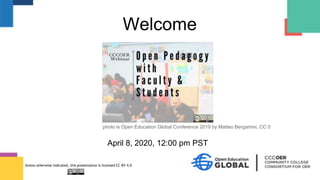
photo is Open Education Global Conference 2019 by Matteo Bergamini, CC 0
Unless otherwise indicated, this presentation is licensed CC-BY 4.0
Agenda
● Introductions
● CCCOER overview
● OER at Paradise Valley Community College
● Keene State College
● Montgomery College
● Q & A
● Upcoming events and announcements
Speakers
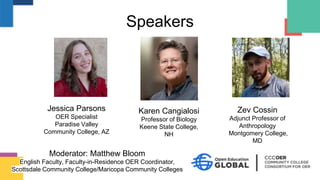
Moderator: Matthew Bloom
English Faculty, Faculty-in-Residence OER Coordinator,
Scottsdale Community College/Maricopa Community Colleges
Jessica Parsons
OER Specialist
Paradise Valley
Community College, AZ
Zev Cossin
Adjunct Professor of
Anthropology
Montgomery College,
MD
Karen Cangialosi
Professor of Biology
Keene State College,
NH
● Expand awareness & access to high-
quality OER
● Support faculty choice & development
● Foster regional OER leadership
● Improve student success
CCCOER Mission
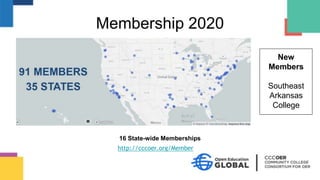
Membership 2020
http://cccoer.org/Member
16 State-wide Memberships
New
Members
Southeast
Arkansas
College
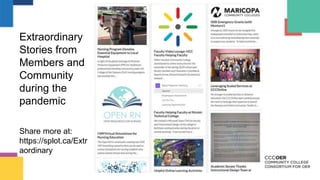
Extraordinary
Stories from
Members and
Community
during the
pandemic
Share more at:
https://splot.ca/Extr
aordinary
Paradise Valley Community College
David Dwork
Mathematics Faculty
Jessica Parsons
Open Educational
Resource (OER)
Specialist
OER at PVCC
OER Specialist Program
Based on College of the Canyons Program
9
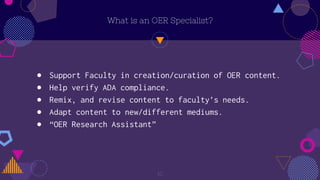
What is an OER Specialist?
10
● Support Faculty in creation/curation of OER content.
● Help verify ADA compliance.
● Remix, and revise content to faculty’s needs.
● Adapt content to new/different mediums.
● “OER Research Assistant”
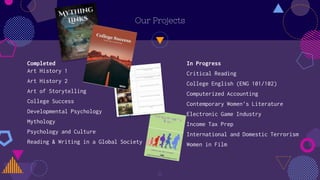
Our Projects
Completed
Art History 1
Art History 2
Art of Storytelling
College Success
Developmental Psychology
Mythology
Psychology and Culture
Reading & Writing in a Global Society
In Progress
Critical Reading
College English (ENG 101/102)
Computerized Accounting
Contemporary Women’s Literature
Electronic Game Industry
Income Tax Prep
International and Domestic Terrorism
Women in Film
11
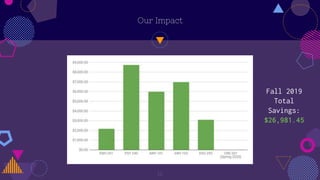
Our Impact
12
Fall 2019
Total
Savings:
$26,981.45
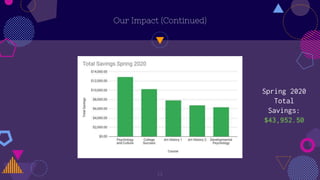
Our Impact (Continued)
13
Spring 2020
Total
Savings:
$43,952.50
Our Impact (Continued)
14
Total Savings:
$70,933.95
In 2 Semesters of program operation
15
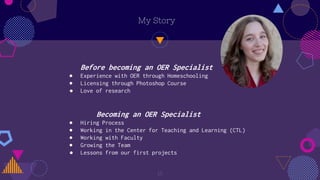
My Story
Before becoming an OER Specialist
● Experience with OER through Homeschooling
● Licensing through Photoshop Course
● Love of research
Becoming an OER Specialist
● Hiring Process
● Working in the Center for Teaching and Learning (CTL)
● Working with Faculty
● Growing the Team
● Lessons from our first projects
16
Lessons Learned
● Work a semester or two ahead
● It’s not all about the full course
● Follow up with faculty constantly
● Realize that Midterms and Finals are NOT good times for
meetings
● Always ask about copyrighted content, you might be
surprised
● There’s always room for rewrites
● Save everything, you never know when you might do a
similar course or topic again
● Keep talking about OER, we are our best advocates
Thanks!Any questions?
OERSpecialist@paradisevalley.edu
👍
17 Slides by Slide Carnival
Keene State College
Karen Cangialosi
Professor of Biology
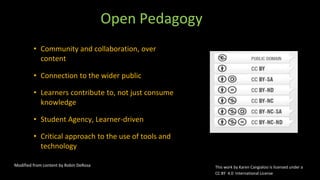
Open Pedagogy
• Community and collaboration, over
content
• Connection to the wider public
• Learners contribute to, not just consume
knowledge
• Student Agency, Learner-driven
• Critical approach to the use of tools and
technology
Modified from content by Robin DeRosa This work by Karen Cangialosi is licensed under a
CC BY 4.0 International License
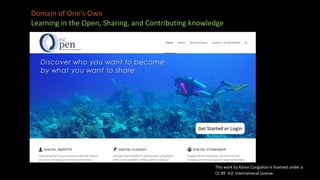
Domain of One’s Own
Learning in the Open, Sharing, and Contributing knowledge
This work by Karen Cangialosi is licensed under a
CC BY 4.0 International License
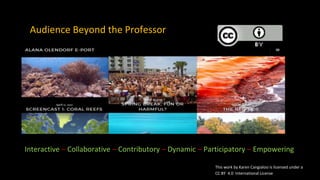
Audience Beyond the Professor
Interactive – Collaborative – Contributory – Dynamic – Participatory – Empowering
This work by Karen Cangialosi is licensed under a
CC BY 4.0 International License
“It was a drastic and honestly scary change going
from a traditional learning course where I only have
my instructor’s opinion to worry about.”
Keene State College student
This work by Karen Cangialosi is licensed under a
CC BY 4.0 International License
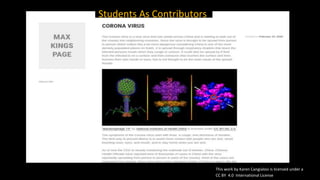
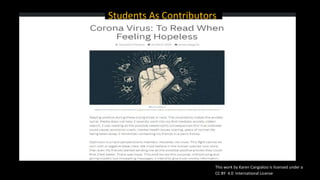
Students As Contributors
This work by Karen Cangialosi is licensed under a
CC BY 4.0 International License
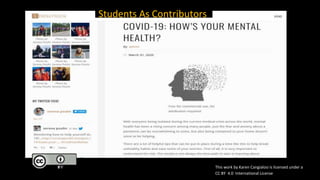
Students As Contributors
This work by Karen Cangialosi is licensed under a
CC BY 4.0 International License
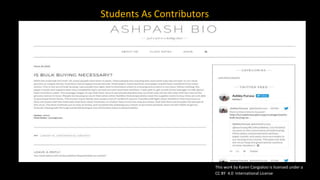
Students As Contributors
This work by Karen Cangialosi is licensed under a
CC BY 4.0 International License
Students As Contributors
Some “Free” Tools for Blogging, making Websites:
Wordpres
s
Google sites Blogger
Tumblr
Wix
This work by Karen Cangialosi is licensed under a
CC BY 4.0 International License
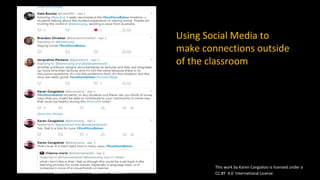
Using Social Media to
make connections outside
of the classroom
This work by Karen Cangialosi is licensed under a
CC BY 4.0 International License
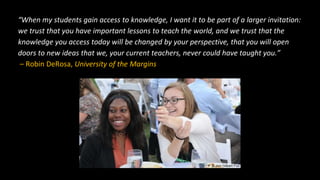
“When my students gain access to knowledge, I want it to be part of a larger invitation:
we trust that you have important lessons to teach the world, and we trust that the
knowledge you access today will be changed by your perspective, that you will open
doors to new ideas that we, your current teachers, never could have taught you.”
– Robin DeRosa, University of the Margins
Montgomery College
Zev Cossin
Adjunct Professor of
Anthropology
Eduardo Chaves Serrano
Student - Zero Hunger
Assignment
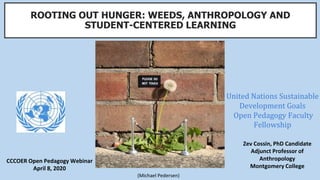
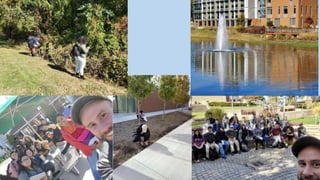
ROOTING OUT HUNGER: WEEDS, ANTHROPOLOGY AND
STUDENT-CENTERED LEARNING
CCCOER Open Pedagogy Webinar
April 8, 2020
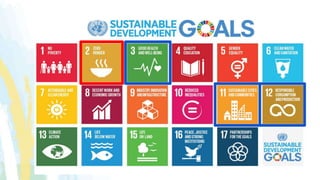
United Nations Sustainable
Development Goals
Open Pedagogy Faculty
Fellowship
Zev Cossin, PhD Candidate
Adjunct Professor of
Anthropology
Montgomery College
(Michael Pedersen)
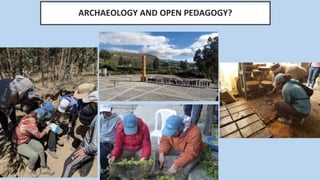
ARCHAEOLOGY AND OPEN PEDAGOGY?
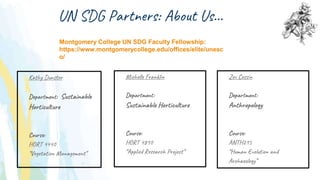
UN SDG Partners: About Us…
Zev Cossin
Department:
Anthropology
Course:
ANTH215
“Human Evolution and
Archaeology”
Michelle Franklin
Department:
Sustainable Horticulture
Course:
HORT 4810
“Applied Research Project”
Kathy Dunster
Department: Sustainable
Horticulture
Course:
HORT 4440
“Vegetation Management”
Montgomery College UN SDG Faculty Fellowship:
https://www.montgomerycollege.edu/offices/elite/unesc
o/
Sustainable Development Goals
Renewable Assignment #2 – iNaturalist
#CitizenScience
“Finding Food for Free: Weeds”
‘What is a weed? A plant whose virtues have not been discovered.’
—Ralph Waldo Emerson, Fortune of the Republic Lecture, 1878
‘A wild plant growing where it is not wanted and in competition with other plants.’
— Compact Oxford English Dictionary
Plants grow in even the most concrete of inner-city urban jungles. As you walk through the city,
if you open your eyes and look at the ground around your feet, you will see many plants growing
wildly in nooks and crannies, sidewalk cracks, and open spaces of every type. Some of these
plants are edible or medicinal and can provide a forager with fresh greens loaded with essential
nutrients for free, helping achieve SDG#2, Zero Hunger by 2030.
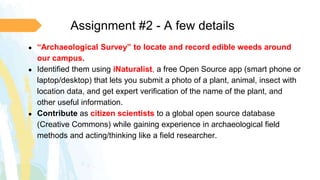
Assignment #2 - A few details
● “Archaeological Survey” to locate and record edible weeds around
our campus.
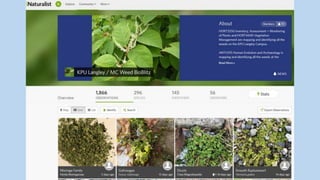
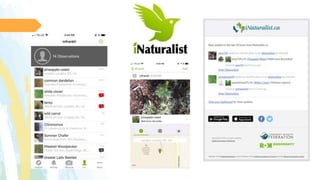
● Identified them using iNaturalist, a free Open Source app (smart phone or
laptop/desktop) that lets you submit a photo of a plant, animal, insect with
location data, and get expert verification of the name of the plant, and
other useful information.
● Contribute as citizen scientists to a global open source database
(Creative Commons) while gaining experience in archaeological field
methods and acting/thinking like a field researcher.
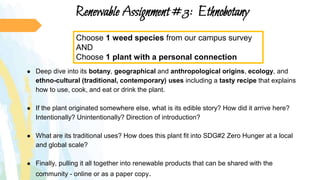
Renewable Assignment #3: Ethnobotany
● Deep dive into its botany, geographical and anthropological origins, ecology, and
ethno-cultural (traditional, contemporary) uses including a tasty recipe that explains
how to use, cook, and eat or drink the plant.
● If the plant originated somewhere else, what is its edible story? How did it arrive here?
Intentionally? Unintentionally? Direction of introduction?
● What are its traditional uses? How does this plant fit into SDG#2 Zero Hunger at a local
and global scale?
● Finally, pulling it all together into renewable products that can be shared with the
community - online or as a paper copy.
Choose 1 weed species from our campus survey
AND
Choose 1 plant with a personal connection
CHALLENGE: INTEGRATE THE
ASSIGNMENTS INTO THE COURSE
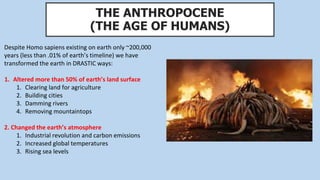
THE ANTHROPOCENE
(THE AGE OF HUMANS)
Despite Homo sapiens existing on earth only ~200,000
years (less than .01% of earth’s timeline) we have
transformed the earth in DRASTIC ways:
1. Altered more than 50% of earth’s land surface
1. Clearing land for agriculture
2. Building cities
3. Damming rivers
4. Removing mountaintops
2. Changed the earth’s atmosphere
1. Industrial revolution and carbon emissions
2. Increased global temperatures
3. Rising sea levels
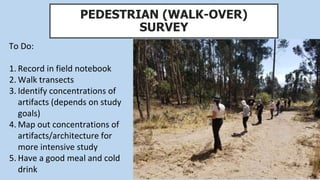
PEDESTRIAN (WALK-OVER)
SURVEY
To Do:
1. Record in field notebook
2. Walk transects
3. Identify concentrations of
artifacts (depends on study
goals)
4. Map out concentrations of
artifacts/architecture for
more intensive study
5. Have a good meal and cold
drink
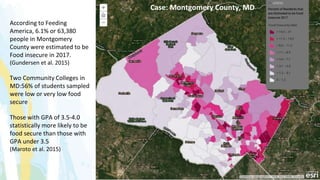
The ProblemAccording to Feeding
America, 6.1% or 63,380
people in Montgomery
County were estimated to be
Food insecure in 2017.
(Gundersen et al. 2015)
Two Community Colleges in
MD:56% of students sampled
were low or very low food
secure
Those with GPA of 3.5-4.0
statistically more likely to be
food secure than those with
GPA under 3.5
(Maroto et al. 2015)
Case: Montgomery County, MD
Checklist:
✔ Attempted to integrate the assignments thematically within the
course outcomes
✔Attempted to gain student buy-in and understanding of the urgency
of the contemporary moment
LET’S SEE WHAT HAPPENS…
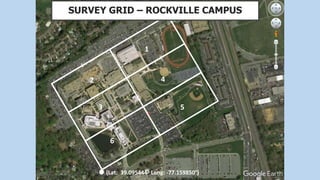
1
2 4
3
6
5
(Lat: 39.095444° Long: -77.159850°)
SURVEY GRID – ROCKVILLE CAMPUS
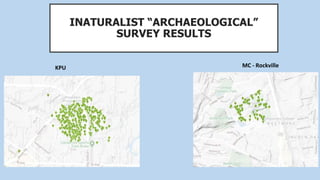
KPU MC - Rockville
INATURALIST “ARCHAEOLOGICAL”
SURVEY RESULTS
Anthropology 215
Human Evolution and
Archaeology
UN SDG 2 – Zero Hunger
Renewable Assignment - Ethnobotany
ANTH 215
Eduardo Chaves
Field
Journal
Summary
• Initial survey on Thursday, October 24,
2019 between 11:30 a.m. and 12:00 p.m.
• All groups split, our group took Zone 5.
– Half of the Parking Lot 11
– Entirety of Parking Lot 12
– Robert E. Parilla Performing Arts Center
– Welcome Center
– The Athletic Fields including the
Baseball Field
• Personally tasked to survey area outside
Welcome Center.
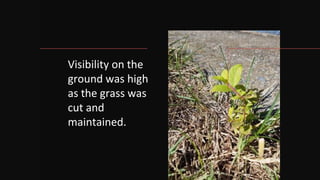
Visibility on the
ground was high
as the grass was
cut and
maintained.
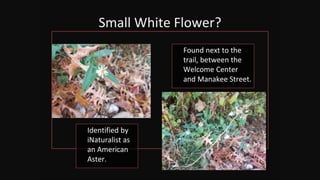
Small White Flower?
Found next to the
trail, between the
Welcome Center
and Manakee Street.
Identified by
iNaturalist as
an American
Aster.
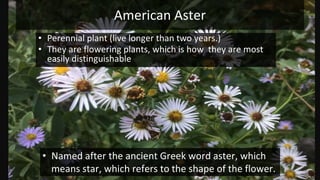
• Perennial plant (live longer than two years.)
• They are flowering plants, which is how they are most
easily distinguishable
• Named after the ancient Greek word aster, which
means star, which refers to the shape of the flower.
American Aster
Cultural History
and Uses
• Asters are very commonly
seen as garden flowers,
because they are small and
colorful.
• They also have several
medicinal purposes in
Chinese and Native American
medicine.
• The leaves were cooked to
serve as greens, while the
roots were used in stews and
soups.
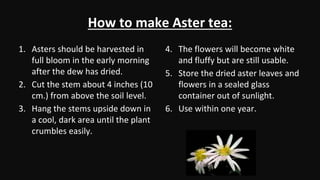
How to make Aster tea:
1. Asters should be harvested in
full bloom in the early morning
after the dew has dried.
2. Cut the stem about 4 inches (10
cm.) from above the soil level.
3. Hang the stems upside down in
a cool, dark area until the plant
crumbles easily.
4. The flowers will become white
and fluffy but are still usable.
5. Store the dried aster leaves and
flowers in a sealed glass
container out of sunlight.
6. Use within one year.
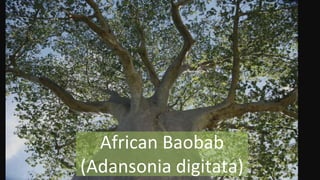
African Baobab
(Adansonia digitata)
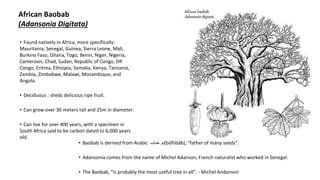
African Baobab
(Adansonia Digitata)
• Found natively in Africa, more specifically:
Mauritania, Senegal, Guinea, Sierra Leone, Mali,
Burkina Faso, Ghana, Togo, Benin, Niger, Nigeria,
Cameroon, Chad, Sudan, Republic of Congo, DR
Congo, Eritrea, Ethiopia, Somalia, Kenya, Tanzania,
Zambia, Zimbabwe, Malawi, Mozambique, and
Angola.
• Deciduous : sheds delicious ripe fruit.
• Can grow over 30 meters tall and 25m in diameter.
• Can live for over 400 years, with a specimen in
South Africa said to be carbon dated to 6,000 years
old.
• Baobab is derived from Arabic ‫بو‬‫باب‬ ِ‫ح‬ (būħibāb), "father of many seeds“.
• Adansonia comes from the name of Michel Adanson, French naturalist who worked in Senegal.
• The Baobab, “is probably the most useful tree in all”. - Michel Andanson
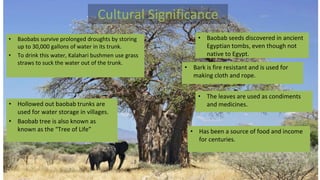
Cultural Significance
• Baobabs survive prolonged droughts by storing
up to 30,000 gallons of water in its trunk.
• To drink this water, Kalahari bushmen use grass
straws to suck the water out of the trunk.
• Baobab seeds discovered in ancient
Egyptian tombs, even though not
native to Egypt.
• Bark is fire resistant and is used for
making cloth and rope.
• The leaves are used as condiments
and medicines.• Hollowed out baobab trunks are
used for water storage in villages.
• Baobab tree is also known as
known as the “Tree of Life” • Has been a source of food and income
for centuries.
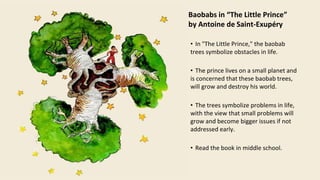
Baobabs in “The Little Prince”
by Antoine de Saint-Exupéry
• In "The Little Prince," the baobab
trees symbolize obstacles in life.
• The prince lives on a small planet and
is concerned that these baobab trees,
will grow and destroy his world.
• The trees symbolize problems in life,
with the view that small problems will
grow and become bigger issues if not
addressed early.
• Read the book in middle school.
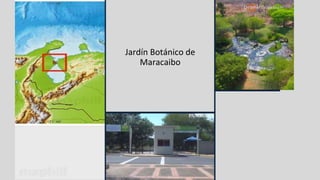
Jardín Botánico de
Maracaibo
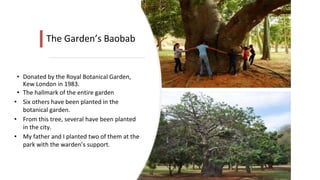
The Garden’s Baobab
• Donated by the Royal Botanical Garden,
Kew London in 1983.
• The hallmark of the entire garden
• Six others have been planted in the
botanical garden.
• From this tree, several have been planted
in the city.
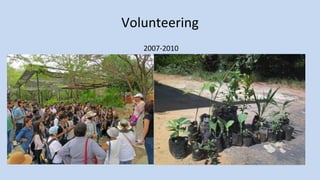
• My father and I planted two of them at the
park with the warden’s support.
Volunteering
2007-2010
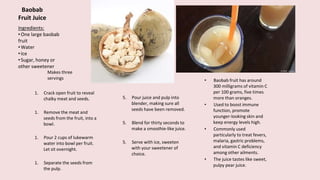
Baobab
Fruit Juice
1. Crack open fruit to reveal
chalky meat and seeds.
1. Remove the meat and
seeds from the fruit, into a
bowl.
1. Pour 2 cups of lukewarm
water into bowl per fruit.
Let sit overnight.
1. Separate the seeds from
the pulp.
Ingredients:
•One large baobab
fruit
•Water
•Ice
•Sugar, honey or
other sweetener
5. Pour juice and pulp into
blender, making sure all
seeds have been removed.
5. Blend for thirty seconds to
make a smoothie-like juice.
5. Serve with ice, sweeten
with your sweetener of
choice.
• Baobab fruit has around
300 milligrams of vitamin C
per 100 grams, five times
more than oranges.
• Used to boost immune
function, promote
younger-looking skin and
keep energy levels high.
• Commonly used
particularly to treat fevers,
malaria, gastric problems,
and vitamin C deficiency
among other ailments.
• The juice tastes like sweet,
pulpy pear juice.
Makes three
servings
Questions?
Spring webinars (3pm EST unless otherwise noted)
May
6
User-friendly Design with OER
June
3
Sustainability: If I had to do it over again ...
Descriptions & Registration:
bit.ly/CCCOERspring2020
Stay in the Loop
● Upcoming Conferences
See our website under “Get-Involved”
● Join our Community Email
○ https://www.cccoer.org/community-email/
● Read our EDI blog posts
○ https://www.cccoer.org
Image: pixabay.com
http://cccoer.org
Questions?
Contact Info:
@unatdaly -- unatdaly@oeglobal.org
@cccoer Liz Yata -- lizyata@oeglobal.org
Lisa Young -- lisa.young@scottsdalecc.edu
@suetash Sue Tashjian -- stashjian@necc.mass.edu
Thank you!

Faculty and Students Share about Open Pedagogy

  • 1.
    April 8, 2020,12:00 pm PST Welcome photo is Open Education Global Conference 2019 by Matteo Bergamini, CC 0 Unless otherwise indicated, this presentation is licensed CC-BY 4.0
  • 2.
    Agenda ● Introductions ● CCCOERoverview ● OER at Paradise Valley Community College ● Keene State College ● Montgomery College ● Q & A ● Upcoming events and announcements
  • 3.
    Speakers Moderator: Matthew Bloom EnglishFaculty, Faculty-in-Residence OER Coordinator, Scottsdale Community College/Maricopa Community Colleges Jessica Parsons OER Specialist Paradise Valley Community College, AZ Zev Cossin Adjunct Professor of Anthropology Montgomery College, MD Karen Cangialosi Professor of Biology Keene State College, NH
  • 4.
    ● Expand awareness& access to high- quality OER ● Support faculty choice & development ● Foster regional OER leadership ● Improve student success CCCOER Mission
  • 5.
    Membership 2020 http://cccoer.org/Member 16 State-wideMemberships New Members Southeast Arkansas College
  • 6.
    Extraordinary Stories from Members and Community duringthe pandemic Share more at: https://splot.ca/Extr aordinary
  • 7.
    Paradise Valley CommunityCollege David Dwork Mathematics Faculty Jessica Parsons Open Educational Resource (OER) Specialist
  • 8.
  • 9.
    OER Specialist Program Basedon College of the Canyons Program 9
  • 10.
    What is anOER Specialist? 10 ● Support Faculty in creation/curation of OER content. ● Help verify ADA compliance. ● Remix, and revise content to faculty’s needs. ● Adapt content to new/different mediums. ● “OER Research Assistant”
  • 11.
    Our Projects Completed Art History1 Art History 2 Art of Storytelling College Success Developmental Psychology Mythology Psychology and Culture Reading & Writing in a Global Society In Progress Critical Reading College English (ENG 101/102) Computerized Accounting Contemporary Women’s Literature Electronic Game Industry Income Tax Prep International and Domestic Terrorism Women in Film 11
  • 12.
  • 13.
    Our Impact (Continued) 13 Spring2020 Total Savings: $43,952.50
  • 14.
    Our Impact (Continued) 14 TotalSavings: $70,933.95 In 2 Semesters of program operation
  • 15.
    15 My Story Before becomingan OER Specialist ● Experience with OER through Homeschooling ● Licensing through Photoshop Course ● Love of research Becoming an OER Specialist ● Hiring Process ● Working in the Center for Teaching and Learning (CTL) ● Working with Faculty ● Growing the Team ● Lessons from our first projects
  • 16.
    16 Lessons Learned ● Worka semester or two ahead ● It’s not all about the full course ● Follow up with faculty constantly ● Realize that Midterms and Finals are NOT good times for meetings ● Always ask about copyrighted content, you might be surprised ● There’s always room for rewrites ● Save everything, you never know when you might do a similar course or topic again ● Keep talking about OER, we are our best advocates
  • 17.
  • 18.
    Keene State College KarenCangialosi Professor of Biology
  • 19.
    Open Pedagogy • Communityand collaboration, over content • Connection to the wider public • Learners contribute to, not just consume knowledge • Student Agency, Learner-driven • Critical approach to the use of tools and technology Modified from content by Robin DeRosa This work by Karen Cangialosi is licensed under a CC BY 4.0 International License
  • 20.
    Domain of One’sOwn Learning in the Open, Sharing, and Contributing knowledge This work by Karen Cangialosi is licensed under a CC BY 4.0 International License
  • 21.
    Audience Beyond theProfessor Interactive – Collaborative – Contributory – Dynamic – Participatory – Empowering This work by Karen Cangialosi is licensed under a CC BY 4.0 International License
  • 22.
    “It was adrastic and honestly scary change going from a traditional learning course where I only have my instructor’s opinion to worry about.” Keene State College student
  • 23.
    This work byKaren Cangialosi is licensed under a CC BY 4.0 International License Students As Contributors
  • 24.
    This work byKaren Cangialosi is licensed under a CC BY 4.0 International License Students As Contributors
  • 25.
    This work byKaren Cangialosi is licensed under a CC BY 4.0 International License Students As Contributors
  • 26.
    This work byKaren Cangialosi is licensed under a CC BY 4.0 International License Students As Contributors
  • 27.
    Some “Free” Toolsfor Blogging, making Websites: Wordpres s Google sites Blogger Tumblr Wix This work by Karen Cangialosi is licensed under a CC BY 4.0 International License
  • 28.
    Using Social Mediato make connections outside of the classroom This work by Karen Cangialosi is licensed under a CC BY 4.0 International License
  • 29.
    “When my studentsgain access to knowledge, I want it to be part of a larger invitation: we trust that you have important lessons to teach the world, and we trust that the knowledge you access today will be changed by your perspective, that you will open doors to new ideas that we, your current teachers, never could have taught you.” – Robin DeRosa, University of the Margins
  • 30.
    Montgomery College Zev Cossin AdjunctProfessor of Anthropology Eduardo Chaves Serrano Student - Zero Hunger Assignment
  • 31.
    ROOTING OUT HUNGER:WEEDS, ANTHROPOLOGY AND STUDENT-CENTERED LEARNING CCCOER Open Pedagogy Webinar April 8, 2020 United Nations Sustainable Development Goals Open Pedagogy Faculty Fellowship Zev Cossin, PhD Candidate Adjunct Professor of Anthropology Montgomery College (Michael Pedersen)
  • 32.
  • 33.
    UN SDG Partners:About Us… Zev Cossin Department: Anthropology Course: ANTH215 “Human Evolution and Archaeology” Michelle Franklin Department: Sustainable Horticulture Course: HORT 4810 “Applied Research Project” Kathy Dunster Department: Sustainable Horticulture Course: HORT 4440 “Vegetation Management” Montgomery College UN SDG Faculty Fellowship: https://www.montgomerycollege.edu/offices/elite/unesc o/
  • 34.
  • 35.
    Renewable Assignment #2– iNaturalist #CitizenScience “Finding Food for Free: Weeds” ‘What is a weed? A plant whose virtues have not been discovered.’ —Ralph Waldo Emerson, Fortune of the Republic Lecture, 1878 ‘A wild plant growing where it is not wanted and in competition with other plants.’ — Compact Oxford English Dictionary Plants grow in even the most concrete of inner-city urban jungles. As you walk through the city, if you open your eyes and look at the ground around your feet, you will see many plants growing wildly in nooks and crannies, sidewalk cracks, and open spaces of every type. Some of these plants are edible or medicinal and can provide a forager with fresh greens loaded with essential nutrients for free, helping achieve SDG#2, Zero Hunger by 2030.
  • 36.
    Assignment #2 -A few details ● “Archaeological Survey” to locate and record edible weeds around our campus. ● Identified them using iNaturalist, a free Open Source app (smart phone or laptop/desktop) that lets you submit a photo of a plant, animal, insect with location data, and get expert verification of the name of the plant, and other useful information. ● Contribute as citizen scientists to a global open source database (Creative Commons) while gaining experience in archaeological field methods and acting/thinking like a field researcher.
  • 38.
    Renewable Assignment #3:Ethnobotany ● Deep dive into its botany, geographical and anthropological origins, ecology, and ethno-cultural (traditional, contemporary) uses including a tasty recipe that explains how to use, cook, and eat or drink the plant. ● If the plant originated somewhere else, what is its edible story? How did it arrive here? Intentionally? Unintentionally? Direction of introduction? ● What are its traditional uses? How does this plant fit into SDG#2 Zero Hunger at a local and global scale? ● Finally, pulling it all together into renewable products that can be shared with the community - online or as a paper copy. Choose 1 weed species from our campus survey AND Choose 1 plant with a personal connection
  • 39.
  • 40.
    THE ANTHROPOCENE (THE AGEOF HUMANS) Despite Homo sapiens existing on earth only ~200,000 years (less than .01% of earth’s timeline) we have transformed the earth in DRASTIC ways: 1. Altered more than 50% of earth’s land surface 1. Clearing land for agriculture 2. Building cities 3. Damming rivers 4. Removing mountaintops 2. Changed the earth’s atmosphere 1. Industrial revolution and carbon emissions 2. Increased global temperatures 3. Rising sea levels
  • 41.
    PEDESTRIAN (WALK-OVER) SURVEY To Do: 1.Record in field notebook 2. Walk transects 3. Identify concentrations of artifacts (depends on study goals) 4. Map out concentrations of artifacts/architecture for more intensive study 5. Have a good meal and cold drink
  • 42.
    The ProblemAccording toFeeding America, 6.1% or 63,380 people in Montgomery County were estimated to be Food insecure in 2017. (Gundersen et al. 2015) Two Community Colleges in MD:56% of students sampled were low or very low food secure Those with GPA of 3.5-4.0 statistically more likely to be food secure than those with GPA under 3.5 (Maroto et al. 2015) Case: Montgomery County, MD
  • 43.
    Checklist: ✔ Attempted tointegrate the assignments thematically within the course outcomes ✔Attempted to gain student buy-in and understanding of the urgency of the contemporary moment LET’S SEE WHAT HAPPENS…
  • 44.
    1 2 4 3 6 5 (Lat: 39.095444°Long: -77.159850°) SURVEY GRID – ROCKVILLE CAMPUS
  • 47.
    KPU MC -Rockville INATURALIST “ARCHAEOLOGICAL” SURVEY RESULTS
  • 48.
    Anthropology 215 Human Evolutionand Archaeology UN SDG 2 – Zero Hunger Renewable Assignment - Ethnobotany ANTH 215 Eduardo Chaves
  • 49.
    Field Journal Summary • Initial surveyon Thursday, October 24, 2019 between 11:30 a.m. and 12:00 p.m. • All groups split, our group took Zone 5. – Half of the Parking Lot 11 – Entirety of Parking Lot 12 – Robert E. Parilla Performing Arts Center – Welcome Center – The Athletic Fields including the Baseball Field • Personally tasked to survey area outside Welcome Center.
  • 50.
    Visibility on the groundwas high as the grass was cut and maintained.
  • 51.
    Small White Flower? Foundnext to the trail, between the Welcome Center and Manakee Street. Identified by iNaturalist as an American Aster.
  • 52.
    • Perennial plant(live longer than two years.) • They are flowering plants, which is how they are most easily distinguishable • Named after the ancient Greek word aster, which means star, which refers to the shape of the flower. American Aster
  • 53.
    Cultural History and Uses •Asters are very commonly seen as garden flowers, because they are small and colorful. • They also have several medicinal purposes in Chinese and Native American medicine. • The leaves were cooked to serve as greens, while the roots were used in stews and soups.
  • 54.
    How to makeAster tea: 1. Asters should be harvested in full bloom in the early morning after the dew has dried. 2. Cut the stem about 4 inches (10 cm.) from above the soil level. 3. Hang the stems upside down in a cool, dark area until the plant crumbles easily. 4. The flowers will become white and fluffy but are still usable. 5. Store the dried aster leaves and flowers in a sealed glass container out of sunlight. 6. Use within one year.
  • 55.
  • 56.
    African Baobab (Adansonia Digitata) •Found natively in Africa, more specifically: Mauritania, Senegal, Guinea, Sierra Leone, Mali, Burkina Faso, Ghana, Togo, Benin, Niger, Nigeria, Cameroon, Chad, Sudan, Republic of Congo, DR Congo, Eritrea, Ethiopia, Somalia, Kenya, Tanzania, Zambia, Zimbabwe, Malawi, Mozambique, and Angola. • Deciduous : sheds delicious ripe fruit. • Can grow over 30 meters tall and 25m in diameter. • Can live for over 400 years, with a specimen in South Africa said to be carbon dated to 6,000 years old. • Baobab is derived from Arabic ‫بو‬‫باب‬ ِ‫ح‬ (būħibāb), "father of many seeds“. • Adansonia comes from the name of Michel Adanson, French naturalist who worked in Senegal. • The Baobab, “is probably the most useful tree in all”. - Michel Andanson
  • 57.
    Cultural Significance • Baobabssurvive prolonged droughts by storing up to 30,000 gallons of water in its trunk. • To drink this water, Kalahari bushmen use grass straws to suck the water out of the trunk. • Baobab seeds discovered in ancient Egyptian tombs, even though not native to Egypt. • Bark is fire resistant and is used for making cloth and rope. • The leaves are used as condiments and medicines.• Hollowed out baobab trunks are used for water storage in villages. • Baobab tree is also known as known as the “Tree of Life” • Has been a source of food and income for centuries.
  • 58.
    Baobabs in “TheLittle Prince” by Antoine de Saint-Exupéry • In "The Little Prince," the baobab trees symbolize obstacles in life. • The prince lives on a small planet and is concerned that these baobab trees, will grow and destroy his world. • The trees symbolize problems in life, with the view that small problems will grow and become bigger issues if not addressed early. • Read the book in middle school.
  • 59.
  • 60.
    The Garden’s Baobab •Donated by the Royal Botanical Garden, Kew London in 1983. • The hallmark of the entire garden • Six others have been planted in the botanical garden. • From this tree, several have been planted in the city. • My father and I planted two of them at the park with the warden’s support.
  • 61.
  • 62.
    Baobab Fruit Juice 1. Crackopen fruit to reveal chalky meat and seeds. 1. Remove the meat and seeds from the fruit, into a bowl. 1. Pour 2 cups of lukewarm water into bowl per fruit. Let sit overnight. 1. Separate the seeds from the pulp. Ingredients: •One large baobab fruit •Water •Ice •Sugar, honey or other sweetener 5. Pour juice and pulp into blender, making sure all seeds have been removed. 5. Blend for thirty seconds to make a smoothie-like juice. 5. Serve with ice, sweeten with your sweetener of choice. • Baobab fruit has around 300 milligrams of vitamin C per 100 grams, five times more than oranges. • Used to boost immune function, promote younger-looking skin and keep energy levels high. • Commonly used particularly to treat fevers, malaria, gastric problems, and vitamin C deficiency among other ailments. • The juice tastes like sweet, pulpy pear juice. Makes three servings
  • 63.
  • 64.
    Spring webinars (3pmEST unless otherwise noted) May 6 User-friendly Design with OER June 3 Sustainability: If I had to do it over again ... Descriptions & Registration: bit.ly/CCCOERspring2020
  • 65.
    Stay in theLoop ● Upcoming Conferences See our website under “Get-Involved” ● Join our Community Email ○ https://www.cccoer.org/community-email/ ● Read our EDI blog posts ○ https://www.cccoer.org Image: pixabay.com http://cccoer.org
  • 66.
    Questions? Contact Info: @unatdaly --unatdaly@oeglobal.org @cccoer Liz Yata -- lizyata@oeglobal.org Lisa Young -- lisa.young@scottsdalecc.edu @suetash Sue Tashjian -- stashjian@necc.mass.edu Thank you!