COMPENDIAL METHODS OF DISSOLUTION
PRESENTED BY
GIRIJA G. S.
M.PHARM 2ND
SEM
DEPT. OF PHARMACEUTICS
MALLIGE COLLEGE OF PHARMACY
INTRODUCTION
• Dissolution is a process in which a solid substance solubilizes in a given
solvent i.e., Mass transfer from the solid surface to the liquid phase.
• Bioavailability is defined is defined as the rate and extent (amount) of
absorption of unchanged drugs from its dosage form.
Needs for dissolution testing
1. To ensure product quality & performance of manufacturing process.
2. Requirement for regulatory approval for product marketing.
the best available tool which can quantitatively assure about the biological
availability of a drug from its formulation is in-vitro dissolution test,
• Factors influencing the design of dissolution test
1. Factors related to the dissolution apparatus
2. Factors related to the dissolution fluid
3. Process parameters
• Classification of dissolution apparatus based on presence or absence of sink
conditions:
1. Closed compartment apparatus- limited volume apparatus operating under non
sink conditions
2. Open compartment apparatus- dosage form is contained in column which is
brought in continuous contact with the fresh, flowing dissolution medium i.e.,
Sink conditions.
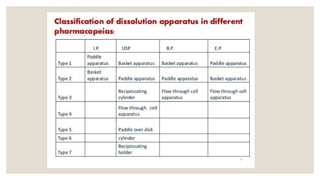
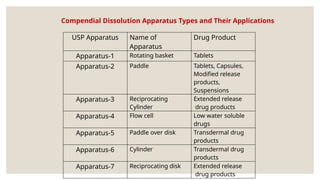
USP Apparatus Name of
Apparatus
Drug Product
Apparatus-1 Rotating basket Tablets
Apparatus-2 Paddle Tablets, Capsules,
Modified release
products,
Suspensions
Apparatus-3 Reciprocating
Cylinder
Extended release
drug products
Apparatus-4 Flow cell Low water soluble
drugs
Apparatus-5 Paddle over disk Transdermal drug
products
Apparatus-6 Cylinder Transdermal drug
products
Apparatus-7 Reciprocating disk Extended release
drug products
Compendial Dissolution Apparatus Types and Their Applications
USP apparatus type I
(Basket)
Dissolution Baskets
Mesh size ranges from 40 - 10
Common problems associated
with the rotating basket test
• Clogging
• Inhomogeneity in the agitation
• Wire basket corrodes
• Low Media Agitation
•Dissolution being accelerated
due to abrasion
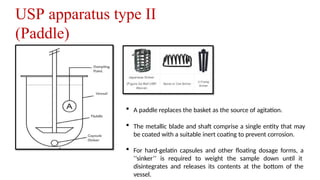
USP apparatus type II
(Paddle)
 A paddle replaces the basket as the source of agitation.
 The metallic blade and shaft comprise a single entity that may
be coated with a suitable inert coating to prevent corrosion.
 For hard-gelatin capsules and other floating dosage forms, a
‘‘sinker’’ is required to weight the sample down until it
disintegrates and releases its contents at the bottom of the
vessel.
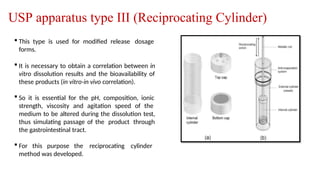
USP apparatus type III (Reciprocating Cylinder)
 This type is used for modified release dosage
forms.
 It is necessary to obtain a correlation between in
vitro dissolution results and the bioavailability of
these products (in vitro-in vivo correlation).
 So it is essential for the pH, composition, ionic
strength, viscosity and agitation speed of the
medium to be altered during the dissolution test,
thus simulating passage of the product through
the gastrointestinal tract.
 For this purpose the reciprocating cylinder
method was developed.
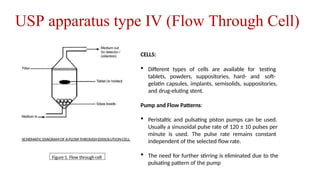
USP apparatus type IV (Flow Through Cell)
CELLS:
 Different types of cells are available for testing
tablets, powders, suppositories, hard- and soft-
gelatin capsules, implants, semisolids, suppositories,
and drug-eluting stent.
Pump and Flow Patterns:
 Peristaltic and pulsating piston pumps can be used.
Usually a sinusoidal pulse rate of 120 ± 10 pulses per
minute is used. The pulse rate remains constant
independent of the selected flow rate.
 The need for further stirring is eliminated due to the
pulsating pattern of the pump
Figure 1. Flow through cell
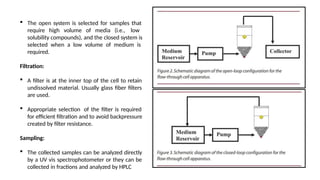
 The open system is selected for samples that
require high volume of media (i.e., low
solubility compounds), and the closed system is
selected when a low volume of medium is
required.
Filtration:
 A filter is at the inner top of the cell to retain
undissolved material. Usually glass fiber filters
are used.
 Appropriate selection of the filter is required
for efficient filtration and to avoid backpressure
created by filter resistance.
Sampling:
 The collected samples can be analyzed directly
by a UV vis spectrophotometer or they can be
collected in fractions and analyzed by HPLC
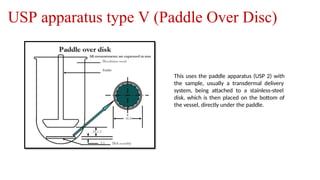
USP apparatus type V (Paddle Over Disc)
This uses the paddle apparatus (USP 2) with
the sample, usually a transdermal delivery
system, being attached to a stainless-steel
disk, which is then placed on the bottom of
the vessel, directly under the paddle.
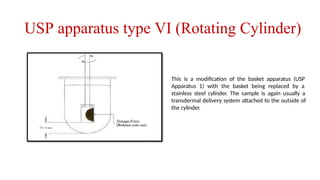
USP apparatus type VI (Rotating Cylinder)
This is a modification of the basket apparatus (USP
Apparatus 1) with the basket being replaced by a
stainless steel cylinder. The sample is again usually a
transdermal delivery system attached to the outside of
the cylinder.
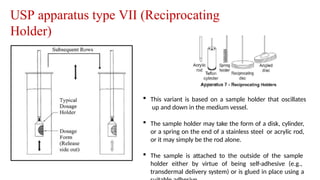
USP apparatus type VII (Reciprocating
Holder)
 This variant is based on a sample holder that oscillates
up and down in the medium vessel.
 The sample holder may take the form of a disk, cylinder,
or a spring on the end of a stainless steel or acrylic rod,
or it may simply be the rod alone.
 The sample is attached to the outside of the sample
holder either by virtue of being self-adhesive (e.g.,
transdermal delivery system) or is glued in place using a
QUESTIONS
1. DISCUSS THE VARIOUS COMPENDIAL METHODS OF DRUG DISSOLUTION
THANK
YOU

Compendial METHODS of dissolution / various methods

  • 1.
    COMPENDIAL METHODS OFDISSOLUTION PRESENTED BY GIRIJA G. S. M.PHARM 2ND SEM DEPT. OF PHARMACEUTICS MALLIGE COLLEGE OF PHARMACY
  • 2.
    INTRODUCTION • Dissolution isa process in which a solid substance solubilizes in a given solvent i.e., Mass transfer from the solid surface to the liquid phase. • Bioavailability is defined is defined as the rate and extent (amount) of absorption of unchanged drugs from its dosage form. Needs for dissolution testing 1. To ensure product quality & performance of manufacturing process. 2. Requirement for regulatory approval for product marketing.
  • 3.
    the best availabletool which can quantitatively assure about the biological availability of a drug from its formulation is in-vitro dissolution test, • Factors influencing the design of dissolution test 1. Factors related to the dissolution apparatus 2. Factors related to the dissolution fluid 3. Process parameters • Classification of dissolution apparatus based on presence or absence of sink conditions: 1. Closed compartment apparatus- limited volume apparatus operating under non sink conditions 2. Open compartment apparatus- dosage form is contained in column which is brought in continuous contact with the fresh, flowing dissolution medium i.e., Sink conditions.
  • 5.
    USP Apparatus Nameof Apparatus Drug Product Apparatus-1 Rotating basket Tablets Apparatus-2 Paddle Tablets, Capsules, Modified release products, Suspensions Apparatus-3 Reciprocating Cylinder Extended release drug products Apparatus-4 Flow cell Low water soluble drugs Apparatus-5 Paddle over disk Transdermal drug products Apparatus-6 Cylinder Transdermal drug products Apparatus-7 Reciprocating disk Extended release drug products Compendial Dissolution Apparatus Types and Their Applications
  • 6.
    USP apparatus typeI (Basket) Dissolution Baskets Mesh size ranges from 40 - 10 Common problems associated with the rotating basket test • Clogging • Inhomogeneity in the agitation • Wire basket corrodes • Low Media Agitation •Dissolution being accelerated due to abrasion
  • 7.
    USP apparatus typeII (Paddle)  A paddle replaces the basket as the source of agitation.  The metallic blade and shaft comprise a single entity that may be coated with a suitable inert coating to prevent corrosion.  For hard-gelatin capsules and other floating dosage forms, a ‘‘sinker’’ is required to weight the sample down until it disintegrates and releases its contents at the bottom of the vessel.
  • 8.
    USP apparatus typeIII (Reciprocating Cylinder)  This type is used for modified release dosage forms.  It is necessary to obtain a correlation between in vitro dissolution results and the bioavailability of these products (in vitro-in vivo correlation).  So it is essential for the pH, composition, ionic strength, viscosity and agitation speed of the medium to be altered during the dissolution test, thus simulating passage of the product through the gastrointestinal tract.  For this purpose the reciprocating cylinder method was developed.
  • 9.
    USP apparatus typeIV (Flow Through Cell) CELLS:  Different types of cells are available for testing tablets, powders, suppositories, hard- and soft- gelatin capsules, implants, semisolids, suppositories, and drug-eluting stent. Pump and Flow Patterns:  Peristaltic and pulsating piston pumps can be used. Usually a sinusoidal pulse rate of 120 ± 10 pulses per minute is used. The pulse rate remains constant independent of the selected flow rate.  The need for further stirring is eliminated due to the pulsating pattern of the pump Figure 1. Flow through cell
  • 10.
     The opensystem is selected for samples that require high volume of media (i.e., low solubility compounds), and the closed system is selected when a low volume of medium is required. Filtration:  A filter is at the inner top of the cell to retain undissolved material. Usually glass fiber filters are used.  Appropriate selection of the filter is required for efficient filtration and to avoid backpressure created by filter resistance. Sampling:  The collected samples can be analyzed directly by a UV vis spectrophotometer or they can be collected in fractions and analyzed by HPLC
  • 11.
    USP apparatus typeV (Paddle Over Disc) This uses the paddle apparatus (USP 2) with the sample, usually a transdermal delivery system, being attached to a stainless-steel disk, which is then placed on the bottom of the vessel, directly under the paddle.
  • 12.
    USP apparatus typeVI (Rotating Cylinder) This is a modification of the basket apparatus (USP Apparatus 1) with the basket being replaced by a stainless steel cylinder. The sample is again usually a transdermal delivery system attached to the outside of the cylinder.
  • 13.
    USP apparatus typeVII (Reciprocating Holder)  This variant is based on a sample holder that oscillates up and down in the medium vessel.  The sample holder may take the form of a disk, cylinder, or a spring on the end of a stainless steel or acrylic rod, or it may simply be the rod alone.  The sample is attached to the outside of the sample holder either by virtue of being self-adhesive (e.g., transdermal delivery system) or is glued in place using a
  • 14.
    QUESTIONS 1. DISCUSS THEVARIOUS COMPENDIAL METHODS OF DRUG DISSOLUTION
  • 15.