Department of Pharmacy
Guru Ghasidas Vishwavidyalaya, Bilaspur (CG)
Topic: Computer Aided Biopharmaceutical
characterization: Gastrointestinal
absorption Simulation
Presented by-
Sourav Paul
Department of Pharmaceutics, 2nd
Semester
Roll no.: 23082112
Guided by-
Dr. DINESH K. MISHRA
PROFESSOR
Department of Pharmaceutics
Introduction
01
TABLE OF CONTENTS
03
02
06
Theoretical background
05
04
07 08
Model construction Parameter Sensitivity Analysis
Fed vs fasted state
Biowaiver Considerations
Invitro disso. & Invtro
invivo corelation
Virtual Trial
09 Conclusion References
10
INTRODUCTION
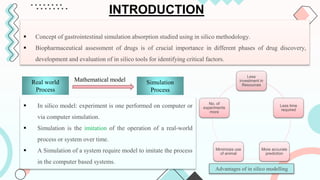
 Concept of gastrointestinal simulation absorption studied using in silico methodology.
 Biopharmaceutical assessment of drugs is of crucial importance in different phases of drug discovery,
development and evaluation of in silico tools for identifying critical factors.
Real world
Process
Mathematical model Simulation
Process
Less
investment in
Resources
Less time
required
More accurate
prediction
Minimizes use
of animal
No. of
experiments
more
Advantages of in silico modelling
 In silico model: experiment is one performed on computer or
via computer simulation.
 Simulation is the imitation of the operation of a real-world
process or system over time.
 A Simulation of a system require model to imitate the process
in the computer based systems.
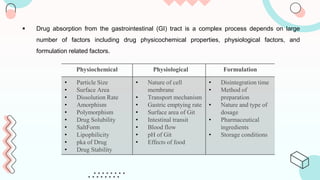
 Drug absorption from the gastrointestinal (GI) tract is a complex process depends on large
number of factors including drug physicochemical properties, physiological factors, and
formulation related factors.
Physiochemical Physiological Formulation
• Particle Size
• Surface Area
• Dissolution Rate
• Amorphism
• Polymorphism
• Drug Solubility
• SaltForm
• Lipophilicity
• pka of Drug
• Drug Stability
• Nature of cell
membrane
• Transport mechanism
• Gastric emptying rate
• Surface area of Git
• Intestinal transit
• Blood flow
• pH of Git
• Effects of food
• Disintegration time
• Method of
preparation
• Nature and type of
dosage
• Pharmaceutical
ingredients
• Storage conditions
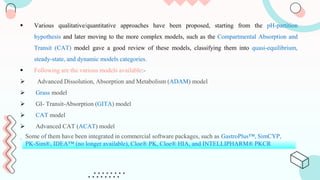
 Various qualitative/quantitative approaches have been proposed, starting from the pH-partition
hypothesis and later moving to the more complex models, such as the Compartmental Absorption and
Transit (CAT) model gave a good review of these models, classifying them into quasi-equilibrium,
steady-state, and dynamic models categories.
 Following are the various models available:-
 Advanced Dissolution, Absorption and Metabolism (ADAM) model
 Grass model
 GI- Transit-Absorption (GITA) model
 CAT model
 Advanced CAT (ACAT) model
. Some of them have been integrated in commercial software packages, such as GastroPlus™, SimCYP,
PK-Sim®, IDEA™ (no longer available), Cloe® PK, Cloe® HIA, and INTELLIPHARM® PKCR
THEORETICAL BACKGROUND
 Simulation software packages, such as GastroPlus™, are advanced technology computer programs
designed to predict PK, and optionally, pharmacodynamic effects of drugs in humans and certain animals.
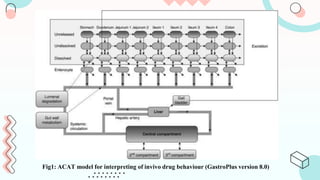
 The underlying model in GastroPlus™ is the ACAT model .
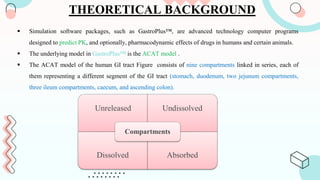
 The ACAT model of the human GI tract Figure consists of nine compartments linked in series, each of
them representing a different segment of the GI tract (stomach, duodenum, two jejunum compartments,
three ileum compartments, caecum, and ascending colon).
Unreleased Undissolved
Dissolved Absorbed
Compartments
Fig1: ACAT model for interpreting of invivo drug behaviour (GastroPlus version 8.0)
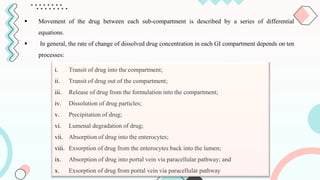
 Movement of the drug between each sub-compartment is described by a series of differential
equations.
 In general, the rate of change of dissolved drug concentration in each GI compartment depends on ten
processes:
i. Transit of drug into the compartment;
ii. Transit of drug out of the compartment;
iii. Release of drug from the formulation into the compartment;
iv. Dissolution of drug particles;
v. Precipitation of drug;
vi. Lumenal degradation of drug;
vii. Absorption of drug into the enterocytes;
viii. Exsorption of drug from the enterocytes back into the lumen;
ix. Absorption of drug into portal vein via paracellular pathway; and
x. Exsorption of drug from portal vein via paracellular pathway
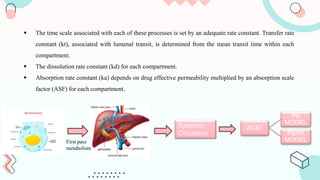
 The time scale associated with each of these processes is set by an adequate rate constant. Transfer rate
constant (kt), associated with lumenal transit, is determined from the mean transit time within each
compartment.
 The dissolution rate constant (kd) for each compartment.
 Absorption rate constant (ka) depends on drug effective permeability multiplied by an absorption scale
factor (ASF) for each compartment.
Systemic
Circulation
ACAT
PK
MODEL
PBPK
MODEL
First pass
metabolism
 By integrating the key input parameters regarding drug absorption, distribution, metabolism, and excretion (e.g.
partition coefficients, metabolic rate constants, elimination rate constants, permeability coefficients, diffusion
coefficients, protein binding constants),
 We can not only estimate drug PK parameters and plasma and tissue concentration-time profiles, but also gain a
more mechanistic insight into the properties of a compound.
 GastroPlus™ ACAT modeling requires a number of input parameters, which should adequately reflect drug
biopharmaceutical properties.
 Default physiology parameters under fasted and fed states (e.g. transit time, pH, volume, length, radii of the
corresponding GI region) are population mean values obtained from published data. The other input parameters
include drug physicochemical properties (i.e. solubility, permeability, logP, pKa, diffusion coefficient)
 PK parameters like clearance (CL), volume of distribution, along with certain formulation characteristics (e.g.
particle size distribution and density, drug release profiles for controlled-release formulations) are determined.
MODEL CONSTRUCTION
Depending on the objective of the study, human or animal physiologies under fasted or fed conditions were
selected for simulations.
The reported studies involved different dosage forms, including solutions, suspensions, immediate and controlled
release (CR) formulations, and all four BCS classes of drugs.
GastroPlus™ to predict the drug PK profile after oral administration.
The common approach is to use literature reported values as initial inputs.
Modeling and simulation start from data collection. Mechanistic absorption models require a number of input
parameters, which can either be experimentally determined or in silico predicted.
A recently published study on GI simulation of nimesulide oral absorption is an interesting example on
how selection of input data might influence model accuracy to predict a drug PK profile
Drug specific absorption models were constructed by two independent analysts, using the same set of in
vivo data, but with different presumptions regarding the key factors that govern nimesulide absorption.
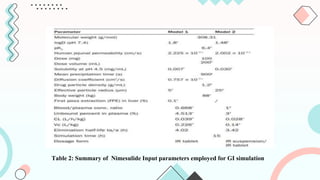
A summary of the input parameters concerning nimesulide physicochemical and PK data is given in
Table 2.
Table 2: Summary of Nimesulide Input parameters employed for GI simulation
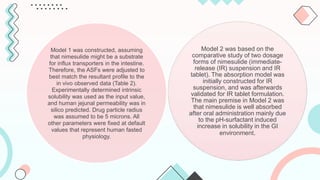
Model 1 was constructed, assuming
that nimesulide might be a substrate
for influx transporters in the intestine.
Therefore, the ASFs were adjusted to
best match the resultant profile to the
in vivo observed data (Table 2).
Experimentally determined intrinsic
solubility was used as the input value,
and human jejunal permeability was in
silico predicted. Drug particle radius
was assumed to be 5 microns. All
other parameters were fixed at default
values that represent human fasted
physiology.
Model 2 was based on the
comparative study of two dosage
forms of nimesulide (immediate-
release (IR) suspension and IR
tablet). The absorption model was
initially constructed for IR
suspension, and was afterwards
validated for IR tablet formulation.
The main premise in Model 2 was
that nimesulide is well absorbed
after oral administration mainly due
to the pH-surfactant induced
increase in solubility in the GI
environment.
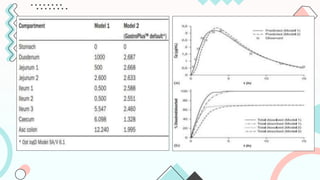
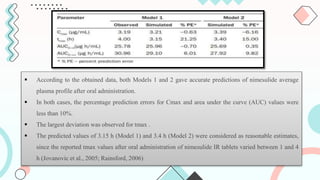
 According to the obtained data, both Models 1 and 2 gave accurate predictions of nimesulide average
plasma profile after oral administration.
 In both cases, the percentage prediction errors for Cmax and area under the curve (AUC) values were
less than 10%.
 The largest deviation was observed for tmax .
 The predicted values of 3.15 h (Model 1) and 3.4 h (Model 2) were considered as reasonable estimates,
since the reported tmax values after oral administration of nimesulide IR tablets varied between 1 and 4
h (Jovanovic et al., 2005; Rainsford, 2006)
However, according to Model 1, the resultant ASF values in the duodenum and jejunum were much higher
than the default GastroPlus™ values, reflecting fast absorption of NIM in the proximal parts of the
intestine.
There were two distinct interpretations: Model 1 outcomes indicated involvement of influx transporters in
nimesulide absorption, while according to the Model 2 outcomes, the pH- surfactant induced increase in
drug solubility was a predominant factor leading to relatively rapid absorption in the proximal intestine.
It should be noted that the Model 2 assumption was supported by the concept of Biopharmaceutics Drug
Disposition Classification System (BDCCS), according to which BCS class II drugs are not expected to be
substrates for influx transporters
Interpretation of the obtained data indicated that the approach applied in Model 2 might be considered as
more realistic, signifying that the related absorption model more likely reflects nimesulide in vivo
absorption.
It was also stressed that, in order to obtain meaningful in silico modeling, the necessary input data have to
be carefully selected and/or experimentally verified
Parameter Sensitivity Analysis
The generated drug-specific absorption model can be used to further explore within the model, such as
understanding how the formulation parameters and/or drug physicochemical properties affect the predicted PK
profiles.
This kind of evaluation is performed by the Parameter Sensitivity Analysis (PSA) feature in GastroPlus™.
When performing PSA, one parameter is changed gradually within a predetermined range, which should be
based on prior knowledge, while keeping all other parameters at baseline levels.
Another option is to use three-dimensional PSA when two parameters are varied at a time, so the combined
effect of these parameters is assessed.
optimized design space can be constructed as a function of the selected parameters.
PSA can serve as a useful tool when the input values for some of the physicochemical properties of a compound
are rough estimates (e.g. from in silico predictions), and when model predictions do not correlate well with in
vivo values.
Virtual Trial
 Inter-subject variability may influence oral drug absorption is determined using virtual
trails.
 Virtual trials were performed on virtual 12 subjects (equal to the number of subjects used in
the clinical study), and the results were presented as mean Cp vs. time profile with 90%
confidence intervals.
 The Virtual Trial mode can also be used to conduct virtual BE studies on 25 subjects.
 Results of the simulations are expressed as means and coefficients of variation for the
fraction of drug absorbed, bioavailability, t max, C max, and AUC values.
Fed vs fasted state
 The presence of food may affect drug absorption via a variety of mechanisms; by impacting
 For example, lipophilic drugs often show increased systemic exposure with food due to higher bile
salt and lipid concentrations.
 Considering that, these models are built based on a prior knowledge of GI physiology in the fasted
and fed states.
a. GI tract physiology (e.g. food-induced changes in gastric emptying time, gastric pH,
intestinal fluid composition, hepatic blood flow),
b. Drug solubility and dissolution,
c. Drug permeation
IVIVC
 In vitro dissolution and in vitro-in vivo correlation (IVIVC) are concepts commonly used in
pharmaceutical research and development to assess the performance and predict the behavior of drugs.
 In vitro dissolution: it's a process of release of drug from dosage form as measured in an in vitro
dissolution apparatus.
 In vivo dissolution: process of dissolution of drugs in the GI tract.
 Correlation: relationship between in vitro dissolution rate and in vivo absorption rate as used in bio-
equivalence guidance
 IVIVC: has been defined as "a predictive mathematical model describing the relationship between an
in-vitro property of a dosage form and an in-vivo response”
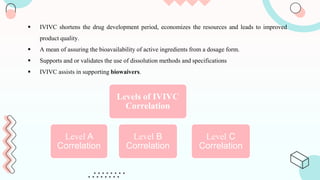
 IVIVC shortens the drug development period, economizes the resources and leads to improved
product quality.
 A mean of assuring the bioavailability of active ingredients from a dosage form.
 Supports and or validates the use of dissolution methods and specifications
 IVIVC assists in supporting biowaivers.
Level A
Correlation
Level B
Correlation
Level C
Correlation
Levels of IVIVC
Correlation
 Level A Correlation: It represents point to point correlation.
 Level B Correlation: Mainly uses the principle of statistical moment analysis. Mean in vitro
dissolution of the drug is compared with mean in vivo residence time of the drug.
 Level C Correlation: It represents single point correlation. One dissolution time point is
compared to one PK parameter.
 The role of biowaivers in the drug approval process has been emphasized since the introduction of BCS
and the release of FDA.
 The term biowaiver refers to the situations in which in vivo BE studies can be substituted with the
relevant in vitro data.
 The main premise, when adopting the biowaiver concept, was to reduce time and costs, and to offer
benefits in terms of ethical considerations.
 The most common type of biowaiver adopted by the regulatory authorities includes the application of
the BCS-based scheme or the application of IVIVC.
 Biowaiver considerations are applied to determine if in vivo bioequivalence studies can be waived for
generic drug products. This involves demonstrating similarity between the generic and reference
products in terms of formulation, in vitro dissolution profiles, and expected pharmacokinetic behavior.
Biowaiver Considerations
CONCLUSION:
 The various examples presented demonstrate that GI modeling has become a powerful tool to
study oral drug absorption and pharmacokinetics.
 By understanding the complex interplay between drug physicochemical and PK properties,
formulation factors, and human physiology characteristics, we might gain an insight into the
influence of a particular factor or set of factors on drug absorption profile, and understand
possible reasons for poor oral bioavailability
1. Erik Sjögren , Helena Thörn , Christer Tannergren In Silico Modeling of Gastrointestinal
Drug Absorption: Predictive Performance of Three Physiologically Based Absorption
Models.
2. https://www.sciencedirect.com/science/article/abs/pii/B9781907568275500068 accessed
on 08.04.24
3. A text book on Computer Aided Drug Development, Abhang S. Snehal, Sharma Prerna
PV Books.
REFERENCES:
Computer aided biopharmaceutical characterization

Computer aided biopharmaceutical characterization

  • 1.
    Department of Pharmacy GuruGhasidas Vishwavidyalaya, Bilaspur (CG) Topic: Computer Aided Biopharmaceutical characterization: Gastrointestinal absorption Simulation Presented by- Sourav Paul Department of Pharmaceutics, 2nd Semester Roll no.: 23082112 Guided by- Dr. DINESH K. MISHRA PROFESSOR Department of Pharmaceutics
  • 2.
    Introduction 01 TABLE OF CONTENTS 03 02 06 Theoreticalbackground 05 04 07 08 Model construction Parameter Sensitivity Analysis Fed vs fasted state Biowaiver Considerations Invitro disso. & Invtro invivo corelation Virtual Trial 09 Conclusion References 10
  • 3.
    INTRODUCTION  Concept ofgastrointestinal simulation absorption studied using in silico methodology.  Biopharmaceutical assessment of drugs is of crucial importance in different phases of drug discovery, development and evaluation of in silico tools for identifying critical factors. Real world Process Mathematical model Simulation Process Less investment in Resources Less time required More accurate prediction Minimizes use of animal No. of experiments more Advantages of in silico modelling  In silico model: experiment is one performed on computer or via computer simulation.  Simulation is the imitation of the operation of a real-world process or system over time.  A Simulation of a system require model to imitate the process in the computer based systems.
  • 4.
     Drug absorptionfrom the gastrointestinal (GI) tract is a complex process depends on large number of factors including drug physicochemical properties, physiological factors, and formulation related factors. Physiochemical Physiological Formulation • Particle Size • Surface Area • Dissolution Rate • Amorphism • Polymorphism • Drug Solubility • SaltForm • Lipophilicity • pka of Drug • Drug Stability • Nature of cell membrane • Transport mechanism • Gastric emptying rate • Surface area of Git • Intestinal transit • Blood flow • pH of Git • Effects of food • Disintegration time • Method of preparation • Nature and type of dosage • Pharmaceutical ingredients • Storage conditions
  • 5.
     Various qualitative/quantitativeapproaches have been proposed, starting from the pH-partition hypothesis and later moving to the more complex models, such as the Compartmental Absorption and Transit (CAT) model gave a good review of these models, classifying them into quasi-equilibrium, steady-state, and dynamic models categories.  Following are the various models available:-  Advanced Dissolution, Absorption and Metabolism (ADAM) model  Grass model  GI- Transit-Absorption (GITA) model  CAT model  Advanced CAT (ACAT) model . Some of them have been integrated in commercial software packages, such as GastroPlus™, SimCYP, PK-Sim®, IDEA™ (no longer available), Cloe® PK, Cloe® HIA, and INTELLIPHARM® PKCR
  • 6.
    THEORETICAL BACKGROUND  Simulationsoftware packages, such as GastroPlus™, are advanced technology computer programs designed to predict PK, and optionally, pharmacodynamic effects of drugs in humans and certain animals.  The underlying model in GastroPlus™ is the ACAT model .  The ACAT model of the human GI tract Figure consists of nine compartments linked in series, each of them representing a different segment of the GI tract (stomach, duodenum, two jejunum compartments, three ileum compartments, caecum, and ascending colon). Unreleased Undissolved Dissolved Absorbed Compartments
  • 7.
    Fig1: ACAT modelfor interpreting of invivo drug behaviour (GastroPlus version 8.0)
  • 8.
     Movement ofthe drug between each sub-compartment is described by a series of differential equations.  In general, the rate of change of dissolved drug concentration in each GI compartment depends on ten processes: i. Transit of drug into the compartment; ii. Transit of drug out of the compartment; iii. Release of drug from the formulation into the compartment; iv. Dissolution of drug particles; v. Precipitation of drug; vi. Lumenal degradation of drug; vii. Absorption of drug into the enterocytes; viii. Exsorption of drug from the enterocytes back into the lumen; ix. Absorption of drug into portal vein via paracellular pathway; and x. Exsorption of drug from portal vein via paracellular pathway
  • 9.
     The timescale associated with each of these processes is set by an adequate rate constant. Transfer rate constant (kt), associated with lumenal transit, is determined from the mean transit time within each compartment.  The dissolution rate constant (kd) for each compartment.  Absorption rate constant (ka) depends on drug effective permeability multiplied by an absorption scale factor (ASF) for each compartment. Systemic Circulation ACAT PK MODEL PBPK MODEL First pass metabolism
  • 10.
     By integratingthe key input parameters regarding drug absorption, distribution, metabolism, and excretion (e.g. partition coefficients, metabolic rate constants, elimination rate constants, permeability coefficients, diffusion coefficients, protein binding constants),  We can not only estimate drug PK parameters and plasma and tissue concentration-time profiles, but also gain a more mechanistic insight into the properties of a compound.  GastroPlus™ ACAT modeling requires a number of input parameters, which should adequately reflect drug biopharmaceutical properties.  Default physiology parameters under fasted and fed states (e.g. transit time, pH, volume, length, radii of the corresponding GI region) are population mean values obtained from published data. The other input parameters include drug physicochemical properties (i.e. solubility, permeability, logP, pKa, diffusion coefficient)  PK parameters like clearance (CL), volume of distribution, along with certain formulation characteristics (e.g. particle size distribution and density, drug release profiles for controlled-release formulations) are determined.
  • 11.
    MODEL CONSTRUCTION Depending onthe objective of the study, human or animal physiologies under fasted or fed conditions were selected for simulations. The reported studies involved different dosage forms, including solutions, suspensions, immediate and controlled release (CR) formulations, and all four BCS classes of drugs. GastroPlus™ to predict the drug PK profile after oral administration. The common approach is to use literature reported values as initial inputs. Modeling and simulation start from data collection. Mechanistic absorption models require a number of input parameters, which can either be experimentally determined or in silico predicted.
  • 12.
    A recently publishedstudy on GI simulation of nimesulide oral absorption is an interesting example on how selection of input data might influence model accuracy to predict a drug PK profile Drug specific absorption models were constructed by two independent analysts, using the same set of in vivo data, but with different presumptions regarding the key factors that govern nimesulide absorption. A summary of the input parameters concerning nimesulide physicochemical and PK data is given in Table 2.
  • 13.
    Table 2: Summaryof Nimesulide Input parameters employed for GI simulation
  • 14.
    Model 1 wasconstructed, assuming that nimesulide might be a substrate for influx transporters in the intestine. Therefore, the ASFs were adjusted to best match the resultant profile to the in vivo observed data (Table 2). Experimentally determined intrinsic solubility was used as the input value, and human jejunal permeability was in silico predicted. Drug particle radius was assumed to be 5 microns. All other parameters were fixed at default values that represent human fasted physiology. Model 2 was based on the comparative study of two dosage forms of nimesulide (immediate- release (IR) suspension and IR tablet). The absorption model was initially constructed for IR suspension, and was afterwards validated for IR tablet formulation. The main premise in Model 2 was that nimesulide is well absorbed after oral administration mainly due to the pH-surfactant induced increase in solubility in the GI environment.
  • 16.
     According tothe obtained data, both Models 1 and 2 gave accurate predictions of nimesulide average plasma profile after oral administration.  In both cases, the percentage prediction errors for Cmax and area under the curve (AUC) values were less than 10%.  The largest deviation was observed for tmax .  The predicted values of 3.15 h (Model 1) and 3.4 h (Model 2) were considered as reasonable estimates, since the reported tmax values after oral administration of nimesulide IR tablets varied between 1 and 4 h (Jovanovic et al., 2005; Rainsford, 2006)
  • 17.
    However, according toModel 1, the resultant ASF values in the duodenum and jejunum were much higher than the default GastroPlus™ values, reflecting fast absorption of NIM in the proximal parts of the intestine. There were two distinct interpretations: Model 1 outcomes indicated involvement of influx transporters in nimesulide absorption, while according to the Model 2 outcomes, the pH- surfactant induced increase in drug solubility was a predominant factor leading to relatively rapid absorption in the proximal intestine. It should be noted that the Model 2 assumption was supported by the concept of Biopharmaceutics Drug Disposition Classification System (BDCCS), according to which BCS class II drugs are not expected to be substrates for influx transporters Interpretation of the obtained data indicated that the approach applied in Model 2 might be considered as more realistic, signifying that the related absorption model more likely reflects nimesulide in vivo absorption. It was also stressed that, in order to obtain meaningful in silico modeling, the necessary input data have to be carefully selected and/or experimentally verified
  • 18.
    Parameter Sensitivity Analysis Thegenerated drug-specific absorption model can be used to further explore within the model, such as understanding how the formulation parameters and/or drug physicochemical properties affect the predicted PK profiles. This kind of evaluation is performed by the Parameter Sensitivity Analysis (PSA) feature in GastroPlus™. When performing PSA, one parameter is changed gradually within a predetermined range, which should be based on prior knowledge, while keeping all other parameters at baseline levels. Another option is to use three-dimensional PSA when two parameters are varied at a time, so the combined effect of these parameters is assessed. optimized design space can be constructed as a function of the selected parameters. PSA can serve as a useful tool when the input values for some of the physicochemical properties of a compound are rough estimates (e.g. from in silico predictions), and when model predictions do not correlate well with in vivo values.
  • 19.
    Virtual Trial  Inter-subjectvariability may influence oral drug absorption is determined using virtual trails.  Virtual trials were performed on virtual 12 subjects (equal to the number of subjects used in the clinical study), and the results were presented as mean Cp vs. time profile with 90% confidence intervals.  The Virtual Trial mode can also be used to conduct virtual BE studies on 25 subjects.  Results of the simulations are expressed as means and coefficients of variation for the fraction of drug absorbed, bioavailability, t max, C max, and AUC values.
  • 20.
    Fed vs fastedstate  The presence of food may affect drug absorption via a variety of mechanisms; by impacting  For example, lipophilic drugs often show increased systemic exposure with food due to higher bile salt and lipid concentrations.  Considering that, these models are built based on a prior knowledge of GI physiology in the fasted and fed states. a. GI tract physiology (e.g. food-induced changes in gastric emptying time, gastric pH, intestinal fluid composition, hepatic blood flow), b. Drug solubility and dissolution, c. Drug permeation
  • 21.
    IVIVC  In vitrodissolution and in vitro-in vivo correlation (IVIVC) are concepts commonly used in pharmaceutical research and development to assess the performance and predict the behavior of drugs.  In vitro dissolution: it's a process of release of drug from dosage form as measured in an in vitro dissolution apparatus.  In vivo dissolution: process of dissolution of drugs in the GI tract.  Correlation: relationship between in vitro dissolution rate and in vivo absorption rate as used in bio- equivalence guidance  IVIVC: has been defined as "a predictive mathematical model describing the relationship between an in-vitro property of a dosage form and an in-vivo response”
  • 22.
     IVIVC shortensthe drug development period, economizes the resources and leads to improved product quality.  A mean of assuring the bioavailability of active ingredients from a dosage form.  Supports and or validates the use of dissolution methods and specifications  IVIVC assists in supporting biowaivers. Level A Correlation Level B Correlation Level C Correlation Levels of IVIVC Correlation
  • 23.
     Level ACorrelation: It represents point to point correlation.  Level B Correlation: Mainly uses the principle of statistical moment analysis. Mean in vitro dissolution of the drug is compared with mean in vivo residence time of the drug.  Level C Correlation: It represents single point correlation. One dissolution time point is compared to one PK parameter.
  • 24.
     The roleof biowaivers in the drug approval process has been emphasized since the introduction of BCS and the release of FDA.  The term biowaiver refers to the situations in which in vivo BE studies can be substituted with the relevant in vitro data.  The main premise, when adopting the biowaiver concept, was to reduce time and costs, and to offer benefits in terms of ethical considerations.  The most common type of biowaiver adopted by the regulatory authorities includes the application of the BCS-based scheme or the application of IVIVC.  Biowaiver considerations are applied to determine if in vivo bioequivalence studies can be waived for generic drug products. This involves demonstrating similarity between the generic and reference products in terms of formulation, in vitro dissolution profiles, and expected pharmacokinetic behavior. Biowaiver Considerations
  • 25.
    CONCLUSION:  The variousexamples presented demonstrate that GI modeling has become a powerful tool to study oral drug absorption and pharmacokinetics.  By understanding the complex interplay between drug physicochemical and PK properties, formulation factors, and human physiology characteristics, we might gain an insight into the influence of a particular factor or set of factors on drug absorption profile, and understand possible reasons for poor oral bioavailability
  • 26.
    1. Erik Sjögren, Helena Thörn , Christer Tannergren In Silico Modeling of Gastrointestinal Drug Absorption: Predictive Performance of Three Physiologically Based Absorption Models. 2. https://www.sciencedirect.com/science/article/abs/pii/B9781907568275500068 accessed on 08.04.24 3. A text book on Computer Aided Drug Development, Abhang S. Snehal, Sharma Prerna PV Books. REFERENCES: