SEMINAR ON BBB-CHOLINE
TRANSPORTER
PRESENTED BY-ROSHAN M JAIN
(M.PHARM 1ST YEAR)
SUBMITTED TO-
Dr . A . GEETHALAKSHMI
(HOD and Professor of department of
pharmaceutics)
RR COLLEGE OF PHARMACY
BLOOD-BRAIN BARRIER
• The blood-brain barrier (BBB) is highly selective permeability
barrier that separates the circulating blood from the brain
extracellular fluid (BECF) in the central nervous system (CNS).
• BBB is a unique membranous barrier that tightly segregates
the brain from the circulating blood .
• The blood-brain barrier acts very effectively to protect the
brain from many common bacterial infections .
• The blood-brain barrier is composed of high density cells
restricting passage of substances from the bloodstream much
more than endothelial cells in capillaries .
STRUCTURE OF BBB
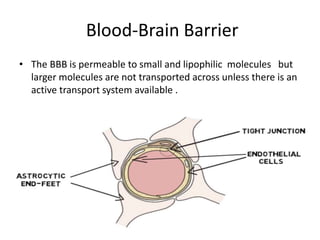
• Capillaries of brain are lined with a layer of special
endothelial cells that are sealed with tight junctions .
• These tight junction called zona occludens .
• The blood-brain barrier blocks all molecules except those that
cross cell membranes by means of lipid solubility ( such as
oxygen , carbon dioxide , ethanol , and steroid hormones )
and those that are allowed in by specific transport system
(such as sugar and some amino acids ) .
• Substances with a molecular higher than 500 daltons
generally cannot cross BBB .
Blood-Brain Barrier
• The BBB is permeable to small and lipophilic molecules but
larger molecules are not transported across unless there is an
active transport system available .
CHOLINERGIC TRANSPORT
• Drugs affecting the ANS are divided into two groups .
According to the types of neurons involved in their
mechanism of action .
 Cholinergics – acts on the receptor stimulated by ach
 Adrenergics – acts on the receptor stimulated by
norepinephrine .
CHOLINERGIC AGENTS
• Cholinergic agents are the drugs that act either directly or
indirectly produce effect similar to those by acetylcholine.
• while studying the pharmacological actions of Ach they are
distinguished two types of activities designated as muscarinic
and nicotinic
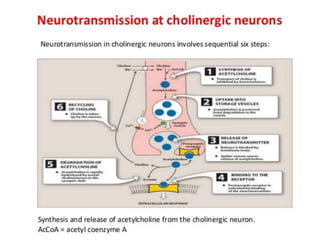
SYSTHESIS OF ACH
• Choline is take up into the nerve terminals by
special choline transport system mediated by a carrier
co transport sodium .
• It can be inhibited by hemicholinium .
• The choline is acetylated by the enzyme called as
choline acetyl transferase to from Ach the acetyl group
source is acetyl-coA .
STORAGE AND RELEASE OF ACH
• The Ach is packaged into vesicles by an active transport
process coupled with the efflux of protons .
• The mature vesicles also contain ATP and proteoglycon
channel .
• When an action potential propagated voltage sensitive
calcium channels in the pre synaptic membrane opens causes
an increase in intracellular calcium .
• Elevated calcium levels promote the fusion of synaptic
vesicles with the cell membrane and release of their contents
into the synaptic cleft .
• This release can be blocked by botulinum toxin .
• Ach is degraded by acetylcholinestearse and forms choline
and aceate in the synaptic cleft .
CHOLINERGIC RECEPTORS
• Cholinergic receptors have been characterized as nicotinic and
muscarinic on the basis of their ability to be bound by
naturally occurring alkaloids nicotine and muscarine
respectively .
• They are two classes of receptors
MUSCARINIC & NICOTINIC
1. Muscarinic receptors are G protein-coupled receptors .
2. Nicotinic receptors belongs to ligand gated receptors .
• SUB TYPES OF MUSCARINIC RECEPTORS :
M 1 , M 2 , M 3 .
• SUB TYPES OF NICOTINIC RECEPTORS :
Nm , Nn .
M1
Location : gastric paracrine gland , CNS , sympathetic ganglia
Functional response : acid secretion
cognitive function (learning & memory)
depolarisation of autonomic ganglia
Agonists : oxotremorine
Antagonists : pirenzepine , telenzepine
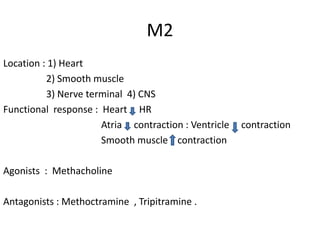
M2
Location : 1) Heart
2) Smooth muscle
3) Nerve terminal 4) CNS
Functional response : Heart HR
Atria contraction : Ventricle contraction
Smooth muscle contraction
Agonists : Methacholine
Antagonists : Methoctramine , Tripitramine .
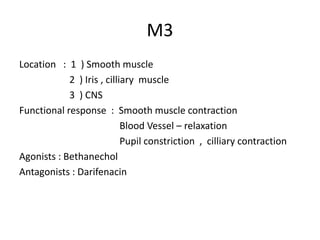
M3
Location : 1 ) Smooth muscle
2 ) Iris , cilliary muscle
3 ) CNS
Functional response : Smooth muscle contraction
Blood Vessel – relaxation
Pupil constriction , cilliary contraction
Agonists : Bethanechol
Antagonists : Darifenacin
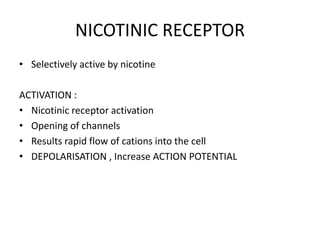
NICOTINIC RECEPTOR
• Selectively active by nicotine
ACTIVATION :
• Nicotinic receptor activation
• Opening of channels
• Results rapid flow of cations into the cell
• DEPOLARISATION , Increase ACTION POTENTIAL
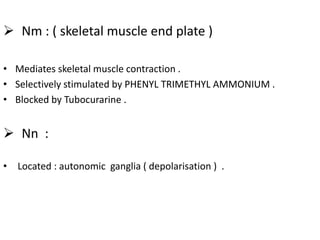
 Nm : ( skeletal muscle end plate )
• Mediates skeletal muscle contraction .
• Selectively stimulated by PHENYL TRIMETHYL AMMONIUM .
• Blocked by Tubocurarine .
 Nn :
• Located : autonomic ganglia ( depolarisation ) .
REFERENCE
• SEAN EKINS.COMPUTER ADDED DRUG
DEVELOPMENT.2018 ;PAGE NO 506 .
• WWW.WIKIPEDIA.COM.
• WWW.SLIDESHARE.COM.
Bbb choline transporter

Bbb choline transporter

  • 1.
    SEMINAR ON BBB-CHOLINE TRANSPORTER PRESENTEDBY-ROSHAN M JAIN (M.PHARM 1ST YEAR) SUBMITTED TO- Dr . A . GEETHALAKSHMI (HOD and Professor of department of pharmaceutics) RR COLLEGE OF PHARMACY
  • 2.
    BLOOD-BRAIN BARRIER • Theblood-brain barrier (BBB) is highly selective permeability barrier that separates the circulating blood from the brain extracellular fluid (BECF) in the central nervous system (CNS). • BBB is a unique membranous barrier that tightly segregates the brain from the circulating blood . • The blood-brain barrier acts very effectively to protect the brain from many common bacterial infections . • The blood-brain barrier is composed of high density cells restricting passage of substances from the bloodstream much more than endothelial cells in capillaries .
  • 3.
    STRUCTURE OF BBB •Capillaries of brain are lined with a layer of special endothelial cells that are sealed with tight junctions . • These tight junction called zona occludens . • The blood-brain barrier blocks all molecules except those that cross cell membranes by means of lipid solubility ( such as oxygen , carbon dioxide , ethanol , and steroid hormones ) and those that are allowed in by specific transport system (such as sugar and some amino acids ) . • Substances with a molecular higher than 500 daltons generally cannot cross BBB .
  • 4.
    Blood-Brain Barrier • TheBBB is permeable to small and lipophilic molecules but larger molecules are not transported across unless there is an active transport system available .
  • 5.
    CHOLINERGIC TRANSPORT • Drugsaffecting the ANS are divided into two groups . According to the types of neurons involved in their mechanism of action .  Cholinergics – acts on the receptor stimulated by ach  Adrenergics – acts on the receptor stimulated by norepinephrine .
  • 6.
    CHOLINERGIC AGENTS • Cholinergicagents are the drugs that act either directly or indirectly produce effect similar to those by acetylcholine. • while studying the pharmacological actions of Ach they are distinguished two types of activities designated as muscarinic and nicotinic
  • 7.
    SYSTHESIS OF ACH •Choline is take up into the nerve terminals by special choline transport system mediated by a carrier co transport sodium . • It can be inhibited by hemicholinium . • The choline is acetylated by the enzyme called as choline acetyl transferase to from Ach the acetyl group source is acetyl-coA .
  • 8.
    STORAGE AND RELEASEOF ACH • The Ach is packaged into vesicles by an active transport process coupled with the efflux of protons . • The mature vesicles also contain ATP and proteoglycon channel . • When an action potential propagated voltage sensitive calcium channels in the pre synaptic membrane opens causes an increase in intracellular calcium . • Elevated calcium levels promote the fusion of synaptic vesicles with the cell membrane and release of their contents into the synaptic cleft . • This release can be blocked by botulinum toxin . • Ach is degraded by acetylcholinestearse and forms choline and aceate in the synaptic cleft .
  • 10.
    CHOLINERGIC RECEPTORS • Cholinergicreceptors have been characterized as nicotinic and muscarinic on the basis of their ability to be bound by naturally occurring alkaloids nicotine and muscarine respectively . • They are two classes of receptors MUSCARINIC & NICOTINIC 1. Muscarinic receptors are G protein-coupled receptors . 2. Nicotinic receptors belongs to ligand gated receptors .
  • 11.
    • SUB TYPESOF MUSCARINIC RECEPTORS : M 1 , M 2 , M 3 . • SUB TYPES OF NICOTINIC RECEPTORS : Nm , Nn . M1 Location : gastric paracrine gland , CNS , sympathetic ganglia Functional response : acid secretion cognitive function (learning & memory) depolarisation of autonomic ganglia Agonists : oxotremorine Antagonists : pirenzepine , telenzepine
  • 12.
    M2 Location : 1)Heart 2) Smooth muscle 3) Nerve terminal 4) CNS Functional response : Heart HR Atria contraction : Ventricle contraction Smooth muscle contraction Agonists : Methacholine Antagonists : Methoctramine , Tripitramine .
  • 13.
    M3 Location : 1) Smooth muscle 2 ) Iris , cilliary muscle 3 ) CNS Functional response : Smooth muscle contraction Blood Vessel – relaxation Pupil constriction , cilliary contraction Agonists : Bethanechol Antagonists : Darifenacin
  • 14.
    NICOTINIC RECEPTOR • Selectivelyactive by nicotine ACTIVATION : • Nicotinic receptor activation • Opening of channels • Results rapid flow of cations into the cell • DEPOLARISATION , Increase ACTION POTENTIAL
  • 15.
     Nm :( skeletal muscle end plate ) • Mediates skeletal muscle contraction . • Selectively stimulated by PHENYL TRIMETHYL AMMONIUM . • Blocked by Tubocurarine .  Nn : • Located : autonomic ganglia ( depolarisation ) .
  • 16.
    REFERENCE • SEAN EKINS.COMPUTERADDED DRUG DEVELOPMENT.2018 ;PAGE NO 506 . • WWW.WIKIPEDIA.COM. • WWW.SLIDESHARE.COM.