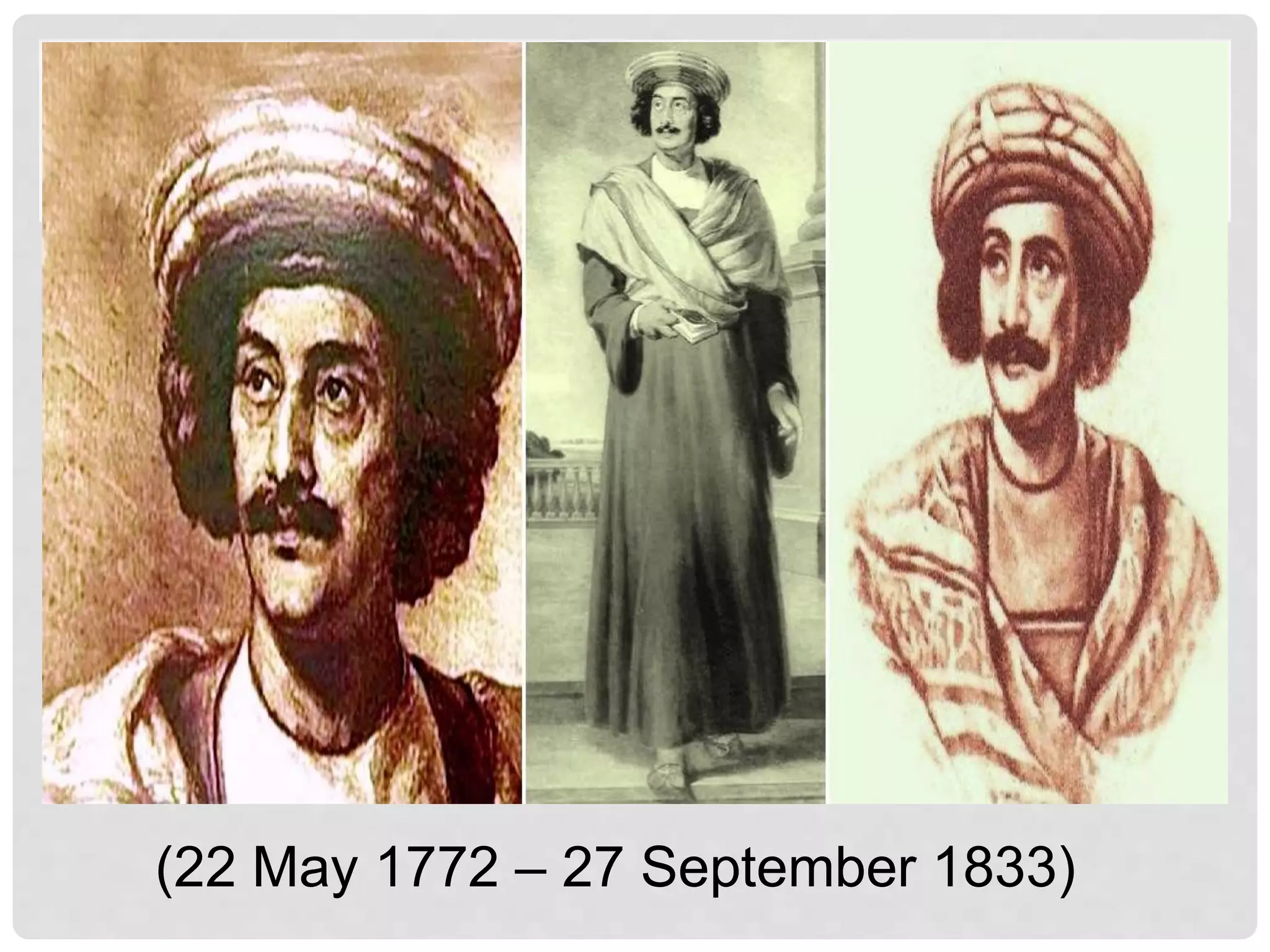
RAJA RAM MOHAN ROY
(22 May 1772 – 27 September 1833)
RAJA RAM MOHAN ROY
Raja Ram Mohan Roy was born on May 22, 1772 in
village Radhanagar in the District of Hooghly in Bengal.
His father Ramkanto Roy, was a Vaishnavite, while his
mother, Tarini, was from a Shakta background. Raja Ram
Mohun Roy was sent to Patna for higher studies. By the
age of fifteen, Raja Rammohun Roy had learnt Bangla,
Persian, Arabic and Sanskrit.
RAJA RAM MOHAN ROY
Popularly known as the “Maker of Modern India”. Raja
Ram Mohan Roy, a social and educational reformer, was
an idealist who contributed immensely in eradicating social
evils prevalent in the society during the 18th century. He
made every possible effort to make his motherland a
better place for the future generations to come.
He put laudable efforts to transform the face of India
and dared to defy the age-old Hindu traditions. A
modernist by virtue, he undertook a lot of social reforms to
change the society and worked for the upliftment of the
status of women in India.
SOCIAL REFORMS
• ATMIYA SABHA
In 1814, Raja Ram Mohan Roy formed Atmiya Sabha.
Atmiya Sabha tried to initiate social and religious reforms
in the society. Raja Ram Mohan Roy campaigned for
rights for women, including the right for widows to remarry,
and the right for women to hold property. He actively
opposed Sati system and the practice of polygamy.
BRAMHO SAMAJ
In 1828, Raja Ram Mohan Roy founded the 'Brahmo
Samaj'. Through 'Brahmo Samaj, he wanted to expose the
religious hypocrisies and check the growing influence of
Christianity on the Hindu society.
Reforms through Brahmo Samaj:
• Brahmo Sabha which was transferred into Brahmo Samaj
became the vehicle of Ram Mohan’s socio religious reforms.
It preached monotheism. It condemned idolatry. It saw no
difference between man and man because it accepted the
fatherhood of God and brotherhood of mankind. It condemned
ritualistic practices like animal sacrifice. It also fought for the
emancipation of women. Thus, many evil practices like caste
system, Sati, Child marriage. Polygamy etc. were the targets
of the Brahmo Samaj.
• The Brahmo movement gained momentum through
Debendranath Tagore and Keshab Chandra Sen later on.
Thus for the creation of a healthy society, Brahmo Samaj was
determined. This definitely created a mile stone in the cultural
heritage of India.
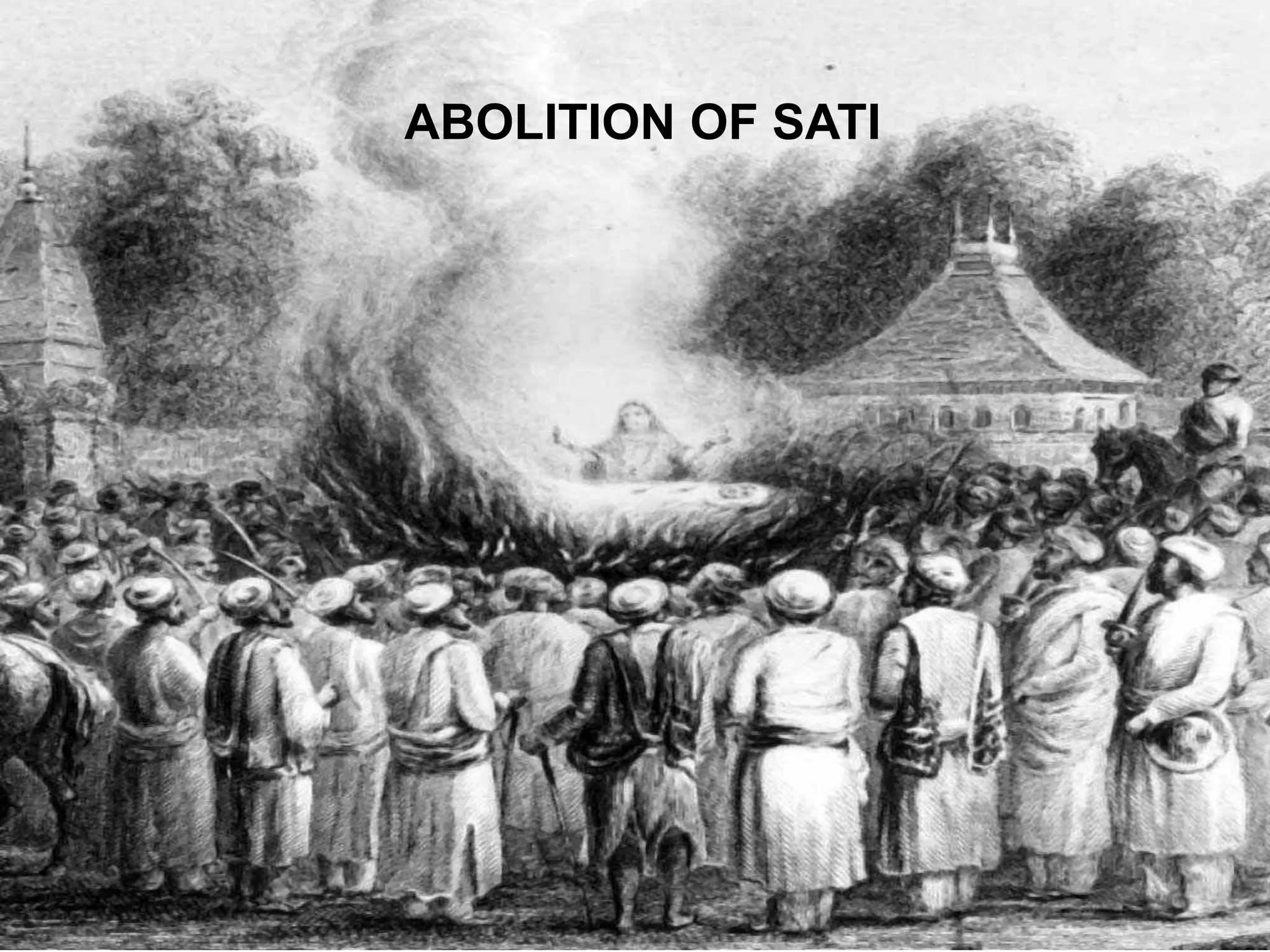
• ABOLITION OF SATI
ABOLITION OF SATI
Raja Ram Mohan Roy raised his voice against the Sati
system. Ram Mohan protested it vehemently. Even he
went to England to give witness before the Privy Council
against this cruel practice where the orthodox Indians had
appealed hot to repeal his system. His efforts bore fruits
and this practice was stopped by an Act passed in 1829
during Lord William Bentinck. Thus, a long prevailing ugly
practice of the Hindus was uprooted.
Voice against idolatry:
Ram Mohan raised his voice against idolatry. In his book
‘Tuhfat-ul-Muwahhidin’ he championed the cause of
Monotheism. He criticized idol-worship by the Hindus. He
also opposed the principle of Trinitariasm’ (God, Son
Jesus and the holy spirit) of the Christianity. He rejected
polytheism, idol-worship and rituals of different religions.
He advocated monotheism or unity among gods. He also
advised people to be guided by the conscience. He
inspired men to cultivate rationality. To all he appealed to
observe the principle of unity of God.
Champion of Women Liberty:
Raja Ram Mohan Roy advocated the liberty of Women.
He was determined to give women her proper place in the
society. Besides abolishing Sati, he advocated in favor of
widow remarriage. He also told that like the sons,
daughters have also their right over parental property. He
also influenced the British government to bring necessary
modification in the existing law. He raised voice against
child-marriage and polygamy. He was the advocate of
women education. Thus, he advocated women’s liberty out
and out and awakened them.
Opposition to Caste System:
The caste system was a very ugly practice prevailing in
Indian society right from the later Vedic age. Indian society
was fragmented by the name of different castes. The
higher castes like Brahmins and Kshatriyas looked down
upon the Sudras, Chandalas and other aboriginals. Ram
Mohan opposed this ugly system of the Indian society. To
him everybody was a son or daughter of the God. So,
there is no difference among men.By advocating this
equality among men. Ram Mohan became the eyesore of
many higher caste Indians.
Advocate of Western Education:
Mohan Roy realized the importance of English language.
He could visualize the need of a scientific, rational and
progressive education for the Indians. He supported the
move of Lord Macaulay and championed the cause of the
English system of education in India. His motto was to
take Indians the path of progress. He established English
school in 1816 and Vedanta College in 1825. He wanted
to introduce modern system of education.
He also desired that the Indian Vedic studies and
philosophical systems were to be studied and analyzed
properly.
Champion of Internationalism:
He wanted universal religion, synthesis of human culture
and ideas, end of imperialism and peaceful co-existence
of nations.
Champion of Nationalism:
Raja Ram Mohan Roy believed in the political freedom of
man. He advised Indians to have self-freedom in thought
and action. He showed a bright example by condemning
the Jury Act of 1826 which had introduced religious
discrimination in the law courts. According to this Act a
Hindu or a Mohammedan could be tried either by a
European or a native Christian but not vice versa.
Further, Ram Mohan Roy himself proceeded to London to
plead a case on behalf of Akbar II, the Mughal Emperor.
Economic Ideas:
Ram Mohan’s economic ideas were tinged with liberalism.
He wanted the state intervention to protect the property of
the individual. He advocated that the peasants should be
protected by the government from the tyranny of the
landlords. He wanted the British authority to intervene in
the affairs of the Zamindars to protect the peasants.
THANK YOU

Raja Ram Mohan Roy

  • 1.
  • 2.
    (22 May 1772– 27 September 1833)
  • 3.
    RAJA RAM MOHANROY Raja Ram Mohan Roy was born on May 22, 1772 in village Radhanagar in the District of Hooghly in Bengal. His father Ramkanto Roy, was a Vaishnavite, while his mother, Tarini, was from a Shakta background. Raja Ram Mohun Roy was sent to Patna for higher studies. By the age of fifteen, Raja Rammohun Roy had learnt Bangla, Persian, Arabic and Sanskrit.
  • 4.
    RAJA RAM MOHANROY Popularly known as the “Maker of Modern India”. Raja Ram Mohan Roy, a social and educational reformer, was an idealist who contributed immensely in eradicating social evils prevalent in the society during the 18th century. He made every possible effort to make his motherland a better place for the future generations to come. He put laudable efforts to transform the face of India and dared to defy the age-old Hindu traditions. A modernist by virtue, he undertook a lot of social reforms to change the society and worked for the upliftment of the status of women in India.
  • 5.
    SOCIAL REFORMS • ATMIYASABHA In 1814, Raja Ram Mohan Roy formed Atmiya Sabha. Atmiya Sabha tried to initiate social and religious reforms in the society. Raja Ram Mohan Roy campaigned for rights for women, including the right for widows to remarry, and the right for women to hold property. He actively opposed Sati system and the practice of polygamy.
  • 6.
    BRAMHO SAMAJ In 1828,Raja Ram Mohan Roy founded the 'Brahmo Samaj'. Through 'Brahmo Samaj, he wanted to expose the religious hypocrisies and check the growing influence of Christianity on the Hindu society.
  • 7.
    Reforms through BrahmoSamaj: • Brahmo Sabha which was transferred into Brahmo Samaj became the vehicle of Ram Mohan’s socio religious reforms. It preached monotheism. It condemned idolatry. It saw no difference between man and man because it accepted the fatherhood of God and brotherhood of mankind. It condemned ritualistic practices like animal sacrifice. It also fought for the emancipation of women. Thus, many evil practices like caste system, Sati, Child marriage. Polygamy etc. were the targets of the Brahmo Samaj. • The Brahmo movement gained momentum through Debendranath Tagore and Keshab Chandra Sen later on. Thus for the creation of a healthy society, Brahmo Samaj was determined. This definitely created a mile stone in the cultural heritage of India.
  • 8.
    • ABOLITION OFSATI ABOLITION OF SATI
  • 9.
    Raja Ram MohanRoy raised his voice against the Sati system. Ram Mohan protested it vehemently. Even he went to England to give witness before the Privy Council against this cruel practice where the orthodox Indians had appealed hot to repeal his system. His efforts bore fruits and this practice was stopped by an Act passed in 1829 during Lord William Bentinck. Thus, a long prevailing ugly practice of the Hindus was uprooted.
  • 10.
    Voice against idolatry: RamMohan raised his voice against idolatry. In his book ‘Tuhfat-ul-Muwahhidin’ he championed the cause of Monotheism. He criticized idol-worship by the Hindus. He also opposed the principle of Trinitariasm’ (God, Son Jesus and the holy spirit) of the Christianity. He rejected polytheism, idol-worship and rituals of different religions. He advocated monotheism or unity among gods. He also advised people to be guided by the conscience. He inspired men to cultivate rationality. To all he appealed to observe the principle of unity of God.
  • 11.
    Champion of WomenLiberty: Raja Ram Mohan Roy advocated the liberty of Women. He was determined to give women her proper place in the society. Besides abolishing Sati, he advocated in favor of widow remarriage. He also told that like the sons, daughters have also their right over parental property. He also influenced the British government to bring necessary modification in the existing law. He raised voice against child-marriage and polygamy. He was the advocate of women education. Thus, he advocated women’s liberty out and out and awakened them.
  • 12.
    Opposition to CasteSystem: The caste system was a very ugly practice prevailing in Indian society right from the later Vedic age. Indian society was fragmented by the name of different castes. The higher castes like Brahmins and Kshatriyas looked down upon the Sudras, Chandalas and other aboriginals. Ram Mohan opposed this ugly system of the Indian society. To him everybody was a son or daughter of the God. So, there is no difference among men.By advocating this equality among men. Ram Mohan became the eyesore of many higher caste Indians.
  • 13.
    Advocate of WesternEducation: Mohan Roy realized the importance of English language. He could visualize the need of a scientific, rational and progressive education for the Indians. He supported the move of Lord Macaulay and championed the cause of the English system of education in India. His motto was to take Indians the path of progress. He established English school in 1816 and Vedanta College in 1825. He wanted to introduce modern system of education. He also desired that the Indian Vedic studies and philosophical systems were to be studied and analyzed properly.
  • 14.
    Champion of Internationalism: Hewanted universal religion, synthesis of human culture and ideas, end of imperialism and peaceful co-existence of nations. Champion of Nationalism: Raja Ram Mohan Roy believed in the political freedom of man. He advised Indians to have self-freedom in thought and action. He showed a bright example by condemning the Jury Act of 1826 which had introduced religious discrimination in the law courts. According to this Act a Hindu or a Mohammedan could be tried either by a European or a native Christian but not vice versa. Further, Ram Mohan Roy himself proceeded to London to plead a case on behalf of Akbar II, the Mughal Emperor.
  • 15.
    Economic Ideas: Ram Mohan’seconomic ideas were tinged with liberalism. He wanted the state intervention to protect the property of the individual. He advocated that the peasants should be protected by the government from the tyranny of the landlords. He wanted the British authority to intervene in the affairs of the Zamindars to protect the peasants.
  • 16.