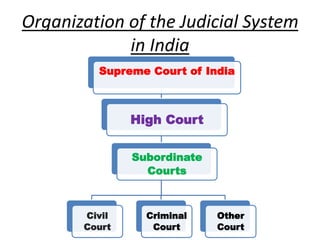
Organization of the Judicial System
in India
Supreme Court of India
High Court
Subordinate
Courts
Civil
Court
Criminal
Court
Other
Court
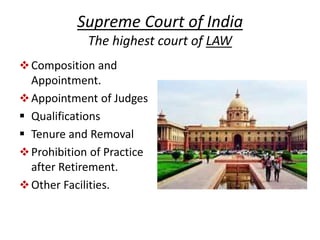
Supreme Court of India
The highest court of LAW
Composition and
Appointment.
Appointment of Judges
 Qualifications
 Tenure and Removal
Prohibition of Practice
after Retirement.
Other Facilities.
Chief Justice of India
The Chief Justice of India (CJI) is the highest
ranking judge in the Supreme Court of India , and
thus holds the highest judicial position in India.
 In accordance with Art.145 of the Constitution of
India and the Supreme Court Rules of Procedure
of 1966 , the Chief Justice allocates all work to
the other judges who are bound to refer the
matter back to him/her in any case where they
require it .
The present Chief Justice is the 42nd since January
1950 .
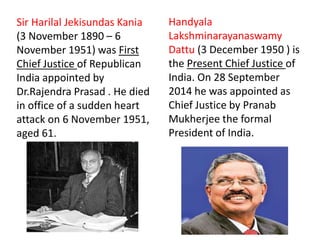
Sir Harilal Jekisundas Kania
(3 November 1890 – 6
November 1951) was First
Chief Justice of Republican
India appointed by
Dr.Rajendra Prasad . He died
in office of a sudden heart
attack on 6 November 1951,
aged 61.
Handyala
Lakshminarayanaswamy
Dattu (3 December 1950 ) is
the Present Chief Justice of
India. On 28 September
2014 he was appointed as
Chief Justice by Pranab
Mukherjee the formal
President of India.
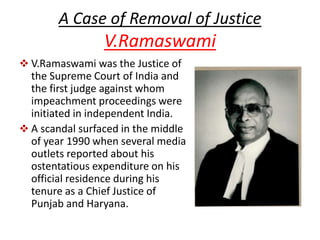
A Case of Removal of Justice
V.Ramaswami
 V.Ramaswami was the Justice of
the Supreme Court of India and
the first judge against whom
impeachment proceedings were
initiated in independent India.
 A scandal surfaced in the middle
of year 1990 when several media
outlets reported about his
ostentatious expenditure on his
official residence during his
tenure as a Chief Justice of
Punjab and Haryana.
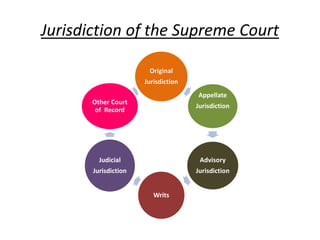
Jurisdiction of the Supreme Court
Original
Jurisdiction
Appellate
Jurisdiction
Advisory
Jurisdiction
Writs
Judicial
Jurisdiction
Other Court
of Record
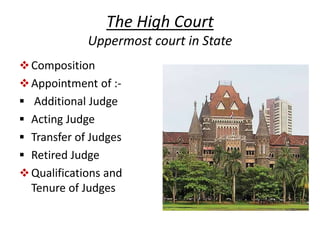
The High Court
Uppermost court in State
Composition
Appointment of :-
 Additional Judge
 Acting Judge
 Transfer of Judges
 Retired Judge
Qualifications and
Tenure of Judges
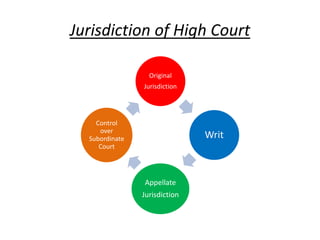
Jurisdiction of High Court
Original
Jurisdiction
Writ
Appellate
Jurisdiction
Control
over
Subordinate
Court
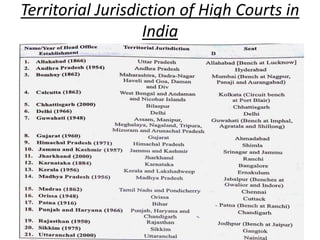
Territorial Jurisdiction of High Courts in
India
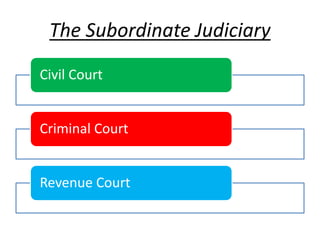
The Subordinate Judiciary
Civil Court
Criminal Court
Revenue Court
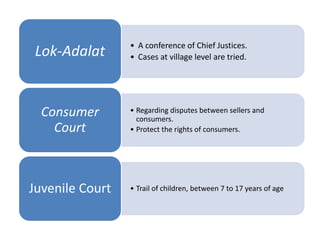
• A conference of Chief Justices.
• Cases at village level are tried.Lok-Adalat
• Regarding disputes between sellers and
consumers.
• Protect the rights of consumers.
Consumer
Court
• Trail of children, between 7 to 17 years of ageJuvenile Court
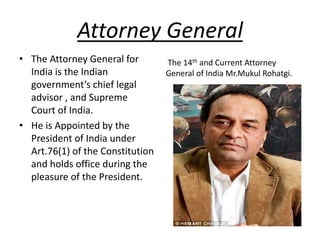
Attorney General
The 14th and Current Attorney
General of India Mr.Mukul Rohatgi.
• The Attorney General for
India is the Indian
government’s chief legal
advisor , and Supreme
Court of India.
• He is Appointed by the
President of India under
Art.76(1) of the Constitution
and holds office during the
pleasure of the President.
THE END
THANK YOU

Judiciary

  • 2.
    Organization of theJudicial System in India Supreme Court of India High Court Subordinate Courts Civil Court Criminal Court Other Court
  • 3.
    Supreme Court ofIndia The highest court of LAW Composition and Appointment. Appointment of Judges  Qualifications  Tenure and Removal Prohibition of Practice after Retirement. Other Facilities.
  • 4.
    Chief Justice ofIndia The Chief Justice of India (CJI) is the highest ranking judge in the Supreme Court of India , and thus holds the highest judicial position in India.  In accordance with Art.145 of the Constitution of India and the Supreme Court Rules of Procedure of 1966 , the Chief Justice allocates all work to the other judges who are bound to refer the matter back to him/her in any case where they require it . The present Chief Justice is the 42nd since January 1950 .
  • 5.
    Sir Harilal JekisundasKania (3 November 1890 – 6 November 1951) was First Chief Justice of Republican India appointed by Dr.Rajendra Prasad . He died in office of a sudden heart attack on 6 November 1951, aged 61. Handyala Lakshminarayanaswamy Dattu (3 December 1950 ) is the Present Chief Justice of India. On 28 September 2014 he was appointed as Chief Justice by Pranab Mukherjee the formal President of India.
  • 6.
    A Case ofRemoval of Justice V.Ramaswami  V.Ramaswami was the Justice of the Supreme Court of India and the first judge against whom impeachment proceedings were initiated in independent India.  A scandal surfaced in the middle of year 1990 when several media outlets reported about his ostentatious expenditure on his official residence during his tenure as a Chief Justice of Punjab and Haryana.
  • 7.
    Jurisdiction of theSupreme Court Original Jurisdiction Appellate Jurisdiction Advisory Jurisdiction Writs Judicial Jurisdiction Other Court of Record
  • 8.
    The High Court Uppermostcourt in State Composition Appointment of :-  Additional Judge  Acting Judge  Transfer of Judges  Retired Judge Qualifications and Tenure of Judges
  • 9.
    Jurisdiction of HighCourt Original Jurisdiction Writ Appellate Jurisdiction Control over Subordinate Court
  • 10.
    Territorial Jurisdiction ofHigh Courts in India
  • 11.
    The Subordinate Judiciary CivilCourt Criminal Court Revenue Court
  • 12.
    • A conferenceof Chief Justices. • Cases at village level are tried.Lok-Adalat • Regarding disputes between sellers and consumers. • Protect the rights of consumers. Consumer Court • Trail of children, between 7 to 17 years of ageJuvenile Court
  • 13.
    Attorney General The 14thand Current Attorney General of India Mr.Mukul Rohatgi. • The Attorney General for India is the Indian government’s chief legal advisor , and Supreme Court of India. • He is Appointed by the President of India under Art.76(1) of the Constitution and holds office during the pleasure of the President.
  • 14.