WELCOME
JYOTHISHA P. NAIR
SOCIAL SCIENCE
ZM17EDSS02
ZAINAB MEMORIAL COLLEGE OF
TEACHER EDUCATION, CHERKALA.
KASARAGOD
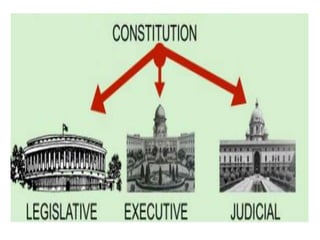
Indian Parliament
Rashtrapati Bhavan
Supreme Court of India
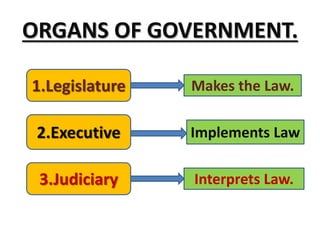
ORGANS OF GOVERNMENT.
1.Legislature
2.Executive
3.Judiciary
Makes the Law.
Implements Law
Interprets Law.
GOVERNMENT OF INDIA
(Central/Union Government)
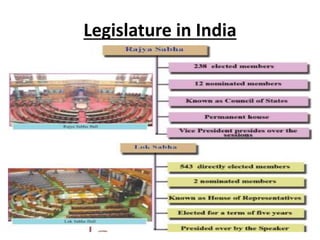
Legislature in India
• The legislature in India is known as the
Parliament.
• It consists of the President & two houses
namely Rajya Sabha & Lok Sabha.
• The Rajya Sabha is known as the Upper house
& the Lok Sabha is known as the Lower house.
• Since it has two houses it is known as
Bicameral Legislature.
Legislature in India
Rajya Sabha Lok Sabha
Legislature in India
Executive in India
• In India there are two levels of Executive;
Central Executive & State Executive.
• The Central Executive consists of the
President, Central ministers and Bureaucracy.
• The head of the State Level Executive is
Governor. The Chief Minister and his Cabinet
act as the real executive in the States.
Judiciary in India
• There may be arise disputes between
individuals, individuals and government,
between central & state governments, and
among states on various issues.
• It is the judiciary which resolves these
disputes.
• By punishing the guilty & protecting the
innocents, the courts implement justice.
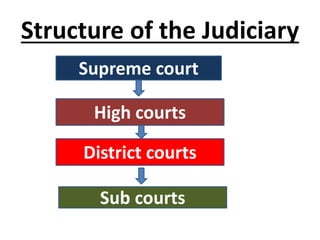
Structure of the Judiciary
Supreme court
High courts
District courts
Sub courts
Supreme Court of India
• The supreme court is
the apex court in India.
• It consists of a Chief
Justice and Judges
appointed by the
President.
• At present the Supreme
Court has a Chief Justice
and 30 judges.
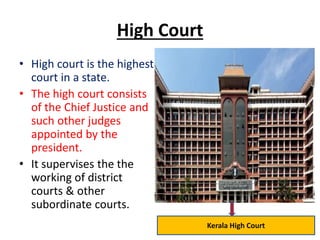
High Court
• High court is the highest
court in a state.
• The high court consists
of the Chief Justice and
such other judges
appointed by the
president.
• It supervises the the
working of district
courts & other
subordinate courts.
Kerala High Court
Subordinate Courts
• Subordinate courts consist of District Courts,
Sub courts, Munsif Courts, and Magistrate
Courts.
• They give verdicts on civil and criminal cases.
“You have now learnt about
the three organs of the
government. Government
becomes effective only when
these three organs work
together with mutual respect
and in accordance with the
Constitutional Provisions.”
REFERENCE
• SCERT Social Science Text Book Class : VIII -
Kerala Syllabus.
THANK YOU

Our govt.ppt[1]

  • 1.
  • 2.
    JYOTHISHA P. NAIR SOCIALSCIENCE ZM17EDSS02 ZAINAB MEMORIAL COLLEGE OF TEACHER EDUCATION, CHERKALA. KASARAGOD
  • 4.
  • 5.
  • 6.
  • 7.
  • 8.
  • 9.
    Legislature in India •The legislature in India is known as the Parliament. • It consists of the President & two houses namely Rajya Sabha & Lok Sabha. • The Rajya Sabha is known as the Upper house & the Lok Sabha is known as the Lower house. • Since it has two houses it is known as Bicameral Legislature.
  • 10.
  • 11.
  • 12.
    Executive in India •In India there are two levels of Executive; Central Executive & State Executive. • The Central Executive consists of the President, Central ministers and Bureaucracy. • The head of the State Level Executive is Governor. The Chief Minister and his Cabinet act as the real executive in the States.
  • 13.
    Judiciary in India •There may be arise disputes between individuals, individuals and government, between central & state governments, and among states on various issues. • It is the judiciary which resolves these disputes. • By punishing the guilty & protecting the innocents, the courts implement justice.
  • 14.
    Structure of theJudiciary Supreme court High courts District courts Sub courts
  • 15.
    Supreme Court ofIndia • The supreme court is the apex court in India. • It consists of a Chief Justice and Judges appointed by the President. • At present the Supreme Court has a Chief Justice and 30 judges.
  • 16.
    High Court • Highcourt is the highest court in a state. • The high court consists of the Chief Justice and such other judges appointed by the president. • It supervises the the working of district courts & other subordinate courts. Kerala High Court
  • 17.
    Subordinate Courts • Subordinatecourts consist of District Courts, Sub courts, Munsif Courts, and Magistrate Courts. • They give verdicts on civil and criminal cases.
  • 18.
    “You have nowlearnt about the three organs of the government. Government becomes effective only when these three organs work together with mutual respect and in accordance with the Constitutional Provisions.”
  • 19.
    REFERENCE • SCERT SocialScience Text Book Class : VIII - Kerala Syllabus.
  • 20.