COMPARATIVE TESTING OF 31
TANK LINING SYSTEMS
Amal Al-Borno
Charter Coating Service (2000) Ltd.
#6, 4604 – 13th Street N.E.
Calgary, AB, Canada T2E 6P1
aalborno@chartercoating.com
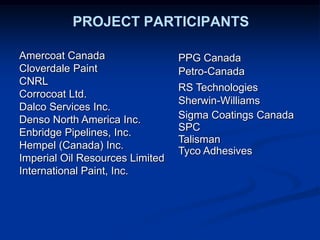
Amercoat Canada
Cloverdale Paint
CNRL
Corrocoat Ltd.
Dalco Services Inc.
Denso North America Inc.
Enbridge Pipelines, Inc.
Hempel (Canada) Inc.
Imperial Oil Resources Limited
International Paint, Inc.
PPG Canada
Petro-Canada
RS Technologies
Sherwin-Williams
Sigma Coatings Canada
SPC
Talisman
Tyco Adhesives
PROJECT PARTICIPANTS
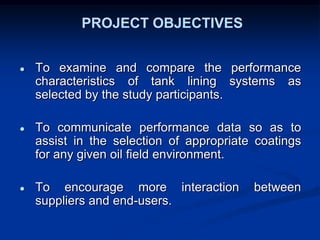
PROJECT OBJECTIVES
● To examine and compare the performance
characteristics of tank lining systems as
selected by the study participants.
● To communicate performance data so as to
assist in the selection of appropriate coatings
for any given oil field environment.
● To encourage more interaction between
suppliers and end-users.
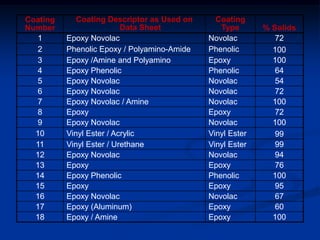
Coating
Number
Coating Descriptor as Used on
Data Sheet
Coating
Type % Solids
1 Epoxy Novolac Novolac 72
2 Phenolic Epoxy / Polyamino-Amide Phenolic 100
3 Epoxy /Amine and Polyamino Epoxy 100
4 Epoxy Phenolic Phenolic 64
5 Epoxy Novolac Novolac 54
6 Epoxy Novolac Novolac 72
7 Epoxy Novolac / Amine Novolac 100
8 Epoxy Epoxy 72
9 Epoxy Novolac Novolac 100
10 Vinyl Ester / Acrylic Vinyl Ester 99
11 Vinyl Ester / Urethane Vinyl Ester 99
12 Epoxy Novolac Novolac 94
13 Epoxy Epoxy 76
14 Epoxy Phenolic Phenolic 100
15 Epoxy Epoxy 95
16 Epoxy Novolac Novolac 67
17 Epoxy (Aluminum) Epoxy 60
18 Epoxy / Amine Epoxy 100
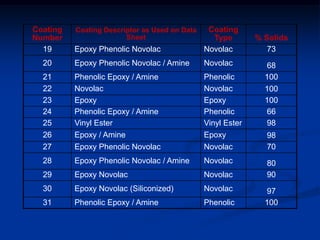
Coating
Number
Coating Descriptor as Used on Data
Sheet
Coating
Type % Solids
19 Epoxy Phenolic Novolac Novolac 73
20 Epoxy Phenolic Novolac / Amine Novolac 68
21 Phenolic Epoxy / Amine Phenolic 100
22 Novolac Novolac 100
23 Epoxy Epoxy 100
24 Phenolic Epoxy / Amine Phenolic 66
25 Vinyl Ester Vinyl Ester 98
26 Epoxy / Amine Epoxy 98
27 Epoxy Phenolic Novolac Novolac 70
28 Epoxy Phenolic Novolac / Amine Novolac 80
29 Epoxy Novolac Novolac 90
30 Epoxy Novolac (Siliconized) Novolac 97
31 Phenolic Epoxy / Amine Phenolic 100
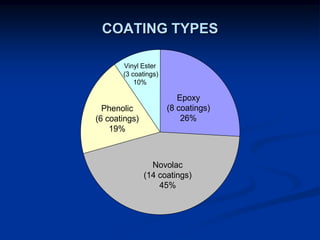
COATING TYPES
Vinyl Ester
(3 coatings)
10%
Epoxy
(8 coatings)
26%
Novolac
(14 coatings)
45%
Phenolic
(6 coatings)
19%
APPLICATION AND SAMPLE CUTTING
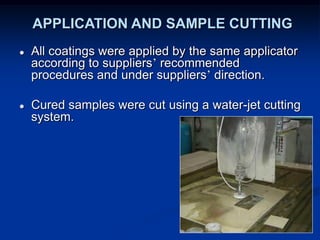
● All coatings were applied by the same applicator
according to suppliers’ recommended
procedures and under suppliers’ direction.
● Cured samples were cut using a water-jet cutting
system.
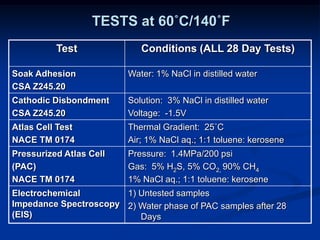
TESTS at 60˚C/140˚F
Test Conditions (ALL 28 Day Tests)
Soak Adhesion
CSA Z245.20
Water: 1% NaCl in distilled water
Cathodic Disbondment
CSA Z245.20
Solution: 3% NaCl in distilled water
Voltage: -1.5V
Atlas Cell Test
NACE TM 0174
Thermal Gradient: 25˚C
Air; 1% NaCl aq.; 1:1 toluene: kerosene
Pressurized Atlas Cell
(PAC)
NACE TM 0174
Pressure: 1.4MPa/200 psi
Gas: 5% H2S, 5% CO2, 90% CH4
1% NaCl aq.; 1:1 toluene: kerosene
Electrochemical
Impedance Spectroscopy
(EIS)
1) Untested samples
2) Water phase of PAC samples after 28
Days
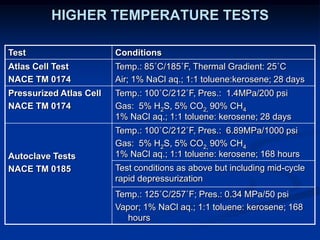
HIGHER TEMPERATURE TESTS
Test Conditions
Atlas Cell Test
NACE TM 0174
Temp.: 85˚C/185˚F, Thermal Gradient: 25˚C
Air; 1% NaCl aq.; 1:1 toluene:kerosene; 28 days
Pressurized Atlas Cell
NACE TM 0174
Temp.: 100˚C/212˚F, Pres.: 1.4MPa/200 psi
Gas: 5% H2S, 5% CO2, 90% CH4
1% NaCl aq.; 1:1 toluene: kerosene; 28 days
Autoclave Tests
NACE TM 0185
Temp.: 100˚C/212˚F, Pres.: 6.89MPa/1000 psi
Gas: 5% H2S, 5% CO2, 90% CH4
1% NaCl aq.; 1:1 toluene: kerosene; 168 hours
Test conditions as above but including mid-cycle
rapid depressurization
Temp.: 125˚C/257˚F; Pres.: 0.34 MPa/50 psi
Vapor; 1% NaCl aq.; 1:1 toluene: kerosene; 168
hours
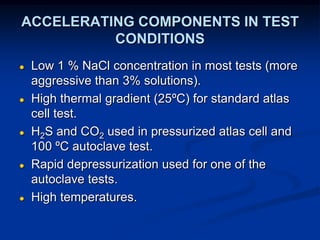
ACCELERATING COMPONENTS IN TEST
CONDITIONS
● Low 1 % NaCl concentration in most tests (more
aggressive than 3% solutions).
● High thermal gradient (25ºC) for standard atlas
cell test.
● H2S and CO2 used in pressurized atlas cell and
100 ºC autoclave test.
● Rapid depressurization used for one of the
autoclave tests.
● High temperatures.
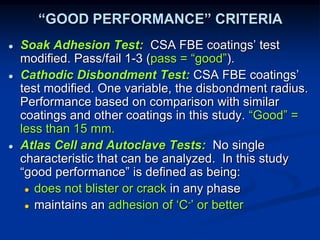
“GOOD PERFORMANCE” CRITERIA
● Soak Adhesion Test: CSA FBE coatings’ test
modified. Pass/fail 1-3 (pass = “good”).
● Cathodic Disbondment Test: CSA FBE coatings’
test modified. One variable, the disbondment radius.
Performance based on comparison with similar
coatings and other coatings in this study. “Good” =
less than 15 mm.
● Atlas Cell and Autoclave Tests: No single
characteristic that can be analyzed. In this study
“good performance” is defined as being:
● does not blister or crack in any phase
● maintains an adhesion of ‘C-’ or better
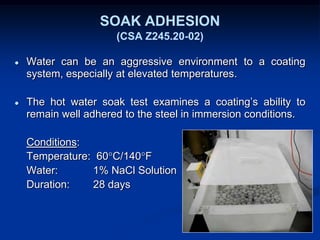
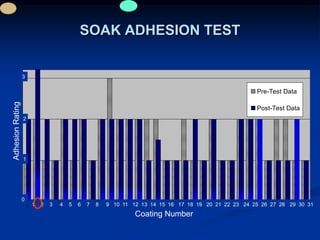
SOAK ADHESION
(CSA Z245.20-02)
● Water can be an aggressive environment to a coating
system, especially at elevated temperatures.
● The hot water soak test examines a coating’s ability to
remain well adhered to the steel in immersion conditions.
Conditions:
Temperature: 60°C/140°F
Water: 1% NaCl Solution
Duration: 28 days
SOAK ADHESION TEST
0
1
2
3
1 2 3 4 5 6 7 8 9 10 11 12 13 14 15 16 17 18 19 20 21 22 23 24 25 26 27 28 29 30 31
Coating Number
AdhesionRating
Pre-Test Data
Post-Test Data
*Decimal value denot est he average of t wo disparat e pre-t est scores.
AdhesionRating
Coating Number
1 2 3 4 5 6 7 8 9 10 11 12 13 14 15 16 17 18 19 20 21 22 23 24 25 26 27 28 29 30 31
0
1
2
3
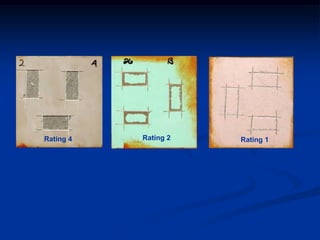
Rating 4 Rating 2 Rating 1
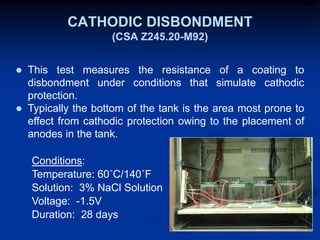
CATHODIC DISBONDMENT
(CSA Z245.20-M92)
 This test measures the resistance of a coating to
disbondment under conditions that simulate cathodic
protection.
 Typically the bottom of the tank is the area most prone to
effect from cathodic protection owing to the placement of
anodes in the tank.
Conditions:
Temperature: 60˚C/140˚F
Solution: 3% NaCl Solution
Voltage: -1.5V
Duration: 28 days
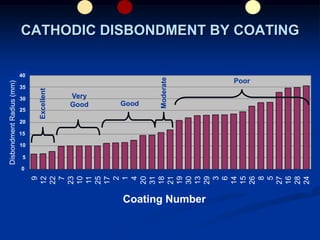
CATHODIC DISBONDMENT BY COATING
DisbondmentRadius(mm)
9
12
22
7
23
10
11
25
17
2
1
4
20
31
18
21
19
30
13
29
3
6
14
15
26
8
5
27
16
28
24
Coating Number
0
5
10
15
20
25
30
35
40
Excellent
Very
Good Good
Moderate
Poor
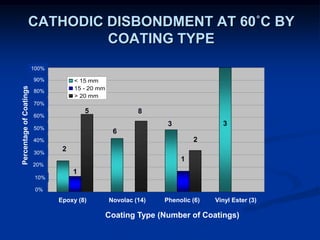
CATHODIC DISBONDMENT AT 60˚C BY
COATING TYPE
0%
10%
20%
30%
40%
50%
60%
70%
80%
90%
100%
Epoxy (8) Novolac (14) Phenolic (6) Vinyl Ester (3)
Coating Type (Number of Coatings)
PercentageofCoatings
< 15 mm
15 - 20 mm
> 20 mm
Epoxy (8) Novolac (14) Phenolic (6) Vinyl Ester (3)
Coating Type (Number of Coatings)
PercentageofCoatings
0%
10%
20%
30%
40%
50%
60%
70%
80%
90%
100%
2
1
5
6
8
3
1
2
3
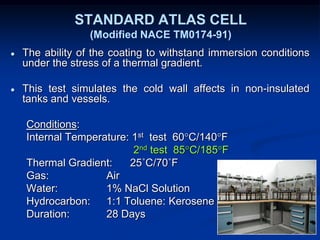
STANDARD ATLAS CELL
(Modified NACE TM0174-91)
● The ability of the coating to withstand immersion conditions
under the stress of a thermal gradient.
● This test simulates the cold wall affects in non-insulated
tanks and vessels.
Conditions:
Internal Temperature: 1st test 60°C/140°F
2nd test 85°C/185°F
Thermal Gradient: 25˚C/70˚F
Gas: Air
Water: 1% NaCl Solution
Hydrocarbon: 1:1 Toluene: Kerosene
Duration: 28 Days
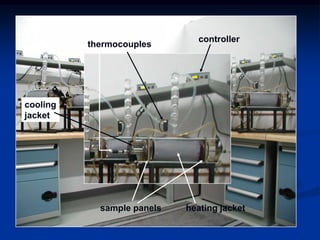
controller
sample panels heating jacket
cooling
jacket
thermocouples
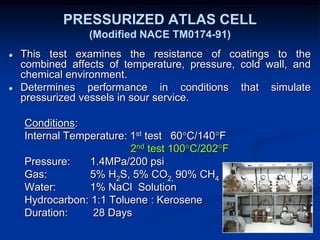
PRESSURIZED ATLAS CELL
(Modified NACE TM0174-91)
● This test examines the resistance of coatings to the
combined affects of temperature, pressure, cold wall, and
chemical environment.
● Determines performance in conditions that simulate
pressurized vessels in sour service.
Conditions:
Internal Temperature: 1st test 60°C/140°F
2nd test 100°C/202°F
Pressure: 1.4MPa/200 psi
Gas: 5% H2S, 5% CO2, 90% CH4
Water: 1% NaCl Solution
Hydrocarbon: 1:1 Toluene : Kerosene
Duration: 28 Days
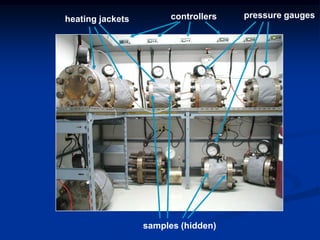
controllersheating jackets pressure gauges
samples (hidden)
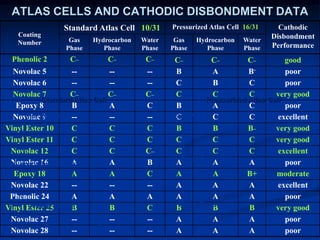
ATLAS CELLS AND CATHODIC DISBONDMENT DATA
Coating
Number
Standard Atlas Cell 10/31 Pressurized Atlas Cell 16/31 Cathodic
Disbondment
Performance
Gas
Phase
Hydrocarbon
Phase
Water
Phase
Gas
Phase
Hydrocarbon
Phase
Water
Phase
Phenolic 2 C_ C_ C_
C_ C_ C_ good
Novolac 5 -- -- -- B A B- poor
Novolac 6 -- -- -- C B C poor
Novolac 7 C_ C_ C_ C C C very good
Epoxy 8 B A C B A C poor
Novolac 9 -- -- -- C C C excellent
Vinyl Ester 10 C C C B B B_ very good
Vinyl Ester 11 C C C C C C very good
Novolac 12 C C C_ C C C excellent
Novolac 16 A A B A A A poor
Epoxy 18 A A C A A B+ moderate
Novolac 22 -- -- -- A A A excellent
Phenolic 24 A A A A A A poor
Vinyl Ester 25 B B C B B B very good
Novolac 27 -- -- -- A A A poor
Novolac 28 -- -- -- A A A poor
Pressurized Atlas CellStandard Atlas Cell
Water Phase
Hydrocarbon Phase
Gas Phase
Water Phase
Hydrocarbon Phase
Gas Phase
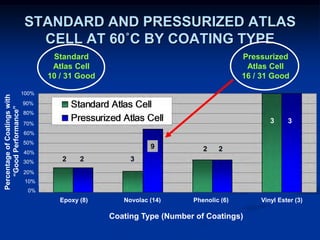
STANDARD AND PRESSURIZED ATLAS
CELL AT 60˚C BY COATING TYPE
Standard
Atlas Cell
10 / 31 Good
Pressurized
Atlas Cell
16 / 31 Good
Coating Type (Number of Coatings)
0%
10%
20%
30%
40%
50%
60%
70%
80%
90%
100%
PercentageofCoatingswith
“GoodPerformance”
2 2 3
9 2 2
3 3
Epoxy (8) Novolac (14) Phenolic (6) Vinyl Ester (3)
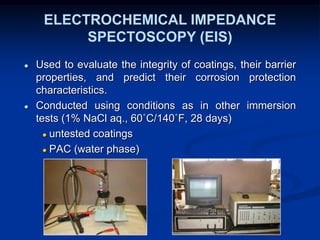
ELECTROCHEMICAL IMPEDANCE
SPECTOSCOPY (EIS)
● Used to evaluate the integrity of coatings, their barrier
properties, and predict their corrosion protection
characteristics.
● Conducted using conditions as in other immersion
tests (1% NaCl aq., 60˚C/140˚F, 28 days)
● untested coatings
● PAC (water phase)
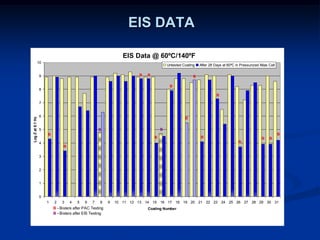
EIS DATA
EIS Data @ 60ºC/140ºF
0
1
2
3
4
5
6
7
8
9
10
1 2 3 4 5 6 7 8 9 10 11 12 13 14 15 16 17 18 19 20 21 22 23 24 25 26 27 28 29 30 31
Coating Number
LogZat0.1Hz
Untested Coating After 28 Days at 60ºC in Pressurized Atlas Cell
B
B
B - Bisters after PAC Testing
B - Bisters after EIS Testing
B
B
B
B
B
B
B
B
B
B
BB
B
B
Epoxy Novolac Phenolic Vinyl
Ester
LogZat0.1Hz
Coating Type
2
3
4
5
6
7
8
9
0
1
10 ?
?
? ?
?
?
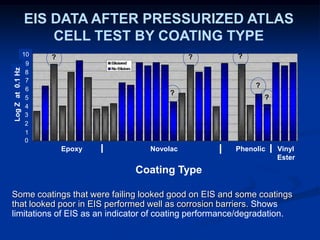
EIS DATA AFTER PRESSURIZED ATLAS
CELL TEST BY COATING TYPE
Some coatings that were failing looked good on EIS and some coatings
that looked poor in EIS performed well as corrosion barriers. Shows
limitations of EIS as an indicator of coating performance/degradation.
4.0
5.0
6.0
7.0
8.0
9.0
10.0
0 5 10 15 20 25 30 35 40
Disbondment Radius (mm)
LogZat0.1Hz
Disbondment Radius (mm)
LogZat0.1Hz
4
5
6
7
8
9
10
0 5 10 15 20 25 30 35 40
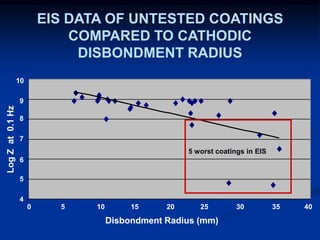
5 worst coatings in EIS
EIS DATA OF UNTESTED COATINGS
COMPARED TO CATHODIC
DISBONDMENT RADIUS
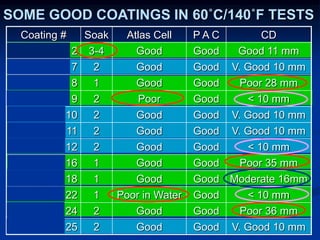
Coating # Soak Atlas Cell P A C CD
Phenolic 2 3-4 Good Good Good 11 mm
Novolac 7 2 Good Good V. Good 10 mm
Epoxy 8 1 Good Good Poor 28 mm
Novolac 9 2 Poor Good < 10 mm
Vinyl Ester 10 2 Good Good V. Good 10 mm
Vinyl Ester 11 2 Good Good V. Good 10 mm
Novolac 12 2 Good Good < 10 mm
Novolac 16 1 Good Good Poor 35 mm
Epoxy 18 1 Good Good Moderate 16mm
Novolac 22 1 Poor in Water Good < 10 mm
Phenolic 24 2 Good Good Poor 36 mm
Vinyl Ester 25 2 Good Good V. Good 10 mm
SOME GOOD COATINGS IN 60˚C/140˚F TESTS
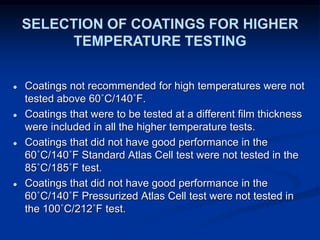
● Coatings not recommended for high temperatures were not
tested above 60˚C/140˚F.
● Coatings that were to be tested at a different film thickness
were included in all the higher temperature tests.
● Coatings that did not have good performance in the
60˚C/140˚F Standard Atlas Cell test were not tested in the
85˚C/185˚F test.
● Coatings that did not have good performance in the
60˚C/140˚F Pressurized Atlas Cell test were not tested in
the 100˚C/212˚F test.
SELECTION OF COATINGS FOR HIGHER
TEMPERATURE TESTING
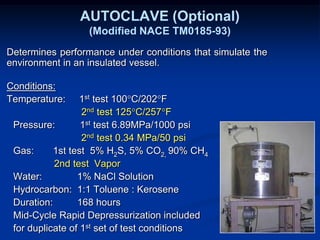
Determines performance under conditions that simulate the
environment in an insulated vessel.
Conditions:
Temperature: 1st test 100°C/202°F
2nd test 125°C/257°F
Pressure: 1st test 6.89MPa/1000 psi
2nd test 0.34 MPa/50 psi
Gas: 1st test 5% H2S, 5% CO2, 90% CH4
2nd test Vapor
Water: 1% NaCl Solution
Hydrocarbon: 1:1 Toluene : Kerosene
Duration: 168 hours
Mid-Cycle Rapid Depressurization included
for duplicate of 1st set of test conditions
AUTOCLAVE (Optional)
(Modified NACE TM0185-93)
0%
10%
20%
30%
40%
50%
60%
70%
80%
90%
100%
Epoxy (8) Novolac (14) Phenolic (6) Vinyl Ester (3)
Coating Type (Number of Coatings)
Percentagewith"GoodPerformance"
Epoxy (8) Novolac (14) Phenolic (6) Vinyl Ester (3)
Coating Type (Number of Coatings)
Percentagewith“GoodPerformance”
0%
10%
20%
30%
40%
50%
60%
70%
80%
90%
100%
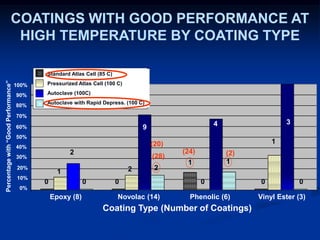
Standard Atlas Cell (85 C)
Pressurized Atlas Cell (100 C)
Autoclave (100C)
Autoclave with Rapid Depress. (100 C)
Autoclave with Mid-Cycle Rapid Depressurization
COATINGS WITH GOOD PERFORMANCE AT
HIGH TEMPERATURE BY COATING TYPE
0
1
2
0 0 0 0 0
9
2 2
1
4 3
(24)
(28)
1
(2)
1
(20)
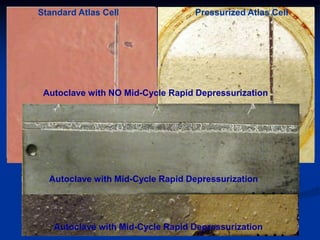
Autoclave with Mid-Cycle Rapid Depressurization
Autoclave with NO Mid-Cycle Rapid Depressurization
Pressurized Atlas Cell
Autoclave with Mid-Cycle Rapid Depressurization
Standard Atlas Cell
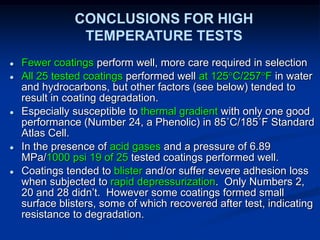
● Fewer coatings perform well, more care required in selection
● All 25 tested coatings performed well at 125C/257F in water
and hydrocarbons, but other factors (see below) tended to
result in coating degradation.
● Especially susceptible to thermal gradient with only one good
performance (Number 24, a Phenolic) in 85˚C/185˚F Standard
Atlas Cell.
● In the presence of acid gases and a pressure of 6.89
MPa/1000 psi 19 of 25 tested coatings performed well.
● Coatings tended to blister and/or suffer severe adhesion loss
when subjected to rapid depressurization. Only Numbers 2,
20 and 28 didn’t. However some coatings formed small
surface blisters, some of which recovered after test, indicating
resistance to degradation.
CONCLUSIONS FOR HIGH
TEMPERATURE TESTS
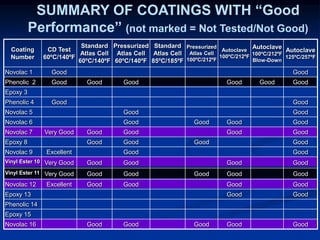
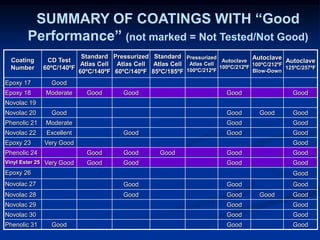
SUMMARY OF COATINGS WITH “Good
Performance” (not marked = Not Tested/Not Good)
Coating
Number
CD Test
60ºC/140ºF
Standard
Atlas Cell
60ºC/140ºF
Pressurized
Atlas Cell
60ºC/140ºF
Standard
Atlas Cell
85ºC/185ºF
Pressurized
Atlas Cell
100ºC/212ºF
Autoclave
100ºC/212ºF
Autoclave
100ºC/212ºF
Blow-Down
Autoclave
125ºC/257ºF
Novolac 1 Good Good
Phenolic 2 Good Good Good Good Good Good
Epoxy 3
Phenolic 4 Good Good
Novolac 5 Good Good
Novolac 6 Good Good Good Good
Novolac 7 Very Good Good Good Good Good
Epoxy 8 Good Good Good Good
Novolac 9 Excellent Good Good
Vinyl Ester 10 Very Good Good Good Good Good
Vinyl Ester 11 Very Good Good Good Good Good Good
Novolac 12 Excellent Good Good Good Good
Epoxy 13 Good Good
Phenolic 14
Epoxy 15
Novolac 16 Good Good Good Good Good
SUMMARY OF COATINGS WITH “Good
Performance” (not marked = Not Tested/Not Good)
Coating
Number
CD Test
60ºC/140ºF
Standard
Atlas Cell
60ºC/140ºF
Pressurized
Atlas Cell
60ºC/140ºF
Standard
Atlas Cell
85ºC/185ºF
Pressurized
Atlas Cell
100ºC/212ºF
Autoclave
100ºC/212ºF
Autoclave
100ºC/212ºF
Blow-Down
Autoclave
125ºC/257ºF
Epoxy 17 Good
Epoxy 18 Moderate Good Good Good Good
Novolac 19
Novolac 20 Good Good Good Good
Phenolic 21 Moderate Good Good
Novolac 22 Excellent Good Good Good
Epoxy 23 Very Good Good
Phenolic 24 Good Good Good Good Good
Vinyl Ester 25 Very Good Good Good Good Good
Epoxy 26 Good
Novolac 27 Good Good Good
Novolac 28 Good Good Good Good
Novolac 29 Good Good
Novolac 30 Good Good
Phenolic 31 Good Good Good
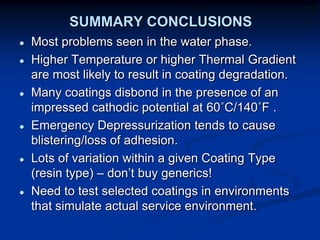
SUMMARY CONCLUSIONS
● Most problems seen in the water phase.
● Higher Temperature or higher Thermal Gradient
are most likely to result in coating degradation.
● Many coatings disbond in the presence of an
impressed cathodic potential at 60˚C/140˚F .
● Emergency Depressurization tends to cause
blistering/loss of adhesion.
● Lots of variation within a given Coating Type
(resin type) – don’t buy generics!
● Need to test selected coatings in environments
that simulate actual service environment.
COMPARATIVE TESTING OF 31
TANK LINING SYSTEMS
Amal Al-Borno
Charter Coating Service (2000) Ltd.
#6, 4604 – 13th Street N.E.
Calgary, AB, Canada T2E 6P1
aalborno@chartercoating.com

Comparative Testing of 31 Tank Lining Systems

  • 1.
    COMPARATIVE TESTING OF31 TANK LINING SYSTEMS Amal Al-Borno Charter Coating Service (2000) Ltd. #6, 4604 – 13th Street N.E. Calgary, AB, Canada T2E 6P1 aalborno@chartercoating.com
  • 2.
    Amercoat Canada Cloverdale Paint CNRL CorrocoatLtd. Dalco Services Inc. Denso North America Inc. Enbridge Pipelines, Inc. Hempel (Canada) Inc. Imperial Oil Resources Limited International Paint, Inc. PPG Canada Petro-Canada RS Technologies Sherwin-Williams Sigma Coatings Canada SPC Talisman Tyco Adhesives PROJECT PARTICIPANTS
  • 3.
    PROJECT OBJECTIVES ● Toexamine and compare the performance characteristics of tank lining systems as selected by the study participants. ● To communicate performance data so as to assist in the selection of appropriate coatings for any given oil field environment. ● To encourage more interaction between suppliers and end-users.
  • 4.
    Coating Number Coating Descriptor asUsed on Data Sheet Coating Type % Solids 1 Epoxy Novolac Novolac 72 2 Phenolic Epoxy / Polyamino-Amide Phenolic 100 3 Epoxy /Amine and Polyamino Epoxy 100 4 Epoxy Phenolic Phenolic 64 5 Epoxy Novolac Novolac 54 6 Epoxy Novolac Novolac 72 7 Epoxy Novolac / Amine Novolac 100 8 Epoxy Epoxy 72 9 Epoxy Novolac Novolac 100 10 Vinyl Ester / Acrylic Vinyl Ester 99 11 Vinyl Ester / Urethane Vinyl Ester 99 12 Epoxy Novolac Novolac 94 13 Epoxy Epoxy 76 14 Epoxy Phenolic Phenolic 100 15 Epoxy Epoxy 95 16 Epoxy Novolac Novolac 67 17 Epoxy (Aluminum) Epoxy 60 18 Epoxy / Amine Epoxy 100
  • 5.
    Coating Number Coating Descriptor asUsed on Data Sheet Coating Type % Solids 19 Epoxy Phenolic Novolac Novolac 73 20 Epoxy Phenolic Novolac / Amine Novolac 68 21 Phenolic Epoxy / Amine Phenolic 100 22 Novolac Novolac 100 23 Epoxy Epoxy 100 24 Phenolic Epoxy / Amine Phenolic 66 25 Vinyl Ester Vinyl Ester 98 26 Epoxy / Amine Epoxy 98 27 Epoxy Phenolic Novolac Novolac 70 28 Epoxy Phenolic Novolac / Amine Novolac 80 29 Epoxy Novolac Novolac 90 30 Epoxy Novolac (Siliconized) Novolac 97 31 Phenolic Epoxy / Amine Phenolic 100
  • 6.
    COATING TYPES Vinyl Ester (3coatings) 10% Epoxy (8 coatings) 26% Novolac (14 coatings) 45% Phenolic (6 coatings) 19%
  • 7.
    APPLICATION AND SAMPLECUTTING ● All coatings were applied by the same applicator according to suppliers’ recommended procedures and under suppliers’ direction. ● Cured samples were cut using a water-jet cutting system.
  • 8.
    TESTS at 60˚C/140˚F TestConditions (ALL 28 Day Tests) Soak Adhesion CSA Z245.20 Water: 1% NaCl in distilled water Cathodic Disbondment CSA Z245.20 Solution: 3% NaCl in distilled water Voltage: -1.5V Atlas Cell Test NACE TM 0174 Thermal Gradient: 25˚C Air; 1% NaCl aq.; 1:1 toluene: kerosene Pressurized Atlas Cell (PAC) NACE TM 0174 Pressure: 1.4MPa/200 psi Gas: 5% H2S, 5% CO2, 90% CH4 1% NaCl aq.; 1:1 toluene: kerosene Electrochemical Impedance Spectroscopy (EIS) 1) Untested samples 2) Water phase of PAC samples after 28 Days
  • 9.
    HIGHER TEMPERATURE TESTS TestConditions Atlas Cell Test NACE TM 0174 Temp.: 85˚C/185˚F, Thermal Gradient: 25˚C Air; 1% NaCl aq.; 1:1 toluene:kerosene; 28 days Pressurized Atlas Cell NACE TM 0174 Temp.: 100˚C/212˚F, Pres.: 1.4MPa/200 psi Gas: 5% H2S, 5% CO2, 90% CH4 1% NaCl aq.; 1:1 toluene: kerosene; 28 days Autoclave Tests NACE TM 0185 Temp.: 100˚C/212˚F, Pres.: 6.89MPa/1000 psi Gas: 5% H2S, 5% CO2, 90% CH4 1% NaCl aq.; 1:1 toluene: kerosene; 168 hours Test conditions as above but including mid-cycle rapid depressurization Temp.: 125˚C/257˚F; Pres.: 0.34 MPa/50 psi Vapor; 1% NaCl aq.; 1:1 toluene: kerosene; 168 hours
  • 10.
    ACCELERATING COMPONENTS INTEST CONDITIONS ● Low 1 % NaCl concentration in most tests (more aggressive than 3% solutions). ● High thermal gradient (25ºC) for standard atlas cell test. ● H2S and CO2 used in pressurized atlas cell and 100 ºC autoclave test. ● Rapid depressurization used for one of the autoclave tests. ● High temperatures.
  • 11.
    “GOOD PERFORMANCE” CRITERIA ●Soak Adhesion Test: CSA FBE coatings’ test modified. Pass/fail 1-3 (pass = “good”). ● Cathodic Disbondment Test: CSA FBE coatings’ test modified. One variable, the disbondment radius. Performance based on comparison with similar coatings and other coatings in this study. “Good” = less than 15 mm. ● Atlas Cell and Autoclave Tests: No single characteristic that can be analyzed. In this study “good performance” is defined as being: ● does not blister or crack in any phase ● maintains an adhesion of ‘C-’ or better
  • 12.
    SOAK ADHESION (CSA Z245.20-02) ●Water can be an aggressive environment to a coating system, especially at elevated temperatures. ● The hot water soak test examines a coating’s ability to remain well adhered to the steel in immersion conditions. Conditions: Temperature: 60°C/140°F Water: 1% NaCl Solution Duration: 28 days
  • 13.
    SOAK ADHESION TEST 0 1 2 3 12 3 4 5 6 7 8 9 10 11 12 13 14 15 16 17 18 19 20 21 22 23 24 25 26 27 28 29 30 31 Coating Number AdhesionRating Pre-Test Data Post-Test Data *Decimal value denot est he average of t wo disparat e pre-t est scores. AdhesionRating Coating Number 1 2 3 4 5 6 7 8 9 10 11 12 13 14 15 16 17 18 19 20 21 22 23 24 25 26 27 28 29 30 31 0 1 2 3
  • 14.
    Rating 4 Rating2 Rating 1
  • 15.
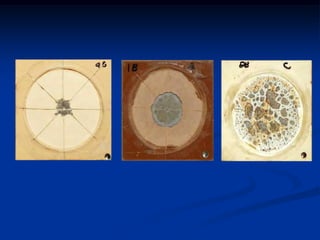
    CATHODIC DISBONDMENT (CSA Z245.20-M92) This test measures the resistance of a coating to disbondment under conditions that simulate cathodic protection.  Typically the bottom of the tank is the area most prone to effect from cathodic protection owing to the placement of anodes in the tank. Conditions: Temperature: 60˚C/140˚F Solution: 3% NaCl Solution Voltage: -1.5V Duration: 28 days
  • 16.
    CATHODIC DISBONDMENT BYCOATING DisbondmentRadius(mm) 9 12 22 7 23 10 11 25 17 2 1 4 20 31 18 21 19 30 13 29 3 6 14 15 26 8 5 27 16 28 24 Coating Number 0 5 10 15 20 25 30 35 40 Excellent Very Good Good Moderate Poor
  • 18.
    CATHODIC DISBONDMENT AT60˚C BY COATING TYPE 0% 10% 20% 30% 40% 50% 60% 70% 80% 90% 100% Epoxy (8) Novolac (14) Phenolic (6) Vinyl Ester (3) Coating Type (Number of Coatings) PercentageofCoatings < 15 mm 15 - 20 mm > 20 mm Epoxy (8) Novolac (14) Phenolic (6) Vinyl Ester (3) Coating Type (Number of Coatings) PercentageofCoatings 0% 10% 20% 30% 40% 50% 60% 70% 80% 90% 100% 2 1 5 6 8 3 1 2 3
  • 19.
    STANDARD ATLAS CELL (ModifiedNACE TM0174-91) ● The ability of the coating to withstand immersion conditions under the stress of a thermal gradient. ● This test simulates the cold wall affects in non-insulated tanks and vessels. Conditions: Internal Temperature: 1st test 60°C/140°F 2nd test 85°C/185°F Thermal Gradient: 25˚C/70˚F Gas: Air Water: 1% NaCl Solution Hydrocarbon: 1:1 Toluene: Kerosene Duration: 28 Days
  • 20.
    controller sample panels heatingjacket cooling jacket thermocouples
  • 21.
    PRESSURIZED ATLAS CELL (ModifiedNACE TM0174-91) ● This test examines the resistance of coatings to the combined affects of temperature, pressure, cold wall, and chemical environment. ● Determines performance in conditions that simulate pressurized vessels in sour service. Conditions: Internal Temperature: 1st test 60°C/140°F 2nd test 100°C/202°F Pressure: 1.4MPa/200 psi Gas: 5% H2S, 5% CO2, 90% CH4 Water: 1% NaCl Solution Hydrocarbon: 1:1 Toluene : Kerosene Duration: 28 Days
  • 22.
    controllersheating jackets pressuregauges samples (hidden)
  • 23.
    ATLAS CELLS ANDCATHODIC DISBONDMENT DATA Coating Number Standard Atlas Cell 10/31 Pressurized Atlas Cell 16/31 Cathodic Disbondment Performance Gas Phase Hydrocarbon Phase Water Phase Gas Phase Hydrocarbon Phase Water Phase Phenolic 2 C_ C_ C_ C_ C_ C_ good Novolac 5 -- -- -- B A B- poor Novolac 6 -- -- -- C B C poor Novolac 7 C_ C_ C_ C C C very good Epoxy 8 B A C B A C poor Novolac 9 -- -- -- C C C excellent Vinyl Ester 10 C C C B B B_ very good Vinyl Ester 11 C C C C C C very good Novolac 12 C C C_ C C C excellent Novolac 16 A A B A A A poor Epoxy 18 A A C A A B+ moderate Novolac 22 -- -- -- A A A excellent Phenolic 24 A A A A A A poor Vinyl Ester 25 B B C B B B very good Novolac 27 -- -- -- A A A poor Novolac 28 -- -- -- A A A poor Pressurized Atlas CellStandard Atlas Cell Water Phase Hydrocarbon Phase Gas Phase Water Phase Hydrocarbon Phase Gas Phase
  • 25.
    STANDARD AND PRESSURIZEDATLAS CELL AT 60˚C BY COATING TYPE Standard Atlas Cell 10 / 31 Good Pressurized Atlas Cell 16 / 31 Good Coating Type (Number of Coatings) 0% 10% 20% 30% 40% 50% 60% 70% 80% 90% 100% PercentageofCoatingswith “GoodPerformance” 2 2 3 9 2 2 3 3 Epoxy (8) Novolac (14) Phenolic (6) Vinyl Ester (3)
  • 26.
    ELECTROCHEMICAL IMPEDANCE SPECTOSCOPY (EIS) ●Used to evaluate the integrity of coatings, their barrier properties, and predict their corrosion protection characteristics. ● Conducted using conditions as in other immersion tests (1% NaCl aq., 60˚C/140˚F, 28 days) ● untested coatings ● PAC (water phase)
  • 27.
    EIS DATA EIS Data@ 60ºC/140ºF 0 1 2 3 4 5 6 7 8 9 10 1 2 3 4 5 6 7 8 9 10 11 12 13 14 15 16 17 18 19 20 21 22 23 24 25 26 27 28 29 30 31 Coating Number LogZat0.1Hz Untested Coating After 28 Days at 60ºC in Pressurized Atlas Cell B B B - Bisters after PAC Testing B - Bisters after EIS Testing B B B B B B B B B B BB B B
  • 28.
    Epoxy Novolac PhenolicVinyl Ester LogZat0.1Hz Coating Type 2 3 4 5 6 7 8 9 0 1 10 ? ? ? ? ? ? EIS DATA AFTER PRESSURIZED ATLAS CELL TEST BY COATING TYPE Some coatings that were failing looked good on EIS and some coatings that looked poor in EIS performed well as corrosion barriers. Shows limitations of EIS as an indicator of coating performance/degradation.
  • 29.
    4.0 5.0 6.0 7.0 8.0 9.0 10.0 0 5 1015 20 25 30 35 40 Disbondment Radius (mm) LogZat0.1Hz Disbondment Radius (mm) LogZat0.1Hz 4 5 6 7 8 9 10 0 5 10 15 20 25 30 35 40 5 worst coatings in EIS EIS DATA OF UNTESTED COATINGS COMPARED TO CATHODIC DISBONDMENT RADIUS
  • 30.
    Coating # SoakAtlas Cell P A C CD Phenolic 2 3-4 Good Good Good 11 mm Novolac 7 2 Good Good V. Good 10 mm Epoxy 8 1 Good Good Poor 28 mm Novolac 9 2 Poor Good < 10 mm Vinyl Ester 10 2 Good Good V. Good 10 mm Vinyl Ester 11 2 Good Good V. Good 10 mm Novolac 12 2 Good Good < 10 mm Novolac 16 1 Good Good Poor 35 mm Epoxy 18 1 Good Good Moderate 16mm Novolac 22 1 Poor in Water Good < 10 mm Phenolic 24 2 Good Good Poor 36 mm Vinyl Ester 25 2 Good Good V. Good 10 mm SOME GOOD COATINGS IN 60˚C/140˚F TESTS
  • 31.
    ● Coatings notrecommended for high temperatures were not tested above 60˚C/140˚F. ● Coatings that were to be tested at a different film thickness were included in all the higher temperature tests. ● Coatings that did not have good performance in the 60˚C/140˚F Standard Atlas Cell test were not tested in the 85˚C/185˚F test. ● Coatings that did not have good performance in the 60˚C/140˚F Pressurized Atlas Cell test were not tested in the 100˚C/212˚F test. SELECTION OF COATINGS FOR HIGHER TEMPERATURE TESTING
  • 32.
    Determines performance underconditions that simulate the environment in an insulated vessel. Conditions: Temperature: 1st test 100°C/202°F 2nd test 125°C/257°F Pressure: 1st test 6.89MPa/1000 psi 2nd test 0.34 MPa/50 psi Gas: 1st test 5% H2S, 5% CO2, 90% CH4 2nd test Vapor Water: 1% NaCl Solution Hydrocarbon: 1:1 Toluene : Kerosene Duration: 168 hours Mid-Cycle Rapid Depressurization included for duplicate of 1st set of test conditions AUTOCLAVE (Optional) (Modified NACE TM0185-93)
  • 33.
    0% 10% 20% 30% 40% 50% 60% 70% 80% 90% 100% Epoxy (8) Novolac(14) Phenolic (6) Vinyl Ester (3) Coating Type (Number of Coatings) Percentagewith"GoodPerformance" Epoxy (8) Novolac (14) Phenolic (6) Vinyl Ester (3) Coating Type (Number of Coatings) Percentagewith“GoodPerformance” 0% 10% 20% 30% 40% 50% 60% 70% 80% 90% 100% Standard Atlas Cell (85 C) Pressurized Atlas Cell (100 C) Autoclave (100C) Autoclave with Rapid Depress. (100 C) Autoclave with Mid-Cycle Rapid Depressurization COATINGS WITH GOOD PERFORMANCE AT HIGH TEMPERATURE BY COATING TYPE 0 1 2 0 0 0 0 0 9 2 2 1 4 3 (24) (28) 1 (2) 1 (20)
  • 34.
    Autoclave with Mid-CycleRapid Depressurization Autoclave with NO Mid-Cycle Rapid Depressurization Pressurized Atlas Cell Autoclave with Mid-Cycle Rapid Depressurization Autoclave with Mid-Cycle Rapid Depressurization Standard Atlas Cell
  • 35.
    ● Fewer coatingsperform well, more care required in selection ● All 25 tested coatings performed well at 125C/257F in water and hydrocarbons, but other factors (see below) tended to result in coating degradation. ● Especially susceptible to thermal gradient with only one good performance (Number 24, a Phenolic) in 85˚C/185˚F Standard Atlas Cell. ● In the presence of acid gases and a pressure of 6.89 MPa/1000 psi 19 of 25 tested coatings performed well. ● Coatings tended to blister and/or suffer severe adhesion loss when subjected to rapid depressurization. Only Numbers 2, 20 and 28 didn’t. However some coatings formed small surface blisters, some of which recovered after test, indicating resistance to degradation. CONCLUSIONS FOR HIGH TEMPERATURE TESTS
  • 36.
    SUMMARY OF COATINGSWITH “Good Performance” (not marked = Not Tested/Not Good) Coating Number CD Test 60ºC/140ºF Standard Atlas Cell 60ºC/140ºF Pressurized Atlas Cell 60ºC/140ºF Standard Atlas Cell 85ºC/185ºF Pressurized Atlas Cell 100ºC/212ºF Autoclave 100ºC/212ºF Autoclave 100ºC/212ºF Blow-Down Autoclave 125ºC/257ºF Novolac 1 Good Good Phenolic 2 Good Good Good Good Good Good Epoxy 3 Phenolic 4 Good Good Novolac 5 Good Good Novolac 6 Good Good Good Good Novolac 7 Very Good Good Good Good Good Epoxy 8 Good Good Good Good Novolac 9 Excellent Good Good Vinyl Ester 10 Very Good Good Good Good Good Vinyl Ester 11 Very Good Good Good Good Good Good Novolac 12 Excellent Good Good Good Good Epoxy 13 Good Good Phenolic 14 Epoxy 15 Novolac 16 Good Good Good Good Good
  • 37.
    SUMMARY OF COATINGSWITH “Good Performance” (not marked = Not Tested/Not Good) Coating Number CD Test 60ºC/140ºF Standard Atlas Cell 60ºC/140ºF Pressurized Atlas Cell 60ºC/140ºF Standard Atlas Cell 85ºC/185ºF Pressurized Atlas Cell 100ºC/212ºF Autoclave 100ºC/212ºF Autoclave 100ºC/212ºF Blow-Down Autoclave 125ºC/257ºF Epoxy 17 Good Epoxy 18 Moderate Good Good Good Good Novolac 19 Novolac 20 Good Good Good Good Phenolic 21 Moderate Good Good Novolac 22 Excellent Good Good Good Epoxy 23 Very Good Good Phenolic 24 Good Good Good Good Good Vinyl Ester 25 Very Good Good Good Good Good Epoxy 26 Good Novolac 27 Good Good Good Novolac 28 Good Good Good Good Novolac 29 Good Good Novolac 30 Good Good Phenolic 31 Good Good Good
  • 38.
    SUMMARY CONCLUSIONS ● Mostproblems seen in the water phase. ● Higher Temperature or higher Thermal Gradient are most likely to result in coating degradation. ● Many coatings disbond in the presence of an impressed cathodic potential at 60˚C/140˚F . ● Emergency Depressurization tends to cause blistering/loss of adhesion. ● Lots of variation within a given Coating Type (resin type) – don’t buy generics! ● Need to test selected coatings in environments that simulate actual service environment.
  • 39.
    COMPARATIVE TESTING OF31 TANK LINING SYSTEMS Amal Al-Borno Charter Coating Service (2000) Ltd. #6, 4604 – 13th Street N.E. Calgary, AB, Canada T2E 6P1 aalborno@chartercoating.com