Phosphating on Ferrous and
Aluminium Alloys
Reference : D. B. Freeman, Phosphating
and Metal Pre-treatment, Industrial
Press Inc, New York, 1986.
Zinc Phosphate Processes
for Paint Bonding :
An Example of Applications
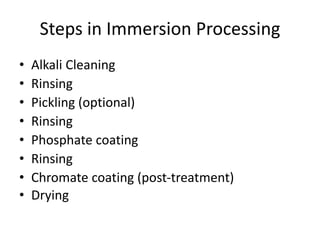
Steps in Immersion Processing
• Alkali Cleaning
• Rinsing
• Pickling (optional)
• Rinsing
• Phosphate coating
• Rinsing
• Chromate coating (post-treatment)
• Drying
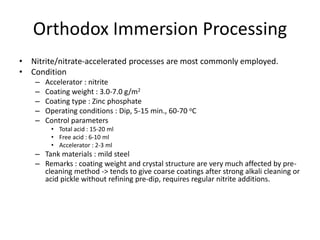
Orthodox Immersion Processing
• Nitrite/nitrate-accelerated processes are most commonly employed.
• Condition
– Accelerator : nitrite
– Coating weight : 3.0-7.0 g/m2
– Coating type : Zinc phosphate
– Operating conditions : Dip, 5-15 min., 60-70 oC
– Control parameters
• Total acid : 15-20 ml
• Free acid : 6-10 ml
• Accelerator : 2-3 ml
– Tank materials : mild steel
– Remarks : coating weight and crystal structure are very much affected by pre-
cleaning method -> tends to give coarse coatings after strong alkali cleaning or
acid pickle without refining pre-dip, requires regular nitrite additions.
Calcium-modified Immersion
Processing
• Coat-refining agents
– Organic refining agents : limited effect
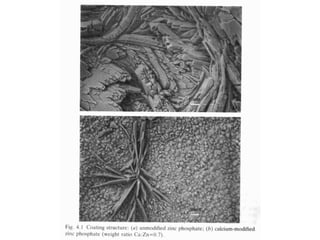
– Calcium -> mixed zinc calcium phosphate (Scholzite, Zn2Ca(PO4)2.2H2O
• Smoother than normal zinc phosphate coating
• Unaffected by pre-cleaning
• Condition
– Accelerator : nitrite
– Coating weight : 2.0-4.5 g/m2
– Coating type : Calcium modified zinc phosphate
– Operating conditions : Dip, 2-5 min., 60-70 oC
– Control parameters
• Total acid : 18-22 ml
• Accelerator : 1.0-2.5 ml
– Tank materials : mild steel
– Remarks : refined coatings after alkali or acid cleaning without refining pre-
rinse. Particulary suitable for one-coat finishes. Requires regular nitrite
additions.
Spray Processing
• Typical Spray Zinc Phosphate for Paint Bonding
• Conditions
– Accelerator : nitrite
– Coating weight : 1.6-2.4 g/m2
– Coating type : Zinc phosphate
– Operating conditions : Spray, 1-2 min., 45-60 oC
– Control parameters
• Total acid : 15-20 ml
• Free acid : 0.4-0.6 ml
• Accelerator : (no information)
– Tank materials : mild steel
– Remarks : (no information)
Spray Processing
• Multimetal Spray Zinc Phosphate for Paint Bonding
• Nickel and simple and/or complex fluorides are added.
• used in automotive industry, where significant amounts of galvanized steel
are employed.
• widespread in USA
• Conditions
– Accelerator : nitrite
– Coating weight : 2.0-3.5 g/m2
– Coating type : Zinc phosphate
– Operating conditions : Spray, 1-3 min., 55-70 oC
– Control parameters
• Total acid : 15-20 ml
• Free acid : (no information)
• Accelerator : 0.5-2.5 ml
– Tank materials : mild steel, stainless steel for longer life
– Remarks : -
Spray Processing
• Low-temperature Spray Zinc Phosphate for Paint Bonding
• Manganese is added.
• used in UK and Italy
• Conditions
– Accelerator : nitrite
– Coating weight : 1.8-2.4 g/m2
– Coating type : Zinc manganese phosphate
– Operating conditions : Spray, 1-2 min., 25-35 oC
– Control parameters
• Total acid : 15-25 ml
• Free acid : 0.2-1.0 ml
• Accelerator : 3-4 ml
– Tank materials : mild steel
– Remarks : low temperature, low stain
Spray Processing
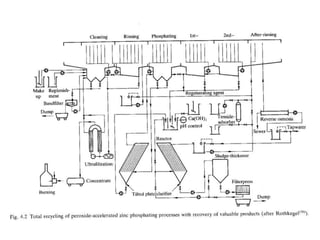
• Spray Zinc Phosphate for Paint Bonding for Closed-loop Operation
• NaOH used as neutralising agent for hydrogen peroxide system leads to
accumulation of Na ions in the bath. Zinc carbonate is used instead.
• Conditions
– Accelerator : hydrogen peroxide
– Coating weight : 1.4-2.0 g/m2
– Coating type : Zinc phosphate
– Operating conditions : Spray, 1-2 min., 55-60 oC
– Control parameters
• Total acid : 14-16 ml
• Free acid : 0.7-1.2 ml
• Accelerator : 3-4 ml
– Tank materials : mild steel, stainless steel for longer life
– Remarks : can be incorperated in closed-loop ststem to give total recycling of
rinse water and no liquid effluent
Spray Processing
• Spray Zinc Phosphate for Paint Bonding
• Low stability of nitrite -> Chlorate + Sodium metanitrobenzene
sulphonate
• Conditions
– Accelerator : Chlorate/metanitro-benzene sulphonate
– Coating weight : 1.4-2.0 g/m2
– Coating type : Zinc phosphate
– Operating conditions : Spray, 40-120 s, 45-50 oC
– Control parameters
• Total acid : 10-12 ml
• Free acid : 0.8-1.0 ml
• Accelerator : (no information)
– Tank materials : mild steel, stainless steel for longer life
– Remarks : (no information)
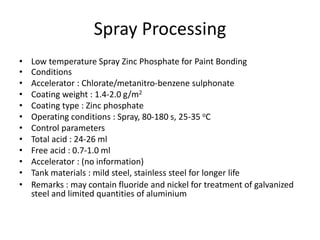
Spray Processing
• Low temperature Spray Zinc Phosphate for Paint Bonding
• Conditions
• Accelerator : Chlorate/metanitro-benzene sulphonate
• Coating weight : 1.4-2.0 g/m2
• Coating type : Zinc phosphate
• Operating conditions : Spray, 80-180 s, 25-35 oC
• Control parameters
• Total acid : 24-26 ml
• Free acid : 0.7-1.0 ml
• Accelerator : (no information)
• Tank materials : mild steel, stainless steel for longer life
• Remarks : may contain fluoride and nickel for treatment of galvanized
steel and limited quantities of aluminium
Electropaint
• Anodic systems
• Cathodic systems
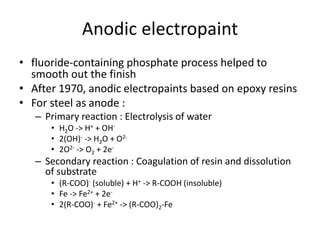
Anodic electropaint
• fluoride-containing phosphate process helped to
smooth out the finish
• After 1970, anodic electropaints based on epoxy resins
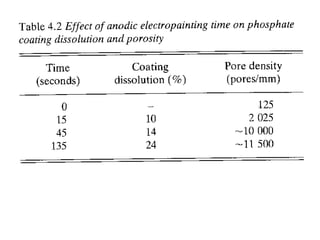
• For steel as anode :
– Primary reaction : Electrolysis of water
• H2O -> H+ + OH-
• 2(OH)- -> H2O + O2-
• 2O2- -> O2 + 2e-
– Secondary reaction : Coagulation of resin and dissolution
of substrate
• (R-COO)- (soluble) + H+ -> R-COOH (insoluble)
• Fe -> Fe2+ + 2e-
• 2(R-COO)- + Fe2+ -> (R-COO)2-Fe
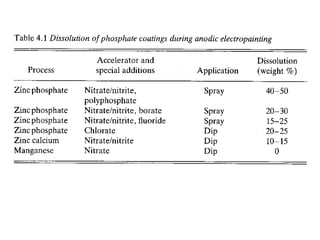
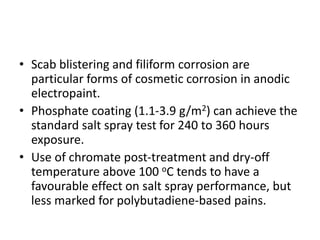
• Scab blistering and filiform corrosion are
particular forms of cosmetic corrosion in anodic
electropaint.
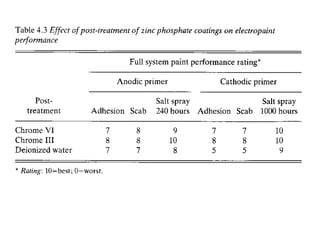
• Phosphate coating (1.1-3.9 g/m2) can achieve the
standard salt spray test for 240 to 360 hours
exposure.
• Use of chromate post-treatment and dry-off
temperature above 100 oC tends to have a
favourable effect on salt spray performance, but
less marked for polybutadiene-based pains.
Cathodic electropaint
• Japan and Europe led the change to cathodic
primers for higher standards of corrosion
protection.
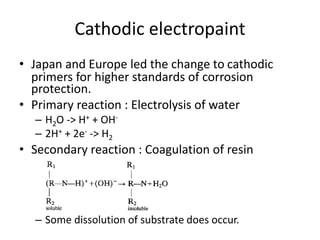
• Primary reaction : Electrolysis of water
– H2O -> H+ + OH-
– 2H+ + 2e- -> H2
• Secondary reaction : Coagulation of resin
– Some dissolution of substrate does occur.
Advantages of cathodic over anodic
deposition
• Better throwing power
• Better salt spray performance (up-graded
from 250-400 hours with anodic systems to
500-1000 hours)
• Reduced susceptibility to cosmetic corrosion
• Better performance on steel that has not been
pre-treated.
Disadvantages of cathodic over anodic
deposition
• Higher stoving temperatures
• Increased need for corrosion-resistant plant as
a result of lower operating pH
• Problems with low rupture voltage on certain
zinc-coated steels
• More stringent pre-treatment requirement
Phosphate coating as pre-treatment
for electropaint
• Trend to full dip
• Zinc phosphate coatings formed by immersion are superior
that those obtained by spray methods.
• Immersion leads to higher content of phosphophyllite than
hopeite.
• Amorphous iron compounds may also present leading to
favourable characteristics, not only the presence of
phosphophyllite.
• Ideal coating weight for cathodic paint lies between 1.4-2.4
g/m2.
• Nickel and zinc phosphating with a high ratio Ni:Zn results
in a mixed nickel zinc phosphate, Zn2Ni(PO4)2.4H2O was also
developed.
phosphate coating on alloys

phosphate coating on alloys

  • 1.
    Phosphating on Ferrousand Aluminium Alloys Reference : D. B. Freeman, Phosphating and Metal Pre-treatment, Industrial Press Inc, New York, 1986.
  • 2.
    Zinc Phosphate Processes forPaint Bonding : An Example of Applications
  • 3.
    Steps in ImmersionProcessing • Alkali Cleaning • Rinsing • Pickling (optional) • Rinsing • Phosphate coating • Rinsing • Chromate coating (post-treatment) • Drying
  • 4.
    Orthodox Immersion Processing •Nitrite/nitrate-accelerated processes are most commonly employed. • Condition – Accelerator : nitrite – Coating weight : 3.0-7.0 g/m2 – Coating type : Zinc phosphate – Operating conditions : Dip, 5-15 min., 60-70 oC – Control parameters • Total acid : 15-20 ml • Free acid : 6-10 ml • Accelerator : 2-3 ml – Tank materials : mild steel – Remarks : coating weight and crystal structure are very much affected by pre- cleaning method -> tends to give coarse coatings after strong alkali cleaning or acid pickle without refining pre-dip, requires regular nitrite additions.
  • 5.
    Calcium-modified Immersion Processing • Coat-refiningagents – Organic refining agents : limited effect – Calcium -> mixed zinc calcium phosphate (Scholzite, Zn2Ca(PO4)2.2H2O • Smoother than normal zinc phosphate coating • Unaffected by pre-cleaning • Condition – Accelerator : nitrite – Coating weight : 2.0-4.5 g/m2 – Coating type : Calcium modified zinc phosphate – Operating conditions : Dip, 2-5 min., 60-70 oC – Control parameters • Total acid : 18-22 ml • Accelerator : 1.0-2.5 ml – Tank materials : mild steel – Remarks : refined coatings after alkali or acid cleaning without refining pre- rinse. Particulary suitable for one-coat finishes. Requires regular nitrite additions.
  • 7.
    Spray Processing • TypicalSpray Zinc Phosphate for Paint Bonding • Conditions – Accelerator : nitrite – Coating weight : 1.6-2.4 g/m2 – Coating type : Zinc phosphate – Operating conditions : Spray, 1-2 min., 45-60 oC – Control parameters • Total acid : 15-20 ml • Free acid : 0.4-0.6 ml • Accelerator : (no information) – Tank materials : mild steel – Remarks : (no information)
  • 8.
    Spray Processing • MultimetalSpray Zinc Phosphate for Paint Bonding • Nickel and simple and/or complex fluorides are added. • used in automotive industry, where significant amounts of galvanized steel are employed. • widespread in USA • Conditions – Accelerator : nitrite – Coating weight : 2.0-3.5 g/m2 – Coating type : Zinc phosphate – Operating conditions : Spray, 1-3 min., 55-70 oC – Control parameters • Total acid : 15-20 ml • Free acid : (no information) • Accelerator : 0.5-2.5 ml – Tank materials : mild steel, stainless steel for longer life – Remarks : -
  • 9.
    Spray Processing • Low-temperatureSpray Zinc Phosphate for Paint Bonding • Manganese is added. • used in UK and Italy • Conditions – Accelerator : nitrite – Coating weight : 1.8-2.4 g/m2 – Coating type : Zinc manganese phosphate – Operating conditions : Spray, 1-2 min., 25-35 oC – Control parameters • Total acid : 15-25 ml • Free acid : 0.2-1.0 ml • Accelerator : 3-4 ml – Tank materials : mild steel – Remarks : low temperature, low stain
  • 10.
    Spray Processing • SprayZinc Phosphate for Paint Bonding for Closed-loop Operation • NaOH used as neutralising agent for hydrogen peroxide system leads to accumulation of Na ions in the bath. Zinc carbonate is used instead. • Conditions – Accelerator : hydrogen peroxide – Coating weight : 1.4-2.0 g/m2 – Coating type : Zinc phosphate – Operating conditions : Spray, 1-2 min., 55-60 oC – Control parameters • Total acid : 14-16 ml • Free acid : 0.7-1.2 ml • Accelerator : 3-4 ml – Tank materials : mild steel, stainless steel for longer life – Remarks : can be incorperated in closed-loop ststem to give total recycling of rinse water and no liquid effluent
  • 12.
    Spray Processing • SprayZinc Phosphate for Paint Bonding • Low stability of nitrite -> Chlorate + Sodium metanitrobenzene sulphonate • Conditions – Accelerator : Chlorate/metanitro-benzene sulphonate – Coating weight : 1.4-2.0 g/m2 – Coating type : Zinc phosphate – Operating conditions : Spray, 40-120 s, 45-50 oC – Control parameters • Total acid : 10-12 ml • Free acid : 0.8-1.0 ml • Accelerator : (no information) – Tank materials : mild steel, stainless steel for longer life – Remarks : (no information)
  • 13.
    Spray Processing • Lowtemperature Spray Zinc Phosphate for Paint Bonding • Conditions • Accelerator : Chlorate/metanitro-benzene sulphonate • Coating weight : 1.4-2.0 g/m2 • Coating type : Zinc phosphate • Operating conditions : Spray, 80-180 s, 25-35 oC • Control parameters • Total acid : 24-26 ml • Free acid : 0.7-1.0 ml • Accelerator : (no information) • Tank materials : mild steel, stainless steel for longer life • Remarks : may contain fluoride and nickel for treatment of galvanized steel and limited quantities of aluminium
  • 14.
  • 15.
    Anodic electropaint • fluoride-containingphosphate process helped to smooth out the finish • After 1970, anodic electropaints based on epoxy resins • For steel as anode : – Primary reaction : Electrolysis of water • H2O -> H+ + OH- • 2(OH)- -> H2O + O2- • 2O2- -> O2 + 2e- – Secondary reaction : Coagulation of resin and dissolution of substrate • (R-COO)- (soluble) + H+ -> R-COOH (insoluble) • Fe -> Fe2+ + 2e- • 2(R-COO)- + Fe2+ -> (R-COO)2-Fe
  • 18.
    • Scab blisteringand filiform corrosion are particular forms of cosmetic corrosion in anodic electropaint. • Phosphate coating (1.1-3.9 g/m2) can achieve the standard salt spray test for 240 to 360 hours exposure. • Use of chromate post-treatment and dry-off temperature above 100 oC tends to have a favourable effect on salt spray performance, but less marked for polybutadiene-based pains.
  • 20.
    Cathodic electropaint • Japanand Europe led the change to cathodic primers for higher standards of corrosion protection. • Primary reaction : Electrolysis of water – H2O -> H+ + OH- – 2H+ + 2e- -> H2 • Secondary reaction : Coagulation of resin – Some dissolution of substrate does occur.
  • 21.
    Advantages of cathodicover anodic deposition • Better throwing power • Better salt spray performance (up-graded from 250-400 hours with anodic systems to 500-1000 hours) • Reduced susceptibility to cosmetic corrosion • Better performance on steel that has not been pre-treated.
  • 22.
    Disadvantages of cathodicover anodic deposition • Higher stoving temperatures • Increased need for corrosion-resistant plant as a result of lower operating pH • Problems with low rupture voltage on certain zinc-coated steels • More stringent pre-treatment requirement
  • 23.
    Phosphate coating aspre-treatment for electropaint • Trend to full dip • Zinc phosphate coatings formed by immersion are superior that those obtained by spray methods. • Immersion leads to higher content of phosphophyllite than hopeite. • Amorphous iron compounds may also present leading to favourable characteristics, not only the presence of phosphophyllite. • Ideal coating weight for cathodic paint lies between 1.4-2.4 g/m2. • Nickel and zinc phosphating with a high ratio Ni:Zn results in a mixed nickel zinc phosphate, Zn2Ni(PO4)2.4H2O was also developed.