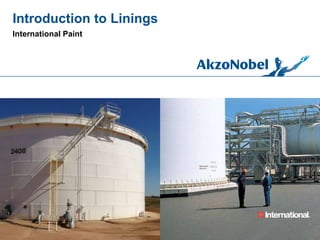
Introduction to Linings
International Paint
Agenda
1. Introduction
2. What is a lining?
3. Types of Linings
4. Choosing / Specifying the Lining System
5. Surface Preparation
6. Application
7. Return to Service
8. Question and Answer
Who is International Paint?
International Paint has operated within the coatings industry
for over 100 years and supplies protective, marine and yacht
coatings to some of the largest companies around the world.
International Protective Coatings is part of AkzoNobel, the
world’s largest coatings supplier. So what makes us different
from other suppliers?
Well, the answer is one we are proud of.
• Global Reach – Operational bases in 60 countries
• More than 5,100 employees world wide
• Proven, environmentally responsible solutions
• Maximizing our customers’ return on investment
• A commitment to innovation and sustainability
• Sole supplier of Devoe High Performance Coatings
http://info.international-pc.com/Linings
What is a Lining?
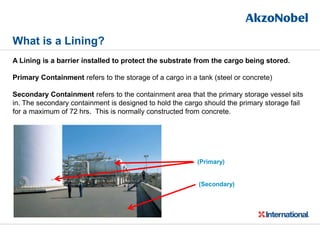
A Lining is a barrier installed to protect the substrate from the cargo being stored.
Primary Containment refers to the storage of a cargo in a tank (steel or concrete)
Secondary Containment refers to the containment area that the primary storage vessel sits
in. The secondary containment is designed to hold the cargo should the primary storage fail
for a maximum of 72 hrs. This is normally constructed from concrete.
(Primary)
(Secondary)
The Basics:
Primary Containment
All tank linings are two component materials...Some examples are: epoxy, epoxy
novolac, vinyl esters, novolac vinyl ester, polyester, polyurea, or polyurethane to
mention a few.
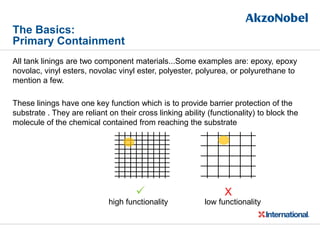
These linings have one key function which is to provide barrier protection of the
substrate . They are reliant on their cross linking ability (functionality) to block the
molecule of the chemical contained from reaching the substrate
high functionality low functionality
X.
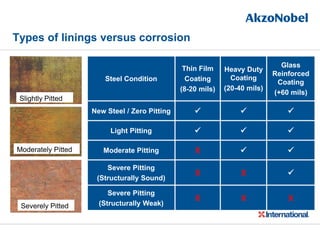
Types of linings versus corrosion
Steel Condition
Thin Film
Coating
(8-20 mils)
Heavy Duty
Coating
(20-40 mils)
Glass
Reinforced
Coating
(+60 mils)
New Steel / Zero Pitting   
Light Pitting   
Moderate Pitting X  
Severe Pitting
(Structurally Sound)
X X 
Severe Pitting
(Structurally Weak)
X X X
Slightly Pitted
Moderately Pitted
Severely Pitted
The Specification
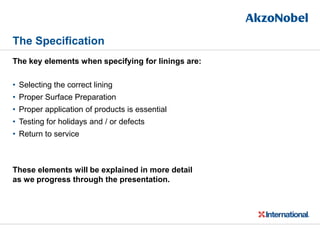
The key elements when specifying for linings are:
• Selecting the correct lining
• Proper Surface Preparation
• Proper application of products is essential
• Testing for holidays and / or defects
• Return to service
These elements will be explained in more detail
as we progress through the presentation.
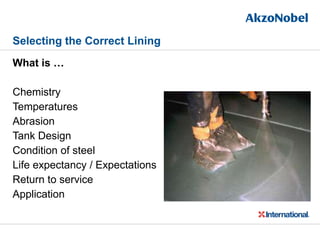
Selecting the Correct Lining
What is …
Chemistry
Temperatures
Abrasion
Tank Design
Condition of steel
Life expectancy / Expectations
Return to service
Application
Surface Preparation
It is essential with tank linings to achieve the correct surface preparation.
Typical Industry Criteria...Can vary by application and Supplier!
• A minimum of NACE 2, some immersion environments require NACE 1
• A sharp, angular profile
• For the application of a thin film lining the profile is typically 2 - 3 mils
• For the application of a thick film lining the profile is typically 3 – 5 mils
• Chlorides: Less than or equal to 5μg/cm2
• Sulphates: Less than or equal to 5μg/cm2
• Nitrates: Less than or equal to 5μg/cm2
• The total of all 3 soluble salt types must not exceed 10μg/cm2
IMPORTANT: Notes on Entry
Entering a tank or confined space is one of the most dangerous
practices in our industry.
It is important to follow the site HS&E policy which must be
demonstrated before entry to a confined space.
The area must be de-gassed and gas/sniff tested before entry in ALL
cases.
All entrants must wear the appropriate PPE and breathing apparatus,
the area must also be free from sources of ignition.
Refer to onsite Safety Manager for additional information.
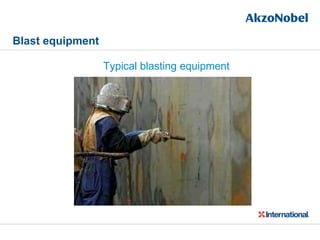
Typical blasting equipment
Blast equipment
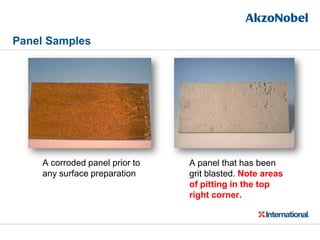
A corroded panel prior to
any surface preparation
A panel that has been
grit blasted. Note areas
of pitting in the top
right corner.
Panel Samples
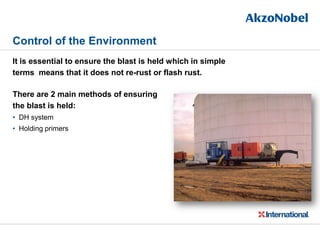
Control of the Environment
It is essential to ensure the blast is held which in simple
terms means that it does not re-rust or flash rust.
There are 2 main methods of ensuring
the blast is held:
• DH system
• Holding primers
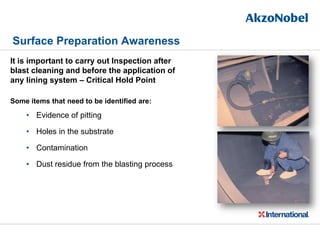
Surface Preparation Awareness
It is important to carry out Inspection after
blast cleaning and before the application of
any lining system – Critical Hold Point
Some items that need to be identified are:
• Evidence of pitting
• Holes in the substrate
• Contamination
• Dust residue from the blasting process
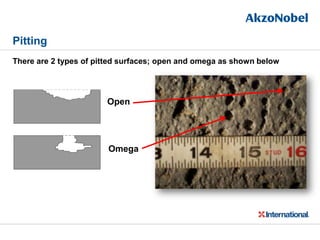
Pitting
There are 2 types of pitted surfaces; open and omega as shown below
Open
Omega
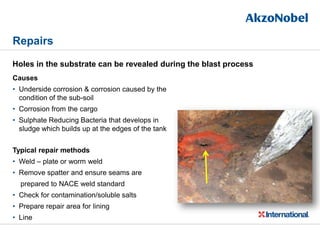
Repairs
Causes
• Underside corrosion & corrosion caused by the
condition of the sub-soil
• Corrosion from the cargo
• Sulphate Reducing Bacteria that develops in
sludge which builds up at the edges of the tank
Typical repair methods
• Weld – plate or worm weld
• Remove spatter and ensure seams are
prepared to NACE weld standard
• Check for contamination/soluble salts
• Prepare repair area for lining
• Line
Holes in the substrate can be revealed during the blast process
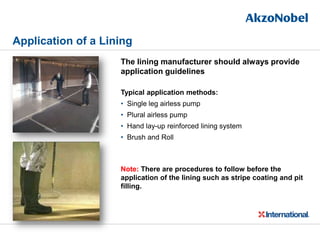
Application of a Lining
The lining manufacturer should always provide
application guidelines
Typical application methods:
• Single leg airless pump
• Plural airless pump
• Hand lay-up reinforced lining system
• Brush and Roll
Note: There are procedures to follow before the
application of the lining such as stripe coating and pit
filling.
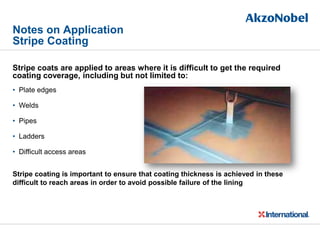
Notes on Application
Stripe Coating
Stripe coats are applied to areas where it is difficult to get the required
coating coverage, including but not limited to:
• Plate edges
• Welds
• Pipes
• Ladders
• Difficult access areas
Stripe coating is important to ensure that coating thickness is achieved in these
difficult to reach areas in order to avoid possible failure of the lining
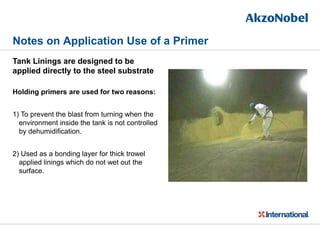
Notes on Application Use of a Primer
Tank Linings are designed to be
applied directly to the steel substrate
Holding primers are used for two reasons:
1) To prevent the blast from turning when the
environment inside the tank is not controlled
by dehumidification.
2) Used as a bonding layer for thick trowel
applied linings which do not wet out the
surface.
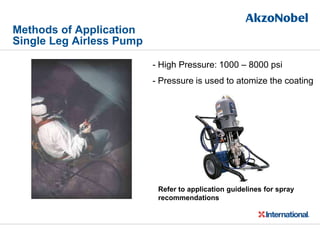
Methods of Application
Single Leg Airless Pump
- High Pressure: 1000 – 8000 psi
- Pressure is used to atomize the coating
Refer to application guidelines for spray
recommendations
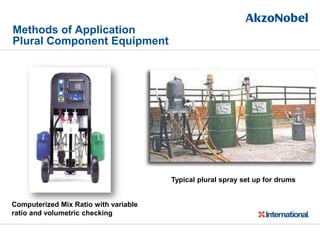
Typical plural spray set up for drums
Computerized Mix Ratio with variable
ratio and volumetric checking
Methods of Application
Plural Component Equipment
Method of Application
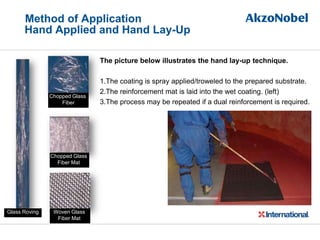
Hand Applied and Hand Lay-Up
The picture below illustrates the hand lay-up technique.
1.The coating is spray applied/troweled to the prepared substrate.
2.The reinforcement mat is laid into the wet coating. (left)
3.The process may be repeated if a dual reinforcement is required.
Glass Roving Woven Glass
Fiber Mat
Chopped Glass
Fiber Mat
Chopped Glass
Fiber
Notes on Application
Control of Thickness
• Continuous checking of WFT should take place throughout the application
• Performance of the lining can be effected by over and under application of the lining which
can lead to:
• Cracking
• Solvent entrapment
• Improper curing
• Runs or sags
• Increase dry time
• Shorter service life
If you have any questions regarding the Minimum and Maximum DFT
of a lining consult your local technical department!
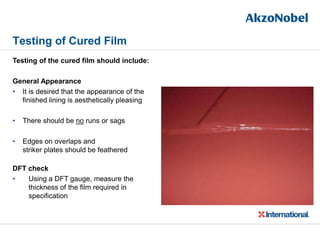
Testing of Cured Film
Testing of the cured film should include:
General Appearance
• It is desired that the appearance of the
finished lining is aesthetically pleasing
• There should be no runs or sags
• Edges on overlaps and
striker plates should be feathered
DFT check
• Using a DFT gauge, measure the
thickness of the film required in
specification
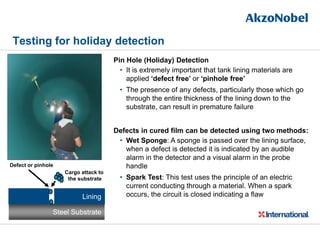
Testing for holiday detection
Pin Hole (Holiday) Detection
• It is extremely important that tank lining materials are
applied ‘defect free’ or ‘pinhole free’
• The presence of any defects, particularly those which go
through the entire thickness of the lining down to the
substrate, can result in premature failure
Defects in cured film can be detected using two methods:
• Wet Sponge: A sponge is passed over the lining surface,
when a defect is detected it is indicated by an audible
alarm in the detector and a visual alarm in the probe
handle
• Spark Test: This test uses the principle of an electric
current conducting through a material. When a spark
occurs, the circuit is closed indicating a flaw
Steel Substrate
Lining
Cargo attack to
the substrate
Defect or pinhole
Repairs & Return to Service
Repairs to a lining defect are relatively simple:
• Typically lining is abraded to create proper tooth for adhesion
• Size of the repair determines application method
• Always refer to the manufacturer’s application guidelines for repairs
Considerations for return to service:
• Variations in temperature of the substrate and environment
• The type of lining installed, some linings cure faster than others
• For more information contact manufacturer
Get to Know International Paint
Our Protective coatings business in USA, Canada, Mexico, Caribbean,
and Central America offers a technologically driven product range to
protect steel and concrete structures for new construction and
maintenance in a wide range of environments and industries.
Our coatings are used in many markets including mining, power
generation, oil, gas and chemical processing. With a core range of
products available worldwide, our customers receive consistent product
quality and service regardless of location. When you specify International
Protective Coatings, you can be assured that you will receive high quality
products worldwide.
http://info.international-pc.com/linings
Questions?
http://info.international-pc.com/linings

Introduction to linings

  • 1.
  • 2.
    Agenda 1. Introduction 2. Whatis a lining? 3. Types of Linings 4. Choosing / Specifying the Lining System 5. Surface Preparation 6. Application 7. Return to Service 8. Question and Answer
  • 3.
    Who is InternationalPaint? International Paint has operated within the coatings industry for over 100 years and supplies protective, marine and yacht coatings to some of the largest companies around the world. International Protective Coatings is part of AkzoNobel, the world’s largest coatings supplier. So what makes us different from other suppliers? Well, the answer is one we are proud of. • Global Reach – Operational bases in 60 countries • More than 5,100 employees world wide • Proven, environmentally responsible solutions • Maximizing our customers’ return on investment • A commitment to innovation and sustainability • Sole supplier of Devoe High Performance Coatings http://info.international-pc.com/Linings
  • 4.
    What is aLining? A Lining is a barrier installed to protect the substrate from the cargo being stored. Primary Containment refers to the storage of a cargo in a tank (steel or concrete) Secondary Containment refers to the containment area that the primary storage vessel sits in. The secondary containment is designed to hold the cargo should the primary storage fail for a maximum of 72 hrs. This is normally constructed from concrete. (Primary) (Secondary)
  • 5.
    The Basics: Primary Containment Alltank linings are two component materials...Some examples are: epoxy, epoxy novolac, vinyl esters, novolac vinyl ester, polyester, polyurea, or polyurethane to mention a few. These linings have one key function which is to provide barrier protection of the substrate . They are reliant on their cross linking ability (functionality) to block the molecule of the chemical contained from reaching the substrate high functionality low functionality X.
  • 6.
    Types of liningsversus corrosion Steel Condition Thin Film Coating (8-20 mils) Heavy Duty Coating (20-40 mils) Glass Reinforced Coating (+60 mils) New Steel / Zero Pitting    Light Pitting    Moderate Pitting X   Severe Pitting (Structurally Sound) X X  Severe Pitting (Structurally Weak) X X X Slightly Pitted Moderately Pitted Severely Pitted
  • 7.
    The Specification The keyelements when specifying for linings are: • Selecting the correct lining • Proper Surface Preparation • Proper application of products is essential • Testing for holidays and / or defects • Return to service These elements will be explained in more detail as we progress through the presentation.
  • 8.
    Selecting the CorrectLining What is … Chemistry Temperatures Abrasion Tank Design Condition of steel Life expectancy / Expectations Return to service Application
  • 9.
    Surface Preparation It isessential with tank linings to achieve the correct surface preparation. Typical Industry Criteria...Can vary by application and Supplier! • A minimum of NACE 2, some immersion environments require NACE 1 • A sharp, angular profile • For the application of a thin film lining the profile is typically 2 - 3 mils • For the application of a thick film lining the profile is typically 3 – 5 mils • Chlorides: Less than or equal to 5μg/cm2 • Sulphates: Less than or equal to 5μg/cm2 • Nitrates: Less than or equal to 5μg/cm2 • The total of all 3 soluble salt types must not exceed 10μg/cm2
  • 10.
    IMPORTANT: Notes onEntry Entering a tank or confined space is one of the most dangerous practices in our industry. It is important to follow the site HS&E policy which must be demonstrated before entry to a confined space. The area must be de-gassed and gas/sniff tested before entry in ALL cases. All entrants must wear the appropriate PPE and breathing apparatus, the area must also be free from sources of ignition. Refer to onsite Safety Manager for additional information.
  • 11.
  • 12.
    A corroded panelprior to any surface preparation A panel that has been grit blasted. Note areas of pitting in the top right corner. Panel Samples
  • 13.
    Control of theEnvironment It is essential to ensure the blast is held which in simple terms means that it does not re-rust or flash rust. There are 2 main methods of ensuring the blast is held: • DH system • Holding primers
  • 14.
    Surface Preparation Awareness Itis important to carry out Inspection after blast cleaning and before the application of any lining system – Critical Hold Point Some items that need to be identified are: • Evidence of pitting • Holes in the substrate • Contamination • Dust residue from the blasting process
  • 15.
    Pitting There are 2types of pitted surfaces; open and omega as shown below Open Omega
  • 16.
    Repairs Causes • Underside corrosion& corrosion caused by the condition of the sub-soil • Corrosion from the cargo • Sulphate Reducing Bacteria that develops in sludge which builds up at the edges of the tank Typical repair methods • Weld – plate or worm weld • Remove spatter and ensure seams are prepared to NACE weld standard • Check for contamination/soluble salts • Prepare repair area for lining • Line Holes in the substrate can be revealed during the blast process
  • 17.
    Application of aLining The lining manufacturer should always provide application guidelines Typical application methods: • Single leg airless pump • Plural airless pump • Hand lay-up reinforced lining system • Brush and Roll Note: There are procedures to follow before the application of the lining such as stripe coating and pit filling.
  • 18.
    Notes on Application StripeCoating Stripe coats are applied to areas where it is difficult to get the required coating coverage, including but not limited to: • Plate edges • Welds • Pipes • Ladders • Difficult access areas Stripe coating is important to ensure that coating thickness is achieved in these difficult to reach areas in order to avoid possible failure of the lining
  • 19.
    Notes on ApplicationUse of a Primer Tank Linings are designed to be applied directly to the steel substrate Holding primers are used for two reasons: 1) To prevent the blast from turning when the environment inside the tank is not controlled by dehumidification. 2) Used as a bonding layer for thick trowel applied linings which do not wet out the surface.
  • 20.
    Methods of Application SingleLeg Airless Pump - High Pressure: 1000 – 8000 psi - Pressure is used to atomize the coating Refer to application guidelines for spray recommendations
  • 21.
    Typical plural sprayset up for drums Computerized Mix Ratio with variable ratio and volumetric checking Methods of Application Plural Component Equipment
  • 22.
    Method of Application HandApplied and Hand Lay-Up The picture below illustrates the hand lay-up technique. 1.The coating is spray applied/troweled to the prepared substrate. 2.The reinforcement mat is laid into the wet coating. (left) 3.The process may be repeated if a dual reinforcement is required. Glass Roving Woven Glass Fiber Mat Chopped Glass Fiber Mat Chopped Glass Fiber
  • 23.
    Notes on Application Controlof Thickness • Continuous checking of WFT should take place throughout the application • Performance of the lining can be effected by over and under application of the lining which can lead to: • Cracking • Solvent entrapment • Improper curing • Runs or sags • Increase dry time • Shorter service life If you have any questions regarding the Minimum and Maximum DFT of a lining consult your local technical department!
  • 24.
    Testing of CuredFilm Testing of the cured film should include: General Appearance • It is desired that the appearance of the finished lining is aesthetically pleasing • There should be no runs or sags • Edges on overlaps and striker plates should be feathered DFT check • Using a DFT gauge, measure the thickness of the film required in specification
  • 25.
    Testing for holidaydetection Pin Hole (Holiday) Detection • It is extremely important that tank lining materials are applied ‘defect free’ or ‘pinhole free’ • The presence of any defects, particularly those which go through the entire thickness of the lining down to the substrate, can result in premature failure Defects in cured film can be detected using two methods: • Wet Sponge: A sponge is passed over the lining surface, when a defect is detected it is indicated by an audible alarm in the detector and a visual alarm in the probe handle • Spark Test: This test uses the principle of an electric current conducting through a material. When a spark occurs, the circuit is closed indicating a flaw Steel Substrate Lining Cargo attack to the substrate Defect or pinhole
  • 26.
    Repairs & Returnto Service Repairs to a lining defect are relatively simple: • Typically lining is abraded to create proper tooth for adhesion • Size of the repair determines application method • Always refer to the manufacturer’s application guidelines for repairs Considerations for return to service: • Variations in temperature of the substrate and environment • The type of lining installed, some linings cure faster than others • For more information contact manufacturer
  • 27.
    Get to KnowInternational Paint Our Protective coatings business in USA, Canada, Mexico, Caribbean, and Central America offers a technologically driven product range to protect steel and concrete structures for new construction and maintenance in a wide range of environments and industries. Our coatings are used in many markets including mining, power generation, oil, gas and chemical processing. With a core range of products available worldwide, our customers receive consistent product quality and service regardless of location. When you specify International Protective Coatings, you can be assured that you will receive high quality products worldwide. http://info.international-pc.com/linings
  • 28.