COMPUTER AIDED
FORMULATION DEVELOPMENT
• SIDDU K M
• M PHARM
• DEPARTMENT OF PHARMACEUTICS
• AL AMEEN COLLEGE OF PHARMACY, BENGALURU
CONTENTS
• OPTIMIZATION
• OPTIMIZATION PARAMETRES
• RESPONSE SURAFCE CURVES
• EXPERIMENTAL DESIGNS
• TYPES OF EXPERIMENTAL DESIGNS
• FACTORIAL DESIGNS
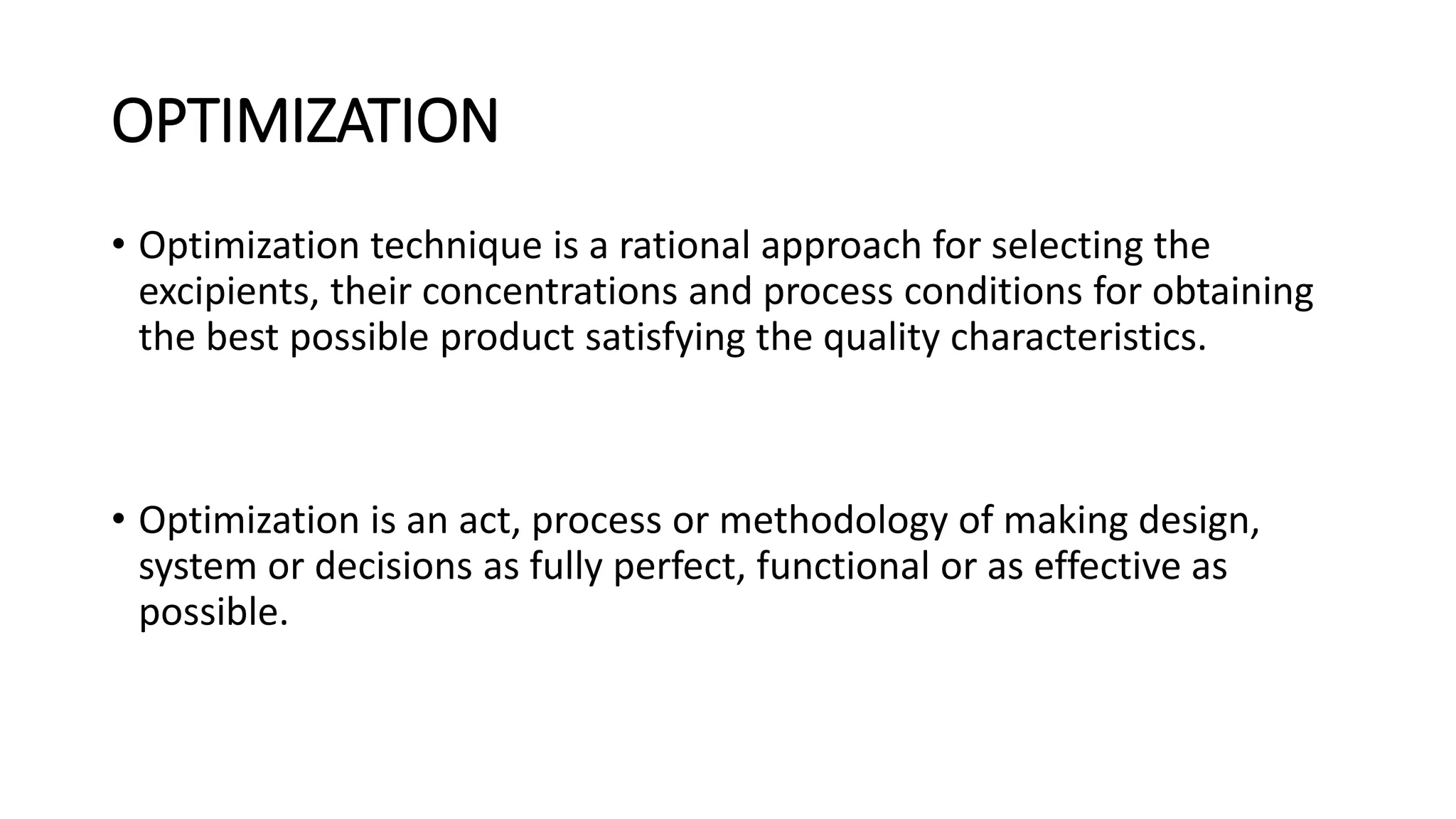
OPTIMIZATION
• Optimization technique is a rational approach for selecting the
excipients, their concentrations and process conditions for obtaining
the best possible product satisfying the quality characteristics.
• Optimization is an act, process or methodology of making design,
system or decisions as fully perfect, functional or as effective as
possible.
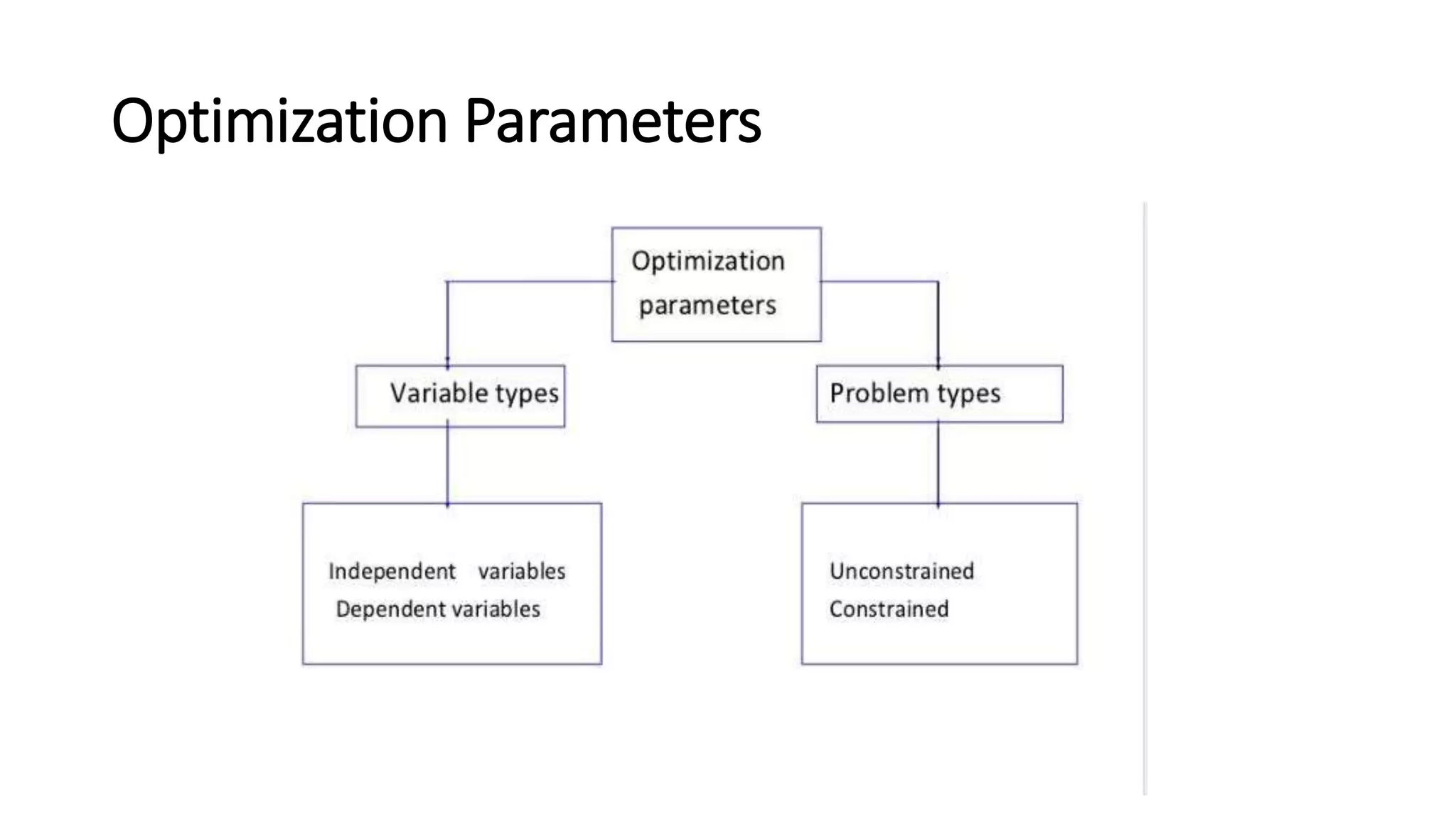
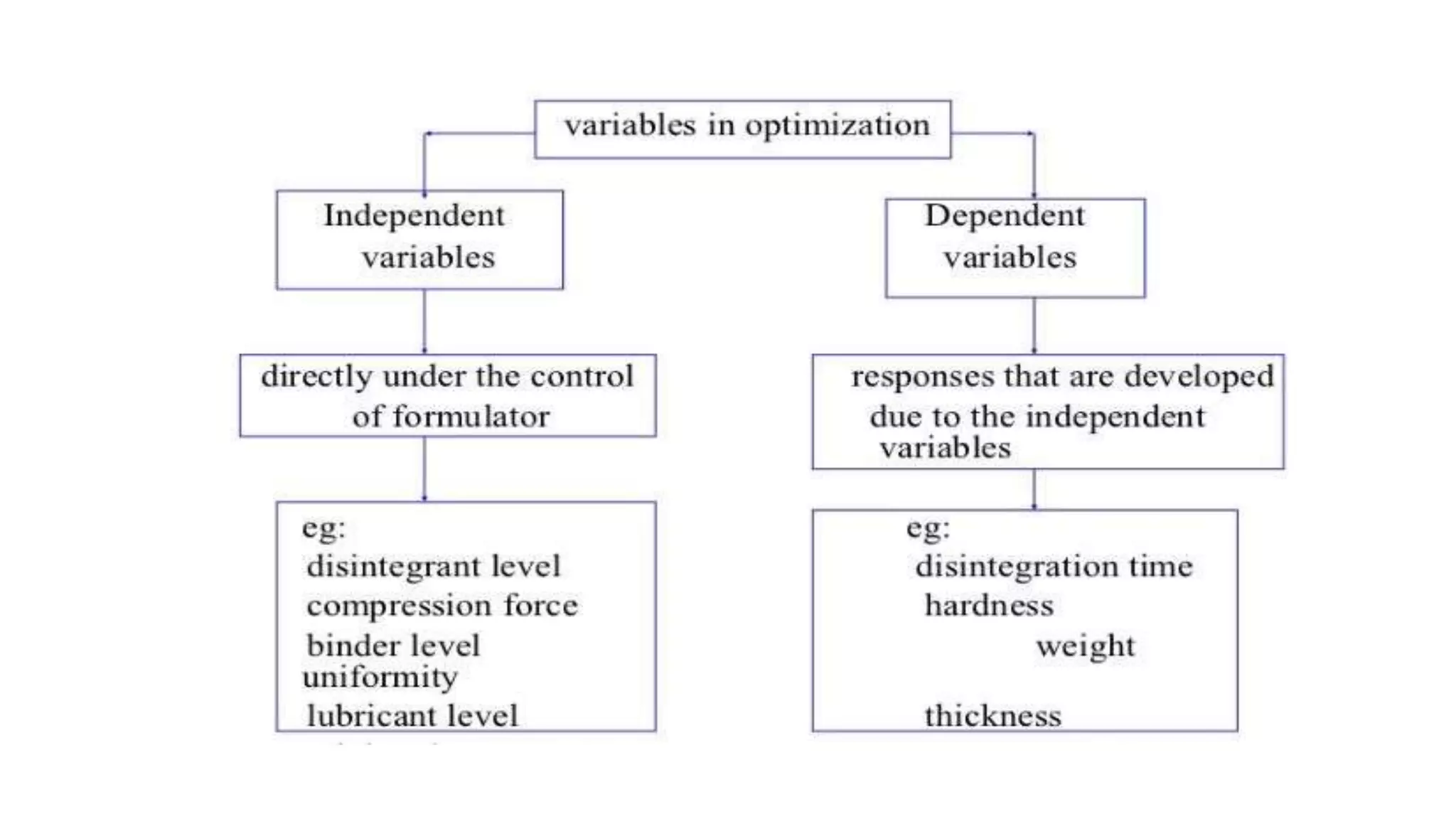
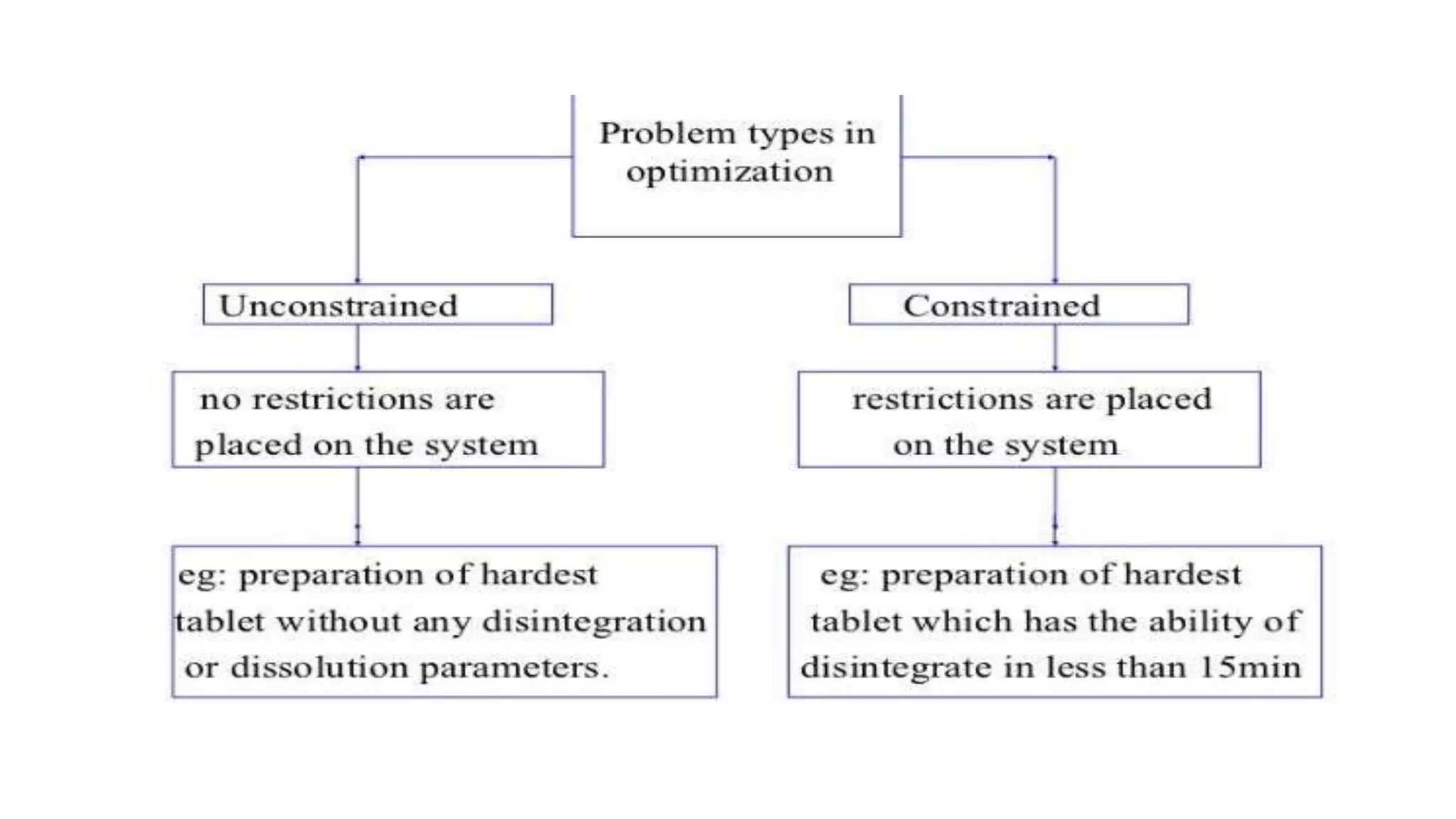
Optimization Parameters
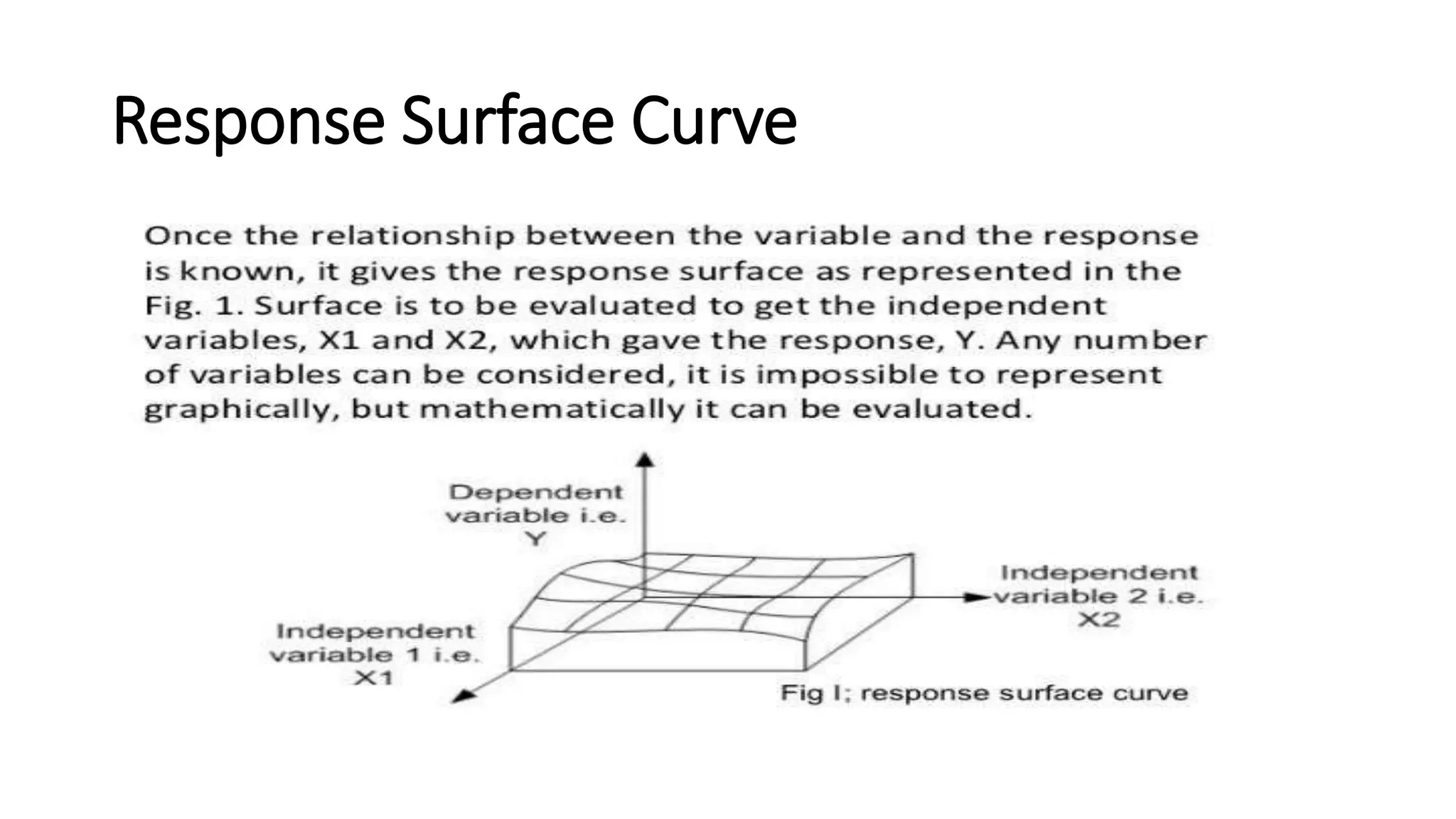
Response Surface Curve
Experimental Designs
• Modern pharmaceutical optimization involves systematic design of
experiments (DoE) to improve formulation irregularities.
• Design of Experiment (DoE) may be defined as the strategy for setting
up experiments in such a manner that the required information is
obtained as efficiently & precisely as possible.
Types of Experimental Designs
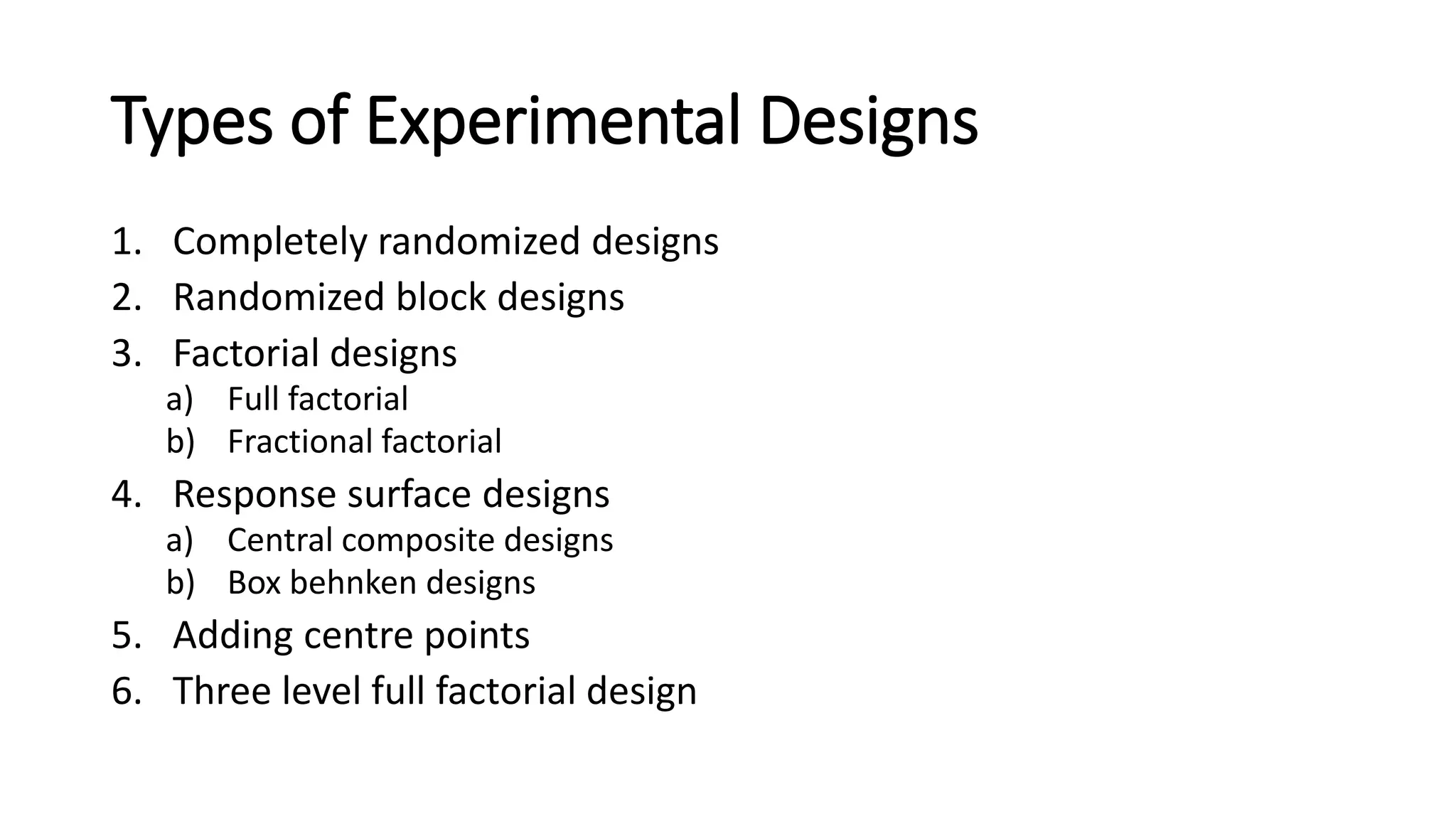
1. Completely randomized designs
2. Randomized block designs
3. Factorial designs
a) Full factorial
b) Fractional factorial
4. Response surface designs
a) Central composite designs
b) Box behnken designs
5. Adding centre points
6. Three level full factorial design
Factorial Designs
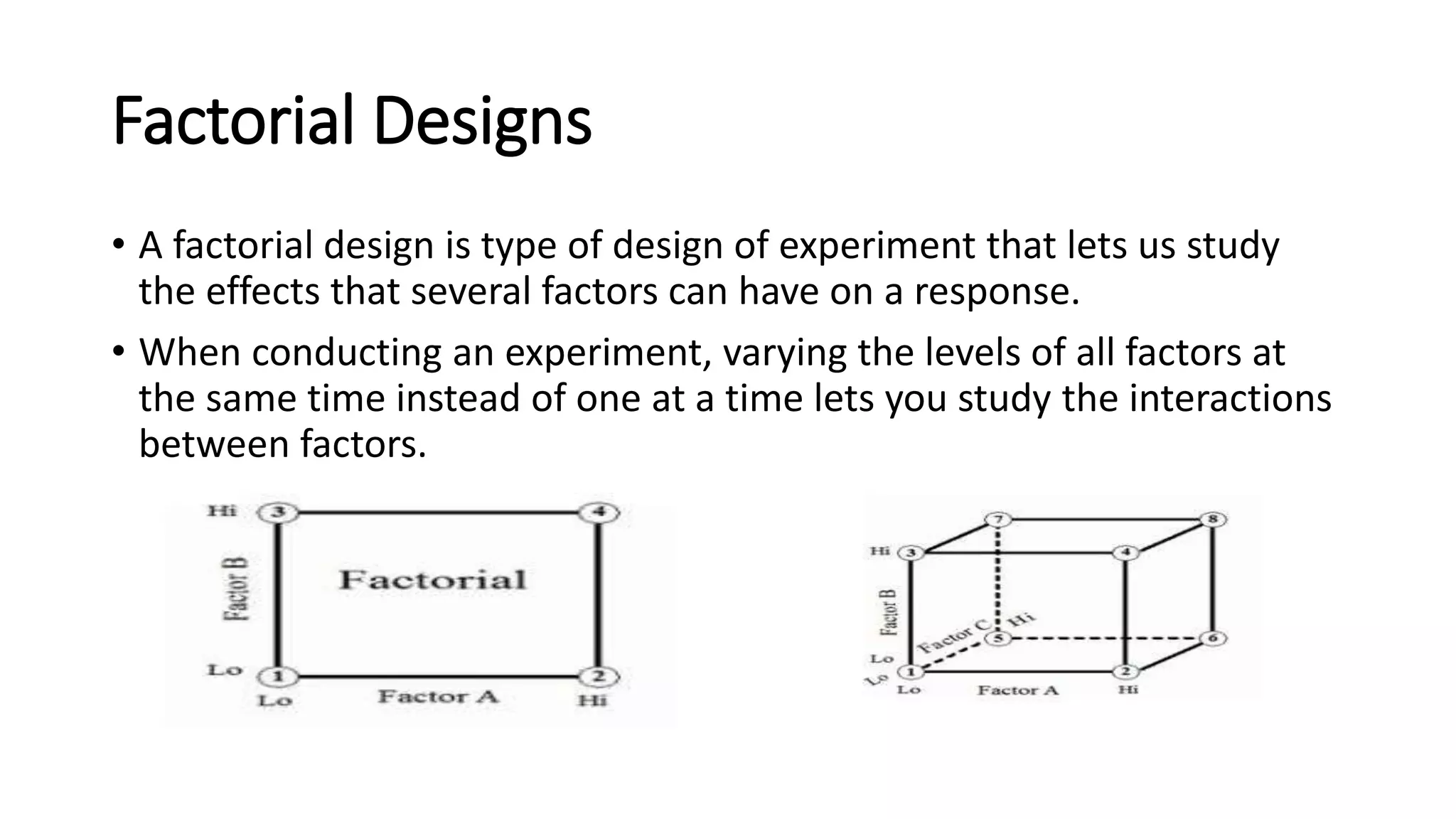
• A factorial design is type of design of experiment that lets us study
the effects that several factors can have on a response.
• When conducting an experiment, varying the levels of all factors at
the same time instead of one at a time lets you study the interactions
between factors.
Full Factorial Design
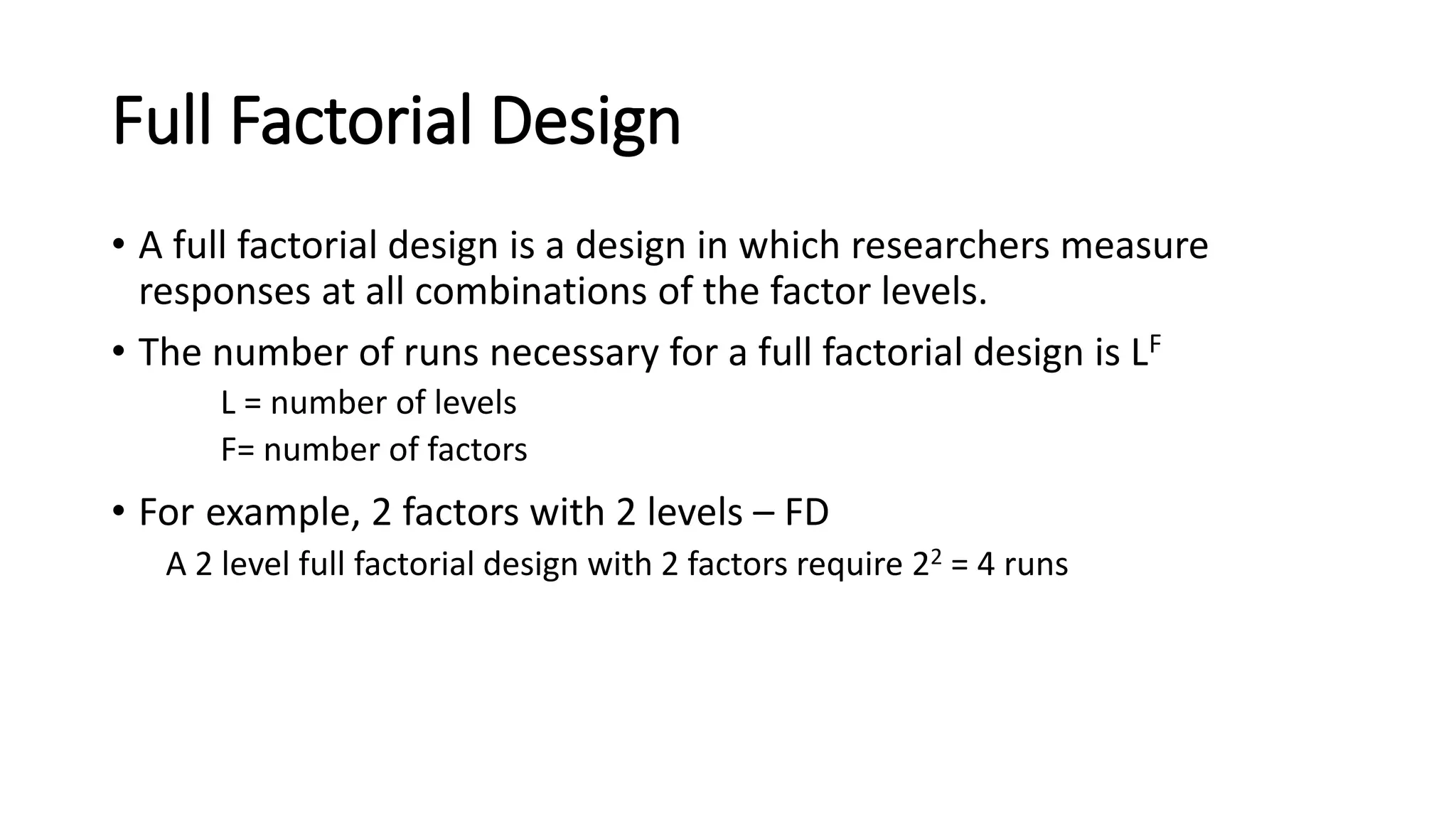
• A full factorial design is a design in which researchers measure
responses at all combinations of the factor levels.
• The number of runs necessary for a full factorial design is LF
L = number of levels
F= number of factors
• For example, 2 factors with 2 levels – FD
A 2 level full factorial design with 2 factors require 22 = 4 runs
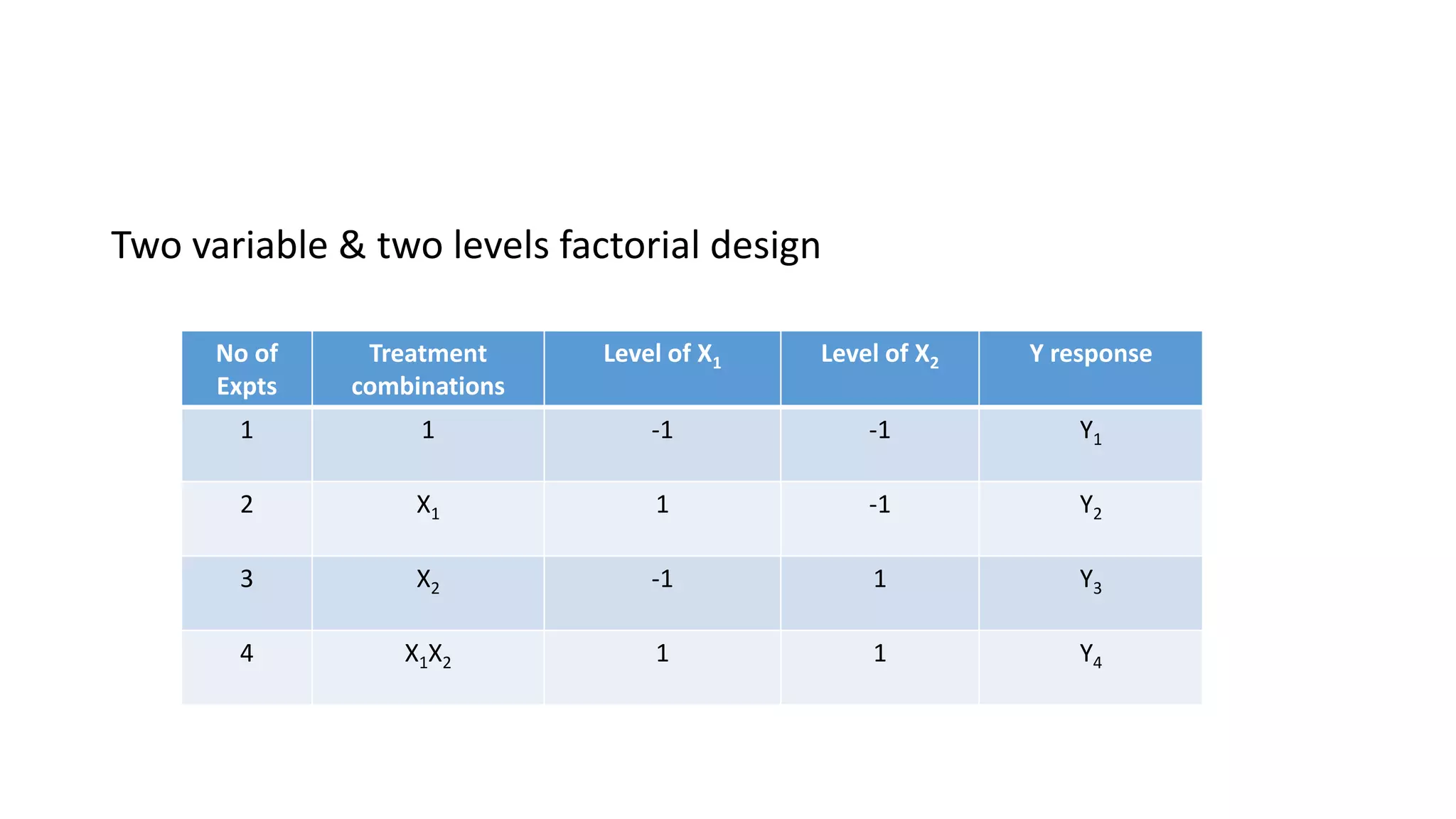
Two variable & two levels factorial design
No of
Expts
Treatment
combinations
Level of X1 Level of X2 Y response
1 1 -1 -1 Y1
2 X1 1 -1 Y2
3 X2 -1 1 Y3
4 X1X2 1 1 Y4
Fractional Factorial Design
• A fractional factorial design is a design is a design in which
experiments conduct only a selected subsets or fraction of the runs in
the full factorial design.
• Fractional factorial designs are a good choice when resources are
limited or the number of factors in the design is large because they
use fewer runs then the full factorial designs.
• A fractional factorial design uses a subset of a full factorial design
• The fractional factorial design that includes half of the runs that a full
factorial design has
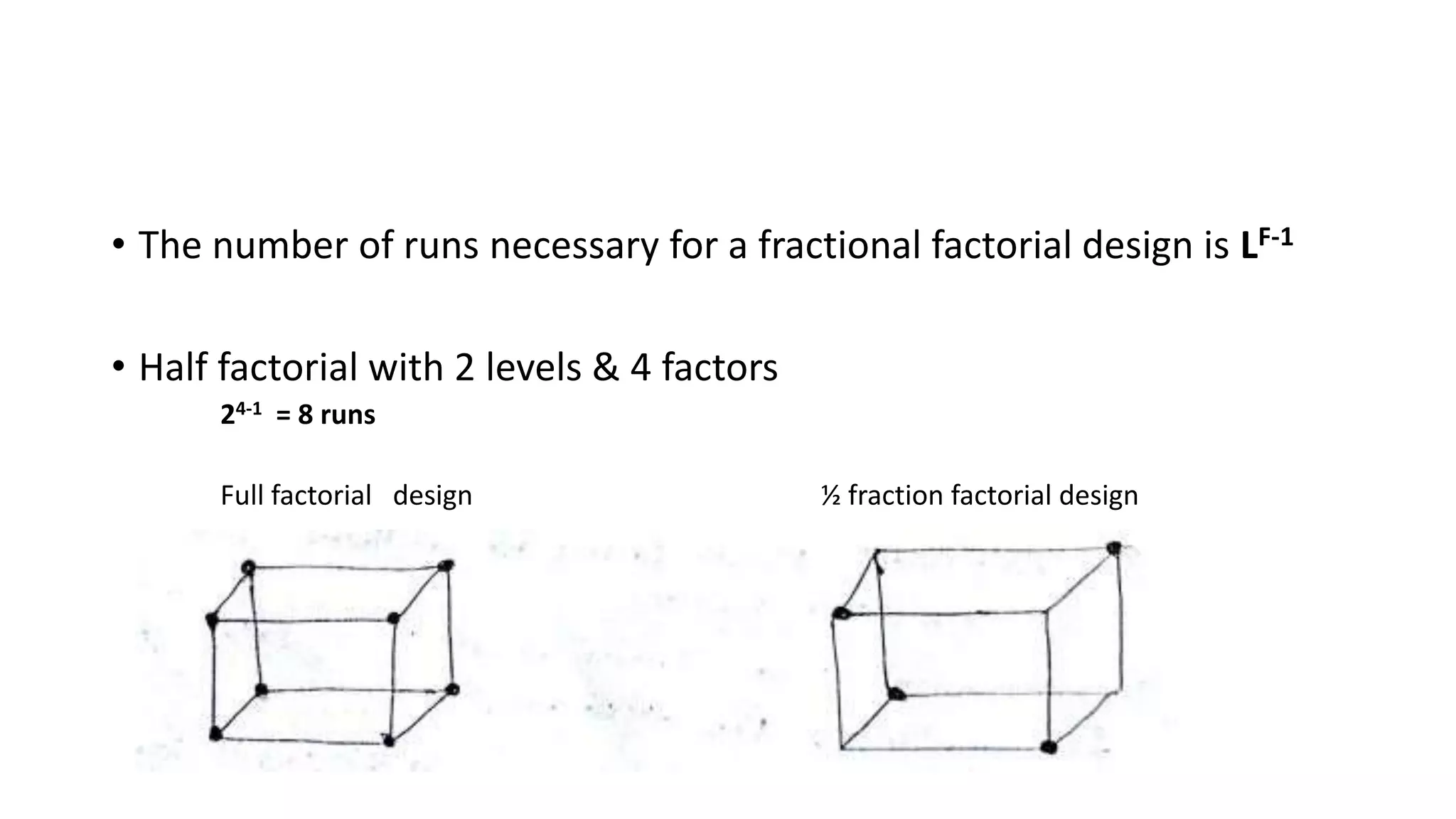
• The number of runs necessary for a fractional factorial design is LF-1
• Half factorial with 2 levels & 4 factors
24-1 = 8 runs
Full factorial design ½ fraction factorial design
• The full factorial design contains twice as many design points as the ½
fraction design.
• The response is only measured at four of the possible eight factorial
portion of the design.
THANK YOU

Computer aided formulation development

  • 1.
    COMPUTER AIDED FORMULATION DEVELOPMENT •SIDDU K M • M PHARM • DEPARTMENT OF PHARMACEUTICS • AL AMEEN COLLEGE OF PHARMACY, BENGALURU
  • 2.
    CONTENTS • OPTIMIZATION • OPTIMIZATIONPARAMETRES • RESPONSE SURAFCE CURVES • EXPERIMENTAL DESIGNS • TYPES OF EXPERIMENTAL DESIGNS • FACTORIAL DESIGNS
  • 3.
    OPTIMIZATION • Optimization techniqueis a rational approach for selecting the excipients, their concentrations and process conditions for obtaining the best possible product satisfying the quality characteristics. • Optimization is an act, process or methodology of making design, system or decisions as fully perfect, functional or as effective as possible.
  • 4.
  • 7.
  • 8.
    Experimental Designs • Modernpharmaceutical optimization involves systematic design of experiments (DoE) to improve formulation irregularities. • Design of Experiment (DoE) may be defined as the strategy for setting up experiments in such a manner that the required information is obtained as efficiently & precisely as possible.
  • 9.
    Types of ExperimentalDesigns 1. Completely randomized designs 2. Randomized block designs 3. Factorial designs a) Full factorial b) Fractional factorial 4. Response surface designs a) Central composite designs b) Box behnken designs 5. Adding centre points 6. Three level full factorial design
  • 10.
    Factorial Designs • Afactorial design is type of design of experiment that lets us study the effects that several factors can have on a response. • When conducting an experiment, varying the levels of all factors at the same time instead of one at a time lets you study the interactions between factors.
  • 11.
    Full Factorial Design •A full factorial design is a design in which researchers measure responses at all combinations of the factor levels. • The number of runs necessary for a full factorial design is LF L = number of levels F= number of factors • For example, 2 factors with 2 levels – FD A 2 level full factorial design with 2 factors require 22 = 4 runs
  • 12.
    Two variable &two levels factorial design No of Expts Treatment combinations Level of X1 Level of X2 Y response 1 1 -1 -1 Y1 2 X1 1 -1 Y2 3 X2 -1 1 Y3 4 X1X2 1 1 Y4
  • 13.
    Fractional Factorial Design •A fractional factorial design is a design is a design in which experiments conduct only a selected subsets or fraction of the runs in the full factorial design. • Fractional factorial designs are a good choice when resources are limited or the number of factors in the design is large because they use fewer runs then the full factorial designs. • A fractional factorial design uses a subset of a full factorial design • The fractional factorial design that includes half of the runs that a full factorial design has
  • 14.
    • The numberof runs necessary for a fractional factorial design is LF-1 • Half factorial with 2 levels & 4 factors 24-1 = 8 runs Full factorial design ½ fraction factorial design
  • 15.
    • The fullfactorial design contains twice as many design points as the ½ fraction design. • The response is only measured at four of the possible eight factorial portion of the design.
  • 16.