Dr.Shivalingappa B.P
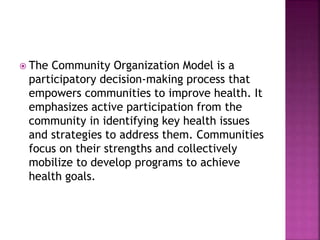
 The Community Organization Model is a
participatory decision-making process that
empowers communities to improve health. It
emphasizes active participation from the
community in identifying key health issues
and strategies to address them. Communities
focus on their strengths and collectively
mobilize to develop programs to achieve
health goals.
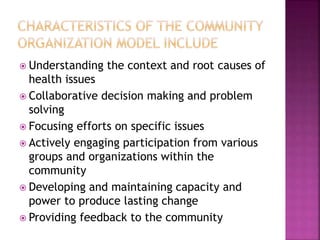
 Understanding the context and root causes of
health issues
 Collaborative decision making and problem
solving
 Focusing efforts on specific issues
 Actively engaging participation from various
groups and organizations within the
community
 Developing and maintaining capacity and
power to produce lasting change
 Providing feedback to the community
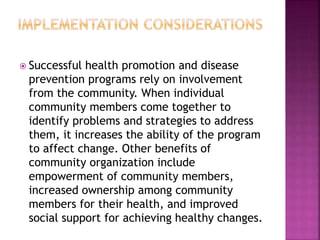
 Successful health promotion and disease
prevention programs rely on involvement
from the community. When individual
community members come together to
identify problems and strategies to address
them, it increases the ability of the program
to affect change. Other benefits of
community organization include
empowerment of community members,
increased ownership among community
members for their health, and improved
social support for achieving healthy changes.
 -to begin to assess the assets (strengths) and
deficits (problems) of geographic
(neighborhood)
and functional (interest) communities;
-to begin to apply models of organizing to
specific social change endeavors;
-to acquire beginning skill in specific
organizing tools and techniques such as
running meetings
and public speaking, and use of media.
-to acquire ability to critically analyze
situations and problem-solve.
 -to appreciate the complexity of and
competence needed for the organizer role.
-to value citizen, community and
client/consumer participation and
empowerment.
-to value to struggles and conflicts inherent
in organizing for social and economic justice
within an
historical context and democratic
framework.
 This course is being offered as part of an interdisciplinary
Hunter College faculty collaboration to explore the
feasibility of establishing an undergraduate program in
Community Organizing and Development (C.O.D.).
Students who successfully complete the requirements will
receive 3 credits through a course number in Urban Studies
(URBS 403.95), Political Science (317.06), Sociology
(225.35) and Community Health Education (400.50). Much
of its content, structure and process were suggested
through a series of meetings with faculty as well as
community organizers outside of Hunter. It has been
revised with input from students who took the course in
Fall 1995 and 1996, Guest lecturers include members of
the faculty and organizers working in NYC. Students will be
encouraged to actively participate in and evaluate the
course and all its features. Suggestions for improving the
course will be welcome. Students will be expected to do a
volunteer 20 hours during the semester in a community
organizing setting as part of the major class assignment.

Community organization

  • 1.
  • 2.
     The CommunityOrganization Model is a participatory decision-making process that empowers communities to improve health. It emphasizes active participation from the community in identifying key health issues and strategies to address them. Communities focus on their strengths and collectively mobilize to develop programs to achieve health goals.
  • 3.
     Understanding thecontext and root causes of health issues  Collaborative decision making and problem solving  Focusing efforts on specific issues  Actively engaging participation from various groups and organizations within the community  Developing and maintaining capacity and power to produce lasting change  Providing feedback to the community
  • 4.
     Successful healthpromotion and disease prevention programs rely on involvement from the community. When individual community members come together to identify problems and strategies to address them, it increases the ability of the program to affect change. Other benefits of community organization include empowerment of community members, increased ownership among community members for their health, and improved social support for achieving healthy changes.
  • 5.
     -to beginto assess the assets (strengths) and deficits (problems) of geographic (neighborhood) and functional (interest) communities; -to begin to apply models of organizing to specific social change endeavors; -to acquire beginning skill in specific organizing tools and techniques such as running meetings and public speaking, and use of media. -to acquire ability to critically analyze situations and problem-solve.
  • 6.
     -to appreciatethe complexity of and competence needed for the organizer role. -to value citizen, community and client/consumer participation and empowerment. -to value to struggles and conflicts inherent in organizing for social and economic justice within an historical context and democratic framework.
  • 7.
     This courseis being offered as part of an interdisciplinary Hunter College faculty collaboration to explore the feasibility of establishing an undergraduate program in Community Organizing and Development (C.O.D.). Students who successfully complete the requirements will receive 3 credits through a course number in Urban Studies (URBS 403.95), Political Science (317.06), Sociology (225.35) and Community Health Education (400.50). Much of its content, structure and process were suggested through a series of meetings with faculty as well as community organizers outside of Hunter. It has been revised with input from students who took the course in Fall 1995 and 1996, Guest lecturers include members of the faculty and organizers working in NYC. Students will be encouraged to actively participate in and evaluate the course and all its features. Suggestions for improving the course will be welcome. Students will be expected to do a volunteer 20 hours during the semester in a community organizing setting as part of the major class assignment.