

EHS 402
COMMUNITY RESEARCH PROJECT
(4 CREDITS)
MS. OLULEGAN
“Happiness doesn't result from
what we get, but from what we
give.” ― Ben carson
“You give but little when you give of
your possessions. It is when you give of
yourself that you truly give.” ― Kahlil
Gibran

…
ACRONYMS AND DEFINITIONS
•
•
•
•
•
•
•
•
•

CLTS: Community-Led Total Sanitation
CC: Community Consultant
INGO: International Non Government Organization
MDG: Millennium Development Goal
NL: Natural Leader; Leaders emerging from ODF villages
as a result of CLTS triggering process at the local level
OD: Open Defecation
ODF: Open Defecation Free
PRA: Participatory rural appraisal
WSSCC: Water Supply and Sanitation Collaborative
Council
ACRONYMS AND DEFINITIONS
• IHHS: Individual Household Hardware Subsidy
• IRSP: Integrated Rural Support Programme
• Plan RESA :Plan International, Region of Eastern and
Southern Africa
• PM: Participatory Methodology
• RSPN: Rural Support Programme Network, Pakistan
• TSC: Total Sanitation Campaign of the Indian
Government
• UNICEF: United Nations Children‟s Fund
• VERC: Village Education Resource Centre
• WSP: Water and Sanitation Programme, World Bank
Community-Led Total
Sanitation

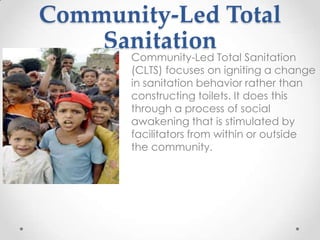
Community-Led Total Sanitation
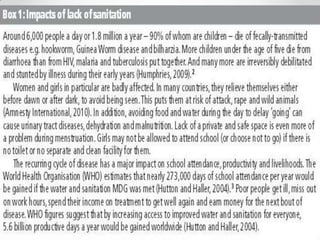
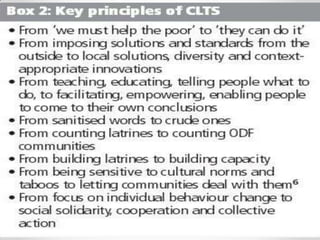
(CLTS) focuses on igniting a change
in sanitation behavior rather than
constructing toilets. It does this
through a process of social
awakening that is stimulated by
facilitators from within or outside
the community.
When it occurs
well, CLTS
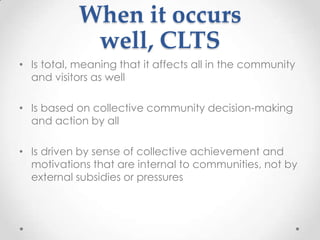
• Is total, meaning that it affects all in the community
and visitors as well
• Is based on collective community decision-making
and action by all
• Is driven by sense of collective achievement and
motivations that are internal to communities, not by
external subsidies or pressures
When it occurs
well, CLTS
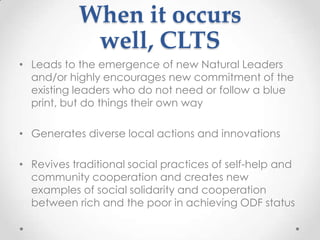
• Leads to the emergence of new Natural Leaders
and/or highly encourages new commitment of the
existing leaders who do not need or follow a blue
print, but do things their own way

• Generates diverse local actions and innovations
• Revives traditional social practices of self-help and
community cooperation and creates new
examples of social solidarity and cooperation
between rich and the poor in achieving ODF status
•

When it occurs well,
CLTSand children in a
Engages men, women, youth

time-bound campaign and local action to end OD
followed by general cleaning up

• Often through the collective drive of communities
attracts local leaders, elected people‟s
representatives, the local government and NGOs to
help, support, encourage and spread ideas
When it occurs
well, CLTS

• ODF communities gradually move up along the
sanitation ladder and improve structure and design
of their toilets through better linkages with the local
businessmen and traders/dealers of sanitation
hardware
• Often ODF communities don‟t stop at achieving
ODF status but move on to achieving other
collective common goals like „no hunger or
starvation in the village‟, „no children without school
enrolment and all going to school‟ „equal wages for
all labours and reduced inequality of men‟s and
women‟s labour‟ etc.
Two conditions are crucial:
1. The attitudes and behaviour of facilitators:
Not everyone can be a good facilitator. Facilitating
CLTS is an aptitude. It can be learnt, but it will come
more naturally to some than to others. It is different
from facilitating conventional participatory processes
like PRA. Behaviour and attitudes are crucial. What
works best for triggering CLTS is a combination of
boldness, empathy, humour and fun. It demands a
hands-off approach, not teaching or lecturing, but
facilitating to enable people to confront their
unpalatable realities.
2. The sensitive support of institutions.
Not every organization is suitable for promoting CLTS.
Institutional support needs to be consistent and flexible.
Any top-down target and disbursement-driven approach is
liable to undermine CLTS, though general sanitation
campaigns can be effective provided they are used in a
„community empowerment‟ mode rather than a
„prescriptive‟ and „target achievement‟ mode. Two big
dangers are too much money, because CLTS needs
relatively little, and rapid recruitment and inadequate
orientation, training and socializing of staff. This demands a
form of restraint that is difficult in many bureaucracies.
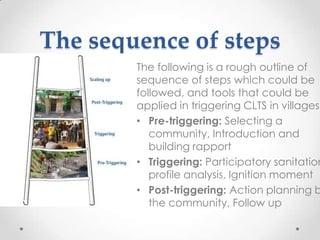
The sequence of steps

The following is a rough outline of
sequence of steps which could be
followed, and tools that could be
applied in triggering CLTS in villages.
• Pre-triggering: Selecting a
community, Introduction and
building rapport
• Triggering: Participatory sanitation
profile analysis, Ignition moment
• Post-triggering: Action planning b
the community, Follow up
`
COMMUNITY-LED TOTAL SANITATION

COMMUNITY-LED TOTAL SANITATION

  • 1.
    EHS 402 COMMUNITY RESEARCHPROJECT (4 CREDITS) MS. OLULEGAN
  • 2.
    “Happiness doesn't resultfrom what we get, but from what we give.” ― Ben carson
  • 3.
    “You give butlittle when you give of your possessions. It is when you give of yourself that you truly give.” ― Kahlil Gibran …
  • 4.
    ACRONYMS AND DEFINITIONS • • • • • • • • • CLTS:Community-Led Total Sanitation CC: Community Consultant INGO: International Non Government Organization MDG: Millennium Development Goal NL: Natural Leader; Leaders emerging from ODF villages as a result of CLTS triggering process at the local level OD: Open Defecation ODF: Open Defecation Free PRA: Participatory rural appraisal WSSCC: Water Supply and Sanitation Collaborative Council
  • 5.
    ACRONYMS AND DEFINITIONS •IHHS: Individual Household Hardware Subsidy • IRSP: Integrated Rural Support Programme • Plan RESA :Plan International, Region of Eastern and Southern Africa • PM: Participatory Methodology • RSPN: Rural Support Programme Network, Pakistan • TSC: Total Sanitation Campaign of the Indian Government • UNICEF: United Nations Children‟s Fund • VERC: Village Education Resource Centre • WSP: Water and Sanitation Programme, World Bank
  • 6.
    Community-Led Total Sanitation Community-Led TotalSanitation (CLTS) focuses on igniting a change in sanitation behavior rather than constructing toilets. It does this through a process of social awakening that is stimulated by facilitators from within or outside the community.
  • 9.
    When it occurs well,CLTS • Is total, meaning that it affects all in the community and visitors as well • Is based on collective community decision-making and action by all • Is driven by sense of collective achievement and motivations that are internal to communities, not by external subsidies or pressures
  • 10.
    When it occurs well,CLTS • Leads to the emergence of new Natural Leaders and/or highly encourages new commitment of the existing leaders who do not need or follow a blue print, but do things their own way • Generates diverse local actions and innovations • Revives traditional social practices of self-help and community cooperation and creates new examples of social solidarity and cooperation between rich and the poor in achieving ODF status
  • 11.
    • When it occurswell, CLTSand children in a Engages men, women, youth time-bound campaign and local action to end OD followed by general cleaning up • Often through the collective drive of communities attracts local leaders, elected people‟s representatives, the local government and NGOs to help, support, encourage and spread ideas
  • 12.
    When it occurs well,CLTS • ODF communities gradually move up along the sanitation ladder and improve structure and design of their toilets through better linkages with the local businessmen and traders/dealers of sanitation hardware • Often ODF communities don‟t stop at achieving ODF status but move on to achieving other collective common goals like „no hunger or starvation in the village‟, „no children without school enrolment and all going to school‟ „equal wages for all labours and reduced inequality of men‟s and women‟s labour‟ etc.
  • 14.
    Two conditions arecrucial: 1. The attitudes and behaviour of facilitators: Not everyone can be a good facilitator. Facilitating CLTS is an aptitude. It can be learnt, but it will come more naturally to some than to others. It is different from facilitating conventional participatory processes like PRA. Behaviour and attitudes are crucial. What works best for triggering CLTS is a combination of boldness, empathy, humour and fun. It demands a hands-off approach, not teaching or lecturing, but facilitating to enable people to confront their unpalatable realities.
  • 15.
    2. The sensitivesupport of institutions. Not every organization is suitable for promoting CLTS. Institutional support needs to be consistent and flexible. Any top-down target and disbursement-driven approach is liable to undermine CLTS, though general sanitation campaigns can be effective provided they are used in a „community empowerment‟ mode rather than a „prescriptive‟ and „target achievement‟ mode. Two big dangers are too much money, because CLTS needs relatively little, and rapid recruitment and inadequate orientation, training and socializing of staff. This demands a form of restraint that is difficult in many bureaucracies.
  • 17.
    The sequence ofsteps The following is a rough outline of sequence of steps which could be followed, and tools that could be applied in triggering CLTS in villages. • Pre-triggering: Selecting a community, Introduction and building rapport • Triggering: Participatory sanitation profile analysis, Ignition moment • Post-triggering: Action planning b the community, Follow up
  • 18.

Editor's Notes

  • #7 It concentrates on the whole community rather than on individual behaviours. Collective benefit from stopping open defecation (OD) can encourage a more cooperative approach. People decide together how they will create a clean and hygienic environment that benefits everyone. It is fundamental that CLTS involves no individual household hardware subsidy and does not prescribe latrine models. Social solidarity, help and cooperation among the households in the community are a common and vital element in CLTS. Other important characteristics are the spontaneous emergence of Natural Leaders (NLs) as a community proceeds towards ODF status; local innovations of low cost toilet models using locally available materials, and community-innovated systems of reward, penalty, spread and scaling-up. CLTS encourages the community to take responsibility and to take its own action.In its fullest sense, total sanitation includes a range of behaviours such as: stopping all open defecation; ensuring that everyone uses a hygienic toilet; washing hands with soap before preparing food and eating, after using the toilet, and after contact with babies’ faeces, or birds and animals; handling food and water in a hygienic manner; and safe disposal of animal and domestic waste to create a clean and safe environment. CLTS concentrates on ending open defecation (OD) as a first significant step and entry point to changing behaviour. It starts by enabling people to do their own sanitation profile through appraisal, observation and analysis of their practices of OD and the effects these have. This kindles feelings of shame and disgust, and often a desire to stop OD and clean up their neighbourhood