Community Led Total Sanitation
(CLTS): An Approach that works
Arvind kumar
WATSAN CLUSTER COORDINATOR- Saran
What is CLTS
• CLTS is an innovative methodology for mobilising communities to completely eliminate
open defecation (OD). Communities are facilitated to conduct their own appraisal and
analysis of open defecation (OD) and take their own action to become ODF (open
defecation free).
• The cardinal objectives of the CLTS have been the drive to create a healthy environment
with basic sanitation means such as well aerated latrines in the rural areas to combat
the menace of open defecation in rural communities especially.
• It allows the people to be involved in assessing its level of open defecation and
proffering solution on how to make their community open defecation free.
CLTS was pioneered by Kamal Kar (a development consultant from India) together
with VERC (Village Education Resource Centre), a partner of WaterAid
Bangladesh, in 2000 in Mosmoil, a village in the Rajshahi district of
Bangladesh, whilst evaluating a traditionally subsidised sanitation programme.
CLTS in India
 Community Led Total Sanitation (CLTS) in India is mostly
used within the framework of Government of India’s Total
Sanitation Campaign (TSC), which was launched in 1999.
 CLTS is reportedly in use now in 16 of 35 states in India.
Since its introduction in Ahmednagar and Nanded districts of
Maharashtra in 2002 on a pilot basis, CLTS has been
reportedly used in varying degrees across 135 districts in
the country so far, particularly since 2006. As per a rough
estimate, around 5 million people have gained access to safe
sanitation following CLTS interventions across rural India.
Continue……
 Himachal Pradesh (HP) and Haryana are the two states where CLTS has been
used in all the districts. . While HP remains the only state where state sanitation
strategy of 2005 adopts CLTS principles of no-subsidy and community
ownership of the sanitation agenda, Haryana is a state which has underplayed
the provision of subsidy in TSC to support those who have tried to make the
sanitation drive community led using the CLTS approach, as in the districts of
Panipat and Sirsa.
 In Himachal Pradesh and Haryana where CLTS has been used in all the
districts of the state, results have been remarkably better with around 60-70%
increase in sanitation coverage over a period of 4-5 years during 2006-2010.
 In states of Meghalaya, Maharashtra, and Madhya Pradesh, where CLTS has
been introduced in few of the districts, rate of increase in sanitation coverage
has been in the range of around 30-40% during the same period.
 In the state of Bihar, where there is provision of subsidy both for above poverty
line (APL) and below poverty line (BPL) households with no CLTS activity so far,
the rate of increase in sanitation coverage has been only around 20% in that
period.
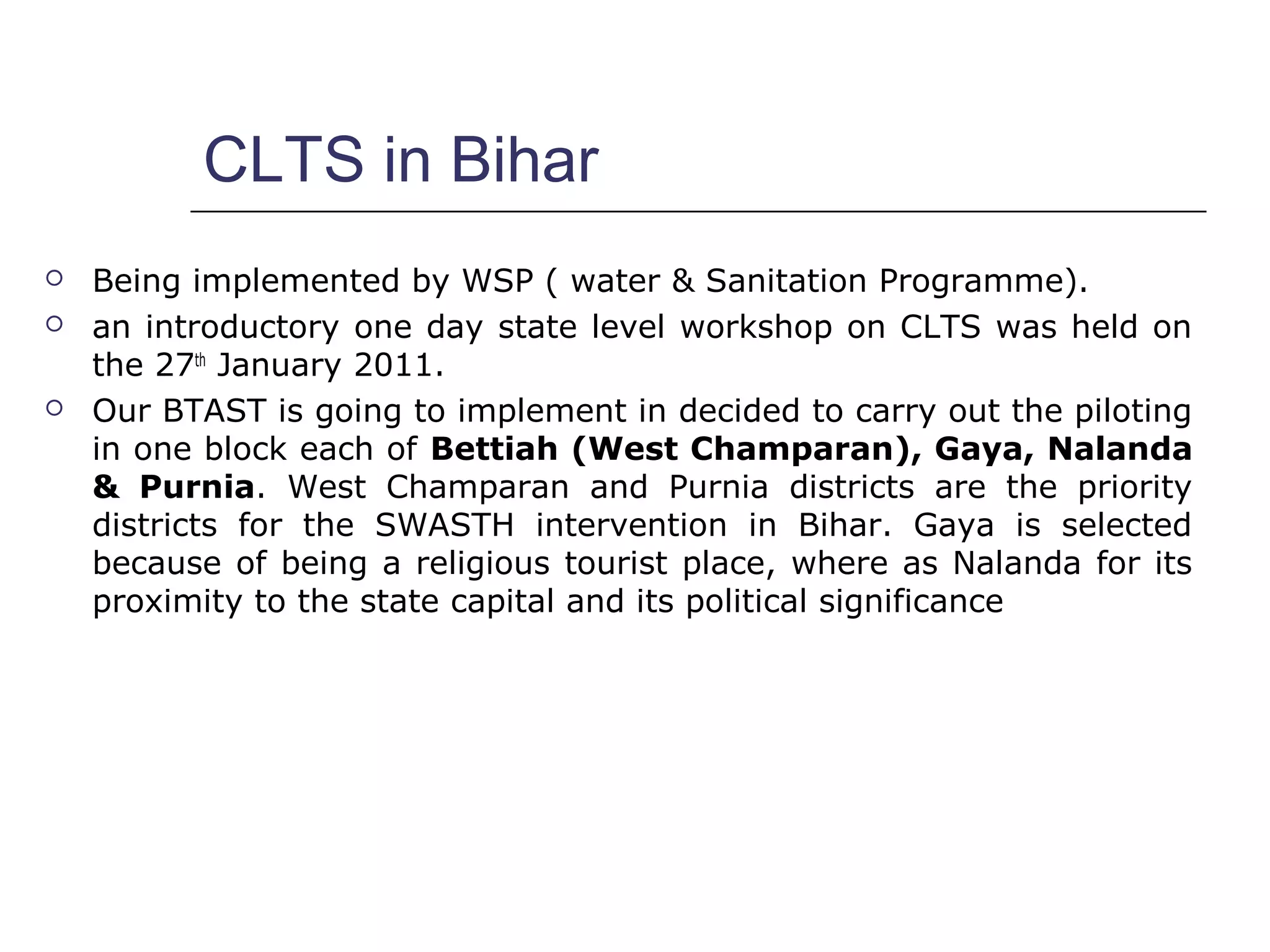
CLTS in Bihar
 Being implemented by WSP ( water & Sanitation Programme).
 an introductory one day state level workshop on CLTS was held on
the 27th
January 2011.
 Our BTAST is going to implement in decided to carry out the piloting
in one block each of Bettiah (West Champaran), Gaya, Nalanda
& Purnia. West Champaran and Purnia districts are the priority
districts for the SWASTH intervention in Bihar. Gaya is selected
because of being a religious tourist place, where as Nalanda for its
proximity to the state capital and its political significance
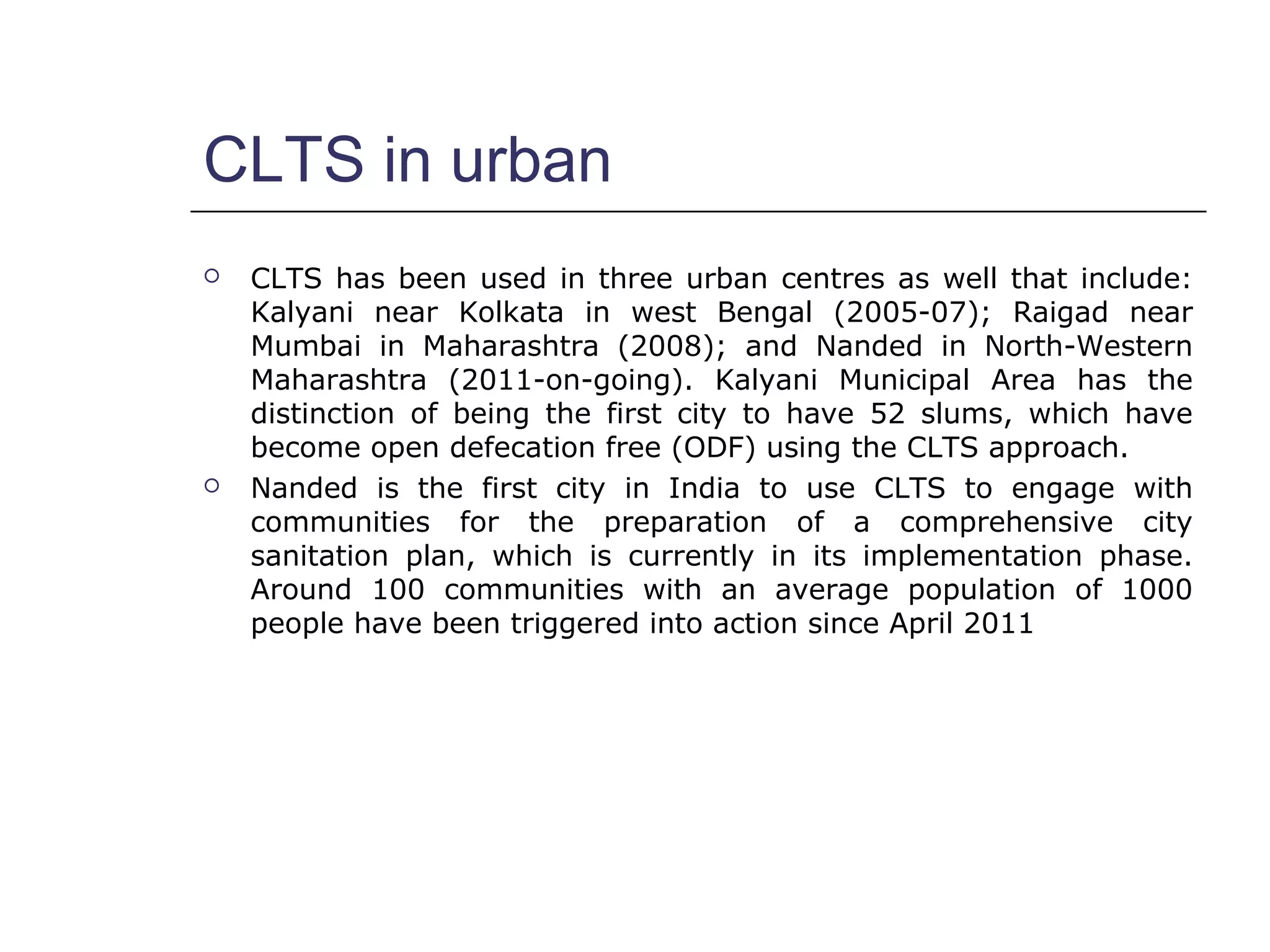
CLTS in urban
 CLTS has been used in three urban centres as well that include:
Kalyani near Kolkata in west Bengal (2005-07); Raigad near
Mumbai in Maharashtra (2008); and Nanded in North-Western
Maharashtra (2011-on-going). Kalyani Municipal Area has the
distinction of being the first city to have 52 slums, which have
become open defecation free (ODF) using the CLTS approach.
 Nanded is the first city in India to use CLTS to engage with
communities for the preparation of a comprehensive city
sanitation plan, which is currently in its implementation phase.
Around 100 communities with an average population of 1000
people have been triggered into action since April 2011
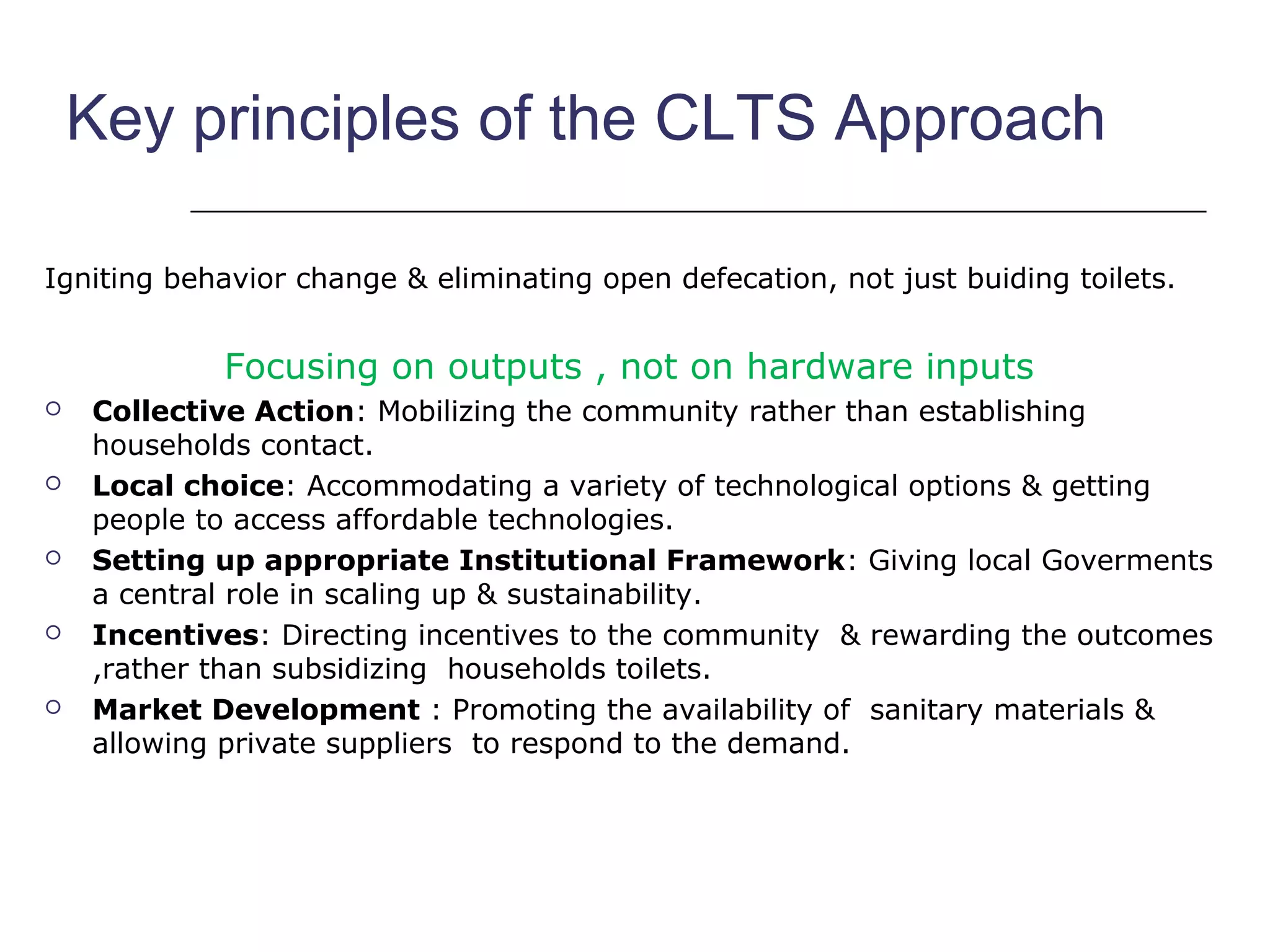
Key principles of the CLTS Approach
Igniting behavior change & eliminating open defecation, not just buiding toilets.
Focusing on outputs , not on hardware inputs
 Collective Action: Mobilizing the community rather than establishing
households contact.
 Local choice: Accommodating a variety of technological options & getting
people to access affordable technologies.
 Setting up appropriate Institutional Framework: Giving local Goverments
a central role in scaling up & sustainability.
 Incentives: Directing incentives to the community & rewarding the outcomes
,rather than subsidizing households toilets.
 Market Development : Promoting the availability of sanitary materials &
allowing private suppliers to respond to the demand.
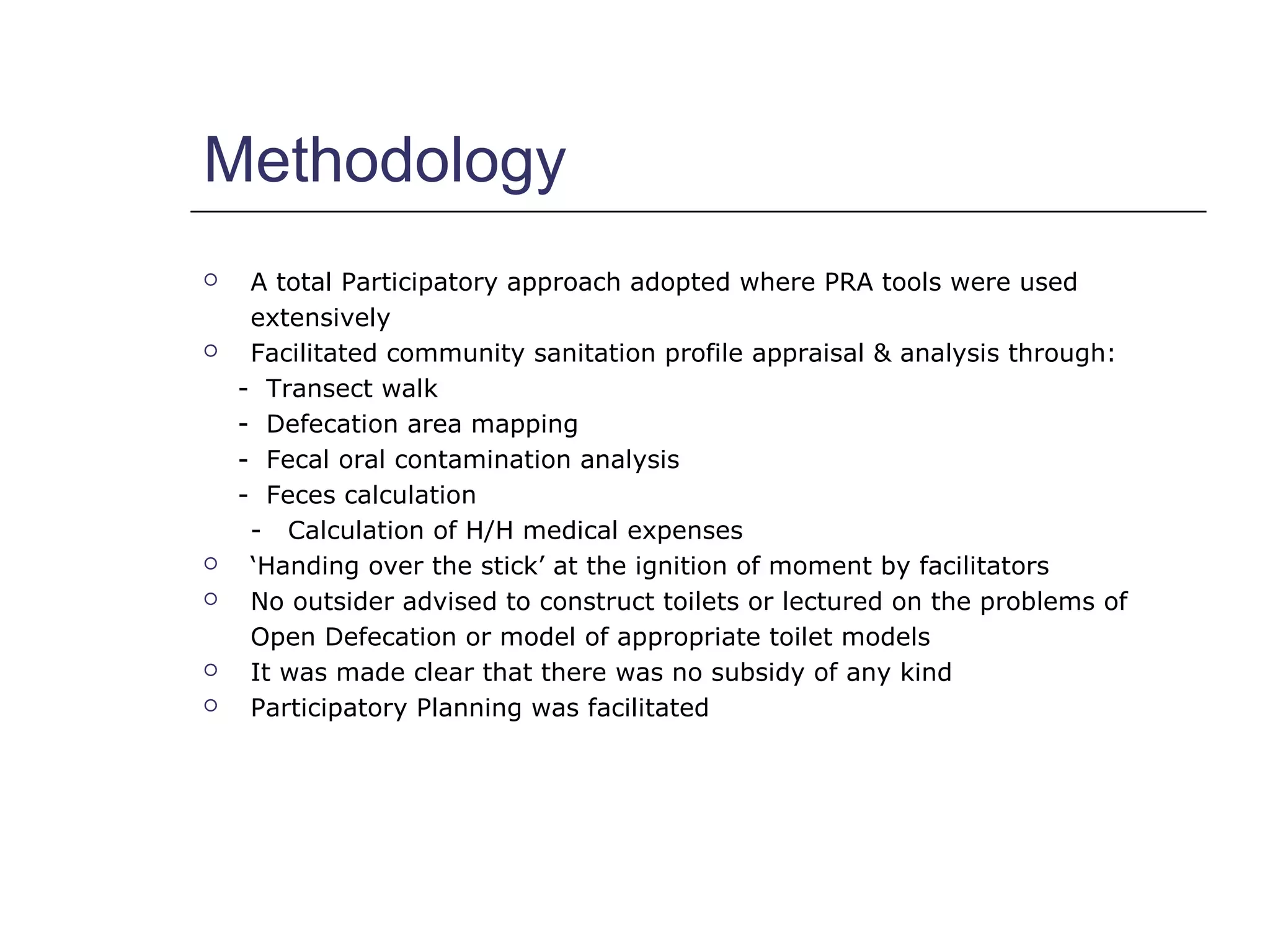
Methodology
 A total Participatory approach adopted where PRA tools were used
extensively
 Facilitated community sanitation profile appraisal & analysis through:
- Transect walk
- Defecation area mapping
- Fecal oral contamination analysis
- Feces calculation
- Calculation of H/H medical expenses
 ‘Handing over the stick’ at the ignition of moment by facilitators
 No outsider advised to construct toilets or lectured on the problems of
Open Defecation or model of appropriate toilet models
 It was made clear that there was no subsidy of any kind
 Participatory Planning was facilitated
Role of Block Cordinator
 Preparation of Block micro plan and it’s submission through
BWSC to the DWSM for necessary action / approval.
 Co-ordination among Block level officials, NGOs, CBOs, SHG,PRIs
& others
 Implementation of the WATSAN micro-plan – IHHL construction,
solid and liquid waste management, Operation & Maintenance of
School & Anganwadi toilets, Mini water supply Scheme as per
direction of Government.
 Ensure and enable / construction of toilets by the beneficiary
himself.
 Mobilization of community contribution for construction of toilet &
operation & maintenance of rural water supply scheme .
 Ensure use and sustainability of hardware interventions.

Ms. Bhavana Luthra: Resource Person
 Bhawana Luthra is Manager, Training at LEAD ( Leadership for Environment
& Development) India. She carries a sound understanding of the community
based demand responsive and participatory approaches to project planning
and management, particularly in the water, sanitation, health &
hygiene and livelihoods sector. Has first hand on-the-ground experience
of facilitating community processes, identifying best practices, and culling
out and documenting key learning from innovative community driven
projects in Madhya Pradesh, Himachal Pradesh and Chhattisgarh.
 Was the team leader for organizing a series of community led total
sanitation (CLTS) training of trainers workshops in the states of
Himachal Pradesh and Meghalaya in India. Has trained more than 500
trainers in CLTS so far as the leader of the resource team providing
capacity building support to Government functionaries, NGOs, CBOS in the
approach and methodology of Community Led Total Sanitation in
Himachal Pradesh under the assignment“ Resource Agency for
support in Community Led Total Sanitation in India”.
We need to shift from the “Blue print” approach to
“Community Led Innovative” approach which is more
flexible.
THANK YOU

Presentation on CLTS_ Arvind

  • 1.
    Community Led TotalSanitation (CLTS): An Approach that works Arvind kumar WATSAN CLUSTER COORDINATOR- Saran
  • 2.
    What is CLTS •CLTS is an innovative methodology for mobilising communities to completely eliminate open defecation (OD). Communities are facilitated to conduct their own appraisal and analysis of open defecation (OD) and take their own action to become ODF (open defecation free). • The cardinal objectives of the CLTS have been the drive to create a healthy environment with basic sanitation means such as well aerated latrines in the rural areas to combat the menace of open defecation in rural communities especially. • It allows the people to be involved in assessing its level of open defecation and proffering solution on how to make their community open defecation free. CLTS was pioneered by Kamal Kar (a development consultant from India) together with VERC (Village Education Resource Centre), a partner of WaterAid Bangladesh, in 2000 in Mosmoil, a village in the Rajshahi district of Bangladesh, whilst evaluating a traditionally subsidised sanitation programme.
  • 3.
    CLTS in India Community Led Total Sanitation (CLTS) in India is mostly used within the framework of Government of India’s Total Sanitation Campaign (TSC), which was launched in 1999.  CLTS is reportedly in use now in 16 of 35 states in India. Since its introduction in Ahmednagar and Nanded districts of Maharashtra in 2002 on a pilot basis, CLTS has been reportedly used in varying degrees across 135 districts in the country so far, particularly since 2006. As per a rough estimate, around 5 million people have gained access to safe sanitation following CLTS interventions across rural India.
  • 4.
    Continue……  Himachal Pradesh(HP) and Haryana are the two states where CLTS has been used in all the districts. . While HP remains the only state where state sanitation strategy of 2005 adopts CLTS principles of no-subsidy and community ownership of the sanitation agenda, Haryana is a state which has underplayed the provision of subsidy in TSC to support those who have tried to make the sanitation drive community led using the CLTS approach, as in the districts of Panipat and Sirsa.  In Himachal Pradesh and Haryana where CLTS has been used in all the districts of the state, results have been remarkably better with around 60-70% increase in sanitation coverage over a period of 4-5 years during 2006-2010.  In states of Meghalaya, Maharashtra, and Madhya Pradesh, where CLTS has been introduced in few of the districts, rate of increase in sanitation coverage has been in the range of around 30-40% during the same period.  In the state of Bihar, where there is provision of subsidy both for above poverty line (APL) and below poverty line (BPL) households with no CLTS activity so far, the rate of increase in sanitation coverage has been only around 20% in that period.
  • 5.
    CLTS in Bihar Being implemented by WSP ( water & Sanitation Programme).  an introductory one day state level workshop on CLTS was held on the 27th January 2011.  Our BTAST is going to implement in decided to carry out the piloting in one block each of Bettiah (West Champaran), Gaya, Nalanda & Purnia. West Champaran and Purnia districts are the priority districts for the SWASTH intervention in Bihar. Gaya is selected because of being a religious tourist place, where as Nalanda for its proximity to the state capital and its political significance
  • 6.
    CLTS in urban CLTS has been used in three urban centres as well that include: Kalyani near Kolkata in west Bengal (2005-07); Raigad near Mumbai in Maharashtra (2008); and Nanded in North-Western Maharashtra (2011-on-going). Kalyani Municipal Area has the distinction of being the first city to have 52 slums, which have become open defecation free (ODF) using the CLTS approach.  Nanded is the first city in India to use CLTS to engage with communities for the preparation of a comprehensive city sanitation plan, which is currently in its implementation phase. Around 100 communities with an average population of 1000 people have been triggered into action since April 2011
  • 7.
    Key principles ofthe CLTS Approach Igniting behavior change & eliminating open defecation, not just buiding toilets. Focusing on outputs , not on hardware inputs  Collective Action: Mobilizing the community rather than establishing households contact.  Local choice: Accommodating a variety of technological options & getting people to access affordable technologies.  Setting up appropriate Institutional Framework: Giving local Goverments a central role in scaling up & sustainability.  Incentives: Directing incentives to the community & rewarding the outcomes ,rather than subsidizing households toilets.  Market Development : Promoting the availability of sanitary materials & allowing private suppliers to respond to the demand.
  • 8.
    Methodology  A totalParticipatory approach adopted where PRA tools were used extensively  Facilitated community sanitation profile appraisal & analysis through: - Transect walk - Defecation area mapping - Fecal oral contamination analysis - Feces calculation - Calculation of H/H medical expenses  ‘Handing over the stick’ at the ignition of moment by facilitators  No outsider advised to construct toilets or lectured on the problems of Open Defecation or model of appropriate toilet models  It was made clear that there was no subsidy of any kind  Participatory Planning was facilitated
  • 9.
    Role of BlockCordinator  Preparation of Block micro plan and it’s submission through BWSC to the DWSM for necessary action / approval.  Co-ordination among Block level officials, NGOs, CBOs, SHG,PRIs & others  Implementation of the WATSAN micro-plan – IHHL construction, solid and liquid waste management, Operation & Maintenance of School & Anganwadi toilets, Mini water supply Scheme as per direction of Government.  Ensure and enable / construction of toilets by the beneficiary himself.  Mobilization of community contribution for construction of toilet & operation & maintenance of rural water supply scheme .  Ensure use and sustainability of hardware interventions. 
  • 10.
    Ms. Bhavana Luthra:Resource Person  Bhawana Luthra is Manager, Training at LEAD ( Leadership for Environment & Development) India. She carries a sound understanding of the community based demand responsive and participatory approaches to project planning and management, particularly in the water, sanitation, health & hygiene and livelihoods sector. Has first hand on-the-ground experience of facilitating community processes, identifying best practices, and culling out and documenting key learning from innovative community driven projects in Madhya Pradesh, Himachal Pradesh and Chhattisgarh.  Was the team leader for organizing a series of community led total sanitation (CLTS) training of trainers workshops in the states of Himachal Pradesh and Meghalaya in India. Has trained more than 500 trainers in CLTS so far as the leader of the resource team providing capacity building support to Government functionaries, NGOs, CBOS in the approach and methodology of Community Led Total Sanitation in Himachal Pradesh under the assignment“ Resource Agency for support in Community Led Total Sanitation in India”.
  • 11.
    We need toshift from the “Blue print” approach to “Community Led Innovative” approach which is more flexible. THANK YOU

Editor's Notes

  • #3 In Begusarai: 5 panchayat are selected for NGP for 2010-2011. In sanitation status:Only IHHL both APL & BPL.