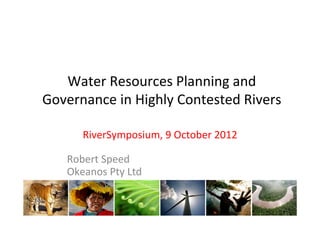
Water	
  Resources	
  Planning	
  and	
  
Governance	
  in	
  Highly	
  Contested	
  Rivers	
  

          RiverSymposium,	
  9	
  October	
  2012	


     Robert	
  Speed	
  
     Okeanos	
  Pty	
  Ltd	


The image cannot be displayed. Your computer may not have enough memory to open the image, or the image may have been corrupted. Restart your computer, and then open the file again. If the red x still appears, you may have to delete the image and then insert it again.
gregated global gap between existing accessible, reliable
ply1 and 2030 water withdrawals, assuming no efficiency gain
m3, 154 basins/regions

                                                        6,900
                                         2%              900
                                       CAGR                                                                      -40%
                                                                           2,800
                                                        1,500
             Municipal &             4,500                                                                       4,200
             Domestic                                                                          100
                                      600                                                                         700         Groundwater
             Industry                 800
                                                                          Relevant supply quantity is
                                                                                much lower that the
                                                        4,500              absolute renewable water
                                                                                availability in nature           3,500       Surface water
             Agriculture             3,100


                                  Existing     2030         Basins with                    Basins with        Existing
                                  withdrawals2 withdrawals3 deficits                       surplus            accessible,
                                                                                                              reliable,
                                                                                                              sustainable
                                                                                                              supply1
                    Units:	
  billion	
  m3	
  
ng supply which canSource:	
  Mat 90% reliability, based on historical hydrology and infrastructure investments scheduled through 2010; net of
                     be provided ckinsey,	
  2009,	
  Char%ng	
  our	
  Water	
  
 nmental requirements
                    Future	
  
d on 2010 agricultural production analyses from IFPRI
d on GDP, population projections and agricultural production projections from IFPRI; considers no water productivity gains between 2005-2030

E: Water 2030 Global Water Supply and Demand model; agricultural production based on IFPRI IMPACT-WATER base case
Historical	
  PerspecHves	
  and	
  
                        Approaches	


  Infrastructure &              Systemic water                  Growth &
      water use                   resources                    development
• water resource (surface)   • catchment (IWRM)            • political-economic
• reconciliation             • resource protection         • inter-sectoral
• demand projections         • demand management           • uncertainty (change)
• water supply regulation    • WQ management               • water as catalyst/const
• system optimisation        • stakeholder engagement      • adaptive management
      pre-­‐1970’s	
            1980’s	
  &	
  1990s	
              2000’s	
  
Issue	
  1.	
  	
  
•  In	
  heavily	
  contested	
  basins,	
  it	
  is	
  oQen	
  no	
  
   longer	
  possible	
  to	
  allocate	
  and	
  manage	
  water	
  
   resources	
  to	
  meet	
  all	
  developmental	
  
   demands.	
  
•  Water	
  is	
  both	
  a	
  major	
  constraint	
  and	
  also	
  a	
  
   catalyst	
  for	
  economic	
  development.	
  
        ShiQ	
  from	
  “water	
  for	
  the	
  economy”	
  to	
  
        “water	
  in	
  the	
  economy”	
  
The image cannot be displayed. Your computer may not have enough memory to open the image, or the image may have been corrupted. Restart your computer, and then open the file again. If the red x still appears, you may have to delete the image and then insert it again.


Lesson:	
  	
  
Water	
  plans	
  and	
  development	
  plans	
  should	
  
be	
  developed	
  through	
  an	
  itera6ve	
  process	


Issue	
  2.	
  
•  People	
  –	
  and	
  what	
  they	
  value	
  –	
  maXer	
  in	
  
   water	
  resources	
  management.	
  All	
  the	
  more	
  so	
  
   in	
  contested	
  basins.	
  
Lesson:	
  	
  
Understand	
  the	
  social	
  and	
  cultural	
  values	
  
and	
  incorporate	
  those	
  in	
  the	
  process	
  
Issue	
  3.	
  
•  Where	
  water	
  resources	
  development	
  offers	
  
   clear	
  social	
  and	
  economic	
  benefits,	
  
   environmental	
  protecHon	
  needs	
  to	
  
   demonstrate	
  an	
  equally	
  compelling	
  case.	


  In	
  developing	
  countries,	
  this	
  is	
  even	
  more	
  
   	
  criHcal.	
  	
  
95%	
  
                                                    decline	
  in	
  
                                                    fish	
  fry	
  

Lesson:	
  the	
  importance	
  of	
  good	
  science	
  and	
  
monitoring	
  only	
  increases	
  as	
  basins	
  become	
  
more	
  contested	
  
Issue	
  4.	
  
•  Challenges	
  associated	
  with	
  water	
  security	
  are	
  
   intricately	
  linked	
  with	
  issues	
  related	
  to	
  food	
  
   and	
  energy	
  security	
  
Lesson:	
  	
  
Understand	
  the	
  connec6ons,	
  the	
  
dependencies,	
  and	
  the	
  costs	
  and	
  benefits	
  
Issue	
  5.	
  
•  Having	
  an	
  aspiraHonal	
  vision	
  for	
  a	
  basin	
  can	
  
   promote	
  a	
  long-­‐term	
  view	
  
   	
  BUT	
  
   	
  may	
  not	
  always	
  provide	
  guidance	
  on	
  how	
  
   	
  trade-­‐offs	
  	
  should	
  be	
  managed	
  
Lesson:	
  	
  
Acknowledge	
  that	
  you	
  can’t	
  have	
  everything	
  
and	
  decide	
  what	
  it	
  is	
  you	
  want	
  from	
  the	
  basin	
  
	
                                                     Pegram	
  et	
  al.,	
  2012	
  
Thank	
  you!	
  

Water Resources Planning and Governance in Highly Contested Rivers

  • 1.
    Water  Resources  Planning  and   Governance  in  Highly  Contested  Rivers   RiverSymposium,  9  October  2012     Robert  Speed   Okeanos  Pty  Ltd      
  • 2.
    The image cannotbe displayed. Your computer may not have enough memory to open the image, or the image may have been corrupted. Restart your computer, and then open the file again. If the red x still appears, you may have to delete the image and then insert it again.
  • 3.
    gregated global gapbetween existing accessible, reliable ply1 and 2030 water withdrawals, assuming no efficiency gain m3, 154 basins/regions 6,900 2% 900 CAGR -40% 2,800 1,500 Municipal & 4,500 4,200 Domestic 100 600 700 Groundwater Industry 800 Relevant supply quantity is much lower that the 4,500 absolute renewable water availability in nature 3,500 Surface water Agriculture 3,100 Existing 2030 Basins with Basins with Existing withdrawals2 withdrawals3 deficits surplus accessible, reliable, sustainable supply1 Units:  billion  m3   ng supply which canSource:  Mat 90% reliability, based on historical hydrology and infrastructure investments scheduled through 2010; net of be provided ckinsey,  2009,  Char%ng  our  Water   nmental requirements Future   d on 2010 agricultural production analyses from IFPRI d on GDP, population projections and agricultural production projections from IFPRI; considers no water productivity gains between 2005-2030 E: Water 2030 Global Water Supply and Demand model; agricultural production based on IFPRI IMPACT-WATER base case
  • 4.
    Historical  PerspecHves  and   Approaches   Infrastructure & Systemic water Growth & water use resources development • water resource (surface) • catchment (IWRM) • political-economic • reconciliation • resource protection • inter-sectoral • demand projections • demand management • uncertainty (change) • water supply regulation • WQ management • water as catalyst/const • system optimisation • stakeholder engagement • adaptive management pre-­‐1970’s   1980’s  &  1990s   2000’s  
  • 5.
    Issue  1.     •  In  heavily  contested  basins,  it  is  oQen  no   longer  possible  to  allocate  and  manage  water   resources  to  meet  all  developmental   demands.   •  Water  is  both  a  major  constraint  and  also  a   catalyst  for  economic  development.   ShiQ  from  “water  for  the  economy”  to   “water  in  the  economy”  
  • 6.
    The image cannotbe displayed. Your computer may not have enough memory to open the image, or the image may have been corrupted. Restart your computer, and then open the file again. If the red x still appears, you may have to delete the image and then insert it again. Lesson:     Water  plans  and  development  plans  should   be  developed  through  an  itera6ve  process    
  • 7.
    Issue  2.   • People  –  and  what  they  value  –  maXer  in   water  resources  management.  All  the  more  so   in  contested  basins.  
  • 8.
    Lesson:     Understand  the  social  and  cultural  values   and  incorporate  those  in  the  process  
  • 9.
    Issue  3.   • Where  water  resources  development  offers   clear  social  and  economic  benefits,   environmental  protecHon  needs  to   demonstrate  an  equally  compelling  case.          In  developing  countries,  this  is  even  more    criHcal.    
  • 10.
    95%   decline  in   fish  fry   Lesson:  the  importance  of  good  science  and   monitoring  only  increases  as  basins  become   more  contested  
  • 11.
    Issue  4.   • Challenges  associated  with  water  security  are   intricately  linked  with  issues  related  to  food   and  energy  security  
  • 12.
    Lesson:     Understand  the  connec6ons,  the   dependencies,  and  the  costs  and  benefits  
  • 13.
    Issue  5.   • Having  an  aspiraHonal  vision  for  a  basin  can   promote  a  long-­‐term  view    BUT    may  not  always  provide  guidance  on  how    trade-­‐offs    should  be  managed  
  • 14.
    Lesson:     Acknowledge  that  you  can’t  have  everything   and  decide  what  it  is  you  want  from  the  basin     Pegram  et  al.,  2012  
  • 15.