Community Viral Load
Sample Collection
Presentation Outline
• Understand the Viral Load (VL) sample cascade; Eligibility; & requisition
• Understand what are your Responsibilities in Community VL sample
Collection
• Process of VL sample collection & Preparing DBS
• VL sample/DBS Quality – Criteria for Sample Rejection
• Field Tester Tool kit & its contents
Who should get Community viral load sample collection?
• Eligible PLHIV on ART.
• Client consented to community VL sample collection
Viral Load Request –within ART Clinic
• Line list for clients eligible for community VL sample
collection is generated and handed over to the community
team
• Community team/COVS notifies patient, and books
appointment for Community VL sample collection
• Once appointment is confirmed, The Clinician requests for
VL testing using the VL laboratory request form, updates
Patient care card, and hands completed request form to
CHSO/COVS
• COVS/CHSO documents into his Community VL sample
collection log at the facility and goes to the community
What are your responsibilities? (As community VL sample
collectors)
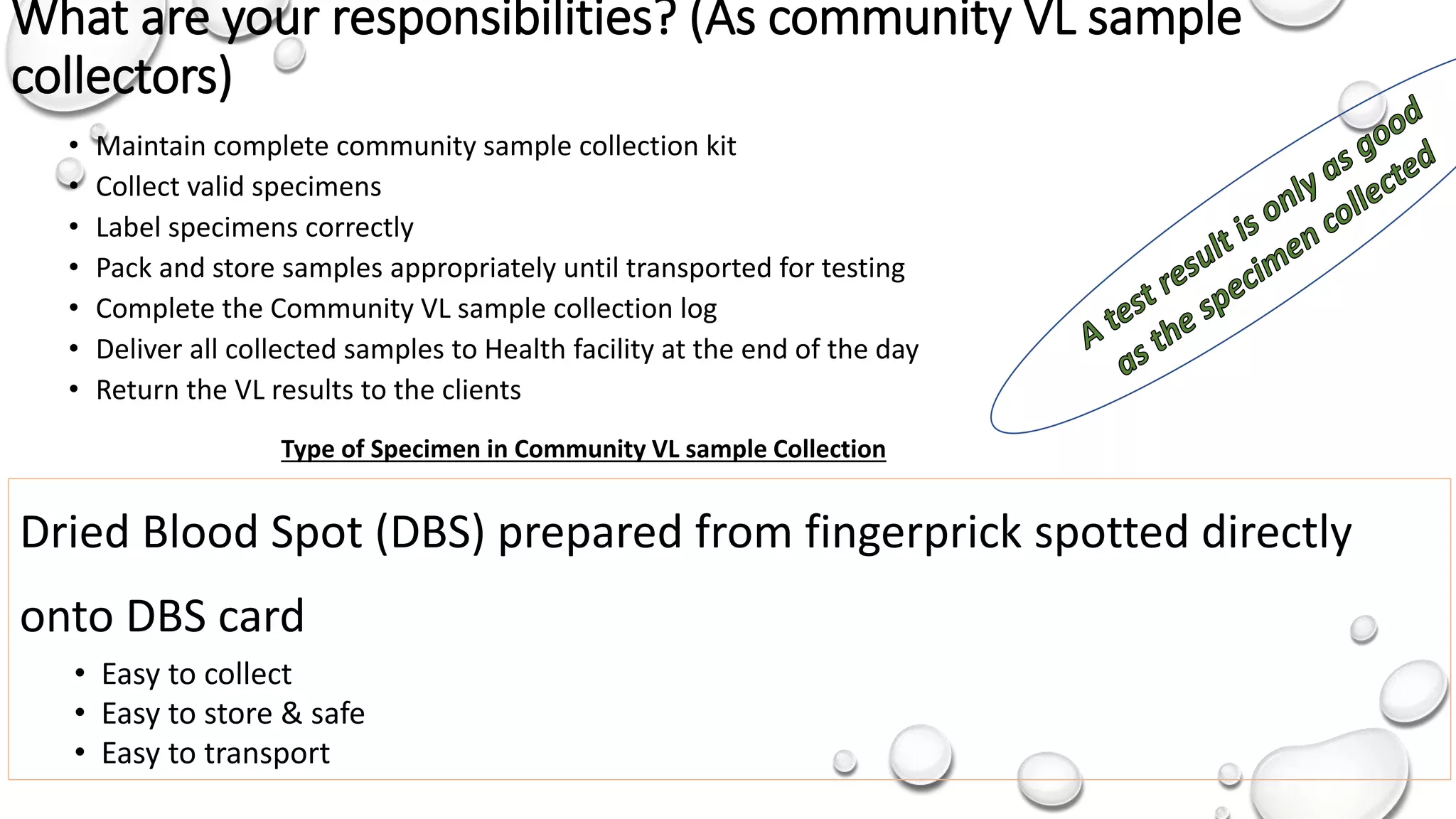
• Maintain complete community sample collection kit
• Collect valid specimens
• Label specimens correctly
• Pack and store samples appropriately until transported for testing
• Complete the Community VL sample collection log
• Deliver all collected samples to Health facility at the end of the day
• Return the VL results to the clients
Type of Specimen in Community VL sample Collection
Dried Blood Spot (DBS) prepared from fingerprick spotted directly
onto DBS card
• Easy to collect
• Easy to store & safe
• Easy to transport
Community VL sample
Processing - DBS
Preparing for DBS Sample collection in the Community
1) Prepare place & Materials
2) Prepare patient-Identification & Verification
3) Collect & Dry specimen & waste disposal
 Make sure the place provides
privacy & confidentiality to the
patient
 Away from wind and dust
 Not exposed to direct sun light
 Clean and non cluttered space
 Calm and where you will not be
distracted
 Labeling DBS card before
sample collection (use
unique patient ID i.e.
CES/JMH/111 and date of
collection) & indicate VL in
upper right corner of the
DBS
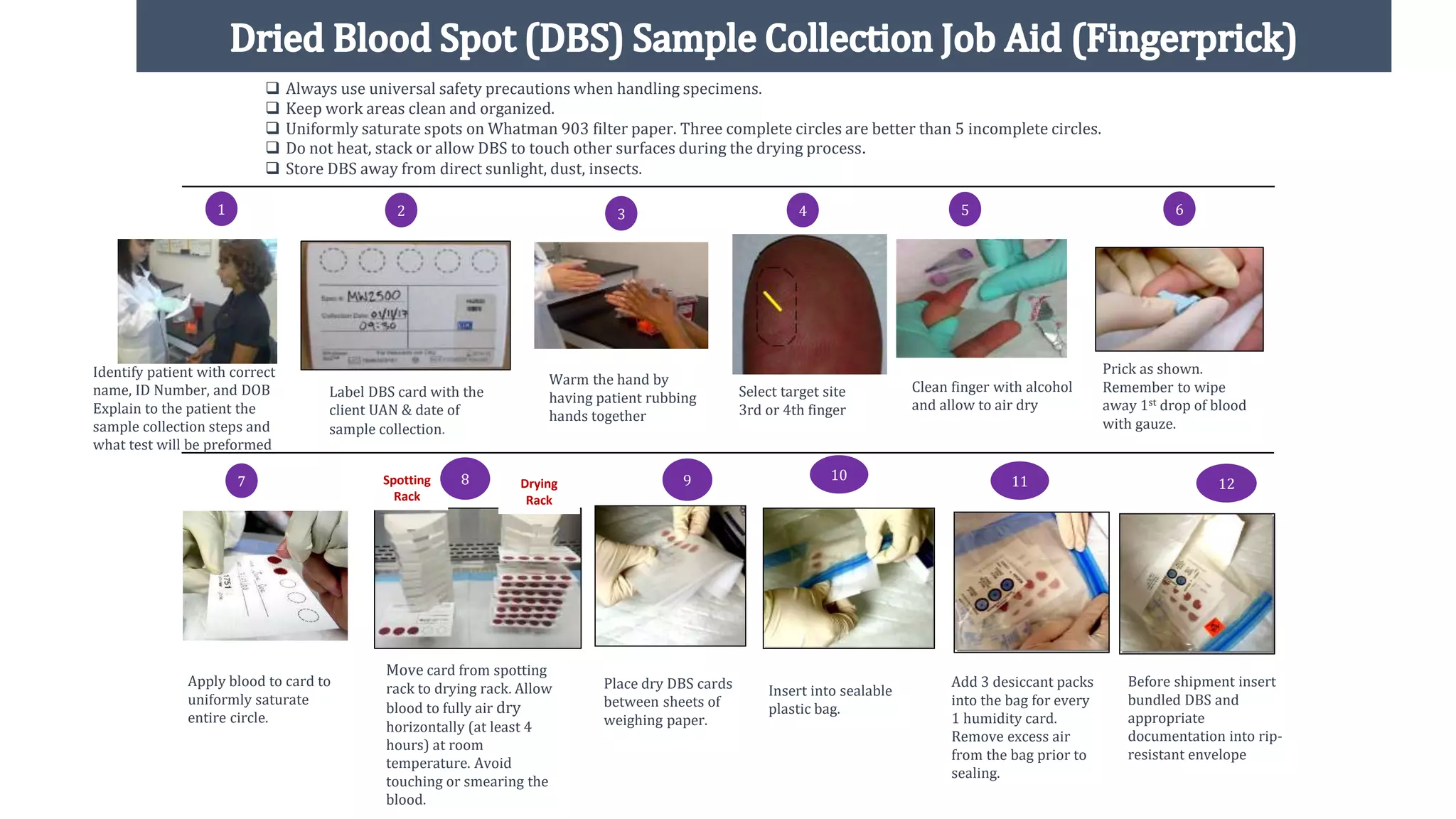
 Always use universal safety precautions when handling specimens.
 Keep work areas clean and organized.
 Uniformly saturate spots on Whatman 903 filter paper. Three complete circles are better than 5 incomplete circles.
 Do not heat, stack or allow DBS to touch other surfaces during the drying process.
 Store DBS away from direct sunlight, dust, insects.
6
2 3 4
1
Prick as shown.
Remember to wipe
away 1st drop of blood
with gauze.
Select target site
3rd or 4th finger
Apply blood to card to
uniformly saturate
entire circle.
Add 3 desiccant packs
into the bag for every
1 humidity card.
Remove excess air
from the bag prior to
sealing.
Insert into sealable
plastic bag.
Place dry DBS cards
between sheets of
weighing paper.
Before shipment insert
bundled DBS and
appropriate
documentation into rip-
resistant envelope
Move card from spotting
rack to drying rack. Allow
blood to fully air dry
horizontally (at least 4
hours) at room
temperature. Avoid
touching or smearing the
blood.
Drying
Rack
Spotting
Rack
12
11
10
8 9
Warm the hand by
having patient rubbing
hands together
7
5
Label DBS card with the
client UAN & date of
sample collection.
Identify patient with correct
name, ID Number, and DOB
Explain to the patient the
sample collection steps and
what test will be preformed
Clean finger with alcohol
and allow to air dry
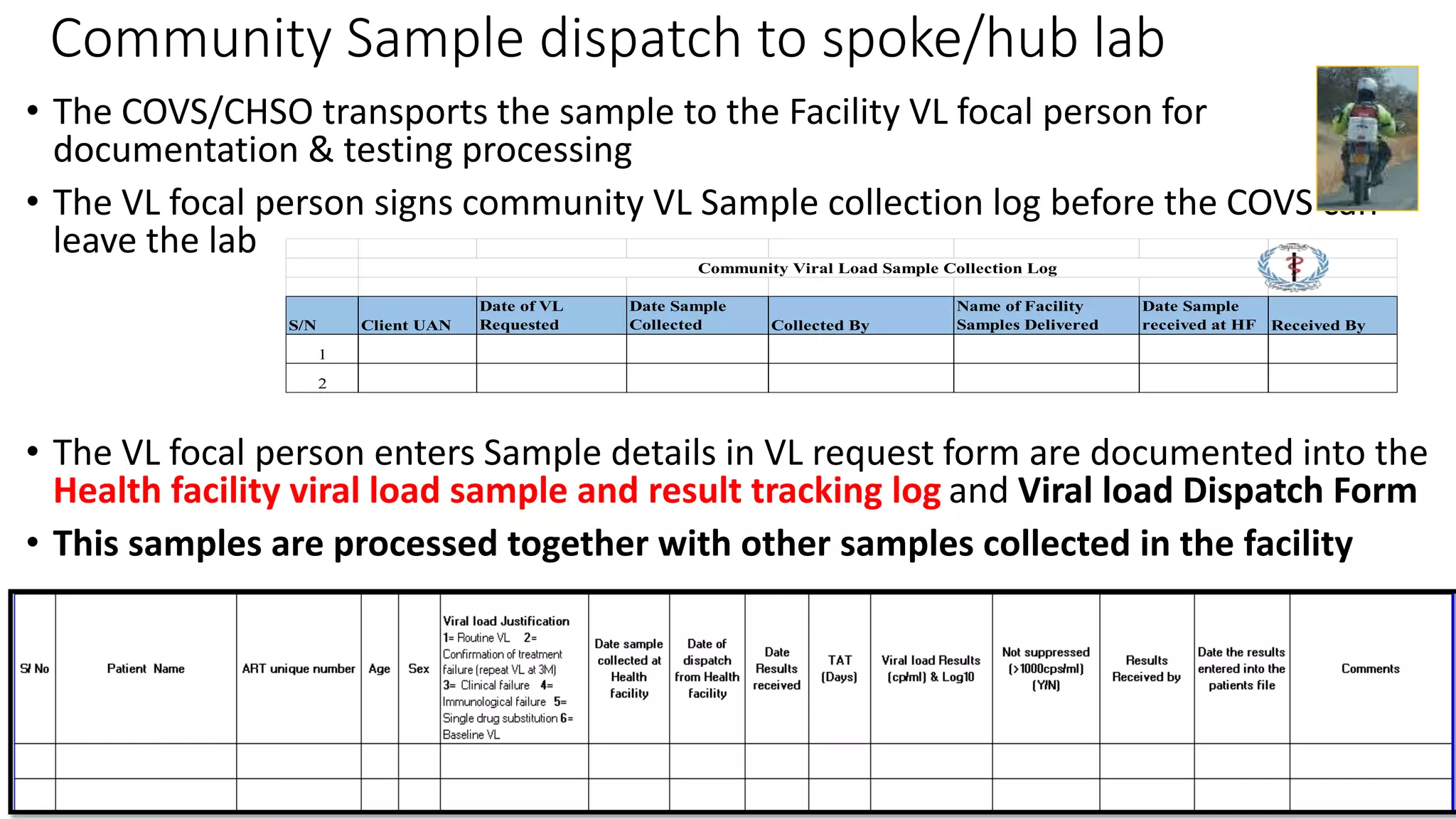
Community Sample dispatch to spoke/hub lab
• The COVS/CHSO transports the sample to the Facility VL focal person for
documentation & testing processing
• The VL focal person signs community VL Sample collection log before the COVS can
leave the lab
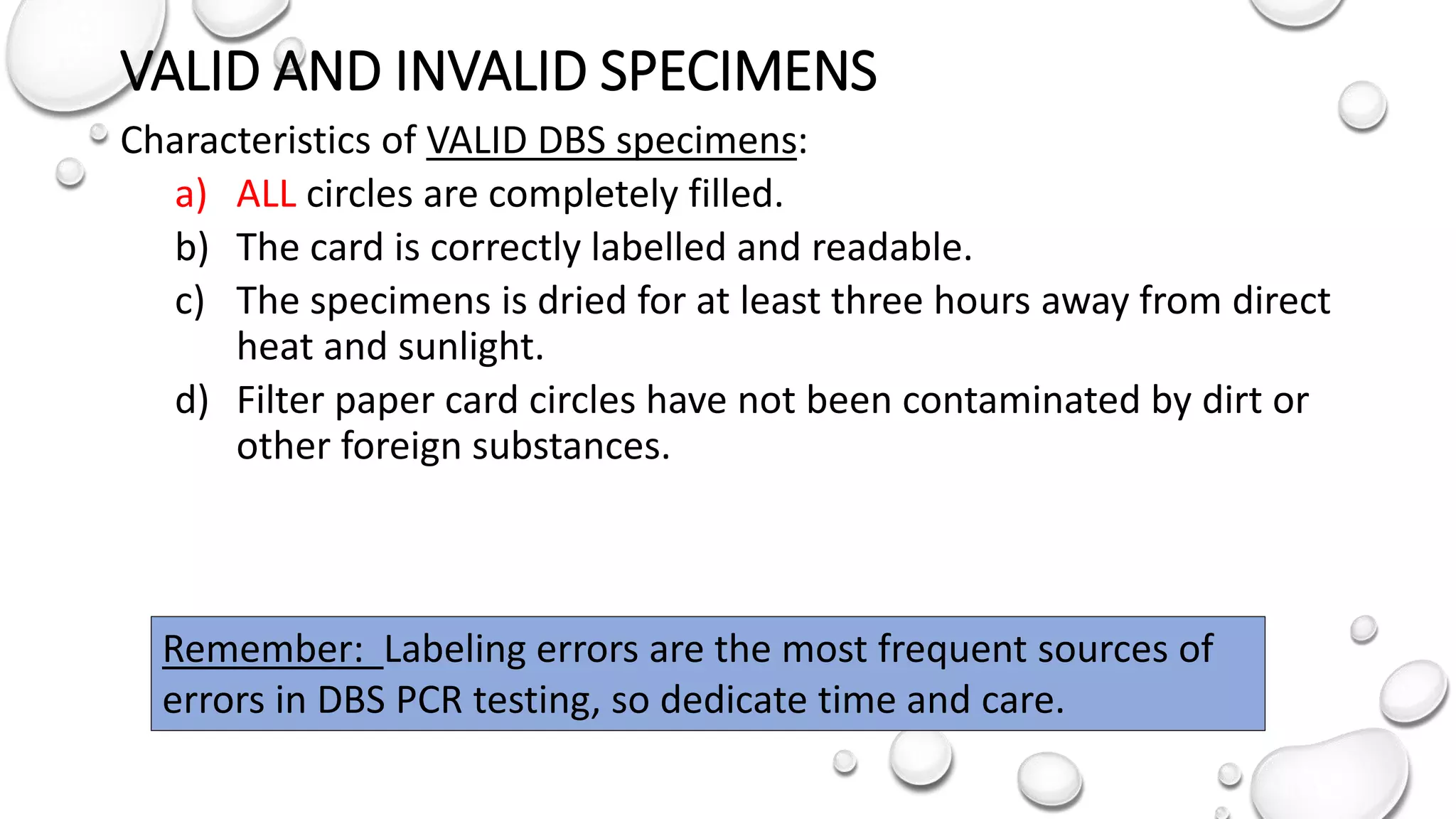
• The VL focal person enters Sample details in VL request form are documented into the
Health facility viral load sample and result tracking log and Viral load Dispatch Form
• This samples are processed together with other samples collected in the facility
S/N Client UAN
Date of VL
Requested
Date Sample
Collected Collected By
Name of Facility
Samples Delivered
Date Sample
received at HF Received By
1
2
Community Viral Load Sample Collection Log
Summary of Community Sample collection & Processing
Facility VL Focal
Person/Lab
Field Tool Kit
Unigold
HIV Determine
RT
Community VL sample collection Kit content
• Community VL sample collection Log
• Hand Sanitizer/ 70% ethanol
• Gloves – 1 box
• Alcohol Swab – 100 swabs
• Plastic Table cover – 1 pc
• Cardboard Sharps container – 1
• Sterile safety lancets– 1 pack
• Cotton wool balls
• Small biohazard bags – 10 pcs
• Pen (blue)
• DBS Cards (desiccants + ziplock bags) – 10
pcs
• VL sample collection Job aid
VALID AND INVALID SPECIMENS
Characteristics of VALID DBS specimens:
a) ALL circles are completely filled.
b) The card is correctly labelled and readable.
c) The specimens is dried for at least three hours away from direct
heat and sunlight.
d) Filter paper card circles have not been contaminated by dirt or
other foreign substances.
Remember: Labeling errors are the most frequent sources of
errors in DBS PCR testing, so dedicate time and care.
Valid and invalid DBS cont’d…
Characteristics of INVALID DBS specimens:
a) Improper or incorrect filling of DBS card.
b) Mismatch of DBS card info and requisition/Dispatch form info.
c) Not enough blood and/or blood spots for testing.
d) Specimen appears scratched or abraded.
e) Oversaturated specimens.
f) Specimen appears clotted or layered (putting multiple drops).
g) Applying blood to both sides of filter paper card.
h) Specimen is hemolyzed, discolored or contaminated
i) Specimen collected on expired card
j) insufficiently dried DBS (humidity >60%)
Patient details on DBS card are not READABLE.
Invalid specimen
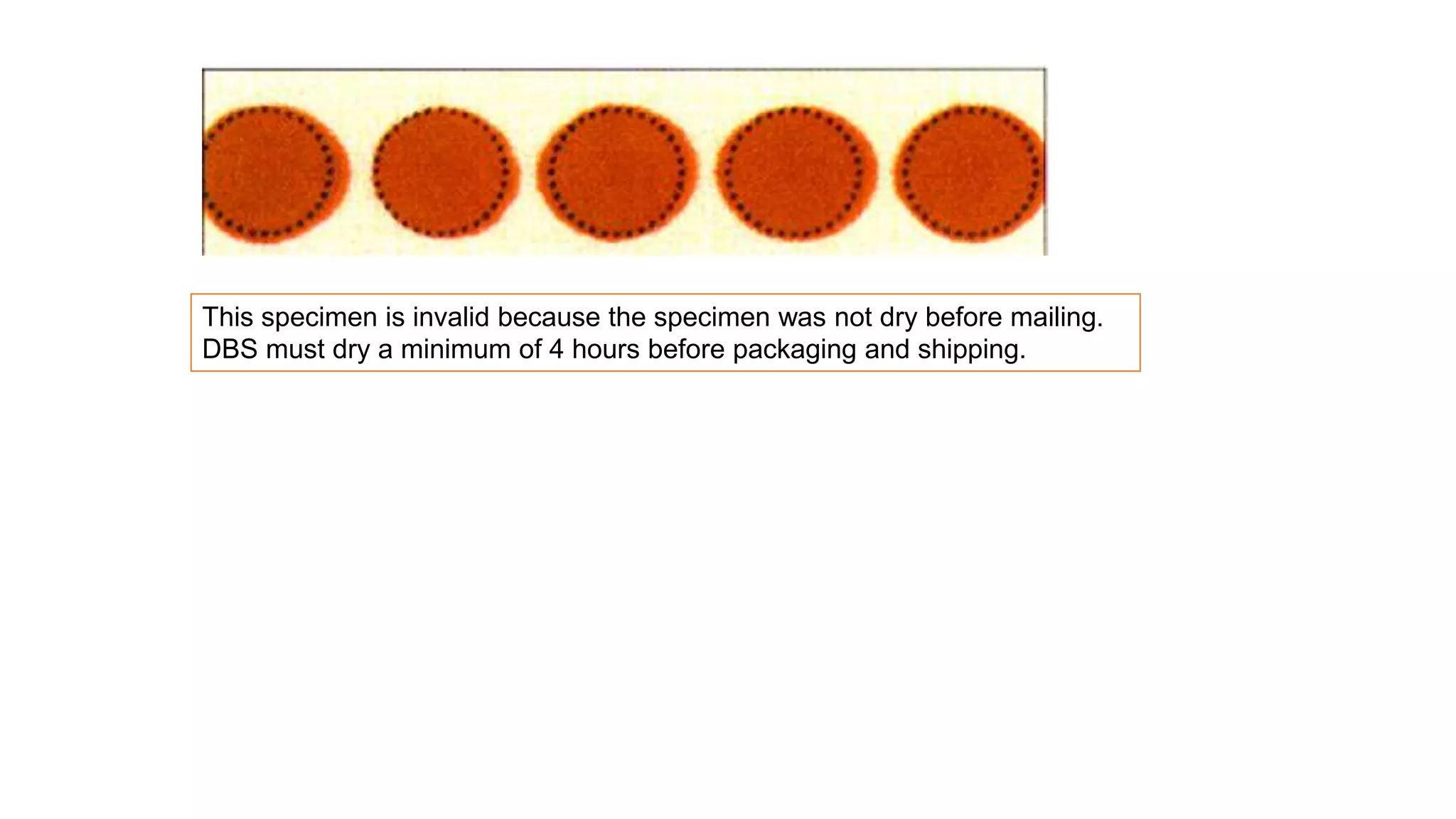
This specimen is invalid because it appears scratched or abraded.
This may have been caused by applying blood with a capillary tube or other device
which came in contact with the card.
This specimen is invalid because the specimen was not dry before mailing.
DBS must dry a minimum of 4 hours before packaging and shipping.
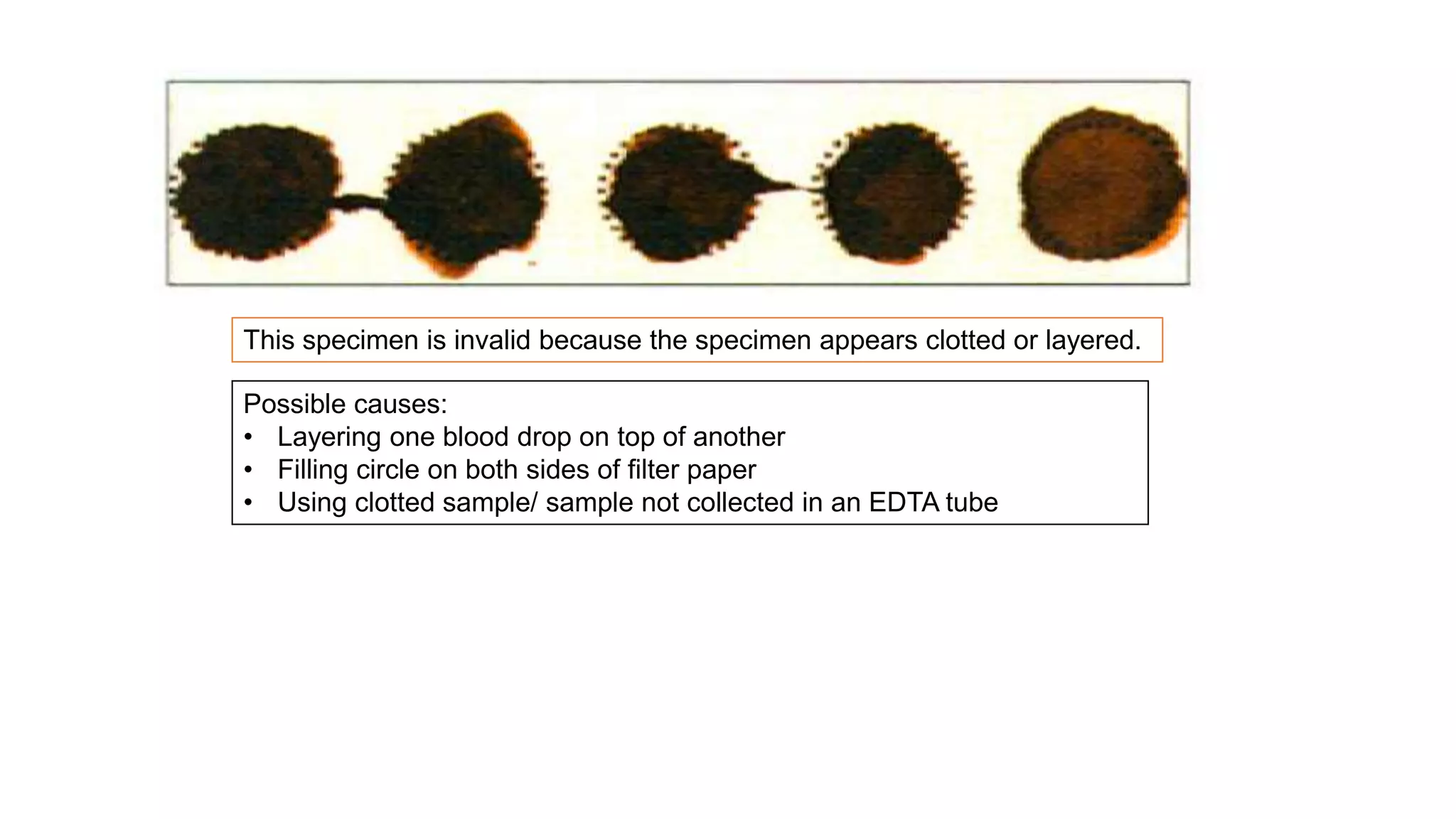
This specimen is invalid because the specimen appears clotted or layered.
Possible causes:
• Layering one blood drop on top of another
• Filling circle on both sides of filter paper
• Using clotted sample/ sample not collected in an EDTA tube
This specimen is invalid because the specimen appears haemolyzed, discoloured, or
contaminated.
Possible causes:
• Allowing filter paper to come in contact with glove or un-gloved hands or substances
either before or after blood collection
• Exposing blood spots to direct heat
Invalid specimen, too saturated.
Possible causes
Soaking both sides of the filter paper card
Applying blood with a syringe
Sample exhibits serum rings
Possible causes:
-Use of clotted blood
-Drying specimen improperly
This specimen is invalid because no blood was applied to the filter paper.

Community Viral Load Sample Collection_V2_Team Review_Feb10-22.pptx

  • 1.
  • 2.
    Presentation Outline • Understandthe Viral Load (VL) sample cascade; Eligibility; & requisition • Understand what are your Responsibilities in Community VL sample Collection • Process of VL sample collection & Preparing DBS • VL sample/DBS Quality – Criteria for Sample Rejection • Field Tester Tool kit & its contents
  • 3.
    Who should getCommunity viral load sample collection? • Eligible PLHIV on ART. • Client consented to community VL sample collection
  • 4.
    Viral Load Request–within ART Clinic • Line list for clients eligible for community VL sample collection is generated and handed over to the community team • Community team/COVS notifies patient, and books appointment for Community VL sample collection • Once appointment is confirmed, The Clinician requests for VL testing using the VL laboratory request form, updates Patient care card, and hands completed request form to CHSO/COVS • COVS/CHSO documents into his Community VL sample collection log at the facility and goes to the community
  • 5.
    What are yourresponsibilities? (As community VL sample collectors) • Maintain complete community sample collection kit • Collect valid specimens • Label specimens correctly • Pack and store samples appropriately until transported for testing • Complete the Community VL sample collection log • Deliver all collected samples to Health facility at the end of the day • Return the VL results to the clients Type of Specimen in Community VL sample Collection Dried Blood Spot (DBS) prepared from fingerprick spotted directly onto DBS card • Easy to collect • Easy to store & safe • Easy to transport
  • 6.
  • 7.
    Preparing for DBSSample collection in the Community 1) Prepare place & Materials 2) Prepare patient-Identification & Verification 3) Collect & Dry specimen & waste disposal  Make sure the place provides privacy & confidentiality to the patient  Away from wind and dust  Not exposed to direct sun light  Clean and non cluttered space  Calm and where you will not be distracted  Labeling DBS card before sample collection (use unique patient ID i.e. CES/JMH/111 and date of collection) & indicate VL in upper right corner of the DBS
  • 8.
     Always useuniversal safety precautions when handling specimens.  Keep work areas clean and organized.  Uniformly saturate spots on Whatman 903 filter paper. Three complete circles are better than 5 incomplete circles.  Do not heat, stack or allow DBS to touch other surfaces during the drying process.  Store DBS away from direct sunlight, dust, insects. 6 2 3 4 1 Prick as shown. Remember to wipe away 1st drop of blood with gauze. Select target site 3rd or 4th finger Apply blood to card to uniformly saturate entire circle. Add 3 desiccant packs into the bag for every 1 humidity card. Remove excess air from the bag prior to sealing. Insert into sealable plastic bag. Place dry DBS cards between sheets of weighing paper. Before shipment insert bundled DBS and appropriate documentation into rip- resistant envelope Move card from spotting rack to drying rack. Allow blood to fully air dry horizontally (at least 4 hours) at room temperature. Avoid touching or smearing the blood. Drying Rack Spotting Rack 12 11 10 8 9 Warm the hand by having patient rubbing hands together 7 5 Label DBS card with the client UAN & date of sample collection. Identify patient with correct name, ID Number, and DOB Explain to the patient the sample collection steps and what test will be preformed Clean finger with alcohol and allow to air dry
  • 9.
    Community Sample dispatchto spoke/hub lab • The COVS/CHSO transports the sample to the Facility VL focal person for documentation & testing processing • The VL focal person signs community VL Sample collection log before the COVS can leave the lab • The VL focal person enters Sample details in VL request form are documented into the Health facility viral load sample and result tracking log and Viral load Dispatch Form • This samples are processed together with other samples collected in the facility S/N Client UAN Date of VL Requested Date Sample Collected Collected By Name of Facility Samples Delivered Date Sample received at HF Received By 1 2 Community Viral Load Sample Collection Log
  • 10.
    Summary of CommunitySample collection & Processing Facility VL Focal Person/Lab
  • 11.
    Field Tool Kit Unigold HIVDetermine RT Community VL sample collection Kit content • Community VL sample collection Log • Hand Sanitizer/ 70% ethanol • Gloves – 1 box • Alcohol Swab – 100 swabs • Plastic Table cover – 1 pc • Cardboard Sharps container – 1 • Sterile safety lancets– 1 pack • Cotton wool balls • Small biohazard bags – 10 pcs • Pen (blue) • DBS Cards (desiccants + ziplock bags) – 10 pcs • VL sample collection Job aid
  • 12.
    VALID AND INVALIDSPECIMENS Characteristics of VALID DBS specimens: a) ALL circles are completely filled. b) The card is correctly labelled and readable. c) The specimens is dried for at least three hours away from direct heat and sunlight. d) Filter paper card circles have not been contaminated by dirt or other foreign substances. Remember: Labeling errors are the most frequent sources of errors in DBS PCR testing, so dedicate time and care.
  • 13.
    Valid and invalidDBS cont’d… Characteristics of INVALID DBS specimens: a) Improper or incorrect filling of DBS card. b) Mismatch of DBS card info and requisition/Dispatch form info. c) Not enough blood and/or blood spots for testing. d) Specimen appears scratched or abraded. e) Oversaturated specimens. f) Specimen appears clotted or layered (putting multiple drops). g) Applying blood to both sides of filter paper card. h) Specimen is hemolyzed, discolored or contaminated i) Specimen collected on expired card j) insufficiently dried DBS (humidity >60%)
  • 14.
    Patient details onDBS card are not READABLE. Invalid specimen
  • 15.
    This specimen isinvalid because it appears scratched or abraded. This may have been caused by applying blood with a capillary tube or other device which came in contact with the card.
  • 16.
    This specimen isinvalid because the specimen was not dry before mailing. DBS must dry a minimum of 4 hours before packaging and shipping.
  • 17.
    This specimen isinvalid because the specimen appears clotted or layered. Possible causes: • Layering one blood drop on top of another • Filling circle on both sides of filter paper • Using clotted sample/ sample not collected in an EDTA tube
  • 18.
    This specimen isinvalid because the specimen appears haemolyzed, discoloured, or contaminated. Possible causes: • Allowing filter paper to come in contact with glove or un-gloved hands or substances either before or after blood collection • Exposing blood spots to direct heat
  • 19.
    Invalid specimen, toosaturated. Possible causes Soaking both sides of the filter paper card Applying blood with a syringe
  • 20.
    Sample exhibits serumrings Possible causes: -Use of clotted blood -Drying specimen improperly
  • 21.
    This specimen isinvalid because no blood was applied to the filter paper.

Editor's Notes

  • #8 Key principles Prepare the place where we are going to draw blood and prepare the DBS Prepare the patient about what he is having the test and how they are going to get the result Prepare the materials to perform the test