Standard Operating
procedure
Standard Operating procedure
• General definition
• A set of written instructions that document a routine or repetitive
activity Followed by an organization
• Laboratory definition
• Documents that include a set of step–by–step instructions that
laboratory staff should meticulously follow when performing a
procedure
• These SOPs are complied to laboratory management system to help
lab staff to carry out complex routine operations
• Following well-written SOPs would ensure
Consistency
Accuracy
• Everyone should perform the tests exactly the same way
• So that the same result can be expected from all staff
• Consistency enables people who use laboratory results
to observe changes in a particular patient’s results over
time
• Following written procedures helps laboratory staff
produce more accurate results
• They do not rely on memory alone so they will not
forget steps in the process
• Following well-written SOPs would ensure
Consistency
Accuracy
Quality
Consistent (reliable) + Accurate
results are primary goals of the
laboratory and could be
considered as the definition of
quality in the laboratory
A good SOP should be
• Concise, Detailed and Clear So that staff not normally performing the procedure will
be able to do so by following the SOP (All necessary details should be included e.g.
ambient temperature requirements and precise timing instructions)
• Easily understood by new personnel or students in training
• Reviewed and Approved by the laboratory management Approval is indicated by a
signature and a date (this is important to ensure that the procedures being used for
testing in the laboratory are those that are up to date and appropriate)
• Updated on a regular basis
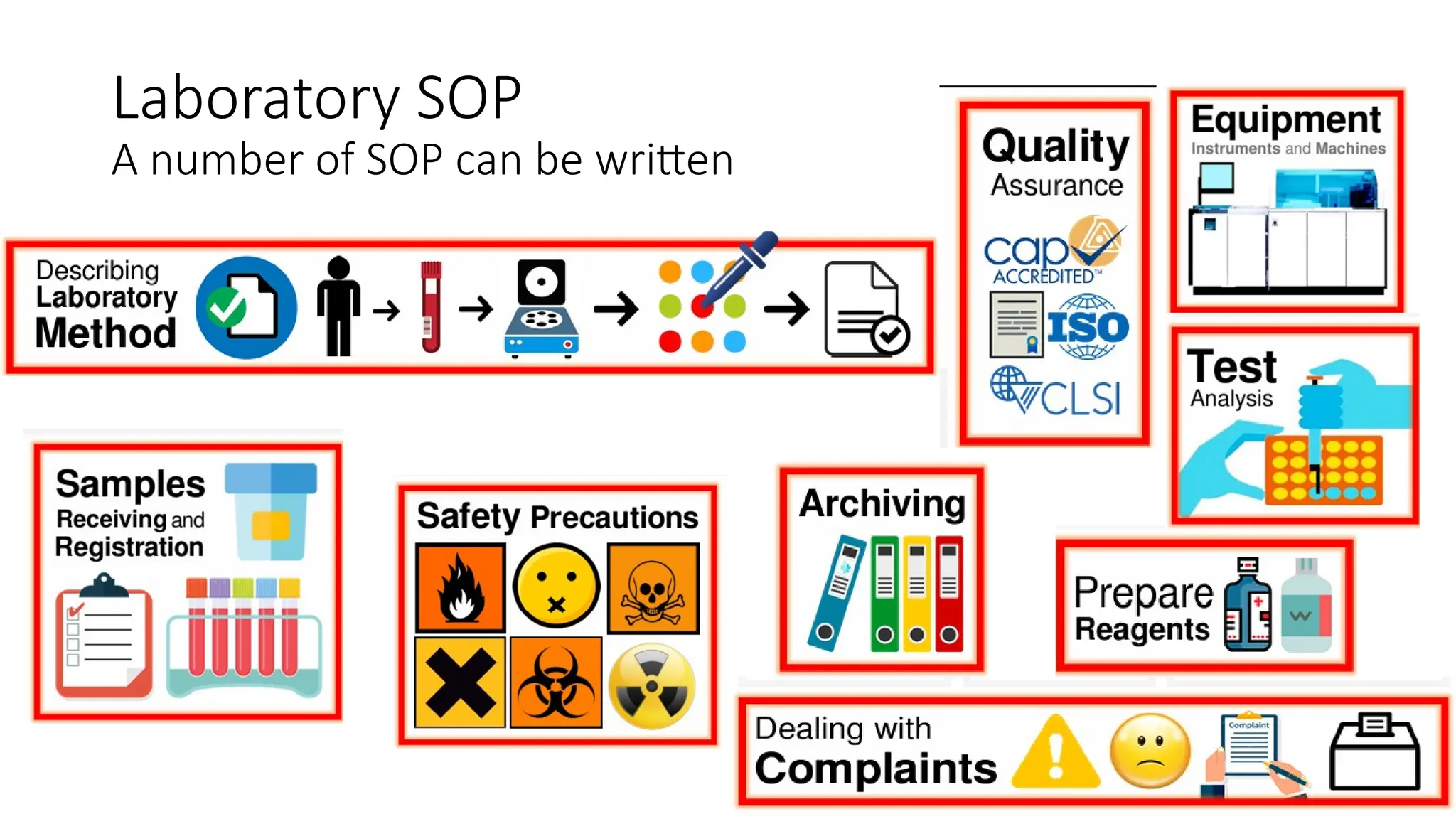
Laboratory SOP
A number of SOP can be written
• Writing SOPs is a Team Mission
• Spreading the tasks of writing SOPs over different staff members
1. Prevents the overloading of one staff member with a huge amount of
work
2. Increases the involvement and commitment of all staff members
Package inserts are NOT SOP’s
• Package inserts do NOT include specific information that pertains to
your laboratory
• Do NOT rely solely on manufacturer’s package inserts for SOP’s
• DO use information from the package insert to include in the SOP’s
• DO use illustrations from package inserts
SOP should contain information on
1. Who can perform the test
2. Their qualification and training
3. How to carry out the test - pre-analytical, analytical and post-analytical stages of
test/procedure
4. Laboratory conditions required for the test/ procedure
5. Routine care and maintenance of equipment
6. Precautions and safety instructions
7. Trouble shooting measures
8. Waste disposal and
9. Linkage with reference laboratories.
Roadmap
SOP overview
• SOPs are documents that include:
• A set of step–by–step instructions that laboratory staff should
meticulously follow when performing a procedure
• In quality management it is important that You do what you say and
say what you do
• By recording all the major processes in the laboratory in SOPs
• You assure that these processes are carried out in exactly the same way every
time Which means that you have standardized the process
Benefits of SOP
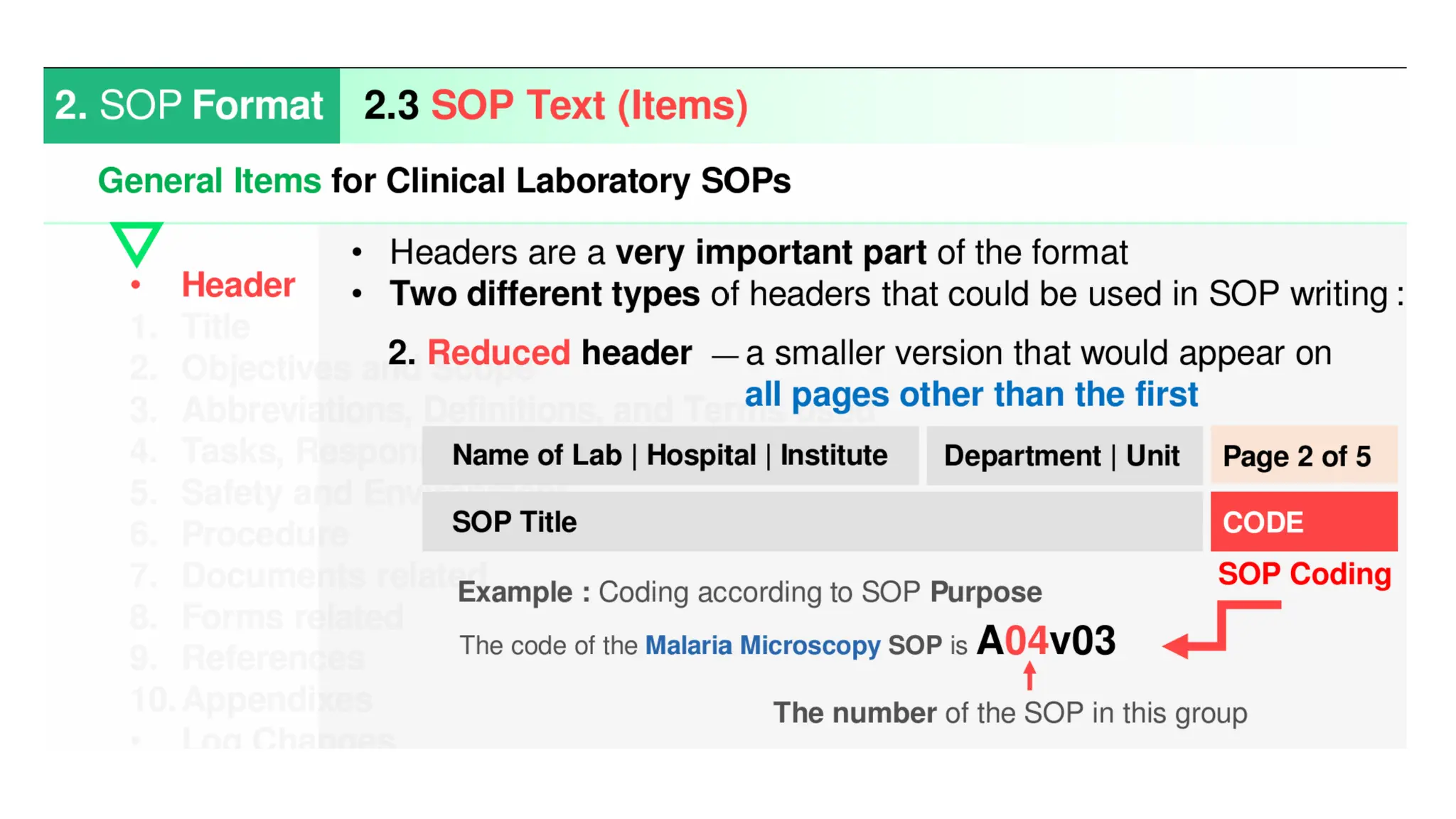
SOP format
• Format of SOP are standardized so that
• Staff can easily recognise the flow of information and use thm
efficiently
National Public Health Lab
Pathology Unit
Leishmans Stain
Standard operating procedure in labs.pptx

Standard operating procedure in labs.pptx

  • 1.
  • 2.
    Standard Operating procedure •General definition • A set of written instructions that document a routine or repetitive activity Followed by an organization • Laboratory definition • Documents that include a set of step–by–step instructions that laboratory staff should meticulously follow when performing a procedure • These SOPs are complied to laboratory management system to help lab staff to carry out complex routine operations
  • 3.
    • Following well-writtenSOPs would ensure Consistency Accuracy • Everyone should perform the tests exactly the same way • So that the same result can be expected from all staff • Consistency enables people who use laboratory results to observe changes in a particular patient’s results over time • Following written procedures helps laboratory staff produce more accurate results • They do not rely on memory alone so they will not forget steps in the process
  • 4.
    • Following well-writtenSOPs would ensure Consistency Accuracy Quality Consistent (reliable) + Accurate results are primary goals of the laboratory and could be considered as the definition of quality in the laboratory
  • 5.
    A good SOPshould be • Concise, Detailed and Clear So that staff not normally performing the procedure will be able to do so by following the SOP (All necessary details should be included e.g. ambient temperature requirements and precise timing instructions) • Easily understood by new personnel or students in training • Reviewed and Approved by the laboratory management Approval is indicated by a signature and a date (this is important to ensure that the procedures being used for testing in the laboratory are those that are up to date and appropriate) • Updated on a regular basis
  • 6.
    Laboratory SOP A numberof SOP can be written
  • 7.
    • Writing SOPsis a Team Mission • Spreading the tasks of writing SOPs over different staff members 1. Prevents the overloading of one staff member with a huge amount of work 2. Increases the involvement and commitment of all staff members
  • 8.
    Package inserts areNOT SOP’s • Package inserts do NOT include specific information that pertains to your laboratory • Do NOT rely solely on manufacturer’s package inserts for SOP’s • DO use information from the package insert to include in the SOP’s • DO use illustrations from package inserts
  • 9.
    SOP should containinformation on 1. Who can perform the test 2. Their qualification and training 3. How to carry out the test - pre-analytical, analytical and post-analytical stages of test/procedure 4. Laboratory conditions required for the test/ procedure 5. Routine care and maintenance of equipment 6. Precautions and safety instructions 7. Trouble shooting measures 8. Waste disposal and 9. Linkage with reference laboratories.
  • 10.
  • 11.
    SOP overview • SOPsare documents that include: • A set of step–by–step instructions that laboratory staff should meticulously follow when performing a procedure • In quality management it is important that You do what you say and say what you do • By recording all the major processes in the laboratory in SOPs • You assure that these processes are carried out in exactly the same way every time Which means that you have standardized the process
  • 12.
  • 19.
    SOP format • Formatof SOP are standardized so that • Staff can easily recognise the flow of information and use thm efficiently
  • 21.
    National Public HealthLab Pathology Unit Leishmans Stain