Economic Environment
Chapter 2
Nature of economic environment
• An economy or economic system refers in which the various economic
activities relating to production, distribution, exchange and consumption of
goods and services that are organized in a country and the way in which the
people of a country earn their living.
• Economic environment influences the business to a great extent it refers to
all factors that affect the functioning of a business unit
Factors
• Important factors are:
• Economic conditions
• Economic policies
• Economic systems
Please Support us!
CLICK TO SUBSCRIBE CLICK TO FOLLOW
Economic condition
• The economic conditions of a country –for example, the nature of the
economy, the stage of development of the economy, economic resources,
the level of income, the distribution of income and assets, etc.- are among
the very important determinants of business strategies.
• In a developing country, the low income may be the reason for the very low
demand for the product.
Economic policies
• Some types or categories of business are favourably affected by government
policy, some adversely affected, while it is neutral to some others.
• E.g. a restrictive import policy may greatly help the import competing
industries, while a liberalisation of the import policy may create difficulties
for such industries
Economic System
• The scope of the private business depends on the economic system.
• The freedom of the private enterprise is the greatest in the free market
economy.
Economic system
• The economic system in a country decides the development prospects of a
country to a great extent . Government regulations of economic activities
depends to a very large extent on the nature of economic system
• There are three important types of economic systems
• Capitalism
• Socialism
• Mixed economy
Capitalism
• Capitalism is an economic system in which trade, industry and the means of
production are controlled by private owners with the goal of making profits
in a market economy. Central characteristics of capitalism include capital
accumulation, competitive markets and wage labour In a capitalist economy,
the parties to a transaction typically determine the prices at which assets,
goods, and services are exchanged.
Advantages
• Government - One could say the same for capitalism. Basically, when
governments attempt to control the economy. We end up with problems
such as:
• Corruption
• Lack of incentives
• Poor information
• Efficient Allocation of Resources - In theory, capitalism or the ‘invisible hand of
the market’ ensures resources are distributed according to consumer preferences.
Firms are not rewarded for producing goods people don’t want.
• Efficient Production - In a market system, firms have incentives to be
productively efficient – cutting costs to improve competitiveness and productivity.
If firms don’t remain productive and efficient they will go out of business.
• Dynamic Efficiency - This is efficiency over time. Firms in a capitalist system
need to respond to changes in consumer preferences and respond to new consumer
trends.
• Financial Incentives - Evidence suggests that people work hardest when there is a
personal financial incentive. E.g. entrepreneurs only take risks in setting up
businesses because of the potential for large financial reward.
Disadvantage
• Irrational Behaviour - E.g. People ignore economic fundamentals but get
caught up in speculative bubbles. Stock market boom and bust of 1920s is a
classic example. American housing market in 2000s is another.
• Inequality - The benefits of Capitalism are rarely equitably distributed.
Wealth tend to accrue to a small % of the population. This means that
demand for luxury goods is often limited to a small % of the workforce
• Monopoly Behaviour - A free market allows firms to gain monopoly power and
exploit customers, through charging higher prices. Firms often gain monopsony
power and pay lower wages to workers. For example, in the nineteenth century
American rail-roads often exploited their monopoly power in setting higher prices.
• Immobilities - In a free market, factors of production are supposed to be able to
easily move from an unprofitable sector to a new profitable industry. However, in
practice this is much more difficult. E.g. a farm worker who is made unemployed
cannot just fly off to a big city and find a new job. He has geographical ties to his
birthplace; he may not have the right skills for the job. Therefore, in capitalist
societies we often see long periods of unemployment and recession.
Socialism
• Socialism is an economic system characterised by social ownership of the
means of production and co-operative management of the economy. "Social
ownership" may refer to cooperative enterprises, common ownership, state
ownership, citizen ownership of equity, or any combination of these.
• A socialist economic system consists of a system of production and
distribution organised to directly satisfy economic demands and human
needs, so that goods and services are produced directly for use instead of for
private profit driven by the accumulation of capital.
Advantages
• A Fair System - Socialism gives equal distribution of national wealth and provides everyone
with equal opportunities, irrespective of their, color, caste, creed or economic status.
Socialism, in its truest sense, means equality by all means.
• Reducing Disparities - Socialism reduces the social, economic, and political inequalities
that exist within capitalist societies. By taking the ownerships of production units from the
rich and presenting them to the workers, the government gives the workers a chance to earn
more profits and thus rise to levels of economic well being
• More Humane & True - The effort to make everybody equal in economic, social, and
political terms makes socialism more morally worthwhile than capitalism. It reinforces the
fact that everyone was created equally and it was only through human actions that disparities
arose.
• Eliminates Social Evils - Socialism reduces poverty with eatable wealth
distribution. It also eliminates ill health, as it lays the foundation for the availability
of proper health facilities for everyone. Socialism eliminates other forms of social
deprivation too, by caring for everyone.
• Improved Standard Of Living - The idea behind socialism is to bring up the
living standards of the poorest. It actually works towards raising the living standards
to similar levels, as the better-off members of the respective societies.
• Creates Better Human Resources - As all people, irrespective of their
differences, are provided extensive public services and better facilities, they achieve
their full potential. Better education facilities for all also help in creating better
human resource. Manpower doubles, thus doubling the country’s economic growth,
as everyone works towards a life of betterment.
• Unity - As people work for a common cause and all the profits are shared equally,
the feeling of selfishness is eliminated and a united feeling is gained. Plus, since
socialism bars the difference caused on the grounds of color, sex, creed or religion,
harmony and unity become the keywords for the countrymen.
Disadvantage
• Unreal Theory - True socialism is an imaginative theory and cannot be implemented as it
is. Today, socialism is not adopted in the same way, as it was advocated by Karl Marx and
other socialists. The original form of socialism is neither preached nor practiced.
• Improper Implementation - In socialist countries today, there are a handful of bureaucrats
who control and use the power of the state. They redistribute and regulate wealth and
decide on taxation for the people. Thus, in reality, people do not have control over wealth.
This limits people’s political freedom and reverses the overall concept.
• Negatively Influences Growth Of Economy - Socialism is actually economically
inefficient, as it puts off entrepreneurs from generating wealth, because they usually have to
pay higher taxes.
• Poverty & Social Evils Are Not Eliminated - Socialism might redistribute some
of the wealth of the richest members of the society to the poor, but this move does
not eliminate poverty as a whole. The overall growth of economy suffers
considerably. If there is not enough wealth, then distribution can be hampered.
• No Real Increase In Standard Of Living - Instead of improving the living
standards for all, socialism actually lowers the income of the richest to reduce the
divide and make them fall close to the income levels of the poorest.
• Boosts Incompetence - As socialism provides the poorest with higher levels of
income via social security payments, it deters them from working hard, if at all. It
also creates a negative feeling in the minds of hard working fellows, as they gain no
extra incentives for working hard. Adding to their woes, lazy people get paid equally
as they do. This negatively impacts productivity and thus economic growth.
Mixed economy
• Mixed economy is an economic system in which both the private sector and state
direct the economy, reflecting characteristics of both market economies and
planned economies. Most mixed economies can be described as market economies
with strong regulatory oversight, and many mixed economies feature a variety of
government-run enterprises and governmental provision of public goods.
• The basic idea of the mixed economy is that the means of production are mainly
under private ownership; that markets remain the dominant form of economic
coordination; and that profit-seeking enterprises and the accumulation of capital
remains the fundamental driving force behind economic activity.
Advantage
• Rapid economic development – In mixed economy both private and public sectors work
side by side. The combined efforts lead to rapid economic development. The economic
resources of the economy are used efficiently. Wastages of resources are minimized.
• Lesser inequality of income - Right to own property is granted. Law of inheritance is also
applied, so certain members of society grow richer and richer. Public sector in the economy
tries to provide economic facility to the general masses. It reduces inequality of income.
• Balanced regional growth - The planning commission of the country makes policies for
the development!"of every region of the economy. The government tries to develop all
regions and every section of population.
• Freedom to own private property - Individuals are free to acquire property
and retain in their own names, so the initiative to work more and earn more
is there. It helps in the rapid development of the economy in the field of
agriculture, industry and other services.
• Planned development - The planing commission is empowered to make
effective plans for the development of the economy. We, in India, have also
adopted planned developmental economy and introduced five year plans.
• Public interest - The public sector looks into the interest of the general
public. The government under this economy is said to be welfare state. It
introduces social insurance schemes, incurs expenditure and manages
economy in the interest of general masses of the country.
Disadvantage
• Fear of nationalisation - Private and public sector coexists. The government has
the power to nationalise and own any industry, so private sector remains under a
psychological fear that their industry may be nationalised or taken over in the public
interest.
• Inequality of income - Inspite of all the efforts of the government to bring
equality, rich people grow richer and the inequality prevails. Economic resources
economic developments are concentrated with certain big industries.
• Corruption - Corruption is the common feature of mixed economy. Black-
marketing, profiteering, dishonest dealings and corruption is seen both at higher
and lower levels.
Industrial policy
• The Industrial Policy plan of a country, sometimes shortened as IP, is its
official strategic effort to encourage the development and growth of the
manufacturing sector of the economy.
• The government takes measures "aimed at improving the competitiveness
and capabilities of domestic firms and promoting structural transformation.
"A country's infrastructure (transportation, telecommunications and energy
industry) is a major part of the manufacturing sector that usually has a key
role in IP
Department of Industrial Policy & Promotion
• Department of Industrial Policy & Promotion was established in the year 1995, and
in the year 2000 Department of Industrial Development was merged with it. It is
working under the Ministry of Commerce and Industry, Government of India. This
department is responsible for formulation and implementation of promotional and
developmental measures for growth of the industrial sector, keeping in view the
national priorities and socio-economic objectives. While individual Administrative
Ministries look after the production, distribution, development and planning aspects
of specific industries allocated to them, Department of Industrial Policy &
Promotion is responsible for the overall industrial policy. It is also responsible for
facilitating and increasing the FDI flows to the country.
Compensation Act
• Workmen’s Compensation Act of 1923
• The Workmen’s Compensation Act compensates a workman for any injury
suffered during the course of his employment or to his dependents in the
case of his death. The Act provides for the rate at which compensation shall
be paid to an employee. This is one of many social security laws in India.
FERA
• The Foreign Exchange Regulation Act (FERA) was legislation passed by the
Indian Parliament in 1973 by the government of Indira Gandhi and came
into force with effect from January 1, 1974. FERA imposed stringent
regulations on certain kinds of payments, the dealings in foreign exchange
and securities and the transactions which had an indirect impact on the
foreign exchange and the import and export of currency. The bill was
formulated with the aim of regulating payments and foreign exchange.
• Regulated in India by the Foreign Exchange Regulation Act(FERA),1973.
• Consisted of 81 sections.
• FERA Emphasized strict exchange control.
• Control everything that was specified, relating to foreign exchange.
• Law violators were treated as criminal offenders.
• Aimed at minimizing dealings in foreign exchange and foreign securities
FEMA
• The Foreign Exchange Management Act (FEMA) is a 1999 Indian
Law "to consolidate and amend the law relating to foreign exchange with the
objective of facilitating external trade and payments and for promoting the
orderly development and maintenance of foreign exchange market in India".
It was passed in the winter session of Parliament in 1999, replacing FERA.
This act seeks to make offenses related to foreign exchange civil offenses. It
extends to the whole of India replacing FERA, which had become
incompatible with the pro-liberalisation policies of the Government of
India.
• Activities such as payments made to any person outside India or receipts from them, along with the deals in
foreign exchange and foreign security is restricted. It is FEMA that gives the central government the power
to impose the restrictions.
• Restrictions are imposed on people living in India who carry out transactions in foreign exchange, foreign
security or who own or hold immovable property abroad.
• Without general or specific permission of the MA restricts the transactions involving foreign exchange or
foreign security and payments from outside the country to India – the transactions should be made only
through an authorised person.
• Deals in foreign exchange under the current account by an authorised person can be restricted by the Central
Government, based on public interest.
• Although selling or drawing of foreign exchange is done through an authorised person, the RBI is
empowered by this Act to subject the capital account transactions to a number of restrictions.
• People living in India will be permitted to carry out transactions in foreign exchange, foreign security or to
own or hold immovable property abroad if the currency, security or property was owned or acquired when
he/she was living outside India, or when it was inherited by him/her from someone living outside India.
• Exporters are needed to furnish their export details to RBI. To ensure that the transactions are carried out
properly, RBI may ask the exporters to comply to its necessary requirements.
Simililarity between FERA and FEMA
The similarities between FERA and FEMA are as follows:
• The Reserve Bank of India and central government would continue to be the
regulatory bodies.
• Presumption of extra territorial jurisdiction as envisaged in section (1) of
FERA has been retained.
• The Directorate of Enforcement continues to be the agency for
enforcement of the provisions of the law such as conducting search and
seizure
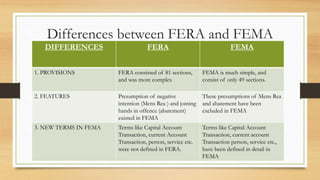
Differences between FERA and FEMA
DIFFERENCES FERA FEMA
1. PROVISIONS FERA consisted of 81 sections,
and was more complex
FEMA is much simple, and
consist of only 49 sections.
2. FEATURES Presumption of negative
intention (Mens Rea ) and joining
hands in offence (abatement)
existed in FEMA
These presumptions of Mens Rea
and abatement have been
excluded in FEMA
3. NEW TERMS IN FEMA Terms like Capital Account
Transaction, current Account
Transaction, person, service etc.
were not defined in FERA.
Terms like Capital Account
Transaction, current account
Transaction person, service etc.,
have been defined in detail in
FEMA
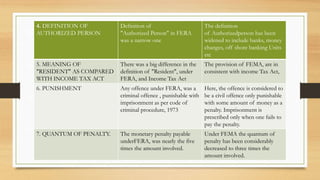
4. DEFINITION OF
AUTHORIZED PERSON
Definition of
"Authorized Person" in FERA
was a narrow one
The definition
of Authorizedperson has been
widened to include banks, money
changes, off shore banking Units
etc
5. MEANING OF
"RESIDENT" AS COMPARED
WITH INCOME TAX ACT
There was a big difference in the
definition of "Resident", under
FERA, and Income Tax Act
The provision of FEMA, are in
consistent with income Tax Act,
6. PUNISHMENT Any offence under FERA, was a
criminal offence , punishable with
imprisonment as per code of
criminal procedure, 1973
Here, the offence is considered to
be a civil offence only punishable
with some amount of money as a
penalty. Imprisonment is
prescribed only when one fails to
pay the penalty.
7. QUANTUM OF PENALTY. The monetary penalty payable
underFERA, was nearly the five
times the amount involved.
Under FEMA the quantum of
penalty has been considerably
decreased to three times the
amount involved.
8. APPEAL An appeal against the order of
"Adjudicating office", before "
Foreign Exchange Regulation
Appellate Board went before
High Court
The appellate authority under
FEMA is the special Director (
Appeals) Appeal against the order
of Adjudicating Authorities and
special Director (appeals) lies
before "Appellate Tribunal for
Foreign Exchange."
9. RIGHT OF ASSISTANCE
DURING LEGAL
PROCEEDINGS
FERA did not contain any
express provision on the right of
on impleadedperson to take legal
assistance
FEMA expressly recognizes the
right of appellant to take
assistance of legal practitioner or
chartered accountant (32)
10. POWER OF SEARCH AND
SEIZE
FERA conferred wide powers on
a police officer not below the
rank of a Deputy Superintendent
of Police to make a search
The scope and power of search
and seizure has been curtailed to
a great extent
Monetary Policy
• Monetary policy is the process by which monetary authority of a country,
generally a central bank controls the supply of money in the economy by
exercising its control over interest rates in order to maintain price stability
and achieve high economic growth. In India, the central monetary authority
is the Reserve Bank of India (RBI). is so designed as to maintain the price
stability in the economy
Objectives
• Price Stability - Price Stability implies promoting economic development with considerable emphasis on price
stability. The centre of focus is to facilitate the environment which is favourable to the architecture that enables the
developmental projects to run swiftly while also maintaining reasonable price stability.
• Controlled Expansion Of Bank Credit - One of the important functions of RBI is the controlled expansion of
bank credit and money supply with special attention to seasonal requirement for credit without affecting the output.
• Promotion of Fixed Investment - The aim here is to increase the productivity of investment by restraining non
essential fixed investment.
• Restriction of Inventories - Overfilling of stocks and products becoming outdated due to excess of stock often
results is sickness of the unit. To avoid this problem the central monetary authority carries out this essential
function of restricting the inventories. The main objective of this policy is to avoid over-stocking and idle money in
the organization
• Promotion of Exports and Food Procurement - OperationsMonetary policy pays special
attention in order to boost exports and facilitate the trade. It is an independent objective of
monetary policy.
• Desired Distribution of Credit - Monetary authority has control over the decisions
regarding the allocation of credit to priority sector and small borrowers. This policy decides
over the specified percentage of credit that is to be allocated to priority sector and small
borrowers.
• Equitable Distribution of Credit - The policy of Reserve Bank aims equitable distribution
to all sectors of the economy and all social and economic class of people
• To Promote Efficiency - It is another essential aspect where the central banks pay a lot of
attention. It tries to increase the efficiency in the financial system and tries to incorporate
structural changes such as deregulating interest rates, ease operational constraints in the
credit delivery system, to introduce new money market instruments etc.
• Reducing the Rigidity - RBI tries to bring about the flexibilities in the operations which
provide a considerable autonomy. It encourages more competitive environment and
diversification. It maintains its control over financial system whenever and wherever
necessary to maintain the discipline and prudence in operations of the financial system.
Major Operations
• Open Market Operations - An open market operation is an instrument
of monetary policy which involves buying or selling of
government securities from or to the public and banks. This mechanism
influences the reserve position of the banks, yield on government securities
and cost of bank credit. The RBI sells government securities to contract the
flow of credit and buys government securities to increase credit flow. Open
market operation makes bank rate policy effective and maintains stability in
government securities market.
• Cash Reserve Ratio - Cash Reserve Ratio is a certain percentage of bank
deposits which banks are required to keep with RBI in the form of reserves
or balances .Higher the CRR with the RBI lower will be the liquidity in the
system and vice-versa.RBI is empowered to vary CRR between 15 percent
and 3 percent.
• Cash Reserve Ratio - Cash Reserve Ratio is a certain percentage of bank
deposits which banks are required to keep with RBI in the form of reserves
or balances .Higher the CRR with the RBI lower will be the liquidity in the
system and vice-versa.RBI is empowered to vary CRR between 15 percent
and 3 percent.
• Bank Rate Policy - The bank rate, also known as the discount rate, is the
rate of interest charged by the RBI for providing funds or loans to the
banking system. This banking system involves commercial and co-operative
banks, Industrial Development Bank of India, EXIM Bank, and other
approved financial institutes.
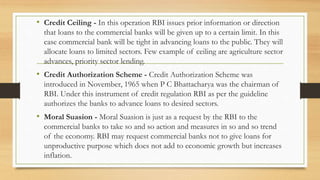
• Credit Ceiling - In this operation RBI issues prior information or direction
that loans to the commercial banks will be given up to a certain limit. In this
case commercial bank will be tight in advancing loans to the public. They will
allocate loans to limited sectors. Few example of ceiling are agriculture sector
advances, priority sector lending.
• Credit Authorization Scheme - Credit Authorization Scheme was
introduced in November, 1965 when P C Bhattacharya was the chairman of
RBI. Under this instrument of credit regulation RBI as per the guideline
authorizes the banks to advance loans to desired sectors.
• Moral Suasion - Moral Suasion is just as a request by the RBI to the
commercial banks to take so and so action and measures in so and so trend
of the economy. RBI may request commercial banks not to give loans for
unproductive purpose which does not add to economic growth but increases
inflation.
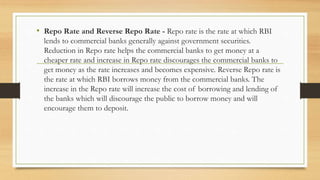
• Repo Rate and Reverse Repo Rate - Repo rate is the rate at which RBI
lends to commercial banks generally against government securities.
Reduction in Repo rate helps the commercial banks to get money at a
cheaper rate and increase in Repo rate discourages the commercial banks to
get money as the rate increases and becomes expensive. Reverse Repo rate is
the rate at which RBI borrows money from the commercial banks. The
increase in the Repo rate will increase the cost of borrowing and lending of
the banks which will discourage the public to borrow money and will
encourage them to deposit.
Fiscal Policy
• The fiscal policy is concerned with the raising of government revenue and
incurring of government expenditure. To generate revenue and to incur
expenditure, the government frames a policy called budgetary policy or fiscal
policy. So, the fiscal policy is concerned with government expenditure and
government revenue.
Objectives
• Development by effective Mobilisation of Resources
• Efficient allocation of Financial Resources
• Reduction in inequalities of Income and Wealth
• Price Stability and Control of Inflation
• Employment Generation
• Balanced Regional Development
• Reducing the Deficit in the Balance of Payment
• Capital Formation
• Increasing National Income
• Development of Infrastructure
• Foreign Exchange Earnings
Exim Policy
• The Foreign Trade Policy of India is guided by the Export Import in known
as in short EXIM Policy of the Indian Government and is regulated by
the Foreign Trade Development and Regulation Act, 1992.
DGFT (Directorate General of Foreign Trade) is the main governing body
in matters related to Exim Policy.
History
• In the year 1962, the Government of India appointed a special Exim
Policy Committee to review the government previous export import
policies. The committee was later on approved by the Government of India.
Mr. V. P. Singh, the then Commerce Minister and announced the Exim Policy
on the 12th of April, 1985. Initially the EXIM Policy was introduced for the
period of three years with main objective to boost the export business in
India
Objectives
• To accelerate the economy from low level of economic activities to high level of economic activities by
making it a globally oriented vibrant economy and to derive maximum benefits from expanding global
market opportunities.
• To stimulate sustained economic growth by providing access to essential raw materials, intermediates,
components,' consumables and capital goods required for augmenting production.
• To enhance the techno local strength and efficiency of Indian agriculture, industry and services,
thereby, improving their competitiveness.
• To generate new employment.
• Opportunities and encourage the attainment of internationally accepted standards of quality.
• To provide quality consumer products at reasonable prices.
Governing Bodies
• The Government of India notifies the Exim Policy for a period of five years (1997-
2002) under Section 5 of the Foreign Trade (Development and Regulation
Act), 1992 The current Export Import Policy covers the period 2002-2007. The
Exim Policy is updated every year on the 31st of March and the modifications,
improvements and new schemes became effective from 1st April of every year. All
types of changes or modifications related to the EXIM Policy is normally
announced by the Union Minister of Commerce and Industry who co-ordinates
with the Ministry of Finance, the Directorate General of Forieng Trade
and network of Dgft Regional Offices.
Small Scale Industry
• A small scale industry (SSI) is an industrial undertaking in which the
investment in fixed assets in plant & machinery,whether held on ownership
term or on lease or hire purchase, does not exceed Rs. 1Crore. However, this
investment limit is varied by the Government from time to time.
• Entrepreneurs in small scale sector are normally not required to obtain a
licence either from the Central Government or the State Government for
setting up units in any part of the country.
• Registration of a small scale unit is also not compulsory. But,its registration
with the State Directorate or Commissioner of Industries or DIC's makes
the unit eligible for availing different types of Government assistance like
financial assistance from the Department of Industries, medium and long
term loans from State Financial Corporations and other commercial banks,
machinery on hire-purchase basis from the National Small Industries
Corporation,etc. Registration is also an essential requirement for getting
benefits of special schemes for promotion of SSI.
Types
• Manufacturing Industries - Those units which are producing complete articles for direct
consumption and also for processing industries are called as manufacturing industries. For
example : Powerlooms, engineering industries, coin industries, khadi industries, food processing
industries etc.
• Ancillary Industries - The industries which are producing parts and components and rendering
services to large industries are called as ancillary industries.
• Service Industries - Service industries are those which are covering light repair shops necessary
to maintain mechanical equipments. These industries are essentially machine- based.
• Feeder Industries - Feeder industries are those which are specialising in certain types of
products and services, e.g. casting, electro-plating, welding, etc.
• Mining or Quarries.
Advantages
• Employment
• Meets the demand of local market
• Gainful Employment to women
• Less burden on imports
• Less Capital
• Less sophisticated technology
• Good use of raw material
Disadvantage
• No Technical awareness
• Unable to market the goods
• Problem gathering raw materials
• Financial constraints
• Price disadvantages
• Lack of marketing and distribution network

Economic environment

  • 1.
  • 2.
    Nature of economicenvironment • An economy or economic system refers in which the various economic activities relating to production, distribution, exchange and consumption of goods and services that are organized in a country and the way in which the people of a country earn their living. • Economic environment influences the business to a great extent it refers to all factors that affect the functioning of a business unit
  • 3.
    Factors • Important factorsare: • Economic conditions • Economic policies • Economic systems
  • 4.
    Please Support us! CLICKTO SUBSCRIBE CLICK TO FOLLOW
  • 5.
    Economic condition • Theeconomic conditions of a country –for example, the nature of the economy, the stage of development of the economy, economic resources, the level of income, the distribution of income and assets, etc.- are among the very important determinants of business strategies. • In a developing country, the low income may be the reason for the very low demand for the product.
  • 6.
    Economic policies • Sometypes or categories of business are favourably affected by government policy, some adversely affected, while it is neutral to some others. • E.g. a restrictive import policy may greatly help the import competing industries, while a liberalisation of the import policy may create difficulties for such industries
  • 7.
    Economic System • Thescope of the private business depends on the economic system. • The freedom of the private enterprise is the greatest in the free market economy.
  • 8.
    Economic system • Theeconomic system in a country decides the development prospects of a country to a great extent . Government regulations of economic activities depends to a very large extent on the nature of economic system • There are three important types of economic systems • Capitalism • Socialism • Mixed economy
  • 9.
    Capitalism • Capitalism isan economic system in which trade, industry and the means of production are controlled by private owners with the goal of making profits in a market economy. Central characteristics of capitalism include capital accumulation, competitive markets and wage labour In a capitalist economy, the parties to a transaction typically determine the prices at which assets, goods, and services are exchanged.
  • 10.
    Advantages • Government -One could say the same for capitalism. Basically, when governments attempt to control the economy. We end up with problems such as: • Corruption • Lack of incentives • Poor information
  • 11.
    • Efficient Allocationof Resources - In theory, capitalism or the ‘invisible hand of the market’ ensures resources are distributed according to consumer preferences. Firms are not rewarded for producing goods people don’t want. • Efficient Production - In a market system, firms have incentives to be productively efficient – cutting costs to improve competitiveness and productivity. If firms don’t remain productive and efficient they will go out of business. • Dynamic Efficiency - This is efficiency over time. Firms in a capitalist system need to respond to changes in consumer preferences and respond to new consumer trends. • Financial Incentives - Evidence suggests that people work hardest when there is a personal financial incentive. E.g. entrepreneurs only take risks in setting up businesses because of the potential for large financial reward.
  • 12.
    Disadvantage • Irrational Behaviour- E.g. People ignore economic fundamentals but get caught up in speculative bubbles. Stock market boom and bust of 1920s is a classic example. American housing market in 2000s is another. • Inequality - The benefits of Capitalism are rarely equitably distributed. Wealth tend to accrue to a small % of the population. This means that demand for luxury goods is often limited to a small % of the workforce
  • 13.
    • Monopoly Behaviour- A free market allows firms to gain monopoly power and exploit customers, through charging higher prices. Firms often gain monopsony power and pay lower wages to workers. For example, in the nineteenth century American rail-roads often exploited their monopoly power in setting higher prices. • Immobilities - In a free market, factors of production are supposed to be able to easily move from an unprofitable sector to a new profitable industry. However, in practice this is much more difficult. E.g. a farm worker who is made unemployed cannot just fly off to a big city and find a new job. He has geographical ties to his birthplace; he may not have the right skills for the job. Therefore, in capitalist societies we often see long periods of unemployment and recession.
  • 14.
    Socialism • Socialism isan economic system characterised by social ownership of the means of production and co-operative management of the economy. "Social ownership" may refer to cooperative enterprises, common ownership, state ownership, citizen ownership of equity, or any combination of these. • A socialist economic system consists of a system of production and distribution organised to directly satisfy economic demands and human needs, so that goods and services are produced directly for use instead of for private profit driven by the accumulation of capital.
  • 15.
    Advantages • A FairSystem - Socialism gives equal distribution of national wealth and provides everyone with equal opportunities, irrespective of their, color, caste, creed or economic status. Socialism, in its truest sense, means equality by all means. • Reducing Disparities - Socialism reduces the social, economic, and political inequalities that exist within capitalist societies. By taking the ownerships of production units from the rich and presenting them to the workers, the government gives the workers a chance to earn more profits and thus rise to levels of economic well being • More Humane & True - The effort to make everybody equal in economic, social, and political terms makes socialism more morally worthwhile than capitalism. It reinforces the fact that everyone was created equally and it was only through human actions that disparities arose.
  • 16.
    • Eliminates SocialEvils - Socialism reduces poverty with eatable wealth distribution. It also eliminates ill health, as it lays the foundation for the availability of proper health facilities for everyone. Socialism eliminates other forms of social deprivation too, by caring for everyone. • Improved Standard Of Living - The idea behind socialism is to bring up the living standards of the poorest. It actually works towards raising the living standards to similar levels, as the better-off members of the respective societies. • Creates Better Human Resources - As all people, irrespective of their differences, are provided extensive public services and better facilities, they achieve their full potential. Better education facilities for all also help in creating better human resource. Manpower doubles, thus doubling the country’s economic growth, as everyone works towards a life of betterment. • Unity - As people work for a common cause and all the profits are shared equally, the feeling of selfishness is eliminated and a united feeling is gained. Plus, since socialism bars the difference caused on the grounds of color, sex, creed or religion, harmony and unity become the keywords for the countrymen.
  • 17.
    Disadvantage • Unreal Theory- True socialism is an imaginative theory and cannot be implemented as it is. Today, socialism is not adopted in the same way, as it was advocated by Karl Marx and other socialists. The original form of socialism is neither preached nor practiced. • Improper Implementation - In socialist countries today, there are a handful of bureaucrats who control and use the power of the state. They redistribute and regulate wealth and decide on taxation for the people. Thus, in reality, people do not have control over wealth. This limits people’s political freedom and reverses the overall concept. • Negatively Influences Growth Of Economy - Socialism is actually economically inefficient, as it puts off entrepreneurs from generating wealth, because they usually have to pay higher taxes.
  • 18.
    • Poverty &Social Evils Are Not Eliminated - Socialism might redistribute some of the wealth of the richest members of the society to the poor, but this move does not eliminate poverty as a whole. The overall growth of economy suffers considerably. If there is not enough wealth, then distribution can be hampered. • No Real Increase In Standard Of Living - Instead of improving the living standards for all, socialism actually lowers the income of the richest to reduce the divide and make them fall close to the income levels of the poorest. • Boosts Incompetence - As socialism provides the poorest with higher levels of income via social security payments, it deters them from working hard, if at all. It also creates a negative feeling in the minds of hard working fellows, as they gain no extra incentives for working hard. Adding to their woes, lazy people get paid equally as they do. This negatively impacts productivity and thus economic growth.
  • 19.
    Mixed economy • Mixedeconomy is an economic system in which both the private sector and state direct the economy, reflecting characteristics of both market economies and planned economies. Most mixed economies can be described as market economies with strong regulatory oversight, and many mixed economies feature a variety of government-run enterprises and governmental provision of public goods. • The basic idea of the mixed economy is that the means of production are mainly under private ownership; that markets remain the dominant form of economic coordination; and that profit-seeking enterprises and the accumulation of capital remains the fundamental driving force behind economic activity.
  • 20.
    Advantage • Rapid economicdevelopment – In mixed economy both private and public sectors work side by side. The combined efforts lead to rapid economic development. The economic resources of the economy are used efficiently. Wastages of resources are minimized. • Lesser inequality of income - Right to own property is granted. Law of inheritance is also applied, so certain members of society grow richer and richer. Public sector in the economy tries to provide economic facility to the general masses. It reduces inequality of income. • Balanced regional growth - The planning commission of the country makes policies for the development!"of every region of the economy. The government tries to develop all regions and every section of population.
  • 21.
    • Freedom toown private property - Individuals are free to acquire property and retain in their own names, so the initiative to work more and earn more is there. It helps in the rapid development of the economy in the field of agriculture, industry and other services. • Planned development - The planing commission is empowered to make effective plans for the development of the economy. We, in India, have also adopted planned developmental economy and introduced five year plans. • Public interest - The public sector looks into the interest of the general public. The government under this economy is said to be welfare state. It introduces social insurance schemes, incurs expenditure and manages economy in the interest of general masses of the country.
  • 22.
    Disadvantage • Fear ofnationalisation - Private and public sector coexists. The government has the power to nationalise and own any industry, so private sector remains under a psychological fear that their industry may be nationalised or taken over in the public interest. • Inequality of income - Inspite of all the efforts of the government to bring equality, rich people grow richer and the inequality prevails. Economic resources economic developments are concentrated with certain big industries. • Corruption - Corruption is the common feature of mixed economy. Black- marketing, profiteering, dishonest dealings and corruption is seen both at higher and lower levels.
  • 23.
    Industrial policy • TheIndustrial Policy plan of a country, sometimes shortened as IP, is its official strategic effort to encourage the development and growth of the manufacturing sector of the economy. • The government takes measures "aimed at improving the competitiveness and capabilities of domestic firms and promoting structural transformation. "A country's infrastructure (transportation, telecommunications and energy industry) is a major part of the manufacturing sector that usually has a key role in IP
  • 24.
    Department of IndustrialPolicy & Promotion • Department of Industrial Policy & Promotion was established in the year 1995, and in the year 2000 Department of Industrial Development was merged with it. It is working under the Ministry of Commerce and Industry, Government of India. This department is responsible for formulation and implementation of promotional and developmental measures for growth of the industrial sector, keeping in view the national priorities and socio-economic objectives. While individual Administrative Ministries look after the production, distribution, development and planning aspects of specific industries allocated to them, Department of Industrial Policy & Promotion is responsible for the overall industrial policy. It is also responsible for facilitating and increasing the FDI flows to the country.
  • 25.
    Compensation Act • Workmen’sCompensation Act of 1923 • The Workmen’s Compensation Act compensates a workman for any injury suffered during the course of his employment or to his dependents in the case of his death. The Act provides for the rate at which compensation shall be paid to an employee. This is one of many social security laws in India.
  • 27.
    FERA • The ForeignExchange Regulation Act (FERA) was legislation passed by the Indian Parliament in 1973 by the government of Indira Gandhi and came into force with effect from January 1, 1974. FERA imposed stringent regulations on certain kinds of payments, the dealings in foreign exchange and securities and the transactions which had an indirect impact on the foreign exchange and the import and export of currency. The bill was formulated with the aim of regulating payments and foreign exchange.
  • 28.
    • Regulated inIndia by the Foreign Exchange Regulation Act(FERA),1973. • Consisted of 81 sections. • FERA Emphasized strict exchange control. • Control everything that was specified, relating to foreign exchange. • Law violators were treated as criminal offenders. • Aimed at minimizing dealings in foreign exchange and foreign securities
  • 29.
    FEMA • The ForeignExchange Management Act (FEMA) is a 1999 Indian Law "to consolidate and amend the law relating to foreign exchange with the objective of facilitating external trade and payments and for promoting the orderly development and maintenance of foreign exchange market in India". It was passed in the winter session of Parliament in 1999, replacing FERA. This act seeks to make offenses related to foreign exchange civil offenses. It extends to the whole of India replacing FERA, which had become incompatible with the pro-liberalisation policies of the Government of India.
  • 30.
    • Activities suchas payments made to any person outside India or receipts from them, along with the deals in foreign exchange and foreign security is restricted. It is FEMA that gives the central government the power to impose the restrictions. • Restrictions are imposed on people living in India who carry out transactions in foreign exchange, foreign security or who own or hold immovable property abroad. • Without general or specific permission of the MA restricts the transactions involving foreign exchange or foreign security and payments from outside the country to India – the transactions should be made only through an authorised person. • Deals in foreign exchange under the current account by an authorised person can be restricted by the Central Government, based on public interest. • Although selling or drawing of foreign exchange is done through an authorised person, the RBI is empowered by this Act to subject the capital account transactions to a number of restrictions. • People living in India will be permitted to carry out transactions in foreign exchange, foreign security or to own or hold immovable property abroad if the currency, security or property was owned or acquired when he/she was living outside India, or when it was inherited by him/her from someone living outside India. • Exporters are needed to furnish their export details to RBI. To ensure that the transactions are carried out properly, RBI may ask the exporters to comply to its necessary requirements.
  • 31.
    Simililarity between FERAand FEMA The similarities between FERA and FEMA are as follows: • The Reserve Bank of India and central government would continue to be the regulatory bodies. • Presumption of extra territorial jurisdiction as envisaged in section (1) of FERA has been retained. • The Directorate of Enforcement continues to be the agency for enforcement of the provisions of the law such as conducting search and seizure
  • 32.
    Differences between FERAand FEMA DIFFERENCES FERA FEMA 1. PROVISIONS FERA consisted of 81 sections, and was more complex FEMA is much simple, and consist of only 49 sections. 2. FEATURES Presumption of negative intention (Mens Rea ) and joining hands in offence (abatement) existed in FEMA These presumptions of Mens Rea and abatement have been excluded in FEMA 3. NEW TERMS IN FEMA Terms like Capital Account Transaction, current Account Transaction, person, service etc. were not defined in FERA. Terms like Capital Account Transaction, current account Transaction person, service etc., have been defined in detail in FEMA
  • 33.
    4. DEFINITION OF AUTHORIZEDPERSON Definition of "Authorized Person" in FERA was a narrow one The definition of Authorizedperson has been widened to include banks, money changes, off shore banking Units etc 5. MEANING OF "RESIDENT" AS COMPARED WITH INCOME TAX ACT There was a big difference in the definition of "Resident", under FERA, and Income Tax Act The provision of FEMA, are in consistent with income Tax Act, 6. PUNISHMENT Any offence under FERA, was a criminal offence , punishable with imprisonment as per code of criminal procedure, 1973 Here, the offence is considered to be a civil offence only punishable with some amount of money as a penalty. Imprisonment is prescribed only when one fails to pay the penalty. 7. QUANTUM OF PENALTY. The monetary penalty payable underFERA, was nearly the five times the amount involved. Under FEMA the quantum of penalty has been considerably decreased to three times the amount involved.
  • 34.
    8. APPEAL Anappeal against the order of "Adjudicating office", before " Foreign Exchange Regulation Appellate Board went before High Court The appellate authority under FEMA is the special Director ( Appeals) Appeal against the order of Adjudicating Authorities and special Director (appeals) lies before "Appellate Tribunal for Foreign Exchange." 9. RIGHT OF ASSISTANCE DURING LEGAL PROCEEDINGS FERA did not contain any express provision on the right of on impleadedperson to take legal assistance FEMA expressly recognizes the right of appellant to take assistance of legal practitioner or chartered accountant (32) 10. POWER OF SEARCH AND SEIZE FERA conferred wide powers on a police officer not below the rank of a Deputy Superintendent of Police to make a search The scope and power of search and seizure has been curtailed to a great extent
  • 35.
    Monetary Policy • Monetarypolicy is the process by which monetary authority of a country, generally a central bank controls the supply of money in the economy by exercising its control over interest rates in order to maintain price stability and achieve high economic growth. In India, the central monetary authority is the Reserve Bank of India (RBI). is so designed as to maintain the price stability in the economy
  • 36.
    Objectives • Price Stability- Price Stability implies promoting economic development with considerable emphasis on price stability. The centre of focus is to facilitate the environment which is favourable to the architecture that enables the developmental projects to run swiftly while also maintaining reasonable price stability. • Controlled Expansion Of Bank Credit - One of the important functions of RBI is the controlled expansion of bank credit and money supply with special attention to seasonal requirement for credit without affecting the output. • Promotion of Fixed Investment - The aim here is to increase the productivity of investment by restraining non essential fixed investment. • Restriction of Inventories - Overfilling of stocks and products becoming outdated due to excess of stock often results is sickness of the unit. To avoid this problem the central monetary authority carries out this essential function of restricting the inventories. The main objective of this policy is to avoid over-stocking and idle money in the organization
  • 37.
    • Promotion ofExports and Food Procurement - OperationsMonetary policy pays special attention in order to boost exports and facilitate the trade. It is an independent objective of monetary policy. • Desired Distribution of Credit - Monetary authority has control over the decisions regarding the allocation of credit to priority sector and small borrowers. This policy decides over the specified percentage of credit that is to be allocated to priority sector and small borrowers. • Equitable Distribution of Credit - The policy of Reserve Bank aims equitable distribution to all sectors of the economy and all social and economic class of people • To Promote Efficiency - It is another essential aspect where the central banks pay a lot of attention. It tries to increase the efficiency in the financial system and tries to incorporate structural changes such as deregulating interest rates, ease operational constraints in the credit delivery system, to introduce new money market instruments etc. • Reducing the Rigidity - RBI tries to bring about the flexibilities in the operations which provide a considerable autonomy. It encourages more competitive environment and diversification. It maintains its control over financial system whenever and wherever necessary to maintain the discipline and prudence in operations of the financial system.
  • 38.
    Major Operations • OpenMarket Operations - An open market operation is an instrument of monetary policy which involves buying or selling of government securities from or to the public and banks. This mechanism influences the reserve position of the banks, yield on government securities and cost of bank credit. The RBI sells government securities to contract the flow of credit and buys government securities to increase credit flow. Open market operation makes bank rate policy effective and maintains stability in government securities market.
  • 39.
    • Cash ReserveRatio - Cash Reserve Ratio is a certain percentage of bank deposits which banks are required to keep with RBI in the form of reserves or balances .Higher the CRR with the RBI lower will be the liquidity in the system and vice-versa.RBI is empowered to vary CRR between 15 percent and 3 percent. • Cash Reserve Ratio - Cash Reserve Ratio is a certain percentage of bank deposits which banks are required to keep with RBI in the form of reserves or balances .Higher the CRR with the RBI lower will be the liquidity in the system and vice-versa.RBI is empowered to vary CRR between 15 percent and 3 percent. • Bank Rate Policy - The bank rate, also known as the discount rate, is the rate of interest charged by the RBI for providing funds or loans to the banking system. This banking system involves commercial and co-operative banks, Industrial Development Bank of India, EXIM Bank, and other approved financial institutes.
  • 40.
    • Credit Ceiling- In this operation RBI issues prior information or direction that loans to the commercial banks will be given up to a certain limit. In this case commercial bank will be tight in advancing loans to the public. They will allocate loans to limited sectors. Few example of ceiling are agriculture sector advances, priority sector lending. • Credit Authorization Scheme - Credit Authorization Scheme was introduced in November, 1965 when P C Bhattacharya was the chairman of RBI. Under this instrument of credit regulation RBI as per the guideline authorizes the banks to advance loans to desired sectors. • Moral Suasion - Moral Suasion is just as a request by the RBI to the commercial banks to take so and so action and measures in so and so trend of the economy. RBI may request commercial banks not to give loans for unproductive purpose which does not add to economic growth but increases inflation.
  • 41.
    • Repo Rateand Reverse Repo Rate - Repo rate is the rate at which RBI lends to commercial banks generally against government securities. Reduction in Repo rate helps the commercial banks to get money at a cheaper rate and increase in Repo rate discourages the commercial banks to get money as the rate increases and becomes expensive. Reverse Repo rate is the rate at which RBI borrows money from the commercial banks. The increase in the Repo rate will increase the cost of borrowing and lending of the banks which will discourage the public to borrow money and will encourage them to deposit.
  • 42.
    Fiscal Policy • Thefiscal policy is concerned with the raising of government revenue and incurring of government expenditure. To generate revenue and to incur expenditure, the government frames a policy called budgetary policy or fiscal policy. So, the fiscal policy is concerned with government expenditure and government revenue.
  • 43.
    Objectives • Development byeffective Mobilisation of Resources • Efficient allocation of Financial Resources • Reduction in inequalities of Income and Wealth • Price Stability and Control of Inflation • Employment Generation • Balanced Regional Development • Reducing the Deficit in the Balance of Payment • Capital Formation • Increasing National Income • Development of Infrastructure • Foreign Exchange Earnings
  • 44.
    Exim Policy • TheForeign Trade Policy of India is guided by the Export Import in known as in short EXIM Policy of the Indian Government and is regulated by the Foreign Trade Development and Regulation Act, 1992. DGFT (Directorate General of Foreign Trade) is the main governing body in matters related to Exim Policy.
  • 45.
    History • In theyear 1962, the Government of India appointed a special Exim Policy Committee to review the government previous export import policies. The committee was later on approved by the Government of India. Mr. V. P. Singh, the then Commerce Minister and announced the Exim Policy on the 12th of April, 1985. Initially the EXIM Policy was introduced for the period of three years with main objective to boost the export business in India
  • 46.
    Objectives • To acceleratethe economy from low level of economic activities to high level of economic activities by making it a globally oriented vibrant economy and to derive maximum benefits from expanding global market opportunities. • To stimulate sustained economic growth by providing access to essential raw materials, intermediates, components,' consumables and capital goods required for augmenting production. • To enhance the techno local strength and efficiency of Indian agriculture, industry and services, thereby, improving their competitiveness. • To generate new employment. • Opportunities and encourage the attainment of internationally accepted standards of quality. • To provide quality consumer products at reasonable prices.
  • 47.
    Governing Bodies • TheGovernment of India notifies the Exim Policy for a period of five years (1997- 2002) under Section 5 of the Foreign Trade (Development and Regulation Act), 1992 The current Export Import Policy covers the period 2002-2007. The Exim Policy is updated every year on the 31st of March and the modifications, improvements and new schemes became effective from 1st April of every year. All types of changes or modifications related to the EXIM Policy is normally announced by the Union Minister of Commerce and Industry who co-ordinates with the Ministry of Finance, the Directorate General of Forieng Trade and network of Dgft Regional Offices.
  • 48.
    Small Scale Industry •A small scale industry (SSI) is an industrial undertaking in which the investment in fixed assets in plant & machinery,whether held on ownership term or on lease or hire purchase, does not exceed Rs. 1Crore. However, this investment limit is varied by the Government from time to time. • Entrepreneurs in small scale sector are normally not required to obtain a licence either from the Central Government or the State Government for setting up units in any part of the country.
  • 49.
    • Registration ofa small scale unit is also not compulsory. But,its registration with the State Directorate or Commissioner of Industries or DIC's makes the unit eligible for availing different types of Government assistance like financial assistance from the Department of Industries, medium and long term loans from State Financial Corporations and other commercial banks, machinery on hire-purchase basis from the National Small Industries Corporation,etc. Registration is also an essential requirement for getting benefits of special schemes for promotion of SSI.
  • 50.
    Types • Manufacturing Industries- Those units which are producing complete articles for direct consumption and also for processing industries are called as manufacturing industries. For example : Powerlooms, engineering industries, coin industries, khadi industries, food processing industries etc. • Ancillary Industries - The industries which are producing parts and components and rendering services to large industries are called as ancillary industries. • Service Industries - Service industries are those which are covering light repair shops necessary to maintain mechanical equipments. These industries are essentially machine- based. • Feeder Industries - Feeder industries are those which are specialising in certain types of products and services, e.g. casting, electro-plating, welding, etc. • Mining or Quarries.
  • 51.
    Advantages • Employment • Meetsthe demand of local market • Gainful Employment to women • Less burden on imports • Less Capital • Less sophisticated technology • Good use of raw material
  • 52.
    Disadvantage • No Technicalawareness • Unable to market the goods • Problem gathering raw materials • Financial constraints • Price disadvantages • Lack of marketing and distribution network