INTORDUCTION
• The economic history of India can be divided into three
periods ranging from the pre-colonial period lasting up to
the 17th century till independence in 1947 and post
independence.
• The Indian economy is the world’s twelfth largest
according to market exchange rates .It is also the fourth
largest economy by Purchasing Power Party(PPP) basis .
From 1947-1991, the India Economy System was based on
social democratic-based policies
• Indian Economy System are farther divided into three
1. Capitalist economy
2. Socialist economy
3. Mixed economy Indian
Economy
Capitalist
Mixed
socialist
Definition
Socialist economy is also known as socialism
• Socialism is a term applied to an economic
system in which property is held in common
and not individually , and relationships are
governed by a political hierarchy . Common
ownership doesn’t mean decisions are made
collectively , however. Instead, individuals in
positions of authority make decisions in the
name of collective group.
Objective
The objective of the project is the viewpoint the
history of the socialist economy. This type of
economy is for the welfare of the people. As our
country is a developing one, it becomes
significantly important to study about the
welfare economy as profit maximization cannot
be the objective of our country at the phase.
Hence, this project would study various aspects
of the socialist economy in an order to derive its
features and draw out proposition that can be
implemented and executed in our country
Metholodology
The method to be used in the building of
process of this project is
The ‘SECONDARY DATA COLLECTION
METHOD’. Reports and publications of
ministries, departments of the government .
Reports and publications of reputed INGO’S
such as UNDP, ADB, UNESCO,WHO, World
Banks etc . and Reports and publications of
reliable NGO’s , journals, periodicals etc, to be
used in the assembling of project.
• Values of socialism have roots in pre-capitalist institutions such
as the religious communes, reciprocal obligations, and communal
charity of Mediaeval Europe, the development of its economic
theory primarily reflects and responds to the monumental
changes brought about by the dissolution of feudalism and the
emergence of specifically capitalist social relations
• Historically speaking, the most pressing needs of this new
system were an assured supply of the elements of industry –
land, elaborate machinery, and labour – and these imperatives led
to the commodification of these elements.
HOW DID SOCIALIST ECONOMY COME TO
ORIGIN?
• The first organized theories of socialist economics
were significantly impacted by classical economic
theory, including elements in Adam Smith, Robert
Malthus and David Ricardo
• In Smith there is a conception of a common good not
provided by the market, a class analysis, a concern for
the dehumanizing aspects of the factory system, and
the concept of rent as being unproductive
FEATURES OF SOCIALIST ECONOMY
 (I) Economic, Social and Political Equality:
Under socialism, there is almost equality between rich and poor. There is
no problem of class struggle.
 (II) Public or collective ownership of resources:
In this economy all the material means of production are owned and used by
state organs.
However, it does not mean that private enterprise and private property are
totally nonexistent in socialist economy, but their relative importance is so
insignificant that they can be ignored.
 1.. Economic planning:
A socialist economy is a fully planned economy. Planning may be centralized
or decentralized. All the basic decisions for the control and regulation of
the economy are taken by government. Similarly all the basic and strategic
functions are performed according to a definite plan. Formulation of plans
is the responsibility of a central planning authority.
 2. Social welfare motive:
In a socialist economy research are used in production process to
maximize social welfare instead of private profits.
Social welfare is the basis of all economic decisions and economic policies.
Price policy is guided by social welfare motive. Everyone is entitled to the
benefits of socialized production on the basis of equal rights.
 3.. Little importance of price mechanism:
In a socialist economy the price mechanism is given a minor role in resource
allocation. A specific plan based on social needs provides guidelines for
resources allocation. However, in democratic socialism the price system is
allowed some role according to the size of private sector.
 4. People co-operation:
Socialist economy is a planned economy. No plan can possibly succeed without the
active participation of people.Therefore, while fixing the priorities of plans the
central planning authority keeps in mind the interest of the community to seek
the active participation of people in the implementation of plan, the government
may provide special incentives.
 5. Lack of competition:
The resources are in government ownership. Therefore, government decides-
what, how and for whom to produce.
 6.. Non-existence of social parasites:
In a socialist economy the society is not divided between haves and
haves-notes or between ‘master and servants ’. In other words the society
is not classified between capitalist and working class. Here all arc masters
and all are workers. The philosophy of a socialist economy is-“to each
according to his needs and from each according to his ability.” Thus there
is no place of social parasites and no possibility of exploitation.
 7.. Equality of opportunity:
Socialism guarantees equality of opportunities and equal pay for equal work.
Government does not discriminate among members of the society on the
basis of cast, creed, religion and sex.In short, a socialist economy is not
controlled and regulated by market mechanism. It is a comprehensively
planned economy. This economy is in sharp contrast to a capitalist economy.
MERITS OF SOCIALISTIC ECONOMY
 1. Social Justice is Assured:
The chief merit of socialism is that it assures of social justice. Under socialism
the inequalities of income are reduced to the minimum and the national income is
more equitably and evenly distributed. The socialist principle provides for a fair
share for all. No one is permitted to have unearned income.
 2. Rapid Economic Development:
A socialist economy is likely to grow much faster than a capitalist economy. The
experience of the U.S.S.R. and other socialist countries amply proved this. The
main factors making for the fast growth rate is the full use of resources,
scientific planning and quick decisions.
 3. Production According to Basic Needs:
In this economy the production is directed to satisfy the basic needs of the
people first. As far as possible, the production of food, clothing or building
materials is guided by the basic needs of the people and is not according to
the purchasing power of the rich section of the society.
 4. Balanced Economic Development:
Economic planning is meant to carry out balanced development of the
economy. All the regions of the country are taken care of. Development of
the backward areas is also given a priority. Similarly, agriculture and
industry, heavy and small industry develops side by side. As a result there is
no lop-sided development of the economy.
 5. It has Economic Stability:
Another important merit is the economic stability which a socialist economy
has. A capitalist economy is often suffering from economic fluctuations
resulting in lot of unemployment and wastage of resources. There is a good
deal of misery among the working classes in periods of depression in a socialist
economy.
 6. It has More Flexibility:
A socialist economy is much more flexible than a capitalist economy because of
the control on market forces. The socialist economy can be geared to war
times as early as it is operated during peace-time. Rather the state having
ownership of means of production can meet the needed changes much better
than the slow moving market mechanism of the capitalist economy.
 7. Conservation of Natural Resources:
A socialist economy has a great advantage of planning for the future.
Wasteful use of the country’s natural resources is a common problem in all
the capitalistic economies. Private enterprise does not care for the future. A
planning authority can take the interest of future generations into account by
preparing plans for conservation of the country’s non-renewable resources
like coal, petroleum, forests and soil.
 8. Equitable Distribution of Wealth and Income:
A socialist economy is operated with the aim of providing equal opportunity
for all citizens in earning incomes. Generally, private property is restricted to
some basic needs. There is no amassing of wealth by a few. Wealth is also
equitably distributed because private enterprise is given a limited role.
 9. No Exploitation and Class Struggle:
A socialist economy can also get rid of the basic maladies of the capitalist economy.
There is no question of exploitation in as much as the state determines the
distribution pattern of country’s income. Further the whole society is the common aim
of all planning. No sections are discriminated against. There is not special favour at
any class. Therefore, there is no scope for anything like the class struggle which is a
characteristic of the capitalist economy.
 10. Social Welfare Activities:
A Socialist Economy is oriented to the social needs. The government provides for full
security. There is automatic care for the children of those who meet accidents while
performing their duties. There is provision for old age pension for all. The slogan is “to
each according to his needs, from each according to his capacity.”
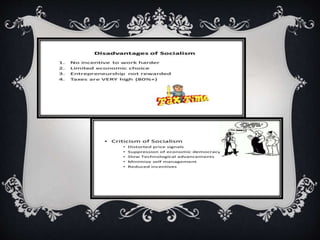
DEMERITS OF SOCIALISTIC ECONOMY
 1. No Suitable Basis of Cost Calculation:
Von Hayek and Bobbins have pointed out that there is not proper basis of cost
calculation in a socialist economy. They say that the means of production being
owned by the government, there is no market price for the factors of
production.
 2. Loss of Consumers’ Sovereignty:
There is loss of consumers’ sovereignty in a socialist economy. Consumers do not
have the freedom to buy whatever commodities they want. They can consume
only those commodities which are available in department stores. Often the
quantities which they can buy are fixed by the state.
 3. No Freedom of Occupation:
There is also no freedom of occupation in such a society. Every
person is provided job by the state. But he cannot leave or change it.
Even the place of work is allotted by the state. All occupational
movements are sanctioned by the state.
 4. Malallocation of Resources:
Under socialism, there is arbitrary allocation of resources. The
central planning authority often commits mistakes in resource
allocation because the entire work is done on trial and error basis.
 5. Bureaucratic:
A socialist economy is said to be a bureaucratic economy. It is
operated like a machine. So it does not provide the necessary
initiative to the people to work hard. People work due to the fear of
higher authorities and not for any personal gain or self-interest.
CO M PA RA TI VE ST U D Y O F CA PI T A LI ST SOCIALI ST
A ND M I XED ECO NO M Y
 Capitalist economy:
 Where all the resources are owned and operated by private individuals or
firms.
 The main aim is profit Maximization.
 Socialistic Economy:
 Where all the resources are owned and operated by the government.
 The main aim is welfare of people.
 Mixed Economy:
 Where all the resources are owned and operated by both private firms and
government and work together for the welfare of the economy and its
people.
COMPARISON BETWEEN CAPITALIST AND
SOCIALIST ECONOMY
COMPARISON BETWEEN SOCIALIST AND
MIXED ECONOMY
Socialist economy Mixed economy
(i) Resources are owned and
controlled by govt.
(i) Resources are owned and
controlled by both private
firms and govt.
(ii) Tries to achieve profit
along with social welfare
(ii) Aimed only of welfare of
society
(iii) Greater competition in
markets
(iii) Lesser or no competition
(iv) Narrow gap between rich
and poor
(vi) Wider gap between rich
and poor
COUNTRY’S FOLLOW’S SOCIALIST ECONOMY
Example-
China
 Denmark
 Finland
 Netherlands
 Canada
 Sweden
COUNTRY STUDY- CHINA
In China the government manages
and controls the economy . Many
of the domestic companies are
owned and run by the government
.Recently , the Chinese economy
has becomes more geared towards
capitalism, but is still officially
socialist . Life in china remains
relatively less stressful and more
relaxed than life in capitalist
countries like America
WELCOME QUERIES
THANK YOU !!!
🤔
SO ….DO U
HAVE ANY
QUESTIONS
FOR ME

Socialist economic

  • 1.
    INTORDUCTION • The economichistory of India can be divided into three periods ranging from the pre-colonial period lasting up to the 17th century till independence in 1947 and post independence. • The Indian economy is the world’s twelfth largest according to market exchange rates .It is also the fourth largest economy by Purchasing Power Party(PPP) basis . From 1947-1991, the India Economy System was based on social democratic-based policies • Indian Economy System are farther divided into three 1. Capitalist economy 2. Socialist economy 3. Mixed economy Indian Economy Capitalist Mixed socialist
  • 2.
    Definition Socialist economy isalso known as socialism • Socialism is a term applied to an economic system in which property is held in common and not individually , and relationships are governed by a political hierarchy . Common ownership doesn’t mean decisions are made collectively , however. Instead, individuals in positions of authority make decisions in the name of collective group.
  • 4.
    Objective The objective ofthe project is the viewpoint the history of the socialist economy. This type of economy is for the welfare of the people. As our country is a developing one, it becomes significantly important to study about the welfare economy as profit maximization cannot be the objective of our country at the phase. Hence, this project would study various aspects of the socialist economy in an order to derive its features and draw out proposition that can be implemented and executed in our country
  • 6.
    Metholodology The method tobe used in the building of process of this project is The ‘SECONDARY DATA COLLECTION METHOD’. Reports and publications of ministries, departments of the government . Reports and publications of reputed INGO’S such as UNDP, ADB, UNESCO,WHO, World Banks etc . and Reports and publications of reliable NGO’s , journals, periodicals etc, to be used in the assembling of project.
  • 7.
    • Values ofsocialism have roots in pre-capitalist institutions such as the religious communes, reciprocal obligations, and communal charity of Mediaeval Europe, the development of its economic theory primarily reflects and responds to the monumental changes brought about by the dissolution of feudalism and the emergence of specifically capitalist social relations • Historically speaking, the most pressing needs of this new system were an assured supply of the elements of industry – land, elaborate machinery, and labour – and these imperatives led to the commodification of these elements. HOW DID SOCIALIST ECONOMY COME TO ORIGIN?
  • 8.
    • The firstorganized theories of socialist economics were significantly impacted by classical economic theory, including elements in Adam Smith, Robert Malthus and David Ricardo • In Smith there is a conception of a common good not provided by the market, a class analysis, a concern for the dehumanizing aspects of the factory system, and the concept of rent as being unproductive
  • 10.
    FEATURES OF SOCIALISTECONOMY  (I) Economic, Social and Political Equality: Under socialism, there is almost equality between rich and poor. There is no problem of class struggle.  (II) Public or collective ownership of resources: In this economy all the material means of production are owned and used by state organs. However, it does not mean that private enterprise and private property are totally nonexistent in socialist economy, but their relative importance is so insignificant that they can be ignored.
  • 11.
     1.. Economicplanning: A socialist economy is a fully planned economy. Planning may be centralized or decentralized. All the basic decisions for the control and regulation of the economy are taken by government. Similarly all the basic and strategic functions are performed according to a definite plan. Formulation of plans is the responsibility of a central planning authority.  2. Social welfare motive: In a socialist economy research are used in production process to maximize social welfare instead of private profits. Social welfare is the basis of all economic decisions and economic policies. Price policy is guided by social welfare motive. Everyone is entitled to the benefits of socialized production on the basis of equal rights.
  • 12.
     3.. Littleimportance of price mechanism: In a socialist economy the price mechanism is given a minor role in resource allocation. A specific plan based on social needs provides guidelines for resources allocation. However, in democratic socialism the price system is allowed some role according to the size of private sector.  4. People co-operation: Socialist economy is a planned economy. No plan can possibly succeed without the active participation of people.Therefore, while fixing the priorities of plans the central planning authority keeps in mind the interest of the community to seek the active participation of people in the implementation of plan, the government may provide special incentives.  5. Lack of competition: The resources are in government ownership. Therefore, government decides- what, how and for whom to produce.
  • 13.
     6.. Non-existenceof social parasites: In a socialist economy the society is not divided between haves and haves-notes or between ‘master and servants ’. In other words the society is not classified between capitalist and working class. Here all arc masters and all are workers. The philosophy of a socialist economy is-“to each according to his needs and from each according to his ability.” Thus there is no place of social parasites and no possibility of exploitation.  7.. Equality of opportunity: Socialism guarantees equality of opportunities and equal pay for equal work. Government does not discriminate among members of the society on the basis of cast, creed, religion and sex.In short, a socialist economy is not controlled and regulated by market mechanism. It is a comprehensively planned economy. This economy is in sharp contrast to a capitalist economy.
  • 15.
    MERITS OF SOCIALISTICECONOMY  1. Social Justice is Assured: The chief merit of socialism is that it assures of social justice. Under socialism the inequalities of income are reduced to the minimum and the national income is more equitably and evenly distributed. The socialist principle provides for a fair share for all. No one is permitted to have unearned income.  2. Rapid Economic Development: A socialist economy is likely to grow much faster than a capitalist economy. The experience of the U.S.S.R. and other socialist countries amply proved this. The main factors making for the fast growth rate is the full use of resources, scientific planning and quick decisions.
  • 16.
     3. ProductionAccording to Basic Needs: In this economy the production is directed to satisfy the basic needs of the people first. As far as possible, the production of food, clothing or building materials is guided by the basic needs of the people and is not according to the purchasing power of the rich section of the society.  4. Balanced Economic Development: Economic planning is meant to carry out balanced development of the economy. All the regions of the country are taken care of. Development of the backward areas is also given a priority. Similarly, agriculture and industry, heavy and small industry develops side by side. As a result there is no lop-sided development of the economy.
  • 17.
     5. Ithas Economic Stability: Another important merit is the economic stability which a socialist economy has. A capitalist economy is often suffering from economic fluctuations resulting in lot of unemployment and wastage of resources. There is a good deal of misery among the working classes in periods of depression in a socialist economy.  6. It has More Flexibility: A socialist economy is much more flexible than a capitalist economy because of the control on market forces. The socialist economy can be geared to war times as early as it is operated during peace-time. Rather the state having ownership of means of production can meet the needed changes much better than the slow moving market mechanism of the capitalist economy.
  • 18.
     7. Conservationof Natural Resources: A socialist economy has a great advantage of planning for the future. Wasteful use of the country’s natural resources is a common problem in all the capitalistic economies. Private enterprise does not care for the future. A planning authority can take the interest of future generations into account by preparing plans for conservation of the country’s non-renewable resources like coal, petroleum, forests and soil.  8. Equitable Distribution of Wealth and Income: A socialist economy is operated with the aim of providing equal opportunity for all citizens in earning incomes. Generally, private property is restricted to some basic needs. There is no amassing of wealth by a few. Wealth is also equitably distributed because private enterprise is given a limited role.
  • 19.
     9. NoExploitation and Class Struggle: A socialist economy can also get rid of the basic maladies of the capitalist economy. There is no question of exploitation in as much as the state determines the distribution pattern of country’s income. Further the whole society is the common aim of all planning. No sections are discriminated against. There is not special favour at any class. Therefore, there is no scope for anything like the class struggle which is a characteristic of the capitalist economy.  10. Social Welfare Activities: A Socialist Economy is oriented to the social needs. The government provides for full security. There is automatic care for the children of those who meet accidents while performing their duties. There is provision for old age pension for all. The slogan is “to each according to his needs, from each according to his capacity.”
  • 21.
    DEMERITS OF SOCIALISTICECONOMY  1. No Suitable Basis of Cost Calculation: Von Hayek and Bobbins have pointed out that there is not proper basis of cost calculation in a socialist economy. They say that the means of production being owned by the government, there is no market price for the factors of production.  2. Loss of Consumers’ Sovereignty: There is loss of consumers’ sovereignty in a socialist economy. Consumers do not have the freedom to buy whatever commodities they want. They can consume only those commodities which are available in department stores. Often the quantities which they can buy are fixed by the state.
  • 22.
     3. NoFreedom of Occupation: There is also no freedom of occupation in such a society. Every person is provided job by the state. But he cannot leave or change it. Even the place of work is allotted by the state. All occupational movements are sanctioned by the state.  4. Malallocation of Resources: Under socialism, there is arbitrary allocation of resources. The central planning authority often commits mistakes in resource allocation because the entire work is done on trial and error basis.  5. Bureaucratic: A socialist economy is said to be a bureaucratic economy. It is operated like a machine. So it does not provide the necessary initiative to the people to work hard. People work due to the fear of higher authorities and not for any personal gain or self-interest.
  • 24.
    CO M PARA TI VE ST U D Y O F CA PI T A LI ST SOCIALI ST A ND M I XED ECO NO M Y  Capitalist economy:  Where all the resources are owned and operated by private individuals or firms.  The main aim is profit Maximization.  Socialistic Economy:  Where all the resources are owned and operated by the government.  The main aim is welfare of people.  Mixed Economy:  Where all the resources are owned and operated by both private firms and government and work together for the welfare of the economy and its people.
  • 25.
    COMPARISON BETWEEN CAPITALISTAND SOCIALIST ECONOMY
  • 27.
    COMPARISON BETWEEN SOCIALISTAND MIXED ECONOMY Socialist economy Mixed economy (i) Resources are owned and controlled by govt. (i) Resources are owned and controlled by both private firms and govt. (ii) Tries to achieve profit along with social welfare (ii) Aimed only of welfare of society (iii) Greater competition in markets (iii) Lesser or no competition (iv) Narrow gap between rich and poor (vi) Wider gap between rich and poor
  • 28.
    COUNTRY’S FOLLOW’S SOCIALISTECONOMY Example- China  Denmark  Finland  Netherlands  Canada  Sweden
  • 29.
    COUNTRY STUDY- CHINA InChina the government manages and controls the economy . Many of the domestic companies are owned and run by the government .Recently , the Chinese economy has becomes more geared towards capitalism, but is still officially socialist . Life in china remains relatively less stressful and more relaxed than life in capitalist countries like America
  • 31.
    WELCOME QUERIES THANK YOU!!! 🤔 SO ….DO U HAVE ANY QUESTIONS FOR ME